Woman Having Her Hair Combed

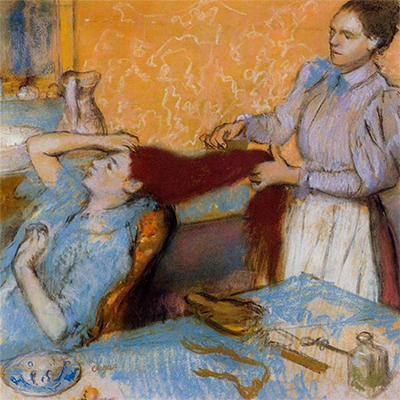
Standing attendant draws the long red hair of a blue-clothed reclining woman against an orange wall Buy Art Prints Now
from Amazon

* As an Amazon Associate, and partner with Google Adsense and Ezoic, I earn from qualifying purchases.


by
Tom Gurney BSc (Hons) is an art history expert with over 20 years experience
Published on June 19, 2020 / Updated on September 28, 2026
Email: tomgurney1@gmail.com / Phone: +44 7429 011000

Degas Woman Having Her Hair Combed: Introduction

A woman in a loose blue garment leans back while another woman draws her long red hair toward the right. An orange wall fills the space behind them, and a blue-covered surface carries small objects in front. In Edgar Degas's Woman Having Her Hair Combed, the action is ordinary but the arrangement is charged. The hair forms a visible link between two people whose roles are unequal: one sits and receives attention, while the other stands and performs the work. The image holds stillness and a tug of movement in the same nearly square field. [1][2] [5]

The work discussed here is the private-collection pastel Christie’s catalogues as La Coiffure (La Toilette), Lemoisne no. 1129. It dates from about 1892–95 and measures 55.2 × 56.5 cm. The pastel is on joined tracing paper laid down on card and then on board. Its blue-clothed woman and orange interior distinguish it from the Metropolitan Museum's vertical nude with an attendant and the National Gallery's later, predominantly red oil. [1][2][3][4]

At a glance

  • ArtistEdgar Degas
  • Route titleWoman Having Her Hair Combed
  • Catalogue titleLa Coiffure (La Toilette)
  • DateAbout 1892–95
  • MediumPastel on joined tracing paper laid down on card and board
  • Dimensions55.2 × 56.5 cm
  • Catalogue referenceLemoisne 1129
  • CollectionPrivate collection, per Christie's later sale catalogue

Contents

  1. Introduction
  2. At a Glance
  3. Two women joined by hair
  4. Blue garment, orange room
  5. The task and the person doing it
  6. Related works, different objects
  7. A documented private-collection history
  8. Looking once more

The medium and scale make this a different object from two better documented public-museum works. The Met's Woman Having Her Hair Combed, accession 29.100.35, is a vertical pastel from about 1886–88 showing a nude seated woman. London's National Gallery owns Combing the Hair (La Coiffure), NG4865, a horizontal oil about 1896 with a largely red palette. Both are useful comparisons, but neither supplies the facts for the square pastel discussed here. Its Lemoisne number, material and date distinguish it from those paintings. [1][3][4]

Two women joined by hair

The seated woman reclines with one arm raised toward her head. Her hair extends toward the standing figure, who holds or brushes it. This long red band is not only an anatomical detail; it is the connection that structures the scene. Follow it from the seated head across to the worker's hands, and the eye crosses the space between the two bodies. The action could be described in a few words, yet Degas makes it the central visual event. [1][2]

Christie's calls the standing woman a maidservant. Her posture and task support that reading, but the catalogue does not identify her by name. We can understand the image as one person being served by another without pretending to know the sitter's household or biography. The seated woman wears a blue dressing gown; the other stands in plainer clothing. Those differences suggest a relation of service, but the painting presents the act of combing more directly than it presents a complete social history of either figure. [1][2]

The seated pose may at first look comfortable. The woman leans back, her body supported, one arm arcing over her head. The line of hair suggests a pull, however, and the action of brushing can involve resistance. We cannot know from the image alone whether she experiences relief, discomfort or simply routine. It is more accurate to describe how Degas has made the gesture tense than to assign a private feeling. The standing figure's hands have a task; the seated figure's body responds visibly. That relation is enough to give the scene energy. [1]

The picture is nearly square. Its shape keeps the two women in a relatively close field, unlike a wide theatrical scene that would let them spread apart. The hair crosses this compact space, and the warm wall presses behind them. The viewer is close to a domestic action yet not invited into either woman's thoughts. This proximity and distance can coexist. We see the mechanics of the task very clearly, while the social and emotional meanings remain less certain. [1][2]

The near-square shape also prevents a conventional division into a foreground portrait and a background helper. The standing attendant reaches nearly to the top of the sheet, and the seated figure extends toward the left. Their scale is comparable enough that we must attend to both. The line of hair crosses the centre rather than disappearing into an accessory at the edge. That decision keeps the work itself, and the relationship it requires, in the middle of the picture. The viewer is therefore asked to look at a task shared across two bodies, not to isolate a single sitter from the person who attends to her. [1]

The raised arm of the seated woman may help steady her hair or reflect the brushing motion. It also balances the attendant's working arms on the opposite side. Degas makes the two figures answer each other through gesture. One reaches up; the other reaches across. The hair connects these directions like a taut ribbon. The composition works through bodies and color before it becomes a story with named characters. [1]

Blue garment, orange room

The seated woman's blue gown stands against a warm orange wall. A blue-covered surface returns in the foreground, so the cool color appears both on her body and before it. Her red hair crosses those blue notes and meets the warmer background. The result is a strong play of color around an otherwise simple task. Christie’s later lot essay specifically notices the sumptuous blue peignoir, a dressing gown associated with hair care, and the force of the brushing in the arrangement. [1]

The orange background does not map a precise room. It gives heat and pressure to the scene. Pale lines and marks interrupt it, but the main experience is of a warm field against which the women and the pulled hair become legible. At the lower edge, blue and small objects suggest the practical surroundings of grooming. One can notice a brush-like form or container without using a 400-pixel legacy image to identify every item as a particular cosmetic or tool. The picture's color and gesture are more secure than a detailed inventory of an imagined dressing table. [1][2]

The blue does two jobs. It marks the seated woman's garment, making her body a large cool shape. It also stabilizes the lower part of the composition, where scattered items and strokes could otherwise dissolve into the orange. Degas draws the eye between these areas. The warm wall and hair might dominate, but the gown and foreground answer them. This exchange helps make the image feel active even though both figures remain within a small domestic space. [1]

Pastel permits the marks to remain visible as colored strokes. The hair can look dense and directional, while the wall and garment have different textures of application. The catalogue identifies the medium and support; it does not provide a layer-by-layer conservation account. A modest reproduction can show broad changes in handling, not the exact sequence of every pigment application. It is enough to see that color is not merely filling pre-drawn outlines. It helps organize the force between the figures. [1][2]

The scene's apparent informality should not be mistaken for an unplanned glimpse. Degas chose where the figures, hair and objects sit within the square. The work is built on joined tracing paper, later laid down on card and board, according to Christie's. That physical description reveals a constructed support. It does not tell us which sheet was joined first or why each join was made. The secure fact is that the finished image came from a worked, assembled surface rather than one untouched piece of paper. [1][2]

The joined support is especially relevant to an image of hair being handled. The picture seems to focus on a fleeting gesture, yet its paper was materially extended or combined. Degas could adjust the field in which the gesture appears. We do not need to invent the exact sequence of joins to recognize a broader point: an image that feels momentary may depend on repeated decisions about its physical edges. The visible act of grooming and the invisible labor of making the sheet remain distinct, but both resist the idea that this is merely a spontaneous snapshot. [1][2]

The task and the person doing it

Hair care is a familiar activity, but the picture gives it a social structure. One woman is attended to; another does the attending. This may be a maid and her employer, as the auction catalogue interprets the standing figure, but we should avoid making her simply a pair of hands. Her body is fully visible enough to shape the composition. The standing figure occupies the right side, directs the action and gives the long hair its diagonal pull. The seated woman is the focus of care, yet the worker has considerable pictorial agency. [1][2]

This is one reason the pastel differs from the Met's earlier nude. In the Met work, the attendant is only partly seen, and the nude woman receives the principal attention. Here the attendant is prominent and clothed, standing beside a seated woman who is also clothed. Both works involve hair being combed, but their framing changes how labor appears. A generic title can conceal that difference between the two visible figures and their relation. [1][3]

The action also blurs care and force. Brushing hair can be a service, a routine and a physical pull. Degas does not show an exchange of words or a clear reaction that settles its meaning. The seated figure's raised arm and backward tilt register the action. The standing figure's grip gives it direction. A reader can notice the asymmetry of who does the work without assuming that either figure feels a particular emotion. Such restraint preserves the complexity of a scene that is visually precise but narratively incomplete. [1]

Christie's later essay sets the pastel among Degas's 1890s scenes of women absorbed in bathing, dressing and grooming. That context is helpful, but the two figures here should not be treated as interchangeable with every woman in those pictures. The blue gown, square support, open view of the attendant and red hair across the composition define this version. The subject is recurring; the object is specific. [1]

Watch: Edgar Degas

Explore his paintings, drawings and sculpture in three short videos.

London's National Gallery calls its oil Combing the Hair (La Coiffure). It dates the painting about 1896, identifies it as oil on canvas and gives its much larger size as 114.3 × 146.7 cm. Its red-clothed seated figure and standing maid share a general action with the pastel, but the oil's dominant orange-red setting and wide dimensions change the effect. The National Gallery also notes that the oil remained in Degas's studio and later belonged to Henri Matisse. None of those later ownership facts applies to the private pastel. [4]

Christie's describes the pastel as closely related to the London oil and catalogues it separately as Lemoisne 1129, while the London painting is Lemoisne 1128. Those adjacent numbers and related subjects are easy to confuse. We can compare how the motif developed without claiming a simple one-way copy from one finished work to another. The auction catalogue's circa-1892–95 date for the pastel comes before the National Gallery's about-1896 date for the oil, but that chronology alone does not document every step of Degas's process. [1][4]

The Met's 29.100.35 has the same English title. Its object description connects that nude to the bathers Degas considered for the 1886 Impressionist exhibition. The square private-collection pastel was dated about 1892–95 by Christie’s; it cannot be presented as a work intended for the 1886 show. The two works differ in clothing, shape, support and date despite their shared title. [1][3]

The National Gallery's discussion of the London oil includes interpretations about its models and the seated woman's possible pregnancy. Those statements are tied to that painting and its own evidence. This pastel does not inherit them because it resembles the oil. Similarly, the Met's audio asks why its nude may not have appeared in 1886; that uncertainty should not become a story about the private 1890s sheet. Comparisons help only when their boundaries are clear. [3][4]

A documented private-collection history

The 2021 Christie's catalogue traces the pastel from Galerie Bernheim-Jeune to Paul Durand-Ruel's Paris gallery in 1899, then to its New York gallery in 1900. It entered Henry Ruben Ickelheimer's collection in 1931 and passed through the Isles family before its 2021 sale. A later Christie's catalogue records a subsequent private owner. These records give a traceable market and collection history, though they do not publicly name every current custodian. They also explain why a well-known Degas image may lack a stable public-museum accession. [1][2]

The same catalogue identifies the pastel in Lemoisne's 1946 catalogue as no. 1129 and lists numerous exhibitions. They include a 1967 Metropolitan Museum summer loan and the 1996–97 Degas: Beyond Impressionism exhibition in London and Chicago. A loan to the Met is not accession into its permanent collection. That distinction matters here because the Met today owns the different 29.100.35 work with the same broad English title. An exhibition record can connect a private picture to public viewing without changing who owns it. [2][3]

Looking once more

Begin at the seated woman's raised arm, then follow the red hair toward the attendant's hands. Look at how the orange wall amplifies that red line, while the blue gown and foreground keep the picture from becoming one warm field. Finally, look at both women's positions: one is supported by a chair, the other stands and works. The routine act of combing becomes an arrangement of physical connection, color and social relation. [1][2]

This private-collection pastel, La Coiffure (La Toilette), shows Degas returning to an intimate subject without making it simple. The two figures are close, but their feelings remain private. The hair joins them visibly, while their tasks differ. Its near-square format, joined paper and blue-orange color structure distinguish it from the Met nude and the later London oil. Lemoisne 1129 identifies this particular work. For a wider view of the medium and subject, see Degas's pastels and his bathers. [1][2]

Artworks directory

A selected index of documented works, combining owner records with entries sampled across Michel Schulman’s digital catalogue raisonné. It is not a complete catalogue. View the full catalogue

406 artworks

NameDateMedium
>Group of dancers (MS 77)1893Pastel
[Self-Portrait with Christine and Yvonne Lerolle]probably 1895–96Photograph
A Woman Seated beside a Vase of Flowers (Madame Paul Valpinçon?)1865Oil painting
Achille de Gas as midshipman (MS 718)1857Painting
Achille Degas (MS 715)1864Painting
After the bath - Woman Drying Herself (MS 1038)1888—1892Pastel
After the bath (MS 1037)1893Pastel
After the bath (MS 1046)1905Pastel
After the bath (MS 1060)1895Pastel
After the bath (MS 1061)1898Pastel
After the bath (MS 1062)1895Pastel
After the bath (MS 1063)1896Painting
After the bath (MS 1064)1896Painting
After the bath (MS 1065)1896Painting
After the bath (MS 1391)1900Pastel
After the bath (MS 1402)1888Pastel
After the bath (MS 1744)1886Pastel
Arlequin et danseuses (MS 2224)1884Pastel
At the café Châteaudun (MS 1913)1869—1871Painting
At the horse track (MS 1929)1869—1872Painting
At the Milliner's1881Pastel
At the milliner's (MS 2587)1882—1885Painting
At the milliner's (MS 562)1882Pastel
At the milliner's (MS 565)1882Pastel
At the milliner's (MS 567)1885Painting
At the races (MS 85)1861Painting
At the races - Jockeys (MS 92)1868Painting
At the races - The start. (MS 98)1860Painting
Auguste de Gas (MS 1243)1857Painting
Autumn landscape (MS 1403)1890Pastel
Ballet Dancers in the Wingsc. 1890–1900Pastel
Ballet scene (MS 452)1885Painting
Ballet scene (MS 454)1896Painting
Ballet scene (MS 458)1887—1890Pastel
Bather Drying Herselfc. 1883–84Pastel
Beach at low tide (MS 1730)1869Pastel
Beach at low tide (MS 1742)1869Pastel
Beach at low tide (MS 1907)1869Pastel
Beach at low tide (MS 1915)1869Pastel
Beach at low tide (MS 2070)1869Pastel
Before the race (MS 73)1882Painting
Before the race (MS 74)1882Painting
Before the race (MS 81)1884Pastel
Before the race (MS 82)1885Pastel
Before the race (MS 86)1884Painting
Before the start (MS 78)1885Pastel
Boat at low tide (MS 1407)1869Pastel
Breakfast after the bath (MS 1039)1890Pastel
Breakfast after the bath (MS 1565)1895—1898Pastel
Bust of a woman (MS 869)1887—1890Painting
By the seashore (MS 1917)1869Pastel
Calm sea seen from a cliff (MS 1741)1869Painting
Chatting (MS 2061)1882—1885Pastel
Cliff on the seashore (MS 1230)1869Pastel
Cliff on the seashore (MS 671)1869Pastel
Copy after "The Finding of Moses" by Véronèse (MS 1401)1860Painting
Criminals physiognomies (MS 858)1881Pastel
Crouching nude woman from behind (MS 1235)1876Pastel
Dance exercises (MS 270)1891Pastel
Dancer (MS 282)1899Pastel
Dancer (MS 492)1880—1885Pastel
Dancer adjusting her bodice (MS 1576)1875Painting
Dancer adjusting her bodice (MS 293)1890Painting
Dancer adjusting her shoulder strap (MS 283)1899Pastel
Dancer adjusting her shoulder strap (MS 285)1889—1896Pastel
Dancer adjusting her shoulder straps (MS 275)1896—1899Pastel
Dancer Adjusting Her Slipper1873Graphite and chalk
Dancer adjusting her slipper (MS 1588)1887Pastel
Dancer adjusting her slipppers (MS 1581)1880Pastel
Dancer at the barre (MS 1731)1895—1898Pastel
Dancer at the barre (MS 2073)1874Pastel
Dancer at the barre (MS 2570)1885Pastel
Dancer bending (MS 486)1874—1879Pastel
Dancer bowing on her knee (MS 494)1895Pastel
Dancer combing her hair (MS 1390)1879Painting
Dancer dressing (MS 1745)1889Pastel
Dancer exercising (MS 483)1874Pastel
Dancer fastening her shoe (MS 2077)1887Pastel
Dancer in blue (MS 2349)1902Pastel
Dancer in bust (MS 1726)1897Pastel
Dancer in bust (MS 277)1895—1899Pastel
Dancer in green (MS 2608)1897—1901Pastel
Dancer in green (MS 273)1878Pastel
Dancer in pink bowing (MS 1418)1878Pastel
Dancer in red (MS 280)1893Pastel
Dancer in Ukrainian Dress1899Pastel
Dancer leaning (MS 2585)1874—1879Pastel
Dancer Moving Forward, Arms Raisedc. 1885–90Sculpture
Dancer nude study (MS 2348)1902Pastel
Dancer on stage (MS 1415)1879Painting
Dancer on stage (MS 478)1881—1885Pastel
Dancer Putting on Her Stocking1890s/1911Sculpture
Dancer reading (MS 165)1879Pastel
Dancer seated (MS 121)1872Painting
Dancer seen from behind (MS 2211)1889Pastel
Dancer seen from the back (MS 171)1874Painting
Dancer tilting (MS 423)1883Pastel
Dancer with a fan (MS 2592)1876Pastel
Dancer with arms crossed (MS 274)1872Painting
Dancer with arms raised (MS 1743)1891Pastel
Dancer with green bodice (MS 2345)1902Pastel
Dancer with raised arms (MS 475)1870Painting
Dancer with tambourine (MS 2053)1882Pastel
Dancer with tambourine (MS 450)1883Painting
Dancer with tambourine (MS 465)1897Painting
Dancers (MS 2215)1878Painting
Dancers (MS 2217)1890Pastel
Dancers (MS 2362)1904—1906Pastel
Dancers (MS 294)1890Pastel
Dancers (MS 471)1878Pastel
Dancers adjusting their hair (MS 286)1897Pastel
Dancers at rest (MS 1228)1898Pastel
Dancers at rest (MS 224)1874Painting
Dancers at the barre (MS 266)1877Pastel
Dancers at the barre (MS 267)1880Pastel
Dancers at the barre (MS 268)1900Painting
Dancers at the barre (MS 269)1900Pastel
Dancers Backstage1876/1883Oil painting
Dancers backstage (MS 271)1890Painting
Dancers behind the wings (MS 288)1880Pastel
Dancers bowing (MS 453)1885Pastel
Dancers in a landscape setting (MS 466)1895—1898Pastel
Dancers in pink (MS 1738)1900Pastel
Dancers in pink (MS 2364)1904Pastel
Dancers in red skirts (MS 451)1884Painting
Dancers in white (MS 1748)1878Pastel
Dancers in yellow skirts (MS 2359)1903Pastel
Dancers on stage (MS 1417)1881Pastel
Dancers on stage (MS 460)1880Pastel
Dancers on stage (MS 474)1884Pastel
Dancers resting (MS 2604)1890—1895Pastel
Dancers with fans (MS 291)1890Pastel
Dancers, Pink and Greenc. 1890Oil painting
Dante and Virgil at the Entrance of Hell (MS 2072)1857—1860Painting
Degas in studio smock (MS 688)1862Painting
Dunes along the sea (MS 1905)1869Pastel
Edmond Duranty (MS 732)1879Pastel
Elena et Camilla Primicile Carafa di Mantejasi (MS 695)1867Painting
Estelle Musson Balfour (MS 704)1872Painting
Estelle Musson Balfour (MS 710)1863—1865Painting
Fallen jockey (MS 1388)1870Painting
Farm at the foot of a cliff (MS 1918)1869Pastel
Four dancers (MS 1728)1885Pastel
Four dancers (MS 2365)1905Pastel
Four dancers (MS 287)1899Painting
Four dancers in blue (MS 2355)1903Pastel
Four dancers in the wings (MS 2356)1903Pastel
Four dancers on stage (MS 473)1897—1900Pastel
Germain Musson (MS 700)1853Painting
Getting off the bath (MS 1057)1884Pastel
Getting out of the bath (MS 1398)1898Pastel
Getting out of the bath (MS 1583)1879Pastel
Getting out of the bath (MS 1725)1900Pastel
Getting out of the bath (MS 2343)1901Pastel
Getting out of the bath (MS 2607)1895—1898Pastel
Giovanna Bellelli (MS 1242)1856Painting
Giulia Bellelli (MS 722)1858Painting
Green dancers (MS 469)1878Pastel
Hairdressing (MS 1387)1895Painting
Head of a woman (MS 290)1865Pastel
Head of a woman (MS 861)1873—1875Painting
Henri Degas and his niece Lucie Degas (MS 701)1875—1876Painting
Henri Rouart in front of his factory (MS 759)1875Painting
Horse races (MS 1928)1869—1872Painting
Horse races at Longchamp (MS 87)1873Painting
Horse riders in a lanscape (MS 2079)1860—1861Painting
Horse turned to the right (MS 95)1881—1885Pastel
Horse Walkingpossibly early 1870sSculpture
Horsemen riding on the sea shore (MS 1914)1868Pastel
Horseride (MS 80)1890—1895Painting
Horses and jockeys (MS 84)1890Painting
Horses in a medow (MS 2076)1871Painting
Houses along a cliff (MS 1587)1880—1890Painting
Houses on a cliff overlooking the sea (MS 1925)1869Pastel
Houses on the sea shore (MS 1408)1869Pastel
In the dance foyer (MS 2575)1897Pastel
James Tissot (MS 762)1867Painting
Jeantaud, Linet et Laîné (MS 859)1871Painting
Jockey (MS 2213)1889Pastel
Jockey in a red cap (MS 1931)1868Painting
Jockeys (MS 75)1877Painting
Jockeys (MS 83)1890Painting
Jockeys at Epsom (MS 97)1860Painting
Jules Perrot (MS 755)1875Painting
L'arlequin (MS 2223)1890Pastel
La Savoisienne (MS 863)1860—1862Painting
Lady with a parasol (MS 93)1870—1872Painting
Landscapec. 1877–79Monotype
Landscape1892Monotype with pastel
Landscape (MS 1572)1892Pastel
Landscape (MS 2233)1890—1893Painting
Landscape (MS 2234)1890—1893Pastel
Landscape with houses (MS 2567)1885—1890Pastel
Landscape with path leading to a copse of trees (MS 2610)1890—1892Painting
Laundress carrying linen (MS 2351)1902Pastel
Laundresses and horse (MS 2350)1902Pastel
Laundresses carrying baskets (MS 2352)1902Pastel
Little Dancer Aged Fourteen1878–81Sculpture
Little girl carrying flowers in her apron (MS 855)1862Painting
Lyda (MS 91)1870Painting
Marguerite de Gas (MS 713)1853—1854Painting
Mary Cassatt at the Louvre: The Paintings Gallery1879–80Print
Mathilde Musson Bell (MS 706)1872—1873Pastel
Meadow along a stream (MS 1934)1870—1875Pastel
Meadow bordering a river (MS 1577)Pastel
Mlle Bécat at the Ambassadeurs (MS 1410)1885Pastel
Morning toilette (MS 2078)1894Pastel
Mountain lake (MS 2229)1890—1893Pastel
Mountainous landscape (MS 2227)1890—1893Pastel
Mountainous landscape (MS 2230)1890—1893Pastel
Mr. and Mrs. Henry Rouart (MS 2358)1904Pastel
Mr. and Mrs. Louis Rouart (MS 2357)1904Pastel
Mr. and Mrs. Louis Rouart (MS 2360)1904Pastel
Mrs Alexis Rouart and her children (MS 1396)1905Pastel
Mrs Camus (MS 1908)1869Pastel
Naked woman at rest (MS 1557)1880Pastel
Naked woman drying herself (MS 1045)1900Pastel
Naked woman drying herself (MS 1058)1886Pastel
Naked woman warming up (MS 2065)1880Pastel
Nude woman combing her hair (MS 1245)1877—1879Pastel
Nude woman combing her hair (MS 2353)1903Pastel
Olive trees in a mountaineous landscape (MS 1574)1892Pastel
Porrtaits of women (MS 857)1868Painting
Portrait of a man (MS 1733)1864Painting
Portrait of a Man (MS 2220)1890Pastel
Portrait of a man [Portrait of man in an armchair] (MS 853)1866Painting
Portrait of a woman (Attributed) (MS 1404)1867Painting
Portrait of a woman (MS 2067)1885Painting
Portrait of a woman (MS 862)1878—1889Pastel
Portrait of a woman (MS 868)1884Painting
Portrait of a woman (MS 873)1867—1868Painting
Portrait of a woman before a piano (MS 2060)1882—1885Pastel
Portrait of a woman with a hat (MS 872)1884Pastel
Portrait of a woman with hat (MS 870)1887—1890Painting
Portrait of a young girl (MS 1901)1868Painting
Portrait of a young lady (MS 867)1878Painting
Portrait of a young woman after a D-drawing attributed to Leonardo da Vinci (MS 875)1858Painting
Portrait of Brandon (MS 2084)1874—1878Painting
Portrait of Elena Carafa (MS 696)1875Painting
Portrait of Henry Michel-Lévy (MS 1414)1873Painting
Portrait of the artist (MS 690)1863Painting
Preparation for the dance class (MS 247)1890Pastel
Program for the artistic evening of May 15, 1884 at the Ponsin Gallery (MS 2071)1884Pastel
Race Horsesc. 1885–88Pastel
Race horses (MS 76)1880Pastel
Races in the country (MS 96)1869Painting
Reclining nude woman (MS 2342)1901Pastel
René de Gas (MS 720)1855Painting
René de Gas with a inkwell (MS 719)1855Painting
Resting on field (MS 2055)1882Pastel
Riverbank (MS 1571)1890Pastel
Riverbank (MS 2083)1870—1875Pastel
Road in a forest (MS 1932)1870—1875Pastel
Road in a forest (MS 1933)1870—1873Pastel
Rocky coast (MS 1413)1890—1893Pastel
Rocky landscape (MS 2228)1890—1893Painting
Rue du Quesnoy at Saint-Valery-sur-Somme (MS 2069)1895—1898Pastel
Ruins of a bridge over a river (MS 1394)1892Pastel
Scene from the Steeplechase: The Fallen Jockey1866, reworked 1880–81 and c. 1897Oil painting
Sea at low tide (MS 1916)1869Pastel
Sea shore (MS 1920)1869Pastel
Sea shore (MS 1921)1869Pastel
Sea shore (MS 1924)1869Pastel
Seascape (MS 1906)1869Pastel
Seated nude woman combing her hair (MS 1236)1890Pastel
Seated woman brushing her hair (MS 2600)1887—1890Pastel
Self-Portraitc. 1855Drawing
Self-Portrait (MS 689)1862Painting
Self-Portrait (MS 691)1856—1858Painting
Self-Portrait (MS 693)1857—1858Painting
Self-Portrait (MS 694)1857Painting
Self-Portrait with White Collarc. 1857Oil on paper on canvas
Sitting woman combing her hair (MS 2568)1887—1890Pastel
Standing man in a bowler hat (MS 717)1874Painting
Standing nude woman (MS 1237)1880Pastel
Standing nude woman (MS 2218)1890Pastel
Standing woman (MS 1737)1866Painting
Stream in the undergrowth (MS 1935)1870—1875Painting
Studies of a woman's head and a seated dancer (MS 481)1879Pastel
Study for Mr and Mrs Louis Rouart (MS 1750)1904Pastel
Study for Mrs Camus at the piano (MS 2573)1869Pastel
Study of a Nude (Dancer at the Barre)1884–1900Drawing
Study of dancers (MS 2344)1901Painting
Study of folds of a hooded cloak (MS 2074)1861—1864Painting
Study of nude woman (MS 2059)1884Pastel
Study of sky (MS 1923)1869Pastel
The ball (MS 1248)1879Painting
The ballet rehearsal (MS 298)1877Painting
The bath (MS 1586)1900—1905Pastel
The bath (MS 2222)1890Drawing
The cellist Pilet (MS 1253)1868Painting
The child in blue (MS 854)1854Painting
The chocolate cup after the bath (MS 1247)1905—1907Pastel
The convalescent (MS 702)1872—1873Painting
The conversation (MS 1570)1895Pastel
The cup of chocolate (MS 1564)1900—1905Pastel
The Dance Class1874Oil on canvas
The dance class (MS 1406)1876Pastel
The dance class (MS 2068)1876Pastel
The Dance Lessonc. 1879Oil painting
The dance lesson or ballet class (MS 212)1875Pastel
The dance lesson or ballet class (MS 215)1878Painting
The dancer's rest (MS 1724)1885Pastel
The Duchess Montejasi and her Daughters Elena and Camilla (MS 699)1881Painting
The Duchess of Montejasi-Cicerale (MS 698)1868Painting
The duet (MS 1393)1877—1879Pastel
The duet (MS 1416)1877Pastel
The Extras or The chorus (MS 1254)1877Pastel
The false start (MS 99)1870Painting
The Firesidec. 1876–77Monotype
The Giovanna and Giulia Bellelli Sisters (MS 721)1865Painting
The Holy Family - Copy. (MS 1903)1868—1872Painting
The Holy Family after Sebastiano del Piombo (MS 1751)1857Drawing
The march (MS 56)1866Painting
The pedicure (MS 1251)1873Painting
The racecourse - Amateur jockeys near a carriage (MS 1249)1878Painting
The Races1871–72Oil painting
The rehearsal of the ballet (MS 2057)1881Painting
The singer (MS 2591)1877—1880Pastel
The Tubc. 1889Sculpture
The tub (MS 1252)1886Pastel
The violist (MS 2569)1880Pastel
Three dancers (MS 1585)1889Pastel
Three dancers (MS 2064)1879Painting
Three dancers (MS 2210)1889Pastel
Three dancers (MS 2216)1899Pastel
Three dancers (MS 2354)1903Pastel
Three dancers (MS 2614)1899Pastel
Three dancers (MS 467)1895—1898Pastel
Three dancers (MS 468)1890Pastel
Three dancers in salmon pink skirts (MS 2363)1904—1906Pastel
Three heads of men (MS 860)1871Painting
Three jockeys (MS 79)1900Pastel
Three study of dancers (MS 482)1879—1880Pastel
Two bathers (MS 2347)1902Pastel
Two Dancers1873Drawing
Two dancers (MS 1722)1880—1885Pastel
Two dancers (MS 2611)1880Pastel
Two dancers (MS 295)1890Pastel
Two dancers (MS 296)1890Pastel
Two dancers at rest or Dancers in blue (MS 1229)1898Pastel
Two Dancers in bust (MS 2561)1897Pastel
Two harlequins (MS 396)1885Pastel
Two sitting dancers (MS 1736)1896Pastel
Two Womenc. 1878/1880Pastel
Two women at their bath (MS 1568)1895Pastel
Valleys (MS 2232)1890—1893Pastel
View of Saint-Valery-sur-Somme (MS 2560)1896Painting
Walter Sickert, Daniel Halévy, Ludovic Halévy, Jacques-Emile Blanche, Gervex, Boulanger-Cavé (MS 856)1885Pastel
Wheat field and line of trees (MS 2225)1890—1892Pastel
Woman at her toilette (MS 1041)1890—1894Pastel
Woman at her toilette (MS 1048)1903Pastel
Woman at her toilette (MS 1050)1900Pastel
Woman at her toilette (MS 1559)1892Pastel
Woman at her toilette (MS 1561)1905—1907Pastel
Woman at her toilette (MS 2346)1902Pastel
Woman at her toilette (MS 2565)1895—1903Pastel
Woman Bathing in a Shallow Tub1885Pastel
Woman before a mirror (MS 370)1885—1886Pastel
Woman cleaning her left foot (MS 1232)1886Pastel
Woman combing her hair (MS 1746)1894Pastel
Woman combing her hair (MS 1238)1887—1890Pastel
Woman combing her hair (MS 1560)1892—1895Pastel
Woman combing her hair (MS 1727)1890Pastel
Woman combing her hair (MS 2237)1890—1895Pastel
Woman combing her hair before a mirror (MS 1250)1870—1875Painting
Woman comnbing her hair (MS 2209)1885Pastel
Woman drying erself after the bath (MS 2236)1890—1895Pastel
Woman drying her hair (MS 1042)1894Pastel
Woman drying her hair (MS 1044)1897Pastel
Woman drying her hair (MS 1569)1900Pastel
Woman drying her hair (MS 1729)1900—1903Pastel
Woman drying her hair (MS 1732)1885Pastel
Woman drying her left arm (MS 1055)1884Pastel
Woman drying her left arm (MS 1056)1884Pastel
Woman drying her right arm (MS 1052)1884Pastel
Woman drying herself (MS 1053)1884Pastel
Woman drying herself (MS 1059)1886Pastel
Woman drying herself (MS 1397)1888Pastel
Woman drying herself after the bath (MS 1562)1895Pastel
Woman Drying herself after the bath (MS 1563)1883Pastel
Woman drying herself after the bath wearing yellow mules (MS 2208)1889Pastel
Woman getting out of the bath (MS 1240)1881Pastel
Woman Having Her Hair Combedc. 1886–88Pastel
Woman in her bath washing her left leg (MS 1234)1883Pastel
Woman in mauve dress seated in an armchair or Mrs Alexis Rouart and Her Children (MS 2366)1905Pastel
Woman in red dressing gown combing her hair (MS 2207)1880Pastel
Woman Ironingbegun c. 1876, completed c. 1887Oil painting
Woman looking through opera glasses (MS 89)1881Painting
Woman sitting on a lawn (MS 2056)1882Pastel
Woman washing up in her tub (MS 1239)1892Pastel
Woman with a dog (MS 865)1875—1880Painting
Woman with a white apron (MS 94)1855Drawing
Woman with an umbrella (Mrs Jeantaud) (MS 866)1877—1880Painting
Woman with blue hat (MS 1558)1889Pastel
Woman with opera glasses (MS 90)1877Painting
Women ironing (MS 587)1875Painting
Women on the terrace of a café (MS 1241)1877Pastel
Young girl with white shawl (MS 874)1871Painting
Young spartan girls challenging boys (MS 1412)1860Painting
Young woman (MS 871)1890Painting
Young woman in black (MS 879)1861—1865Painting
Young woman in her bath (MS 1566)1890Pastel
Young woman standing by a table (MS 1739)1855Painting
Young woman tying the ribbons of her hat (MS 1244)1882Pastel
Young woman with her hand facing her mouth (MS 864)1875Painting

Discussion

Share what you notice in Degas’s woman having her hair combed.

Reader Insights

Close Looking

How does the line of hair connect the two figures?

Context

What changes when you follow the orange and blue colour fields?

Open Question

Which details distinguish this pastel from the Met and London works?

Join the Conversation

Share your reading of these works below.

References

  1. Christie's, La Coiffure (La Toilette), later lot 6559929, catalogue record and essay, search-indexed text consulted 27 September 2026. View source
  2. Christie's, La Coiffure (La Toilette), 2021 lot 35C, object, provenance, literature and exhibition record, accessed 27 September 2026. View source
  3. Metropolitan Museum of Art, Woman Having Her Hair Combed, 29.100.35, separate object record and audio transcript, accessed 27 September 2026. View source
  4. National Gallery, London, Combing the Hair (La Coiffure), NG4865, separate oil painting record, accessed 27 September 2026. View source
  5. Edgar Degas, La Coiffure (La Toilette), circa 1892–95, pastel on joined tracing paper laid down on card laid down on board. Private collection, Lemoisne 1129. Collection record. View source