* As an Amazon Associate, and partner with Google Adsense and Ezoic, I earn from qualifying purchases.
by Tom Gurney Tom Gurney BSc (Hons) is an art history expert with over 20 years experience
Published on June 19, 2020 / Updated on September 28, 2026
Email: tomgurney1@gmail.com / Phone: +44 7429 011000
Degas Women Ironing: Introduction
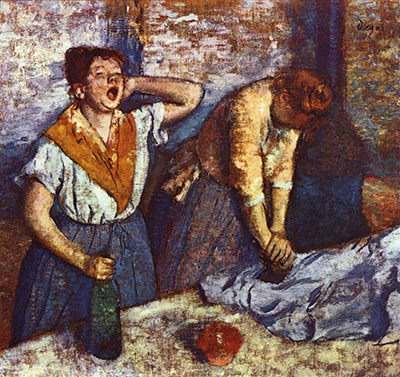
One woman yawns while another leans into an iron. In Edgar Degas's Women Ironing, their movements differ but belong to the same tiring task. A bottle and small objects sit within the laundry setting; pale fabric and a blue wall surround the figures. The painting does not present a cheerful domestic chore. It makes a viewer feel the alternation between repeated physical effort and a brief lapse of energy. The woman at the iron still presses forward. The other opens her mouth wide, as if the body's need for rest has become visible before the work is finished. [1][5]
The exact painting discussed here is the Musée d'Orsay's Repasseuses, accession RF 1985. The owner dates it 1884–86, identifies oil on canvas and gives its size as 76 × 81.4 cm. That exact identification matters because Degas made four variations of a closely related two-woman ironing scene, and he painted other single ironers as well. The Orsay record identifies RF 1985 without confusing it with those other works. [1]
At a glance
ArtistEdgar Degas
Route titleWomen Ironing
Collection titleRepasseuses
Date1884–86
MediumOil on canvas
Dimensions76 × 81.4 cm
CollectionMusée d'Orsay, Paris, RF 1985
Series positionThird of four similar paired compositions, per Orsay
Orsay's current object record supplies these identifiers and describes the two women as workers in a laundry. It also explains the canvas's striking surface: Degas laid oil paint directly on a coarse, unprepared support, allowing brown linen to show through. That is not simply a later sign of wear. It contributes to a grainy texture and makes softer colors stand out. The physical surface and the bodily gestures belong to the same picture of work: both resist a slick, polished finish. [1]
A yawn beside an iron
The contrast between the figures is immediately legible. One woman leans on the iron, body angled into pressure. The other yawns. A yawn is a momentary event, but it tells us something about duration: fatigue accumulates before it bursts into a single gesture. The ironer's pose shows sustained work in progress. Degas places those two time scales side by side, asking us to see not a dramatic incident but the rhythm of an ordinary working day. [1]
Orsay describes the pair as weary and sees Degas attending to gestures rather than making them heroic or caricatured. That matters because paintings of workers can turn them into moral symbols or comic “types.” Here the act of pressing and the involuntary yawn remain specific. The figures occupy a setting where the body has to do the task. Their faces and postures do not ask us to applaud a grand accomplishment, but neither do they make the work trivial. The image gives physical effort pictorial weight. [1]
The bottle in the scene is easy to overinterpret. It is visible and helps establish the working environment, but it does not justify saying that either woman is drunk or that we know how she uses it. A reader may notice it and connect it to contemporary images of working-class fatigue. The painting itself does not provide a confession or medical record. Keeping that distinction allows the yawn and press of the iron to remain the primary evidence rather than turning a small object into a sensational story about an unidentified worker. [1]
The woman leaning over the iron directs attention downward and forward. A heavy iron requires pressure, and the body follows the tool. The yawning figure's opening mouth draws attention upward. These opposed directions give the painting movement without making either worker travel across the room. The work is repetitive and local: a garment is pressed, another may follow. Degas studies motion at the scale of hands, shoulders and tired posture, much as he studied the bodily demands of dancers. The jobs are different, but the artist's interest in the mechanics of movement connects them. [1][3]
The figures' closeness also matters. They share a work area and a rhythm, but Degas does not merge them into one generic laundress. One is still exerting herself, one temporarily gives way to fatigue. The difference prevents a simple allegory in which all workers feel the same thing at the same time. We can read the pair as complementary moments of labor without inventing a conversation between them or a known relationship outside the frame. [1]
What ironing demanded
The Cleveland Museum of Art's 2023 exhibition on Degas and laundresses describes laundry work in nineteenth-century Paris as difficult and poorly paid. Women washed and ironed in shops that could be open to the street, and some carried heavy baskets through the city. Heat, repetitive motion and the weight of tools were part of the job. This context helps a modern viewer understand why a woman leaning over an iron and another yawning could represent more than a passing domestic scene. Their effort belonged to a visible urban industry. [2][3]
The Cleveland curator's account emphasizes the motion of lifting and pressing a heavy iron while keeping fabric from scorching. Pressing was skilled attention as well as strength: too little force would fail to smooth cloth, while too much heat or delay could damage it. The Orsay picture compresses that practical knowledge into a body angled toward a work surface. We cannot infer the exact weight of the iron in the painting from the small reproduction, but the physical type of labor is documented by the exhibition research. [1][3]
The clothes and linens being washed were part of other Parisians' appearances. An elegant dress in a portrait or a dancer's costume on stage could depend on workers who cleaned, pressed and delivered fabric. Cleveland's exhibition asks viewers to notice this often hidden labor in the history of Impressionism. Degas's paired ironers bring it directly into the painting. The women are not merely backstage support for someone else's finery; their work itself becomes the subject. [2]
That broader context should not be mistaken for the private biography of Orsay's two figures. The museums do not name them in the records used here. Cleveland notes that some laundresses had to supplement wages in other ways because of poor pay. Nothing in RF 1985 identifies either painted woman with those circumstances. A responsible account can describe the industry's economic hardship while declining to attach a particular personal history to an anonymous sitter. Doing so keeps the workers from being reduced to an unsupported stereotype. [1][2]
Laundry shops were also visually accessible to urban observers. Cleveland describes working women ironing near the street and carrying goods through neighborhoods. Degas's interest in laundresses formed part of his sustained attention to work in modern Paris. Orsay says he returned to the subject from 1869 to 1895. The date range of the particular canvas, 1884–86, belongs within that larger exploration. It should not be confused with the date of every related drawing, print or painting. [1][2]
Four related versions
Orsay identifies its canvas as the third of four variations on a near-identical paired composition. In each, a figure yawns while another leans over an iron. This repeated treatment is not an excuse to merge the works. Small changes in color, surface or placement can matter, and each physical canvas has its own owner and history. The present route's old 400-pixel splash has been compared with Orsay's image and matches RF 1985, including its two figures, bottle, red note and distinctive blue wall. [1]
Repetition itself is revealing. Degas did not simply see a laundry scene once and move on. He found a set of gestures worth testing again in paint. A yawn may last seconds, but a series of versions allows the artist to revisit its shape, relation to the pressing figure and place within the room. This is a hypothesis about the visual purpose of repetition, not a full documented chronology of the four works. Orsay supplies their number and this canvas's position; it does not give this page permission to assign every change a motive or exact order beyond that statement. [1]
The existence of a series makes exact identification especially important. Other Degas ironers may look similar in a small reproduction, but RF 1985 shows two women: one yawns while the other presses down on an iron. The accession, size, date and composition together distinguish this canvas from related works. [1]
Degas painted single ironers too. The National Gallery of Art in Washington owns an 1887 Woman Ironing, a vertical painting of one woman at a work surface. It shares the occupation, but it is distinct from the paired Orsay composition. Such comparisons can show the breadth of Degas's interest in laundresses while reinforcing the need for exact object identity. A general subject label is never a substitute for a collection record. [1][4]
Watch: Edgar Degas
Explore his paintings, drawings and sculpture in three short videos.
Degas, The Dance Class
Smarthistory
Look closely at Degas’s off-duty dancers and his unusual view into the rehearsal room.
The Orsay account makes a specific technical point: oil paint lies directly on an unprepared, coarse canvas, and brown linen shows in places beneath it. This surface gives the picture a grainy texture. It also changes how color appears. The museum says the rough brown support helps pastel-like hues vibrate. That description links material choices to visible effect without requiring us to invent a pigment formula or an undocumented conservation treatment. [1]
The rough surface may be especially appropriate for a scene of strenuous, repetitive work, but that is an interpretation. We can say the texture makes the painting feel less smooth and finished than a highly polished Salon canvas. We cannot say Degas chose this support solely to symbolize poverty. The material fact is documented; the symbolic reading should remain provisional. A useful visual question is whether the viewer senses the cloth of the painted linens differently when the physical linen of the support is allowed to show through. [1]
This relationship between depicted fabric and canvas fabric is one of the work's subtler effects. Laundry concerns textiles: washing, drying and pressing them until they can return to use. The picture itself is painted on textile. Where its brown weave remains visible, the image's support refuses to disappear completely behind the scene. Degas did not paint a laundry on an invisible neutral plane. He used a coarse material that remains present while depicting women whose job was to handle cloth. The connection is interpretive, but grounded in the owner's account of the surface. [1]
The blue wall sets off the workers and their objects. It provides a cool field against flesh, white cloth and warmer marks. In a small image it may seem simply a backdrop, yet it is part of the painting's color structure. The two women do not float in empty space; they share a cramped area with work surfaces and tools. Color directs us between them, while the rough support keeps their surroundings from feeling too clean or decorative. [1]
Naturalism and a contemporary novel
Orsay connects the subject to the naturalist and social concerns of Degas's time. Its text mentions Émile Zola's L'Assommoir, published in 1877, which includes a laundry and describes hardship in working-class Paris. The novel is a valuable contemporary context for understanding why laundresses could be seen as subjects worthy of serious art. It is not evidence that RF 1985 illustrates a specific scene from Zola or that its two women are fictional characters from the book. [1]
Degas's painting gives us a visual account of effort rather than a complete social narrative. It shows a yawn, a body leaning into an iron, objects and surfaces of a laundry. It does not reveal wages, employer, address or family circumstances. Cleveland's historical research can supply the industry's broader conditions, while the canvas supplies these particular gestures. The two kinds of evidence support one another when their limits remain clear. [1][2][3]
The painting avoids idealized heroism, according to Orsay, but it also avoids caricature. This balance matters. An image of exhaustion can invite pity, laughter or recognition. Degas's women are not painted as a theatrical moral lesson. They are bodies in the midst of work. The ironer has to keep pressing despite fatigue nearby; the yawning figure has no guarantee that rest will follow. The scene's emotional force comes from the ordinary persistence of the task. [1]
In the history of Impressionism, paintings of leisure often receive more attention than images of the labor that made leisure possible. Cleveland's exhibition placed Degas's laundress subjects in that wider story. RF 1985 is an especially direct case because two workers occupy nearly the whole pictorial field. The washing and ironing business is not tucked into a background service role. Degas makes viewers face its gestures and bodily cost, even while leaving the women's names unknown. [1][2]
From Degas to Orsay
Orsay's provenance records the painting with dealer Paul Durand-Ruel in 1891, then Paul Gallimard, Manzi and Count Isaac de Camondo. Camondo's 1911 bequest brought it to the French national collections, and it was later assigned to the Musée d'Orsay in 1986. These ownership details are not the main story of the women's work, but they fix the canvas's identity and explain its current public setting. A similar version may have followed a different route. [1]
The owner record describes Orsay's canvas as the third variation, yet does not turn the painted figures into named people. Collection history is precise about dealers and a collector; the workers remain unidentified. That imbalance is common in art records. A page can avoid compounding it by treating the women only as symbols. Their individual names are unavailable, but their distinct gestures are visible and deserve attention. The ironer presses; the other yawns. Each contributes something specific to the scene. [1]
Looking once more
Begin with the yawn, then cross to the ironer's bent body and the tool against cloth. Notice the bottle and other objects without turning them into unsupported biography. Look at the blue wall and at places where coarse brown canvas may show through the paint. The picture's surfaces and gestures work together: material roughness, bodily effort and a fleeting need for rest all remain visible. [1]
Women Ironing—Orsay's Repasseuses, RF 1985—shows work as an accumulation of small, difficult movements. Its two women embody different moments of the same labor, and the coarse canvas gives their setting a tactile force. Exact identification keeps this third variant apart from Degas's other laundresses. A careful reading can place it within the history of poorly paid women's work without inventing the private lives of the people shown. For further context, see Degas's paintings and his portraits of modern work. [1][2][3]
Artworks directory
A selected index of documented works, combining owner records with entries sampled across Michel Schulman’s digital catalogue raisonné. It is not a complete catalogue. View the full catalogue
Tom Gurney is an art history expert. He received a BSc (Hons) degree from Salford University, UK, and has also studied famous artists and art movements for over 20 years.
Tom has also published a number of books related to art history and continues to contribute to a number of different art websites. You can read more on Tom Gurney here.



 Buy Art Prints Now
 by Tom Gurney