by Tom Gurney
Tom Gurney BSc (Hons) is an art history expert with over 20 years experience
Published on June 19, 2020 / Updated on November 1, 2026
Email: tomgurney1@gmail.com / Phone: +44 7429 011000
Woman: Costume Design for La Création du monde: Introduction
A striped skirt spreads below a black rectangular torso. Raised arms turn sharply at the elbows, while an ochre-and-black circular head floats above horizontal bands at the neck. Fernand Léger’s Woman, designed for La Création du monde around 1922–23, transforms a human figure into a striking arrangement of signs. The design is reproduced among the ballet’s surviving costume drawings in Dansmuseet, Stockholm. [1]
The sheet invites us to imagine a figure that could move, although everything we see remains fixed on paper. It belongs to the collaboration that brought Léger’s forms into the theatre: La Création du monde, first performed by the Ballets suédois in Paris on 25 October 1923. [2] Its clear silhouette makes an immediate impression; its interrupted body offers a more unusual idea of what a stage character might be.
At a Glance
- ArtistFernand Léger
- DesignWoman, for La Création du monde
- DateAbout 1922–23
- TypeCostume design on paper
- CollectionDansmuseet, Stockholm
- Ballet premiere25 October 1923, Théâtre des Champs-Élysées, Paris
This work across Fernand Léger’s career
Nudes in the Forest
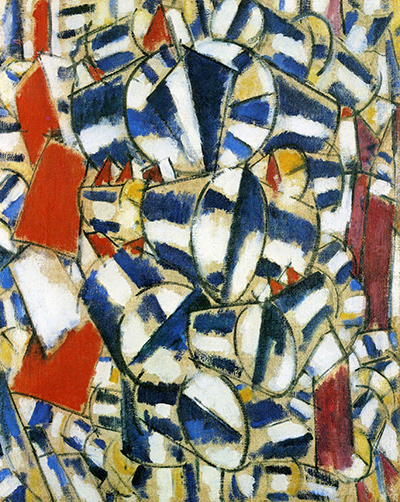
1909–1911 [3]Contrast of Forms
1913 [4]The Mechanic
1920 [6]Three Women
1921–22 [7]Contents
- A body assembled from separate signs
- The white spaces carry the design
- From a paper figure to a theatrical presence
- The collaboration behind the ballet
- African sources and a Parisian interpretation
- A different use of Léger’s geometry
- The surviving design and its limits
A body assembled from separate signs
The head is a nearly complete circle divided into dark and ochre areas. A small angular mark suggests a facial feature without giving the face a naturalistic expression. Below it, several horizontal strokes stand in for a neck or collar. Pale intervals separate those strokes, so the connection between head and torso becomes a rhythm of dark marks and open paper rather than a continuous anatomical passage.
The torso is a broad black block. Its upper edge joins the outstretched arms, whose elbows bend upwards. At one side, narrow ochre bands interrupt the black sleeve. They give that arm a small internal rhythm while preserving its angular outline. The two arms balance the figure, but their different markings prevent the pose from becoming a perfectly repeated pattern.
Below the torso, a short pale interval opens before the skirt begins. Its horizontal stripes grow wider towards the hem, building a triangular outline from separate strokes. The legs resume below, dark and slightly angled. Ochre circles mark the knees, and small black feet supply the final rounded accents. Almost every part of the figure has been replaced by a clearly distinguishable shape, yet their arrangement still lets us read a person.
The white spaces carry the design
The paper between the forms is as active as the black and ochre. Narrow strips separate the head from its collar, the collar from the body, and the body from the skirt. At the lower edge, further dark horizontal marks appear beside the legs. Their continuation outside the limbs makes the lower half feel like a figure emerging from a striped field.
These gaps complicate the silhouette. From farther away, the eye can gather the pieces into a single standing woman. Closer looking reveals interruptions at the very places where a natural body would ordinarily join. Léger makes recognition depend on the position of parts rather than on a complete bodily outline. The figure holds together because a circle sits where a head is expected, sleeves lead towards hands, and two legs support the wide skirt.
The restricted palette strengthens that effect. Black gives the body its main weight; ochre identifies a few points at the head, sleeve and knees. Those coloured accents let the eye move between distant parts without requiring soft modelling. There is no visible need to assign a fixed symbolic meaning to each colour. Their placement already explains much of their pictorial work.
From a paper figure to a theatrical presence
A costume drawing records an idea for performance. It can propose an outline, a pattern and the relation of different parts without explaining every practical detail of construction. This sheet supplies no complete account of its reverse, fastenings or internal support. Its strongest information is frontal: the shape a spectator might recognise and the contrasts that would remain visible across a stage.
The raised arms offer an especially useful way to think about that purpose. Their angles establish a pose before any movement has occurred. If such a figure turned or shifted, the broad skirt and small knee circles would offer further points of changing alignment. This is a reading of the drawing’s possibilities, rather than a reconstruction of a documented dance step. The surviving sheet cannot tell us exactly how this particular design was realised or worn.
For the production more broadly, the Biot museum explains that Léger intended performers to disappear beneath animal costumes and to mask or neutralise the human face. Its discussion concerns a separate monkey design, whose form responded to Börlin’s choreography. [11] That evidence helps place the woman within a theatrical project in which the visible performer could become inseparable from a fabricated figure.
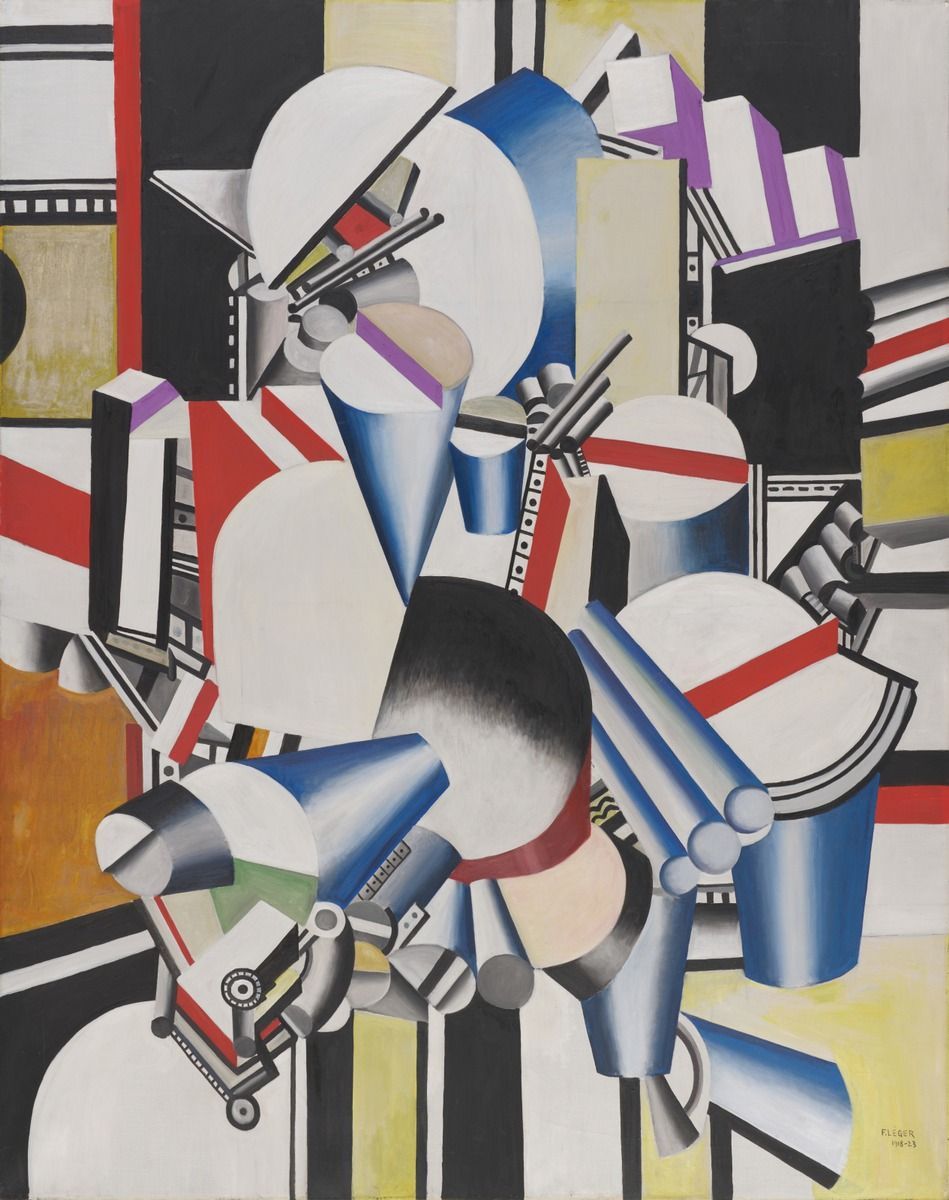
Fernand Léger, Mechanical Elements, 1918–23, Basel. A painting shown for comparison with constructed form in the costume design; it is not a stage design.
The collaboration behind the ballet
The Ballets suédois brought together different kinds of work under Rolf de Maré’s direction. For La Création du monde, Blaise Cendrars supplied the argument, Darius Milhaud composed the music, Jean Börlin choreographed the ballet, and Léger designed its visual world. The Bibliothèque nationale de France records the premiere at the Théâtre des Champs-Élysées on 25 October 1923. [2]
This distribution of responsibilities matters when looking at the sheet. Léger’s woman was one component of a performance shaped by music, dance, lighting and scenery. A drawing can survive independently and reward close attention, but its original purpose reached beyond the sheet. The visual artist was proposing something that other people would have to build, carry, wear or animate.
Amanda Holly Beresford’s study treats this movement from painting into performance as a central issue. Her account of the ballet describes a stage populated by constructed beings and performers concealed within its visual apparatus. [1] The drawing’s separated geometry makes particular sense in that setting: its human presence is communicated through arrangement, while its forms remain emphatically artificial.
African sources and a Parisian interpretation
The production drew on African creation narratives mediated through Cendrars’s writing and on African art studied and transformed by Léger. Beresford discusses his use of illustrated publications, museum displays and private collections, while stressing the distance between his designs and an ethnographically faithful representation. [1] The ballet was a modern European interpretation assembled through those channels.
That context calls for care with the word African. It does not identify a single style, culture or meaning shared by every object that interested the collaborators. Nor does the title Woman establish that this figure represents a documented costume tradition. The surviving drawing presents Léger’s particular combination of geometric simplification, strong pattern and a deliberately altered human silhouette.
The circular head and emphatic joints may suggest associations with constructed or carved figures, but the sheet alone cannot identify an exact source for each feature. Looking at how the forms operate is more revealing than attaching an unsupported cultural explanation to every mark. The wide skirt, interrupted neck and knee discs belong to an imagined stage body, formed within the unequal cultural exchanges of the period.
A different use of Léger’s geometry
Comparing the design with Woman with a Book brings the difference between a costume proposal and a painted figure into focus. The painting gives its body substantial rounded volume. Here, the torso is flat and the skirt is built from stripes. Both make a figure through simplified parts, but the costume sheet depends more strongly on silhouette and separation.
The same comparison can be extended to Ballet mécanique, Léger’s later experiment with film. These are distinct projects, with different collaborators and conditions of movement. The costume belongs to a live theatrical production; the film constructs rhythm through moving images. Their relationship lies in a sustained interest in making ordinary bodily appearance yield to another visual order, rather than in a shared performance or score.
The drawing also rewards comparison with Léger’s broader work on paper. Its marks remain economical and plainly visible. They do not conceal the process of inventing a figure behind an illusion of flesh. A black rectangle, a widening set of stripes and a few circles are enough to suggest a presence with a distinctive posture.

Fernand Léger, Woman with a Book, 1923. Shown for comparison: modelled painted volume differs from the costume design’s flat silhouette.
The surviving design and its limits
Beresford reproduces this woman at the lower left of Figure 80, alongside designs for a bird, a fetish figure and an N’Guil or sorcerer. Her caption dates the group to 1922–23 and locates the drawings at Dansmuseet, Stockholm. [1] The woman’s divided circular head, raised arms, striped skirt and ochre knees match the image shown here.
The caption supplies a secure design identification, but it does not give an individual inventory number or dimensions for this sheet. Keeping those details open allows the drawing to be appreciated without borrowing measurements from another surviving costume design. Its identity as a proposal for La Création du monde is the useful starting point.
What remains most striking is the balance between legibility and interruption. The figure is easy to recognise, yet its body repeatedly breaks into separate marks. Léger has imagined a woman whose visual life begins in the spaces between those parts. On paper, that invention is already vivid; its intended destination was a stage where colour and shape could acquire movement.
Léger in video
Explore abstraction, monumental painting and cinema through films from MoMA and the Centre Pompidou. These videos offer context for Léger’s wider work; the restoration film is in French.
Ballet mécanique (1924) | MoMA FILM VAULT SUMMER CAMP
MoMA’s Film Vault presentation offers a way to watch Léger and Dudley Murphy’s experiment with cinematic rhythm. This presentation is one viewing version, rather than evidence of a single synchronised 1924 film-and-score premiere.
Watch on YouTubeFernand Léger artworks directory
Works covered in these articles and further documented works. Studies and finished works have separate entries; alternate titles share an entry. This is not a catalogue raisonné.
| Name | Date | Medium |
|---|---|---|
| Acrobats and Clowns from Le Cirque | 1950 | |
| Adieu New York | 1946 | Painting |
| Ballet mécanique | 1924 | Film |
| Big Julie | 1945 | Painting |
| Builders with Aloe | 1951 | Painting |
| Charlot cubiste | 1924 | Sculpture |
| Chimneys on Rooftops | 1911 | Painting |
| Cirque (artist’s book) | 1950 | |
| Composition | 1929 | Painting |
| Composition (Study for Nude Model in the Studio) | 1912 | Drawing |
| Composition of Three Figures | 1932 | Painting |
| Composition with Two Parrots | 1935–39 | Painting |
| Construction Workers Final State | 1950 | Painting |
| Contrast of Forms | 1913 | Painting |
| Derrière le miroir, nos.121–122 (posthumous publication, includes a lithograph after Léger) | 1960 | |
| Drawing for The Card Game | 1917 | Drawing |
| Drawing for The Staircase | 1913 | Drawing |
| En attendant le départ | 1914 | Drawing |
| Grand Parade with Red Background | 1953 | Painting |
| J’ai tué (illustrated book) | 1918 | |
| La Cocarde, l’avion brisé | About 1916 | Drawing |
| La Couseuse | about1910 | Painting |
| La Fin du monde filmée par l’Ange N.-D. (illustrated book) | 1919 | |
| Les Femmes au bouquet (Women with a Bouquet) | 1921 | Painting |
| Man and Woman | 1921 | Painting |
| Man in Profile with Rope: Study for The Constructors | 1950/1 | Drawing |
| Man in the Blue Hat | 1937 | Painting |
| Matinée d’ivresse, from Les Illuminations | 1949 | |
| Mechanical Elements | 1918–23 | Painting |
| Mechanical Elements (Metropolitan Museum) | 1920 | Painting |
| Men in the City | 1919 | Painting |
| Mes voyages (posthumous illustrated book) | 1960 | |
| Mona Lisa with the Keys | 1930 | Painting |
| Nude Model in the Studio | 1912–13 | Painting |
| Nudes in the Forest | 1909–1911 | Painting |
| Propellers Second State | 1918 | Painting |
| Reading | 1924 | Painting |
| Soldier with a Pipe | 1916 | Painting |
| Soldiers Playing Cards | 1917 | Painting |
| Soldiers Playing Cards (front drawing) | 1916 | Drawing |
| Standing Nude, Rear View | 1911 | Drawing |
| Still Life with a Beer Mug | 1921–2 | Painting |
| Still Life with Tankard | 1921 | Drawing |
| Study for The Aviator | 1920 | Drawing |
| The Acrobat and his Partner | 1948 | Painting |
| The Acrobats in the Circus | 1918 | Painting |
| The Alarm Clock | 1914 | Painting |
| The Chalices and the Sponge, stained-glass model | 1950 | Drawing |
| The City | 1919 | Painting |
| The Disks in the City | 1920 | Painting |
| The Mechanic | 1920 | Painting |
| The Railway Crossing | 1919 | Painting |
| The Three Musicians | 1944, after a 1924–25 drawing | Painting |
| The Wheels | 1945 | Drawing |
| Three Women | 1921–22 | Painting |
| Two Women Holding Flowers | 1954 | Painting |
| Umbrella and Bowler | 1926 | Painting |
| Verdun, dessin du front | About 1915 | Drawing |
| Woman with a Book | 1923 | Painting |
| Woman: Costume Design for La Création du monde | c.1922–23 | Drawing |
Frequently Asked Questions
Beresford reproduces the matching woman design among works in Dansmuseet, Stockholm. Her grouped caption does not supply the individual sheet’s inventory number or dimensions. [1]
No. La Création du monde was a theatrical ballet with music by Darius Milhaud and choreography by Jean Börlin. Ballet mécanique is a separate film project. [2]
Discussion
Look again at the images and ideas explored in Woman: Costume Design for La Création du monde. These editorial prompts invite your observations.
Reader Insights
Which shape first makes the arrangement read as a human figure?
How do the pale gaps change the connection between the head, torso and skirt?
What does this drawing make easy to imagine about a stage costume, and what does it leave open?
Join the Conversation
Share a detail, comparison or question about Woman: Costume Design for La Création du monde below.
References
- Amanda Holly Beresford, The Performance of Art: Picasso, Léger, and Modern Dance, 1917–1925 (MA thesis, Washington University in St. Louis, 2012), printed pp.114–122 for the production discussion and p.186, Fig.80, for the matching Woman design. Relevant passages read and plate visually inspected; the whole thesis is not claimed as read. Consulted 31 October 2026. View source.
- Bibliothèque nationale de France, La création du monde: ballet en un acte, performance record FRBNF41395947. Complete short production record, credits and premiere information. French source; consulted 31 October 2026. View source.
- Kröller-Müller Museum, Nus dans la forêt / Nude Figures in a Forest, collection record KM 101.045. Current date, medium, identifier, curatorial sections “Distinctive cubist style”, “Geometric shapes” and “‘Battle of volumes’”, and museum reproduction. View source.
- Fondation Beyeler, Contraste de formes, Fernand Léger, current collection record, Inv.90.6: date, medium, dimensions, collection and signature on reverse. View source.
- Philadelphia Museum of Art, The City, 1919, collection record and interpretation; A. E. Gallatin Collection, 1952-61-58. View source.
- National Gallery of Canada, The Mechanic, 1920, accession 14985, collection details and interpretive paragraph; French collection record, Le mécanicien. View source.
- The Museum of Modern Art, Fernand Léger. Three Women. 1921–22, collection record, object 189.1942: artwork image, metadata, 2021 gallery label, publication excerpt, installation history and provenance. View source.
- Musée national Fernand Léger, La Joconde aux clés, collection record and museum commentary (French): object data, owning museum image, artist recollection, sardine tin and symbolic interpretations. The artist’s recollection is consulted as reproduced by the museum; the page does not date it. View source.
- Musée national Fernand Léger, “Les années 50, les constructeurs”, complete Les Constructeurs (définitif) entry and accompanying museum image: title, 1950 date, oil on canvas, 300 × 228 cm, inventory MNFL 94001, 1969 donation and museum-mediated Renault-canteen recollection. View source.
- Musée national Fernand Léger, La Grande Parade sur fond rouge, complete object record and displayed reproduction: 1953, oil on canvas, 114.5 × 156.2 cm, inventory MNFL 96006; donation of Nadia Léger and Georges Bauquier. View source.
- Musée national Fernand Léger, Étude d’un costume pour le ballet La Création du monde. Complete short collection commentary on the separate monkey design, used for production context only; its measurements, date and inventory do not describe the Woman sheet. French source; consulted 31 October 2026. View source.