



 by Tom Gurney
Tom Gurney BSc (Hons) is an art history expert with over 20 years experience
Published on June 19, 2020 / Updated on November 20, 2026
Email: tomgurney1@gmail.com / Phone: +44 7429 011000
Introduction
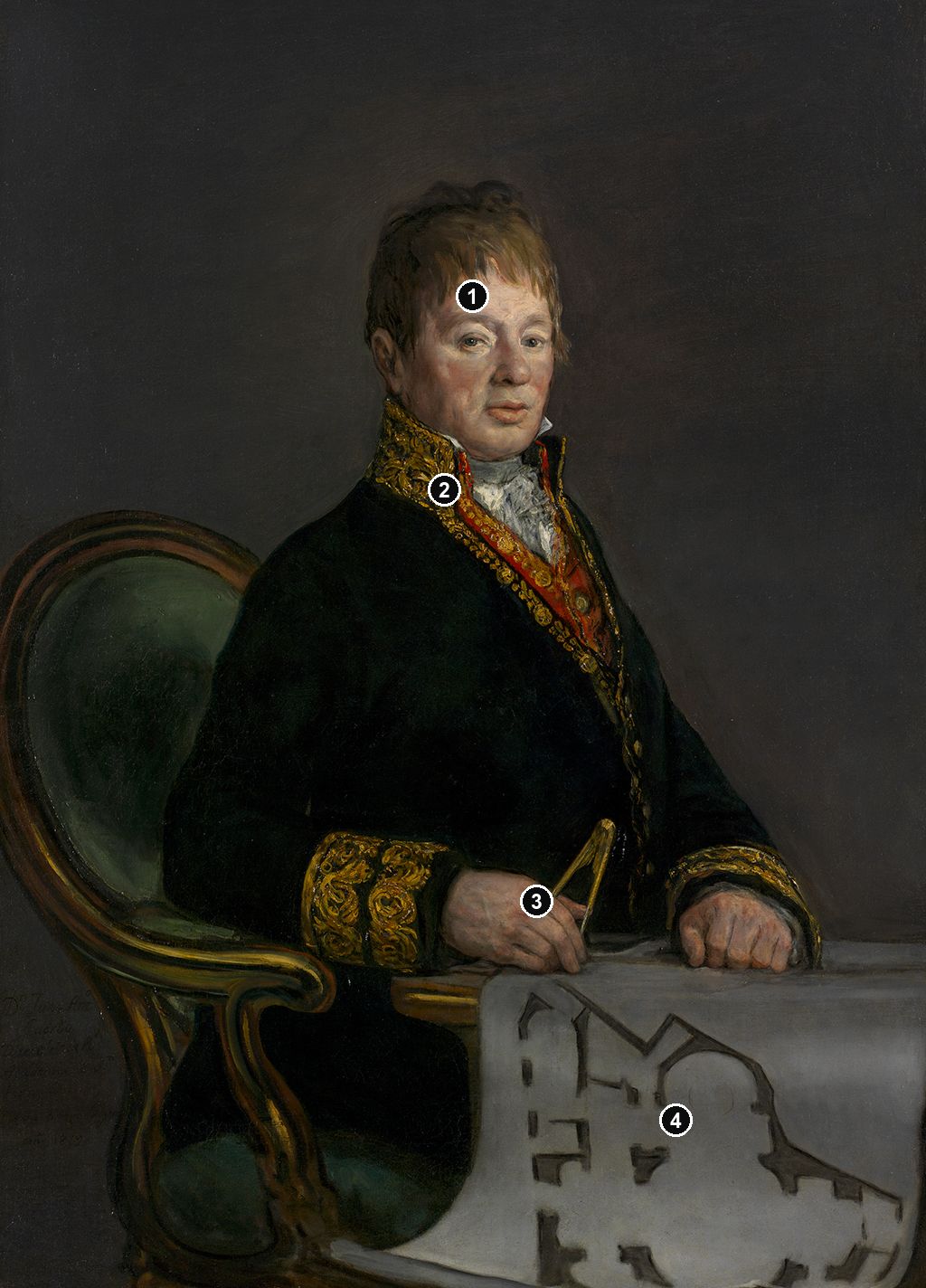
Juan Antonio Cuervo looks up from a drawing that hangs over the edge of his table. His right hand still holds a pair of dividers, and his left rests on the paper. Goya gives the architect enough space to show both the instrument and the plan, but the light reaches Cuervo’s face first. The embroidery at his collar and cuffs identifies him as a member of Spain’s Royal Academy of San Fernando. Lower down, in a corner much easier to overlook, Goya names Cuervo as a director of the Academy and signs himself as his friend. [1] [2]
At a Glance
- ArtistFrancisco de Goya y Lucientes
- TitlePortrait of Don Juan Antonio Cuervo
- Date1819, inscribed on the painting. [1] [2]
- Medium and dimensionsOil on canvas, 120 × 87 cm (height × width, unframed). [1]
- CollectionThe Cleveland Museum of Art, accession 1943.90, Mr. and Mrs. William H. Marlatt Fund. [1]
- SitterJuan Antonio Cuervo (1757–1834), architect and director of architecture at the Royal Academy of San Fernando. [3] [4]
Works across Goya’s career
The Parasol
1777The Nude Maja
1795–1800Saturn Devouring His Son
c. 1820–23The Dog
c. 1820–23From the face to the plan
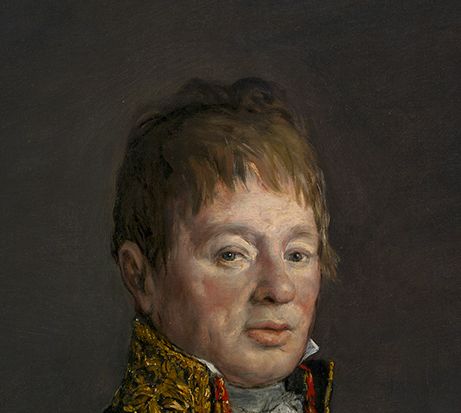
Cuervo sits at an angle, with his chest turned towards the right of the canvas and his face turned far enough back for his eyes to meet ours. His shoulders fill the centre of the picture, with the curve of an upholstered chair rising beside him on the left. The chair’s frame catches the light along the rim and again at the scroll of the arm. Above it there is little to locate him in a particular room. The grey-brown around the head gives Goya space to pick out loose strands of hair and the lit edge of the cheek. The mouth is slightly open, and the colour around the cheeks and nose is warmer than the light across the forehead. [1] [2]
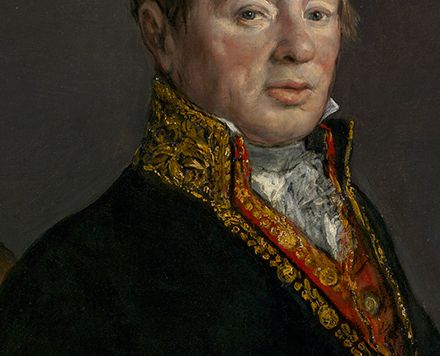
The dark coat nearly joins the background along the shoulder, so the gold stitching does some of the work of defining Cuervo’s posture. It follows the high collar down into the red facing and turns up again in broad bands around the cuffs. The neckcloth, between the embroidery and the face, catches light in short, pale strokes. At the hand on the left of the picture, the cuff’s finer pattern gives way to visible veins, knuckles and creases. Goya lets the hand remain recognisably at work even as the pattern on the sleeve establishes the formality of the dress. [1] [2]
The dividers are in Cuervo’s right hand, on our left. Their legs open into a narrow triangle above his knuckles. A draughtsman can use a tool like this to take off a distance or transfer it from one part of a drawing to another. His other hand steadies the sheet, and the drawing comes forward towards us. As the paper bends over the edge of the table, the dark lines turn with it. The lower and right edges of the canvas then cut across its design. We see enough of the widths, openings and curves to take the plan seriously as an object of work, and enough of the paper’s weight and bend to understand how it sits in the room. [1] [2]
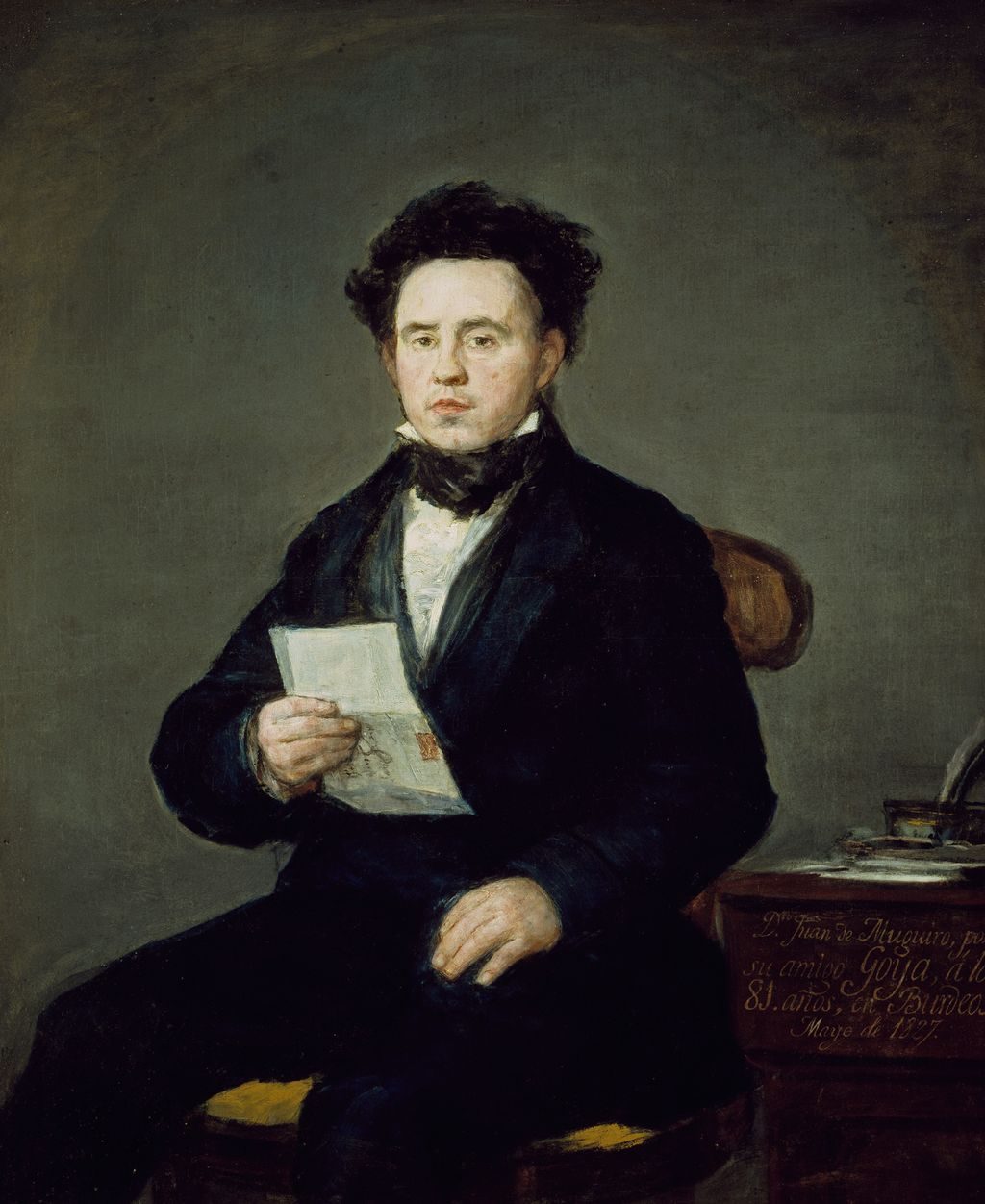
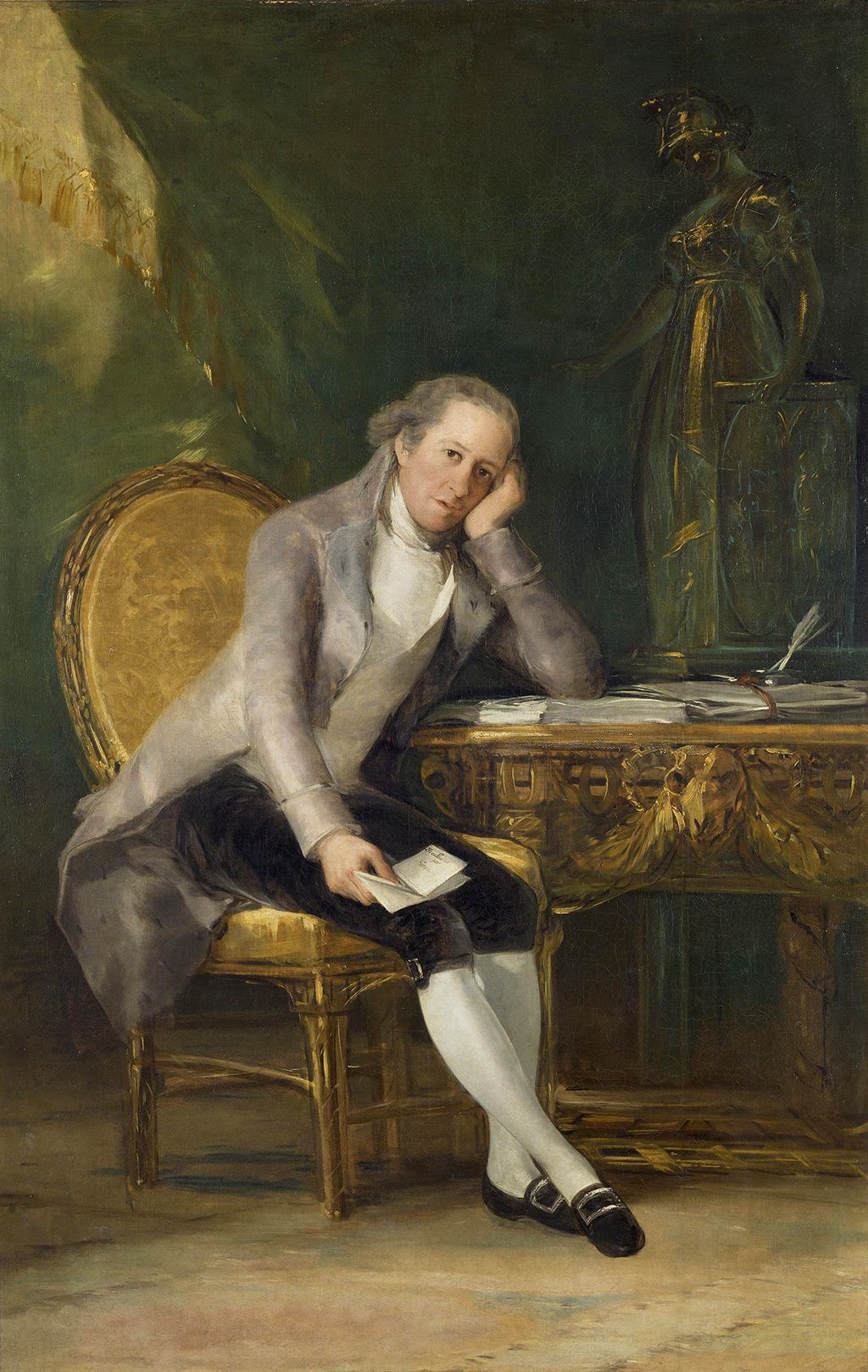
In Gaspar Melchor de Jovellanos, another seated portrait by Goya, the papers lie under the arm that supports the sitter’s head. The long stretch of desk gives Jovellanos room to lean. Cuervo sits more upright and keeps both hands close to the instrument and drawing. In Don Juan Bautista de Muguiro, the paper is held up near the chest, small enough to be opened and read in one hand. Cuervo’s sheet is large enough to occupy much of the foreground. Its scale, and the way it spills over the furniture, make the character of his work visible before we read his title. [1] [6] [7]
Annotated Details from Portrait of Don Juan Antonio Cuervo
Follow the eyes, the embroidered collar and the dividers down to the drawing.
Details from PORTRAIT OF DON JUAN ANTONIO CUERVO
Details from the Cleveland Museum of Art portrait (1943.90).
Cuervo’s face
The turned head catches the light against the grey ground.
The embroidered collar
Gold embroidery catches the light on the red collar.
The hand and dividers
Cuervo holds his dividers just above the sheet.
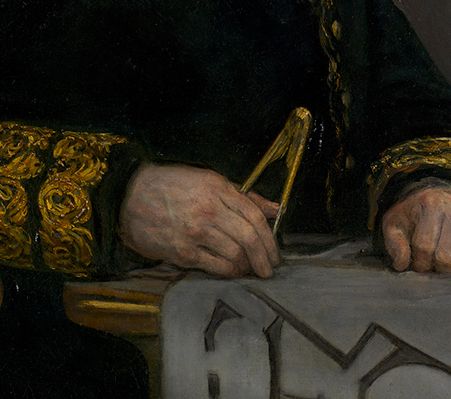
The drawing at the edge of the table
The architectural drawing bends over the table edge.
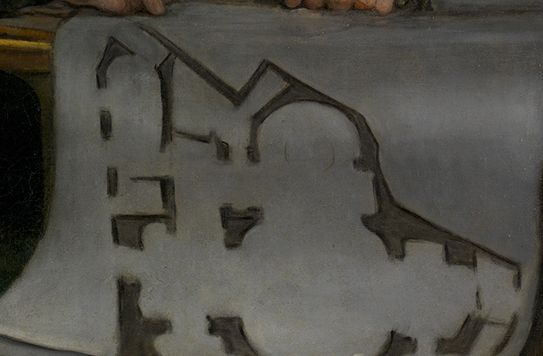
Which church is on the sheet?
The Cleveland Museum of Art identifies the plan as Cuervo’s design for the Church of Santiago in Madrid. The Fundación Goya en Aragón also records a proposed identification with another Madrid church, San Sebastián, and gives Santiago as a possibility. In the painting the drawing is oblique and cut off by the edge. Cleveland’s identification links it to a documented project close to the Royal Palace, the present church of Santiago y San Juan Bautista. [1] [2] [5]
Cuervo’s connection with the Santiago project reaches back to 1806. In April that year the ecclesiastical visitor in Madrid submitted his drawings to the Royal Academy for review. Its commission approved the ground plan and asked that the principal door face the Plaza de Santiago instead of the Calle de Santa Clara. The church that stands there today opens onto the square. Work on the new building took place between 1811 and 1814, during the years of the Peninsular War and its immediate aftermath. The building succeeded two medieval parish churches and was consecrated in 1817, two years before Cuervo sat for Goya. Its central space has a plan based on a Greek cross, with four arms arranged around the centre. [3] [5]
The decision about the doorway shows what an Academy review could change. The direction of the entrance determined how the parishioners would approach the church from the surrounding streets, even with the interior plan approved. By 1819, when Goya painted the portrait, Cuervo had himself been responsible for teaching architecture at the Academy and taken part in the review of other building projects. The sheet on his table sits between those two sides of his career. It evokes the work of designing a building and the scrutiny that designs underwent within the institution named in the dedication. [1] [3] [5]
Goya on film
Five films explore Goya’s portraits, prints, Black Paintings and painting techniques.
The Duke of Wellington by Goya
The portrait, its military decorations and its later theft.
Watch on YouTubeFrom Academy student to director of architecture
Cuervo was born in Oviedo in 1757. He assisted Ventura Rodríguez on the hospital chapel there and went on to work with him in Madrid. The Academy’s record of Cuervo’s early studies describes exercises in drawing architectural details from ancient buildings and printed architectural authorities. He studied, for instance, an entablature from the Roman temple known as the Maison Carrée at Nîmes through Palladio’s account. These were measured exercises in how a building was put together. In 1781 the Academy awarded him second prize in its architecture competition. [3] [4]
He became deputy director of architecture in 1801 and director of architecture in 1814. His work for the Academy covered matters beyond the classroom. In 1812 he was among the members charged with collecting and safeguarding artworks that had been gathered in Madrid from religious houses during the French occupation. By 1818 he was advising on the stability of a convent tower in Madrid, and in 1819 he submitted designs for parish churches in Algaidas and Casalejas. The Casalejas proposal made use of the existing tower and identified parts of the old structure that could be retained. The compass and plan in the portrait sum up a practice that involved weighing the conditions of existing buildings as well as designing new ones. [3]
The Academy’s own record also helps to explain the title in the painting. The inscription calls Cuervo a director of the Royal Academy, the office he held in its architecture section. When the separate office of director general fell vacant in 1825, Cuervo was one of the candidates. Isidro González Velázquez received the royal appointment. Reading the inscription against the appointments makes it possible to identify the post Goya was celebrating in 1819. [1] [2] [3]
A friend in Academy dress
The inscription is low on the left, where it is easy to miss amid the chair and the shadows. It names the sitter, gives his office, and ends with Por su amigo Goya and the year 1819. The Fundación Goya en Aragón transcribes it as Dn. Juan Anto / Cuerbo / Directr de la Rl / Academia de Sn Fernando / Por su Amigo Goya / año 1819. The slashes mark the line breaks, and Cuerbo is the spelling on the canvas. In English the inscription reads ‘Don Juan Antonio Cuervo, director of the Royal Academy of San Fernando, by his friend Goya, 1819’. The title gives the portrait a formal register, and in the same few lines Goya lets us know how he described his relationship to the sitter. [1] [2]
The following year Goya painted Cuervo’s nephew, Tiburcio Pérez y Cuervo, also an architect. Tiburcio stands with his arms folded and his white shirtsleeves rolled up. The darkness around him recalls the uncle’s portrait, but here it sets off the sleeves in wide, bright passages. The younger man’s stance itself carries much of the character of the image. In the uncle’s portrait Goya gives that same attention to the face and hands, while the Academy clothing and the working drawing establish the kind of authority Cuervo held. [1] [8]
From Madrid to Cleveland
The Cleveland Museum of Art’s provenance lists Francisco Durán y Sirvent in Madrid in 1900 and the dealer Durand-Ruel in Paris with dates of 1900 and 1928. It then lists Godfrey Rockefeller in Greenwich, Connecticut, in 1939, and the New York dealer J. Seligmann. The museum acquired the portrait in 1943 through the Mr. and Mrs. William H. Marlatt Fund. Cleveland’s accession number is 1943.90. The museum records the frame separately, at 136.8 × 105.1 × 7.3 cm. [1]

Artworks directory
| Name | Date | Medium |
|---|---|---|
| And There’s No Help for It, Plate 15 | Printed 1863 | |
| Asmodea | c. 1820–23 | Wall painting transferred to canvas |
| Boys Inflating a Bladder | 1777–78 | Tapestry cartoon |
| Boys Picking Fruit | 1778 | Tapestry cartoon |
| Bullfight in a Divided Ring | 1825 | Lithograph |
| Card Players | 1777–78 | Tapestry cartoon |
| Card Players (sketch) | 1777–78 | Painted sketch |
| Dance on the Banks of the Manzanares | 1777 | Tapestry cartoon |
| Duel with Cudgels | c. 1820–23 | Wall painting transferred to canvas |
| Heads in a Landscape | c. 1820–23 | Easel painting |
| Judith and Holofernes | c. 1820–23 | Wall painting transferred to canvas |
| Leocadia | c. 1820–23 | Wall painting transferred to canvas |
| Maja and Cloaked Men | 1777 | Tapestry cartoon |
| Maja and Cloaked Men (sketch) | 1777 | Painted sketch |
| Majo Clapping in Time to the Music | 1777 | Drawing |
| Men Reading | c. 1820–23 | Wall painting transferred to canvas |
| Out Hunting for Teeth, Plate 12 | 1799 | Etching, burnished aquatint and burin |
| Picnic in the Countryside (sketch) | 1776–78 | Painted sketch |
| Picnic on the Banks of the Manzanares | 1776 | Tapestry cartoon |
| Pilgrimage to San Isidro | c. 1820–23 | Wall painting transferred to canvas |
| Preparatory study for The Sleep of Reason Produces Monsters | c. 1796–97 | Drawing |
| Procession of the Holy Office | c. 1820–23 | Wall painting transferred to canvas |
| Quarrel at the Cockerel Inn (sketch) | 1777 | Painted sketch |
| Quarrel in the New Tavern | 1777 | Tapestry cartoon |
| Saturn Devouring His Son | c. 1820–23 | Wall painting transferred to canvas |
| Seated Majo Smoking | c. 1776 | Drawing |
| The Dog | c. 1820–23 | Wall painting transferred to canvas |
| The Drinker | 1777 | Tapestry cartoon |
| The Fates | c. 1820–23 | Wall painting transferred to canvas |
| The Great He-Goat | c. 1820–23 | Wall painting transferred to canvas |
| The Kite | 1777–78 | Tapestry cartoon |
| The Parasol | 1777 | Oil on canvas, tapestry cartoon |
| The Second of May 1808 | 1814 | Oil on canvas |
| The Sleep of Reason Produces Monsters, Plate 43 | 1799 | Etching and aquatint |
| The Third of May 1808 | 1814 | Oil on canvas |
| Thou Who Canst Not, Plate 42 | 1799 | Etching and burnished aquatint |
| Three Figures | 1776 | Drawing (lost) |
| Two Old Men | c. 1820–23 | Wall painting transferred to canvas |
| Two Old Men Eating Soup | c. 1820–23 | Wall painting transferred to canvas |
| Two Women and a Man | c. 1820–23 | Wall painting transferred to canvas |
| Universal Language: The Author Dreaming | 1797 | Drawing |
| The Family of Charles IV | 1800 | Oil on canvas |
| Witches’ Sabbath (Osuna painting) | 1797–98 | Oil on canvas |
| The Nude Maja | 1795–1800 | Oil on canvas |
| The Clothed Maja | 1800–07 | Oil on canvas |
| Self-Portrait (Drawing) | c. 1796 | Brush and carbon black ink on laid paper |
| The Swing, Madrid Album B.21 | 1795–97 | Brush and carbon black washes |
| Majas Fighting, a Majo Observing, Madrid Album B.15 | 1796–97 | Brush, grey and black washes on laid paper |
| Majos and Majas Conversing, Madrid Album B.16 | c. 1794–97 | Ink wash on paper |
| Weeping Woman and Three Men, Madrid Album B.17 | 1795–97 | Brush, carbon black washes and black chalk |
| Maja Seated on a Chair and Two Companions Behind, Madrid Album B.18 | 1795–97 | Brush and carbon black washes |
| Girl and Bull, Madrid Album B.23 | 1796–97 | Brush and carbon black washes |
| Lovers Sitting on a Rock, Madrid Album B.24 | 1796–97 | Brush and carbon black washes |
| Mariano Ceballos Riding a Bull | 1825 | Crayon lithograph and scraper |
| Landscape (lifetime impression) | c. 1807–10 | Etching and aquatint |
| Self-Portrait (1815), Prado canvas | 1815 | Oil on canvas |
| Self-Portrait (1815), Academy panel | 1815 | Oil on panel |
| Self-Portrait with Dr Arrieta | 1820 | Oil on canvas |
| Christ Crucified | 1780 | Oil on canvas |
| The Last Communion of Saint Joseph of Calasanz | 1819 | Oil on canvas |
| Christ on the Mount of Olives | 1819 | Oil on panel |
| The Flower Girls, or Spring | 1786–87 | Oil on canvas |
| The Grape Harvest, or Autumn | 1786–87 | Oil on canvas |
| The Snowstorm, or Winter | 1786–87 | Oil on canvas |
| The Threshing Ground, or Summer | 1786–87 | Oil on canvas |
| Picnic on the Banks of the Manzanares | 1776 | Oil on canvas |
| The Kite | 1777–78 | Oil on canvas |
| Dance on the Banks of the Manzanares | 1777 | Oil on canvas |
| A Fight at the Venta Nueva | 1777 | Oil on canvas |
| Blind Man’s Bluff | 1788 | Oil on canvas |
| Dogs on a Lead | 1775 | Oil on canvas |
| Hunting with a Decoy | 1775 | Oil on canvas |
| Hunter Loading His Rifle | 1775 | Oil on canvas |
| The Angler | 1775 | Oil on canvas |
| The Hermitage of San Isidro on His Feast Day | 1788 | Oil on canvas |
| The Meadow of San Isidro | 1788 | Oil on canvas |
| The Straw Manikin | 1791–92 | Oil on canvas |
| Witches’ Flight | c. 1797–98 | Oil on canvas |
| A Scene from ‘The Forcibly Bewitched’ | 1798 | Oil on canvas |
| The Duchess of Alba in Black | 1797 | Oil on canvas |
| The Duchess of Alba in White | 1795 | Oil on canvas |
| Charles III in Hunting Dress | c. 1786 | Oil on canvas |
| The Duke and Duchess of Osuna and Their Children | 1787–88 | Oil on canvas |
| Manuel Osorio Manrique de Zúñiga | 1787–88 | Oil on canvas |
| The Marquesa de Pontejos | c. 1786 | Oil on canvas |
| Equestrian Portrait of the 1st Duke of Wellington | 1812 | Oil on canvas |
| The Duke of Wellington | 1812–14 | Oil on wood |
| Portrait of Ferdinand VII of Spain | 1814 | Oil on canvas |
| Gaspar Melchor de Jovellanos | 1798 | Oil on canvas |
| María Tomasa Palafox y Portocarrero | 1804 | Oil on canvas |
| Señora Sabasa García | c. 1806–11 | Oil on canvas |
| Don Juan Bautista de Muguiro | 1827 | Oil on canvas |
| Doña Isabel de Porcel | Before 1805 | Oil on canvas |
| The Colossus | After 1808 | Oil on canvas |
| The Burial of the Sardine | 1808–12 | Oil on panel |
| The Madhouse | 1808–12 | Oil on panel |
| A Procession of Flagellants | 1808–12 | Oil on panel |
| Portrait of Jacques Galos | 1826 | Oil on canvas |
| Portrait of Mariano Goya, the Artist’s Grandson | 1827 | Oil on canvas |
| Milkmaid of Bordeaux | c. 1827 | Oil on canvas |
| Portrait of Don Juan Antonio Cuervo | 1819 | Oil on canvas |
| María Luisa of Parma (Naples version) | c. 1800 | Oil on canvas |
| The Countess of Baena | 1819 | Oil on canvas |
| The Family of the Infante Don Luis | 1783–84 | Oil on canvas |
| The Holy Family | c. 1787 | Oil on canvas |
| Saint Barbara | c. 1773 | Oil on canvas |
| Saints Justa and Rufina | 1817 | Oil on canvas |
| El Tío Paquete | c. 1819–20 | Oil on canvas |
| The Forge | c. 1815–20 | Oil on canvas |
| Majas on a Balcony (Metropolitan Museum version) | c. 1800–10 | Oil on canvas |
| Maja and Celestina on a Balcony | c. 1808–12 | Oil on canvas |
| The Water Bearer | 1808–12 | Oil on canvas |
| Time and the Old Women | c. 1810 | Oil on canvas |
Frequently Asked Questions
It belongs to The Cleveland Museum of Art in Ohio, where it is catalogued as Portrait of Don Juan Antonio Cuervo, accession 1943.90. Goya painted it in oil on canvas in 1819. [1]
Yes. Goya painted Cuervo’s nephew Tiburcio Pérez y Cuervo in 1820. The portrait belongs to The Metropolitan Museum of Art in New York. [8]
Discussion
Look again at the images and ideas explored in Portrait of Don Juan Antonio Cuervo. These editorial prompts invite your observations.
Look at Cuervo’s hands, then at the embroidery on his cuffs. How does Goya give you a sense of what Cuervo does and of the position he holds? What does the dedication add when you find it in the lower left?
Reader Insights
Follow the line from Cuervo’s eyes to his dividers.
What does the view of the drawing add to the portrait?
Join the Conversation
Share a detail, comparison or question about Portrait of Don Juan Antonio Cuervo below.
References
- The Cleveland Museum of Art, Portrait of Don Juan Antonio Cuervo, accession 1943.90. The print record includes the inscription and provenance. View source 1. View source 2.
- Fundación Goya en Aragón, Juan Antonio Cuervo, catalogue entry 205, with inscription transcription and discussion of the painted plan. View source.
- Real Academia de Bellas Artes de San Fernando, ‘Cuervo, Juan Antonio’, digital drawings catalogue and archival biography. View source.
- Real Academia de la Historia, ‘Juan Antonio Cuervo’, Historia Hispánica. View source.
- Comunidad de Madrid, Decreto 53/2026, de 20 de mayo, heritage designation and architectural history of the Iglesia Parroquial de Santiago y San Juan Bautista. See also Ayuntamiento de Madrid, Iglesia parroquial de Santiago y San Juan Bautista, built heritage inventory. View source 1. View source 2.
- Fundación Goya en Aragón, Gaspar Melchor de Jovellanos, catalogue entry 352. View source.
- Fundación Goya en Aragón, Juan Bautista Muguiro, catalogue entry 189. View source.
- The Metropolitan Museum of Art, Tiburcio Pérez y Cuervo (1785/86–1841), the Architect, accession 30.95.242. View source.


