



 by Tom Gurney
Tom Gurney BSc (Hons) is an art history expert with over 20 years experience
Email: tomgurney1@gmail.com / Phone: +44 7429 011000
Gimcrack on Newmarket Heath: Introduction
George Stubbs painted Gimcrack on Newmarket Heath, the composition with a trainer, jockey and stable lad, around 1765 for Frederick St John, second Viscount Bolingbroke. The oil painting measures 102 × 193.6 cm and remains privately held. It is the broad composition with three attendants beside a standing horse, distinct from the Fitzwilliam Museum’s mounted portrait. [1]
The surprise is how much of the picture lies beyond its principal subject. Gimcrack stands far to the left, against a substantial brick building. One man holds his bridle, a boy crouches beneath his flank, and a third figure stands apart with riding equipment. Across the open ground, another horse draws ahead of three pursuers. The distant movement and the foreground attention occupy different scales, asking the eye to move between a contest and the work surrounding it. [1]
At a Glance
This work across George Stubbs’s career
Whistlejacket
about 1762 [6]Contents
- Looking at Gimcrack and his attendants
- Annotated details
- A small horse with a substantial racing history
- What is happening in the distance?
- The Newmarket setting
- Owners, patrons and an admiring spectator
- The mounted portrait at the Fitzwilliam
- Other versions and printed Gimcracks
- Treatment, collecting and changing judgements
- Videos on George Stubbs
Looking at Gimcrack and his attendants
The approaching jockey is identified as John Pratt in Christie’s specialist account. The man holding the bridle is understood as the trainer, whose name is unrecorded; the kneeling stable lad also remains unnamed. [1]
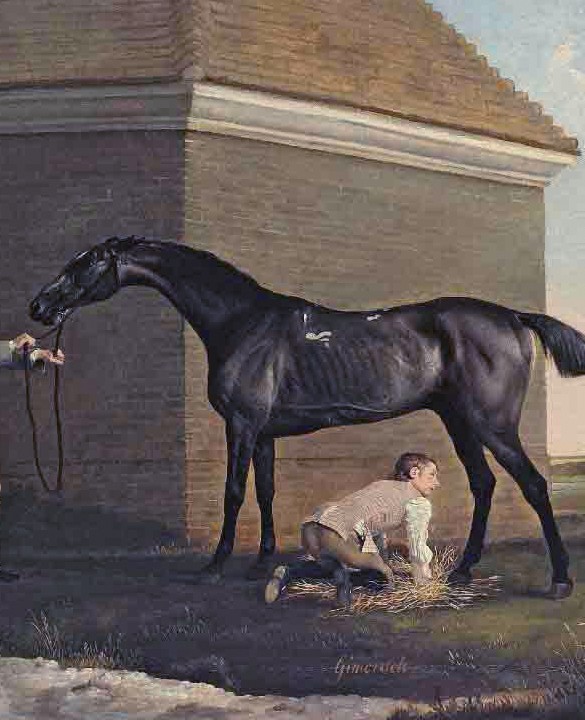
The horse faces left, his neck reaching towards the holder’s hands. His dark body does not read as a single flat shape. Lighter passages trace the upper shoulder, catch parts of the back and spread unevenly over the ribcage; the underside and legs hold deeper tones. The differences make a rounded body perceptible even against the relatively dark wall. Head, mane and short tail form sharper accents. Looking from the nose along the back to the tail reveals a continuous contour, interrupted by small changes in direction rather than an exaggerated arch. The horse’s presence depends on this combination of a clearly bounded silhouette and light moving within it. [1]
The holder stands close to the left edge. His extended forearms bridge the small interval between his chest and Gimcrack’s muzzle; below them, the reins fall in long loops. His pale stockings and breeches remain legible against the shadowed building, while his coat belongs more closely to its muted colours. He neither turns outwards to claim the spectator nor makes a sweeping gesture. His activity is concentrated in the narrow space occupied by hands, leather and the horse’s head. The slack hanging below his grip is especially useful to notice: the image includes both a connection to the horse and the surplus line falling away from that connection. [1]
Rubbing down was part of care after exercise or racing. The Frick Collection’s exhibition notes describe the use of straw or rags to dry sweating horses, explaining the purpose of the sheds represented in Stubbs’s Newmarket landscapes. This gives the kneeling figure’s activity a practical context. He belongs to the horse’s working routine. The distinction changes the character of the encounter: ordinary maintenance is sufficiently important to occupy the foreground of a celebrated animal’s portrait. [14]
The lad’s pale sleeves, bent back and lowered arms form a compact patch of movement below the horse. Straw spreads around his knees and hands. His head rises against Gimcrack’s body, but most of his figure stays beneath the animal’s long horizontal outline. The relationship makes the difference in their sizes immediately clear. It also draws attention to an area easily missed when looking only at the horse’s head: the underside, legs and working space close to the ground. Stubbs gives the straw a lighter, more scattered appearance than the dense dark shapes above it. The boy’s task is thus visible through posture, placement and the material at his hands. [1]
Pratt is separated from this compact group by a strip of open ground. His black jacket, pale breeches and stockings create a strong upright shape. The brown saddle at his side breaks that narrow outline, while his cap and face turn back towards the horse. The equipment helps explain his place in the scene without putting him in the saddle. He is closer in height to the holder than to the boy, but occupies a brighter area with sky behind his upper body. These changes of spacing and background keep three small human figures distinct. None needs to be enlarged into a conventional full-length aristocratic portrait to remain individually noticeable. [1]
Annotated Details from Gimcrack on Newmarket Heath
Select a number on the painting to jump to a closer view.
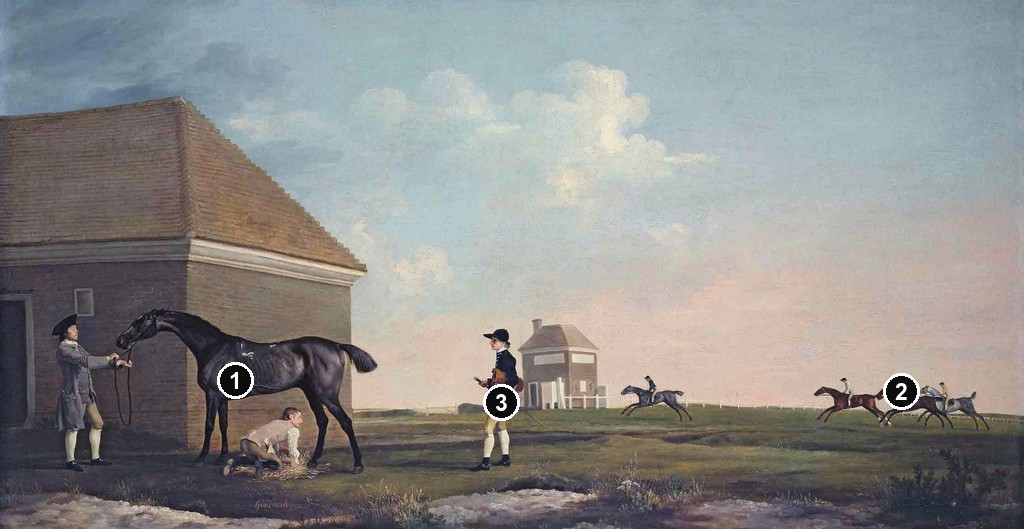
Details from GIMCRACK ON NEWMARKET HEATH
Each crop comes from the same reproduction shown above.
Horse beside the rubbing house
The large horse stands near the dark wall. The people at its head and below its body make the rubbing-down scene a study of work as well as a portrait.
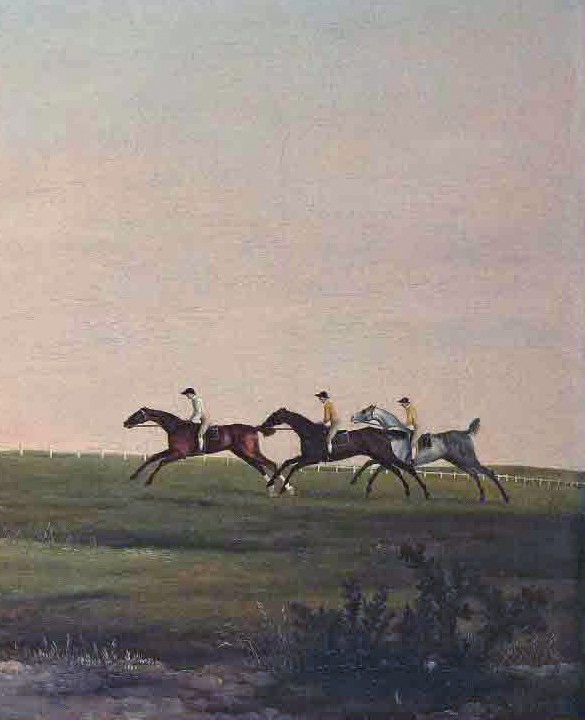
The distant race
Small horses and riders cross the heath near the horizon. Their scale sets the distant action apart from the close group at the rubbing house.
The figure between the two scenes
The upright figure marks the transition from the foreground group to the open heath. The bright breeches pick out the figure against the low horizon.
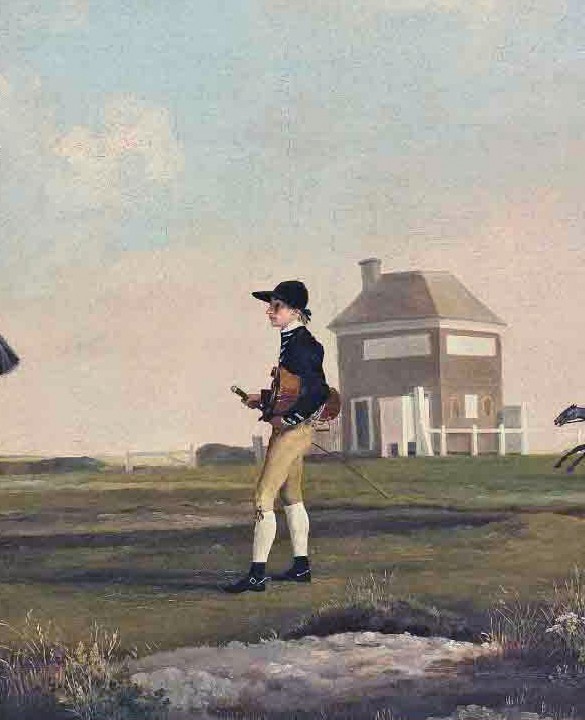
Image source: Whole painting, Christie’s lot 5460656
A small horse with a substantial racing history
Gimcrack was foaled in 1760 and bred by Gideon Elliott of Murrell Green in Hampshire. York Racecourse’s historical booklet identifies his sire as Cripple, a son of the Godolphin Arabian, and his dam as Miss Elliot, by Grisewood’s Partner. He was notably small, although historical measurements vary. His scale matters to the reputation that developed around him: this was an animal whose sustained success exceeded expectations attached to his size. His reputation rested on performance rather than imposing stature. [15]
William Pick’s 1803 Turf Register records seven victories in 1764, followed by a Newmarket win for William Wildman and sale to Bolingbroke. A payment when Selim withdrew was a forfeit, not another completed race. Gimcrack subsequently beat Rocket and Ascham in matches for 1,000 guineas each. Pick places his first defeat, against Bay Malton, before the Second October Meeting victory over Drone. His account also records the later French test of 22½ miles within an hour, and a final victory at Newmarket in 1771 before retirement to stud at Oxcroft. These were different kinds of engagement, spread across years and owners. [16]
The apparent simplicity of a career total can conceal those differences. In an undated letter preserved at Lydiard, Maurice W. Brockwell counted 26 victories from 36 races and challenged extravagant claims made for the horse. His figure is evidence of a later argument about Gimcrack’s reputation, rather than a fresh contemporary record of each start. A reader need not settle every disputed total to understand why the 1765 portrait mattered: the horse already had an established record, and its subsequent career gave later writers further material with which to celebrate or qualify it. [17]
Pick’s sequence also helps distinguish historical racing from the picture’s compressed narrative. Receiving a forfeit, winning a match and returning from a foreign endurance test are separate events. The painted foreground cannot stand for all of them. The register’s specific engagements provide a firmer historical footing than reading a lifetime record directly out of a single landscape. [16]
The register follows him beyond competition: his advertised Oxcroft fee was 25 guineas in 1772 and ten guineas in 1779. Such dated entries document the later stud career without turning every surviving portrait into a record of the same stage. [16]
What is happening in the distance?
The distant leader repeats Gimcrack. Christie’s interprets the background as a trial, probably in late May or June 1765. The proposed identities of the other horses remain tentative; the scene should not be treated as a securely identified race result. [1]
Four mounted horses run towards the left. The leader is visibly detached from the other three, which overlap near the right edge. Their riders lean forward, and their extended limbs produce a much quicker rhythm than the foreground horse’s standing legs. The pale rail behind them marks out the open strip on which they move. Near the middle, a small building rises above their level, its pale divisions and dark openings more regular than the broken ground below. There is no painted crowd lining the course. That absence is visible; the precise historical circumstances behind it require more than looking alone. [1]
An earlier dealer brochure offered a different explanation. Ellis & Smith’s The Bolingbroke Stubbs Racing Pictures called the distant event a victory at the First Spring Meeting of 1765. Its caption also attached the name John Platt to the bridle holder, whereas the modern account identifies the dismounted jockey as Pratt. These disagreements show how much interpretation has accumulated around a seemingly straightforward sporting scene. The brochure is valuable as a record of that history, but its caption cannot safely identify every participant or supply a definitive event. [18]
The temporal construction has also attracted critical attention. Writing in 2023, Yann Tholoniat discusses the coexistence of action in the distance and its aftermath in the foreground. He questions the apparently quiet world presented by Stubbs, arguing that such images can suppress the harsher circumstances of equine competition. His argument concerns the choices made in representing the sport. It directs attention to what the picture makes available for contemplation and what lies outside it. The horses running, the men working and the broad intervals of unoccupied ground need not be understood as an unedited record of one instant. [19]
The eye can make the journey in either direction. Starting with the dark foreground body, it crosses the standing jockey and reaches the smaller moving animals; starting at the right, it follows the runners towards the larger horse waiting at the other end. The continuous strip of land makes that movement easy, while the abrupt difference in scale prevents the two groups from merging. A viewer can recognise a relationship between them without losing the contrast between distant speed and near stillness. The canvas’s width is essential to the effect: the intervals belong to its construction as much as the occupied spaces do. [1]
The Newmarket setting
The large left-hand building gives the painting an unusually firm edge. Its roof slopes down towards the open centre, and a pale cornice runs across the wall above the horse. The brick surfaces and straight divisions are set against the irregular contour of Gimcrack’s body. Above, a considerable expanse of sky remains unobstructed. Pale clouds gather towards the centre, with darker passages towards the upper left and a warmer band low on the right. The warmer colour remains low and pale, allowing the darker foreground group to retain its clarity. [1]
The Frick notes identify Stubbs’s small Newmarket Heath with a Rubbing-Down House as one of two surviving landscapes without people or animals. They suggest that he probably worked from drawings made on the spot and used the painting as a reference for finished compositions. The importance of the building therefore extends beyond its place in one horse portrait: it could help establish a recognisable working environment in several images. [14]
David Pullins develops this point in his study of Stubbs’s working methods. He argues that the unpopulated Newmarket views, retained in the artist’s studio, functioned as reusable settings alongside highly finished animal studies. He relates them to both Gimcrack compositions, Turf and the much later Hambletonian, Rubbing Down. The argument helps explain why recurrence of a building need not identify the same event. A familiar setting could support different portraits and narratives. This places the Newmarket setting within a continuing studio practice, developed across several compositions. [20]
At ground level, the foreground is less smooth than the distant course. Pale exposed earth runs along the lower edge, broken by grass and darker patches. These small irregularities hold the near scene in place, while the far ground is reduced to longer, quieter bands. The name Gimcrack sits low beneath the principal horse, near the transition between dark and pale earth. It is discreet compared with the breadth of the scene. The inscription identifies an individual within a landscape spacious enough to extend well beyond him. [1]
Owners, patrons and an admiring spectator
William Wildman’s connection to Stubbs broadens the social history of these portraits. Sotheby’s account of the later Euston describes him as a grazier and meat salesman who built a prosperous business at Leadenhall Market. He commissioned portraits of Gimcrack and Eclipse and collected other works by the artist. The mounted Gimcrack therefore belongs to a patronage network that included commercial wealth as well as titled owners. Wildman’s profession is documented context; it should not be inferred from the appearance of any of the anonymous attendants in the larger painting. [21]
A letter dated 12 July 1765 gives a different kind of evidence for the horse’s contemporary appeal. Lady Sarah Bunbury, writing from Barton, recalled visiting Newmarket and expressed delight in Gimcrack. She juxtaposed her anxiety about the horse with the political change bringing Rockingham, Grafton and Conway to office, admitting greater concern for the racing. Published in her Life and Letters in 1901, the passage catches a private enthusiasm in the language of someone who knew the society surrounding the course. Its usefulness lies in showing that the animal’s attraction was already personal and immediate in the year usually assigned to the canvas. [22]
Later commemoration took a different form. The York booklet follows the horse’s changing ownership through the French period, Bunbury and Grosvenor, and places the paintings within the continuing culture of the Gimcrack Dinner. The name also survives in York’s Gimcrack Stakes, established in 1846. This legacy can make the horse seem inseparable from York, although the painting presents Newmarket. The remembered animal, the later race and the depicted location belong to connected but distinct histories. [15]
Wildman’s collection was substantial enough for his sons’ 1787 sale to include fifteen works by Stubbs. Sotheby’s account places his purchases alongside his direct commissions, showing that his interest extended beyond simply owning the likeness of a successful horse. The later Euston was another commission for him, rather than an alternative title for Gimcrack. Keeping the animals’ names and the objects’ histories separate reveals a continuing relationship between patron and painter. [21]
The mounted portrait at the Fitzwilliam
The Fitzwilliam Museum’s Gimcrack, with John Pratt up, on Newmarket Heath, accession PD.7-1982, is another oil on canvas of about 1765. Its current object record gives 100 × 124 cm. Painted for Wildman, it may commemorate the horse’s first Newmarket victory on 9 April 1765. That possibility remains a proposal, not an inscribed explanation. The museum acquired the picture in 1982 through a public appeal. [23]
Here Pratt wears red and sits upright on Gimcrack’s back. Horse and rider occupy the right half of a much less elongated composition, with a roofed building behind the hindquarters. A solitary post stands at the left, and trees gather low on the horizon. Clouds fill a large part of the space above. The rider’s vertical body is balanced by the long neck and back beneath him; his hands meet the reins just in front of the saddle. The picture offers no second field of galloping horses to be connected with the standing animal. Its concentration falls on the mounted pair and their immediate surroundings. [23]
The difference becomes clearer when comparing the buildings. In the large painting, the left wall contains the horse and attendants within a dark area before the land opens to the right. In the Fitzwilliam picture, the structure enters from the opposite side, behind a horse that stands against a brighter expanse. The shift changes where the eye finds enclosure and openness. Similar subject matter has produced two differently organised pictures; reducing either to a cropped detail of the other would lose the relationship between the figures, the building and the sky. [1] [23]
The mounted painting’s later history also separates it from the Bolingbroke canvas. The Fitzwilliam traces its ownership through Wildman’s posthumous sale, Sir Walter Gilbey, the Yorkshire Club and the Adeane family. Its present museum identity rests on that particular object history. The movement from private ownership to a public museum changed access to this particular portrait. [23]
Art Fund’s archived appeal record adds a specific financial detail: a £20,000 grant towards a total cost of £601,057. It dates the support to 1983, while the holding museum records acquisition in 1982. The grant formed one part of the wider appeal that secured the painting for a public collection. [24]
The museum records both a signature at the lower right and the name Gimcrack below the horse. The horse is thus named within the image as well as in its title, while the signature marks Stubbs’s authorship. [23]
Other versions and printed Gimcracks
A further multi-figure Gimcrack belongs to the Jockey Club. In 1898 Walter Gilbey described that picture with a bridle holder, a kneeling figure and distant horses, recording Admiral Rous’s bequest and an earlier attribution to Hogarth. His testimony establishes that the composition had a separate collecting and attribution history. It does not relocate the Bolingbroke painting to the Club. Gilbey also described a later, nearly white Gimcrack held by a groom, and reproduced a Turf Gallery account identifying an Oxcroft farmhouse and an assistant groom. These are separate portrait arrangements, associated with the horse’s stud career. [25]
Gilbey’s descriptions also preserve the importance of the human figure in the stud portraits. The Oxcroft account calls the attendant an assistant groom and identifies the setting as the owner’s farm. The horse’s identity continued, but its pictorial setting now concerned breeding and the people maintaining it. Those details help explain why a nearly white Gimcrack beside a single handler can carry the same name as the dark animal attended by three people at Newmarket. They do not supply names for the anonymous workers in the earlier canvas. [25]
The National Gallery’s account of the Turf Project explains the later effort to assemble famous racehorses into a historical series. Begun around 1790, it included copies of earlier pictures and new compositions. Sixteen paintings were completed and exhibited in 1794 at the Turf Gallery in Conduit Street; engravings in two sizes were made by Stubbs’s son for A Review of the Turf. Gimcrack’s return in this setting belongs to a retrospective survey of racing history, rather than another direct observation of the animal in 1765. [26]
The project’s funding failed before its ambitions were fulfilled. That incomplete history is useful when interpreting later reproductions: a set of prints could continue to circulate even though the larger painted survey had not developed as intended. The 1794 display and subsequent impressions belong to the reception of earlier racing fame, rather than to the original circumstances of the Bolingbroke commission. [26]
An actual later edition is documented in Dominic Winter’s 2021 catalogue: a bound set of fourteen large, uncoloured stipple engravings, including Gimcrack, republished by Edward Orme in 1817. The printmaker was George Townly Stubbs, working after George Stubbs. The distinction matters when encountering an image carrying only the horse’s name. A later impression can preserve a portrait’s design while belonging to a different medium, publication and date. The set’s catalogue does not establish that its Gimcrack reproduces the broad Bolingbroke scene. [27]
Nor was every printed Gimcrack designed by Stubbs. The Rijksmuseum holds The Pedigree and Performances of Bay Malton and the grey horse Gimcrack, dated 1766, a mezzotint by Richard Houston after Francis Sartorius, published by Robert Sayer and R. Heber. The paper sheet measures 337 × 456 mm. Its title links the rival horses through both ancestry and performance, showing how racing celebrity could circulate in a documentary format. Its makers and date identify a separate work. Gimcrack’s public image consequently extended beyond the work of a single painter. The broader history of Stubbs’s prints requires those distinctions between designer, printmaker and publisher. [28]
Treatment, collecting and changing judgements
The Ellis & Smith brochure also claimed that the two Bolingbroke racing pictures, Gimcrack and Turf, had been relined and cleaned after previously remaining untouched. This is a historical dealer’s assertion, couched in promotional language. It records an episode in the pictures’ presentation for sale, but supplies neither a modern conservation report nor grounds for repeating its assurances about flawless condition today. The pairing in the brochure is itself revealing: buyers were being invited to consider two works together as prestigious British paintings. [18]
Brockwell’s letter resisted that promotional framing. Addressing the editor of The Times, he questioned the superlatives being used for Gimcrack and separated admiration for the picture from claims about the horse’s supremacy. The undated clipping is an unusually direct reminder that neither sporting fame nor artistic standing has been free from disagreement. Its argument belongs to the painting’s later reception. [17]
The large canvas returned to the family after its 1780 sale, left it in 1943, passed through Walter Hutchinson, and entered the Woolavington Collection in 1951. Exhibitions included the 1984–85 Stubbs retrospective and Stubbs & the Horse in 2004–05. Christie’s sold it on 5 July 2011 for £22,441,250. [1]
Tholoniat’s later reading opens another line of debate: the beauty and order of an animal portrait can coexist with questions about the demands made on its subject. Attention to the human work in the foreground makes that question particularly relevant here. It need not settle into either a claim of perfect harmony or an invented story of suffering. The visible care, the implied exertion and the controlled presentation can all remain part of the encounter. [19]
Pullins’s discussion of reusable settings adds a complementary caution. Recognisability and careful observation do not make every finished painting a literal report of a single occasion. The artist could construct a convincing world from resources developed across different works. That distinction lets this picture be understood both within Stubbs’s racing subjects and as an independent arrangement of bodies, buildings and open land. Its historical information and pictorial construction are inseparable, but they answer different questions. [20]
Videos on George Stubbs
Explore Stubbs’s equestrian painting in its wider context, including two readings of Whistlejacket.
A Horse Lover’s Guide to the YCBA
A museum tour that places Stubbs alongside other artists who painted horses. It includes a look at Pumpkin with a Stable-lad.
Watch on YouTubeGeorge Stubbs artworks directory
Search works and related prints documented in this guide. Separate versions and printing matrices have separate entries; printmakers are named where known. Unidentified historical titles and untraced studio-sale material are discussed in the essays. A dash means that a date is not established here.
| Name | Date | Medium |
|---|---|---|
| A Bay Horse with a Groom | 1791 | Painting |
| A Bay Hunter with Two Playful Spaniels | 1777 | Painting |
| A Bay Hunter, a Springer Spaniel and a Sussex Spaniel in a wooded river Landscape | 1782 | Painting |
| A Cheetah and a Stag with Two Indian Attendants | about 1764 | Painting |
| A Couple of Fox Hounds (coloured print after Stubbs) | — | Print after Stubbs |
| A Couple of Foxhounds | 1792 | Painting |
| A Foxhound on the Scent | 1788 | Drawing |
| A Gentleman driving a Lady in a Phaeton | 1787 | Painting |
| A Grey Horse | 1793 | Painting |
| A Grey Horse (cantering companion) | 1793 | Painting |
| A Grey Stallion in a Landscape | — | Painting |
| A Horse Affrighted at a Lion | 1 May 1788 | |
| A Horse Belonging to the Rt. Honourable Lord Grosvenor called Bandy from his Crooked Leg | about 1763 | Painting |
| A Horse Frightened by a Lion | 1777 | |
| A Lion (A Lion Resting on a Rock) | 1 May 1788 | |
| A Lion Attacking a Horse | 1770 | Painting |
| A Lion Attacking a Horse (monumental Yale canvas) | 1762 | Painting |
| A lion attacking a horse (NGV) | about 1765 | Painting |
| A Lion Devouring a Horse (1788 print) | 1788 | |
| A lion devouring a horse (attribution disputed) | Proposed mid-1770s | Painting |
| A mare and foal with a bay horse | 1771 | Painting |
| A Monkey | 1799 | Painting |
| A Prancing Horse, Facing Right | c. 1790 | Drawing |
| A Rough Dog | 1790 | Painting |
| A Saddled Bay Hunter | 1786 | Painting |
| A Sleeping Leopard | 1 January 1791 | |
| A Tiger and a Sleeping Leopard | 1 May 1788 | |
| A Tigress (John Dixon after Stubbs) | 1772 | Print after Stubbs |
| A Tyger (A Recumbent Leopard by a Tree) | 1 May 1788 | |
| A Tyger (Sleeping Leopard) | 1 May 1788 | |
| An animal found on the coast of New Holland called kanguroo (after Stubbs) | 1773 | Print after Stubbs |
| An animal of a new species found on the coast of New South Wales (after Stubbs) | July 1773 | Print after Stubbs |
| Antinous and Jockey | — | Painting |
| Antinoüs, a chestnut racehorse, in a landscape | Undated | Painting |
| Bandy belonging to Lord Grosvenor (print after Stubbs) | — | Print after Stubbs |
| Baronet (George Townley Stubbs after Stubbs) | 20 February 1794 | Print after Stubbs |
| Baronet with Sam Chifney Up | 1791 | Painting |
| Baronet with Samuel Chifney up (Royal Collection) | 1791 | Painting |
| Bay Hunter by a Lake | 1787 | Painting |
| Brood Mares (Benjamin Green after Stubbs) | Issue 14 November 1776 | Print after Stubbs |
| Brood Mares and Foals | usually dated 1767 | Painting |
| Brown and White Norfolk or Water Spaniel | 1778 | Painting |
| Bulls Fighting | 1786 | Painting |
| Captain Samuel Sharpe Pocklington with His Wife, Pleasance, and possibly His Sister, Frances | 1769 | Painting |
| Death of the Doe (attribution disputed) | 1804 | |
| Der Englische Hühnerhund (Johann Wölfle after Stubbs) | about 1860 | Print after Stubbs |
| Dog (A Foxhound Viewed from Behind) | 1 May 1788 | |
| Dog [A Foxhound on the Scent] | 1788 | |
| Drill and albino baboon | before 1789 | Painting |
| Eclipse (Charles Hunt after Stubbs) | 12 November 1839 | Print after Stubbs |
| Eclipse (George Townley Stubbs after Stubbs) | 1796 | Print after Stubbs |
| Eclipse (oil study) | — | Painting |
| Eclipse (Thomas Burke after Stubbs) | First published 1772 | Print after Stubbs |
| Eclipse and John Wildman (Benjamin Green after Stubbs) | 1772 | Print after Stubbs |
| Eclipse at Newmarket (Jockey Club version) | Proposed early 1790s; often dated 1770 | Painting |
| Eclipse at Newmarket with a groom and jockey | 1770 | Painting |
| Eclipse with Mr Wildman and His Sons | 1769–71 | Painting |
| Eclipse, the Property of Capt.n O Kelly (anonymous print after Stubbs) | Imprint 4 June 1804; impression undated | Print after Stubbs |
| Euston | 1774 | Painting |
| Finished Study for the Seventh Anatomical Table of the Muscles of the Horse | 1756–58 | Drawing |
| Five Brood Mares at the Duke of Cumberland's Stud Farm in Windsor Great Park | 1765 | Painting |
| Fowl Body, Lateral View (Highly Finished Study for an Unpublished Table; Shows the Last Stage in Dissection) | — | Drawing |
| Fowl Body, Lateral View (Probably Prepared for Transfer to the Plate for Engraving of Table XV) | — | Drawing |
| Fowl Skeleton, Lateral View (Finished Study for Table V) | — | Drawing |
| Freeman, the Earl of Clarendon's Gamekeeper, with a Dying Doe and Hound (Yale) | 1800 | Painting |
| George Stubbs (enamel self-portrait) | 1781 | Enamel |
| Gimcrack (George Townley Stubbs after Stubbs) | 1775 | Print after Stubbs |
| Gimcrack on Newmarket Heath, with a trainer, a jockey and a stable lad | about 1765 | Painting |
| Gimcrack, with John Pratt up, on Newmarket Heath | about 1765 | Painting |
| Hambletonian, Rubbing Down | 1800 | Painting |
| Hay-Makers | 1791 | |
| Haycarting | 1795 | Enamel |
| Haymakers | 1785 | Painting |
| Haymakers (Lady Lever Art Gallery) | 1794 | Enamel |
| Hollyhock (with later additions by Vernet and Boucher) | about 1765–70 | Painting |
| Horse Attacked by a Lion (Episode C) | 1768–69 | Painting |
| Horse Attacked by a Lion (Tate enamel) | 1769 | Enamel |
| Horse Devoured by a Lion | Possibly exhibited 1763 | Painting |
| Horse Frightened by a Lion | 1770 | Painting |
| Horse Frightened by a Lion (Episode A; Wedgwood and Bentley after Stubbs) | — | Sculpture |
| Horse Frightened by a Lion (Tate) | Possibly exhibited 1763 | Painting |
| Horse Frightened by a Lion (Yale) | 1762–68 | Painting |
| Horse in the Shade of a Wood | 1780 | Painting |
| Hound Coursing a Stag | about 1762 | Painting |
| Human Figure, Anterior View (Intended for a Plate That was Never Published) | — | Drawing |
| Human Skeleton, Lateral View | 1795–1806 | Drawing |
| Hunt servants setting out (Southill commission) | 1767 | Painting |
| Hühnerhund (The Spanish Pointer) | about 1766 | Painting |
| John and Sophia Musters Riding at Colwick Hall | 1777 | Painting |
| John Musters on his hunter Pilgrim | 1777–78 | Painting |
| Labourers | 1789 | |
| Labourers (Richard Earlom after Stubbs and Amos Greene) | 25 March 1790 | Print after Stubbs |
| Laetitia, Lady Lade (d.1825) | 1793 | Painting |
| Lemon and White Water Spaniel | — | Painting |
| Lion Attacking a Stag | — | Painting |
| Lord Grosvenor's Arabian Stallion with a Groom | about 1765 | Painting |
| Lord Grosvenor's Arabian Stallion with a Groom (Peter Mazell after Stubbs) | 1771 | Print after Stubbs |
| Mambrino (Eaton Hall painting) | — | Painting |
| Mambrino (George Townley Stubbs after Stubbs) | 1794 | Print after Stubbs |
| Mares and Foals belonging to the 2nd Viscount Bolingbroke | about 1761–62 | Painting |
| Mares and foals beneath large oak trees | — | Painting |
| Mares and Foals by a stream | Exhibited 1764 | Painting |
| Mares and Foals in a River Landscape | about 1763–68 | Painting |
| Mares and Foals in an Extensive Landscape | about 1769 | Painting |
| Mares and Foals without a Background | 1762 | Painting |
| Moose Deer (after Stubbs) (Arctic Zoology plate VIII) | 1784–85 publication | Print after Stubbs |
| Newmarket Heath with a Rubbing-Down House | — | Painting |
| Otho (1796 print after Stubbs) | 1 December 1796 | Print after Stubbs |
| Otho, with John Larkin up | 1768 | Painting |
| Pangloss | about 1762 | Painting |
| Patch (Grafton commission) | 1759 | Painting |
| Phaeton and the Chariot of the Sun (enamel) | 1775 | Enamel |
| Phaeton with a Pair of Cream Ponies and a Stable-Lad | 1780–84 | Painting |
| Phillis | 1772 | Painting |
| Portrait of a Large Dog (Dingo) | 1772 | Painting |
| Pumpkin with a Stable-lad | 1774 | Painting |
| Racehorses Exercising at Goodwood | 1759–60 | Painting |
| Reapers (1791 print) | 1791 | |
| Reapers (Tate) | 1785 | Painting |
| Reapers (Yale) | 1795 | Enamel |
| Red Deer: A Stag and a Hind | 1792 | Painting |
| Richard Wedgwood | — | Enamel |
| Ringwood, a Brocklesby Foxhound | 1792 | Painting |
| Scrub, a bay horse belonging to the Marquess of Rockingham | about 1762 | Painting |
| Self Portrait on a White Hunter | 1782 | Enamel |
| Self-Portrait | about 1759 | Painting |
| Shooting (1770 Woollett plate after Stubbs) | 1770 | Print after Stubbs |
| Shooting (1771 Woollett plate after Stubbs) | 1771 | Print after Stubbs |
| Shooting at Goodwood | 1759–60 | Painting |
| Sir John Nelthorpe as a boy | 1756 | Painting |
| Sir John Nelthorpe partridge shooting with one pointer | — | Painting |
| Sir John Nelthorpe, 6th Baronet, out Shooting with His Dogs in Barton Field, Lincolnshire | 1776 | Painting |
| Sleeping Leopard | 1777 | Enamel |
| Soldiers of the 10th Light Dragoons | 1793 | Painting |
| Stallion and Mare (George Townley Stubbs after Stubbs) | 1776; reissued 1789 | Print after Stubbs |
| Steward and gamekeeper with dogs (Southill commission) | 1767 | Painting |
| Studies of a Lemur (Lemur murinus) in six different attitudes | 1773 | Drawing |
| Study for the Self-portrait in Enamel | c. 1781 | Drawing |
| Study of a Lemur | 1773 | Drawing |
| Study of a Racehorse in Action: Galloping to Left, a Semi-Anatomical Study, with Skin Flayed to Show Action of Muscles | — | Drawing |
| Study of the Legs of a Draught-Horse Pulling a Harrow (attributed to Stubbs) | Proposed about 1786 | Drawing |
| Sweet William (Grosvenor panel) | — | Painting |
| Sweet William (Turf Gallery canvas) | — | Painting |
| The Black Stallion Sampson, Portrayed from Three Angles (with landscape additions) | about 1764 | Painting |
| The Charlton Hunt | 1759–60 | Painting |
| The Fall of Phaeton | — | Sculpture |
| The Frightened Horse | 1780 | Sculpture |
| The Grosvenor Hunt | — | Painting |
| The Haymakers (Upton House) | 1783 | Painting |
| The Horse and Lion (George Townley Stubbs after George Stubbs) | 1770 | Print after Stubbs |
| The Kongouro from New Holland | 1772 | Painting |
| The Labourers | 1779 | Painting |
| The Labourers (Southill original) | 1767 | Painting |
| The lion and horse (Benjamin Green after Stubbs) | 1769; reissued 1777 | Print after Stubbs |
| The Milbanke and Melbourne Families | about 1769 | Painting |
| The Moose | 1770 | Painting |
| The Prince of Wales's Phaeton | 1793 | Painting |
| The Reapers (Upton House) | 1783 | Painting |
| The Sebra, or Wild Ass (George Townley Stubbs after Stubbs) | 1771 | Print after Stubbs |
| The Spanish Pointer (Bradford version) | about 1766–68 | Painting |
| The Spanish Pointer (William Woollett after Stubbs) | January 1768 | Print after Stubbs |
| The Third Duke of Dorset's Hunter with a Groom and a Dog | 1768 | Painting |
| Thomas Freeman, Lord Clarendon's gamekeeper, with a dog and a shot doe (with George Townly Stubbs) | 1803 | Painting |
| Turf, with Jockey up, at Newmarket | — | Painting |
| Turk and Crab | — | Painting |
| Two Bay Hunters Communing On The Bank Of A Lake | — | Painting |
| Tygers at Play | 1780 | |
| Viscount Gormanston's White Dog | 1781 | Painting |
| Viscount Gormanston's White Dog (canvas version) | — | Painting |
| Water Spaniel | 1769 | Painting |
| Wedgwood Family Portrait | 1780 | Painting |
| Whistlejacket | about 1762 | Painting |
| Whistlejacket with two other stallions and a groom | Recorded 1762 | Painting |
| White Poodle in a Punt | about 1780 | Painting |
| William Anderson with two Saddle-Horses | 1793 | Painting |
| Working Drawing for the Seventh Anatomical Table of the Muscles of the Horse | 1756–58 | Drawing |
| Zebra | 1763 | Painting |
Discussion
Look again at the images and ideas explored in Gimcrack on Newmarket Heath. These editorial prompts invite your observations.
Reader Insights
Which task most draws your attention among the three attendants?
How does the mounted Gimcrack composition differ from the scene of care on the heath?
Where does your attention move after you have identified Gimcrack, and what draws it there?
Join the Conversation
Share a detail, comparison or question about Gimcrack on Newmarket Heath below.
References
- Christie’s, Gimcrack on Newmarket Heath, with a trainer, a jockey and a stable lad, London, 5 July 2011, lot 12; object details, essay, provenance, exhibitions and whole image. ; dated result corroborated by Christie’s 2011 financial results. Accessed 31 October 2026. View source 1. View source 2.
- Goodwood, The Collection, Painting Collection modal, Racehorses Exercising at Goodwood; An exciting acquisition: a study by George Stubbs, 30 June 2023; History of the Estate Hounds, 4 October 2023; About Goodwood Racecourse. Accessed 4 November 2026. View source.
- Goodwood, The Collection, Painting Collection modal, Racehorses Exercising at Goodwood; An exciting acquisition: a study by George Stubbs, 30 June 2023; History of the Estate Hounds, 4 October 2023; About Goodwood Racecourse. Accessed 4 November 2026. View source.
- Goodwood, The Collection, Painting Collection modal, Racehorses Exercising at Goodwood; An exciting acquisition: a study by George Stubbs, 30 June 2023; History of the Estate Hounds, 4 October 2023; About Goodwood Racecourse. Accessed 4 November 2026. View source.
- Goodwood, The Collection, Painting Collection modal, Racehorses Exercising at Goodwood; An exciting acquisition: a study by George Stubbs, 30 June 2023; History of the Estate Hounds, 4 October 2023; About Goodwood Racecourse. Accessed 4 November 2026. View source.
- National Gallery, Whistlejacket, NG6569, current collection record, provenance, in-depth discussion and frame entry. View source.
- Yale Center for British Art, Zebra, B1981.25.617, current object metadata, gallery labels, Malcolm Warner’s 1998 catalogue entry and provenance supplied through the museum’s public collection record. View source.
- Christie’s, Gimcrack on Newmarket Heath, with a trainer, a jockey and a stable lad, London, 5 July 2011, lot 12; object details, essay, provenance, exhibitions and whole image. View source.
- Christie’s, Gimcrack on Newmarket Heath, with a trainer, a jockey and a stable lad, London, 5 July 2011, lot 12; object details, essay, provenance, exhibitions and whole image. View source.
- Yale University Art Gallery, A Lion Attacking a Horse, 1770, 1955.27.1, collection record. Accessed 4 November 2026. View source.
- Royal Museums Greenwich, ‘The Kongouro from New Holland’ (Kangaroo), ZBA5754. Accessed 4 November 2026. View source.
- Tate, George Stubbs, Haymakers, 1785, T02256; details, Terry Riggs’s collection text (January 1998), and online caption. Collection record. View source.
- Frances Bailey, ‘Hambletonian, Rubbing Down: A masterpiece by George Stubbs’, National Trust Cultural Heritage Magazine, Autumn/Winter 2024, pp. 22–33. Article. View source.
- Frick Collection, George Stubbs (1724–1806): A Celebration, exhibition image notes, 2007, entry for Newmarket Heath with a Rubbing-Down House. Accessed 31 October 2026. View source.
- York Racecourse, Gimcrack Dinner, 14 December 2021, historical booklet, pp. 8–18 and commemoration sections. Accessed 31 October 2026. View source.
- William Pick, The Turf Register, 1803, pp. 346–349, especially pp. 347–348. Accessed 31 October 2026. View source.
- Maurice W. Brockwell, undated letter to the editor of The Times, preserved in the Lydiard Archives; exact publication date unestablished. Accessed 31 October 2026. View source.
- Ellis & Smith, The Bolingbroke Stubbs Racing Pictures, undated brochure, Lydiard Archives, catalogued 1943–1953; scanned introduction and Gimcrack entry. Accessed 31 October 2026. View source.
- Yann Tholoniat, ‘L’ombre au tableau : ce que l’art britannique (ne) dit (pas) de la souffrance animale’, Pratiques, 199–200, 2023, paragraphs 12–15. Accessed 31 October 2026. View source.
- David Pullins, ‘Stubbs, Vernet & Boucher Share a Canvas: Workshops, Authorship & the Status of Painting’, Journal18, 2016. Accessed 31 October 2026. View source.
- Sotheby’s, The British Sale, 2000, lot 9, Euston, William Wildman patronage section. Accessed 31 October 2026. View source.
- Countess of Ilchester and Lord Stavordale, editors, The Life and Letters of Lady Sarah Lennox, volume 1, 1901, pp. 172–173, letter dated 12 July 1765. Accessed 31 October 2026. View source.
- Fitzwilliam Museum, Gimcrack, with John Pratt up, on Newmarket Heath, PD.7-1982, object 3975 and collection essay. ; Accessed 31 October 2026. View source 1. View source 2.
- Art Fund, Gimcrack, with John Pratt up, archived support record, support dated 1983. Accessed 31 October 2026. View source.
- Walter Gilbey, Life of George Stubbs, R.A., 1898, pp. 132, 135–136 and Appendix C, p. 186. Accessed 31 October 2026. View source.
- National Gallery, Stubbs: Portrait of a Horse, 2026, exhibition press essay, Turf Project section. Accessed 31 October 2026. View source.
- Dominic Winter, British and European Paintings and Watercolours, 25 March 2021, lot 349, George Townly Stubbs after George Stubbs, fourteen Turf Gallery prints, 1817 edition. Accessed 31 October 2026. View source.
- Rijksmuseum, The Pedigree and Performances of Bay Malton and the grey horse Gimcrack, RP-P-OB-32.275, 1766. Accessed 31 October 2026. View source.
- Basic title, date and material metadata for Tate’s Reapers (T02257) and Otho (T02375) is adapted from the Tate collection dataset, October 2014, released under CC0. TheHistoryOfArt.org has reconciled labels and versions. This credit does not apply to Tate’s authored catalogue commentary or images.
- Data Source: Yale Center for British Art. Basic object fields are adapted and reconciled for this directory. Reuse is subject to the Center’s Open Data and Data Services Terms of Use. No museum endorsement is implied. This metadata credit does not relabel scholarly essays or images as open data.
- Basic object metadata for A Horse Frightened by a Lion, 1985.38, The Cleveland Museum of Art, John L. Severance Fund, is available under CC0. Titles and design-level grouping have been reconciled for this directory.


