 by Tom Gurney
Tom Gurney BSc (Hons) is an art history expert with over 20 years experience
Email: tomgurney1@gmail.com / Phone: +44 7429 011000
Horse Frightened by a Lion: Introduction
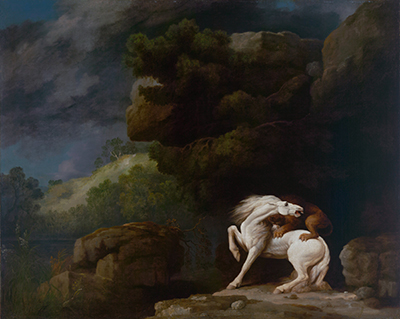
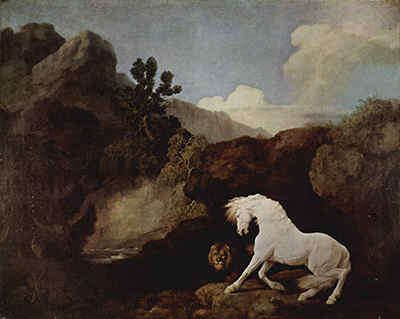
George Stubbs’s Horse Frightened by a Lion at the Walker Art Gallery is a signed painting of 1770. A white horse recoils beside a lion in a rocky landscape. This is the Liverpool canvas, WAG 2387, rather than the earlier painting of the same title at Tate. [1] [2]
The encounter occupies surprisingly little of the picture. Above the animals, cliffs, a tree and open sky establish a much larger world. The horse catches the light while the lion’s body almost disappears into shadow. Before any contact occurs, the unequal visibility of the two bodies has already made the meeting dramatic. [3]
At a Glance
This work across George Stubbs’s career
Whistlejacket
about 1762 [8]Contents
- The Walker painting and its date
- Reading the horse’s recoil
- The lion and the interval between them
- A landscape of openings and barriers
- Observation, recollection and an antique subject
- The earlier Tate version
- Paintings and prints with similar titles
- The sublime and the problem of sympathy
- Collection history and changing interpretations
- Videos on George Stubbs
The Walker painting and its date
The Walker records oil paint on canvas, a support measuring 100.1 × 126.1 cm, and a signature and date at the lower right: Geo: Stubbs / pinxit 1770. The gallery purchased the work in 1910. Its date therefore belongs to this particular canvas, not simply to the beginning of Stubbs’s interest in the subject. [1]
It is useful to place the painting within the broader lion and horse series while keeping the individual encounter in view. Here the horse remains upright and the lion has not mounted its back. There is no bite, attached claw or collapsed body. The action is concentrated in the space between the animals, which makes the possibility of an attack more prominent than any completed event. [3]
The nearly rectangular field is wider than it is high, but the tall rocks resist a simple horizontal reading. The horse lies below the midpoint of the canvas, towards the right edge. The highest cliff rises at the opposite side. These displaced weights keep the animal from becoming an isolated emblem at the centre; it is a conspicuous inhabitant of a setting that greatly exceeds it. [3]
Reading the horse’s recoil
The horse’s head bends towards the left, bringing its muzzle down towards the lion’s level. Its neck forms a sweeping curve, with a thick pale mane spreading across and beyond it. The head is not presented in a flat, detached profile. Turning towards the spectator as well as towards the other animal, it allows the eye, muzzle and curve of the forehead to register together. The body remains more nearly side-on, so the change of direction is visible within a single figure. [3]
Below that curved neck, the forelegs make an angular opening. One reaches diagonally down and left; the other is drawn back beneath the chest. The hindquarters are lowered and the hind legs bend sharply. The forms do not align as a regular sequence of parallel supports. Their differing directions make the pose difficult to resolve into a stable stance, even though the figure remains sharply outlined and legible against the darkness. [3]
The pale tail sweeps beneath and across the rear of the body instead of extending freely into the landscape. Its soft, spreading shape differs from the firm outline of the legs. The mane produces another irregular edge around the head. Together these two expanses of hair interrupt the horse’s otherwise compact silhouette. The loose edges of the hair keep the body’s sharply defined contours from appearing wholly still. [3]
Stubbs gives considerable variation to the white coat. Cool greys pass under the belly and neck, while smaller shadows articulate the shoulder and hindquarters. The brightest passages occur high on the body and in the hair. This is not an unbroken white shape laid over a dark background. Differences within the light area make the torso look rounded, and allow its divisions to remain readable even at a distance. [3]
Fear is made visible through these relations of head, legs, body and hair. The painting does not require the spectator to identify a precise riding movement before understanding the interruption to the horse’s balance. Nor does the white coat by itself explain the encounter. The image’s immediate force comes from how the pale body is placed and articulated: exposed to view, drawn back, and turned towards something much less clearly seen. [3]
The lion and the interval between them
At first the lion can seem little more than a face emerging beside the horse’s forelegs. The brown mane separates its head from the surrounding darks; the eyes and muzzle provide small points of definition. Its body extends leftwards, but does not acquire the same clear perimeter as the horse. The painting distributes descriptive attention unevenly, allowing the horse to announce the confrontation before the lion becomes fully apparent. [3]
The two heads are close without meeting. The horse’s long, pale neck leads down towards this small interval, while the lion’s face is placed low against the rock. The difference in elevation matters: the horse’s body can be seen all at once, but the lion seems to occupy the recess at ground level. The threat comes from a compact presence at the edge of visibility, not from a large animal towering above its intended prey. [3]
The lion’s gaze is also less simply sideways than its relation to the horse might suggest. Its face is turned out towards the viewer. We consequently see both animals without occupying either animal’s exact position. This arrangement makes the confrontation accessible to a spectator standing before the painting, while preserving the bodies’ separation within the landscape. It is a constructed pictorial encounter, with several directions of looking operating at once. [3]
A landscape of openings and barriers
National Museums Liverpool identifies the landscape’s source as Creswell Crags in Nottinghamshire. [1]
The rock formations, however, do much more than locate the scene. At the left, a steep mass rises in successive broken surfaces, with dark hollows below. Across the middle, a lower ledge runs towards the right before opening into another shadowed recess. The horse is set against this second dark area. It is framed by the landscape’s interruptions rather than placed against a continuous screen of foliage. [3]
A passage of water appears through the opening at the lower left. Its pale horizontal traces contrast with the rocks’ steeper edges. It gives a glimpse of depth, but it does not become a broad, welcoming foreground. The viewer encounters the dark cliff before reaching that opening. The small stream therefore expands the landscape while remaining partly withheld, a secondary route for the eye alongside the more immediate passage towards the animals. [3]
Near the middle, a tree rises against the sky and a long trailing growth descends over the rock below it. These forms divide the view without making a solid wall. Gaps remain between foliage, stone and distant ridge. The tree’s upright direction also interrupts the sloping rock, so that the left half contains several kinds of movement before the eye reaches the horse. No precise botanical identification is needed to see their compositional work. [3]
The upper sky is unexpectedly spacious. Blue extends behind large pale clouds, and a distant ridge is visible below. The picture does not envelop every part of the scene in an equivalent darkness. Instead, open air above coexists with the much denser recess around the animals. This makes their low position more striking: there is plenty of sky in the painting, yet very little of it directly surrounds the horse. [3]
The foreground offers another contrast. Warm brown rock and earth beneath the horse pick up some of the lion’s colour, linking the dark animal to the ground. The white figure remains apart from this range. Yet its hooves and bent legs meet the same uneven surface, making it physically involved in the setting. Light separates the horse for attention without removing the ground on which the encounter takes place. [3]
Observation, recollection and an antique subject
The Walker’s account, also published through its Google Arts & Culture partnership, attributes a story to Ozias Humphry: Stubbs borrowed a royal horse and startled it by pushing a brush towards it. This is a retrospective recollection about obtaining a pose, rather than a contemporary record of a lion confronting that horse. [1] [3]
The Walker calls the story that Stubbs witnessed a lion kill a horse in North Africa apocryphal. It supplies no secure eyewitness origin for this painting. [1]
Another proposed source is the ancient Lion Attacking a Horse associated with the Capitoline collections in Rome. That sculpture has a complicated material history. Getty’s account explains that the group survived as a fragment and that its missing parts were supplied in a restoration of 1594. Engravings and replicas helped transmit it to later artists. The classical model was therefore available through more than one object or image, and in a form already shaped by intervention. [17] [18]
The distinction between an attacking group and the Walker scene is fundamental. Here the lion is not attached to the horse. The horse has room to turn, and its back remains uninterrupted by another body. Even if a sculptural struggle helped suggest the broader theme, this canvas asks what an encounter could look like before the two animals are joined. Its separation of the figures is an imaginative transformation of the subject, not a literal repetition of a sculptural group. [18] [3]
The earlier Tate version
Tate’s Horse Frightened by a Lion, T06869, is a separate oil on canvas, catalogued as possibly exhibited in 1763. Its record gives unconfirmed dimensions of 70.5 × 101.9 cm and an acquisition in 1994. Tate associates it, with qualification, with the companion pictures shown at the Society of Artists in 1763. Those exhibition and acquisition details do not describe the Walker painting dated seven years later. [2]
Seen side by side, the differences are immediate. Tate’s horse is golden brown with a pale mane and tail. It occupies much more of the right half, while the lion is more completely visible at the left. The horse’s head projects into a lighter opening beside the rocks. The Walker’s white horse is smaller within a taller landscape and has darkness behind its head. Changing the coat colour is only one part of the revision: scale, surrounding space and visibility have changed with it. [2] [3]
In Tate’s composition, the long diagonal foreleg points towards the low lion across a conspicuous strip of ground. In Liverpool, the lion’s face sits closer to the pale horse’s angular forelegs, and the larger rocks take up more of the field above. The earlier canvas allows the animal group to spread; the Walker compresses it beneath an enlarged setting. These alternatives show why a shared title cannot stand in for the appearance of a particular version. [2] [3]
Tate’s proposed companion is Horse Devoured by a Lion. Its pairing belongs to the earlier exhibition history. The Walker canvas can be understood within the same recurring subject without assuming that every frightened-horse picture originally had its own matching pendant. Repetition across years and formats gave Stubbs several ways to reconsider a moment of alarm. [2]
Paintings and prints with similar titles
The printed versions require equally careful identification. Cleveland’s A Horse Frightened by a Lion, accession 1985.38, is an etching and engraving of 1777, catalogued as state I or II of III. It is a print by George Stubbs, rather than a later date for the Liverpool oil. [19]
In that impression the horse occupies the left, with the lion at the right. A substantial plant rises between them, and tall rock closes the right side. The arrangement resembles the earlier Tate design in reverse more closely than it repeats the Walker’s expansive upper sky and small low group. The horse is modelled with many short marks while the rocks and clouds gather dense, crossing lines. The print offers a materially different account of light: pale paper and dark marks perform work that colour performs in the paintings. [19]
The 1777 impression’s lettering identifies Stubbs as both painter and engraver, then gives a London publication date of 25 September 1777 in his own name. Artist, printmaker and publisher are brought together on the sheet itself. This helps explain the importance of reading the margin as well as the scene: a similar horse and lion can circulate through quite different arrangements of authorship. Cleveland’s cautious identification as either the first or second state also leaves a narrower question open. Its record does not choose between those two states, even though the plate and the year are established. [19]
George Townley Stubbs also made The Horse and Lion after George Stubbs. A documented impression offered at Dominic Winter in 2025 is catalogued as a mezzotint published by John Wesson on 20 September 1770. Its title and lettering had been trimmed away, preventing a secure state identification for that sheet. The shared year does not establish that the print reproduces the Walker canvas. [20]
A further plate, A Horse Affrighted at a Lion, was published on 1 May 1788. The Metropolitan Museum’s impression, 1970.603.1, is an etching with roulette work, third state of three, on a sheet measuring 25.1 × 30.5 cm. This is another distinct printed object, with its own date, process and state history. [21]
Here the large pale horse fills the left side and the lion occupies the lower right. The pair are brought much closer to the edges than in the Walker painting. The turned head, folded hindquarters and streaming mane invite comparison with Liverpool’s white horse, but their direction is reversed and the immense landscape has contracted to rock, dark space and a small patch of vegetation. The resulting encounter feels more compressed because the group now occupies almost the entire image field. [21] [3]
These changes are easier to follow by comparing whole images before comparing titles. Reversed direction, an enlarged body or a reduced landscape can all alter the scene’s emphasis. A print’s date also belongs to its publication history; it does not automatically date the painting that supplied an idea. The wider survey of Stubbs’s prints follows the relationships between artists, plates, publishers and impressions. [19] [21] [3]
The sublime and the problem of sympathy
The contemporary language of the sublime helps explain why such a subject could carry ambitions beyond animal portraiture. In his Philosophical Enquiry, Edmund Burke distinguished the ordinary usefulness of the horse from its capacity to appear terrible and powerful. More generally, he connected the sublime with fear, danger and an arresting force that could precede deliberate reasoning. This was a theory of human response, not a description of an animal’s inner experience. [22]
Applied to this picture, the distinction directs attention to the absence of service. The horse carries no rider, pulls no vehicle and performs no visible task. Its body is displayed in a moment that interrupts purposeful movement. The spectator can admire its strength while also seeing its exposure beside the lion. The picture’s beauty and its disturbing subject occupy the same field, making a comfortable, solely decorative response difficult to sustain. [22] [3]
Aris Sarafianos’s study of Stubbs, Walpole and Burke argues that anatomical knowledge and powerful emotional effects work together in these pictures. He also discusses Stephen Daniels’s alternative emphasis on trained equestrian poses and a landscape shaped by eighteenth-century taste. The disagreement is useful: a scene that looks like remote wilderness may also bear the traces of human training and pictorial staging. These are interpretations of the painting’s construction and reception, rather than proof of a single message intended by Stubbs. [17]
Horace Walpole’s poem about a startled horse supplies an important earlier response. Sarafianos connects it to the 1763 picture and discusses how the poet imagined his own physical feelings answering the painted animal’s distress. It should not be presented as a review of the Walker canvas of 1770. It shows instead that the earlier subject had already encouraged spectators to describe a forceful exchange between looking and feeling. [17]
Collection history and changing interpretations
The painting has subsequently been seen in several different contexts. National Museums Liverpool’s annual report for 2005–06 records its loan to Stubbs and the Horse, shown at the National Gallery in London and at two American venues. That exhibition title foregrounded the horse as a subject extending across his work. [23]
In 2016 it appeared in Stubbs and the Wild at the Holburne Museum in Bath. Caroline Cannon-Brookes’s review identifies the Walker canvas within an exhibition of wild-animal paintings and prints. That setting placed the encounter beside other forms of animal observation and invention. The same image could lead viewers towards Stubbs’s horses or towards his work with less familiar species, depending on the works surrounding it. [24]
A different afterlife appears in Jane O’Sullivan’s 2013 account of her own painting and writing experiment. She selected the Walker composition, removed the lion and brought its white horse into relation with the harnessed horses of Constable’s The Hay Wain. Her intervention challenged the use of animals as vehicles for human stories and questioned human control over them. This is an explicitly modern response, not a recovered eighteenth-century explanation of the original. [25]
O’Sullivan’s example demonstrates how much a change of counterpart can alter the image’s story. Where the horse turns towards a predator in Stubbs, her adaptation makes labour and harnessing the threatening prospect. It does not settle the Walker painting’s meaning; it reveals the continuing usefulness of its conspicuous turned body for new acts of interpretation. A familiar pose remains recognisable even when the surrounding narrative is replaced. [25]
The Courtauld makes another, more restrained comparison in its account of Sawrey Gilpin’s Study of frightened horses. It relates Gilpin’s dramatic animals to the Walker painting through their shared engagement with the sublime. This is a comparison of artistic concerns, not evidence that the drawing copies Stubbs. It places the Liverpool canvas among several attempts to make horses carry a picture’s fear and danger through their posture. [26]
Returning to the Walker image after these different readings, the arrangement retains its particular clarity. The broad sky, broken rocks, narrow glimpse of water and small animal group all remain necessary to the view. Removing any one of them would change the balance between exposure and enclosure. The white horse is the brightest point, but its surroundings determine how that brightness is encountered. The painting’s lasting interest lies in the relation between an acutely legible body and a landscape that gives much less away. [3]
Videos on George Stubbs
Explore Stubbs’s equestrian painting in its wider context, including two readings of Whistlejacket.
A Horse Lover’s Guide to the YCBA
A museum tour that places Stubbs alongside other artists who painted horses. It includes a look at Pumpkin with a Stable-lad.
Watch on YouTubeGeorge Stubbs artworks directory
Search works and related prints documented in this guide. Separate versions and printing matrices have separate entries; printmakers are named where known. Unidentified historical titles and untraced studio-sale material are discussed in the essays. A dash means that a date is not established here.
| Name | Date | Medium |
|---|---|---|
| A Bay Horse with a Groom | 1791 | Painting |
| A Bay Hunter with Two Playful Spaniels | 1777 | Painting |
| A Bay Hunter, a Springer Spaniel and a Sussex Spaniel in a wooded river Landscape | 1782 | Painting |
| A Cheetah and a Stag with Two Indian Attendants | about 1764 | Painting |
| A Couple of Fox Hounds (coloured print after Stubbs) | — | Print after Stubbs |
| A Couple of Foxhounds | 1792 | Painting |
| A Foxhound on the Scent | 1788 | Drawing |
| A Gentleman driving a Lady in a Phaeton | 1787 | Painting |
| A Grey Horse | 1793 | Painting |
| A Grey Horse (cantering companion) | 1793 | Painting |
| A Grey Stallion in a Landscape | — | Painting |
| A Horse Affrighted at a Lion | 1 May 1788 | |
| A Horse Belonging to the Rt. Honourable Lord Grosvenor called Bandy from his Crooked Leg | about 1763 | Painting |
| A Horse Frightened by a Lion | 1777 | |
| A Lion (A Lion Resting on a Rock) | 1 May 1788 | |
| A Lion Attacking a Horse | 1770 | Painting |
| A Lion Attacking a Horse (monumental Yale canvas) | 1762 | Painting |
| A lion attacking a horse (NGV) | about 1765 | Painting |
| A Lion Devouring a Horse (1788 print) | 1788 | |
| A lion devouring a horse (attribution disputed) | Proposed mid-1770s | Painting |
| A mare and foal with a bay horse | 1771 | Painting |
| A Monkey | 1799 | Painting |
| A Prancing Horse, Facing Right | c. 1790 | Drawing |
| A Rough Dog | 1790 | Painting |
| A Saddled Bay Hunter | 1786 | Painting |
| A Sleeping Leopard | 1 January 1791 | |
| A Tiger and a Sleeping Leopard | 1 May 1788 | |
| A Tigress (John Dixon after Stubbs) | 1772 | Print after Stubbs |
| A Tyger (A Recumbent Leopard by a Tree) | 1 May 1788 | |
| A Tyger (Sleeping Leopard) | 1 May 1788 | |
| An animal found on the coast of New Holland called kanguroo (after Stubbs) | 1773 | Print after Stubbs |
| An animal of a new species found on the coast of New South Wales (after Stubbs) | July 1773 | Print after Stubbs |
| Antinous and Jockey | — | Painting |
| Antinoüs, a chestnut racehorse, in a landscape | Undated | Painting |
| Bandy belonging to Lord Grosvenor (print after Stubbs) | — | Print after Stubbs |
| Baronet (George Townley Stubbs after Stubbs) | 20 February 1794 | Print after Stubbs |
| Baronet with Sam Chifney Up | 1791 | Painting |
| Baronet with Samuel Chifney up (Royal Collection) | 1791 | Painting |
| Bay Hunter by a Lake | 1787 | Painting |
| Brood Mares (Benjamin Green after Stubbs) | Issue 14 November 1776 | Print after Stubbs |
| Brood Mares and Foals | usually dated 1767 | Painting |
| Brown and White Norfolk or Water Spaniel | 1778 | Painting |
| Bulls Fighting | 1786 | Painting |
| Captain Samuel Sharpe Pocklington with His Wife, Pleasance, and possibly His Sister, Frances | 1769 | Painting |
| Death of the Doe (attribution disputed) | 1804 | |
| Der Englische Hühnerhund (Johann Wölfle after Stubbs) | about 1860 | Print after Stubbs |
| Dog (A Foxhound Viewed from Behind) | 1 May 1788 | |
| Dog [A Foxhound on the Scent] | 1788 | |
| Drill and albino baboon | before 1789 | Painting |
| Eclipse (Charles Hunt after Stubbs) | 12 November 1839 | Print after Stubbs |
| Eclipse (George Townley Stubbs after Stubbs) | 1796 | Print after Stubbs |
| Eclipse (oil study) | — | Painting |
| Eclipse (Thomas Burke after Stubbs) | First published 1772 | Print after Stubbs |
| Eclipse and John Wildman (Benjamin Green after Stubbs) | 1772 | Print after Stubbs |
| Eclipse at Newmarket (Jockey Club version) | Proposed early 1790s; often dated 1770 | Painting |
| Eclipse at Newmarket with a groom and jockey | 1770 | Painting |
| Eclipse with Mr Wildman and His Sons | 1769–71 | Painting |
| Eclipse, the Property of Capt.n O Kelly (anonymous print after Stubbs) | Imprint 4 June 1804; impression undated | Print after Stubbs |
| Euston | 1774 | Painting |
| Finished Study for the Seventh Anatomical Table of the Muscles of the Horse | 1756–58 | Drawing |
| Five Brood Mares at the Duke of Cumberland's Stud Farm in Windsor Great Park | 1765 | Painting |
| Fowl Body, Lateral View (Highly Finished Study for an Unpublished Table; Shows the Last Stage in Dissection) | — | Drawing |
| Fowl Body, Lateral View (Probably Prepared for Transfer to the Plate for Engraving of Table XV) | — | Drawing |
| Fowl Skeleton, Lateral View (Finished Study for Table V) | — | Drawing |
| Freeman, the Earl of Clarendon's Gamekeeper, with a Dying Doe and Hound (Yale) | 1800 | Painting |
| George Stubbs (enamel self-portrait) | 1781 | Enamel |
| Gimcrack (George Townley Stubbs after Stubbs) | 1775 | Print after Stubbs |
| Gimcrack on Newmarket Heath, with a trainer, a jockey and a stable lad | about 1765 | Painting |
| Gimcrack, with John Pratt up, on Newmarket Heath | about 1765 | Painting |
| Hambletonian, Rubbing Down | 1800 | Painting |
| Hay-Makers | 1791 | |
| Haycarting | 1795 | Enamel |
| Haymakers | 1785 | Painting |
| Haymakers (Lady Lever Art Gallery) | 1794 | Enamel |
| Hollyhock (with later additions by Vernet and Boucher) | about 1765–70 | Painting |
| Horse Attacked by a Lion (Episode C) | 1768–69 | Painting |
| Horse Attacked by a Lion (Tate enamel) | 1769 | Enamel |
| Horse Devoured by a Lion | Possibly exhibited 1763 | Painting |
| Horse Frightened by a Lion | 1770 | Painting |
| Horse Frightened by a Lion (Episode A; Wedgwood and Bentley after Stubbs) | — | Sculpture |
| Horse Frightened by a Lion (Tate) | Possibly exhibited 1763 | Painting |
| Horse Frightened by a Lion (Yale) | 1762–68 | Painting |
| Horse in the Shade of a Wood | 1780 | Painting |
| Hound Coursing a Stag | about 1762 | Painting |
| Human Figure, Anterior View (Intended for a Plate That was Never Published) | — | Drawing |
| Human Skeleton, Lateral View | 1795–1806 | Drawing |
| Hunt servants setting out (Southill commission) | 1767 | Painting |
| Hühnerhund (The Spanish Pointer) | about 1766 | Painting |
| John and Sophia Musters Riding at Colwick Hall | 1777 | Painting |
| John Musters on his hunter Pilgrim | 1777–78 | Painting |
| Labourers | 1789 | |
| Labourers (Richard Earlom after Stubbs and Amos Greene) | 25 March 1790 | Print after Stubbs |
| Laetitia, Lady Lade (d.1825) | 1793 | Painting |
| Lemon and White Water Spaniel | — | Painting |
| Lion Attacking a Stag | — | Painting |
| Lord Grosvenor's Arabian Stallion with a Groom | about 1765 | Painting |
| Lord Grosvenor's Arabian Stallion with a Groom (Peter Mazell after Stubbs) | 1771 | Print after Stubbs |
| Mambrino (Eaton Hall painting) | — | Painting |
| Mambrino (George Townley Stubbs after Stubbs) | 1794 | Print after Stubbs |
| Mares and Foals belonging to the 2nd Viscount Bolingbroke | about 1761–62 | Painting |
| Mares and foals beneath large oak trees | — | Painting |
| Mares and Foals by a stream | Exhibited 1764 | Painting |
| Mares and Foals in a River Landscape | about 1763–68 | Painting |
| Mares and Foals in an Extensive Landscape | about 1769 | Painting |
| Mares and Foals without a Background | 1762 | Painting |
| Moose Deer (after Stubbs) (Arctic Zoology plate VIII) | 1784–85 publication | Print after Stubbs |
| Newmarket Heath with a Rubbing-Down House | — | Painting |
| Otho (1796 print after Stubbs) | 1 December 1796 | Print after Stubbs |
| Otho, with John Larkin up | 1768 | Painting |
| Pangloss | about 1762 | Painting |
| Patch (Grafton commission) | 1759 | Painting |
| Phaeton and the Chariot of the Sun (enamel) | 1775 | Enamel |
| Phaeton with a Pair of Cream Ponies and a Stable-Lad | 1780–84 | Painting |
| Phillis | 1772 | Painting |
| Portrait of a Large Dog (Dingo) | 1772 | Painting |
| Pumpkin with a Stable-lad | 1774 | Painting |
| Racehorses Exercising at Goodwood | 1759–60 | Painting |
| Reapers (1791 print) | 1791 | |
| Reapers (Tate) | 1785 | Painting |
| Reapers (Yale) | 1795 | Enamel |
| Red Deer: A Stag and a Hind | 1792 | Painting |
| Richard Wedgwood | — | Enamel |
| Ringwood, a Brocklesby Foxhound | 1792 | Painting |
| Scrub, a bay horse belonging to the Marquess of Rockingham | about 1762 | Painting |
| Self Portrait on a White Hunter | 1782 | Enamel |
| Self-Portrait | about 1759 | Painting |
| Shooting (1770 Woollett plate after Stubbs) | 1770 | Print after Stubbs |
| Shooting (1771 Woollett plate after Stubbs) | 1771 | Print after Stubbs |
| Shooting at Goodwood | 1759–60 | Painting |
| Sir John Nelthorpe as a boy | 1756 | Painting |
| Sir John Nelthorpe partridge shooting with one pointer | — | Painting |
| Sir John Nelthorpe, 6th Baronet, out Shooting with His Dogs in Barton Field, Lincolnshire | 1776 | Painting |
| Sleeping Leopard | 1777 | Enamel |
| Soldiers of the 10th Light Dragoons | 1793 | Painting |
| Stallion and Mare (George Townley Stubbs after Stubbs) | 1776; reissued 1789 | Print after Stubbs |
| Steward and gamekeeper with dogs (Southill commission) | 1767 | Painting |
| Studies of a Lemur (Lemur murinus) in six different attitudes | 1773 | Drawing |
| Study for the Self-portrait in Enamel | c. 1781 | Drawing |
| Study of a Lemur | 1773 | Drawing |
| Study of a Racehorse in Action: Galloping to Left, a Semi-Anatomical Study, with Skin Flayed to Show Action of Muscles | — | Drawing |
| Study of the Legs of a Draught-Horse Pulling a Harrow (attributed to Stubbs) | Proposed about 1786 | Drawing |
| Sweet William (Grosvenor panel) | — | Painting |
| Sweet William (Turf Gallery canvas) | — | Painting |
| The Black Stallion Sampson, Portrayed from Three Angles (with landscape additions) | about 1764 | Painting |
| The Charlton Hunt | 1759–60 | Painting |
| The Fall of Phaeton | — | Sculpture |
| The Frightened Horse | 1780 | Sculpture |
| The Grosvenor Hunt | — | Painting |
| The Haymakers (Upton House) | 1783 | Painting |
| The Horse and Lion (George Townley Stubbs after George Stubbs) | 1770 | Print after Stubbs |
| The Kongouro from New Holland | 1772 | Painting |
| The Labourers | 1779 | Painting |
| The Labourers (Southill original) | 1767 | Painting |
| The lion and horse (Benjamin Green after Stubbs) | 1769; reissued 1777 | Print after Stubbs |
| The Milbanke and Melbourne Families | about 1769 | Painting |
| The Moose | 1770 | Painting |
| The Prince of Wales's Phaeton | 1793 | Painting |
| The Reapers (Upton House) | 1783 | Painting |
| The Sebra, or Wild Ass (George Townley Stubbs after Stubbs) | 1771 | Print after Stubbs |
| The Spanish Pointer (Bradford version) | about 1766–68 | Painting |
| The Spanish Pointer (William Woollett after Stubbs) | January 1768 | Print after Stubbs |
| The Third Duke of Dorset's Hunter with a Groom and a Dog | 1768 | Painting |
| Thomas Freeman, Lord Clarendon's gamekeeper, with a dog and a shot doe (with George Townly Stubbs) | 1803 | Painting |
| Turf, with Jockey up, at Newmarket | — | Painting |
| Turk and Crab | — | Painting |
| Two Bay Hunters Communing On The Bank Of A Lake | — | Painting |
| Tygers at Play | 1780 | |
| Viscount Gormanston's White Dog | 1781 | Painting |
| Viscount Gormanston's White Dog (canvas version) | — | Painting |
| Water Spaniel | 1769 | Painting |
| Wedgwood Family Portrait | 1780 | Painting |
| Whistlejacket | about 1762 | Painting |
| Whistlejacket with two other stallions and a groom | Recorded 1762 | Painting |
| White Poodle in a Punt | about 1780 | Painting |
| William Anderson with two Saddle-Horses | 1793 | Painting |
| Working Drawing for the Seventh Anatomical Table of the Muscles of the Horse | 1756–58 | Drawing |
| Zebra | 1763 | Painting |
Discussion
Look again at the images and ideas explored in Horse Frightened by a Lion. These editorial prompts invite your observations.
Reader Insights
Which part of the horse’s pose most conveys the encounter?
How does this Liverpool canvas differ from the other lion-and-horse objects discussed here?
Which detail best distinguishes this episode from a later moment in the lion-and-horse sequence?
Join the Conversation
Share a detail, comparison or question about Horse Frightened by a Lion below.
References
- National Museums Liverpool, Horse Frightened by a Lion, WAG 2387, collection record including embedded object metadata. Read online. Accessed 4 November 2026. View source.
- Tate, Horse Frightened by a Lion, T06869. Collection record, Diane Perkins’s March 2001 summary, February 2016 label and whole artwork image. Read online. Accessed 4 November 2026. View source.
- Walker Art Gallery, institution-supplied Horse Frightened by a Lion, Google Arts & Culture. Whole artwork image and accompanying collection text. Read online. Accessed 4 November 2026. View source.
- Goodwood, The Collection, Painting Collection modal, Racehorses Exercising at Goodwood; An exciting acquisition: a study by George Stubbs, 30 June 2023; History of the Estate Hounds, 4 October 2023; About Goodwood Racecourse. Accessed 4 November 2026. View source.
- Goodwood, The Collection, Painting Collection modal, Racehorses Exercising at Goodwood; An exciting acquisition: a study by George Stubbs, 30 June 2023; History of the Estate Hounds, 4 October 2023; About Goodwood Racecourse. Accessed 4 November 2026. View source.
- Goodwood, The Collection, Painting Collection modal, Racehorses Exercising at Goodwood; An exciting acquisition: a study by George Stubbs, 30 June 2023; History of the Estate Hounds, 4 October 2023; About Goodwood Racecourse. Accessed 4 November 2026. View source.
- Goodwood, The Collection, Painting Collection modal, Racehorses Exercising at Goodwood; An exciting acquisition: a study by George Stubbs, 30 June 2023; History of the Estate Hounds, 4 October 2023; About Goodwood Racecourse. Accessed 4 November 2026. View source.
- National Gallery, Whistlejacket, NG6569, current collection record, provenance, in-depth discussion and frame entry. View source.
- Yale Center for British Art, Zebra, B1981.25.617, current object metadata, gallery labels, Malcolm Warner’s 1998 catalogue entry and provenance supplied through the museum’s public collection record. View source.
- Christie’s, Gimcrack on Newmarket Heath, with a trainer, a jockey and a stable lad, London, 5 July 2011, lot 12; object details, essay, provenance, exhibitions and whole image. View source.
- Christie’s, Gimcrack on Newmarket Heath, with a trainer, a jockey and a stable lad, London, 5 July 2011, lot 12; object details, essay, provenance, exhibitions and whole image. View source.
- Yale University Art Gallery, A Lion Attacking a Horse, 1770, 1955.27.1, collection record. Accessed 4 November 2026. View source.
- National Museums Liverpool, Horse Frightened by a Lion, WAG 2387, collection record including embedded object metadata. Read online. Accessed 4 November 2026. View source.
- Royal Museums Greenwich, ‘The Kongouro from New Holland’ (Kangaroo), ZBA5754. Accessed 4 November 2026. View source.
- Tate, George Stubbs, Haymakers, 1785, T02256; details, Terry Riggs’s collection text (January 1998), and online caption. Collection record. View source.
- Frances Bailey, ‘Hambletonian, Rubbing Down: A masterpiece by George Stubbs’, National Trust Cultural Heritage Magazine, Autumn/Winter 2024, pp. 22–33. Article. View source.
- Aris Sarafianos, “Stubbs, Walpole and Burke: Convulsive Imitation and ‘Truth Extorted’”, Tate Papers, no. 13, Spring 2010. Daniels and Walpole discussed through this essay. Read online. Accessed 4 November 2026. View source.
- J. Paul Getty Museum, Getty Villa Displays Ancient Masterpiece on Loan from Capitoline Museums in Rome, 18 July 2012. Read online. Accessed 4 November 2026. View source.
- Cleveland Museum of Art, A Horse Frightened by a Lion, 1777, 1985.38. Collection record and whole print image. Read online. Accessed 4 November 2026. View source.
- Dominic Winter Auctioneers, The Horse & Lion, George Townley Stubbs after George Stubbs, lot 140, 29 January 2025. Read online. Accessed 4 November 2026. View source.
- Metropolitan Museum of Art, A Horse Affrighted at a Lion, 1 May 1788, 1970.603.1. Collection record and whole print image. Read online. Accessed 4 November 2026. View source.
- Edmund Burke, A Philosophical Enquiry into the Origin of Our Ideas of the Sublime and Beautiful, Part II, especially sections I–V; in The Works of the Right Honourable Edmund Burke, volume I, Project Gutenberg electronic edition. Read online. Accessed 4 November 2026. View source.
- National Museums and Galleries on Merseyside, Annual Report and Accounts 2005–2006, HC 75, published February 2007, loans section. Read online. Accessed 4 November 2026. View source.
- Caroline Cannon-Brookes, “Stubbs and the Wild”, British Society for Eighteenth-Century Studies, 12 August 2016. Read online. Accessed 4 November 2026. View source.
- Jane O’Sullivan, “Mixed media: Moving between painting and writing”, 2013, pp. 5–9. Read online. Accessed 4 November 2026. View source.
- Courtauld Gallery, Study of frightened horses, D.1952.RW.2712, collection record and label. Read online. Accessed 4 November 2026. View source.
- Basic title, date and material metadata for Tate’s Reapers (T02257) and Otho (T02375) is adapted from the Tate collection dataset, October 2014, released under CC0. TheHistoryOfArt.org has reconciled labels and versions. This credit does not apply to Tate’s authored catalogue commentary or images.
- Data Source: Yale Center for British Art. Basic object fields are adapted and reconciled for this directory. Reuse is subject to the Center’s Open Data and Data Services Terms of Use. No museum endorsement is implied. This metadata credit does not relabel scholarly essays or images as open data.
- Basic object metadata for A Horse Frightened by a Lion, 1985.38, The Cleveland Museum of Art, John L. Severance Fund, is available under CC0. Titles and design-level grouping have been reconciled for this directory.