


 by Tom Gurney
Tom Gurney BSc (Hons) is an art history expert with over 20 years experience
Published on June 19, 2020 / Updated on November 5, 2026
Email: tomgurney1@gmail.com / Phone: +44 7429 011000
Carlo Barberini’s Portrait Head
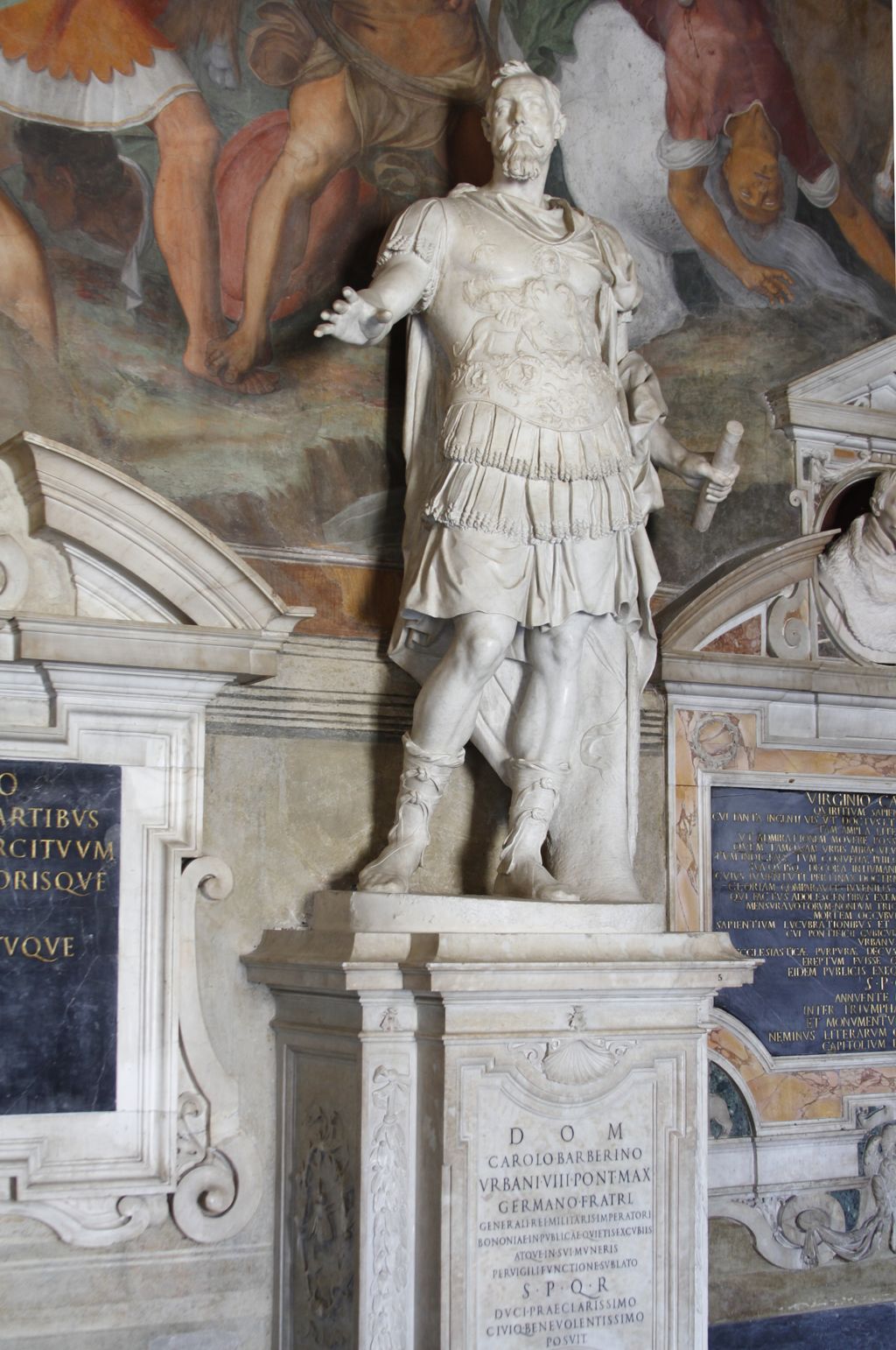
Carlo Barberini stands in Roman armour, but the face above it belongs to the seventeenth century. The turned head, swept hair, moustache and pointed beard give a personal identity to a body shaped by an older tradition of military command. Gian Lorenzo Bernini carved this portrait head for a commemorative statue completed in 1630. Alessandro Algardi restored the ancient torso for the same project. Understanding their different contributions makes the encounter between the individual man and the Roman hero much more interesting. [1] [2]
The complete marble statue belongs to the Capitoline Museums in Rome, where it is recorded as inventory MC1195, with a height of 230 centimetres. It is associated with the Hall of the Captains in the Palazzo dei Conservatori. Bernini’s head is therefore part of a standing public monument, rather than an independent portrait bust. Its meaning grows out of the figure below it and the company it keeps. [1]
At a Glance
The sculpture in Bernini’s career
Contents
A face above armour
Begin with the head, then allow your eye to travel downwards. In the museum’s photograph, Barberini turns towards the side of his outstretched arm. His face does not simply repeat the frontal presentation of the breastplate. This small divergence gives the figure a sense of attention extending beyond its immediate position. The body addresses the room through its broad outline; the head makes that address seem to come from a particular person. [1]
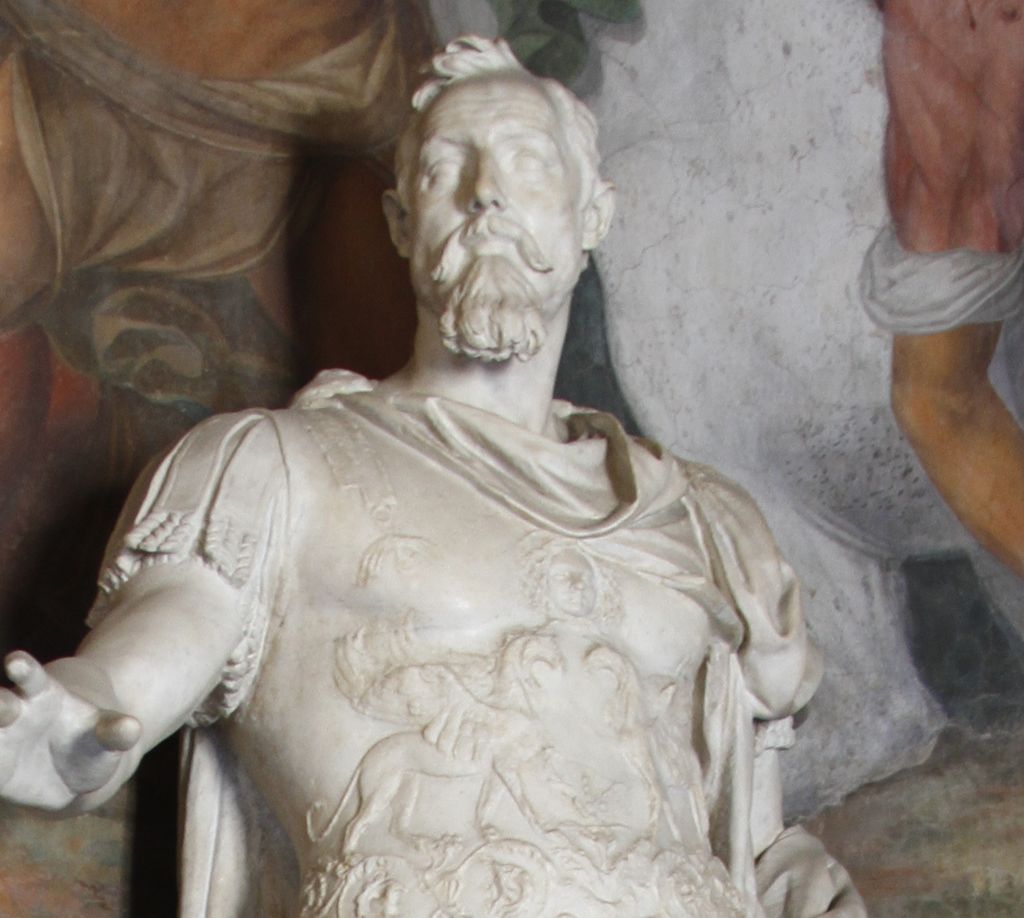
Hair and facial hair help establish that individuality. In his early study of the work, Stanislao Fraschetti drew attention to the waved hair, the lock above the forehead, the prominent nose, the curled moustache and the pointed beard. These are useful details to look for because they break up the large, relatively continuous surfaces of the face. The moustache interrupts the line of the mouth, while the beard carries the face down towards the neck without dissolving its outline into the chest. [3]
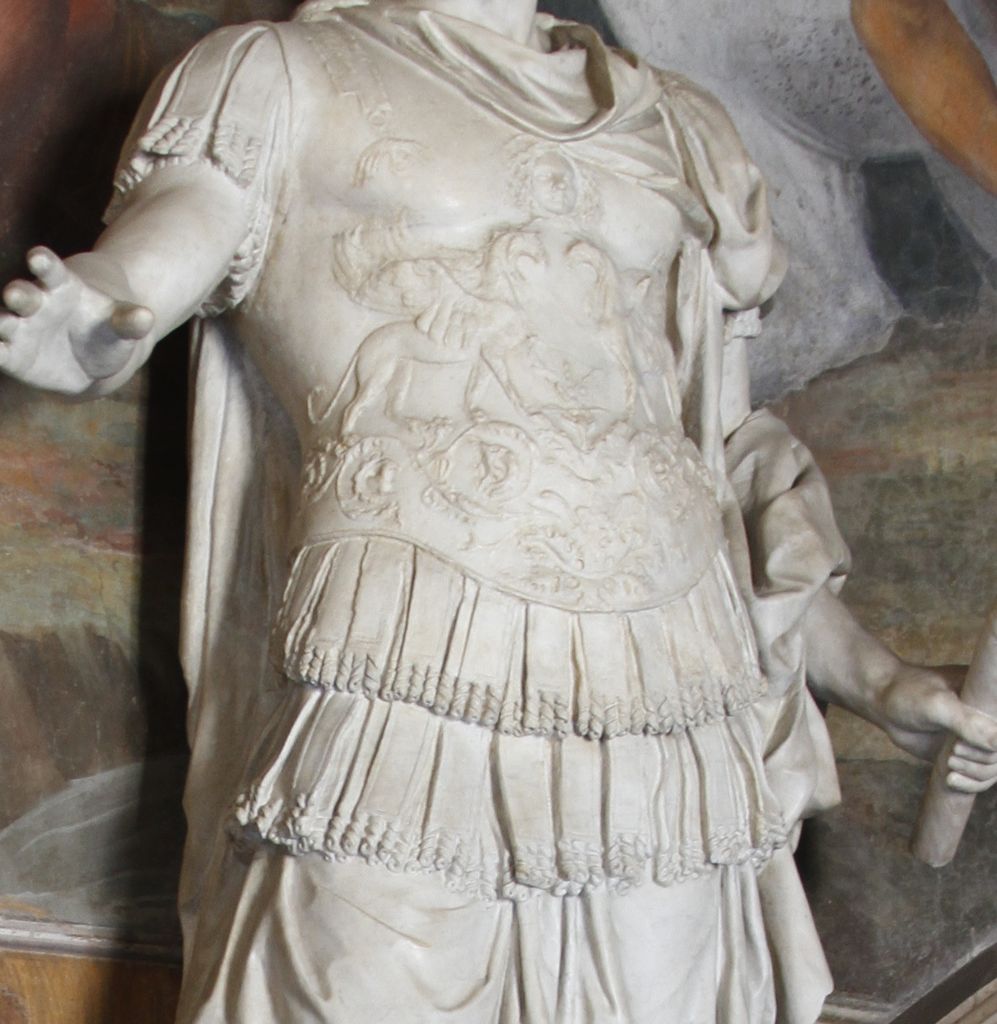
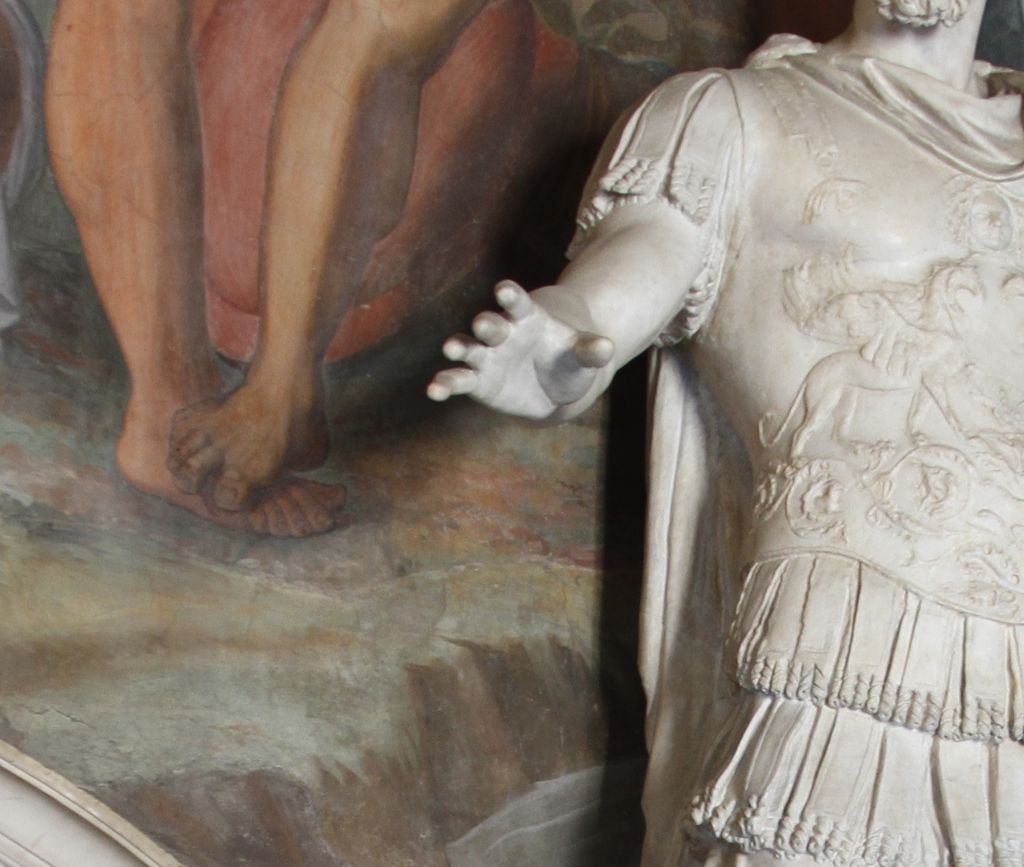
Below this concentrated portrait, the armour presents a different kind of richness. The breastplate is covered with ornament, and a layered fringe marks its lower edge. Drapery gathers across the shoulders and falls along one side. Bare knees, boots and the extended arm make the figure readable at a distance. Seen as a whole, the statue combines a strongly articulated silhouette with much smaller passages of carved decoration. The head has to hold its own within that busy setting. [1]
Fraschetti found the head disproportionately small in relation to the torso. He also disliked the contrast between the ancient body and the livelier modern face, even while admiring the portrait itself. His response identifies a tension that remains worth examining. A viewer can recognise the joined histories of the object without treating their difference as a failure. The slightly uneasy meeting of portrait and heroic body is part of what makes this particular memorial distinctive. [3]
Annotated Details from Carlo Barberini’s Memorial Statue
Look from the portrait head to the armoured torso and the extended restored limb, keeping the contributions of different makers distinct.
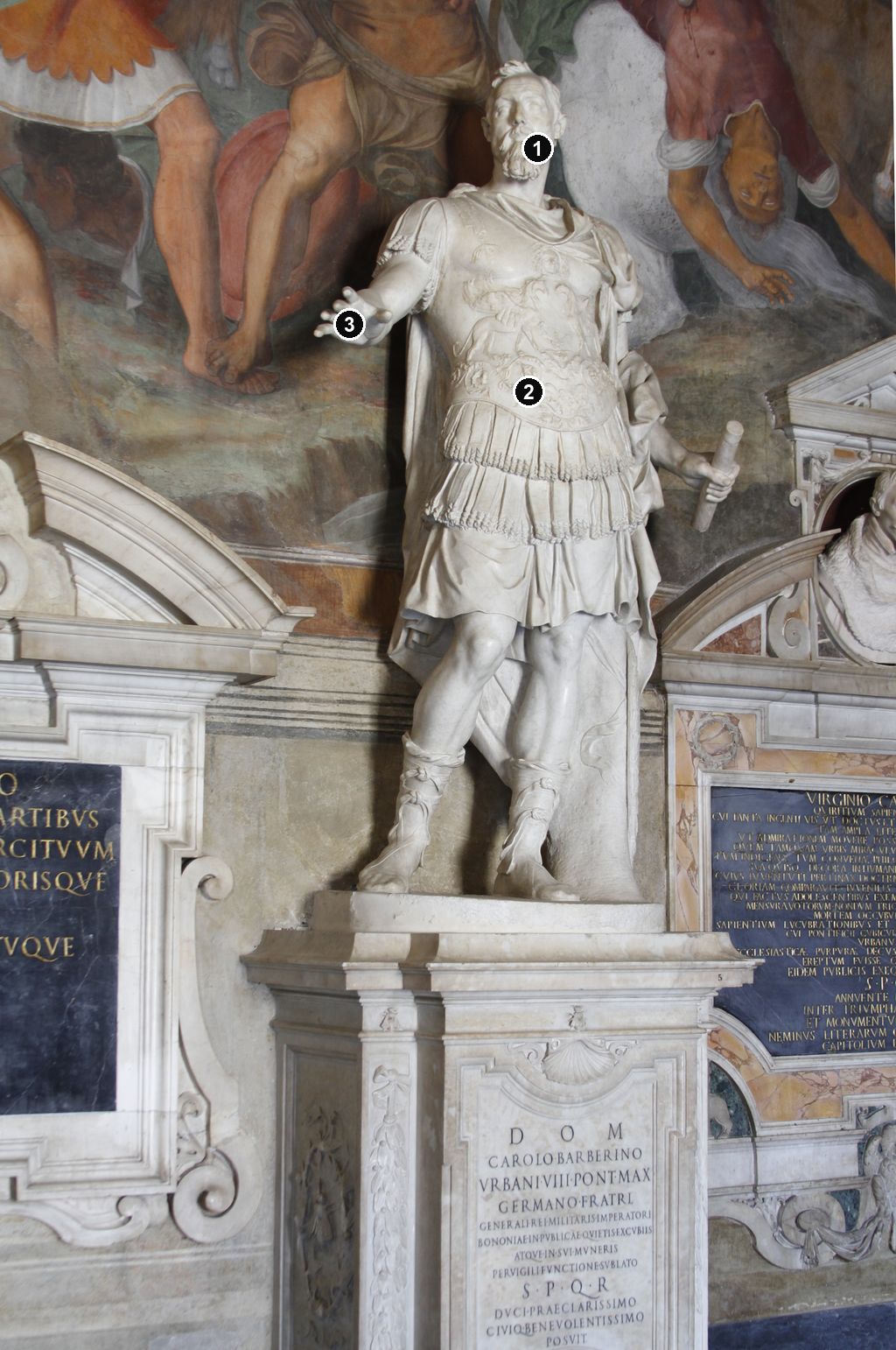
Details from CARLO BARBERINI’S MEMORIAL STATUE
Photograph by José Luiz, CC BY-SA 4.0. Overview annotated and details cropped and resized from the unchanged photograph.
The portrait above the armour
The turned head gives a particular man’s identity to the standing monument. Bernini’s portrait contribution should be distinguished from the body below. [2][3]
The decorated ancient torso
Ornament covers the breastplate, with a layered fringe below. The ancient torso supplies a different kind of presence from the seventeenth-century portrait head. [2]
An arm opening into the room
The extended arm opens the figure’s outline towards the visitor. Algardi’s contribution included restoration of the statue’s arms and legs. [4]
A commander remembered
Carlo was the brother of Pope Urban VIII and commander of the papal armies. He died in Bologna on 25 February 1630. As Irving Lavin explains, his commemoration involved three separate projects: the standing statue in the Palazzo dei Conservatori, a memorial plaque in Santa Maria in Aracoeli, and a temporary catafalque for the funeral ceremonies held in that church on 3 August. [2]
Lavin places these works within an existing civic tradition. Marcantonio Colonna, Alessandro Farnese and Gian Francesco Aldobrandini had already received comparable honours. The proposal for Carlo’s commemoration specifically invoked Aldobrandini’s example. The Roman military figure was consequently a familiar public language, allowing a recent commander to enter a lineage of honoured predecessors. [2]
The distinction between commemoration and burial matters here. The standing figure presents Barberini to a civic audience; the church plaque belongs to another setting and another sculptural form. Neither should be mistaken for a detached version of this head. Nor should the temporary funeral structure be treated as a surviving marble monument. The shared name connects these works, but each performed a different task. [2]
Between two workshops
The division of work is unusually tangible because published payment records describe both making and transport. Fraschetti transcribed an advance to Algardi dated 19 July 1630 for work on the statue intended for the Capitol. A further entry, dated 12 September, records the balance of a total of 160 scudi for restoring the torso. These documents support Algardi’s role as a substantial contributor to the monument, rather than someone who merely touched up a statue wholly carved by Bernini. [3]
Another entry pays a porter named Giovannino and fifteen companions for carrying the torso from Algardi’s premises to Bernini’s so that the head could be made. A later payment concerns sixteen porters taking the completed marble statue from Bernini’s premises to the Capitol on 27 September. Finally, an entry of 28 September records 150 scudi as the balance and full settlement for Bernini’s marble head. This last sum is a settlement payment; it should not automatically be read as the complete cost of his contribution. [3]
These are transcriptions published in 1900, rather than newly examined archival originals, but their practical detail is valuable. They distinguish the restored torso from the newly carved head and show the heavy object passing between workplaces. A finished monument can look like one act of creation. Here the account books allow us to imagine a more physical sequence: a torso prepared in one studio, moved by a team of men, completed in another, and finally installed in public. [3]
The pedestal had its own maker. Fraschetti also prints a payment to the stoneworker Battista Castelli for the marble base, with its work assessed by the named architects in the account. This further contribution matters because the pedestal establishes the statue’s elevation and carries its civic address. The monument’s authorship extends beyond the name attached to its most expressive feature. [3]
Algardi’s contribution
The sculptor Alessandro Algardi brought experience of restoring ancient sculpture to the project. Antonia Nava Cellini’s biography describes his early Roman work on classical statues in the Ludovisi collection, before identifying his additions of arms and legs to the ancient torso used for Carlo Barberini’s honorary figure. Bernini supplied the head. That distinction provides a clearer account than assigning the entire standing figure to either sculptor alone. [4]
Restoration here involved giving a fragment a new, usable identity. The ancient torso supplied the armoured centre; new extremities and a modern portrait completed a commemorative person. This was a creative reconstruction serving a seventeenth-century purpose. Looking at the finished figure, the viewer encounters an antique body made capable of honouring someone who had only recently died. [3] [4]
Fraschetti turned the transfer between studios into a story of professional injury, speculating that Algardi’s work had failed to please or that he was insufficiently valued. The payments establish the movement and the separate tasks, but they do not establish those motives. The collaboration is compelling enough without assuming that every practical decision concealed a personal confrontation. [3]
Fraschetti went further in his stylistic assessment, extending Bernini’s contribution to the fastening of the mantle high on the chest. That is a more particular judgement than the documented payment for the head. It is best understood as his reading of the carving, rather than as another instruction recovered from the accounts. For a visitor, it offers a reason to examine the transition between neck, shoulder and garment closely. [3]
Reading the whole figure
The complete statue rewards a slower movement between detail and distance. From afar, the extended arm opens the composition into the room, while the drapery falling on the opposite side gives weight to its vertical outline. Closer looking brings the ornaments of the breastplate into view. Higher up, the narrower head and its directional turn change the rhythm again. The face is a small part of the marble surface, yet it determines whose presence the whole figure announces. [1]
The portrait’s individuality does not erase the borrowed identity of the Roman commander. Instead, the two remain legible together. Barberini’s moustache and beard belong to the image of a modern man; armour and stance present him through a heroic type. The result invites a question that is easy to overlook when studying a head in isolation: how much of an official portrait belongs to its sitter, and how much belongs to the role that the monument asks him to occupy?
That question also explains why a photograph of the head alone can be both revealing and incomplete. It can bring the modelling of the face closer, but it removes the large armoured body against which Fraschetti judged its proportions. It also removes the outstretched gesture and the pedestal. To understand Bernini’s portrait here, the most useful comparison is between the concentrated expression of the head and the full memorial that gives it scale. [3]
In the Hall of the Captains
The museum places the statue in a room whose late sixteenth-century frescoes by Tommaso Laureti depict exemplary episodes of Roman courage. Portrait statues and inscriptions also commemorate distinguished men and commanders of the papal militia. The setting brings painted ancient examples and more recent public lives into the same field of view. [1]
Against the room’s coloured narrative painting, the pale standing figure has a particularly distinct presence. Its projecting arm belongs to the visitor’s space, while the fresco figures remain on the wall behind it. The head’s sideways attention becomes one element in a larger encounter between sculpture, painting and the people moving through the room. Seen there, Bernini’s contribution can be admired as a portrait without losing the ancient material, Algardi’s additions and the civic purpose that made the portrait necessary.
Artworks directory
Four sculptures documented in the sources for these pages. The Carlo Barberini monument combines an ancient body, Algardi’s restoration and Bernini’s portrait head. The Capitoline Urban VIII statue is credited to Bernini and assistants and is distinct from the Vatican tomb. This selection is not a complete catalogue.
| Name | Date | Medium |
|---|---|---|
| Carlo Barberini memorial (Bernini portrait head; Algardi restoration; ancient torso) | 1630 | Sculpture |
| Urban VIII honorary statue (Bernini and assistants) | 1635–40 | Sculpture |
| Cardinal Richelieu (Louvre marble) | 1640–41 | Sculpture |
| Ecstasy of Saint Teresa, Cornaro Chapel | 1647–52 | Sculpture |
Frequently Asked Questions
It belongs to the Capitoline Museums in Rome and is listed with the Hall of the Captains in the Palazzo dei Conservatori, inventory MC1195. [1]
The standing statue is a different work. Bernini also designed a memorial plaque and a temporary funeral catafalque associated with Carlo Barberini’s commemoration at Aracoeli. [2]
Discussion
Look at the relation between the turned portrait head and the armoured body, keeping the different contributions in view.
Does the contrast between the individual face and the ancient armoured body make the portrait more convincing, or more formal?
Reader Insights
How does the turned head affect the whole figure?
Where do the armour and drapery create different rhythms?
How does collaborative making change your reading of the statue?
Join the Conversation
Share a detail, comparison or question about Carlo Barberini’s Portrait Head below.
References
- Musei Capitolini, Statue of Carlo Barberini, MC1195. English collection record, object photograph and associated Hall of the Captains description. Date, material, height, inventory and room context. Consulted 28 October 2026. View source.Splash image: Carlo Barberini’s memorial: Bernini’s portrait head on an ancient torso restored by Algardi. The full statue is shown. Photograph: José Luiz, via Wikimedia Commons; resized · CC BY-SA 4.0
- Irving Lavin, “Bernini’s Memorial Plaque for Carlo Barberini”, in Visible Spirit: The Art of Gianlorenzo Bernini, vol. I (London: Pindar Press, 2007), pp. 469–479, especially pp. 469–470 and notes 1–5. English; revised reprint of the 1983 article in Journal of the Society of Architectural Historians 42, no. 1, pp. 6–10. Full revised chapter consulted 28 October 2026. View source.
- Stanislao Fraschetti, Il Bernini: la sua vita, la sua opera, il suo tempo (Milan: Ulrico Hoepli, 1900), pp. 96–98, especially p. 96, notes 1–5, and p. 97 with its photograph and pedestal-payment continuation. Italian; digitised volume provided by the Warburg Institute. Relevant text, published account transcriptions and illustration consulted 28 October 2026. View source.
- Antonia Nava Cellini, “Algardi, Alessandro”, Dizionario Biografico degli Italiani, vol. 2 (1960). Italian; paragraphs on early restoration work for Ludovisi and the 1630 Carlo Barberini statue. Consulted 28 October 2026. View source.
- Musei Capitolini, Statue of Pope Urban VIII, 1635–40, MC1201, Bernini and assistants. Accessed 28 October 2026. View source.


