


 by Tom Gurney
Tom Gurney BSc (Hons) is an art history expert with over 20 years experience
Published on June 19, 2020 / Updated on November 5, 2026
Email: tomgurney1@gmail.com / Phone: +44 7429 011000
Urban VIII Memorial
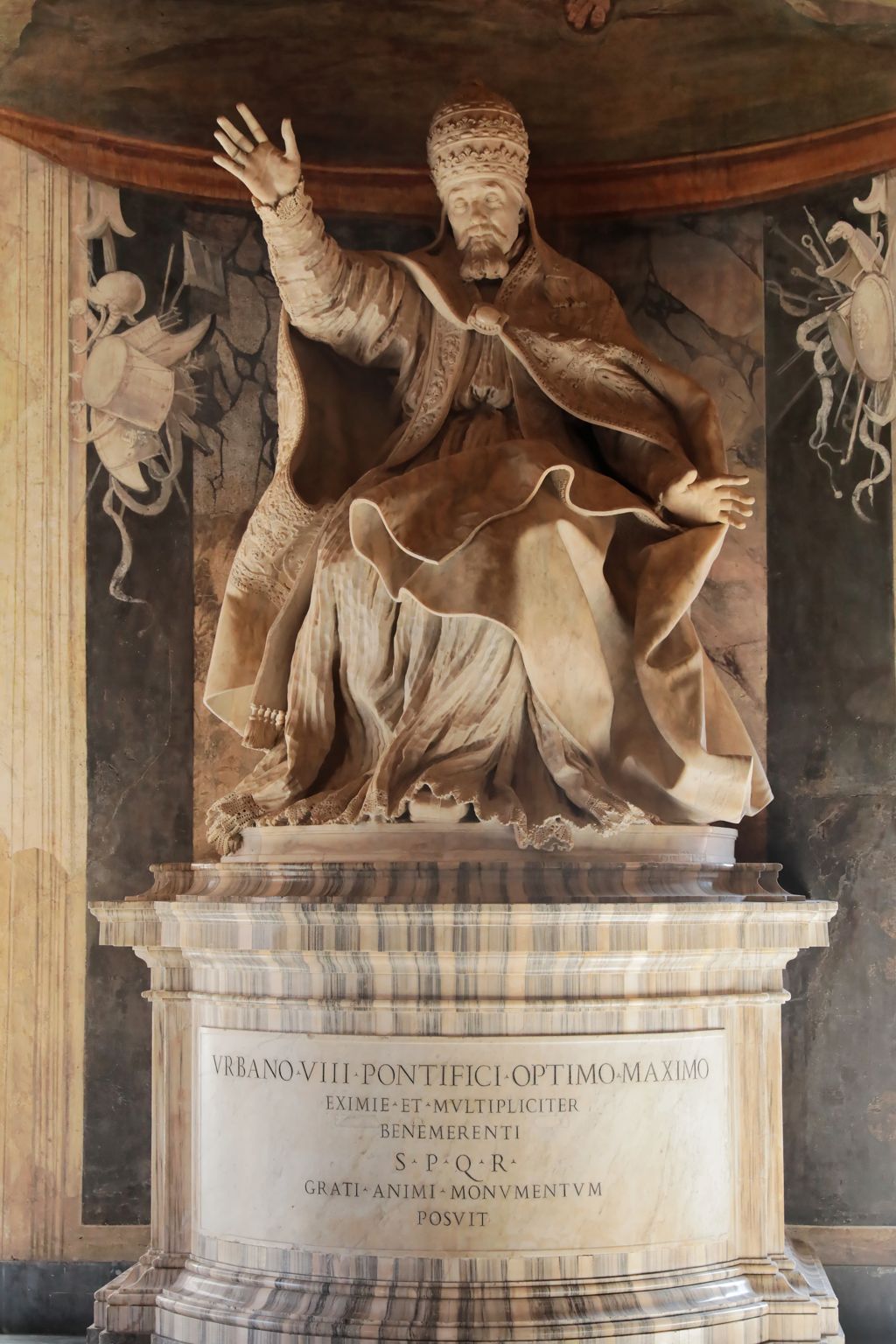
Pope Urban VIII sits high above the visitor, one hand raised and the other opening out beside his throne. His embroidered robes spread across his knees, but their weight does not still the figure: the two arms seem to carry his presence beyond the chair. Bernini's Memorial Statue of Urban VIII is a marble portrait made for Rome's civic authorities, now in the Capitoline Museums. Created between 1635 and 1640, it belongs to the living pope's public image, rather than to the funeral monument Bernini made for him in St Peter's. The museum credits this statue to Gian Lorenzo Bernini and assistants. [1]
At a Glance
The sculpture in Bernini’s career
Contents
A pope in civic space
The statue stands in the Hall of the Horatii and Curiatii in the Palazzo dei Conservatori. This is a setting filled with the ancient history of Rome: large frescoes by Giuseppe Cesari, known as the Cavalier d'Arpino, spread across its walls. The room served for public hearings of the Council. An enthroned pope here entered a civic conversation about authority, memory and the city, rather than appearing solely within a church. [2]
That setting changes the encounter. The figure addresses an assembly room, where people gathered to conduct public business. Its broad outline and emphatic hands can be read at a distance; the face and patterns of the vestments reward a closer view. The sculpture moves between those two scales. From across the room, Urban is a commanding silhouette. Nearer the base, the folds and ornaments make his ceremonial presence more tangible. The contrast is visible in the museum's photograph, where the relatively small head rises above a great expanse of cloth. [1]
The commission came from the Conservators in 1635, with a payment of 2,000 scudi; the completed statue followed in 1640. This makes the word “memorial” potentially misleading if understood as a monument erected after death. Urban's pontificate continued until 1644. The Capitoline Museums' description calls it an honorary statue, a useful distinction: it commemorated a reigning pope within the city's own seat of government. [3] [2]
The movement of the hands
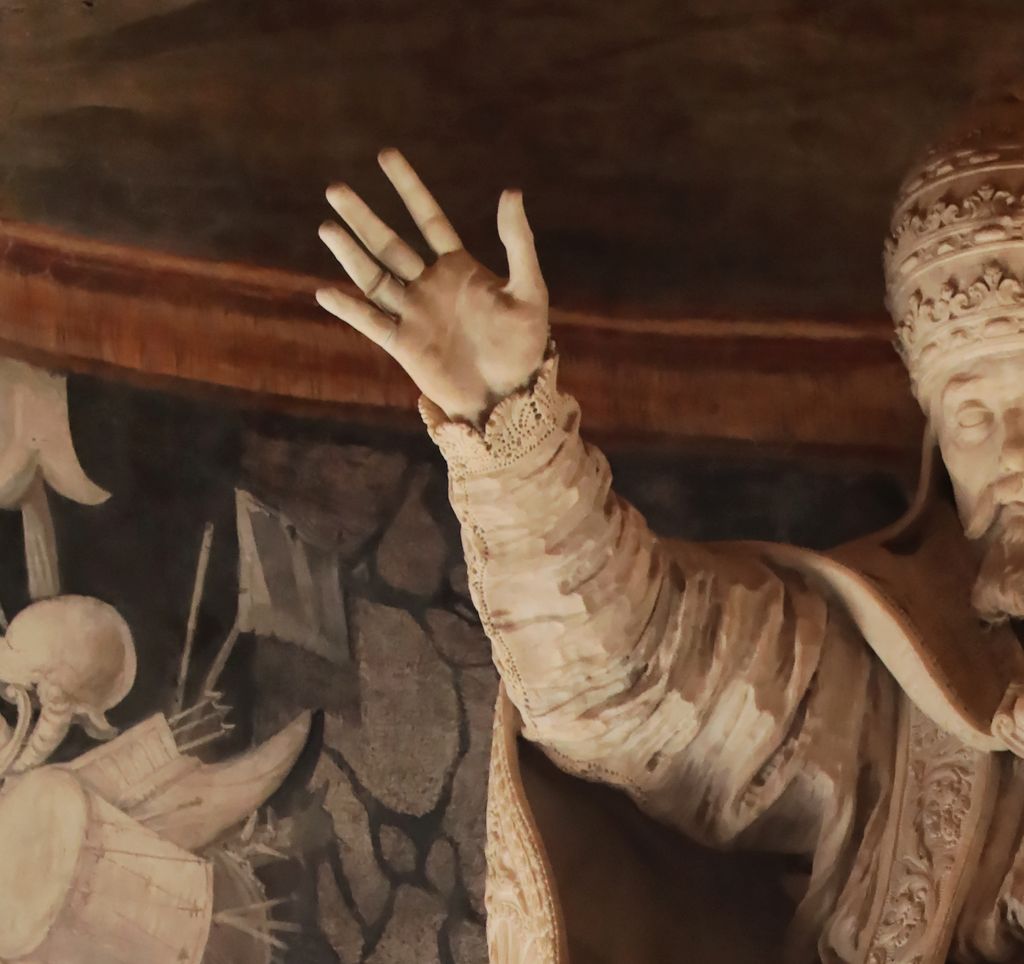
Begin with the right hand, raised above the shoulder on the viewer's left. The fingers spread clearly against the background, while the arm pulls the sleeve upwards in a sequence of folds. Follow that diagonal down towards the chest and the composition becomes denser. The broad ceremonial mantle crosses the body, then sweeps out towards the opposite side. There, the left hand extends lower, away from the throne. The two hands are neither level nor symmetrical, and their difference keeps the frontal figure from becoming rigid. [1]
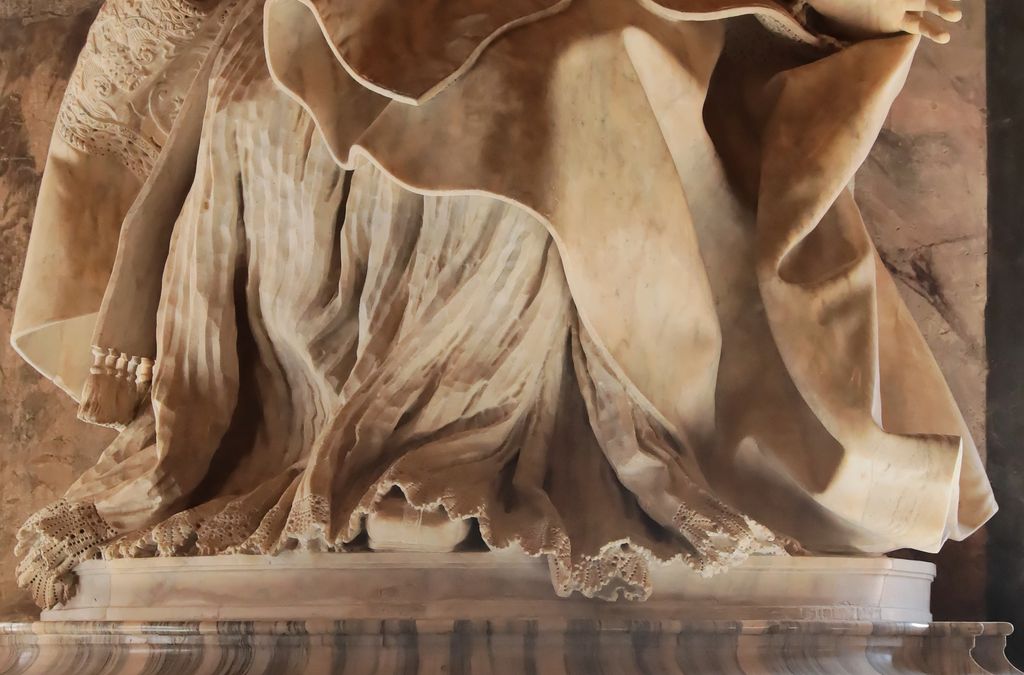
The sculptor's treatment of cloth helps us feel this movement. Along the raised arm, the sleeve gathers tightly; across the lap, the material becomes broad and heavy. Below the knees, narrower folds descend towards the feet. The eye travels through a succession of textures and directions before reaching the base. Urban remains seated throughout, but the drapery gives the impression that a gesture has just unsettled his robes. This is the animation of a ceremonial body, rather than a figure shown walking or struggling. [1]
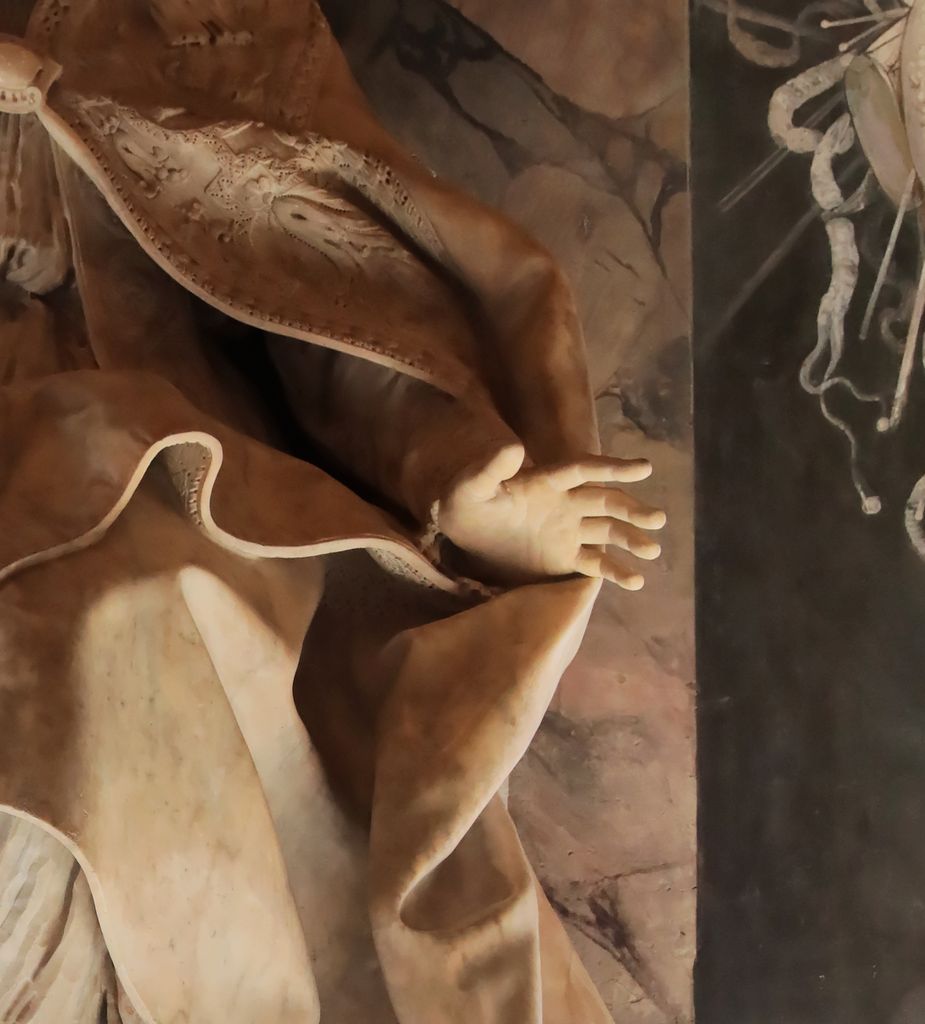
Art historian Irving Lavin singled out the active left hand as an unusual departure from earlier enthroned papal images, where it generally rested or held an attribute. He interpreted its upturned openness as an expression of grace, softening the potentially intimidating authority of a papal monument. Lavin also connected Bernini's figure with the image of Pope Urban I in the Vatican's Sala di Costantino. This is a scholarly reading of the gesture's historical associations, rather than a meaning that the outstretched fingers alone could prove. [4]
Seen without that background, the same hand still offers an accessible point of entry. It opens into the visitor's space, balancing the higher, more formal gesture. Neither hand grips the chair. The figure therefore seems less enclosed by the throne than its substantial seat and heavy garments might lead us to expect. Bernini and his collaborators make authority visible through posture, but also give that posture the suggestion of an exchange with someone standing below. [1]
Annotated Details from The Capitoline Urban VIII
Follow the different gestures of the two hands, then compare the mantle’s uneven edge with the folds beneath it.
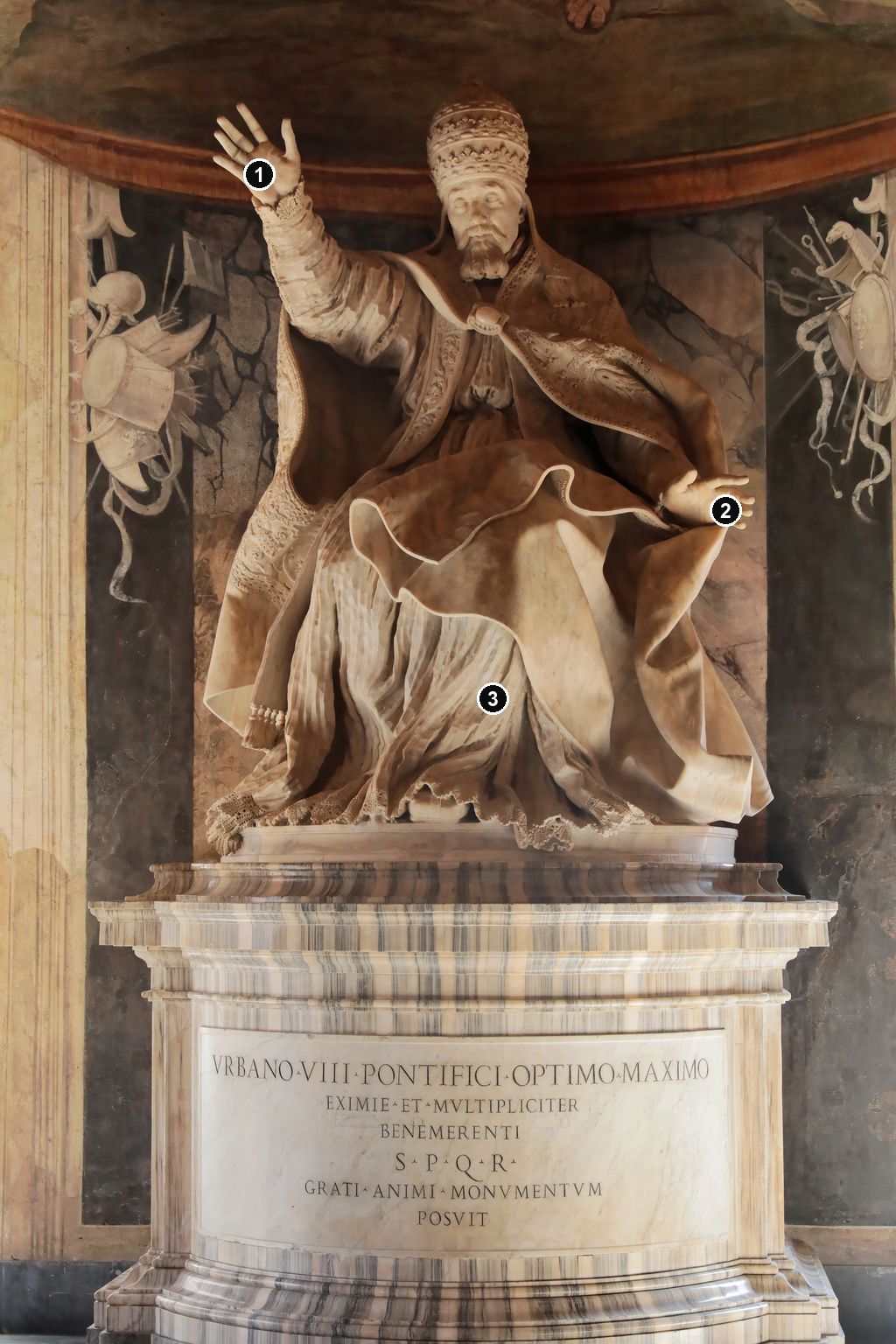
Details from THE CAPITOLINE URBAN VIII
Photograph by Burkhard Mücke, CC BY-SA 4.0. Overview annotated and details cropped and resized from the unchanged photograph.
The raised right hand
The fingers spread above the shoulder and the sleeve gathers around the rising arm. The higher gesture is one half of an uneven arrangement. [1]
The lower hand beside the mantle
The lower hand opens outward beside the mantle. Its position lets the seated figure seem less enclosed by the throne and ceremonial robes. [1]
A moving edge of cloth
The mantle’s broad curved edge crosses narrower folds below. Different directions and depths give the marble much of its variety. [1]
A face within the regalia
The tall papal tiara extends the vertical line above Urban's head. Beneath it, his bearded face occupies a comparatively small area of the whole statue. It would be easy to let the display of costume swallow the portrait. Instead, the forehead, nose and beard provide a compact centre for the much larger gestures. The hands send attention outwards; the face brings it back. The portrait depends on both movements, establishing a person within the apparatus of office. [1]
Look, too, at the edge of the mantle as it crosses the chest. Its ornament differs from the freer folds underneath. These adjacent surfaces ask the eye to distinguish decorated fabric from gathered fabric, even though both are carved in marble. In the museum photograph the sculpture is pale throughout, so much of its visual variety comes from relief, shadow and the turning of surfaces. The hem forms another irregular border above the more orderly mouldings of the pedestal. [1]
The museum records a height of 260 centimetres for the statue. Its size matters to the portrait's effect: the raised hand, elaborate headdress and wide spread of robes belong to a figure larger than the people who approach it. Yet the open left arm interrupts that distance. The viewer looks upwards towards office and rank while also encountering a gesture that seems to reach away from them. The tension between elevation and accessibility gives the statue much of its interest. [1]
Bernini and assistants
The Capitoline attribution, “Gian Lorenzo Bernini … ed aiuti,” identifies both Bernini's authorship and the participation of assistants. It is more precise than treating the monument as the work of a single pair of hands. It also leaves room for uncertainty: the museum's short record does not assign the face, hands or individual passages of drapery to named sculptors. Those divisions cannot safely be reconstructed simply from which details seem most accomplished. [1]
A collaborative attribution need not weaken our experience of the design. The arrangement of arms, seat and mantle works as a connected whole. At the same time, remembering the assistants changes what we ask of the surface. A large monument involved the translation of an artistic conception into a demanding material object. Its coherent presence and the labour of several makers can both be acknowledged without turning every fold into an attribution puzzle.
A monument that moved
Urban's position in the room has changed. The museum's historical account places the statue originally in the middle of a long wall, between the fresco of the combat of the Horatii and Curiatii and the battle of Tullus Hostilius against the Veientes and Fidenates. It was removed during the French occupation in 1798. Following restoration in 1816, Pius VII had it placed on a short side of the hall, on a new base, replacing Taddeo Landini's bronze honorary statue of Sixtus V, which had been destroyed in 1798. [3]
The present ensemble consequently holds several historical moments together. The modern visitor sees Urban across the room from Alessandro Algardi's bronze statue of Innocent X, made in 1645–50. [2] The difference between pale marble and dark bronze makes a comparison almost unavoidable. Yet today's facing arrangement should not be projected back onto the moment when Bernini's statue first arrived. The room's history is part of the sculpture's history: relocation altered its neighbours and the direction from which it addresses the visitor.
Statue and tomb
Bernini also created Urban's tomb in St Peter's, a much larger ensemble completed in 1647. That monument combines marble and bronze; its enthroned pope belongs above allegorical figures and a sarcophagus. [5] The Vatican Museums describe Charity and Justice flanking Death, represented by a bronze skeleton recording the pope's death. [6] Those figures belong to the funeral monument, not to the Capitoline statue. An image containing them cannot illustrate this marble civic portrait as though it were another view of the same object.
The distinction helps explain the different kinds of remembrance. At the Capitol, the pope appears as an honorary presence within a room of public government. In St Peter's, his image participates in a meditation on death and succession. Both use the authority of an enthroned figure, but the surrounding objects change what that authority means. Returning to the marble statue after the comparison, its open arms become particularly striking: the portrait's drama unfolds through the seated body itself, through hands, face and cloth, as Urban addresses the space before him.
Artworks directory
Four sculptures documented in the sources for these pages. The Carlo Barberini monument combines an ancient body, Algardi’s restoration and Bernini’s portrait head. The Capitoline Urban VIII statue is credited to Bernini and assistants and is distinct from the Vatican tomb. This selection is not a complete catalogue.
| Name | Date | Medium |
|---|---|---|
| Carlo Barberini memorial (Bernini portrait head; Algardi restoration; ancient torso) | 1630 | Sculpture |
| Urban VIII honorary statue (Bernini and assistants) | 1635–40 | Sculpture |
| Cardinal Richelieu (Louvre marble) | 1640–41 | Sculpture |
| Ecstasy of Saint Teresa, Cornaro Chapel | 1647–52 | Sculpture |
Frequently Asked Questions
It is the honorary marble statue in the Capitoline Museums, made while Urban VIII was alive. Bernini’s Vatican funeral monument is a separate work. [1][2][5]
The Capitoline Museums credits Bernini and assistants. Its record does not assign individual passages to named collaborators. [1]
The museum records a height of 260 cm for the marble sculpture. [1]
Discussion
Follow the two different gestures of the hands and the moving edges of the mantle across the seated figure.
How does the lower, open hand affect your response to the pope's raised right hand?
Reader Insights
Which hand first directs your attention?
How does the cloth suggest movement?
What changes when this papal figure is seen in a civic room?
Join the Conversation
Share a detail, comparison or question about Urban VIII Memorial below.
References
- Musei Capitolini, Statua di papa Urbano VIII (1635–1640), inventory MC1201, object record and photograph (in Italian). View source.Splash image: Urban VIII, 1635–40, Bernini and assistants. The honorary statue in the Capitoline Museums, distinct from the Vatican tomb. Photograph: Burkhard Mücke, via Wikimedia Commons; resized · CC BY-SA 4.0
- Musei Capitolini, Hall of the Horatii and Curiatii, room history and sculpture descriptions. View source.
- Musei Capitolini, Marble honorary statue of Pope Urban VIII Barberini, inventory Scu 1201, commission and relocation history. View source.
- Irving Lavin, “Urbanitas Urbana: The Pope, the Artist, and the Genius of the Place”, in Lorenza Mochi Onori, Sebastian Schütze and Francesco Solinas, eds., I Barberini e la cultura europea del Seicento (Rome, 2007), pp. 15–30, section “Political and social urbanity,” PDF pp. 10–11, fig. 21 (essay in English). View source.
- Fondazione Federico Zeri, Università di Bologna, Monumento funebre di papa Urbano VIII, object record 79576 (in Italian). View source.
- Vatican Museums, Pope Urban VIII, biographical note, 2026, final paragraph on the funeral monument. View source.
- Musei Capitolini, Statue of Carlo Barberini, 1630, MC1195. Used for the career comparison. Accessed 28 October 2026. View source.


