 by Tom Gurney
Tom Gurney BSc (Hons) is an art history expert with over 20 years experience
Email: tomgurney1@gmail.com / Phone: +44 7429 011000
Portrait of a Humanist in Milan
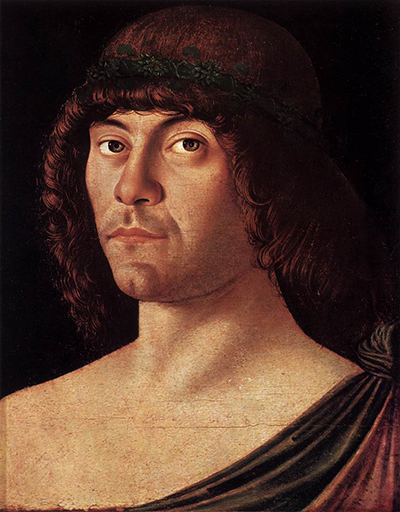
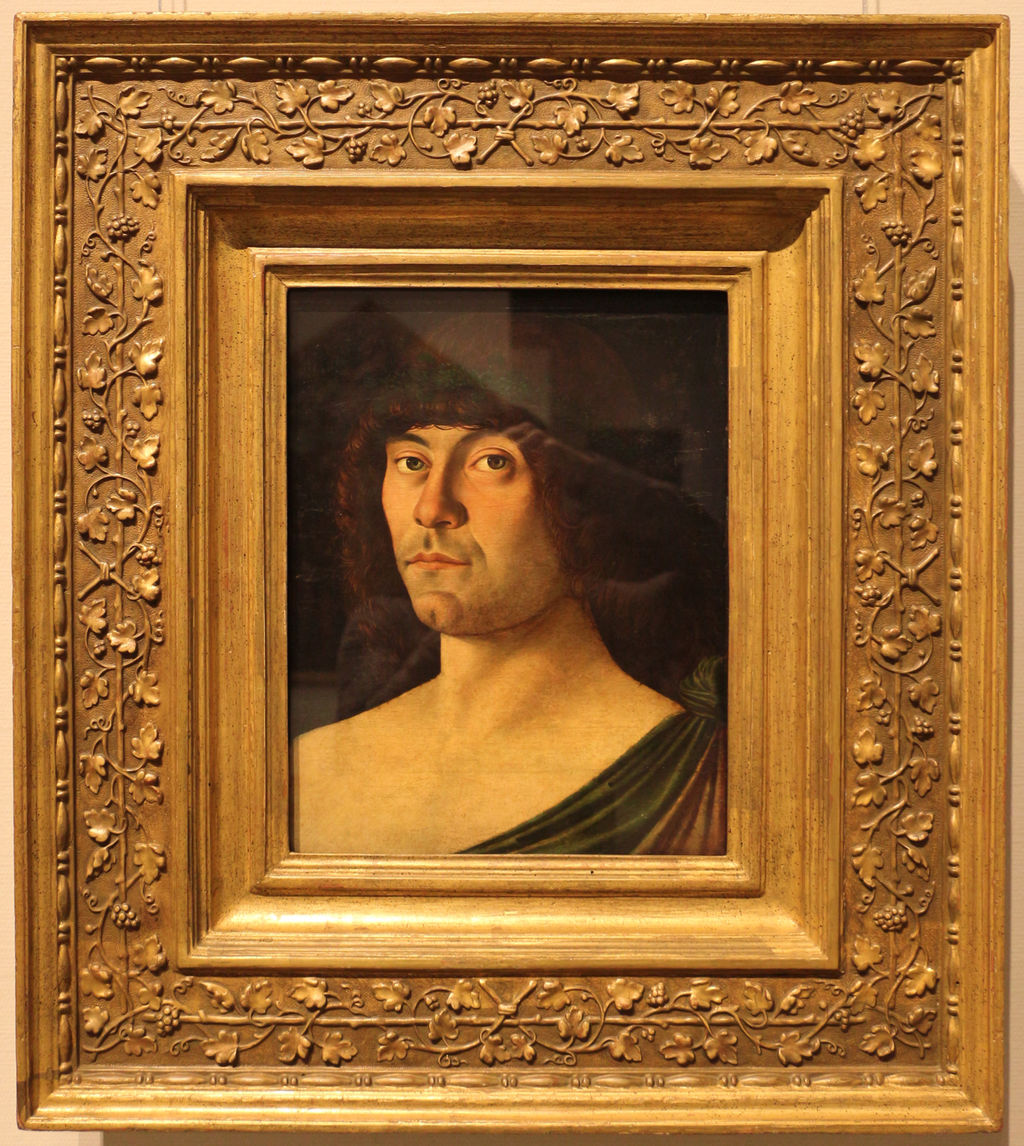
The man in the Portrait of a Humanist turns his head slightly, but his eyes seem to meet ours. A dark green garment crosses his chest and leaves one shoulder bare. Around his hair is a wreath so subdued that it is easy to miss on a first look. The Pinacoteca del Castello Sforzesco in Milan keeps this small oil painting on wood as inventory 249 and catalogues it under Giovanni Bellini. The museum presents the sitter as the Triestine poet Raffaele Zovenzoni, an identification that remains open. Two recent exhibitions have included the possibility that he is Andrea Mantegna. [1] [2] [3] [4]
At a Glance
- ArtistGiovanni Bellini, according to the Castello
- DateAbout 1467 in the Castello catalogue; about 1475–80 in the London exhibition
- MediumOil on wood
- Collection or historic sitePinacoteca del Castello Sforzesco, Milan, inv. 249
The work in Bellini’s career
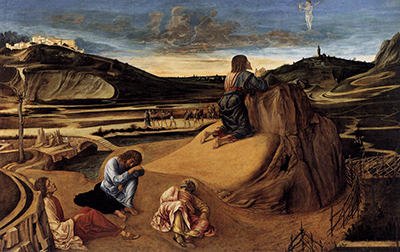
The Agony in the Garden
c. 1458–60Presentation at the Temple
c. 1475Portrait of a Humanist in Milan
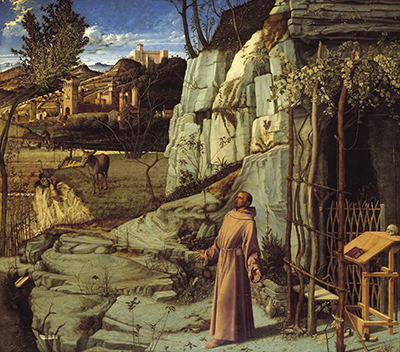
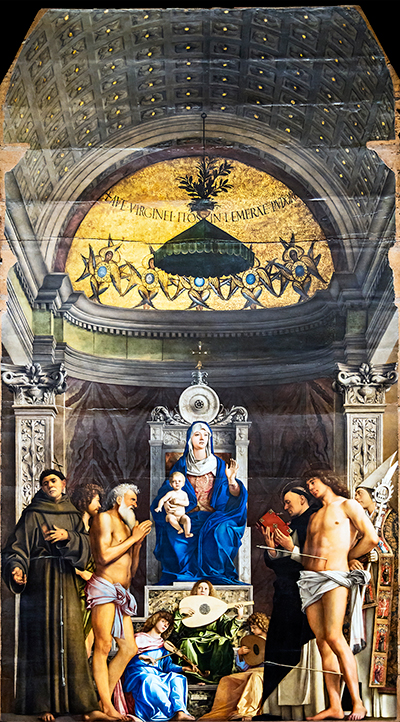
About 1467 in the Castello catalogue; about 1475–80 in the London exhibitionSt. Francis in the Desert
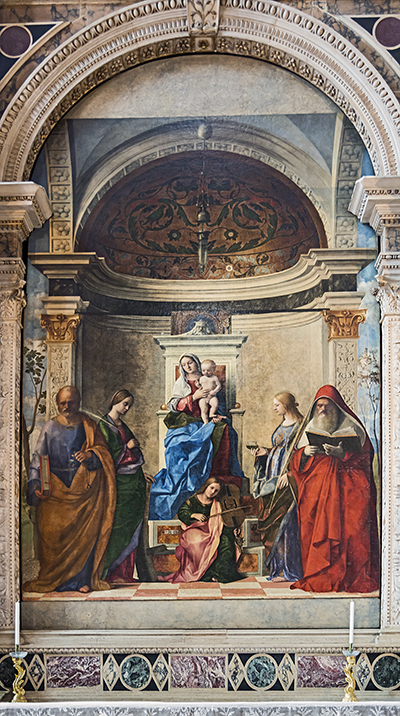
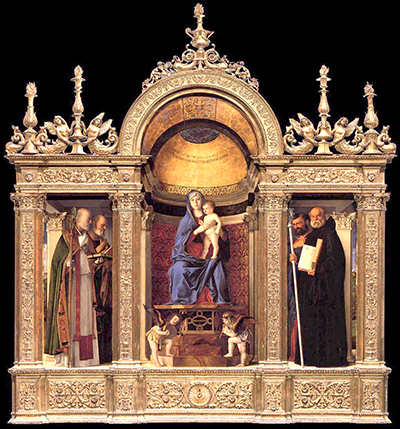
Late 1470sFrari Triptych
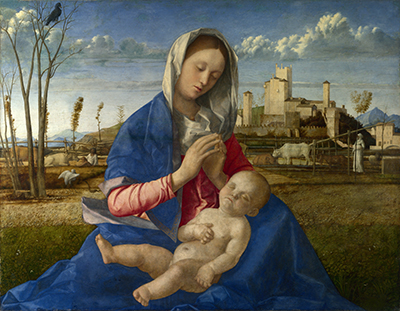
1488Madonna of the Meadow
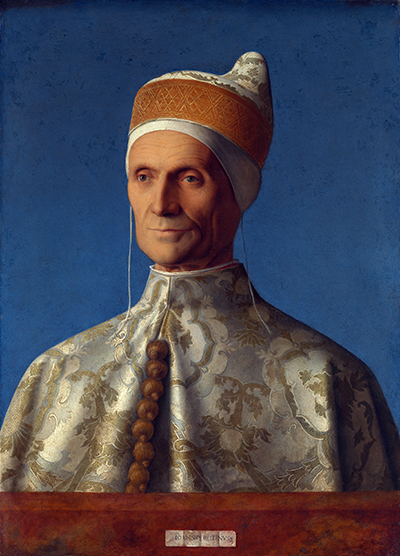
c. 1500–05Doge Leonardo Loredan
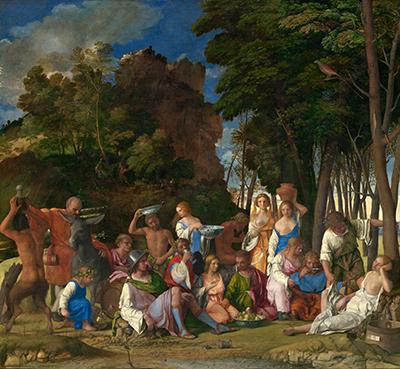
c. 1501–02The Feast of the Gods
Bellini’s signed date 1514How the portrait holds the eye
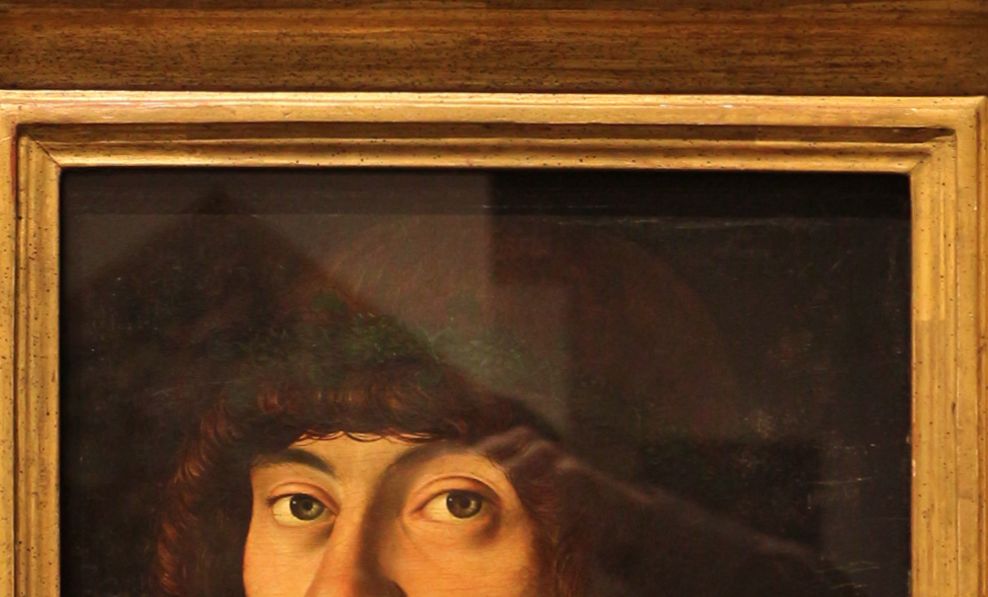
The shoulders and face turn towards the viewer’s left, but the eyes pull back towards the middle. Look at the nearer cheek and then at the far edge of the face. The first has a broad surface on which light passes gradually into shadow. The second is compressed into a narrow contour alongside the nose. This slight turn gives a small painting considerable depth. The fine highlights in the eyes make the man seem alert, even though the lips are closed and the rest of the face is still. [1]
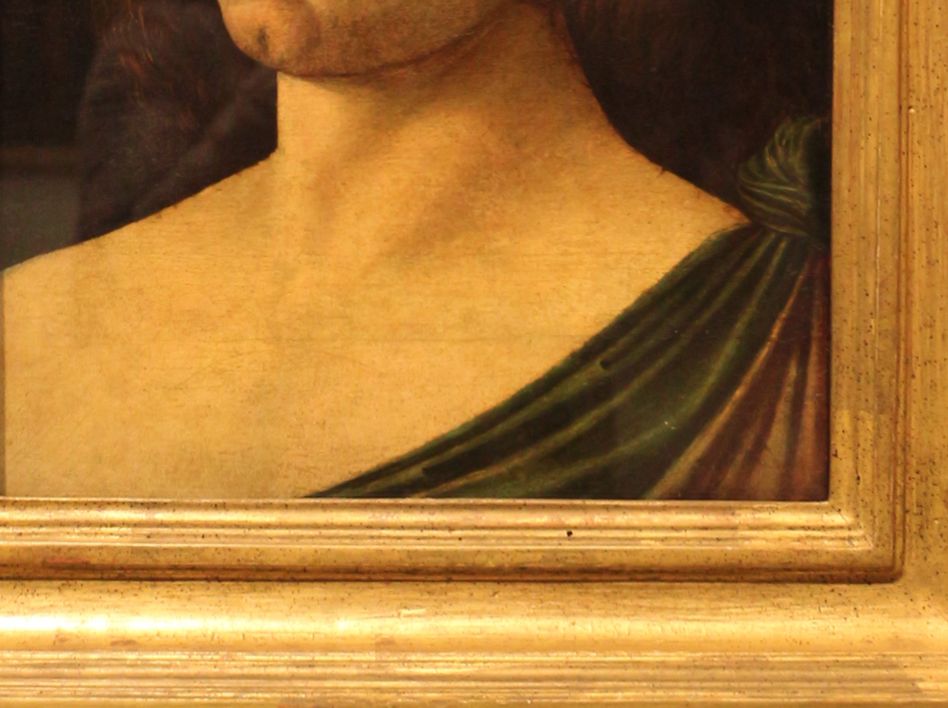
The panel cuts him off high on the chest. The hands and most of the garment are outside the visible field, and the background supplies no room or landscape. The folds rise diagonally across the bottom of the painting and gather near the shoulder at the right of the picture. Together with the turn of the head, that diagonal sets the body in motion while the gaze remains steady. The eye can follow the creases and green highlights all the way up to a small knot at the edge. Above it, the hair and wreath recede into the dark background, extending the silhouette almost to the side of the panel. [1] [2]
The Castello describes the costume as classical and the wreath as myrtle. The regional object record also mentions bindweed. The greenery and draped cloth go a long way towards explaining a title like The Poet Laureate. The wreath is especially easy to overlook against the dark upper half, while the bright expanse of bare skin gives the garment its force. The picture makes the sitter look like someone assuming a role from antiquity. A literary honour is one way to understand that role. The costume offers a clue to how the man wanted to be seen, while his name takes other evidence. [1] [2]
Who might the sitter be?
The Castello’s identification has a basis in Zovenzoni’s acquaintance with Bellini. Zovenzoni was a Latin poet from Trieste who served as his city’s chancellor in 1467 and later worked in Venice revising texts for the printers Wendelin of Speyer and Nicolas Jenson. He wrote about artists including Giovanni and Gentile Bellini and Marco Zoppo. In an epigram he praised Giovanni’s ability to make the faces in his pictures appear alive and implied that his skill made him worthy to paint for Alexander the Great. The Castello dates the oil panel to about 1467 and suggests that Zovenzoni’s crowning as a poet by Emperor Frederick III may have provided the occasion. [1] [5] [6]
Zovenzoni’s dedication in the Istrias, a collection of his poems, offers direct evidence that Bellini portrayed him. In the copy for Johannes Hinderbach, prince-bishop of Trent, the poet says that he was unable to deliver the book in person and would send his portrait in his stead. The manuscript, at the Biblioteca Trivulziana in Milan, is a separate object from the oil painting. Marzia Pontone treats the portrait described in the dedication as missing from the book. Giacomo Alberto Calogero notes that the dedication places the image on a page of the book, which makes the surviving oil panel an improbable match. Art historian Chika Sasaki has explored a different candidate, the separate painted manuscript portrait in the Trivulziana, in terms of the ancient tradition of an author’s portrait and the image’s ability to stand in for the absent poet. The evidence for Bellini's contact with Zovenzoni is therefore stronger than the evidence connecting that contact to this panel. [5] [6] [7] [8]
The alternative of Andrea Mantegna comes from the art historian Giovanni Agosti. Bellini and Mantegna were brothers-in-law, and a portrait of a painter in classical dress would suit the way that Renaissance artists could claim the intellectual standing of poets. London’s Mantegna and Bellini loan record put a question mark after Mantegna’s name. The 2023 Paris exhibition retained that question under the title Portrait of a Young Man Dressed in the Antique Style and dated the painting to about 1475. In both cases Mantegna was proposed as sitter and the painting was listed under Bellini. The panel has also circulated as a likeness of Peter Luder. The German humanist studied in Italy, but died in 1472, before the date of about 1475–80 given by the London loan record. The Castello’s earlier dating would make a sitting possible on chronological grounds alone. The surviving evidence cited for the Milan panel gives no positive basis for that name. [2] [3] [4] [7] [9]
What restoration and the catalogues reveal
The classical costume was once much harder to see. According to the Castello’s regional object file, the restorer Luigi Cavenaghi removed extensive overpaint before 1908, including a cap and a later damask cloak. Those additions had given the man the appearance of a Venetian senator. Removing them revealed a sitter whose uncovered shoulder and antique drapery prompted different questions about his position and identity. The regional record also lists later treatments in 1955 and 1974. In March 2025 the Gallerie dell’Accademia in Venice awarded a further restoration contract for the panel under the Castello’s Zovenzoni title. The published decree records the commission for work, leaving the treatment itself to be documented separately. [2] [10] [16]
Milan received the panel through Malachia De Cristoforis’s bequest in 1876, and the regional catalogue traces it through successive civic inventories. Older photographs also show how its attribution travelled. One Brogi print names Antonello da Messina in its caption. The Fondazione Federico Zeri files photographs of the panel under different headings and records Jacometto Veneziano alongside Antonello among the competing attributions. The regional catalogue also preserves Cima da Conegliano, and Calogero records a modern proposal for Alvise Vivarini while arguing for Bellini himself. The collecting museum and the London and Paris exhibition records favour Bellini. The Castello measures the painted object at 32 × 28 cm. London’s loan record and the Zeri catalogue give 35 × 28 cm for the same portrait. Those measurements are best read with their individual sources. [1] [2] [3] [4] [7] [11] [12]
Looking at Antonello and other portraits
The 2023 Paris exhibition placed the Milan panel alongside Antonello da Messina’s Portrait of a Young Man from the Gemäldegalerie in Berlin. Antonello’s smaller portrait, dated 1478, also draws the viewer in through the slight turn of the body and the concentrated gaze. Its blue sky hints at a distant world, and a painted slip of paper on the foreground ledge gives the artist’s name and the date. The Milan picture brings the face and bare shoulder forward against darkness. The contrast is particularly instructive given the old attribution to Antonello. Both painters could create the effect of someone present at close range, though they chose quite different clothes and surroundings to make that person visible. [4] [11] [13]
Another Portrait of a Young Man in Berlin, inventory S.12, is catalogued under Bellini with a note that scholars have questioned the attribution. Berlin links its format to Antonello’s example. Bellini’s signed Portrait of a Young Man in Washington, dated about 1490, offers a comparison with firmer evidence for authorship. There a black coat and cap, a painted marble ledge and a clear sky set off the sitter, who directs his gaze well away from the viewer. The name on the ledge belongs to Bellini, while the young man himself is anonymous. In Milan, the slight turn of the head and the almost hidden wreath hold our attention on two different things, the particular face and the classical identity the portrait gives it. [14] [15]
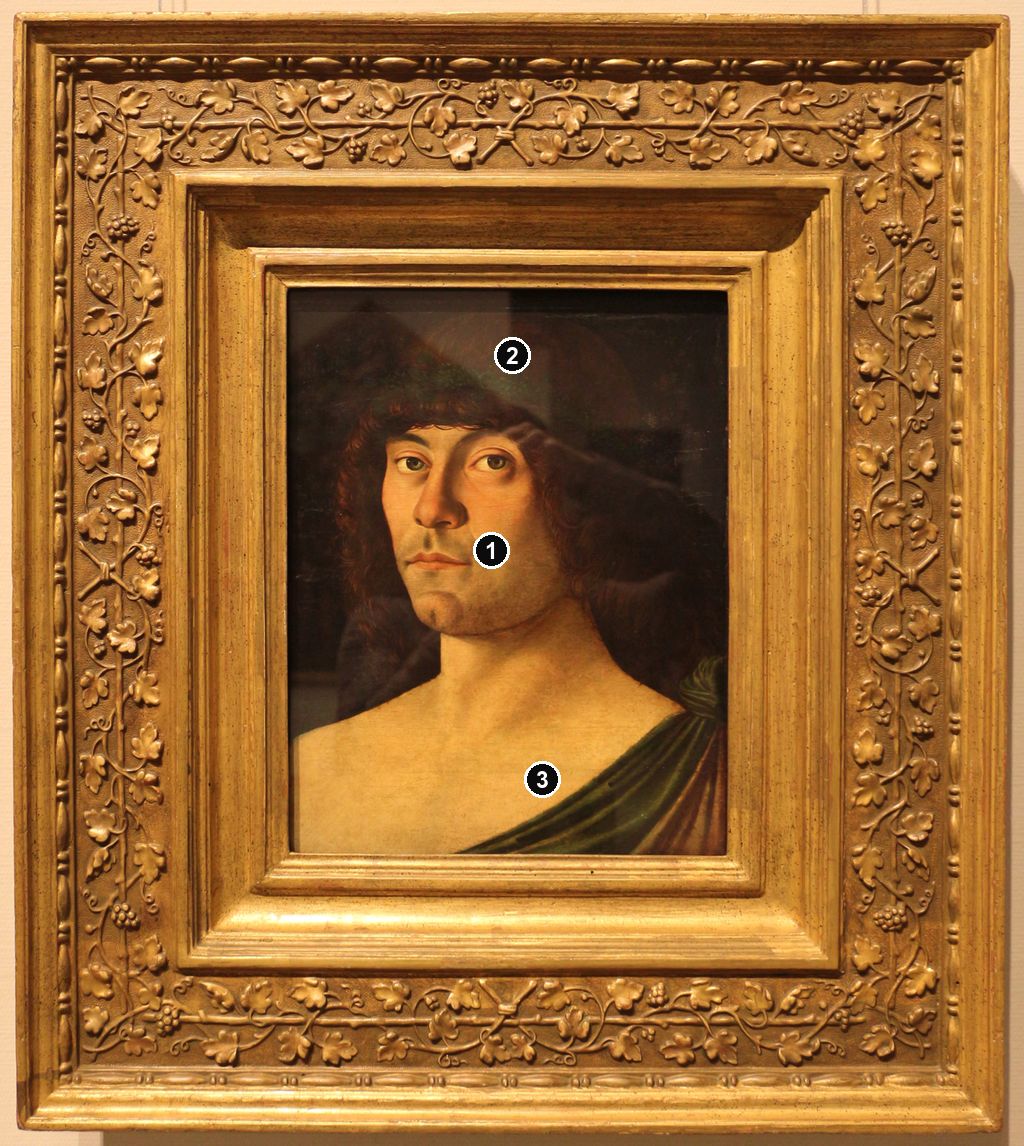
Annotated Details from Portrait of a Humanist at the Castello Sforzesco
Numbered overview and cropped details. Photograph Sailko via Wikimedia Commons. Image source. CC BY 3.0.
Details from PORTRAIT OF A HUMANIST AT THE CASTELLO SFORZESCO
Read the visible paint around the hair and the draped garment without relying on a proposed name for the sitter.
The sitter’s outward gaze
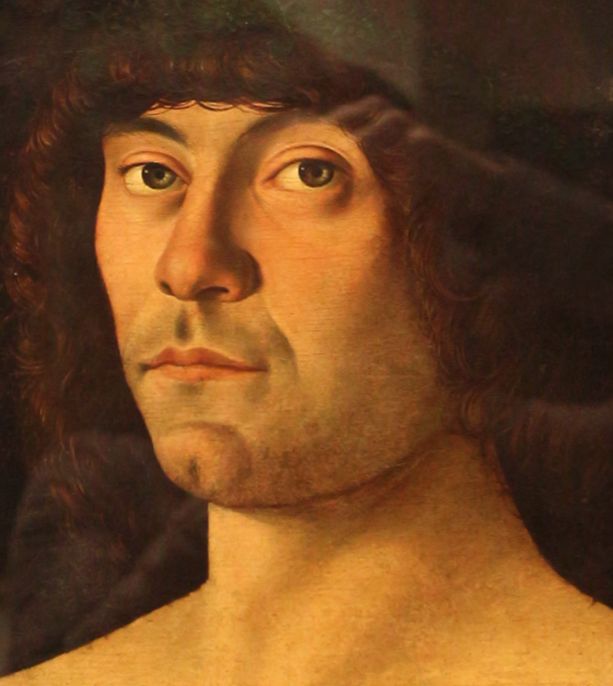
The eyes look out towards the viewer from beneath the heavy fringe. The face is modelled in warmer tones than the distant background.
Hair and its edge
Light traces parts of the outline where the hair meets the surrounding dark colour. The edges soften again towards the sides.
Drape and exposed shoulder
The dark fabric crosses the chest on an angle. Bare shoulder and collarbone take up much of the small field below the head.
Related reading
Artworks directory
Discussion
Look again at the images and ideas explored in Portrait of a Humanist. These editorial prompts invite your observations.
Reader Insights
What role does the slight turn of the head play in the sitter’s gaze?
What does the wreath suggest, and where does the evidence for a specific name end?
What can the clothing and the shape of the portrait tell us about how the sitter is presented?
Join the Conversation
Share a detail, comparison or question about Portrait of a Humanist below.
References
- Castello Sforzesco, Ritratto del poeta Raffaele Zovenzoni (Il poeta laureato). View source.
- Lombardia Beni Culturali, Castello Sforzesco object record B0030-00221. View source.
- National Gallery, London, Mantegna and Bellini loan record X9715, p. 2. View source.
- Musée Jacquemart-André, Giovanni Bellini. Influences croisées, exhibition materials, p. 16. View source.
- Treccani, Dizionario Biografico degli Italiani, “Zovenzoni, Raffaele”. View source.
- Marzia Pontone, “Giovanni Bellini e Raffaele Zovenzoni,” pp. 89–96. View source.
- Giacomo Alberto Calogero, “Non tanto per el guadagno quanto per l’onore,” Intrecci d’arte, n. 59. View source.
- Akita University, interview with Chika Sasaki on the function of the author portrait. View source.
- Deutsche Biographie, “Luder, Petrus”. View source.
- Treccani, Dizionario Biografico degli Italiani, “Cavenaghi, Luigi”. View source.
- Lombardia Beni Culturali, Brogi photograph and inscriptions for inv. 249. View source.
- Fondazione Federico Zeri, photographic catalogue record 28301. View source.
- Gemäldegalerie, Berlin, Antonello da Messina, Portrait of a Young Man, inv. 18. View source.
- Gemäldegalerie, Berlin, Portrait of a Young Man, inv. S.12. View source.
- National Gallery of Art, Washington, Giovanni Bellini, Portrait of a Young Man, 1939.1.182. View source.
- Gallerie dell’Accademia di Venezia, restoration award decree 29, 21 March 2025. View source.