by Tom Gurney
Tom Gurney BSc (Hons) is an art history expert with over 20 years experience
Published on June 19, 2020 / Updated on November 5, 2026
Email: tomgurney1@gmail.com / Phone: +44 7429 011000
Giovanni Bellini Drawings
A small Madonna, an intensely observed old face, a robed figure built from fine strokes of ink: the drawings associated with Giovanni Bellini offer several different ways into his art. Some suggest the rapid invention of a composition, others the patient study of light. Yet they cannot be gathered into a settled catalogue of works by one hand. Museum labels preserve an essential distinction between drawings accepted as Bellini’s, sheets attributed to him, and works associated with his workshop or formerly placed under his name. The British Museum notes that no drawing attributed to Bellini has won universal acceptance as autograph—that is, made by the artist himself. [1]
This uncertainty need not keep us at a distance. It makes looking more rewarding, provided that we ask two questions separately: what does a drawing reveal about the creation of an image, and how confidently can we identify its maker? A convincing resemblance to a Bellini painting may illuminate the first question without finally answering the second.
At a Glance
Contents
Why attribution matters
The British Museum’s Three Heads shows how difficult the separation can be. The collection currently labels this black-chalk sheet “Attributed to: Giovanni Bellini.” Earlier cataloguing placed it under Francesco Bonsignori; Popham and Pouncey proposed Bellini in 1950 through comparisons with painted heads. George Goldner subsequently argued for a skilled member of Bellini’s workshop rather than the master, a position recorded in the museum’s commentary. [1]
A face can resemble a Bellini type because Bellini drew it, because an assistant studied his designs, or because somebody copied a finished picture. These possibilities are historically different, even when the resulting images look close. The Three Heads therefore offers something more interesting than an unresolved name. It brings us close to the problem of recognising a shared visual language while distinguishing the individuals who used it. The museum’s qualified heading remains the appropriate description; the workshop interpretation is an important scholarly proposal within that uncertainty. [1]
A Madonna in Rotterdam
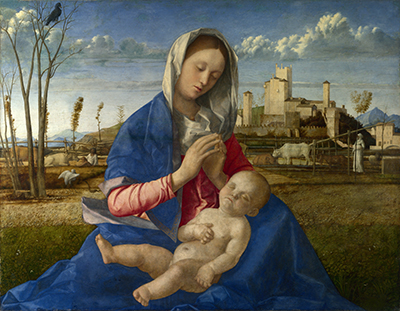
At Museum Boijmans Van Beuningen, Madonna with Christ Child, I 282 (PK), is catalogued under Giovanni Bellini and dated about 1489. This pen-and-brown-ink drawing measures only 94 by 77 millimetres. Albert Elen’s catalogue entry connects it with a signed Madonna in the Huntington collection and explains that most writers have accepted Bellini’s authorship, although Hans Tietze and Erica Tietze-Conrat rejected it. [2]
The tiny sheet has remarkable concentration. The mother’s lowered head and the child’s rounded head lean towards one another, while hatching gathers beside their faces. Long diagonal strokes behind the figures establish a different rhythm from the shorter marks around the eyes, cheeks and neck. The crossed and branching lines of the garments keep the bodies substantial without describing every fold. What might initially look unfinished becomes intelligible as a selective account of the group: the drawing gives greatest attention to the relationship between the two figures.
Elen regards the clipped corners as evidence that the sketch was probably cut from a larger sheet. The connection with the Huntington painting is valuable, but it should not become a claim that all specialists agree on an unquestionably preparatory drawing. Here the museum’s positive attribution coexists with a documented history of disagreement. [2]
The old man and the colour of paper
The Head of an Old Man in the Royal Collection, RCIN 912800, offers a strikingly different experience. Instead of a compact arrangement of bodies, we meet a face with deep-set eyes, a furrowed forehead and a long divided beard. The broad folds around the shoulders frame the more intricate play of lines in the hair. The gaze feels remarkably direct even though the head turns slightly away. The patient description of individual features gives the figure an arresting presence.
The Royal Collection’s Drawing the Italian Renaissance label identifies the medium as brush and ink with white bodycolour on discoloured blue paper, and dates it about 1460–70. It relates the facial type to Saint Anthony in Bellini’s early paintings, while suggesting that the sheet was an independent work rather than preparation for a painting. Tack holes, varnish and fading support the conclusion that it was once framed and displayed. [3]
Its present brownish appearance can therefore mislead. The Royal Collection explains that protected strips at the bottom and left retain the paper’s original blue. The support once contributed much more visibly to the drawing’s effect: dark marks and white touches worked against a coloured middle tone. Paper was an active part of the image, and its alteration has changed the balance we see. [4]
Explore the old man’s head
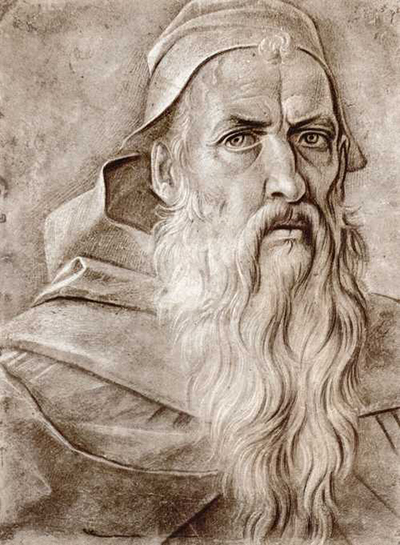
Head of an Old Man
Royal Collection, RCIN 912800. Read the collection’s account of the surviving blue paper.
What specialists see in blue paper
Genevieve Verdigel’s doctoral research places the Windsor head alongside the Uffizi’s Bust of a Bearded Man with a Turban when examining drawing practices in the Veneto. Her discussion explains the practical strength of blue paper: it supplied a middle value between dark ink or chalk and white heightening. Light could be built up as well as shadow deepened. This helps us understand why a drawing might approach the tonal fullness of painting without becoming a coloured picture. [5]
Verdigel also records a dating disagreement. She discusses proposals placing these heads around 1475–85, while noting Sarah Vowles’s support for the Windsor sheet’s earlier date through comparison with Bellini’s early Saint Anthony. The Royal Collection continues to use about 1460–70. The difference is significant, but neither date needs to be disguised as certain. [3] [5]
Her wider argument also cautions against treating blue paper as an exclusive signature of Venice or of one artist. Related practices circulated on the mainland. The material helps reconstruct a working culture; it cannot, on its own, identify a hand. [5]
Line becomes light
The Getty’s Standing Man Wearing a Turban, 91.GA.37, is currently attributed to Giovanni Bellini and dated about 1485. Its account of the figure emphasises hatching and cross-hatching: repeated and intersecting strokes make tonal gradations, give texture to the clothing and organise the contrast between light and shadow. The museum carefully describes the maker as probably Bellini. [6]
That qualification belongs alongside any appreciation of the drawing. The controlled variation of strokes can be admired without upgrading “attributed to” into a secure signature. Line here has more than an outlining role. It allows the eye to distinguish the weight of cloth, the turning of a surface and the darker passages that hold the figure together. The drawing makes a useful companion to the old man’s head because it directs attention from a recognisable subject to a method of making forms visible.
The turban also requires care. Gentile Bellini’s journey to Constantinople forms part of the Getty’s historical context for such figures. It does not make this a documented study from Giovanni’s own travels, nor does it establish the identity of the man represented. [6]
Drawing beneath the paint
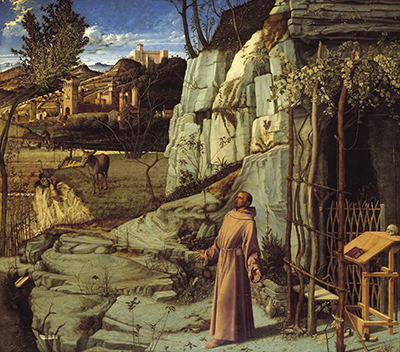
Another body of evidence survives inside paintings. An underdrawing is the design laid onto the prepared painting support before colour covers it. The Frick’s examination of Saint Francis in the Desert describes a composition drawn with a brush and black paint on a white ground, visible through infrared imaging. In the saint’s head, hatching establishes the fall of light as well as the outlines of the face. [7]
This is a particularly useful comparison for the drawings on paper. It shows graphic thinking securely embedded in the making of a Bellini painting: the design already considers illumination. The Frick also identifies changes during painting, including additions around the lectern. Preparation and revision operated together. A detailed design did not prevent the artist from continuing to think as he painted. [7]
The Galleria Borghese’s Virgin and Child, inventory 176, supplies a complementary example. Simona Ciofetta’s catalogue entry reports underdrawing partly transferred from a cartoon, alongside freer strokes and small changes, including an adjustment to the Virgin’s hand supporting Christ’s foot. A cartoon is a drawing used to transfer a design. Mechanical transfer and fresh invention could therefore coexist within one painting. [8]
A workshop could repeat and change
The Borghese account places such practices within the repeated production of devotional Madonnas. Assistants and followers adapted compositions, sometimes reversing groups or varying details. Repetition did not necessarily mean that every stage of a picture was performed by the same person. [8]
That matters when examining a separate sheet. A drawing might help establish a composition, preserve a successful figure, or carry a design between different works. Its function must be investigated rather than inferred from resemblance alone. A close relationship to a painting can be strong evidence of shared invention while leaving the sequence of making unresolved. Was the sheet an initial idea, a working record, or a later copy? The question turns our attention to what the object actually preserves, instead of letting the artist’s name do all the explaining.
When a drawing leaves Bellini’s name
The Morgan Library & Museum’s Last Supper, I, 52, makes the distinction especially clear. Its present heading attributes the drawing to Benedetto Diana, while the record retains its former association with the school of Giovanni Bellini. Earlier exhibition catalogues called it a studio work. The museum now directs readers to the 2019 catalogue Italian Renaissance Drawings at the Morgan Library & Museum, number 55. [9]
The sheet is worked in pen and brush with ink and wash over black chalk, with incised and ruled lines. Its changing attribution does not erase either the drawing or its historical relationship to Venetian art. It changes the claim attached to its maker. Nor does the new heading provide a definite replacement signature: “attributed to Benedetto Diana” remains a qualified judgement. [9]
Bellini’s drawings are best approached with that same combination of attentiveness and precision. Their beauty lies in particular decisions—a cluster of hatch marks, an economical contour, a highlight against coloured paper. Their history lies partly in the continuing effort to understand who made those decisions and how an image travelled through a workshop. Looking closely allows both kinds of interest to remain alive.
Selected drawings and attribution records
This is a guide to the objects discussed here, not a complete catalogue of Bellini’s drawings. The wording distinguishes present collection labels from earlier or alternative opinions.
| Work | Collection and identifier | Attribution used by the collection |
|---|---|---|
| Three Heads | British Museum, 1900,0717.31 | Attributed to Giovanni Bellini; workshop proposal discussed in the commentary. [1] |
| Madonna with Christ Child | Museum Boijmans Van Beuningen, I 282 (PK) | Giovanni Bellini; historical dissent recorded. [2] |
| Head of an Old Man | Royal Collection, RCIN 912800 | Giovanni Bellini. [3] |
| Standing Man Wearing a Turban | Getty Museum, 91.GA.37 | Attributed to Giovanni Bellini. [6] |
| Last Supper | Morgan Library & Museum, I, 52 | Attributed to Benedetto Diana; formerly school/studio of Bellini. [9] |
Artworks directory
Selected drawing records and paintings examined for underdrawing. Current collection attributions are distinguished from historical opinions. The Morgan Last Supper is now attributed to Benedetto Diana and is included for its former Bellini association. A dash means no date is supplied here; this is not a count of autograph Bellini drawings.
| Name | Date | Medium |
|---|---|---|
| Three Heads (attributed to Giovanni Bellini) | — | Drawing |
| Madonna with Christ Child (Boijmans attribution to Bellini) | about 1489 | Drawing |
| Head of an Old Man (Royal Collection attribution to Bellini) | about 1460–70 | Drawing |
| Standing Man Wearing a Turban (attributed to Bellini) | about 1485 | Drawing |
| Last Supper (attributed to Benedetto Diana; formerly school of Bellini) | — | Drawing |
| Saint Francis in the Desert (underdrawing examined) | — | Painting |
| Virgin and Child (Borghese, underdrawing examined) | — | Painting |
Frequently Asked Questions
There is no universally agreed total of autograph sheets. Counts depend on whether a catalogue includes disputed works, workshop drawings and copies. The examples above should not be added together as a total of securely accepted Bellini drawings. [1]
The Royal Collection identifies a facial type associated with Saint Anthony and suggests an independent drawing. Its exhibition label does not identify the man as Bellini himself. [3]
Discussion
Compare the finished study of light in the old man’s face with the searching lines and changing labels of other sheets.
Which reveals more about an artist’s thought: a swift arrangement of figures, or a highly finished study of light on a face?
Reader Insights
Which marks make the old man’s face feel most present?
How might blue paper change the balance of light and shadow?
What can a close relationship to a painting tell us about a drawing?
Join the Conversation
Share a detail, comparison or question about Giovanni Bellini Drawings below.
References
- British Museum, Three Heads, collection record 1900,0717.31, especially the current attribution and curator’s commentary. Includes the positions of Popham and Pouncey (1950), Giles Robertson and George Goldner, “Bellini’s Drawings,” in Peter Humfrey, ed., The Cambridge Companion to Giovanni Bellini (2004), p. 254. View source.
- Albert Elen, Madonna with Christ Child, I 282 (PK), catalogue entry, Italian Drawings 1400–1600, Museum Boijmans Van Beuningen, specifications, attribution history and footnote 1 identifying Huntington inventory 26.99. View source.
- Royal Collection Trust, Drawing the Italian Renaissance, large-print exhibition labels, pp. 88–89, entry for Giovanni Bellini, The Head of an Old Man, RCIN 912800. View source.Splash image: Head of an Old Man, Royal Collection, RCIN 912800, about 1460–70. The paper was originally blue; its present discolouration changes the tonal effect.
- Royal Collection Trust, The Head of an Old Man: surviving blue paper at the protected edges, collection story, RCIN 912800. View source.
- Genevieve Kristl Verdigel, Bartolomeo & Benedetto Montagna and the Role of the Graphic Arts in Vicenza c.1480–1520, PhD thesis, Warburg Institute, University of London, 2020, pp. 47–50, especially p. 48 and notes 137–139; illustration 1.34 and its caption, p. 311. View source.
- J. Paul Getty Museum, Standing Man Wearing a Turban, about 1485, 91.GA.37, current attribution and interpretation of hatching. View source.
- The Frick Collection, Bellini’s Saint Francis in the Desert: technique, exhibition account of underdrawing and changes during painting, especially figures 2–3. View source.
- Simona Ciofetta, Virgin and Child, inventory 176, Galleria Borghese, September 2022, sections on diagnostic investigation, cartoon transfer, adjustments and repeated compositions. View source.
- Morgan Library & Museum, Last Supper, I, 52, attributed to Benedetto Diana, current heading, former attributions and bibliography citing Rhoda Eitel-Porter and John Marciari, Italian Renaissance Drawings at the Morgan Library & Museum (2019), no. 55. View source.