 by Tom Gurney
Tom Gurney BSc (Hons) is an art history expert with over 20 years experience
Email: tomgurney1@gmail.com / Phone: +44 7429 011000
The later Transfiguration in Naples
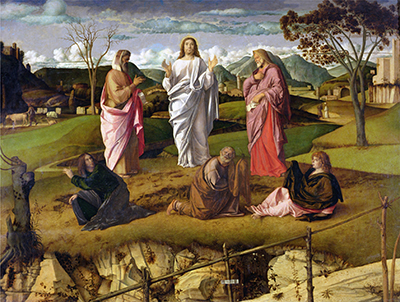
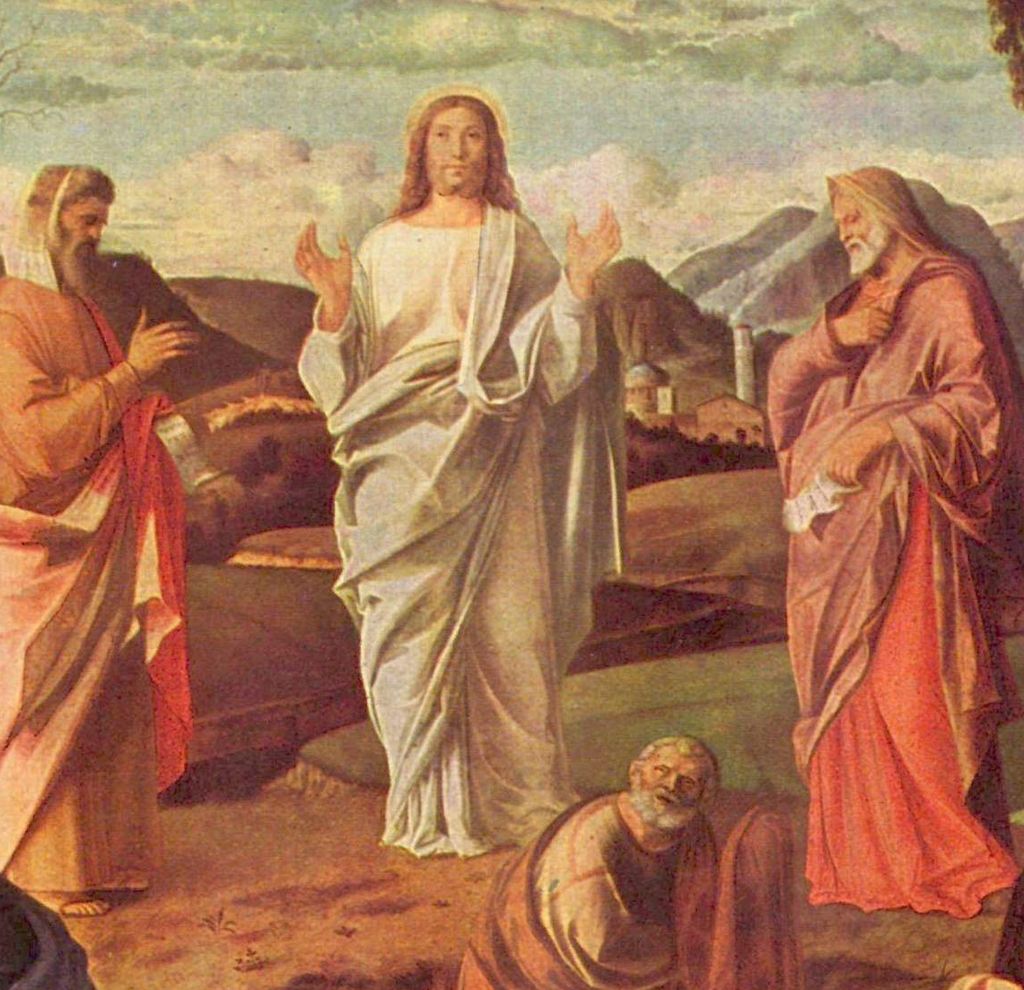
A rough fence runs across the bottom of Giovanni Bellini’s Transfiguration of Christ. Above it, Christ stands with both hands raised and looks straight out of the picture. The folds of his white robe pick up light as clouds do. Behind the prophets at his sides, the ground rolls away into fields, roads and distant hills. Bellini painted this broad oil on wood around 1478–79. It belongs to the Farnese Collection at the Museo e Real Bosco di Capodimonte in Naples, whose restoration report gives its dimensions as 117 × 149.7 cm and its inventory as Q 1930 no. 56, shortened to Q56 in Italy’s national catalogue. [1] [2] [3]
At a Glance
- ArtistGiovanni Bellini
- DateAbout 1478–79
- MediumOil on panel
- LocationMuseo e Real Bosco di Capodimonte, Naples
The work in Bellini’s career
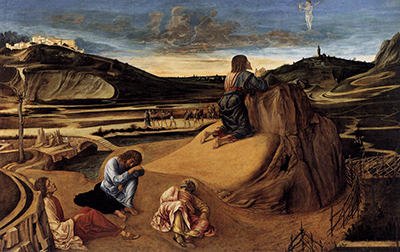
The Agony in the Garden
c. 1458–60Presentation at the Temple
c. 1475The later Transfiguration in Naples
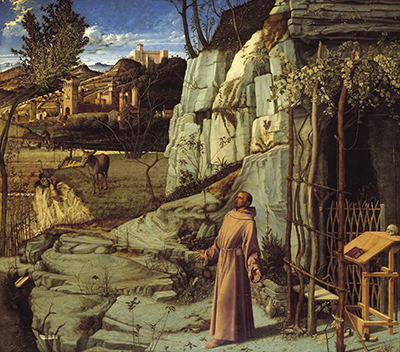
About 1478–79St. Francis in the Desert
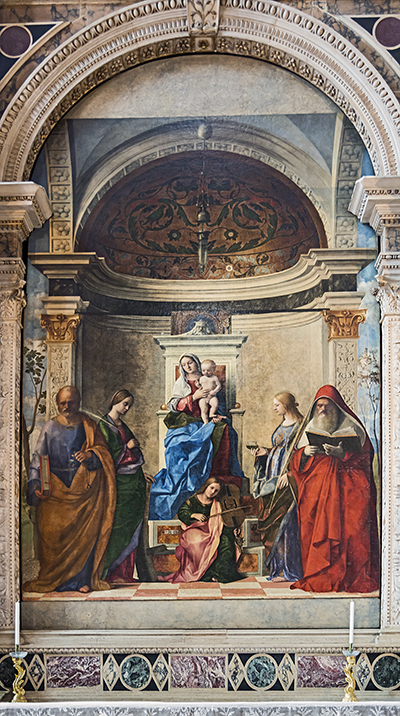
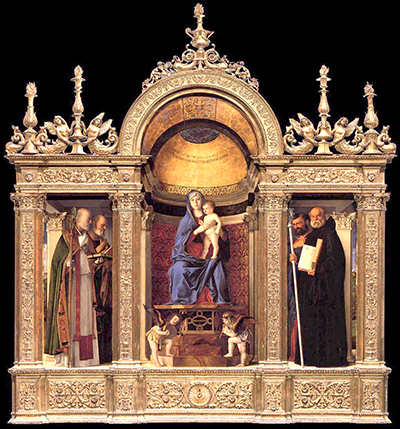
Late 1470sFrari Triptych
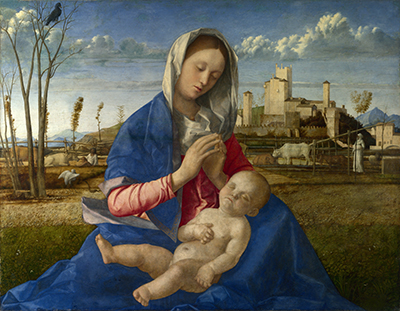
1488Madonna of the Meadow
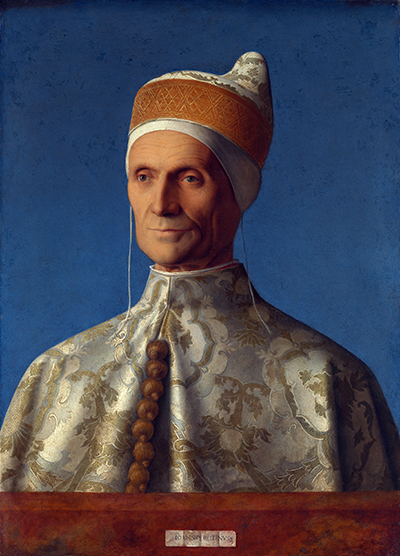
c. 1500–05Doge Leonardo Loredan
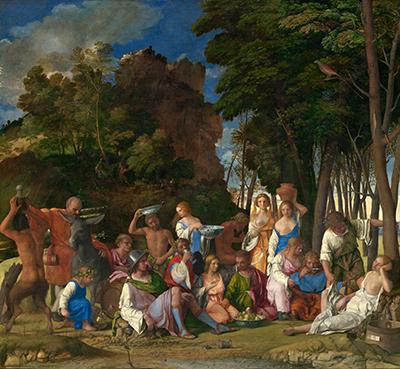
c. 1501–02The Feast of the Gods
Bellini’s signed date 1514The fence, the hillside and the sky
The Gospel accounts in Matthew, Mark and Luke tell how Jesus took Peter, James and John up a mountain. His appearance changed, his clothes became dazzling, and Moses and Elijah appeared beside him. A voice from a cloud identified him as God’s Son. In Luke, the prophets speak with Jesus about what he is to undergo in Jerusalem. The traditional association of Moses with the Law and Elijah with the Prophets gives their presence a particular force. The two men beside Christ bring the Hebrew Scriptures into a scene from the Gospels. [3] [4] [5]
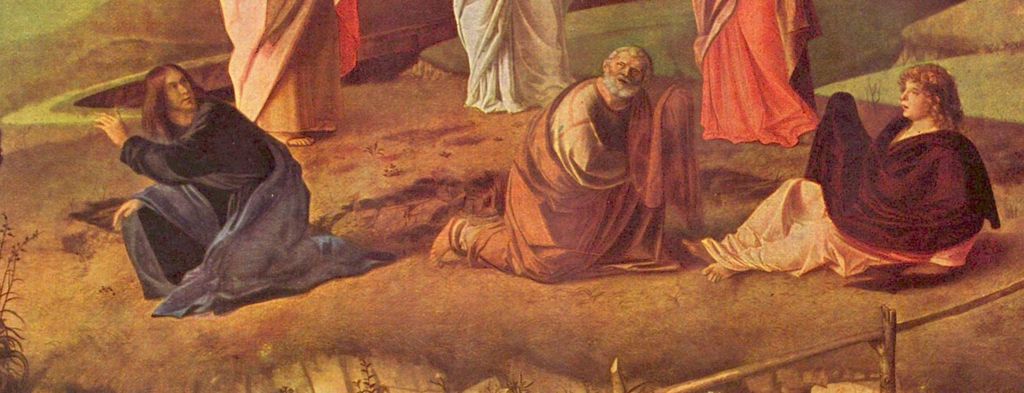
Bellini puts the three standing figures on the same shelf of ground. Christ faces directly towards us, with the open hands and extended arms of the orant, a figure at prayer in early Christian and Byzantine art. Beneath him, one apostle twists and extends an arm, another cranes up from his knees, and the third turns his face across his raised knee. Their bodies register the event in different ways. The two prophets lower their eyes, and Christ’s steady frontal gaze makes the viewer an additional witness. [3] [4] [5]
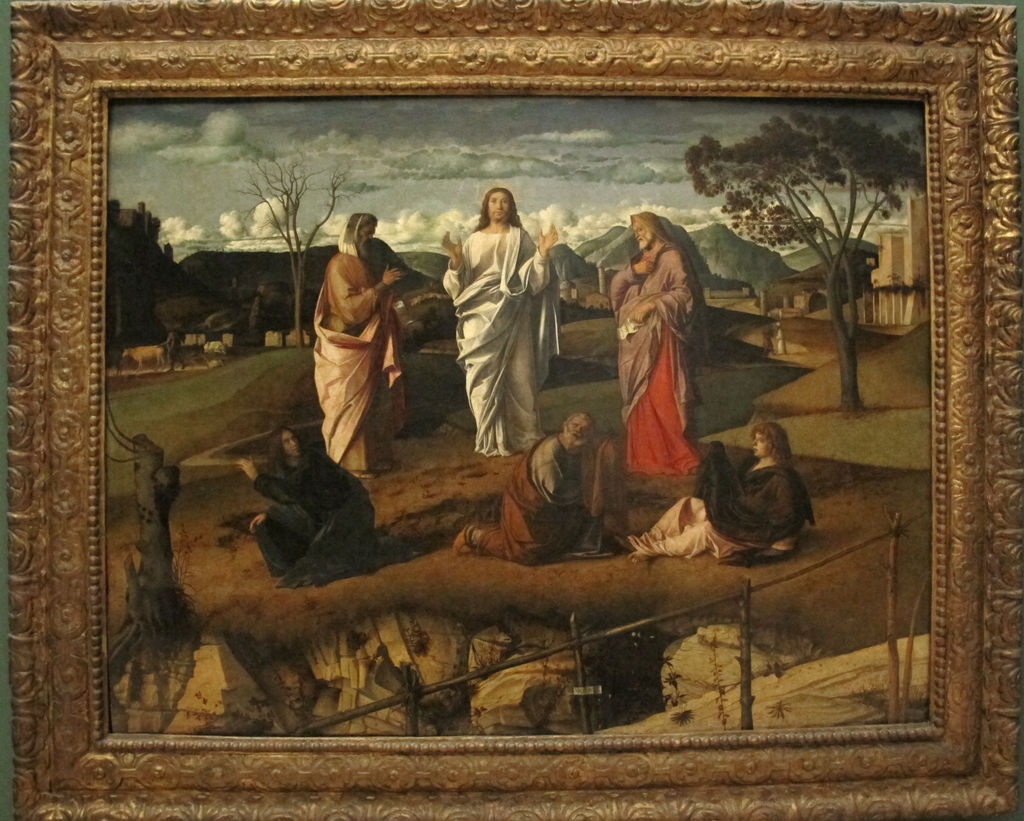
Follow the fence from the lower edge towards the right and the ground begins to make sense. Thin rails tied to upright stakes mark the nearest edge of a rocky drop. Beyond it, the apostles occupy a rough platform that rises gently to the feet of the standing figures. The low horizon leaves room for a strip of bright cloud to run behind all three heads. The jagged rock faces close to the viewer are sharply broken, and small plants lodge in their crevices. The Louvre relates the precision of that foreground geology to Bellini’s brother-in-law Andrea Mantegna. Farther back, colours merge as successive slopes recede. [3] [4] [6]
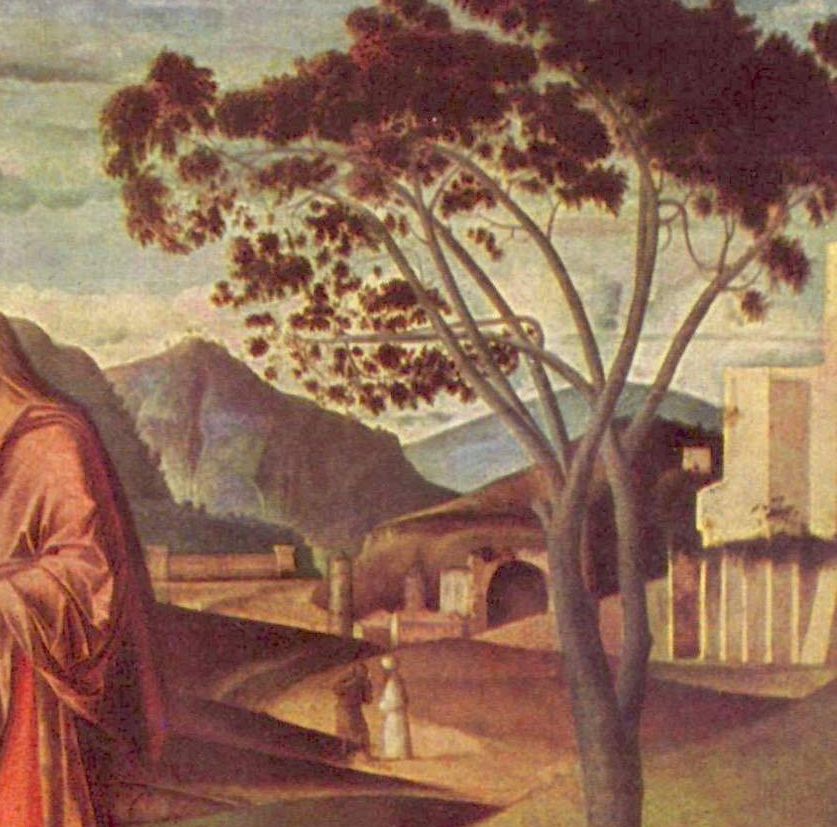
The landscape has its own activity. A farm worker and cattle move through the left-hand fields. A shepherd’s flock on a farther slope and two small figures beside a route at the right are easy to miss at first. A bare tree splits the light at left, and the dense crown of another at right changes the scale of the sky. Rullo and Cerasuolo suggest that the two people on the right represent a Muslim and a Jew, continuing their conversation at a distance from the revelation. Their identities are interpretive, while their posture and small scale make their absorption in each other visible. Bellini keeps these passages in view even while the white robe claims the centre. There is enough space to follow a road into the painting or look up to the bank of dark cloud from which the Gospel voice comes. [3] [4] [5]
Capodimonte identifies the Mausoleum of Theodoric and the bell tower of Sant’Apollinare in Classe, both at Ravenna, among the distant buildings. The basilica contains a mosaic of the Transfiguration. There, a jewelled cross represents Christ, while Saint Apollinaris stands below in prayer among sheep. The conservation researchers suggest that the stance of Bellini’s Christ and the sheep on the hillside recall the mosaic. The comparison helps explain how a familiar Italian landscape could carry a reference to much older Christian art. The rocky foreground has prompted another proposed allusion. The researchers relate the prongs on the cut trunk to the nails of the Crucifixion, a reading consistent with the Gospel conversation about Jerusalem. [4] [5]
The Hebrew inscriptions and the earlier painting
The texts are small enough to disappear in a reduced reproduction. The Restituzioni catalogue records the Hebrew year 5239 on both prophets’ scrolls. That year spans parts of 1478 and 1479, the basis for the museum’s dating. The slip low in the picture near the fence bears the separate Latin signature Ioannes Belli. On Moses’s scroll, David Jacoby read the name Menahem son of Moses beside the date. The reading establishes a name in the painting. The person’s identity and part in the commission remain uncertain. [2] [4] [6] [7]
Elijah’s scroll is harder to read. The Restituzioni catalogue records a possible reference to God gathering his people. The scholar Maria Luisa Mayer Modena identified a word she could decipher and proposed reconstructing the passage as Isaiah 40:11, where the Lord tends his people like a shepherd. That proposal has a visual counterpart in the flock, and the partial inscription leaves room for different readings. The scrolls reward looking closely in their own right, as details that carry both religious meaning and historical evidence. [4] [5] [7]
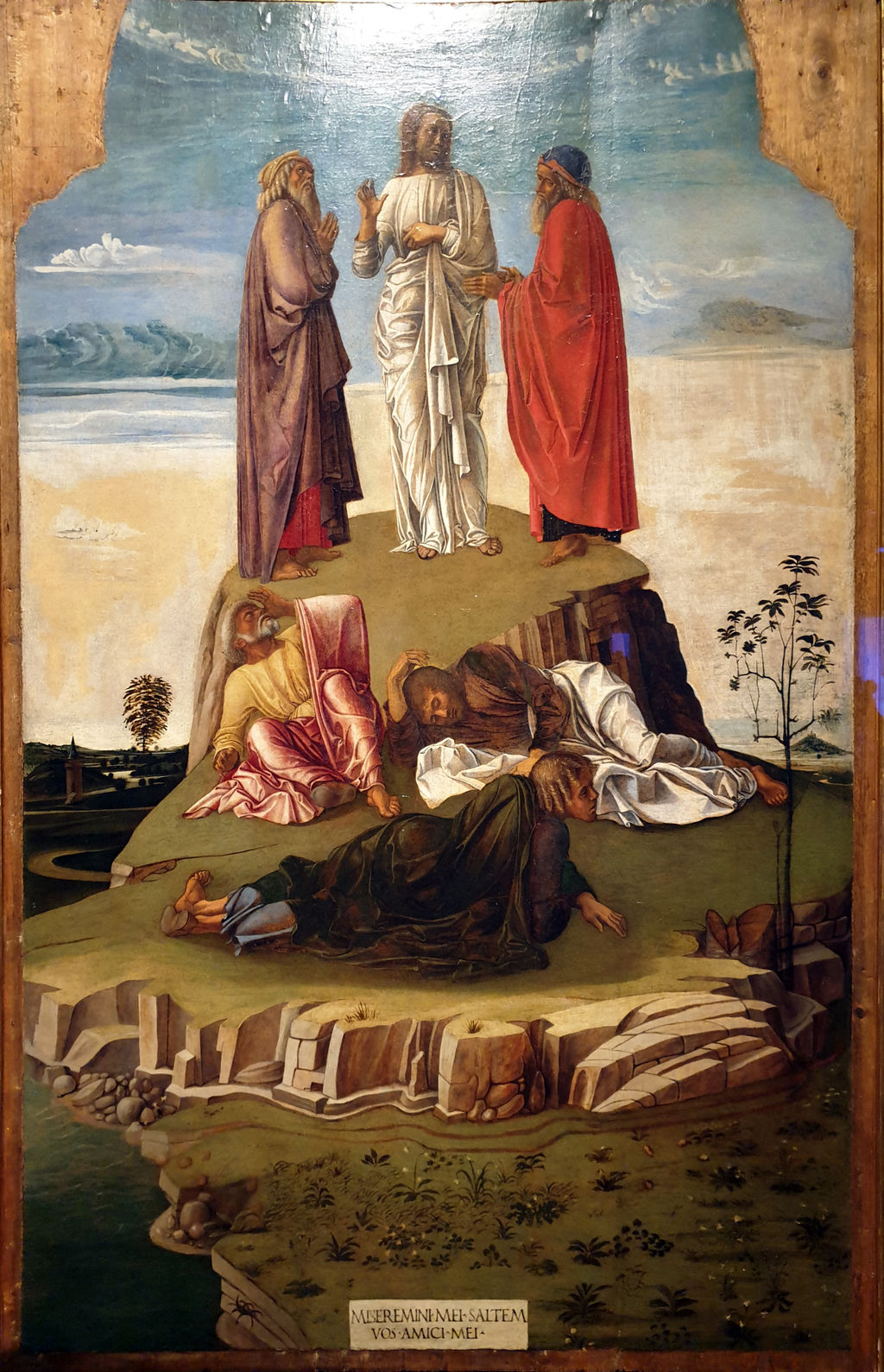
Bellini had painted the subject before. His early Transfiguration at the Museo Correr is a tall Venetian panel in which the eye climbs over sharper tiers of rock from the apostles towards the summit. In Naples, the enclosure and the sweep of distant country give much more of the picture to the horizontal movement of the eye. There is a closer relationship beneath the surface. The Naples prophets originally had their eyes open and turned towards Christ, as in the earlier painting. Bellini lowered their eyelids at the painting stage. He thus gave Christ the strongest outward gaze while the two witnesses beside him appear absorbed in thought. Bellini returned to the subject again for San Salvador in Venice. A head of Christ and a signature fragment associated with that work survive in the Gallerie dell’Accademia. [3] [4] [5] [6] [8] [9]
How Bellini painted the light
Infrared reflectography picked up fine brush hatching in the preparatory drawing, where Bellini planned the shadows as well as the outlines. The preparatory design was precise enough for him to reserve spaces for the figures within the landscape. Technical analysis identified egg yolk dispersed in walnut oil in a pale green preparatory layer beneath the meadow passages. The opaque base supported much thinner glazes that vary the fields from blue-green to brown. Capodimonte also records vermilion and malachite in mixtures that give the shadows of the foreground stone a pink or green cast. [4] [6]
A study by Laurence de Viguerie and colleagues used X-ray fluorescence to map elements and hyperspectral imaging to compare how the paint reflects light at different wavelengths. The maps show lapis lazuli in the blue around Christ’s head and azurite in darker sky passages. The rays immediately around Christ are painted in powdered gold, laid over an amber-coloured translucent halo. Bellini used lead-tin yellow for the rays in the sky. The researchers read this as a material distinction between sacred radiance and sunlight. They also found that Christ’s head had a longer, narrower outline in an earlier state of the design. They suggest that his eyes may initially have been directed upwards or towards Moses. The scans establish the earlier shape more clearly than the direction of the eyes. [5]
The robe depends on small changes in white. A little red lake warms the colour of the inner tunic. Cooler grey shadows in the outer cloak contain antimony, which the research team identified with the mineral pigment stibnite. The study reported this as the earliest instance then identified in a painting. Those cooler shadows give the larger folds weight, while the warmer cloth near Christ’s face catches the eye. From a distance, the two whites help distinguish the folds even where adjacent passages receive the same light. [4] [5]
From the Farnese palaces to Capodimonte
The original destination remains open. Capodimonte and the Restituzioni authors consider the Fioccardo chapel in Vicenza Cathedral a likely possibility. The cathedral archpriest Alberto Fioccardo set plans for the chapel in motion in 1467. Its dedication to the Transfiguration gives it a direct connection to the subject, which had received new liturgical prominence a decade earlier when Pope Callixtus III extended the feast to the universal Church after the victory at Belgrade. The historian Francesco Barbarano recorded a painting by Bellini in the chapel, which was later rebuilt to accommodate the relics of Vicenza’s patron saints. Archival researcher Agata Keran has stressed that the documentary link between the chapel and this particular panel is incomplete. The painting is securely recorded in the Farnese palace at Rome in the inventories of 1644 and 1653 cited in the conservation catalogue. It then appears in Parma, first at the Palazzo del Giardino and later at the Palazzo della Pilotta. Charles of Bourbon inherited the collection through his mother, Elisabetta Farnese, and took the painting to Naples in 1734. [4] [5] [10]
French forces removed the painting in 1799, and it was recovered at Rome before it could be sent further. It spent the years from 1806 to 1815 in the Bourbon collections at Palermo. By 1816 it was in the Palazzo degli Studi at Naples, and it remained with the museum collections there until moving to Capodimonte in 1957. In 2016–17 Capodimonte lent it to the Gallerie d’Italia at Palazzo Leoni Montanari in Vicenza for the five-hundredth anniversary of Bellini’s death. The painting was presented during its treatment at the 2018 Restituzioni exhibition and appeared again in the 2022 edition in Naples. At the Louvre’s 2023–24 Naples à Paris exhibition, in the Grande Galerie, the panel hung near the Louvre’s own Bellinis and two paintings by Antonello da Messina of similar date. [3] [4] [11] [12]
What the restoration could recover
The painting’s reverse is made from two horizontal poplar boards. A past intervention thinned the wood and attached a rigid lattice, or cradle, to keep the panel flat. Over time, the restraint contributed to cracks and compression. Roberto Buda removed the fixed bars, repaired the splits and fitted a chestnut support built to the curvature the wood took when released. Spring fittings allow the panel some movement as its surroundings change. Angela Cerasuolo treated the painted surface. Capodimonte announced the restored work’s return to display in March 2020, and the fuller treatment record appeared in the 2022 Restituzioni catalogue. [1] [4] [6]
One nineteenth-century episode shows how much can hinge on the condition of a face. In 1878 a claim by the restorer Achille Fiore that he had supplied a missing head prompted an official enquiry. Recent inspection revealed extensive abrasion in the area of Peter’s face, where little original surface survives beneath nineteenth-century repaint. The conservators retained that repaint. They could remove more of the later paint from James, whose face remained substantially readable beneath it. They also thinned layers added during earlier restorations where further removal would have exposed preparatory paint stripped of its finishing glazes. A loss near Christ’s right hand and damage elsewhere were integrated with fine hatching that can be recognised up close. [4] [6]
The earlier restoration of 1959–60 had raised doubts about the leafy tree at the right and one of the small figures nearby. Both were hard to see in an X-ray, and their apparent absence raised the possibility that they had been added later. The recent examination found that the materials in those passages are relatively transparent to X-rays and confirmed that both details are original. The tree and figures therefore belong to Bellini’s conception of the landscape. They repay a second look after the brilliant figure at the centre has caught your eye. [4] [6]
Annotated Details from Transfiguration of Christ at Capodimonte
Numbered overview and cropped details. Photograph Faithful reproduction via Wikimedia Commons. Image source. Public Domain Mark 1.0.
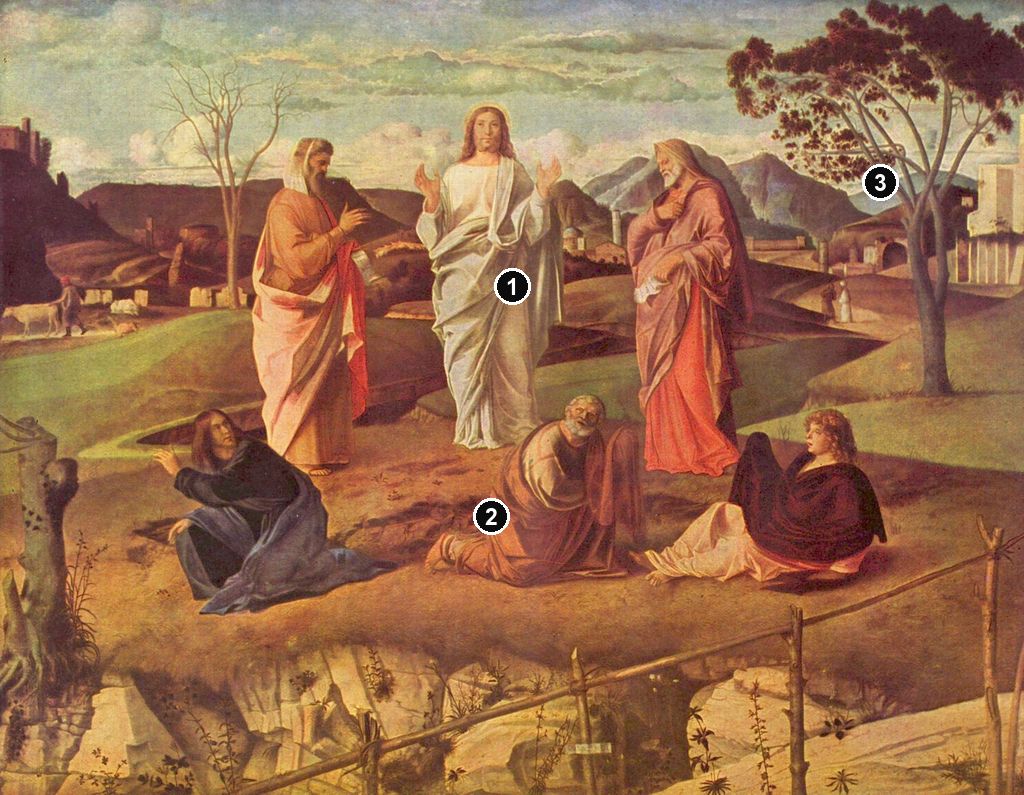
Details from TRANSFIGURATION OF CHRIST AT CAPODIMONTE
Follow the wide composition across the witnesses, the foreground fence and the distant landscape.
The summit group
Christ stands between the prophets. Each figure is given room to turn against the horizontal sweep of landscape.
Disciples on the grass
The figures sit, kneel and twist within the same field. Their line of attention gathers around Christ higher on the hill.
Boughs and buildings
The dark branches on the right break the pale sky. Buildings stretch into the distance beneath and beyond them.
Related reading
Artworks directory
Discussion
Look again at the images and ideas explored in Transfiguration of Christ by Giovanni Bellini (Capodimonte). These editorial prompts invite your observations.
Reader Insights
How does the fence affect the way you approach Christ and the disciples?
Which aspect of the picture changes most when you compare it with the Venice version?
How do the changes discovered during conservation affect the way you read the visible landscape?
Join the Conversation
Share a detail, comparison or question about Transfiguration of Christ by Giovanni Bellini (Capodimonte) below.
References
- Museo e Real Bosco di Capodimonte, Annual Report 2020, “Restauri” View source.
- Italian Ministry of Culture, catalogue record 1500625193, “Trasfigurazione” View source.
- Musée du Louvre, “La Transfiguration du Christ”, Naples à Paris object dossier View source.
- Alessandra Rullo and Angela Cerasuolo, “Giovanni Bellini. La Trasfigurazione”, Restituzioni (2022), pp. 326–337 View source.
- Laurence de Viguerie and colleagues, scientific investigation of Bellini’s Transfiguration, Heritage Science 11, 163 (2023) View source.
- Museo e Real Bosco di Capodimonte, restoration of Bellini’s Transfiguration (2020) View source.
- Maria Luisa Mayer Modena, “Scritte in ebraico nelle opere d’arte italiane”, Acme LX/3 (2007), pp. 113–114 View source.
- Museo Correr, “La trasfigurazione di Cristo”, collection record View source.
- Gallerie dell’Accademia di Venezia, “Testa di Cristo e cartiglio”, catalogue 87 View source.
- Agata Keran, interview on the Vicenza documents and Bellini’s Transfiguration (2021) View source.
- Museo e Real Bosco di Capodimonte, return from the Vicenza exhibition (2017) View source.
- Restituzioni, 2022 exhibition and works list View source.