


 by Tom Gurney
Tom Gurney BSc (Hons) is an art history expert with over 20 years experience
Published on June 19, 2020 / Updated on November 3, 2026
Email: tomgurney1@gmail.com / Phone: +44 7429 011000
Two Women Waltzing at the Moulin Rouge by Henri de Toulouse-Lautrec: Introduction
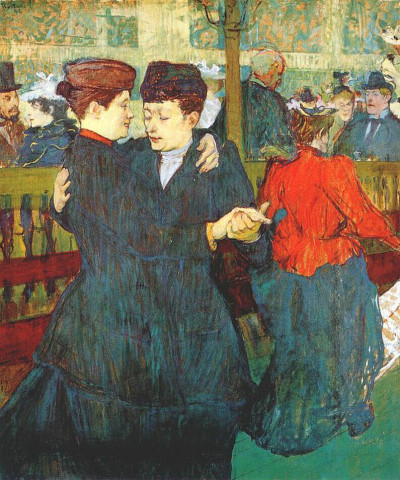
The dancers are close enough for their dark clothes to form a nearly continuous shape. One woman turns her face towards her partner; an arm reaches around a shoulder, while their joined hands project towards the right. Behind them, another woman in a brilliant red blouse faces away. Henri de Toulouse-Lautrec brings us close to a paired dance, letting the surrounding room appear in fragments around the turning bodies.
National Gallery Prague identifies its painting as Moulin Rouge (Waltz at the Moulin Rouge) and dates it to 1892. The title is also rendered in English as Two Women Waltzing at the Moulin Rouge. The painting shown here should be distinguished from Lautrec's separate printed treatments of women dancing: a shared subject does not make different compositions the same work. [1]
At a Glance
- ArtistHenri de Toulouse-Lautrec.
- Subjecttwo women dancing together at the Moulin Rouge.
- Date1892, according to National Gallery Prague.
- Institutional titleMoulin Rouge (Waltz at the Moulin Rouge).
- CollectionNational Gallery Prague.
- Distinguishing featurethe close foreground pair beside a woman in a red blouse seen from behind. [1]
This work across Henri de Toulouse-Lautrec’s career
Contents
- The turn begins in the upper bodies
- Skirts give movement a visible shape
- The red blouse changes the balance
- A room glimpsed around the dancers
- Social dance and public spectacle
- Why the painting's identity matters
The turn begins in the upper bodies
Start with the dancers' heads. They are close together but do not face the viewer in the same way. The woman at the left is turned away from us towards her companion; the other face is more open to our view. This unequal access gives the pair a direction. We seem to catch a particular phase of their movement rather than a symmetrical pose arranged for a portrait.
Their arms make the relationship clearer. The hand resting near the far shoulder brings one body around the other, while the extended hands establish a second point of contact towards the right. Together these contacts create an enclosing shape across the upper part of the group. The viewer can read the embrace without seeing every joint. Lautrec lets the positions of a few hands explain the connection among much larger areas of dark clothing.
The faces occupy only a small part of the painted surface, yet their lighter tones make them especially noticeable. Their closeness supplies an immediate sense of shared attention. It does not establish the women's names or the nature of their relationship. The painting gives us a dance and a bodily exchange; those visible facts remain engaging without adding a story about the sitters that the consulted museum programme does not provide.
Skirts give movement a visible shape
Below the arms, the dark dresses widen into a substantial foreground mass. Their edges do not simply fall straight down from the shoulders. Fabric spreads across the lower left and curves around the pair, making the bodies seem to occupy space through movement. The clothes are part of how the turn becomes visible: their breadth suggests the area swept by the dancers, even where individual legs and steps are difficult to separate.
The surface within that broad mass is active. Vertical and slanting strokes interrupt the darkness, catching changes of direction in the folds. Some passages appear greener, others more nearly black or blue. Looking only for a continuous contour would miss this internal rhythm. The dresses hold together as a large shape, but the marks inside it keep the surface from becoming an inert block at the front of the picture.
The lower edge also changes our position as viewers. We are too close for a complete, clearly separated demonstration of both dancers' footwork. The picture privileges the pair's upper-body connection and the movement of clothing over an instructional view of their steps. That closeness makes the action feel encountered within the room. We see what a nearby observer might notice first, while some information disappears behind other bodies or beyond the frame.
The red blouse changes the balance
The woman at the right gives the dark pair a strong neighbour. Her bright red blouse, gathered above a blue-green skirt, is among the painting's clearest colour accents. Because she faces away, her back supplies a relatively broad, uninterrupted area of colour. The central dancers' faces and hands are small, light points; this neighbouring figure balances them with a larger, warmer presence.
She also prevents the pair from becoming an isolated emblem against an empty ground. Her body overlaps the room and competes for space beside them. We cannot see the dancers independently of the people around them. The scene's movement is therefore social as well as bodily: one pair occupies a busy floor on which other figures have their own directions, gestures and fields of attention.
Compare the upper and lower portions of this neighbouring figure. The red blouse makes the torso immediately distinct, while the skirt approaches the cooler colours of the floor and the dancers' clothes. The difference encourages the eye to rise towards her back and then return towards the central hands. Colour directs our route through the picture without needing a clearly marked path across the dance hall.
Watch: Toulouse-Lautrec
Choose an artist introduction, a film about graphic design or a closer look at At the Moulin Rouge.
A room glimpsed around the dancers
Behind the foreground bodies, small figures gather at tables or stand in the room. Their reduced scale and abbreviated features suggest distance, but the interior is not laid out as a spacious architectural panorama. Furniture, heads and vertical divisions appear wherever the principal group leaves an opening. The foreground dancers seem to have entered a room already populated by people and objects.
The left side is particularly busy. Small patches of pale face, dark hat and red seating compress the social setting into a narrow strip. These accents give the dance a surrounding audience without making every background person a spectator of this particular pair. Some attention may be directed elsewhere. The picture remains convincing because it allows more than one activity to coexist rather than organising the whole room around a single performance.
Vertical elements in the upper background offer a steadier framework behind the moving clothes. They help us distinguish the room's relatively fixed structure from the dancers' curved arrangement. Yet they do not dominate the image. Lautrec lets the interior serve as a setting for movement while keeping the principal visual weight close to us, where the pair's overlapping bodies occupy so much of the surface.
Social dance and public spectacle
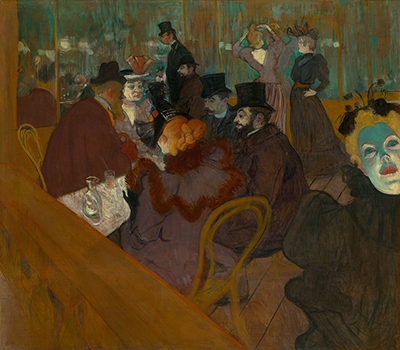
The comparison with At the Moulin Rouge, the Dance is illuminating. In that larger dance-hall scene, a performer and onlookers establish an area of display. Here, the joined pair draws attention inward, towards the connection between two people. The room remains present, but it is seen around a compact action instead of opening broadly around a featured dancer.
This difference changes what we notice. A public spectacle encourages us to follow a conspicuous gesture and the responses of an audience. The waltzing pair asks us to read smaller adjustments: the angle between faces, the reach of an arm, the distribution of cloth around turning bodies. Neither approach is a neutral record of everything in the venue. Each selects a particular relationship between movement and the people who share its space.
The women dancing together should likewise be described without an invented explanation. The picture does not tell us that male partners were unavailable, nor does it name the pair or state what they felt. Its intimacy is visible in proximity and contact. An account that immediately supplies a social anecdote risks overlooking how carefully that intimacy is made through the arrangement of paint on the surface.
Why the painting's identity matters
Prague's Czech title, Valčík v Moulin Rouge, places the waltz within the work's institutional identification. Its museum programme includes the painting in a discussion of the French collection. That evidence supports the title, date and collection used here; it does not by itself supply a full technical account or biographies of the sitters. Keeping those limits clear allows the visual analysis to remain attached to the actual painting. [1]
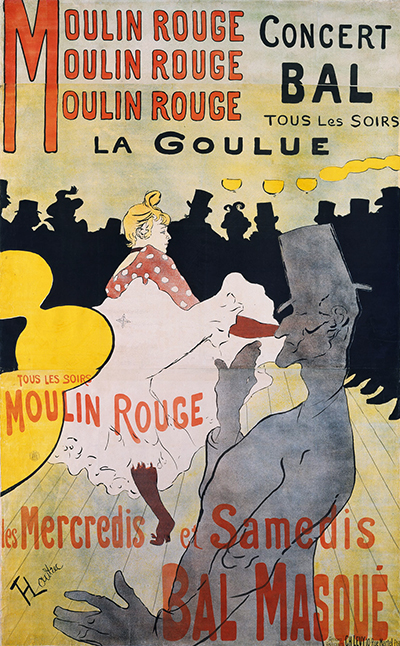
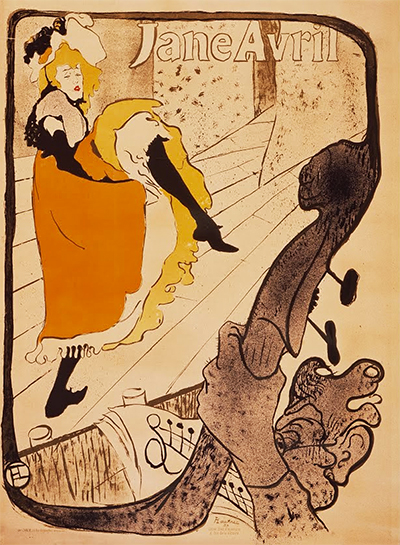
Lautrec's prints make another kind of encounter with dance possible. A printed image has its own composition, materials and history of impressions. Even when two women appear in both a painting and a print, details such as the foreground embrace, the red blouse and the fragmented café background identify what we are looking at here. Repetition of a theme is an invitation to comparison, not a reason to exchange catalogue facts.
Return to the joined hands at the right. They are small beside the broad dresses, but they make the partners' coordination legible. From that point, the eye can travel through the arms to the faces, down through the folds and out towards the neighbouring red figure. The painting's sense of rotation is distributed across that whole route. It captures a dance through relationships among bodies, fabric and surrounding space, rather than through an exaggerated single gesture.
Toulouse-Lautrec artworks directory
Browse 84 identified works and publications in this researched selection. Dates and titles follow the individual records; this is not a complete catalogue of the surviving oeuvre. Print impressions remain attached to their designs. Some listed works do not have a dedicated article. The Drawings guide also contains nine illustrated studies consolidated from former articles.
Discussion
Look again at the images and ideas explored in Two Women Waltzing at the Moulin Rouge by Henri de Toulouse-Lautrec. These editorial prompts invite your observations.
Reader Insights
Which hand or arm first makes the dancers’ connection clear to you?
How does the red blouse change the balance of the dark foreground pair?
What can you see of the room through the spaces left around the dancers?
Join the Conversation
Share a detail, comparison or question about Two Women Waltzing at the Moulin Rouge by Henri de Toulouse-Lautrec below.
References
- National Gallery Prague, Krátké komentáře ke 100. výročí nákupu Francouzské sbírky ČSR, museum programme identifying Henri de Toulouse-Lautrec's Moulin Rouge (Valčík v Moulin Rouge), 1892. Institutional title/date entry consulted; dimensions, inventory number and sitter identities are not asserted here. View source.
- Autoportrait, 1880 (in French). View source.
- ALBERTINA: Der Schimmel Gazelle,GE123DL. View source.
- Franka Blok, Portrait of Vincent van Gogh, 2024. View source.
- Art Institute of Chicago: Moulin Rouge, La Goulue. View source.
- Art Institute of Chicago: At the Moulin Rouge. View source.
- Jane Avril, 1893. View source.
- Au Salon de la rue des Moulins (in French). View source.
- Colta Ives, Toulouse-Lautrec in The Metropolitan Museum of Art, 1996. View source.
- Maurice Joyant (in French). View source.
 Henri de Toulouse-Lautrec.jpg)