


 by Tom Gurney
Tom Gurney BSc (Hons) is an art history expert with over 20 years experience
Published on June 19, 2020 / Updated on November 3, 2026
Email: tomgurney1@gmail.com / Phone: +44 7429 011000
Horse by Henri de Toulouse-Lautrec: Introduction
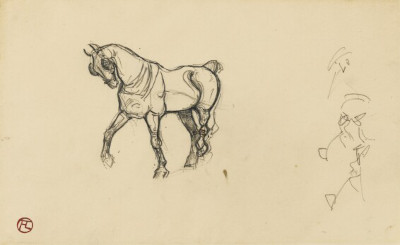
A horse lifts a foreleg into the empty space at the left of a broad sheet. Its body is carefully articulated, while three much smaller human profiles occupy the right margin. Henri de Toulouse-Lautrec's Horse brings these different kinds of observation together without turning them into a single scene. The animal dominates, but the little heads keep the surrounding paper active.
The drawing matches the recto illustrated in Sotheby's 2017 catalogue as Cheval — recto; Cheval — verso, lot 82. The match includes the horse's pose, the three profiles, the red monogram stamp and the small mark below the animal. Sotheby's identifies pencil on paper and reports Dortu numbers D.I.123 for the recto and D.I.124 for the reverse. Its accessible description does not supply an execution date; MutualArt dates the same lot approximately 1879–1881. That range remains an approximate catalogue dating. [1] [2]
At a Glance
- ArtistHenri de Toulouse-Lautrec.
- Auction titleCheval — recto; Cheval — verso.
- Mediumpencil on paper.
- Datecirca 1879–1881 in MutualArt; undated in the accessible Sotheby's description.
- Sheet8 × 12⅜ inches in Sotheby's catalogue.
- Reported catalogue referencesDortu D.I.123 and D.I.124.
- Illustrated siderecto, with horse and three small profiles. [1] [2]
This work across Henri de Toulouse-Lautrec’s career
Horse (current article)
Circa 1879–1881 (MutualArt); undated in accessible Sotheby’s description [1] [2]At the Moulin Rouge
1892–1895 [7]Jane Avril
1893 [8]Contents
- A horse taking up space
- The lifted foreleg
- Three profiles at the edge
- Pencil, paper and the red stamp
- A drawing with another side
A horse taking up space
The horse occupies the left and central parts of the sheet. Its head inclines towards the left, its back runs across the upper middle, and its legs extend below. The animal is large enough for the changes within its outline to be legible, yet substantial areas of paper remain around it. This combination gives the body weight without enclosing it in a stable or landscape.
The upper contour is particularly economical. Ears, mane, neck, back and rump make a continuous route for the eye, but they do not all receive equal emphasis. Short, crowded marks near the head give way to longer stretches across the torso. The change helps distinguish the horse's alert, compact head from the broader mass of its body.
Inside that contour, curved lines suggest the neck and the turning surfaces of the flank. These marks are more than a diagram of an outline. They make the horse's body seem to have different planes, with one part passing into another. The pale paper remains visible between them, so volume emerges through selected accents rather than a fully shaded coat.
The lifted foreleg
The most open gesture is the leg reaching forward at the left. Its bent joints interrupt the more upright rhythm of the other limbs. The small hoof appears suspended against an almost unmarked area. Because the space around it is so clear, that modest movement becomes one of the drawing's strongest signals.
The remaining legs are harder to separate at first glance. Their contours overlap beneath the body, with darker passages around the joints and hooves. Looking from the isolated foreleg towards this denser group, we move from a simple shape to a more complicated arrangement. The drawing uses both clarity and overlap to convey an animal whose limbs occupy different positions in depth.
It is tempting to name a precise gait from any horse pictured with a raised leg. Here the image offers a single arrangement, without a sequence of successive positions or a documented observation session. We can discuss the lifted limb, the planted-looking hooves and the body's balance without claiming a particular instant of a formally identified gait.
The contrast between leg and torso also changes the picture's rhythm. The body is relatively broad and contained. Below it, the limbs break that mass into narrow, angular passages. The animal consequently feels both substantial and capable of movement. Much of that effect depends on the white intervals between its legs.
Watch: Toulouse-Lautrec
Choose an artist introduction, a film about graphic design or a closer look at At the Moulin Rouge.
Three profiles at the edge
The small heads at the right belong to a different scale of drawing. One appears near the upper corner, another below it, and a third farther down. Their features are made from comparatively few strokes. Noses, headwear and changes at the chin establish profiles without the fuller treatment given to the horse.
They are separated from the animal by a broad interval. Nothing in the visible arrangement establishes that these people are standing beside the horse, watching it or occupying the same location. Their presence is better understood first as another use of the sheet. The paper holds several observations, and those observations need not be joined into an illustrated anecdote.
The profiles nevertheless affect how we see the central subject. Their slight, abrupt lines make the horse's more sustained contours seem deliberate. Their position near the edge also gives the right side a reason to remain open. Without them, the paper might appear simply to extend beyond the animal; with them, our attention has somewhere else to go.
The difference is especially noticeable when the drawing is seen small. The horse reads immediately as a complete body. The profiles invite a second, closer look. Lautrec has allowed a dominant study and peripheral marks to coexist, preserving the difference in their scale and degree of elaboration.
Pencil, paper and the red stamp
The primary auction record describes cream wove paper and notes that the sheet was not laid down at the time of the sale. These are physical observations about the auctioned object, rather than conclusions drawn from its yellowish appearance online. A screen reproduction cannot by itself establish the paper's original colour or its present condition. [1]
A red circular monogram appears near the lower left. Sotheby's calls it the artist's monogram stamp. It should therefore be distinguished from a red pencil signature drawn as part of the horse study. Its strong colour makes it conspicuous in reproduction, but the catalogue's description is needed to understand what kind of mark it is. [1]
The stamp sits well below the animal. Visually, it gives the otherwise open lower area a small coloured accent. That effect belongs to our present encounter with the sheet, although it does not establish when the stamp was applied. The drawing's pencil marks and the identifying stamp have different functions, even when both are visible within one image.
A drawing with another side
The auction title identifies a horse on each side of the paper. Recto and verso describe the two faces of one sheet, not two editions of a print. The image reproduced here shows the side matched to the catalogue's recto illustration. The title alone is insufficient grounds for describing the reverse horse's pose or inventing a relationship between the two studies. [1]
Sotheby's also cites Dortu's 1971 catalogue, giving separate numbers for the two faces. Those references help distinguish this sheet from Lautrec's many other equestrian drawings. They are reported from the auction record; they do not mean that the original catalogue has supplied an independently checked account of every mark visible here.
For a different treatment of an animal's head, compare Philibert the Pony. That lithograph concentrates attention on the neck, mane and face. Horse instead combines a complete body with three small human profiles. Its interest lies in the way one sheet accommodates close study, a suggestion of movement and the artist's attention passing towards something else.
Toulouse-Lautrec artworks directory
Browse 84 identified works and publications in this researched selection. Dates and titles follow the individual records; this is not a complete catalogue of the surviving oeuvre. Print impressions remain attached to their designs. Some listed works do not have a dedicated article. The Drawings guide also contains nine illustrated studies consolidated from former articles.
Discussion
Look again at the images and ideas explored in Horse by Henri de Toulouse-Lautrec. These editorial prompts invite your observations.
Reader Insights
How does the lifted foreleg differ from the other limbs?
What do the three small profiles contribute to the sheet?
How does the surrounding open paper affect the horse’s weight?
Join the Conversation
Share a detail, comparison or question about Horse by Henri de Toulouse-Lautrec below.
References
- Sotheby's, Cheval — recto; Cheval — verso, Œuvres sur Papier, Paris, 23 March 2017, lot 82: matching recto image, medium, dimensions, stamp, physical description and reported Dortu references. View source.
- MutualArt, Cheval — recto; Cheval — verso: the matching 23 March 2017 lot, approximately dated 1879–1881. This date is not stated in the accessible primary auction description. View source.
- Autoportrait, 1880 (in French). View source.
- ALBERTINA: Der Schimmel Gazelle,GE123DL. View source.
- Franka Blok, Portrait of Vincent van Gogh, 2024. View source.
- Art Institute of Chicago: Moulin Rouge, La Goulue. View source.
- Art Institute of Chicago: At the Moulin Rouge. View source.
- Jane Avril, 1893. View source.
- Au Salon de la rue des Moulins (in French). View source.
- Colta Ives, Toulouse-Lautrec in The Metropolitan Museum of Art, 1996. View source.
- Maurice Joyant (in French). View source.
 Henri de Toulouse-Lautrec.jpg)