 by
Tom Gurney
Tom Gurney BSc (Hons) is an art history expert with over 20 years experience
Email:
tomgurney1@gmail.com
/ Phone:
+44 7429 011000
The Red Studio by Henri Matisse: a room made with colour: Introduction
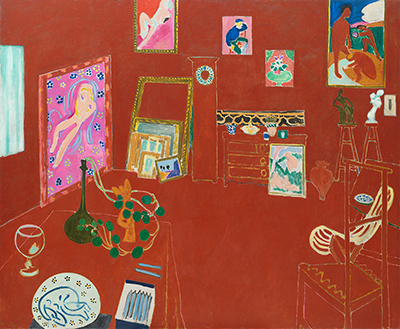
The first impression of Henri Matisse's The Red Studio may be that a bright red surface has swallowed a room. Stay with it and the room begins to reappear. A table edge, a chair, a long-case clock and the corner of a wall are drawn by slender gaps in the colour. Paintings and sculptures stand out in much fuller detail. The contrast makes the artist's work visible as a group while turning the place that contains it into something less certain. This was the studio Matisse used at Issy-les-Moulineaux, but it was not literally red. The red was a decision made in the painting. [1] [2]
Made in autumn 1911, the oil painting is about 181 centimetres high and 219 centimetres wide. It is now in the Museum of Modern Art, New York. Its size matters: the viewer meets an expanse of colour wide enough to surround the smaller pictures represented inside it. The Red Studio is both a view of a workplace and a gathering of Matisse's recent art. Its history leads from an initial commission that did not turn into a sale, through exhibitions in London and the United States, to MoMA's acquisition in 1949. Understanding that history helps explain why a picture once found puzzling became a central example of modern painting. [1] [3]
At a Glance
- Artist Henri Matisse.
- Title The Red Studio ( L'Atelier rouge ); shown as Panneau rouge in 1912.
- Date and place Autumn 1911, Issy-les-Moulineaux, near Paris.
- Medium and size Oil on canvas, 181 × 219.1 cm.
- Collection Museum of Modern Art, New York, object 8.1949.
- Look for The handless clock, thin unpainted-looking boundaries around furniture, pictures within the picture, sculpture, ceramic and plant forms. [1] [4]
This work across Henri Matisse’s career
Contents
- What room is Matisse showing?
- How does the red hold the room together?
- Which artworks are pictured inside it?
- Was the painting red from the beginning?
- Why did Shchukin not take it?
- How did the picture travel?
- How does it compare with Matisse's other interiors?
- What should you notice when looking closely?
What room is Matisse showing?
Matisse moved his main working space to Issy-les-Moulineaux in 1909, near a house shared with his family. The studio stood in a setting with gardens and a greenhouse, where flowers could supply subjects as well as objects for arrangement. By 1911 it held paintings, sculpture, ceramics, furniture and textiles from different parts of his practice. The room was therefore useful both as a place to make work and as a place to see earlier work together. The painting turns that second purpose into its subject. [4] [5]
A photograph taken around the time of The Red Studio provides rare evidence of the actual room. It shows artworks and furniture, but it does not look like a photographic version of the painting. In the canvas Matisse has selected, shifted and transformed what a viewer can see. MoMA's 2022 exhibition brought the picture together with a surviving group of the works represented in it; the project confirms that many small images within the canvas refer to real objects. Yet those objects do not make the painted studio a neutral inventory. Their sizes, placements and appearances have been adjusted to work within this red construction. [4] [3]
The room had a more deliberate physical history than a casual glance at its furnishings might suggest. MoMA's exhibition published letters between Matisse and a firm that supplied prefabricated buildings in 1909. Their plans concerned an iron-framed structure with a metal roof and wood-panelled interior. Matisse asked for changes to doors, window and storage before and after its assembly. The resulting studio was spacious and practical, giving him room for large canvases and a place to keep earlier work in view. A utilitarian building could become the setting for a painting that feels almost unbounded by ordinary walls. [4]
The picture was made about two years after this building was put in place. That interval is enough for a studio to acquire a working life. Paintings from Collioure and Issy could be brought together there; a sculpture might stay on a table while a canvas moved to another wall. MoMA's surviving photograph of the space shows that large works and ceramics were indeed present around the period of the painting. But a photograph fixes one view at one moment. Matisse's painted room brings together what mattered for his composition, including objects with histories extending well beyond that moment. The difference is useful evidence of choice, not a reason to accuse the painting of being inaccurate. [4]
A later family photograph, dated around 1915 in MoMA's exhibition research, shows Matisse with Amélie and their children in the Issy studio. Large Nude still occupies a wall there. This is useful evidence of continuity after The Red Studio was painted: one of the large works represented at the edge of the 1911 canvas remained part of the actual working space for years. The photograph also sets people beside the objects that the red picture leaves to stand alone. It does not prove a single reading of the painting, but it reminds us that the space was used by a family and an artist over time, not staged once solely to become a picture. [4]
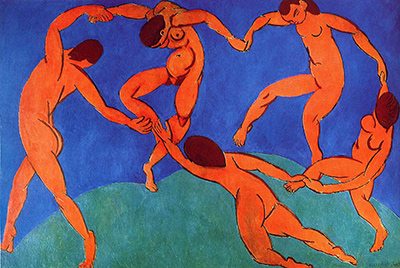
The studio lay at the centre of a period when Matisse was thinking hard about decoration and scale. His large Dance and Music projects for Sergei Shchukin had already demanded attention to a wall and to the viewer's distance from it. The Dessert: Harmony in Red of 1908 had spread a patterned red across another interior. Those works do not explain the later studio picture by themselves, but they help locate the decision to let colour organise a large canvas. The paintings guide follows how Matisse kept changing that relationship between room, surface and object. [5]
How does the red hold the room together?
There is no ordinary boundary where red wall ends and red floor begins. A line toward the left suggests recession, and furniture occupies recognizable positions, yet the red flows over much of what would be separate surfaces in a more descriptive interior. A table at the right, a chair and the central clock can still be found because other colours or thin gaps mark their edges. The room is neither a flat diagram nor a convincing window onto deep space. It gives enough cues for us to move through it while constantly bringing the eye back to the painted plane. [1]
The clock makes that experience especially clear. It stands near the centre, upright, symmetrical and easy to identify. Yet its face lacks hands. MoMA's label suggests an impression of time suspended in the studio; that is an interpretation made possible by the visible detail, not the clock's one compulsory meaning. Its vertical case also gives the composition a strong axis, holding one side of the wide canvas in relation to the other. The viewer can notice both roles without treating the object as a hidden message whose code has been solved. [1]
The pictures within the picture behave differently from the furniture. Their frames and internal colours remain relatively full, so they appear more definite than the red space around them. A small painting on the left may have its own landscape or figure; another on the wall has a character distinct from its neighbour. The red field separates these works from one another while also making them part of one place. That balance is the main visual event of The Red Studio . Its power lies less in a generalized wish to be “modern” than in a specific arrangement: one colour carries the room, while a group of smaller images keeps its own variety. [1] [3]
Even the places where colour stops matter. The narrow edges around furniture can feel like drawing, but they also reveal that a red surface can define a form by leaving something uncovered or differently painted. Follow one such edge around a chair and it may seem to describe a solid object; follow it into another red area and the certainty weakens. Matisse asks the eye to make and remake the space. That activity continues when a depicted sculpture, painted with more substance, reminds us that it once occupied actual space in the studio. [1]
Which artworks are pictured inside it?
The studio contains a small retrospective of Matisse's work. MoMA's 2022 exhibition reunited six surviving paintings, three sculptures and one ceramic that appear inside The Red Studio . These numbers describe what could be brought together, not every artwork that was ever visible in the room. One large painting represented at the left, often called Large Nude , no longer survives; the exhibition's archival research follows it through photographs and related drawings. A small canvas within a larger canvas can therefore be evidence for a lost object as well as part of the composition we see today. [3] [4]
One of the most conspicuous embedded paintings is Le Luxe (II) , the 1907–08 work now in Copenhagen's SMK. Its group of three women belongs to a subject Matisse had explored in several forms. The version in the studio painting is not a miniature photograph of the separate canvas. MoMA's labels report that when Matisse spread Venetian red across the studio picture, he also changed the painted appearance of the figures within this depicted Le Luxe (II) . That small adjustment matters: the earlier work could be reimagined to serve the colour relations of the new one. The represented artwork retains an identity, but it is not exempt from the picture around it. [4]
The ceramic plate is another useful reminder of material difference. Matisse made painted earthenware with the ceramist André Metthey in 1907–08. A ceramic in a studio is a solid object with a glazed surface; in The Red Studio , it becomes a painted circle within a larger painted world. The distinction might seem obvious, yet it is central to the pleasure of looking. We can recognise the plate, then notice how its colour and position help organise the surrounding red. The 2022 exhibition put an actual ceramic beside the picture, allowing visitors to move between object and representation without treating them as interchangeable. [4] [3]
Sculpture deepens that question. The small Decorative Figure and a state of the Jeannette head belong to Matisse's sculptural practice, whose surfaces and profiles change as a person walks around them. The version of Jeannette (IV) represented in the studio painting was a plaster that was later destroyed; a bronze cast helped the 2022 exhibition explore the series. This is why labels and versions matter. A bronze on display decades later does not become the same plaster that once stood in the studio. In the painting, a sculpted head becomes another field of shape and colour; in a gallery, the bronze asks for movement around its volume. [4]
Matisse's range inside the canvas reaches back beyond the immediate months at Issy. Corsica, the Old Mill recalls the early period when he and Amélie spent time in Ajaccio in 1898. Young Sailor (II) brings in a 1906 portrait from Collioure. Cyclamen belongs close to the 1911 studio itself and the nearby flowers and greenhouse. This mix prevents the room from reading as a snapshot of one season of production. It shows the artist putting distinct chapters of work into relation. MoMA's reunion let visitors see how differently sized, coloured and made those individual objects were before Matisse compressed them into one painting. [4] [3]
The lost Large Nude makes the artist's freedom with that compression particularly striking. MoMA's extended label says it was a horizontal work, but within The Red Studio perspective makes it look more upright. Its reclining figure appears tilted. The alteration is more than a technical trick: it lets the large work occupy an awkward edge of the painted room while serving the overall design. Surviving photographs and drawings allow the comparison, but the pictured nude is all that most viewers meet directly. A painted image can preserve a work and change it at the same time. [4]
An inventory can identify the pictures but cannot replace looking at how they share this canvas. Young Sailor (II) began as a portrait made at Collioure; here it becomes one bright rectangle among works from other years. Nude with White Scarf came from Matisse's earlier Paris studio and from a process of revising a figure's pose. In the Issy painting, its particular history is compressed into a smaller image. The viewer who recognises one work may feel invited to recognise all the others, yet the composition keeps pulling attention back to what happens between them: a strip of red, an edge of a frame, a near meeting between a painted object and a drawn piece of furniture. [4]
There is a further asymmetry. The room's everyday furnishings receive little information, while the artworks offer colour and recognizable subjects. This is not how a photograph would necessarily distribute detail. Matisse makes the contents of his practice more legible than the surfaces of the place housing them. The effect can feel like a self-portrait without a body, but it can also feel like a proposal for how to look at art: see each object, then notice the relationships that make them a collection. The work's title names a studio; the painting makes the act of arranging what a studio contains equally important. [1] [2]
Watch: Matisse’s art and working methods
Choose a museum film or a close reading to continue exploring Matisse’s work.
MoMA Conservators discover Matisse's process for "The Red Studio" | CONSERVATION STORIES
Conservators examine the making of The Red Studio.
Watch on YouTubeWas the painting red from the beginning?
No. MoMA's conservation research found that Matisse first painted a studio with a pink floor, blue walls and ochre furniture. Ann Temkin, a curator of the 2022 exhibition, explains that the later Venetian red was carried across much of this earlier arrangement while Matisse kept the depicted artworks and selected objects more distinct. The familiar surface is thus the visible result of a substantial revision, not a first, effortless gesture. It remains possible to describe what the finished picture does without imagining that its final state was planned fully in advance. [2]
The sequence changes the way we look at its thin boundaries. They may feel like lines drawn over red, but many are places where earlier colours or underlayers help define forms because the red does not cover everything in the same way. The exact technical account belongs to conservation study, yet a visitor can test its conclusion with their own eyes: the furniture is present by an edge, whereas paintings within the painting are given concentrated patches of colour. The revision did not erase the room so much as make its different kinds of objects behave differently. [2] [1]
“Venetian red” is a name for the pigment Matisse used in the picture and in his description of it to Shchukin. It does not mean that the walls, floor and furniture of the actual Issy studio had one shared colour. MoMA's object label explicitly says the physical studio was not red. This gap between room and picture can make the painting seem more accurate to the artist's experience, not less: by changing the colours he brought his works, furniture and plant forms into a relation that mattered on canvas. That interpretation still has to stay close to the visible result rather than claim access to a private intention beyond the records. [1] [6]
The altered Le Luxe (II) shows that the red was not merely a background rolled over a completed set of miniatures. Matisse reconsidered at least one of those internal paintings within the new field. MoMA's 2022 label links that change in the depicted figures' colouring to broader questions about how early modern artists represented bodies and racial difference. Its discussion is specific to this work and its time. A responsible reading does not assume the red figures have a fixed symbolic identity, nor does it pretend that decisions about colour were culturally neutral. The strongest evidence is the documented alteration and the visible change it made to the picture. [4]
Why did Shchukin not take it?
Sergei Shchukin had supported Matisse's large decorative work and, in early 1911, asked him for paintings for a room in his Moscow house. MoMA's archival labels say Matisse chose his own studio as a subject, making both The Pink Studio and The Red Studio within that exchange. The two paintings cover different, partly overlapping views of the Issy workspace. Their relationship shows that a studio could yield more than one constructed image; it does not mean that one was simply a rough draft for the other. The Pink Studio has its own history and present owner in Moscow. [4]
In February 1912 Matisse wrote to Shchukin from Tangier, describing the painting's red and how other colours related to it. His letter, displayed and translated in MoMA's exhibition, shows an artist trying to convey what a watercolour summary could not fully reproduce. Shchukin answered that he now preferred Matisse's pictures with figures, singling out a family portrait he admired. The exchange is better evidence for the failed sale than a story that the collector simply hated red or failed a test of modern taste. He expressed a preference among works he knew, and the painting remained with Matisse. [6]
The exchange also makes clear that Matisse saw the red as a relation among things. In the letter he names plants, a textile, furniture and artworks of several colours, all brought into harmony by the larger field. We need not borrow the letter's wording to see that claim on the canvas. The red provides continuity across a space where other colours might otherwise appear as a collection of unrelated small pictures. The response from Shchukin reminds us that the resulting painting was not a guaranteed success with the first intended buyer, however central it may seem in a museum today. [6] [3]
How did the picture travel?
Although Shchukin did not buy The Red Studio , it reached viewers beyond Matisse's studio. Roger Fry's Second Post-Impressionist Exhibition in London showed it in 1912 under the title Panneau rouge , or “Red Panel.” A surviving exhibition receipt records the title, and Fry painted a view of the gallery in which the canvas appeared. The painting also travelled to the 1913 Armory Show in New York, among the events that introduced a wider American audience to European modern art. A work that looks self-contained in a single museum frame once depended on very different exhibition settings and titles. [4]
The London receipt lists other works Matisse lent for the exhibition, including four paintings that can also be found represented within The Red Studio : Nude with White Scarf , Young Sailor (II) , Cyclamen and Le Luxe (II) . Visitors could therefore meet a picture of pictures in proximity to some of the pictures themselves. We cannot reconstruct every person's reaction from an exhibition list, but the arrangement gave viewers an unusually direct chance to compare real object, painted version and surrounding red. It is a historical precursor to MoMA's much later reunion, though the two exhibitions had different aims and displays. [4]
MoMA's current provenance records the painting with Matisse until the mid-1920s, then with David Tennant in London, with Georges Keller of the Bignou Gallery in New York from 1942, and with MoMA from its 1949 purchase. Tennant founded London's Gargoyle Club, where the painting hung for years. The canvas moved from an artist's studio through a social club and a dealer before becoming a museum work. It met audiences under very different conditions along the way. [1] [7]
MoMA's acquisition made The Red Studio more accessible to the public and more visible to generations of artists and critics. Its 2022 exhibition revisited the painting's early uncertainty by reuniting surviving objects represented within it and bringing letters, photos and technical study into view. The exhibition did not restore a lost “original” studio experience. It offered a chance to test how a real ceramic, sculpted head or canvas differed from the small image Matisse made of it. The painting's modern reputation rests partly on how much looking it continues to ask of us, not only on the fact that it eventually entered a major collection. [3] [4]
The museum's 2022 labels include a 1948 letter from trustee James Thrall Soby urging MoMA to acquire the canvas. His response joins an art-historical case to the simpler experience of returning to look. The letter cannot speak for every curator or visitor, but it marks a change from a work that had stayed unsold by its intended patron to one a museum considered essential to its collection. The object's current record then documents the purchase in 1949. These dates give the painting's change of status a traceable history instead of treating recognition as a natural consequence of its red surface. [4] [1]
Its sequence of settings also cautions against treating later fame as proof of an obvious first reception. Shchukin preferred other works; an exhibition audience in London met it under another title; the Armory Show placed it among an unfamiliar range of modern art; patrons of the Gargoyle Club saw it in a social interior; and MoMA framed it as a collected painting. Each setting changed the neighbours around it and the questions a viewer might bring. None changed the 1911 paint, but the picture did not carry one fixed reputation through them all. The early indifference noted by MoMA and the 2022 reconstruction belong to the same continuing history of how it has been read. [3] [4] [7]
How does it compare with Matisse's other interiors?
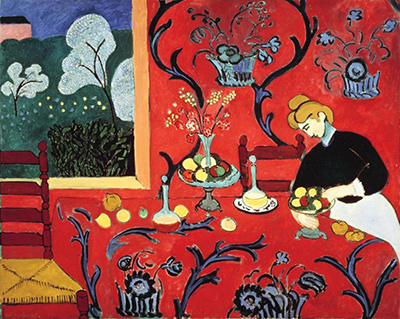
The nearest red comparison is The Dessert: Harmony in Red , painted in 1908 for Shchukin. There a richly patterned red spreads across a dining table and wall, and the window opens toward a landscape. Pattern helps connect parts of a room that would normally be divided by furniture and architecture. In The Red Studio , the red is less an ornamental motif than a broad field that passes across floor, walls and much of the furniture. The small artworks retain their own colours against it. The two paintings use red differently, for different settings, and the one Shchukin owned should not be confused with the studio canvas he declined. [5] [1] [6]
The Pink Studio , made in 1911, is a closer companion in place and commission. MoMA's studio plan and exhibition account show that it and The Red Studio picture different but overlapping portions of the same working building. The pink work gives a different impression of depth and of the separation among objects. Considering them together makes the red picture's omissions and emphases easier to detect. Matisse could choose a subject he knew intimately yet arrive at two visual answers. Neither canvas simply illustrates the other, and a room's physical plan cannot by itself tell us why one painted arrangement works as it does. [4]
Two later Issy views extend that question. The Blue Window of 1913 was painted from a room in the family house, looking toward the studio building through a window. Blue connects inside objects and the outdoor view in a way that echoes, without repeating, the red painting's ability to bind separate things. A 1916–17 Studio, Quai Saint-Michel moves to a Paris workroom and describes another kind of space, with a different balance between art on the wall and the human figure. The comparison shows that “studio painting” was a question Matisse kept returning to, not one solution reached in 1911 and then abandoned. [4]
The comparison also helps place The Red Studio within a career that changed quickly around the First World War. Its wide field and carefully selected objects belong to a moment of ambitious decorative painting. The more austere Piano Lesson of 1916 offers a tighter arrangement of a room and figure. It would be too simple to say the war alone caused that change; Matisse continued to test different means of building pictorial space. The red studio remains distinctive because it makes an artist's own works the most articulate presences within a room painted almost as one colour. [5]
What should you notice when looking closely?
Begin near the lower left, where a white ceramic plate with a blue figure sits against the red. It is an actual object translated into a small painted image, but it also makes the surrounding colour look even more continuous. Follow the nearby forms upward into the cluster of furniture and paintings. The eye moves among framed pictures, yet their stronger internal detail keeps them from dissolving into the red plane. Return to the plate and notice how a round shape can feel both like a thing resting in a room and a mark placed on a canvas. [1] [4]
Next look at the central clock. The long body is nearly the same colour as its surroundings, and its outline is enough to establish its upright position. Its small face holds a lighter circle but gives no hands to read. Move from that axis toward the right, where the furniture is suggested with fewer details than the painting hung above it. The picture asks the viewer to supply enough spatial understanding to recognise a chair or table, then to notice that the representation remains unusually spare. This is not lack of care: the selective detail directs attention toward the art Matisse has placed in the room. [1]
Finally step back. From a distance, the red area may reassert itself before the many objects do. Up close, the individual pictures and the small green plant forms interrupt it. A museum reproduction on a phone or a page can help locate details, but it cannot give the full bodily relation to a painting more than two metres wide. The size allows a viewer to alternate between reading the canvas as one field and walking the eye through what it contains. Those two experiences are not competing solutions. Their movement back and forth is part of the work. [1]
The absent artist is another detail worth considering. There is no figure of Matisse painting at an easel, yet his works, materials and chosen arrangements make his presence felt. Ann Temkin has described Matisse's studio pictures as a kind of self-portrait. That is a curator's illuminating reading, not a literal genre label printed on the canvas. It helps explain why the room can feel personal without showing a face: the painter has organised the evidence of his activity and decided how much of the physical room a viewer needs. Another viewer might place more weight on the puzzle of space or on the history of the pictured works. The painting can support those readings at once. [2] [4]
Explore 113 Matisse artworks
This directory covers the 113 individual works explored in these articles, rather than a complete catalogue of Matisse’s output. Cut-paper designs and prints appear under Drawing in the medium filter; each row names its form. Dates retain the qualifications explained in the linked articles.
Frequently Asked Questions
No. MoMA's label says the room itself was not red. Conservation study shows that the painting originally described its floor, walls and furniture in several colours before Matisse covered much of that arrangement with Venetian red. The colour unites the painted composition, rather than recording a wall treatment in the building. [1] [2]
The clock gives the composition a strong vertical centre and offers a visible paradox: a familiar timepiece with no hands. MoMA has suggested that it can make time feel suspended in the studio. A viewer can consider that interpretation while also looking at its practical role in organising the red expanse. There is no need to claim that Matisse left a single definitive symbolic explanation. [1]
No. The Red Studio was made in the context of work proposed for the Russian collector, but he did not buy it. Their 1912 correspondence shows that he then preferred Matisse's pictures with figures. Shchukin did own other major works by Matisse, including the earlier Dessert: Harmony in Red ; the shared red in their titles should not blur their separate histories. [6] [5]
Many are identifiable paintings by Matisse, and the 2022 MoMA exhibition reunited six surviving paintings with three sculptures and a ceramic represented inside the canvas. Some images were changed when he painted them into the new composition. The pictured Large Nude is known today through photographs, drawings and this painting rather than an extant original. [3] [4]
It is in the Museum of Modern Art, New York. Museum display locations can change, so MoMA's current object page is the place to check before a visit. The painting entered the collection in 1949 after many years in private hands and public exhibitions. [1]
To continue through this chapter of Matisse's career, read the biography for Shchukin and the Issy years, then compare The Pink Studio and The Blue Window as different views connected to the same working place. The Dessert: Harmony in Red gives the earlier red interior a separate context. Return to The Red Studio afterward and ask which object or empty interval first leads your eye into the room.
Discussion
Look again at the images and ideas explored in The Red Studio by Henri Matisse: a room made with colour. These editorial prompts invite your observations.
Reader Insights
What room is Matisse showing?
Which comparison discussed in the article helps you see the work differently?
How do the materials and historical setting affect your reading?
Join the Conversation
Share a detail, comparison or question about The Red Studio by Henri Matisse: a room made with colour below.
References
- Museum of Modern Art , “The Red Studio,” collection record and provenance. View source .
- Ann Temkin , MoMA audio account of The Red Studio . View source .
- Museum of Modern Art , “Matisse: The Red Studio,” 2022 exhibition. View source .
- Museum of Modern Art , Matisse: The Red Studio extended artwork labels (PDF). View source .
- Magdalena Dabrowski , “Henri Matisse (1869–1954),” The Metropolitan Museum of Art, 2004. View source .
- Museum of Modern Art , Matisse: The Red Studio exhibition section texts (PDF). View source .
- Museum of Modern Art , Matisse: The Red Studio press release (PDF). View source .
 Henri Matisse.jpg)