 by
Tom Gurney
Tom Gurney BSc (Hons) is an art history expert with over 20 years experience
Email:
tomgurney1@gmail.com
/ Phone:
+44 7429 011000
Henri Matisse, Still Life with Apples on a Pink Tablecloth, 1924: Introduction
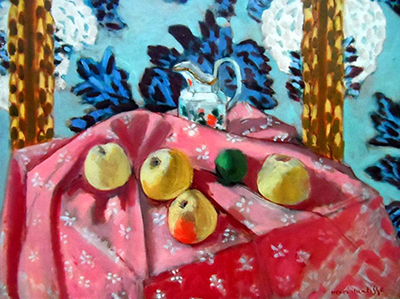
Four yellow apples sit in the folds of a pink cloth; a small green lime stands among them, and a ceramic pitcher rises behind. At first, Henri Matisse's Still Life with Apples on a Pink Tablecloth looks like a simple arrangement of fruit on a table. Then the eye notices how much of the picture is given over to patterned fabric and a flowered blue-green wall. The fruit occupies the centre, but colour and ornament continue across almost every part of the canvas. The National Gallery of Art (NGA) dates the painting 1924 , identifies it as oil on canvas , and records it as 1963.10.169 in its Chester Dale Collection . [1]
The owner's full title adds “tablecloth” to the shorter wording of this page's URL. That detail is useful: the pink surface is not a neutral support for apples. Its folds, white floral marks and broad colour area are among the painting's main subjects. The canvas measures 60.4 × 73 cm , a modest horizontal format in which the table and wall crowd closely together rather than opening into a deep room. [1]
At a Glance
- Artist Henri Matisse
- Work Still Life with Apples on a Pink Tablecloth
- Date 1924
- Explore Painting
This work across Henri Matisse’s career
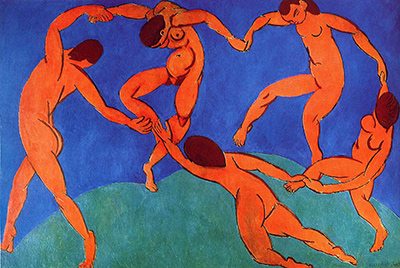
Dance (1910)
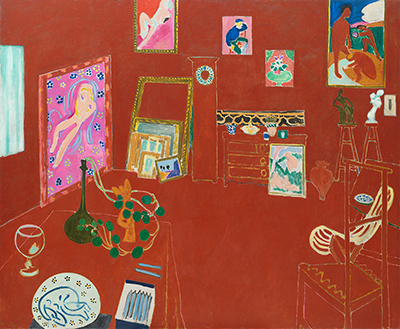
1910The Red Studio
1911The Piano Lesson
1916The Snail
1953Contents
- What is on the table?
- How do the tablecloth and wall work together?
- Why make a still life like this in the 1920s?
- How does it compare with another 1924 still life?
- How did the apple painting reach the National Gallery?
What is on the table?
The four apples are mostly yellow, with greenish passages and, on the one nearest the viewer, a vivid red patch. They are not lined up along the table's back edge. Two sit farther away, while the others move toward the front corner. The small, saturated green lime between the right-hand apples breaks the run of yellow circles. The arrangement offers just enough overlap to let us recognize separate pieces of fruit, but each one also works as a coloured shape within a larger pink field. [1]
Behind the fruit, a ceramic pitcher is partly hidden by a ridge of cloth. It is painted in white, grey-blue and light turquoise, with touches of warmer colour on its floral decoration. Its outline does not stand out as sharply as the fruit's. Matisse lets the pitcher blend into the cool colours behind the table while a small bright area near its rim draws the eye upward. In a small reproduction it is easy to mistake it for a kettle; the NGA's object description identifies a pitcher, and no spout-and-handle story needs to be invented around it. [1]
The tablecloth looks as though it has been gathered and pushed into ridges. Broad, darker pink strokes cut across lighter pink and white areas; small flower-like marks scatter over the cloth. Near the apples the folds make shallow pockets and diagonals, helping to place the fruit. Farther forward, the fabric becomes a wide painted surface in its own right. Matisse uses the folds to suggest depth while keeping attention on colour and brushwork, rather than rendering every wrinkle with smooth light and shadow.
How do the tablecloth and wall work together?
The wall behind the table is blue-green and covered with pale blossoms and darker leafy forms. Two warm vertical bands mark its left and right portions. Their exact architectural or textile role is not established in the owner's description, so it is safest to treat them as visible bands, not certain pillars. The blue floral field and the pink floral field meet behind the pitcher. That boundary is a crucial point of the composition: it tells us where table ends and background begins, yet both areas remain vigorously patterned. [1]
The wall's light flowers are much larger than the tiny marks on the cloth. Their difference in scale helps separate the two surfaces even when their shapes echo one another. Warm brown and yellow strokes in the vertical bands frame the cool blue, while yellow apples pull that warmth into the table. The lime supplies a concentrated green that answers the wall without disappearing into it. These colour connections make the room feel coherent despite the abrupt change from one pattern to another.
Look at the table's front edge. It tilts forward and exposes a broad area of cloth rather than giving us a narrow strip of tabletop. We seem to look slightly down at the fruit, yet the background rises almost vertically behind it. Matisse does not use a single deep perspective to organize every object. Instead, overlap, folds and colour boundaries do the work. This shallow, tilted space makes the apples appear accessible while allowing the patterned surfaces to have nearly equal visual weight.
The painting is loosely handled without being arbitrary. Brushstrokes remain visible in the fruit, pitcher, cloth and wall. A red accent on the nearest apple is answered by small red touches around the pitcher and textile. White marks travel from the tablecloth upward into the background flowers. These recurrences invite the viewer to scan beyond the nominal “subject” of apples. What begins as a still life of five pieces of fruit becomes an exercise in keeping several competing surfaces legible at once.
Watch: Matisse’s art and working methods
Choose a museum film or a close reading to continue exploring Matisse’s work.
MoMA Conservators discover Matisse's process for "The Red Studio" | CONSERVATION STORIES
Conservators examine the making of The Red Studio.
Watch on YouTubeWhy make a still life like this in the 1920s?
Matisse painted many still lifes and interiors during his years working in Nice . The Metropolitan Museum of Art's account of his mid-1920s work describes his interest in placing bouquets and fruit against patterned screens and fabrics. It also notes that the reception of his familiar subjects was mixed: some critics found them repetitive, while Matisse continued to test how colour and pattern could meet on a canvas. This context helps explain why the cloth and backdrop in the apple picture matter as much as the fruit. It does not prove that the particular screen described by the Met appears in this NGA painting, or that this exact arrangement was made on a day when a model was absent. [2]
The Museum of Fine Arts, Boston, likewise shows how Matisse reused studio objects and textiles in different visual settings. A vase, jug or patterned textile could be familiar to him, yet take on a new relation to surrounding colours in each picture. In the NGA canvas the pitcher is partly screened by the cloth and the wall's flowers echo the cloth's small white marks. We do not need to identify the physical fabric or its maker to see that the painted patterns are doing structural work. [3]
How does it compare with another 1924 still life?
The NGA also owns Matisse's Still Life with Pineapple , another 1924 oil painting. It gathers a pineapple, other fruit and a small floral bottle around a large round tray. The same broad ingredients—fruit, a vessel, patterned decor—lead to a different composition. In the apple painting, the rumpled pink textile fills the foreground and carries the fruit forward; the floral pitcher is pushed back toward the wall. In Still Life with Pineapple , the round tray organizes the lower field and the pineapple creates a taller centre of attention. The comparison shows Matisse changing the balance among object, support and background rather than repeating a fixed still-life recipe. [1] [4]
The two paintings have separate NGA accession numbers and histories. The apple canvas is 1963.10.169 , part of the Chester Dale bequest. The pineapple canvas is 1972.9.18 , a later gift from the W. Averell Harriman Foundation. Sharing a museum and year does not mean they were a pair, or that the same tablecloth and pitcher were used in both. For an earlier, different handling of fruit and studio space, the Still Life with Aubergines page leads back to Matisse's 1911 work. [1] [4]
How did the apple painting reach the National Gallery?
The NGA's provenance begins with a sale by Matisse on 4 February 1925 to the Paris dealer Bernheim-Jeune . It passed through the Independent Gallery in London, Mrs R. A. Workman, Reid & Lefèvre, and Kraushaar Galleries before Chester Dale bought it in 1930 . Dale's 1963 bequest brought it to the NGA. The transaction in 1925 is part of the work's ownership history, not a reason to replace the museum's 1924 creation date. In its 1931 MoMA retrospective , the painting appeared under the shorter title Still Life with Apples —another title history detail, not evidence of a second apple picture. [1]
The work belongs to the NGA in Washington, DC. Display can change, so consult the museum's current object page before planning a visit. When looking at a reproduction, start with the red patch on the nearest apple, then follow the repeated warm and cool marks across cloth, pitcher and wall. That path shows why Matisse's small arrangement of ordinary objects can sustain a much wider visual conversation about pattern, colour and space. The paintings directory places it among the site's other documented Matisse canvases. [1]
Explore 113 Matisse artworks
This directory covers the 113 individual works explored in these articles, rather than a complete catalogue of Matisse’s output. Cut-paper designs and prints appear under Drawing in the medium filter; each row names its form. Dates retain the qualifications explained in the linked articles.
Discussion
Look again at the images and ideas explored in Henri Matisse, Still Life with Apples on a Pink Tablecloth, 1924. These editorial prompts invite your observations.
Reader Insights
What is on the table?
Which comparison discussed in the article helps you see the work differently?
How do the materials and historical setting affect your reading?
Join the Conversation
Share a detail, comparison or question about Henri Matisse, Still Life with Apples on a Pink Tablecloth, 1924 below.
References
- National Gallery of Art , Still Life with Apples on a Pink Tablecloth , 1963.10.169, object record, visual description, provenance and exhibition history. View source .
- The Metropolitan Museum of Art , Matisse: In Search of True Painting , gallery account of mid-1920s still lifes. View source .
- Museum of Fine Arts , Boston, Matisse in the Studio exhibition account. View source .
- National Gallery of Art , separate Still Life with Pineapple , 1972.9.18, object record and visual description. View source .
 Henri Matisse.jpg)