



 by Tom Gurney
Tom Gurney BSc (Hons) is an art history expert with over 20 years experience
Published on June 19, 2020 / Updated on October 29, 2026
Email: tomgurney1@gmail.com / Phone: +44 7429 011000
Banks of the Oise: Introduction
Two white sails brighten the shaded river in Henri Rousseau’s Banks of the Oise. The nearer boat has a brilliant red hull; its companion sits farther along a pale channel curving towards the right. Tall trees rise from the left bank, while rounded ochre haystacks gather on the opposite shore. Above them, a long cloud stretches across the sky, its dark underside almost as substantial as the land below. This small landscape draws its force from the way those simple shapes answer one another. The 1985 Museum of Modern Art catalogue reproduces the painting as The Banks of the Oise, an oil on canvas measuring 46.2 × 56 cm, and records it with the Smith College Museum of Art in Northampton, Massachusetts.[1]
At a Glance
- ArtistHenri Rousseau
- SubjectBanks of the Oise
- ExploreFollowing the river; Trees, haystacks and a cloud with weight
This work across Henri Rousseau’s career
Carnival Evening
1886 [2]The Merry Jesters
1906 [7]The Snake Charmer
1907 [8]Contents
- Following the river
- Trees, haystacks and a cloud with weight
- A traditional title and two historical dates
- A countryside within reach of Paris
- Looking beside Monet and Signac
- The painting’s recorded history
- Annotated details
Following the river
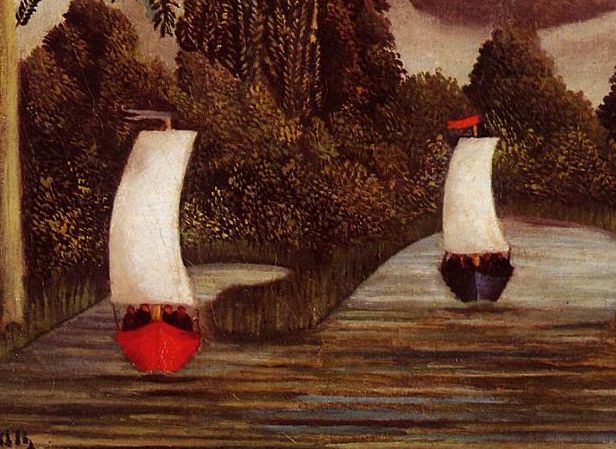
The river offers the clearest way into the picture. Across the foreground, short horizontal strokes of brown, green and blue form a broad, shallow-looking surface. Farther back, the water lightens around the second boat. Between the two vessels, a narrow strip of dark green land projects towards the viewer and divides the visible water. The right-hand passage curves behind it, drawing the eye towards a destination concealed by trees. The landscape invites a journey, then closes the view before it opens into distant country.
Rousseau gives the two boats a similar shape but a different visual weight. Their pale sails are broad below and narrow above, with gently curved sides. The nearer sail occupies a darker setting and appears especially luminous. Beneath it, the red hull supplies the most concentrated colour in the lower half of the painting. The farther hull is darker and smaller, and the little red pennant above its sail repeats the foreground accent. Brightness and colour connect the boats even as their spacing carries us into depth.
The vessels are also remarkably upright. Their masts echo the tree trunks and the long, slender trees rising near the centre-left. These verticals hold the scene steady against the river’s bend. We can read the sails as signs of movement, yet the boats feel suspended within a carefully balanced arrangement. The painting’s quiet comes partly from this tension: the channel promises passage, while the clear silhouettes hold our attention in place.
Trees, haystacks and a cloud with weight
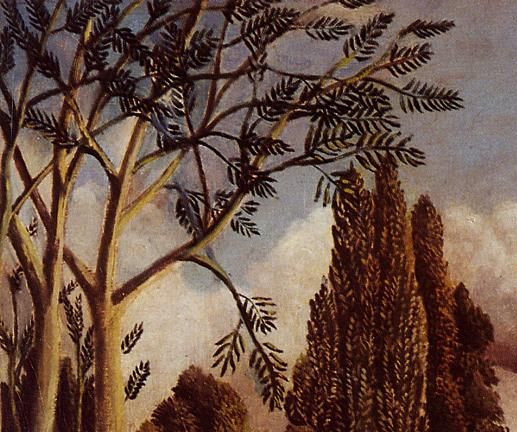
The large trees along the left edge establish the nearest land. Their trunks run out of the picture at the top, and fine branches spread across the sky. Small leaves articulate those branches with a clarity quite different from the dense, mottled foliage farther away. Near the edge, we can follow individual stems; across the river, trees gather into compact masses whose outer contours are easier to distinguish than their interiors.
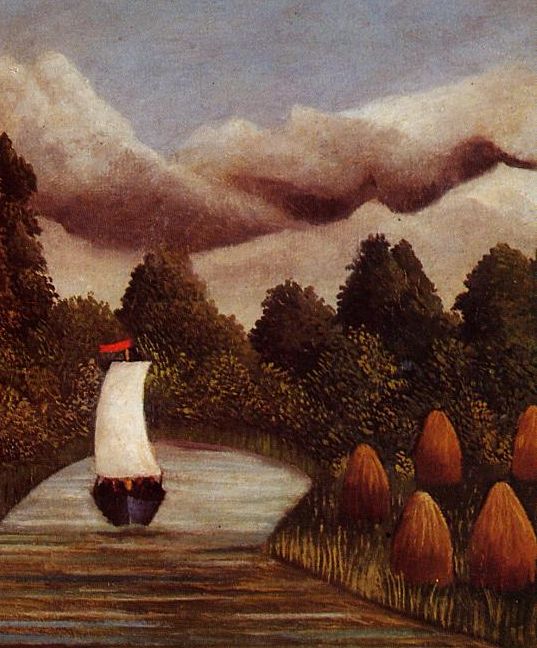
At the right, the haystacks introduce another kind of repeated form. Their rounded tops and tapering sides rise above a narrow fringe of grass. Warm brown and ochre distinguish them from the surrounding greens, but they belong to the same rhythm of upright shapes. The stacks make the bank feel cultivated even though buildings scarcely enter this view. They bring a trace of agricultural work into a scene otherwise dominated by water and vegetation.
The sky has its own terrain. A long gray-brown band runs beneath the cloud’s pale upper edge, which swells and dips across the picture. Its contour answers the rounded trees and haystacks below. Michel Hoog, writing the painting’s 1985 catalogue entry, drew attention to these related curves in the banks, trees and cloud, seeing them as a source of animation within the landscape.[1] From the lower river to the upper sky, a sequence of bends guides the eye.
This exchange between land and cloud makes the atmosphere unusually solid. The pale sky leaves breathing room above the trees, yet the dark cloud band presses down towards them. Below, the water is broken into numerous fine horizontal marks. The broad cloud and the finely worked river create different measures of space: one travels almost uninterrupted across the canvas, while the other asks the eye to move in small steps.
Annotated Details from Banks of the Oise
The numbered points identify visible features discussed in this article. Return from each detail to the whole composition. Henri Rousseau, Banks of the Oise. Historical catalogues date this sailboat composition 1905 or about 1908 and record it at Smith College Museum of Art. Image via Wikimedia Commons; published source: 1984 Rousseau exhibition catalogue. Image source. Public domain. Numbers added to a separate resized overview. Three broad excerpts cropped directly from the published original without enlargement, recolouring, sharpening or retouching.
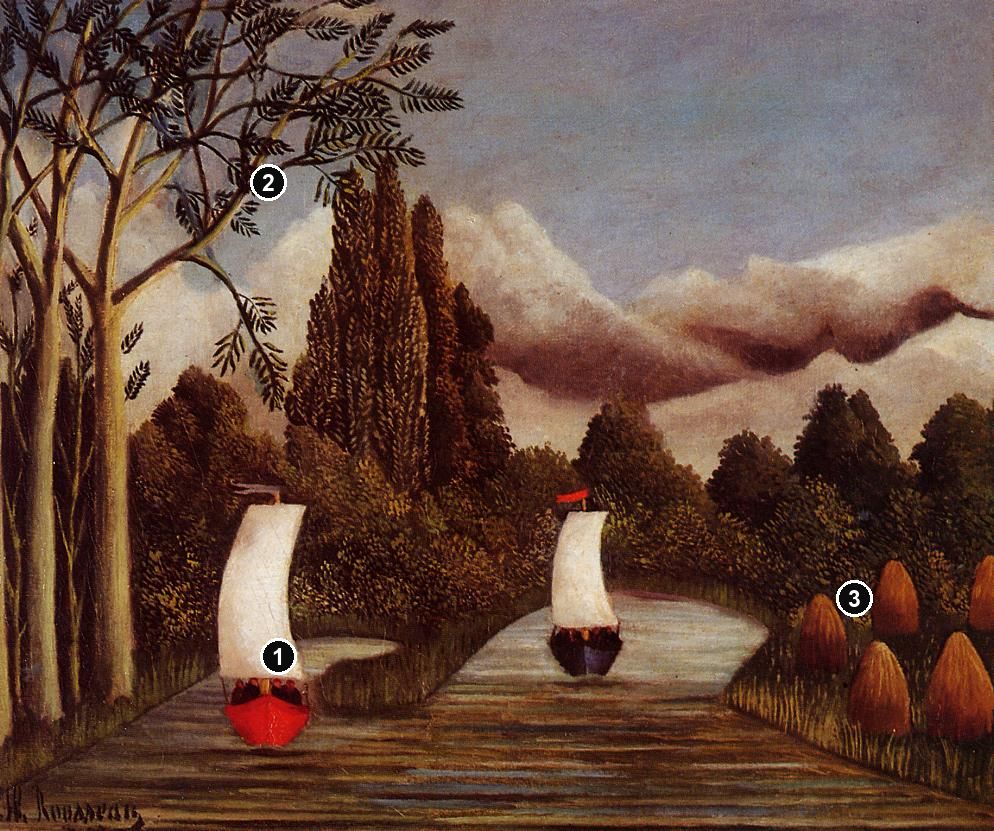
Details from BANKS OF THE OISE
Compare the two boats across the river’s bend, then follow the repeated upright trees and the curves connecting cloud, foliage and stacks.
Two boats joined by a turning channel
The nearer white sail rises above a bright red hull. Beyond the projecting green bank, the second boat occupies a paler passage that turns towards the right. Their upright sails hold the river’s bend steady.
Branches and narrow tree crowns
Fine branches spread across the upper left, while tall pointed tree crowns rise behind them. The small repeated leaves give both kinds of growth clear edges against the broad cloudy sky.
The cloud above a cultivated bank
The cloud’s dark underside forms a long uneven curve above the rounded trees. Ochre haystacks repeat their upright shapes near the water, bringing signs of work into the dense vegetation.
A traditional title and two historical dates
The painting’s title has a long history. Hoog explained in 1985 that he retained the traditional identification with the Oise, tracing it at least as far back as Wilhelm Uhde’s 1921 publication. He also thought this was probably the landscape mentioned in a letter Rousseau wrote to Max Weber on 21 August 1908. That proposed connection remains an identification made by the catalogue author; the letter should not be treated as a certain description of this canvas.[1]
The dates attached to the painting have differed. Daniel Catton Rich’s 1942 MoMA catalogue reproduced the same composition under the date 1905. The 1985 catalogue assigned it approximately 1908.[13][1] Both place it in Rousseau’s later years, but they do not establish a single agreed year. Describing it as an early twentieth-century landscape preserves what those historical accounts share while keeping their disagreement visible.
The place-name is more secure as a traditional title than as a guide to an exact viewpoint. Nothing in the catalogue entry identifies a particular village or fixes the painter’s position on a riverbank. Hoog himself left open whether the composition had been sketched from nature.[1] The painting gives us a persuasive arrangement of river, vegetation, boats and stacks without requiring every bend to correspond to a surveyed stretch of the Oise.
A separate Rousseau landscape also bears the name The Banks of the Oise. Harvard Art Museums identifies that smaller canvas, dated about 1907, with the former title Landscape with Cows.[14] It is the cattle picture discussed on Banks of the Oise II. The two titles can easily be confused; the pair of white sails identifies the composition considered here.
A countryside within reach of Paris
The haystacks and boats give the river two human uses. One bank carries the results of work on the land; the water accommodates small sailing craft. The figures in the boats remain subordinate to their vessels and surroundings. There is no prominent person whose story directs the scene. Instead, the painting distributes attention among the channel, its passengers and the shapes of the banks.
That modest scale of activity belongs within a substantial part of Rousseau’s practice. The Musée de l’Orangerie’s 2026 exhibition account describes his small pictures as works suited to the budgets and interiors of artisans, shopkeepers and other modest buyers. It connects his landscape repertoire with observations made around the changing outskirts of Paris and with the repeated variation of familiar motifs.[15] This gives a useful setting for a canvas of these dimensions, although it does not identify this painting’s first purchaser or establish a commission.
Here, Rousseau lets vegetation occupy most of the land. Hoog considered such an almost wholly vegetal setting relatively unusual among the painter’s landscapes of the Île-de-France.[1] The absence of conspicuous houses or industrial structures changes the balance of the view. Human presence survives in the boats and stacks, while the wooded banks form an enclosure around them. The scene feels sheltered because its cultivated details fit so closely into the larger arrangement of trees and water.
Looking beside Monet and Signac
Hoog proposed two illuminating comparisons. He suggested that the haystacks might offer an unconscious homage to Claude Monet, and that the curved sails and hulls recall boats in Paul Signac’s paintings. His specific example was Signac’s Sloops under Sail Entering the Harbor at Concarneau, a detail of which accompanies the 1985 entry.[1] These are a critic’s suggestions about visual relationships. They do not demonstrate that Rousseau copied either artist for this landscape.
The comparison directs attention to what Rousseau does with familiar subjects. A stack can register as agricultural produce and as a rounded volume; a sail can suggest a boat’s travel while serving as a bright, almost freestanding shape. In this picture, the repetition of sail, tree and stack makes the parts easy to recognise while tying them into a single surface. Each object keeps a firm outline, yet the scene gains continuity through recurring curves and intervals.
Hoog also read the hull, sail and pennant as an arrangement of the French flag’s colours.[1] That observation offers another way to follow the red, pale and dark accents across the boats. It does not establish a political message. The colours concentrate attention amid the surrounding browns and greens.
The painting’s recorded history
The 1985 catalogue lists earlier ownership under Blank in Hofheim, Suermondt in Drove and Voemel in Düsseldorf, and gives Smith College Museum of Art a purchase credit dated 1939.[1] Rich’s 1942 reproduction likewise credits the Smith College Museum of Art.[13] These historical records place the canvas in an American museum collection by the early 1940s. They do not supply dates for every earlier change of ownership.
Across those reproductions, the composition remains readily recognisable: the red boat towards the left, the smaller vessel in the right-hand channel, the tall trunks at the edge and the stacks along the opposite bank. Those relationships are the painting’s lasting point of entry. The eye can follow the boats along the channel, climb the narrow trees, or cross the cloud’s uneven ridge. Each route eventually returns to the bright sails, which make a small opening in the dense, carefully ordered landscape.
Henri Rousseau artworks directory
This directory brings together works covered on this site and other works documented in the cited museum records and catalogues. Alternate titles share one entry; distinct versions remain separate. Historical dates for works without an article follow the cited catalogues. This is not a catalogue raisonné.
Frequently Asked Questions
No. Harvard Art Museums records a separate landscape with cattle, dated about 1907 and formerly titled Landscape with Cows. This painting is distinguished by its two sailing boats.[14]
Its traditional title names the Oise. The 1985 catalogue retains that title but does not establish an exact village or viewpoint, and leaves open whether Rousseau sketched the scene from nature.[1]
Discussion
Look again at the images and ideas explored in Banks of the Oise. These editorial prompts invite your observations.
Reader Insights
How does the river’s bend change the way you move between the two boats?
Which shapes connect the haystacks, trees and cloud, and where do their textures differ?
How would the painting’s balance change if the nearer boat’s red hull were a dark green?
Join the Conversation
Share a detail, comparison or question about Banks of the Oise below.
References
- Michel Hoog, “The Banks of the Oise,” entry 40, in William Rubin, Carolyn Lanchner et al., Henri Rousseau: Essays, Museum of Modern Art, 1985, printed p. 192 and colour plate p. 193 (PDF pp. 197–198). View source.
- Philadelphia Museum of Art, Carnival Evening,1963-181-64,object59593. View source.
- Musée de l’Orangerie / Juliette Degennes, Henri Rousseau,L’ambition de la peinture: Un artiste dans son époque (in French). View source.
- National Gallery, Surprised!, NG6421. View source.
- Musée d’Orsay, La Guerre,RF19461 (in French). View source.
- MoMA, The Sleeping Gypsy. View source.
- Philadelphia Museum of Art, The Merry Jesters, 1950-134-176, object51097. View source.
- Musée d’Orsay, La Charmeuse de serpents, RF 1937 7 (in French). View source.
- Musée de l’Orangerie, La Carriole du Père Junier, RF 1960 26 (in French). View source.
- Solomon R. Guggenheim Museum / Cornelia Lauf, The Football Players,60.1583: current collection record. View source.
- The Museum of Modern Art, Henri Rousseau: Essays (1985), selected catalogue entries, chronology and notes on early devotees. View source. Selected entries, chronology (pp.91–95) and early-devotee notes (pp.262–264) were consulted. Historical collection credits do not establish present ownership.
- MoMA, The Dream, 252.1954. View source.
- Daniel Catton Rich, Henri Rousseau, Museum of Modern Art, in collaboration with the Art Institute of Chicago, 1942, reproduction and caption, printed p. 42 (PDF p. 47). View source.
- Harvard Art Museums, The Banks of the Oise, object 1951.67; identification, former title and date, record consulted 23 October 2026. View source.
- Musée de l’Orangerie, Henri Rousseau, l’ambition de la peinture, exhibition texts, 25 March–20 July 2026, “Variations et déclinaisons. À la recherche du marché,” consulted 23 October 2026. View source. (in French).
- Daniel Catton Rich, Henri Rousseau (The Museum of Modern Art, 1942), selected drawings and landscape studies; historical catalogue. View source. The dated 1942 publication is used for the two Quai d’Auteuil ink views; its Malakoff date differs from the 1985 catalogue.
- MANAS, Laval, Henri Rousseau, dit le Douanier, urban landscapes and preparatory study (in French). View source.
- National Gallery of Art, Self-Portrait (1895), pen-and-ink drawing, accession 1995.47.66. View source.
- The Museum of Modern Art, War (published January 1895), lithograph, accession 684.1943. View source.
- Barnes Foundation, Landscape and Four Young Girls, object 5521, BF855. View source.


 Henri Rousseau.jpg)


 Henri Rousseau.jpg)