



 by Tom Gurney
Tom Gurney BSc (Hons) is an art history expert with over 20 years experience
Published on June 19, 2020 / Updated on October 29, 2026
Email: tomgurney1@gmail.com / Phone: +44 7429 011000
Eve: Introduction
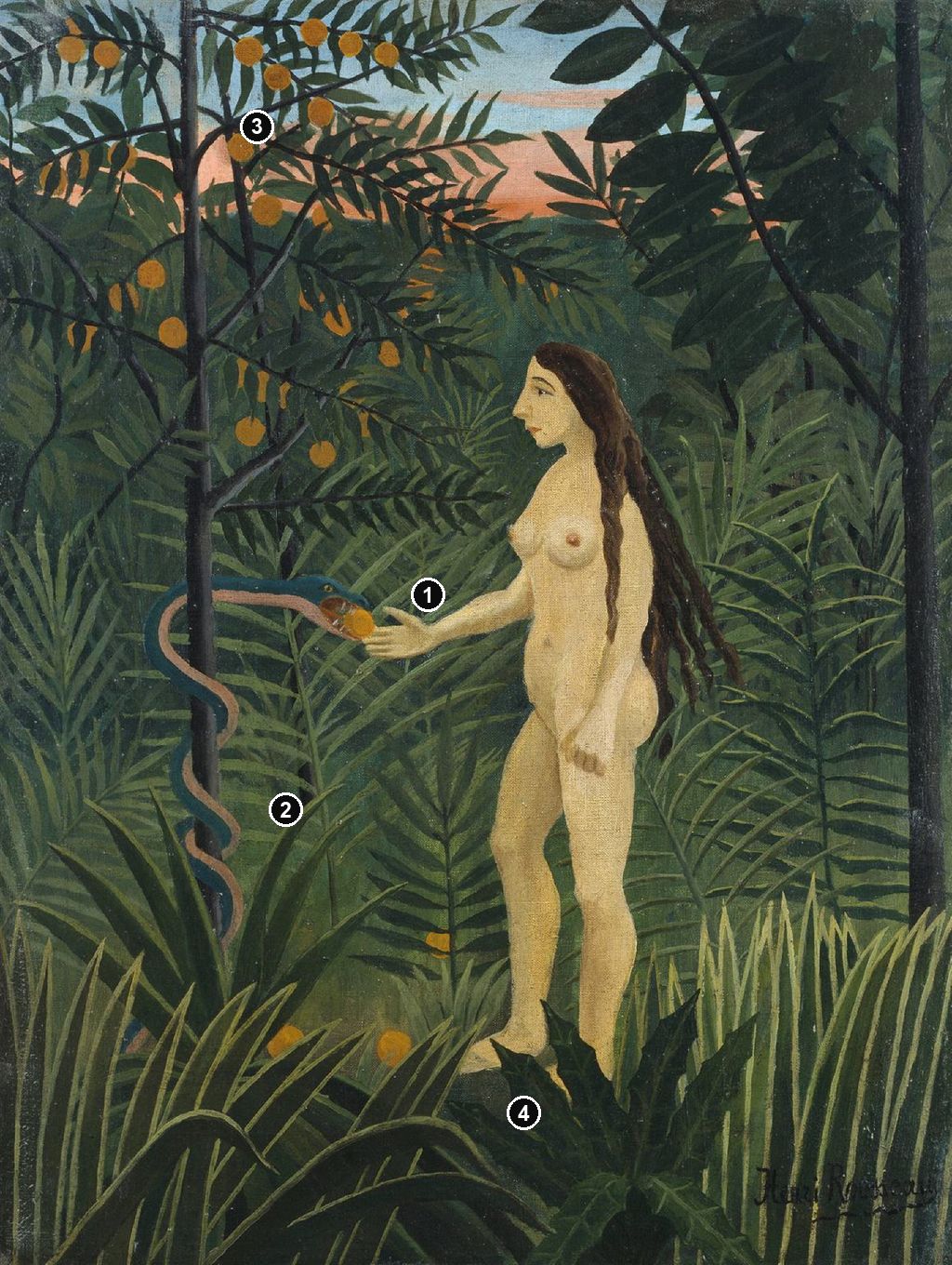
Eve holds out an open hand in a forest that seems almost too crowded to admit her. A blue and pink serpent curves around the slender tree beside her, bringing a round, golden fruit towards her fingers. Her pale body stands clear of the dark vegetation, yet sharp leaves cross her feet and close around her legs. Henri Rousseau holds the encounter still within the restless pattern of the forest. This upright Eve, known in Hamburg as Eva im irdischen Paradies—Eve in the Earthly Paradise—is dated about 1906–07 by the Hamburger Kunsthalle.[1]
At a Glance
- ArtistHenri Rousseau
- SubjectEve
- ExploreThe Hamburg painting; A gesture held in suspension
This work across Henri Rousseau’s career
Carnival Evening
1886 [2]The Merry Jesters
1906 [7]Eve (current article)
c. 1906–1907 [1]The Snake Charmer
1907 [8]Contents
- The Hamburg painting
- A gesture held in suspension
- How the forest fills the canvas
- Eve, the serpent and temptation
- Ownership and the foundation's provenance research
- Two different Eves
- Annotated details
The Hamburg painting
The painting is an oil on canvas measuring 62 × 46 cm. It belongs to the Stiftung Hamburger Kunstsammlungen and is on permanent loan to the Hamburger Kunsthalle. Its narrow format matters to the experience of looking: Eve occupies much of the available height, while the tree and its coiling serpent rise beside her. The scene feels enclosed, with only a thin opening of sky above the foliage.[1]
Older publications give slightly different details. The 1985 Museum of Modern Art catalogue lists Eve as about 1905–07 and 61 × 46 cm, under entry 29. The present Hamburg caption supplies the more recent date range and measurement used here. Both records identify the same composition; the reason for the differences is not given, and the date remains approximate. The catalogue also records the signature at the lower right, where Rousseau's name sits among the foreground plants.[12]
A gesture held in suspension
Eve stands just to the right of the picture's centre. Her face turns left in profile, following the direction of her extended arm. Long brown hair flows down her back, its irregular edge softening the pale silhouette of her shoulder and waist. Her other arm descends towards her hip. The two arms establish different tempos: one remains close to the body, while the other reaches across the foliage towards the serpent.
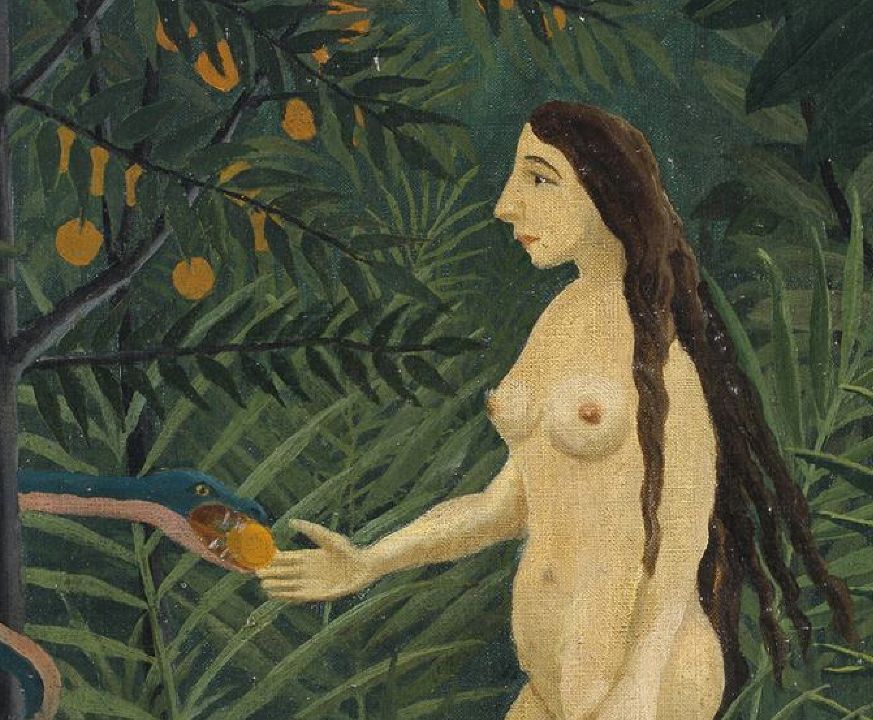
That reaching hand is the hinge of the composition. It opens beneath the fruit, which is still held at the serpent's mouth. The space between hand, fruit and head is small enough to concentrate attention, despite the competing leaf shapes around it. Eve has not brought the fruit to her lips. The painting leaves the contact suspended, allowing the eye to move repeatedly between the creature's head and the waiting fingers.
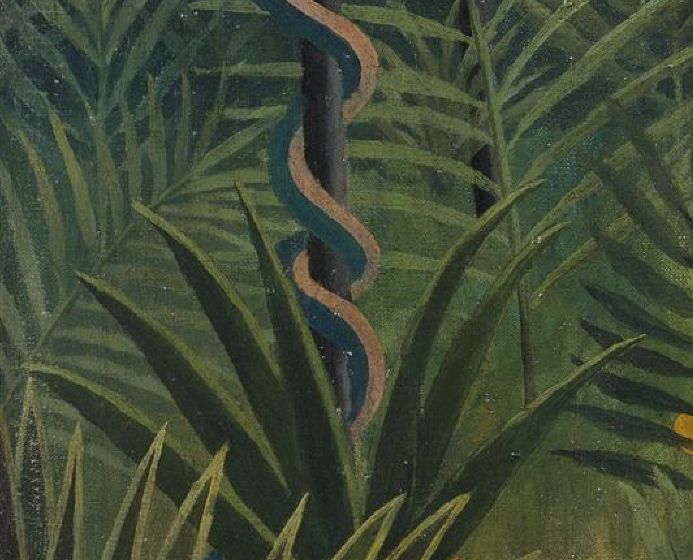
The serpent is unusually conspicuous in colour. Its blue upper surface and pink underside make a ribbon against the green forest. Below its outstretched head, the body loops around the nearly straight trunk, alternately appearing on either side. The repeated bends carry the gaze downwards, towards the vegetation from which the tree emerges. Beside them, Eve's upright body offers a much longer, quieter line. Curve and vertical, creature and woman, meet through the horizontal reach of her arm.
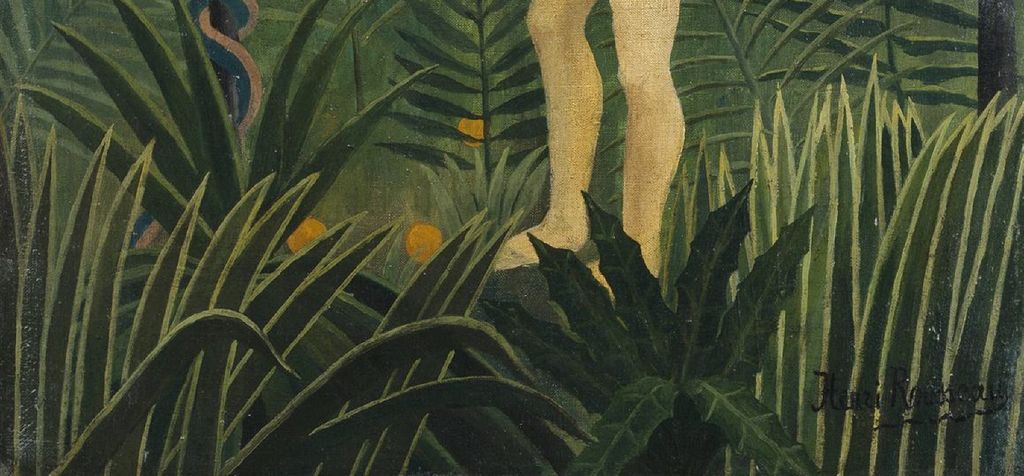
Her body is bounded by firm contours, with softer brownish shading along the limbs and torso. This makes her readable at once against the many greens, while giving her a degree of rounded volume. At her feet, the distinction becomes less secure. Pointed leaves cut across the ankles, and dark foreground foliage hides much of the ground. She seems both placed before the forest and caught inside its growth. The surroundings offer no broad clearing in which the figure can stand apart.
How the forest fills the canvas
Rousseau varies the vegetation through repeated, contrasting shapes. Fine, divided fronds extend sideways behind Eve, while long blades rise diagonally from below. A dark spray of larger leaves bends across the upper right. The fruit tree's narrow leaves open around its branches, creating a lighter, more intricate pattern than the broad forms opposite. The plants can be followed individually, even where their overlapping edges make the space difficult to penetrate.
Several arrangements direct attention back towards the encounter. Leaves behind the arm echo its leftward movement. The straight tree trunk holds the serpent's curves in place. Above Eve, branches and foliage narrow the view of the sky; below her, the blades of grass gather around the legs. The forest forms a succession of screens. Looking through one layer reveals another, rather than a clear path leading into the distance.
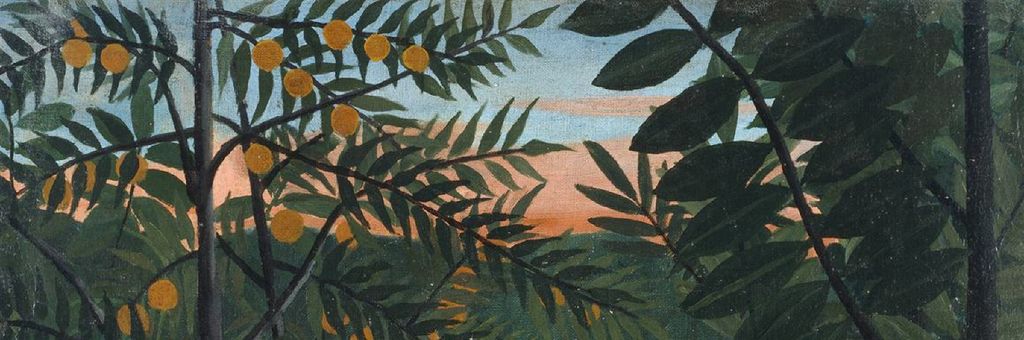
Colour provides a different route through this density. Orange-gold fruits hang high in the tree, continue down its branches and recur near the ground. They connect the upper canopy to the small exchange at Eve's hand. Their warm colour also answers the pink and orange band along the distant horizon. That strip of sky is one of the few uninterrupted passages in the picture, and its warmth gives an otherwise green enclosure a faint outward glow.
A little blue sky remains above the warm horizon, interrupted by leaves of differing sizes. What matters visually is the contrast between this narrow, open distance and the crowded foreground. The eye can reach the horizon, but the body seems unable to follow. Eve's forest is abundant, sharply articulated and close at hand; its farthest space is reduced to a slender coloured interval.
The fruit's roundness makes it easy to pick out among the pointed leaves. Calling it an apple would go beyond its visible identity. Michel Hoog, writing the 1985 catalogue entry, observed that the tree's foliage does not resemble apple leaves. Rousseau's shapes serve the picture's pattern and its subject without providing a dependable botanical key.[12]
Annotated Details from Eve
The numbered points identify visible features discussed in this article. Return from each detail to the whole composition. Henri Rousseau, Eve (Eva im irdischen Paradies), c.1906–07. Stiftung Hamburger Kunstsammlungen, on permanent loan to Hamburger Kunsthalle. Image via Wikimedia Commons; listed source: Hamburger Kunsthalle. Image source. Public domain. Numbers added to a separate resized overview. Four details cropped directly from the published original without enlargement, sharpening, recolouring or retouching.
Details from EVE
Follow the small exchange at Eve’s hand, trace the serpent’s coils, then compare the open sky with the crowded foreground.
A fruit held above an open hand
The serpent brings a round golden fruit towards Eve’s open fingers. Her face turns towards the exchange, while the reaching arm crosses the dense pattern of green leaves.
The serpent winds around the trunk
Below the exchange, the blue and pink body loops around a nearly straight dark trunk. Its repeated curves appear on alternating sides of the tree, creating a winding line through the foliage.
Fruit and a narrow strip of sky
Round golden fruits interrupt the tree’s pointed leaves. Behind them, a narrow pink and blue opening provides a warm, clear interval between the crowded layers of vegetation.
Leaves cross in front of Eve’s feet
Long blades and darker broad leaves overlap the lower legs and feet. The foreground plants press across Eve’s silhouette, making the figure appear caught within the forest’s growth.
Eve, the serpent and temptation
Hoog interpreted this encounter as biblical temptation, with Eve facing the serpent and the fruit it offers. That reading fits the conspicuous pairing of woman and serpent, and the gesture on which the scene turns. It is an interpretation of the imagery rather than evidence of Rousseau's use of a particular biblical text. The picture concentrates the story into a few visible elements: a single woman, an animal, a tree and a fruit poised between them.[12]
The scene's restraint leaves much for the viewer to supply. No Adam appears, and no dramatic recoil, hurried movement or visible expulsion follows the encounter. Eve's profile is composed. The serpent reaches rather than strikes. Within the familiar subject of temptation, this calm gives the painting an unsettled quality: the viewer recognises the stakes of the exchange while the painted world remains almost motionless.
The surrounding forest contributes to that ambiguity. Its fruit suggests plenty, while its pointed leaves and crowded intervals deny an easy, open refuge. Paradise here has a strong physical presence. The plants occupy the lower edge, tower above the figure and press into the space around her hand. Even with the biblical title in mind, one can spend as much time following these rhythms as reconstructing a narrative. Rousseau makes the setting an active part of the encounter.
Ownership and the foundation's provenance research
The 1985 catalogue records the painting in exhibitions in Paris in 1912, under the title Eve au Paradis, and Berlin in 1926. Its brief provenance names P. Mendelssohn-Bartholdy in Berlin. These entries provide points in its early collecting and exhibition history, although they leave its subsequent journey to Hamburg unexplained.[12]
In its 2024 acquisitions publication, the Stiftung Hamburger Kunstsammlungen states that it bought Eve in Switzerland in 1956, the year of the foundation's establishment. The same report, by Arndt Klippgen, explains that an inquiry in 2019 from descendants of the Jewish banker Paul von Mendelssohn-Bartholdy prompted a detailed investigation into the picture's earlier ownership.[13]
According to the report, Mendelssohn-Bartholdy had owned the painting. The inquiry asked which of his two former wives had brought it to Switzerland and sold it, and whether its passage there was connected with Nazi persecution. Klippgen describes two years of research by two researchers under the direction of Ute Haug, financed by the foundation. He reports their conclusion that the painting had been the lawful property of the former wife who was neither Jewish nor persecuted by the Nazis, and that she had taken it to Switzerland and subsequently sold it.[13]
The report identifies a notarised will, documentation of litigation in 1935 and notes concerning a sale to an art dealer in 1948 as the basis for this finding. Those dates describe different parts of the history: the sale notes precede the foundation's purchase in 1956. The account does not name the dealer or set out every intervening transfer.[13]
Klippgen also presents the Eve inquiry as an important experience behind a broader investigation of the foundation's loans to the Kunsthalle, undertaken with the museum from June 2021. The current permanent-loan credit identifies the painting's institutional relationship today; the 2024 report explains part of the work needed to understand how it arrived there.[13]
Two different Eves
The Eve in the Garden of Eden at the Pola Museum of Art offers a revealing comparison. Pola dates that separate oil painting to about 1906–10 and gives its dimensions as 46.5 × 61.4 cm. Its wider canvas, large moon and flower-bearing figure should not be confused with Hamburg's upright woman and serpent.[14]
In the Pola composition, Eve is smaller in relation to the forest. Huge leaves occupy the foreground, flowers gather around her body, and a broad opening carries the eye up towards the moon. Her reaching gesture belongs to an encounter with plants. In Hamburg, the extended arm links her to an animal and its offered fruit. The similar motif of a long-haired nude within dense vegetation produces different centres of attention: one picture lets the figure recede into a spreading garden, while the other brings an exchange close to the viewer.
The Pola Museum's Japanese commentary, drawn from its 2010 catalogue, interprets its own Eve as a personification of primeval forest, placing emphasis on the woman plucking a flower in moonlight. That is the museum's reading of the Pola work. It cannot simply be transferred to the Hamburg painting, whose serpent gives the outstretched hand a different narrative significance. Nor do the approximate, overlapping dates establish that one canvas was a study for the other.[15]
Seen beside that other depiction, Hamburg's Eve becomes more sharply individual. The nearly parallel woman and tree, the serpent's coloured coils and the little orange fruit organise the whole narrow canvas. The eye travels outward into the leaves, then returns to the hand. Whatever breadth of meaning the forest acquires, Rousseau keeps that small, unresolved meeting at the centre of the experience.
Henri Rousseau artworks directory
This directory brings together works covered on this site and other works documented in the cited museum records and catalogues. Alternate titles share one entry; distinct versions remain separate. Historical dates for works without an article follow the cited catalogues. This is not a catalogue raisonné.
Frequently Asked Questions
It is on permanent loan from the Stiftung Hamburger Kunstsammlungen to the Hamburger Kunsthalle. The museum titles it Eva im irdischen Paradies.[1]
Discussion
Look again at the images and ideas explored in Eve. These editorial prompts invite your observations.
Reader Insights
Does the forest make Eve seem sheltered, enclosed or exposed? Which parts of the painting shape your response?
How does the serpent's colour affect the encounter at Eve's hand?
What changes when you compare Hamburg's nearly full-height figure with Eve's smaller scale in the Pola painting?
Join the Conversation
Share a detail, comparison or question about Eve below.
References
- Hamburger Kunsthalle. This is the Modern World: Breakthroughs in Art, 1900–1960, 4 September 2026–30 May 2027, current illustrated caption for Henri Rousseau, Eva im irdischen Paradies; accessed 23 October 2026. View source.
- Philadelphia Museum of Art, Carnival Evening,1963-181-64,object59593. View source.
- Musée de l’Orangerie / Juliette Degennes, Henri Rousseau,L’ambition de la peinture: Un artiste dans son époque (in French). View source.
- National Gallery, Surprised!, NG6421. View source.
- Musée d’Orsay, La Guerre,RF19461 (in French). View source.
- MoMA, The Sleeping Gypsy. View source.
- Philadelphia Museum of Art, The Merry Jesters, 1950-134-176, object51097. View source.
- Musée d’Orsay, La Charmeuse de serpents, RF 1937 7 (in French). View source.
- Musée de l’Orangerie, La Carriole du Père Junier, RF 1960 26 (in French). View source.
- Solomon R. Guggenheim Museum / Cornelia Lauf, The Football Players,60.1583: current collection record. View source.
- MoMA, The Dream, 252.1954. View source.
- Michel Hoog. “Eve,” entry 29, in Carolyn Lanchner and William Rubin et al., Henri Rousseau, Museum of Modern Art, 1985, p. 162 and colour plate p. 163 (PDF pp. 167–168). View source.
- Arndt Klippgen / Stiftung Hamburger Kunstsammlungen. “Projekt Erforschung der Provenienzen der Dauerleihgaben der Stiftung Hamburger Kunstsammlungen in der Hamburger Kunsthalle,” in Ankäufe 2024, 2024, pp. 2–3 (PDF pp. 4–5), including the illustrated Eve caption. View source. (in German).
- Pola Museum of Art. Eve in the Garden of Eden, collection entry 002-0004, current English metadata; accessed 23 October 2026. View source.
- Pola Museum of Art. エデンの園のエヴァ (Eve in the Garden of Eden), collection entry 002-0004, Japanese commentary excerpted from アンリ・ルソー:パリの空の下で, exhibition catalogue, 2010; accessed 23 October 2026. View source. (in Japanese).
- The Museum of Modern Art, Henri Rousseau: Essays (1985), selected catalogue entries, chronology and notes on early devotees. View source. Selected entries, chronology (pp.91–95) and early-devotee notes (pp.262–264) were consulted. Historical collection credits do not establish present ownership.
- Daniel Catton Rich, Henri Rousseau (The Museum of Modern Art, 1942), selected drawings and landscape studies; historical catalogue. View source. The dated 1942 publication is used for the two Quai d’Auteuil ink views; its Malakoff date differs from the 1985 catalogue.
- MANAS, Laval, Henri Rousseau, dit le Douanier, urban landscapes and preparatory study (in French). View source.
- National Gallery of Art, Self-Portrait (1895), pen-and-ink drawing, accession 1995.47.66. View source.
- The Museum of Modern Art, War (published January 1895), lithograph, accession 684.1943. View source.
- Barnes Foundation, Landscape and Four Young Girls, object 5521, BF855. View source.


 Henri Rousseau.jpg)


 Henri Rousseau.jpg)