



 by Tom Gurney
Tom Gurney BSc (Hons) is an art history expert with over 20 years experience
Published on June 19, 2020 / Updated on October 29, 2026
Email: tomgurney1@gmail.com / Phone: +44 7429 011000
Henri Rousseau Prints and Reproductions: Introduction
Henri Rousseau's paintings invite very different kinds of looking. The dense greenery of The Dream draws the eye into a wide, crowded world; the striped figures in The Football Players spring upwards between walls of trees. Choosing a reproduction begins with deciding which of those encounters you want to live with, then finding a format that preserves the picture's shape and detail.
There is also an original printed work to distinguish from these modern reproductions. Rousseau's War was published as a lithograph in January 1895. MoMA holds an impression whose composition measures 22.2 × 33.1 centimetres.[1] Its relationship with the painted War offers a particularly revealing introduction to what happens when an image moves between media and scales.
At a Glance
- ArtistHenri Rousseau
- SubjectHenri Rousseau Prints and Reproductions
- ExploreRousseau's original War lithograph; What a modern reproduction offers
Contents
- Rousseau's original War lithograph
- What a modern reproduction offers
- Let the picture determine the shape
- Choose scale for the way you will look
- Colour, surface and the source image
- Bring the practical details together
- Annotated details
Rousseau's original War lithograph
The lithograph first appeared in L'Ymagier, the review edited by Alfred Jarry and Rémy de Gourmont. In the 1985 MoMA catalogue, Michel Hoog described it as Rousseau's only known print, an assessment that belongs to that catalogue's state of knowledge. Henri Béhar's essay in the same volume explains how Jarry encouraged Gourmont to commission the image within a publication interested in renewing older traditions of popular imagery.[2]
The painting associated with it is a much larger oil on canvas, dated about 1894 and now at the Musée d'Orsay. It measures 114.5 × 195 centimetres.[3] The difference in size matters, but so does the way Rousseau reworks the subject. Horse, armed rider and scattered bodies remain recognisable, while the spaces between them change. The lithograph is a separate graphic composition that rewards comparison with the canvas.
In the print, the sky opens out above the horse. The trees have become small, bare, branching forms, giving much less weight to the edges. Lines gather across the animal and the ground; the bodies lie among angular shapes and overlapping strokes. The lower half feels restless. Turning back to the painting, the black horse reads as a broad silhouette, and the large trees grip the scene from either side. Pale bodies, white dress and pink clouds establish contrasts that the print must achieve through marks and the spaces between them.[2]
The exact order of preparation has been debated. Hoog's catalogue entry favours a simplified reduction of the painting, following Charles Perussaux, while acknowledging a contrary proposal elsewhere in the volume. Publication in January 1895 is secure; it does not establish the date of every preliminary stage.[2] The fuller account of the canvas belongs with War. Here, the important distinction for a buyer is between this historical lithograph and a recently printed image of either version.
Explore Rousseau’s original lithograph
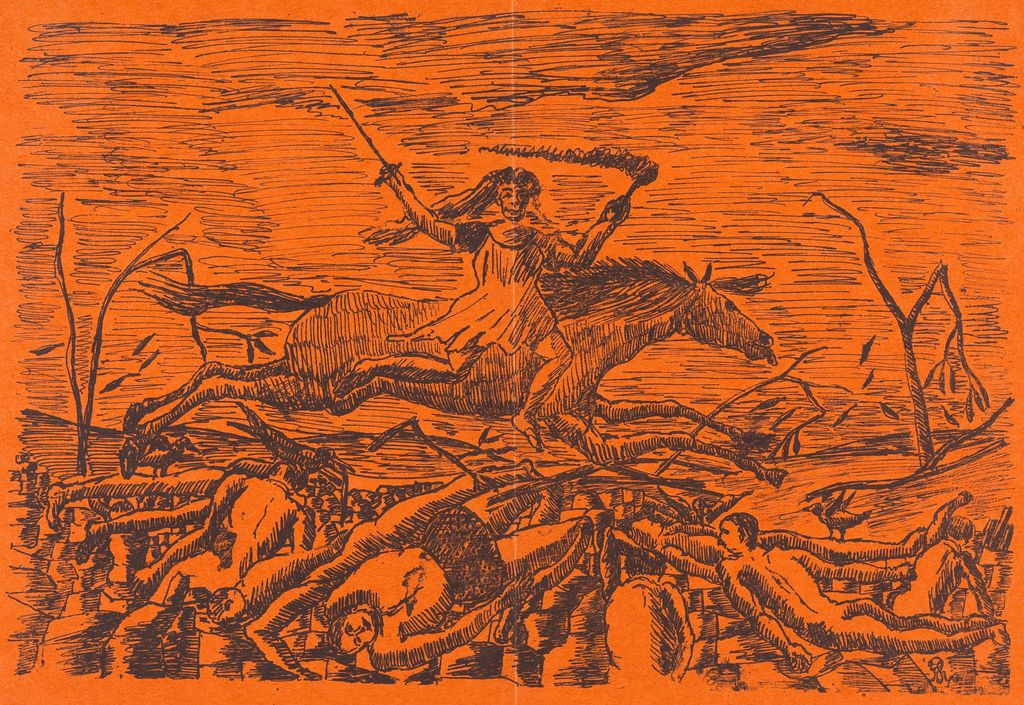
Annotated Details from La Guerre (The War), lithograph
The numbered points identify visible features discussed in this article. Return from each detail to the whole composition. Henri Rousseau, La Guerre (The War), 1894 (published 1895), lithograph on orange wove paper. National Gallery of Art, Washington, Rosenwald Collection, 1964.8.1502. Rosenwald Collection; Courtesy National Gallery of Art, Washington. Image source. CC0 / Public domain. Numbers added to the overview; detail views cropped from the original. No recolouring or retouching.
, lithograph.jpg)
Details from LA GUERRE (THE WAR), LITHOGRAPH
Compare the raised rider, moving horse and crowded foreground with the complete printed composition above.
The rider’s raised arms
Both arms rise away from the body, carrying long angular forms above the horse. Curving lines of hair and fabric break across the straighter strokes of the sky.
, lithograph Detail 01 the-rider-s-raised-arms.jpg)
A horse made from parallel marks
Short strokes run across the long body while the extended legs carry the movement sideways. The orange ground remains visible between the dark marks.
, lithograph Detail 02 a-horse-made-from-parallel-marks.jpg)
Figures among broken forms
Figures lie across the lower part of the print among broken branches and angular shapes. Repeated strokes and overlapping contours make the ground feel crowded and unsettled.
, lithograph Detail 03 figures-among-broken-forms.jpg)
What a modern reproduction offers
A reproduction lets you choose an image for sustained, everyday attention. You may want the whole scene, a particular figure, or the pattern of foliage across a wall. Those are different choices, and the product description should make the choice visible. A detail can be satisfying when you want to study it closely, provided you know which part of the painting it includes.
Begin by comparing the proposed print with the whole work. Are all four edges present? Has the image been stretched to fit a standard rectangle? Does the listing show the actual printed area, or only a room mock-up? A clear view of the image by itself is more useful for these decisions than a photograph in which furniture and framing dominate. The paintings guide can help you explore subjects before settling on a particular reproduction.
Keep the terms in the description separate. A modern print of an oil painting reproduces the painting's appearance. A modern print of the War lithograph reproduces an earlier printed work. In either case, a visible Rousseau signature may simply be part of the image being copied. Its presence in the lower corner does not establish a signature added by hand to the new sheet, or an edition issued by the artist. Claims about an original historical impression require documentation for that particular object; the title and a familiar image alone cannot supply it.
Let the picture determine the shape
The Dream is a horizontal painting from 1910, measuring 204.5 × 298.5 centimetres in MoMA's collection.[4] Its spread is part of its appeal. The reclining woman and curved sofa occupy the left, while animals, musician, leaves and moon draw attention across and upwards. When considering a reproduction above a sofa or along a broad wall, look at how much of that lateral movement remains visible at your intended viewing distance.
A narrow crop centred on the woman changes the encounter considerably. It removes much of the jungle into which she reaches and looks. A crop around the animals gives another emphasis, but loses the strange relationship between domestic furniture and surrounding vegetation. To keep the whole painting, accept its proportions and let a mount or empty wall accommodate the remaining space. Filling every inch of a predetermined frame is a poor reason to sacrifice the relationships that attracted you to the picture.
The Football Players offers an upright alternative. The Guggenheim dates this oil painting to 1908 and gives its current dimensions as 100.3 × 81.1 centimetres.[5] Four striped players occupy a clearing. The ball floats above the raised hands on the left, trees press in at the sides, and a broad stretch of brown ground opens beneath their lifted feet. The sky gives the gestures room to rise.
For this image, check both the top and bottom of the proposed reproduction. Losing sky can crowd the ball and hands; losing foreground can reduce the depth of the clearing. Cutting away the side trees weakens the enclosure around the game. A square version may retain the figures yet alter the structure that makes their movement so striking. These differences matter even if you ultimately prefer a detail.
Choose scale for the way you will look
Measure the intended image area before choosing a frame. A stated size may describe the printed picture, the whole sheet including white borders, or the outside of a framed product. Those measurements answer different questions. For the historical War lithograph, MoMA explicitly gives the size of the composition, 22.2 × 33.1 centimetres; that figure should not be treated as the sheet size.[1] Apply the same care to modern product descriptions.
Then consider where you will stand or sit. A small reproduction near a desk invites close inspection. Across a room, you are more likely to register the broad arrangement first: the bright stripes of the players, the dark mass of the jungle, or the horse extending across War. Choose a size at which the feature you most enjoy remains readable. A larger print gives details more space, but its usefulness still depends on the clarity of the image from which it was made.
With The Dream, inspect whether the woman's face, the lions' eyes and the musician remain distinguishable among the leaves. With The Football Players, examine the separation of fingers, striped sleeves and surrounding foliage. With the War lithograph, look at whether the close lines remain separate or merge into heavy patches. Enlarging an indistinct preview does not reveal the information missing from it. If a listing provides only a small photograph, the finest details of the delivered print remain difficult to judge.
Colour, surface and the source image
Colour is especially consequential in choosing a jungle reproduction. In The Dream, the blue flowers, pale body, dark sofa and differently shaped leaves help the eye find a route through the crowded scene. Compare those relationships as well as the overall green. If foliage becomes a single undifferentiated mass, the image loses much of the pleasure of discovering one form behind another.
Use museum images as a reference point for composition and broad colour relationships, while allowing for differences between screens, photographs and the lighting in your room. A particularly bright preview need not be the most informative one. Look for readable boundaries between forms and enough variation to distinguish the shadows. A claim of perfect colour matching offers less help than a clear image and a precise account of what is being sold.
Surface is a separate preference. Paper may suit the pleasure of looking closely at the War lithograph's lines; canvas may appeal when you want a reproduction of a painting to occupy the wall without a visible paper border. Check the stated support and printing process rather than inferring them from a staged photograph. Reproduced brushwork and the physical texture of the new support are different things. A photograph of painted canvas cannot make a new paper print carry the original paint surface.
Bring the practical details together
Before choosing, read the description alongside the image. It should be clear which Rousseau work is reproduced, whether the view is complete or cropped, what the image and overall dimensions mean, and which support is supplied. If the seller uses a process term, look for an explanation of that process and the material it is printed on. Attractive terminology alone does not answer these questions.
Finally, return to the picture itself. For The Dream, preserve the journey from the sofa into the dense jungle. For The Football Players, give the raised hands, ball and lifted feet their surrounding space. For War, decide whether you want the painting's colour and heavy silhouettes or the lithograph's wiry, open arrangement. A satisfying reproduction keeps the relationships you value visible at the size and distance at which you will encounter it.
Henri Rousseau artworks directory
This directory brings together works covered on this site and other works documented in the cited museum records and catalogues. Alternate titles share one entry; distinct versions remain separate. Historical dates for works without an article follow the cited catalogues. This is not a catalogue raisonné.
Frequently Asked Questions
A modern reproduction is a newly printed image. It may reproduce the oil painting or the lithograph, so check which version is shown. The lithograph has a more open sky, smaller trees and an arrangement built from lines.[2] A listing for a historical impression needs evidence specific to that object.
Choose according to how you want the image to appear and be presented. Consider whether you prefer a paper border and mount, a framed sheet, or a canvas format. In each case, check the actual image dimensions, crop and support before comparing the finished appearance.
An artist's name can be reproduced along with the rest of the picture. A name visible within the image does not establish that the new sheet was signed by hand. Any separate claim about a signature or edition needs its own documentation.
Discussion
Look again at the images and ideas explored in Henri Rousseau Prints and Reproductions. These editorial prompts invite your observations.
Reader Insights
Which details in The Dream would you most regret losing to a crop?
How does your response to War change between the coloured painting and the lithograph?
Would you rather live with a small image that rewards close looking or a larger one that shapes the room?
Join the Conversation
Share a detail, comparison or question about Henri Rousseau Prints and Reproductions below.
References
- The Museum of Modern Art. Henri Rousseau, War, published January 1895, current collection record, accession 684.1943; medium and composition dimensions, accessed 23 October 2026. View source.
- Michel Hoog and Henri Béhar, in Henri Rousseau. MoMA exhibition catalogue, 1985: Hoog, catalogue entry 10, “War,” printed p. 122, plate p. 123 (PDF pp. 127–128); Béhar, “Jarry, Rousseau, and Popular Tradition,” printed pp. 23–24 (PDF pp. 28–29). Entry 10 records the competing working-sequence interpretations and quotes Charles Perussaux's comparison. View source.
- Musée d'Orsay. Henri Rousseau, La Guerre, current collection record, RF 1946 1; date, medium and unframed dimensions, accessed 23 October 2026. View source. (in French).
- The Museum of Modern Art. Henri Rousseau, The Dream, 1910, current collection record, accession 252.1954; date, medium, dimensions and collection image, accessed 23 October 2026. View source.
- Solomon R. Guggenheim Museum. Henri Rousseau, The Football Players, 1908, current collection record, accession 60.1583; date, medium, dimensions and collection image, with essay by Cornelia Lauf, accessed 23 October 2026. View source.
- The Museum of Modern Art, Henri Rousseau: Essays (1985), selected catalogue entries, chronology and notes on early devotees. View source. Selected entries, chronology (pp.91–95) and early-devotee notes (pp.262–264) were consulted. Historical collection credits do not establish present ownership.
- Daniel Catton Rich, Henri Rousseau (The Museum of Modern Art, 1942), selected drawings and landscape studies; historical catalogue. View source. The dated 1942 publication is used for the two Quai d’Auteuil ink views; its Malakoff date differs from the 1985 catalogue.
- MANAS, Laval, Henri Rousseau, dit le Douanier, urban landscapes and preparatory study (in French). View source.
- National Gallery of Art, Self-Portrait (1895), pen-and-ink drawing, accession 1995.47.66. View source.
- Barnes Foundation, Landscape and Four Young Girls, object 5521, BF855. View source.


 Henri Rousseau.jpg)


 Henri Rousseau.jpg)