



 by Tom Gurney
Tom Gurney BSc (Hons) is an art history expert with over 20 years experience
Published on June 19, 2020 / Updated on October 29, 2026
Email: tomgurney1@gmail.com / Phone: +44 7429 011000
Henri Rousseau Drawings: Introduction
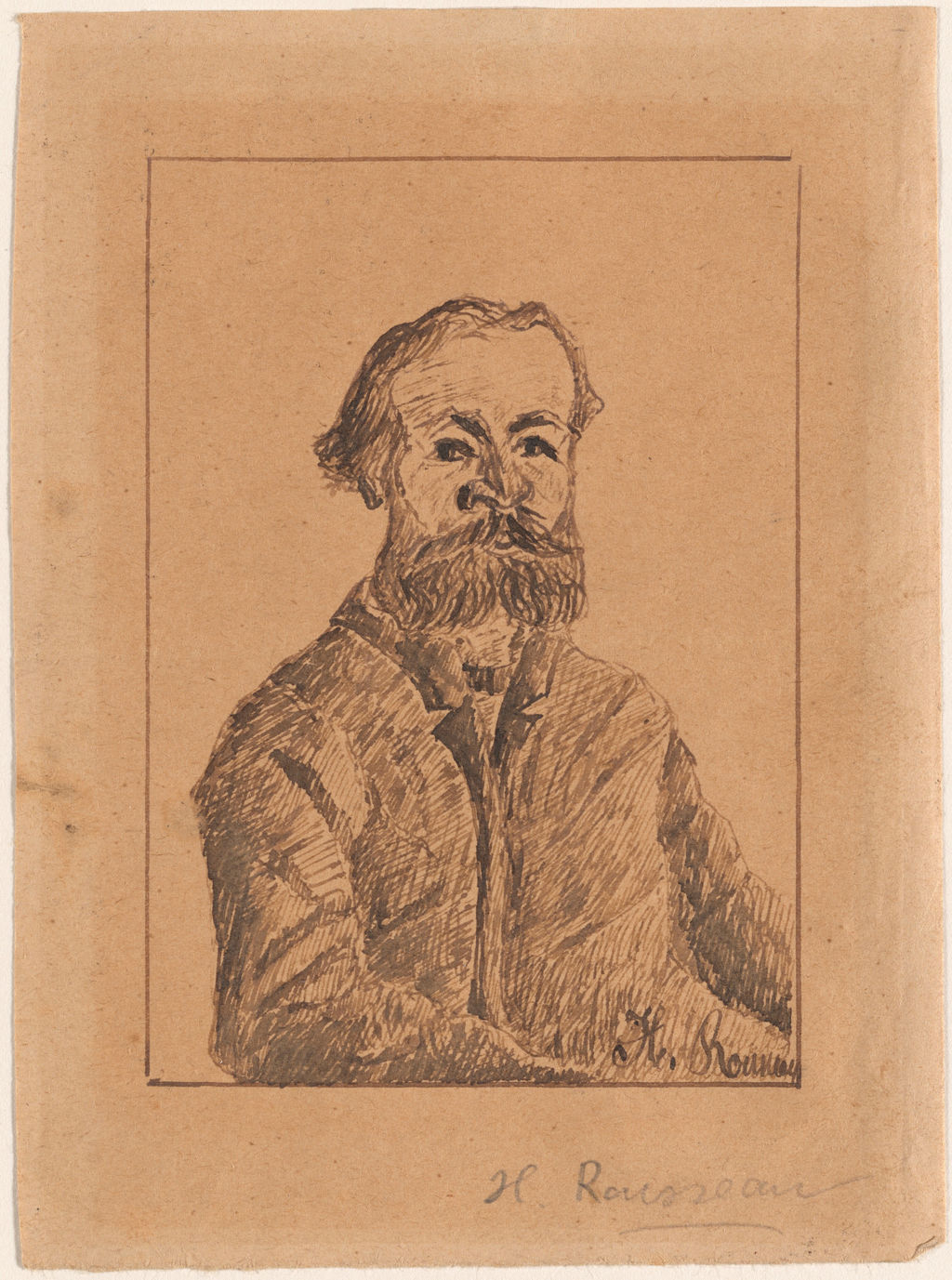
Henri Rousseau's drawings reward close looking at a small scale. In his 1895 Self-Portrait, short brown pen strokes gather into a substantial jacket, a furrowed face and a spreading beard. The sheet is only 13.6 × 10 cm, yet the sitter meets us with considerable presence.[1] Two ink views of the Quai d'Auteuil, dated 1885 and reproduced in Daniel Catton Rich's 1942 study, offer a different encounter: riverfront buildings, a near tree and stretches of open space assembled through lines of changing weight and direction.[2]
Together, these three sheets show how drawing can organise a view, discriminate between surfaces and present an artist to an intended audience. Each rewards attention to the particular marks Rousseau puts on the paper.
At a Glance
- ArtistHenri Rousseau
- SubjectHenri Rousseau Drawings
- ExploreTwo views of the Quai d'Auteuil; The 1895 ink self-portrait
Contents
- Two views of the Quai d'Auteuil
- The 1895 ink self-portrait
- A portrait intended for publication
- Drawing, painted studies and preparation
- How much did Rousseau draw?
- Annotated details
Two views of the Quai d'Auteuil
Rich reproduced the two 1885 drawings side by side. His captions identify River Scene, Quai d'Auteuil as ink on tan paper, measuring 6½ × 4⅞ inches, and Quai d'Auteuil as ink on tan paper, measuring 6 × 4½ inches. Both were then in Max Weber's collection. These are historical catalogue details; the 1942 credit does not establish their present whereabouts.[2] The small, upright formats invite inspection of individual passages, although the printed reproductions necessarily limit what can be said about the original paper and ink.
In River Scene, the eye travels across successive strips of riverbank and buildings. The lower structures have emphatic roofs and openings; behind them, a taller building rises against the comparatively open upper part of the sheet. Lines drawn across the foreground give the bank a definite direction. Small dark accents cluster near the water, while finer marks break up the intervening surfaces. Rousseau makes distance legible by placing one band beyond another and allowing the buildings to interrupt those bands.
The pen has different tasks across the drawing. A long line can establish an edge; several short ones can darken a roof or give a patch of ground a rough texture. The upper sky is also worked, with light horizontal strokes and darker cloudlike bands. Pale intervals between the marks keep the scene open. Even at reproduction scale, one can follow the movement between firmly bounded structures and more dispersed areas of shading.
The neighbouring Quai d'Auteuil brings a tree close to the viewer. Its trunk rises from the lower bank, and its branching crown occupies much of the upper sheet. Behind it, a row of pointed fence posts repeats along a receding edge. Their regular spacing supplies a measured rhythm against the irregular branching above. The water and distant bank remain visible through this nearer structure. Rousseau lets the tree interrupt the view while preserving enough openings to lead the eye beyond it.
One view concentrates attention on the built riverfront; the other gives a near tree the strongest vertical role. Both use a succession of edges to carry the eye into space. Their hatching changes density rather than filling every area equally. The pen's economy leaves a visible relationship between a mark and the surface around it, giving an ordinary urban setting a varied texture.
The 1895 ink self-portrait
The National Gallery of Art in Washington identifies Self-Portrait as pen and brown ink on brown wove paper, dated 1895. It belongs to the Collection of Mr. and Mrs. Paul Mellon and carries accession number 1995.47.66.[1] Its materials give the image an immediate unity: the brown paper remains visible across the face, clothing and empty background, while the ink builds differences in depth and texture.
Rousseau places the bust inside a thin rectangular border. There is ample space above the head, but the jacket broadens towards the lower corners and comes close to filling the width. The head turns slightly while the body presents a broad front. This difference gives the figure a small degree of movement within an otherwise steady arrangement. The eyes face towards us from beneath strongly marked brows, and the beard spreads across the upper chest.
Look first at the jacket. Long diagonal strokes describe broad areas of cloth, with darker groups accumulating around the shoulder and sleeve. Some marks cross one another; others run in close parallel. The changes in direction suggest folds without hiding the separate strokes that create them. Near the centre, the narrow dark opening of the clothing pulls the eye upwards towards the face. The pen moves from these larger areas to much shorter marks around the nose, eyes and forehead.
The beard requires another rhythm. Curving and angled strands gather around the mouth, then separate towards the lower edge. More open paper around the cheeks and forehead supplies light. Rousseau has very little need to describe a surrounding room: the blank field lets the head and shoulders hold our attention. The border contains them almost like a small window, but the sitter's direct address resists any sense of remoteness. The drawing feels both compact and assertive.
Two versions of Rousseau's name appear at the lower right, one inside the rectangle and a paler inscription below it. The museum identifies the lower inscription as graphite and tentatively attributes it to a later hand.[1] We cannot confidently read both names as Rousseau's own signatures.
Annotated Details from Self-Portrait (ink drawing, 1895)
The numbered points identify visible features discussed in this article. Return from each detail to the whole composition. Henri Rousseau, Self-Portrait, 1895. National Gallery of Art, Washington, 1995.47.66. Collection of Mr. and Mrs. Paul Mellon. Image source. CC0 / Public domain. Numbers added to the overview; detail views cropped from the original. No recolouring or retouching.
.jpg)
Details from SELF-PORTRAIT (INK DRAWING, 1895)
Compare the curved beard, diagonal jacket hatching and lower inscriptions with the complete ink drawing above.
Curving lines of the beard
Curved strokes gather around the mouth and spread through the beard. Their changing directions make the hair read differently from the broad, mostly diagonal marks of the coat.
 Detail 01 curving-lines-of-the-beard.jpg)
A jacket built from hatching
Long strokes lie beside one another across the jacket, with darker crossings around its folds. Small areas of brown paper remain visible between the marks.
 Detail 02 a-jacket-built-from-hatching.jpg)
Border and two inscriptions
A dark version of the name sits inside the drawn border; a paler one appears below it. The straight frame separates the dense portrait from the more open paper around it.
 Detail 03 border-and-two-inscriptions.jpg)
A portrait intended for publication
The ink portrait had a particular professional context. The chronology in the 1985 MoMA catalogue records that Rousseau submitted a pen-and-ink self-portrait and a biographical note for a proposed second volume of Portraits du prochain siècle in 1895. That volume was never issued.[3] The drawing belongs to a project through which he sought public recognition.
The autobiographical note is dated Paris, 10 July 1895. Writing about himself in the third person, Rousseau describes hardship, artistic perseverance and an increasingly distinct manner. He casts himself as learning chiefly from nature, with Gérôme and Clément contributing advice. He also singles out his bushy beard as a characteristic feature and associates his membership of the Indépendants with freedom of artistic production.[4] The text is an artist's account of his own development, shaped for an audience; its reference to advice does not establish a formal apprenticeship.
Read alongside the drawing, that attention to the beard becomes especially engaging. The same feature that the note offers as a verbal means of recognition occupies the centre of the portrait. The carefully assembled face and substantial jacket likewise give visual weight to a man presenting himself as an artist. The documented submission brings image and text together; their visual correspondence remains an interpretation, rather than proof of a written programme for the drawing.
The National Gallery traces the sheet through Edmond Girard, called Coutances, in 1895–1927, Paul Rosenberg, the Santamarina collection, and a Sotheby's sale in London on 3 April 1973. The Mellons gave it to the museum in 1995.[1] This is a substantial recorded journey for one small drawing, whose history can be followed much further than the 1942 ownership credits of the river views.
Drawing, painted studies and preparation
A study's purpose and its medium answer different questions. Rich illustrates Street Scene, described as a sketch for View of Malakoff, dates it 1898 and explicitly identifies the medium as oil. His accompanying discussion describes painted sketches made before the motif and subsequently developed into landscapes in the studio.[2] Such an object can be both a painting and a preliminary study. The word “sketch” tells us how it functioned or how summarily it was handled; it does not by itself identify a sheet drawn with pen or pencil.
Laval's MANAS likewise discusses preparation through View of the Île Saint-Louis from the Pont Henri IV, around 1909. The museum describes an initial study made on site, testing the placement of urban elements and relationships of colour before development in the studio.[5] This account helps explain how observation could feed a composed landscape. It does not provide grounds for adding the study to a list of pen drawings. Nor does a preparatory role prove that a particular surviving ink view was made for a particular finished painting.
The Orangerie's exhibition text also describes Rousseau sketching among the natural-history galleries and tropical glasshouses of Paris, observing preserved animals and living plants.[4] This places drawing within a wider practice of gathering visual material for his jungle subjects. It does not identify a surviving sheet behind a particular leaf or animal. An account of sketching and an identifiable drawing offer different kinds of evidence, both worth preserving.
Drawing also needs to be distinguished from the outlines and underlying work within a canvas. A visible painted contour belongs to the painting's construction; an independent ink sheet has its own support, edges and history. The relationship between planning and revision can be explored further through Rousseau's style and technique. For the present drawings, the paper itself matters: it provides the light around the hatching and the field against which each boundary becomes legible.
How much did Rousseau draw?
Rich reports Rousseau's claim to have made more than 200 pen-and-pencil drawings before 1895.[2] That statement offers evidence of the place Rousseau assigned to drawing in his account of his work. It supplies neither a count of surviving sheets nor a list of 200 objects that can now be located. The three examples discussed here establish specific works at two moments, ten years apart; they cannot measure the size or survival rate of his entire drawn output.
The distinction becomes useful when looking at monochrome images elsewhere in his work. The 1985 chronology records the publication of a lithograph of War in the January 1895 issue of L'Ymagier.[3] A lithograph belongs to his prints, even where its black marks resemble pen work in a reproduction. Attending to medium preserves what each object can tell us: the printed image's means of circulation, the painted study's handling of colour, and the ink sheet's direct exchange between line and paper.
Explore Rousseau’s drawings
River Scene, Quai d’Auteuil (1885)
Ink on tan paper, reproduced in Daniel Catton Rich’s 1942 study.
Quai d’Auteuil (1885)
A second ink view, with a foreground tree, reproduced in the same 1942 study.
Henri Rousseau artworks directory
This directory brings together works covered on this site and other works documented in the cited museum records and catalogues. Alternate titles share one entry; distinct versions remain separate. Historical dates for works without an article follow the cited catalogues. This is not a catalogue raisonné.
Frequently Asked Questions
The figure should not be used as a surviving inventory. Rich relays Rousseau's claim that he had made more than 200 pen-and-pencil drawings before 1895; it does not identify 200 surviving works.[2]
It was submitted with a biographical note for a proposed second volume of Portraits du prochain siècle. The volume was never issued.[3]
Discussion
Look again at the images and ideas explored in Henri Rousseau Drawings. These editorial prompts invite your observations.
Reader Insights
How does the near tree in Quai d'Auteuil change the way you enter the scene compared with the buildings in River Scene?
Where does Rousseau leave the paper most open in the self-portrait, and how do those areas shape your attention?
How does knowing the portrait's intended publication context affect your reading of its pose and expression?
Join the Conversation
Share a detail, comparison or question about Henri Rousseau Drawings below.
References
- National Gallery of Art. Self-Portrait, 1895, 1995.47.66, current object record, medium, dimensions, inscriptions and provenance, accessed 23 October 2026. View source.
- Daniel Catton Rich. Henri Rousseau, Museum of Modern Art, 1942, p. 15 (two Quai d'Auteuil ink drawings and captions), p. 16 (Rousseau's reported drawing total), and p. 36 (Street Scene and painted sketches). View source.
- Museum of Modern Art. Henri Rousseau: Essays, 1985, chronology, p. 93, entries for 1894–1895. View source.
- Musée de l'Orangerie. Henri Rousseau, l'ambition de la peinture, exhibition texts, 25 March–20 July 2026, “Moi-même, peintre” (Rousseau's autobiographical note dated 10 July 1895) and “Un style à soi” (sketching and jungle sources). View source. (in French).
- MANAS, Musées de Laval. “Henri Rousseau, dit le Douanier”, discussion of Vue de l'île Saint-Louis prise du pont Henri IV, around 1909, and preparation on site before studio development, accessed 23 October 2026. View source. (in French).
- The Museum of Modern Art, Henri Rousseau: Essays (1985), selected catalogue entries, chronology and notes on early devotees. View source. Selected entries, chronology (pp.91–95) and early-devotee notes (pp.262–264) were consulted. Historical collection credits do not establish present ownership.
- Daniel Catton Rich, Henri Rousseau (The Museum of Modern Art, 1942), selected drawings and landscape studies; historical catalogue. View source. The dated 1942 publication is used for the two Quai d’Auteuil ink views; its Malakoff date differs from the 1985 catalogue.
- The Museum of Modern Art, War (published January 1895), lithograph, accession 684.1943. View source.
- Barnes Foundation, Landscape and Four Young Girls, object 5521, BF855. View source.


 Henri Rousseau.jpg)


 Henri Rousseau.jpg)