


 by Tom Gurney
Tom Gurney BSc (Hons) is an art history expert with over 20 years experience
Published on June 19, 2020 / Updated on October 29, 2026
Email: tomgurney1@gmail.com / Phone: +44 7429 011000
Battle between Tiger and Bull (In a Tropical Forest): Introduction
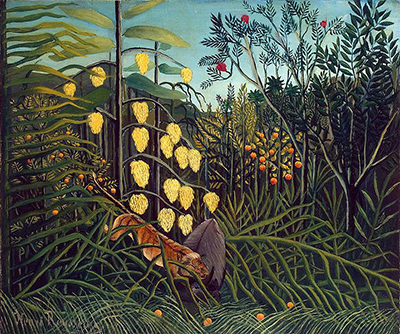
The tiger is almost lost among the leaves. Its orange back enters a tangle of green near the bottom of the picture, meeting the dark bulk of a bull whose lowered head is partly concealed. Above them, yellow fruits hang in orderly rows and fine branches reach into pale blue sky. Henri Rousseau makes the encounter difficult to see all at once. Our eye has to find a route through the plants before it can grasp the violence at their feet.
This is the small painting in the State Hermitage Museum, dated 1908, an original oil on canvas measuring 46 × 56 centimetres. Rousseau also painted a much larger version, now in Cleveland. The two share an animal encounter and a forest of interlacing leaves, but their details and histories differ. On the reverse of the Hermitage canvas, Rousseau himself identified its relationship to the picture he had exhibited at the Salon des Indépendants.[1] The smaller work rewards attention on its own terms: the plants establish an intimate, crowded world in which a struggle occupies surprisingly little space.
At a Glance
- ArtistHenri Rousseau
- SubjectBattle between Tiger and Bull (In a Tropical Forest)
- ExploreA forest in front of the action; What Rousseau wrote on the back
This work across Henri Rousseau’s career
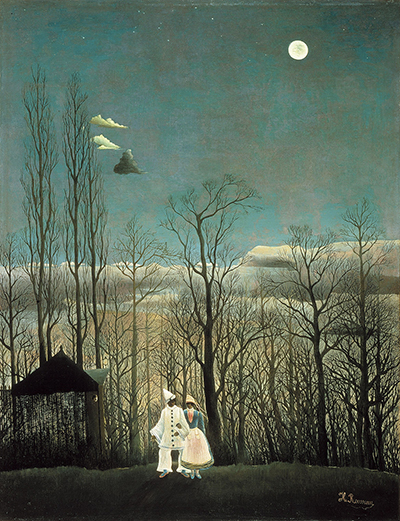
Carnival Evening
1886 [2]The Merry Jesters
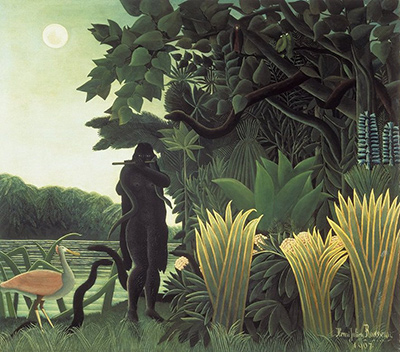
1906 [7]The Snake Charmer
1907 [8]Contents
- A forest in front of the action
- What Rousseau wrote on the back
- The small painting and the large canvas
- An animal image transformed
- From Vollard to the Hermitage
- Annotated details
A forest in front of the action
The animals sit low in the composition, a little to the left of centre. The tiger's curved back and striped flank remain recognisable through the vegetation; the bull rises beside it as a compact, dark grey mass. Their bodies meet along a diagonal that descends towards the foreground. Yet long green blades cross this meeting point, interrupting the outlines we would normally follow to understand an animal in motion. There is no clear patch of ground around the combatants. The forest closes over their bodies as it closes over everything else.
Rousseau gives those obscuring leaves a strong rhythm. Some rise from the lower edge, some bend outwards, and others cut across the picture at sharper angles. Their edges remain distinct even where several overlap. We can follow a single stem for a short distance, lose it in the mesh, then pick up another. The result is a peculiar mixture of legibility and obstruction: individual shapes look carefully defined, while the whole space resists an easy passage through it.
The left and right sides establish different kinds of growth. Broad leaves extend from a tall, straight stem on the left, their long, roughly horizontal shapes stacked above one another. Yellow clusters hang from curved stalks beside it. On the right, thinner stems divide and fork, carrying smaller leaves that become especially delicate against the sky. Red accents appear near their tips, while small orange fruits enliven a denser patch below. The heavy left side and finer right side give the forest variety without breaking its enclosing structure.
The pale blue sky spreads across the upper middle, behind the tallest stems. Looking towards it offers a momentary release from the darker mesh below, but no path leads from the animals to that clearing. The eye can rise where the bodies cannot. Beneath it, a distant band of vegetation introduces smaller shapes, suggesting further forest without setting out a measurable landscape.
Across the bottom, fine grasses bend into another closely woven surface. A few orange dots punctuate this low green screen. Above, the hanging yellow fruits supply larger, brighter intervals. Colour draws us around the painting, so that the eye repeatedly leaves the tiger and returns to the enclosing plants. The struggle gives the scene its dramatic subject; the vegetation determines the pace at which we discover it.
The 1985 Rousseau exhibition catalogue drew attention to this barrier effect, comparing the grasses to the railings of an Art Nouveau balcony.[12] It is a useful comparison because the plants can look simultaneously organic and constructed. Their repeated curves behave almost like an ornamental screen. The image brings us close to the struggle while keeping a dense partition between the event and our view.
Annotated Details from Battle between Tiger and Bull (In a Tropical Forest)
The numbered points identify visible features discussed in this article. Return from each detail to the whole composition. Henri Rousseau, Battle between Tiger and Bull (In a Tropical Forest), 1908. State Hermitage Museum, inventory 6536. The smaller painted version, distinct from the large Cleveland canvas. Image via Wikimedia Commons; published source: Hermitage reproduction. Image source. Public domain. Numbers added to a separate resized overview. Details cropped directly from the published original without enlargement, recolouring or retouching.
.jpg)
Details from BATTLE BETWEEN TIGER AND BULL (IN A TROPICAL FOREST)
Find the two animals low in the forest, then compare the heavy hanging fruit with the fine branches and crossing foreground grasses.
Two animals caught behind the leaves
The tiger’s orange body curves down towards the bull’s low head. Long green blades cross both animals, making us follow the struggle through interruptions; the raised tail carries the movement back towards the left.
 Detail 01 two-animals-caught-behind-the-leaves.jpg)
Hanging clusters on bowed stems
Yellow clusters hang below a series of curved green stalks. Their weight and repeated rounded shapes stand out against the darker upright stems and the long leaves crossing behind them.
 Detail 02 hanging-clusters-on-bowed-stems.jpg)
Fine branches against the sky
Small paired leaves give these thin branches a feathery outline. Red forms punctuate the open pale sky, making the upper forest feel lighter than the dense growth around the animals.
 Detail 03 fine-branches-against-the-sky.jpg)
Grasses woven across the foreground
Long narrow leaves bend, cross and rise into a close screen. Small orange dots interrupt the lower green mesh; the intervals between blades offer only brief glimpses into the darker forest.
 Detail 04 grasses-woven-across-the-foreground.jpg)
What Rousseau wrote on the back
The Hermitage publishes a particularly valuable piece of evidence about this painting: a label on the reverse, written in Rousseau's hand. It names the subject as a combat between a tiger and a bull, then describes the work as a reproduction of his painting shown at the 1908 Salon des Indépendants. His signature follows. The museum also records a signature and the date 1908 at the lower left of the painted face.[1]
Here, the artist's word “reproduction” describes his own painted return to a composition. The Hermitage work is an oil painting by Rousseau, with a changed arrangement of forms. The label provides a relationship to the exhibited canvas, and the 1985 catalogue identifies it as the later, smaller version.[12] It should therefore be approached as a reworking of an established picture. Its compact size alone gives no reason to call it a preparatory study.
The words on the label also clarify the changing English titles. The French taureau means bull. The Hermitage uses Battle between Tiger and Bull, with In a Tropical Forest as an alternative title, while the 1985 catalogue calls the same small canvas Combat of a Tiger and a Buffalo.[1][12] The familiar wording Battling Tiger and Buffalo belongs to this history of title variation. These names lead to the same Hermitage painting, inventory number 6536; they do not establish different versions or a precise zoological identification.
The alternative title directs attention towards something the dramatic animal title can leave in the background. In a Tropical Forest names the encompassing environment. The combat takes place within a much larger organisation of leaves, stems, fruit and sky. Even when the scene has been identified, the forest continues to demand more of our looking than either animal alone.
The small painting and the large canvas
The difference in scale is substantial. Cleveland's Fight Between a Tiger and a Buffalo measures 170 × 189.5 centimetres without its frame; the Hermitage canvas is 46 × 56 centimetres. Both are dated 1908. Cleveland records Rousseau's signature and date at the lower right, whereas the Hermitage records them at the lower left.[13][1] A small reproduction on a screen can conceal this enormous difference in the physical encounter with the paintings.
In the Cleveland version, the tiger's face presents itself more directly to the viewer. Its eyes and muzzle form a prominent point of attention below the bull's heavy body. Large pale fruit clusters hang through the left and middle of the composition, and broad green blades sweep across the foreground. The animal group has an assertiveness that can survive the surrounding plant growth. The leaves still obstruct it, but the tiger's gaze gives the viewer a comparatively immediate point of contact.
The Hermitage tiger is more absorbed into the tangle. Its striped body makes a warm diagonal close to the lower edge, and its head is less frontal and less conspicuous. The yellow hanging clusters are compact and numerous, distributed down the left and central stems. The thin branching growth on the right leaves more of its structure visible, with small orange accents dotted among it. Each version balances the animals, the upright growth and the open sky differently.
The 1985 catalogue explicitly notes that Rousseau simplified and substantially altered the composition when he reduced its format, particularly in the flowers and fruits.[12] Comparing the two images makes that observation concrete. The smaller version carries over the basic opposition between a striped predator and a dark, weighty victim, but the distribution of colour and the character of the surrounding growth have been reconsidered. Its visual interest lies partly in these changed intervals: bright fruit against dark leaves, thin branches against sky, orange stripes behind green blades.
At the smaller scale, these forms invite a close, concentrated encounter. The forest can be taken in as a compact pattern, then explored in detail as a space containing a violent event. That movement between surface and scene is one of the painting's pleasures. We recognise a leaf as an individual shape, then discover how it interrupts an animal; a little further away, the same leaf joins the overall rhythm of the green screen.
An animal image transformed
Rousseau's animals have an identifiable connection with an earlier image. In the Hermitage publication, A. G. Kostenevich names Eugène Pirodon's etching after Charles Verlat's Royal Tiger Attacking a Bull as the source for both Rousseau versions. The 1985 catalogue discusses the same connection, describing the print as a probable source for the large canvas.[1][12] This is evidence of an artist drawing on existing imagery while developing a distinctive setting around it.
Kostenevich distinguishes Verlat's animalist subject from Rousseau's personal interpretation of the jungle.[1] The distinction helps explain where attention falls in the Hermitage painting. Although the animals supply a recognisable struggle, their shapes are bound into the surrounding vegetation. The tiger's stripes echo the repeated slashes and bands of the leaves. The bull's rounded, dark body sits beneath the yellow clusters. The action belongs to the same crowded surface as the fruit and grasses.
Rousseau's sources for tropical scenery were available in Paris. The Musée de l'Orangerie's 2026 exhibition account places his jungles within the world of botanical glasshouses, natural-history displays, press illustrations and exotic imagery circulated through colonial exhibitions. It also rejects the story that these paintings recorded a journey to Mexico.[14] The Hermitage forest can be understood within that culture of observation and borrowed images, assembled into an invented place. There is no need to assign it a single geographical location to appreciate the specificity of its shapes.
The 1985 entry quotes Roch Grey, writing in 1922, on Rousseau's flowers as forms belonging to dreams.[12] This later writer's interpretation of Rousseau catches something visible here: the fruit and foliage seem individually persuasive without adding up to a botanical survey. Their intense presence comes from outline, repetition and colour. Each cluster helps furnish a world whose order is the painter's own.
From Vollard to the Hermitage
The small painting followed a different route through collections from its large companion. The Hermitage records it at the Vollard Gallery in Paris in 1909, then in Sergei Shchukin's collection in Moscow in 1912. It subsequently belonged to Moscow's Museum of Modern Western Art and entered the Hermitage in 1930.[1] These names and dates give the intimate forest scene its own place within the collecting history of Rousseau's work.
The two versions also show how much an encounter with a Rousseau jungle depends on scale and arrangement. In this small canvas, the brightest yellow fruits lead down towards an animal group that remains partly hidden. Fine branches lift the gaze away again. Looking becomes a repeated negotiation between attraction and obstruction, between the clarity of a single shape and the difficulty of seeing through the whole.
Return to the lower part of the painting after following the stems upwards. The tiger has not become easier to isolate. Its orange body still threads between green blades; the bull remains embedded in the dark vegetation. The little forest sustains its density even after we know what is happening inside it. That is the force of this version: a compact painting in which the plants make a violent encounter both close at hand and difficult to reach.
Henri Rousseau artworks directory
This directory brings together works covered on this site and other works documented in the cited museum records and catalogues. Alternate titles share one entry; distinct versions remain separate. Historical dates for works without an article follow the cited catalogues. This is not a catalogue raisonné.
Frequently Asked Questions
It belongs to the State Hermitage Museum, inventory number 6536. The museum records its acquisition in 1930.[1]
Discussion
Look again at the images and ideas explored in Battle between Tiger and Bull (In a Tropical Forest). These editorial prompts invite your observations.
Reader Insights
Which do you notice first: the tiger's orange stripes or the hanging yellow fruit? How does that first attraction shape your reading of the scene?
Compare the tiger's face in the Hermitage and Cleveland versions. How does its direction change your sense of the viewer's position?
Do the foreground leaves make the encounter feel more threatening, more distant, or both?
Join the Conversation
Share a detail, comparison or question about Battle between Tiger and Bull (In a Tropical Forest) below.
References
- A. G. Kostenevich, State Hermitage Museum. “Battle between Tiger and Bull (In a Tropical Forest),” in The State Hermitage: Treasures from the Museum's Collections, volume 2, revised and expanded edition, Booth-Clibborn Editions, 2014, entry 231, pp. 292–293 (PDF p. 164); contributor key, p. 8. Object, inscription, source and provenance. View source.
- Philadelphia Museum of Art, Carnival Evening,1963-181-64,object59593. View source.
- Musée de l’Orangerie / Juliette Degennes, Henri Rousseau,L’ambition de la peinture: Un artiste dans son époque (in French). View source.
- National Gallery, Surprised!, NG6421. View source.
- Musée d’Orsay, La Guerre,RF19461 (in French). View source.
- MoMA, The Sleeping Gypsy. View source.
- Philadelphia Museum of Art, The Merry Jesters, 1950-134-176, object51097. View source.
- Musée d’Orsay, La Charmeuse de serpents, RF 1937 7 (in French). View source.
- Musée de l’Orangerie, La Carriole du Père Junier, RF 1960 26 (in French). View source.
- Solomon R. Guggenheim Museum / Cornelia Lauf, The Football Players,60.1583: current collection record. View source.
- MoMA, The Dream, 252.1954. View source.
- The Museum of Modern Art. Henri Rousseau: Essays, 1985, entry 51, “Combat of a Tiger and a Buffalo,” p. 216, plate p. 217; comparative entry 50, pp. 212–215. English translations from the French by Richard Miller. View source.
- Cleveland Museum of Art. Fight Between a Tiger and a Buffalo, 1908, accession 1949.186, collection record, measurements and inscription; accessed 23 October 2026. View source.
- Musée de l'Orangerie. Henri Rousseau, l'ambition de la peinture, exhibition texts, 2026, section “Un style à soi.” View source. (in French).
- The Museum of Modern Art, Henri Rousseau: Essays (1985), selected catalogue entries, chronology and notes on early devotees. View source. Selected entries, chronology (pp.91–95) and early-devotee notes (pp.262–264) were consulted. Historical collection credits do not establish present ownership.
- Daniel Catton Rich, Henri Rousseau (The Museum of Modern Art, 1942), selected drawings and landscape studies; historical catalogue. View source. The dated 1942 publication is used for the two Quai d’Auteuil ink views; its Malakoff date differs from the 1985 catalogue.
- MANAS, Laval, Henri Rousseau, dit le Douanier, urban landscapes and preparatory study (in French). View source.
- National Gallery of Art, Self-Portrait (1895), pen-and-ink drawing, accession 1995.47.66. View source.
- The Museum of Modern Art, War (published January 1895), lithograph, accession 684.1943. View source.
- Barnes Foundation, Landscape and Four Young Girls, object 5521, BF855. View source.
 Henri Rousseau.jpg)
 Henri Rousseau.jpg)