


 by Tom Gurney
Tom Gurney BSc (Hons) is an art history expert with over 20 years experience
Published on June 19, 2020 / Updated on October 29, 2026
Email: tomgurney1@gmail.com / Phone: +44 7429 011000
Beauty and the Beast: Introduction
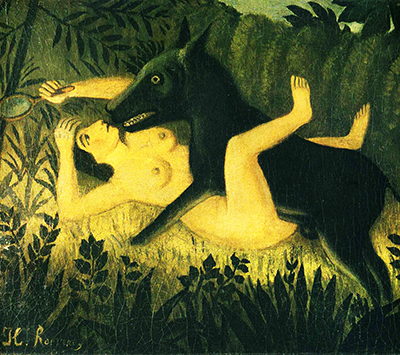
A nude woman lies in a small clearing, her pale body crossed by the dark shape of an animal. Dense leaves surround them, and a hand mirror catches the eye at the left edge. Henri Rousseau's Beauty and the Beast brings an intimate, unsettling encounter into a forest that seems to have closed around its two inhabitants. Painted about 1908, this small oil on canvas is held at Berlin's Sammlung Scharf-Gerstenberg.[1]
At a Glance
- ArtistHenri Rousseau
- SubjectBeauty and the Beast
- ExploreA small painting with a tightly enclosed world; Looking at the woman, the animal and the leaves
This work across Henri Rousseau’s career
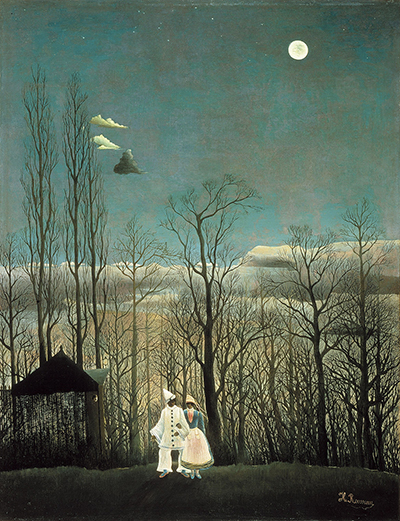
Carnival Evening
1886 [2]The Merry Jesters
1906 [7]The Snake Charmer
1907 [8]Contents
- A small painting with a tightly enclosed world
- Looking at the woman, the animal and the leaves
- Stillness within an erotic encounter
- What might the mirror mean?
- The fairy-tale reading
- A forest assembled in Paris
- A later ecological interpretation
A small painting with a tightly enclosed world
The current Berlin record gives the French title as La belle et la bête, dates the work to about 1908 and identifies Paris as its place of production. The canvas measures 32 × 41.5 centimetres. Its inventory number, SSG 275, distinguishes this particular painting from the many other images associated with the familiar title. Since 2004 it has been a permanent loan from the Stiftung Sammlung Dieter Scharf zur Erinnerung an Otto Gerstenberg to the Sammlung Scharf-Gerstenberg.[1]
Those modest dimensions suit the painting's compressed arrangement. The woman's reclining body extends across almost the entire width of the clearing, while the animal occupies much of its centre and right side. Vegetation presses against the edges of both figures. There is little room to imagine approaching them along a path or looking past them into a distant landscape. Rousseau places the viewer close to an encounter whose setting offers almost no escape for the eye.
A narrow lighter area appears through the foliage near the top, but it does little to open the scene. The clearing functions like a shallow pocket within the forest. Its pale grass provides a continuous ground beneath the figures, and the dark plants along the lower edge establish a screen between their bodies and ours. The feeling of seclusion comes from this arrangement of overlapping shapes as much as from the subject itself.
Looking at the woman, the animal and the leaves
The adult woman reclines with her head towards the left. Her dark hair spreads beside her face, one arm bends near her forehead, and the other reaches towards the oval mirror. Her raised legs create the most emphatic diagonals in the picture. They cross the animal's dark body, breaking its broad mass into smaller areas and drawing attention back towards the meeting of the two figures.
The animal's pointed ears, long muzzle and conspicuously round eye give its head a sharp, alert outline. A row of teeth shows within its partly open mouth. Its head comes close to the woman's face, yet its stiff profile offers few clues to a particular action. The long front leg cuts down across the light ground; farther right, the hindquarters and curved tail complete the animal's extended silhouette. The almost black body is a strong visual presence, with contours that remain clear against the woman's skin and the surrounding grass.
Rousseau gives the two bodies different kinds of emphasis. The woman's flesh is articulated through pale areas and gentle changes of tone. The animal reads first as a large, continuous dark shape. Where their outlines meet, the contrast makes each especially legible. Her bent limbs carry the eye upwards and outwards; its body anchors the composition across the middle. This exchange between pale and dark forms gives the scene a firmness that survives its strange subject.
Leaves repeat around them in clusters, narrow sprays and upright stems. The foreground foliage is particularly dark and sharply outlined. At the left, slender leaves rise beside the mirror; above, larger hanging forms create a canopy. These plants differ in shape, but their repetitions bind the surface together. The lifted feet and bent arms introduce a related rhythm of turns and angles. Bodies and foliage share the same crowded space, while the bare skin remains the brightest sustained passage within it.
The mirror adds a smaller contrast of its own. Its oval face and short handle stand apart from the living forms that fill the picture. Placed near the left boundary, it is easy to overlook on a first glance at the central encounter. Once noticed, however, it changes the questions we ask about the woman: what is she looking at, what could she see, and why is this object present in so secluded a place?
Stillness within an erotic encounter
Bernhard Maaz, writing in the Berlin museum's object description, understands the scene as an erotic encounter marked by an extraordinary pause. He emphasises its suspension and rigidity, including the animal's almost stuffed-toy stiffness and its round-eyed expression. His reading directs attention to a quality that can be lost when the painting is described only through its provocative subject: very little seems to move.[1]
That distinction matters to the experience of looking. The visible teeth might initially suggest danger, and the arrangement of the bodies clearly carries sexual implications. Yet the painting provides none of the surrounding action that would settle its narrative. The animal's long, straight foreleg gives little sense of forward momentum. The open arms, raised limbs and fixed profiles hold the encounter at an uncertain point.
Maaz interprets the pause as shared by the two participants. That remains a curator's account of the painted gestures, rather than a recorded explanation from Rousseau.[1] The picture leaves considerable room between a visible pose and a knowable state of mind. Its stillness can feel calm, awkward or disquieting, depending on where the viewer's attention rests. The orderly contours make the encounter easy to see while its emotional character remains difficult to resolve.
What might the mirror mean?
For Maaz, the hand mirror opens several possible readings. He asks whether it might be an attribute of Venus, the ancient goddess of beauty, or whether it could allude to self-knowledge, an interpretation he regards as less likely. He also considers its relation to the extraordinary situation in which the woman finds herself. The museum's commentary leaves these possibilities open.[1]
The mirror's placement contributes to that openness. It is held beyond the woman's head, close to the vegetation at the picture's margin. We cannot confidently identify a reflected scene within its subdued oval surface. The object therefore introduces the possibility of another view without giving us a clear second image to consult. Rousseau has made the act of looking part of an encounter that already resists an easy explanation.
The connection with beauty is particularly suggestive because of the title. A mirror might allow the woman to contemplate her appearance, while the viewer considers the opposed names assigned to her and the animal. Yet Rousseau gives us no clear reflection through which to share her view. This small object introduces a further uncertainty into a scene whose central figures are so plainly exposed.
The fairy-tale reading
The title naturally invites an association with the story of Beauty and the Beast. A particularly definite version appeared in the visitor text for the Schinkel Pavillon exhibition Sun Rise | Sun Set in 2021, curated by Nina Pohl and Agnes Gryczkowska. That text described the picture through the fairy tale, called the animal a wolf and treated the mirror as enchanted, capable of revealing what its holder desires.[12]
This is a useful record of how the picture has been interpreted, but the Berlin collection record is more cautious about the mirror and does not identify a specific animal species. Neither text supplies a statement by Rousseau establishing the mirror's powers or identifying an exact episode from a particular version of the story.[1][12] The title can guide a reading without turning every detail into an illustration of a known plot.
There is also a productive ambiguity in the French word bête. Maaz draws attention to its capacity to mean an animal as well as the more charged English “beast.”[1] The familiar translated title encourages an immediate contrast between beauty and monstrosity. Looking at the actual figures complicates that contrast. The creature's staring eye and rigid body are as conspicuous as its teeth; the woman's pose is more unusual than a conventional ideal of repose. The painting gives both figures a strangeness that their allotted names cannot fully contain.
A forest assembled in Paris
The surrounding vegetation belongs within Rousseau's wider practice of constructing imagined environments from resources available in Paris. The Musée de l'Orangerie's 2026 exhibition account identifies his visits to the natural-history museum and the Jardin des Plantes glasshouses, together with popular illustrations and imagery circulating through colonial exhibitions, as resources for his jungle paintings. It also stresses the range of this repertoire, which included both violent encounters and more peaceful scenes.[13]
For this particular canvas, those sources provide a context rather than an identified model. No specific plant specimen, illustration or view of a glasshouse has been established here. What we can see is the result of selection and arrangement: foliage forms a dense border, the clearing holds the figures close together, and a few light passages maintain their visibility. Within the broader range of Rousseau's paintings, this small scene concentrates attention on bodily proximity and enclosure.
The Paris setting of its production also helps us understand the forest as an imaginative space. Its effectiveness does not depend on locating a real tropical clearing. Rousseau gives every element a role in the encounter. The foreground screens it, the canopy closes it, and the pale grass brings the two contrasting bodies forward. The vegetation supplies both a setting and a structure for looking.
A later ecological interpretation
The 2021 Schinkel Pavillon text placed the painting within contemporary concern about the destruction of ecosystems. Its curatorial argument questioned definitions of beauty and wilderness formed from an exclusively human perspective, using Rousseau's encounter to unsettle the boundary between human desires and animal life. This was the exhibition's modern interpretive framework.[12]
The painting can sustain such questions because it brings a human figure and an animal into unusually close relation. The distinction implied by its title remains visible, yet the interlocking forms make separation difficult. Leaves surround both bodies without assigning either an obvious privileged territory. These features give a later viewer material for thinking about human relationships with the natural world. They do not establish an ecological intention on Rousseau's part. Read through that later framework, the closed clearing becomes a place to question who defines the beautiful and the wild.
Henri Rousseau artworks directory
This directory brings together works covered on this site and other works documented in the cited museum records and catalogues. Alternate titles share one entry; distinct versions remain separate. Historical dates for works without an article follow the cited catalogues. This is not a catalogue raisonné.
Frequently Asked Questions
The current Staatliche Museen zu Berlin record dates it to about 1908. It is an oil painting on canvas measuring 32 × 41.5 centimetres.[1]
It is part of the Sammlung Scharf-Gerstenberg in Berlin, inventory SSG 275, on permanent loan since 2004 from the Stiftung Sammlung Dieter Scharf zur Erinnerung an Otto Gerstenberg.[1]
Discussion
Look again at the images and ideas explored in Beauty and the Beast. These editorial prompts invite your observations.
Reader Insights
How does the dense border of leaves affect your sense of the encounter's privacy or danger?
Does noticing the mirror change the story you first imagined from the central figures?
Which details make the animal appear threatening, and which make it seem strangely immobile?
Join the Conversation
Share a detail, comparison or question about Beauty and the Beast below.
References
- Staatliche Museen zu Berlin, Sammlung Scharf-Gerstenberg; object description by Bernhard Maaz. La belle et la bête, inventory SSG 275, expert metadata and complete object description, updated 28 August 2026; accessed 23 October 2026. View source. (in German).
- Philadelphia Museum of Art, Carnival Evening,1963-181-64,object59593. View source.
- Musée de l’Orangerie / Juliette Degennes, Henri Rousseau,L’ambition de la peinture: Un artiste dans son époque (in French). View source.
- National Gallery, Surprised!, NG6421. View source.
- Musée d’Orsay, La Guerre,RF19461 (in French). View source.
- MoMA, The Sleeping Gypsy. View source.
- Philadelphia Museum of Art, The Merry Jesters, 1950-134-176, object51097. View source.
- Musée d’Orsay, La Charmeuse de serpents, RF 1937 7 (in French). View source.
- Musée de l’Orangerie, La Carriole du Père Junier, RF 1960 26 (in French). View source.
- Solomon R. Guggenheim Museum / Cornelia Lauf, The Football Players,60.1583: current collection record. View source.
- MoMA, The Dream, 252.1954. View source.
- Schinkel Pavillon. Sun Rise | Sun Set: English visitor exhibition text, 2021, Henri Rousseau entry, PDF p. 18; exhibition curator credits, PDF p. 1. Exhibition curated by Nina Pohl and Agnes Gryczkowska; accessed 23 October 2026. View source.
- Musée de l'Orangerie. Henri Rousseau, l'ambition de la peinture, exhibition texts, 25 March–20 July 2026, especially “Un style à soi”; accessed 23 October 2026. View source. (in French).
- The Museum of Modern Art, Henri Rousseau: Essays (1985), selected catalogue entries, chronology and notes on early devotees. View source. Selected entries, chronology (pp.91–95) and early-devotee notes (pp.262–264) were consulted. Historical collection credits do not establish present ownership.
- Daniel Catton Rich, Henri Rousseau (The Museum of Modern Art, 1942), selected drawings and landscape studies; historical catalogue. View source. The dated 1942 publication is used for the two Quai d’Auteuil ink views; its Malakoff date differs from the 1985 catalogue.
- MANAS, Laval, Henri Rousseau, dit le Douanier, urban landscapes and preparatory study (in French). View source.
- National Gallery of Art, Self-Portrait (1895), pen-and-ink drawing, accession 1995.47.66. View source.
- The Museum of Modern Art, War (published January 1895), lithograph, accession 684.1943. View source.
- Barnes Foundation, Landscape and Four Young Girls, object 5521, BF855. View source.
 Henri Rousseau.jpg)
 Henri Rousseau.jpg)