



 by Tom Gurney
Tom Gurney BSc (Hons) is an art history expert with over 20 years experience
Published on June 19, 2020 / Updated on October 29, 2026
Email: tomgurney1@gmail.com / Phone: +44 7429 011000
Boy on the Rocks: Introduction
The child in Henri Rousseau’s Boy on the Rocks faces us with unwavering composure. A dark jacket spreads across the centre of the picture, two small hands rest beside its opening, and black boots hang among sharp brown peaks. The clothing suggests the care of a formal portrait sitting; the rocky perch makes that sitting difficult to place. Above it all, a broad expanse of pale blue sky leaves the face exposed to our attention. The National Gallery of Art in Washington dates the painting to 1895–1897.[1]
At a Glance
- ArtistHenri Rousseau
- SubjectBoy on the Rocks
- ExploreA small painting with a commanding figure; Face, hands and the act of posing
This work across Henri Rousseau’s career
Carnival Evening
1886 [2]Boy on the Rocks (current article)
1895/1897 [1]The Merry Jesters
1906 [7]The Snake Charmer
1907 [8]Contents
- A small painting with a commanding figure
- Face, hands and the act of posing
- The patterns that hold the body together
- What kind of place are the rocks?
- An unidentified child
- Beside Child with a Doll
- From a Paris sale to Washington
- Annotated details
A small painting with a commanding figure
Painted in oil on linen, the picture measures 55.4 × 45.7 centimetres. It belongs to the National Gallery’s Chester Dale Collection, under accession number 1963.10.63.[1] Those modest dimensions matter when imagining the encounter. This is a portrait that can be taken in at close range, with face, fingers and patterned stockings all within a single glance. Yet the figure has a presence that seems larger than the physical object. Rousseau gives the child the centre and arranges almost everything else around that claim to our attention.
The head stands well below the top edge, surrounded by a generous area of sky. The jacket broadens towards the waist and flares to the left, creating a dark, almost bell-shaped mass. Below it, the legs divide, and the boots point down into the rocky foreground. The outline remains easy to follow even where the relation between body and ground becomes uncertain. At a distance, the picture resolves into a few strong shapes: dark clothing, light face, white stripes and a serrated brown base. Closer looking reveals how much variety Rousseau has fitted inside that simple arrangement.
Face, hands and the act of posing
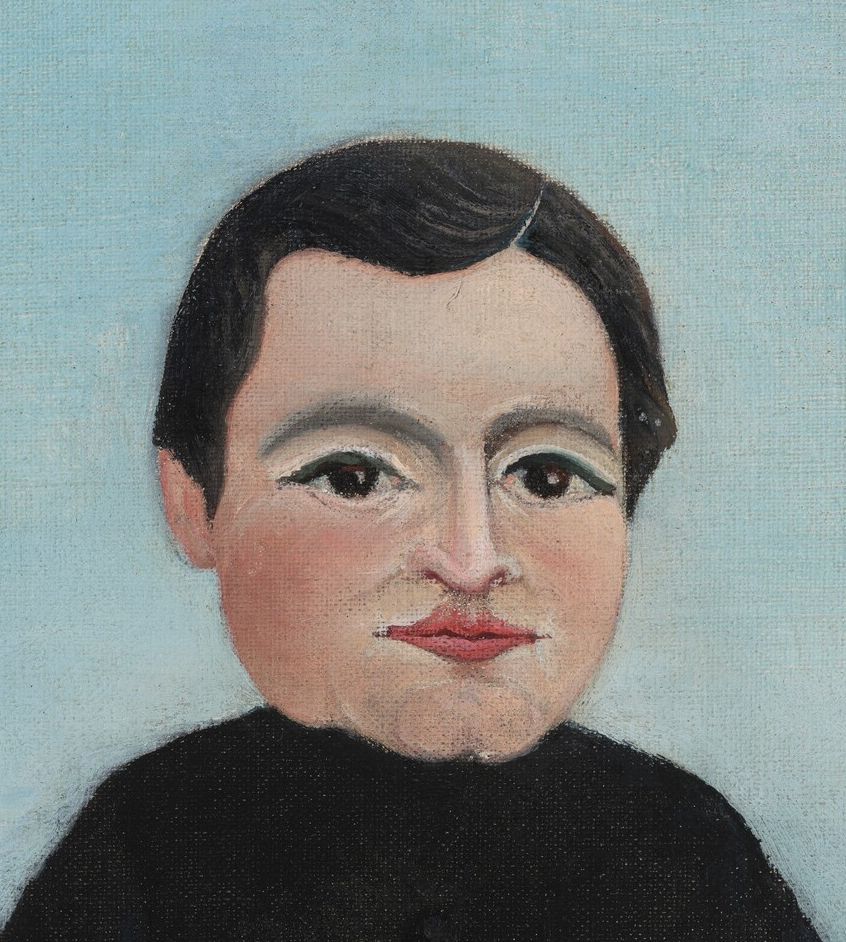
The face is large in relation to the upper body, while the hands seem especially small. This difference draws the eye upwards and keeps it there. Dark hair frames the forehead in a smooth cap; the curved brows and sharply marked eyes give the gaze a concentrated quality. The mouth is carefully defined, with a slight lift at its corners that resists an easy description as either a smile or a solemn expression. Rousseau allows the sitter to look composed without making that composure transparent to us.
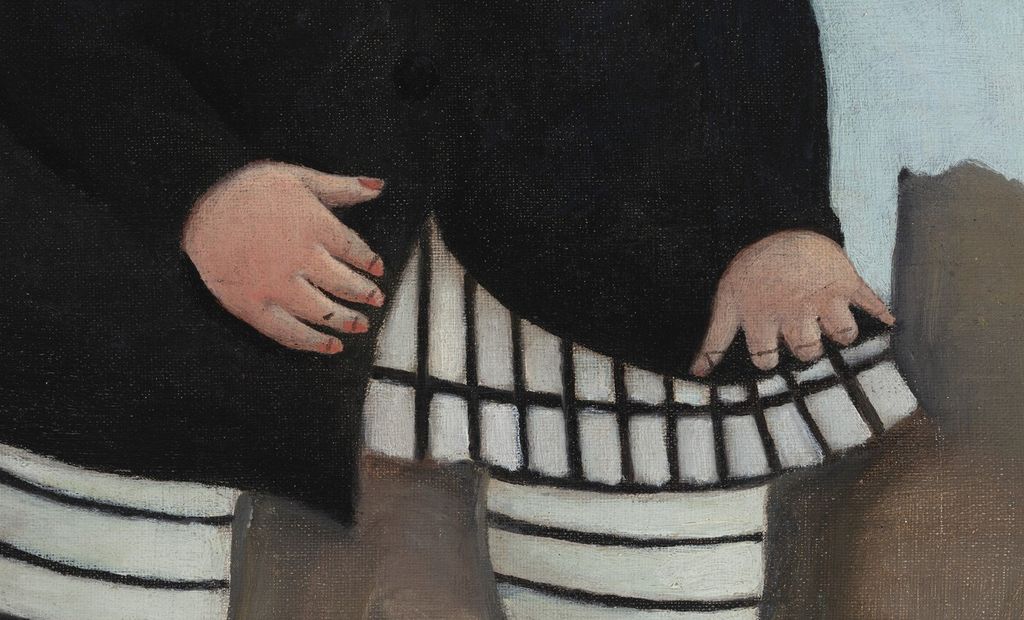
The two hands interrupt the dark jacket with small areas of warm flesh. One rests nearer the middle, its fingers curling towards the opening; the other lies farther out, close to the edge of the white garment. Their unequal positions keep the frontal pose from becoming perfectly symmetrical. The face looks straight ahead, but the body contains these quiet adjustments: the jacket’s longer sweep to one side, the separation of the knees, the different angles of the boots. Stillness here has a carefully articulated shape.
There is little sense of a passing gesture. We cannot readily supply a preceding action or imagine the next movement. That suspension invites prolonged scrutiny, while the strange ground prevents the setting from becoming ordinary. The child seems thoroughly prepared to be looked at. Whether the sitter felt patient, proud, uncomfortable or amused is beyond what the painted expression can establish.
The patterns that hold the body together
The jacket forms the picture’s largest area of darkness. Its buttons can be discerned, but they do not break up its broad continuity. Against that expanse, the white clothing becomes unusually lively. Beneath the opening, vertical and horizontal black lines form a grid. Across the legs, repeated dark bands turn the stockings into alternating strips of light and dark. Each part has a different visual rhythm: the jacket gives weight, the grid gives little compartments, and the stockings carry the eye sideways across the lower body.
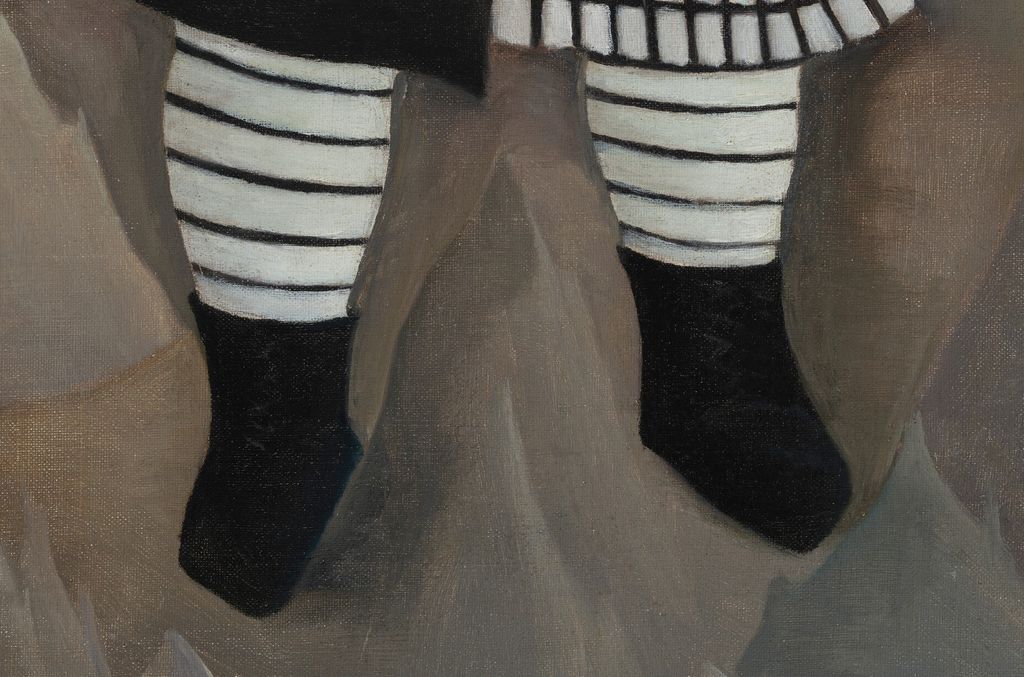
These patterns also affect how we read volume. The lines on the stockings curve gently, suggesting rounded legs, while the grid follows the spreading edge of the garment beneath the jacket. At the same time, the emphatic marks remain conspicuous as painted designs. The eye moves between a clothed body and an arrangement of lines on the surface. Rousseau makes both readings available, and much of the portrait’s peculiar clarity comes from their coexistence.
In his 1942 study, Daniel Catton Rich drew attention to the way the clothing becomes a pattern of clear forms. He also proposed the influence of cabinet photographs on Rousseau’s portraiture. No particular source photograph for Boy on the Rocks is identified in that discussion.[12] The suggestion helps explain why the frontal presentation may feel familiar: the carefully arranged clothes, visible hands and direct address resemble the occasion of a formal likeness. It leaves open how Rousseau developed this particular image. We can recognise the logic of posing without supplying a missing photograph.
What kind of place are the rocks?
The ground offers the greatest resistance to a straightforward reading. Brown points rise around the boots and between the legs, with further peaks crowding the foreground. Some edges are steep and narrow; others swell into broader slopes. Shifts between warmer brown and cooler grey separate their faces. There is enough modelling to make the rocks seem solid, but very little detail to establish their size. We see no trees, houses or other figures that would give the formations a dependable measure.
The same uncertainty affects the child. If these are large mountains, the figure appears enormous. If they are small outcrops, the sitter occupies an awkwardly narrow perch. The painting never supplies a comfortably scaled ledge or an obvious equivalent of a chair. A tall point rises between the legs, and the boots remain visibly apart from each other. The arrangement makes contact between person and setting difficult to reconstruct, even though the strong outlines let us identify every separate part.
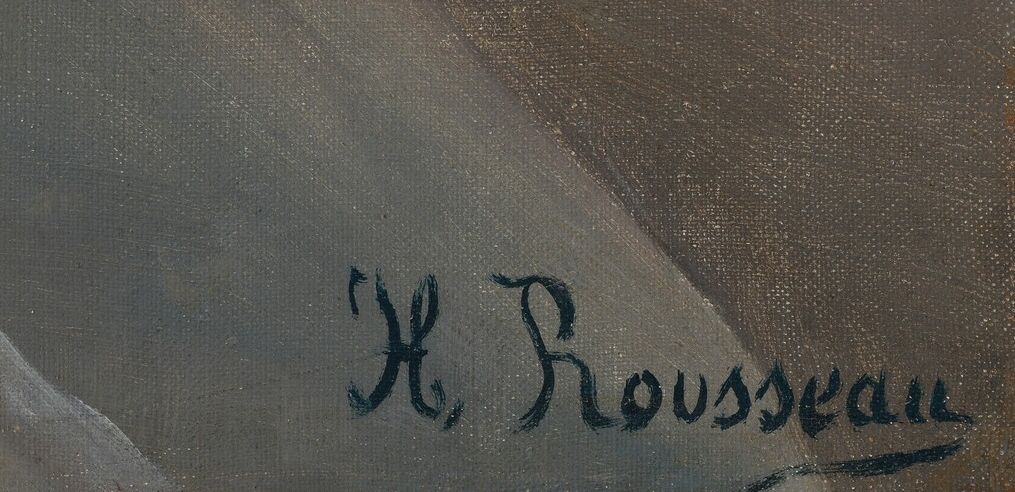
A thin turquoise strip appears beyond the rocks, close to the level where the lower body begins. It suggests distant water, yet occupies too little space to open the scene into an extensive view. Above it, the sky is pale and softly varied, with faint cloud-like passages. The crowded angular foreground contrasts with the room given to the head above. The eye can move freely through the sky before being caught again by the tightly assembled shapes below. At the lower right, Rousseau’s dark signature runs across one of the pale rock faces.
Rich suggested that the rocky setting might derive from the fortifications around Paris. His basis was Rousseau’s explanation of similar forms in another portrait; he did not establish a particular Paris site for this painting.[12] This remains a possible connection, and the peaks need not be treated as evidence of an Alpine journey. Their visible role is easier to describe with confidence. They repeat the downward thrust of the boots, put sharp edges against the rounded face and hands, and turn a seated pose into an encounter with unstable scale.
Annotated Details from Boy on the Rocks
The numbered points identify visible features discussed in this article. Return from each detail to the whole composition. Henri Rousseau, Boy on the Rocks, 1895/1897. National Gallery of Art, Washington, 1963.10.63. Chester Dale Collection. Image source. CC0 / Public domain. Numbers added to the overview; detail views cropped from the original. No recolouring or retouching.
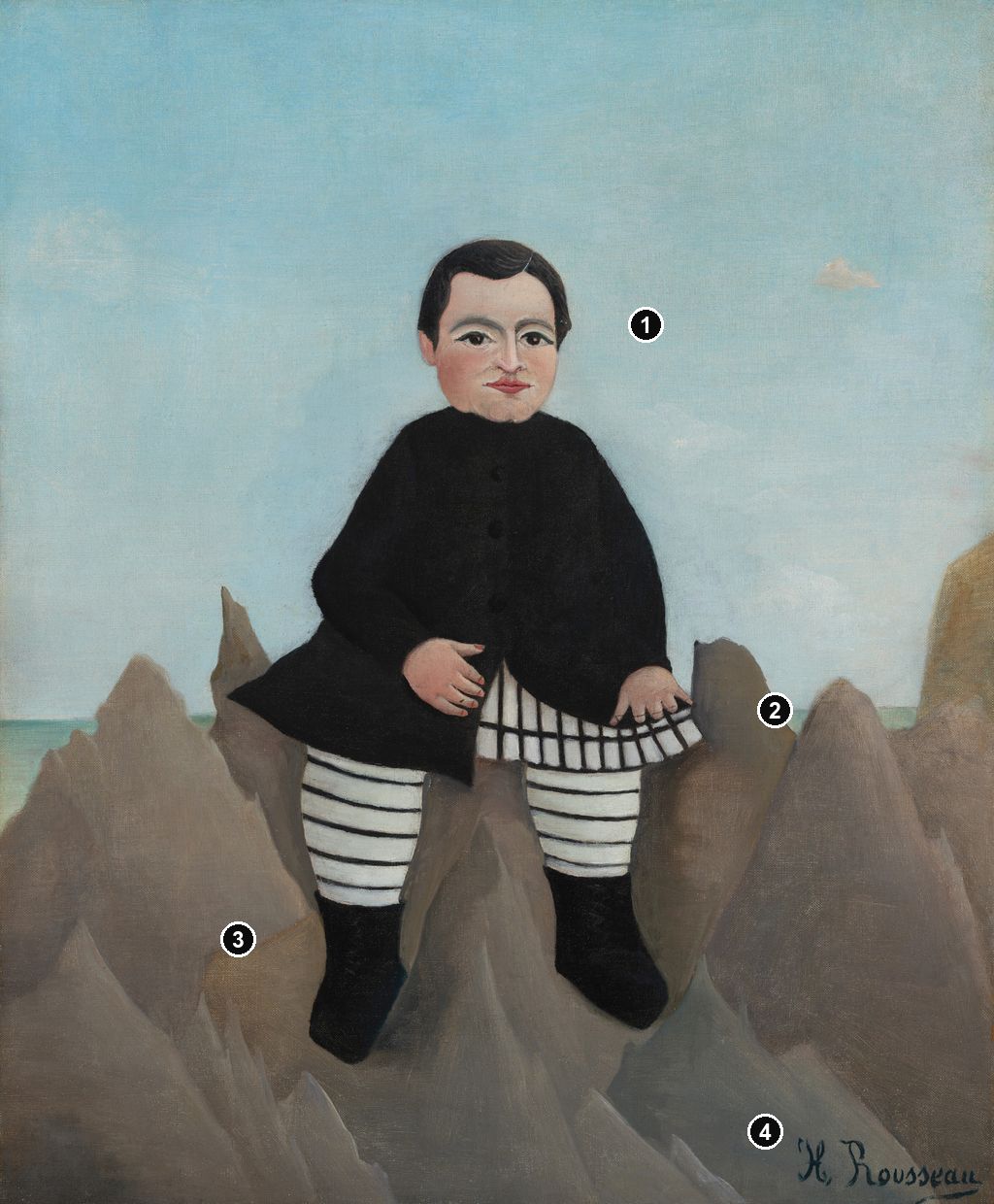
Details from BOY ON THE ROCKS
Return from the face, patterned clothing and sharp rock shapes to the complete portrait and its surrounding expanse of sky.
A face against the sky
Curved brows, dark eyes and a small red mouth stand out within the rounded face. Smooth dark hair gives its outer edge a firm boundary against the pale sky.
Small hands and a black grid
Two small hands rest at different points beside the jacket opening. Below them, black lines divide the white garment into uneven compartments.
Striped stockings and pointed rocks
Dark bands curve across the white stockings. Brown rock points rise between and beside the black boots, with warmer and cooler faces separating their angular forms.
A signature across the rock
The dark signature lies close to the lower edge on a comparatively pale rock face. Its curving letters contrast with the broad sloping planes around it.
An unidentified child
The sitter remains unidentified. The title preserved by the National Gallery names a boy, but its public object record supplies no personal name.[1] The skirt-like garment, large face and short body have encouraged viewers to search for explanations of who the child might be. None of those details establishes a family relationship, exact age or occasion for the portrait. Dress and painted proportions must be approached with care when so little biographical evidence accompanies the image.
That lack of a name makes the particulars of the painting more valuable. The parted hair, carefully placed fingers and contrasting fabrics give the figure an individual presence even while the sitter’s history stays beyond reach. The child’s frontal bearing can suggest dignity; the disproportion between head and hands can make the image disquieting. These are responses to the way Rousseau has organised the portrait. They do not reveal the sitter’s temperament or turn unusual proportions into evidence about the child’s health.
Rich placed the work within a discussion of Rousseau’s child portraits and thought it might have been among those exhibited at the Salon des Indépendants. His wording was tentative, and the identification is not secure.[12] The useful connection is the sustained attention given to a young sitter. Here, childhood is granted the visual weight of a formal portrait, with a direct gaze and a whole surrounding landscape devoted to its presentation.
Beside Child with a Doll
Rousseau’s Child with a Doll, now at the Musée de l’Orangerie, offers a revealing comparison. The museum currently dates that painting to about 1892.[13] Its child also meets the viewer directly, wearing a conspicuously patterned garment against a simple division of sky and ground. A red dress dotted with white marks spreads widely across the body; below it, large legs enter a flowered field. The doll held against the dress introduces a smaller figure within the portrait and makes the difference in scale especially noticeable.
In Boy on the Rocks, the black jacket gives a denser central shape, and the rocks replace the flowered ground with an angular structure. The regular grid and stripes seem particularly orderly against those irregular peaks. Set beside one another, the paintings show how frontal address and patterned clothing can produce distinct encounters. One child holds an object that helps organise the pose; the other has empty hands and an uncertain seat. There is no established reason to identify the two sitters with one another. Their value as a comparison lies in the visible choices Rousseau made around each figure.
From a Paris sale to Washington
The documented ownership trail begins with a sale at the Hôtel Drouot in Paris on 29 April 1927, where the painting appeared as lot 74. Chester Dale purchased it, and it reached the National Gallery through his bequest in 1963. It was shown in the 1928 Wildenstein exhibition of his collection and in MoMA’s 1942 Rousseau exhibition.[1] Rich’s illustration credits the Dale Collection.[12] These records supply a public history for the painting while leaving the original portrait encounter, and the name of the child who faces us, unresolved.
Henri Rousseau artworks directory
This directory brings together works covered on this site and other works documented in the cited museum records and catalogues. Alternate titles share one entry; distinct versions remain separate. Historical dates for works without an article follow the cited catalogues. This is not a catalogue raisonné.
Frequently Asked Questions
The National Gallery dates it to 1895–1897; an exact year is not established in its record.[1]
The sitter is unidentified. The museum’s title should not be expanded into a name, family story or precise age.[1]
Daniel Catton Rich proposed a possible connection with Paris fortifications, based on an explanation associated with another portrait. A specific location for this setting remains unproved.[12]
Discussion
Look again at the images and ideas explored in Boy on the Rocks. These editorial prompts invite your observations.
Reader Insights
How does the portrait change when you look first at the hands and clothing, then at the face?
Which details make the rocks seem large, and which make them seem small?
What changes in the figure’s presence when you compare the rocky setting with the flowered field in Child with a Doll?
Join the Conversation
Share a detail, comparison or question about Boy on the Rocks below.
References
- National Gallery of Art. Boy on the Rocks, 1963.10.63, current object record, artwork overview, visual description, provenance and exhibition history, accessed 23 October 2026. View source.
- Philadelphia Museum of Art, Carnival Evening,1963-181-64,object59593. View source.
- Musée de l’Orangerie / Juliette Degennes, Henri Rousseau,L’ambition de la peinture: Un artiste dans son époque (in French). View source.
- National Gallery, Surprised!, NG6421. View source.
- Musée d’Orsay, La Guerre,RF19461 (in French). View source.
- MoMA, The Sleeping Gypsy. View source.
- Philadelphia Museum of Art, The Merry Jesters, 1950-134-176, object51097. View source.
- Musée d’Orsay, La Charmeuse de serpents, RF 1937 7 (in French). View source.
- Musée de l’Orangerie, La Carriole du Père Junier, RF 1960 26 (in French). View source.
- Solomon R. Guggenheim Museum / Cornelia Lauf, The Football Players,60.1583: current collection record. View source.
- MoMA, The Dream, 252.1954. View source.
- Daniel Catton Rich. Henri Rousseau, Museum of Modern Art, 1942, printed pp. 26–27 (PDF pp. 31–32), child-portrait discussion and Boy on Rocks illustration. View source.
- Musée de l’Orangerie. L’Enfant à la poupée, RF 1963 29, current object record and image, accessed 23 October 2026. View source. (in French).
- The Museum of Modern Art, Henri Rousseau: Essays (1985), selected catalogue entries, chronology and notes on early devotees. View source. Selected entries, chronology (pp.91–95) and early-devotee notes (pp.262–264) were consulted. Historical collection credits do not establish present ownership.
- Daniel Catton Rich, Henri Rousseau (The Museum of Modern Art, 1942), selected drawings and landscape studies; historical catalogue. View source. The dated 1942 publication is used for the two Quai d’Auteuil ink views; its Malakoff date differs from the 1985 catalogue.
- MANAS, Laval, Henri Rousseau, dit le Douanier, urban landscapes and preparatory study (in French). View source.
- National Gallery of Art, Self-Portrait (1895), pen-and-ink drawing, accession 1995.47.66. View source.
- The Museum of Modern Art, War (published January 1895), lithograph, accession 684.1943. View source.
- Barnes Foundation, Landscape and Four Young Girls, object 5521, BF855. View source.


 Henri Rousseau.jpg)


 Henri Rousseau.jpg)