



 by Tom Gurney
Tom Gurney BSc (Hons) is an art history expert with over 20 years experience
Published on June 19, 2020 / Updated on October 29, 2026
Email: tomgurney1@gmail.com / Phone: +44 7429 011000
Carnival Evening: Introduction
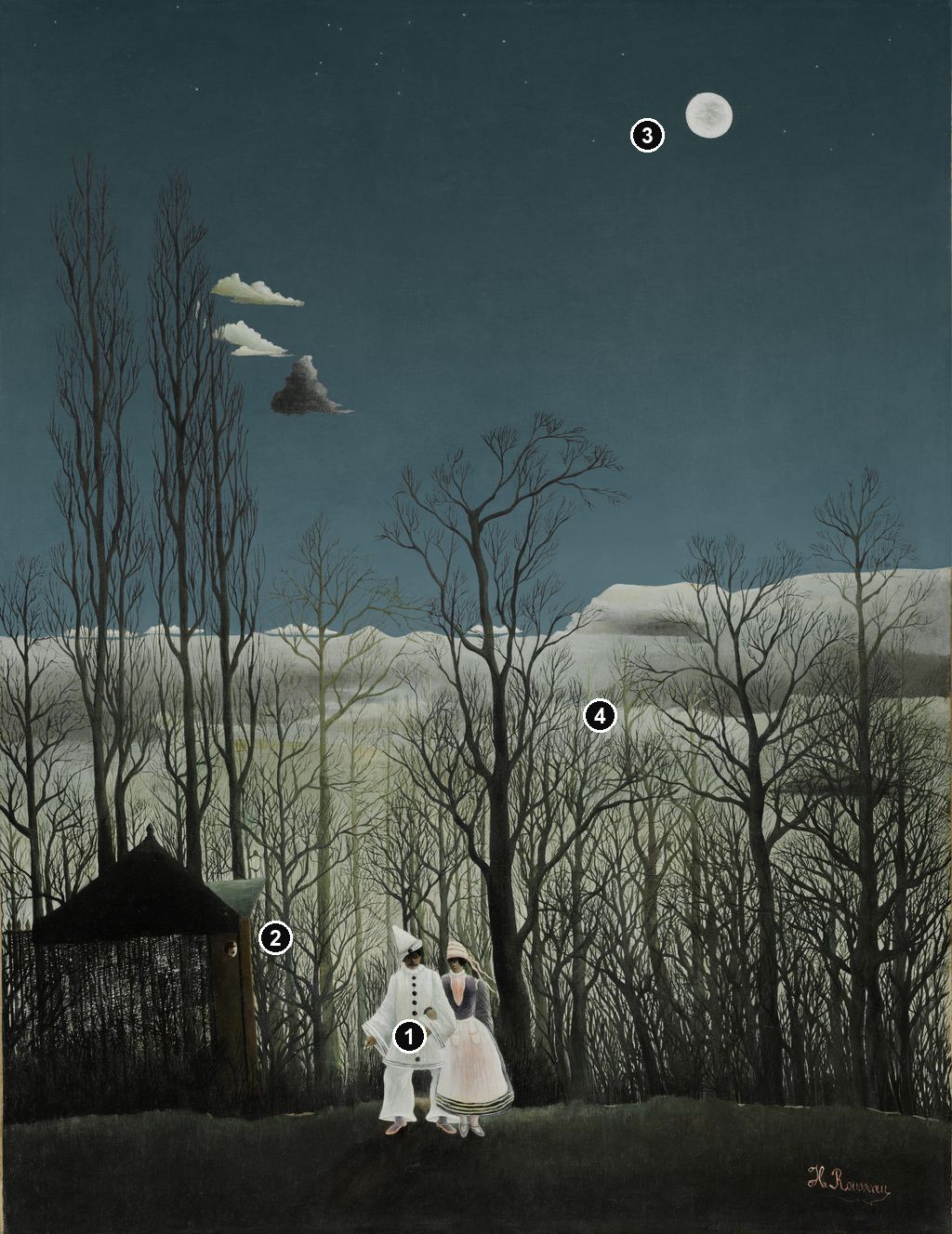
Two figures in carnival dress stand beneath an immense winter sky. Their pale clothes catch the eye before the little hut beside them, the web of bare branches or the moon hanging high above. In Henri Rousseau’s Carnival Evening, painted in 1886, festivity has become a strangely quiet encounter at the edge of a forest. The Philadelphia Museum of Art, which owns the painting, draws attention to its central puzzle: the figures appear to give off their own light while the moon leaves the trees in darkness.[1]
Everything seems available to sight, yet little is explained. The couple has no visible destination, the building offers no clear welcome, and the night contains both a face and a lamp that make its apparent emptiness harder to trust. Rousseau gives these small disturbances room to work. The taller the trees appear, the more exposed the pair becomes.
At a Glance
- ArtistHenri Rousseau
- SubjectCarnival Evening
- ExploreThe couple in the clearing; A moon that does not explain the light
This work across Henri Rousseau’s career
The Merry Jesters
1906 [7]The Snake Charmer
1907 [8]Contents
- An early painting with a public history
- The couple in the clearing
- A moon that does not explain the light
- The hut, the face and the street lamp
- Theatrical associations and early responses
- Rediscovery and the Louis E. Stern Collection
- Annotated details
An early painting with a public history
Carnival Evening belongs to the beginning of Rousseau’s recorded exhibition career. It appeared at the Salon des Indépendants in Paris in 1886 as catalogue number 336. Michel Hoog’s entry in the 1985 Rousseau exhibition catalogue treats it as an unusually secure landmark among the artist’s early paintings. Its date gives us a fixed point from which to consider a painter whose initial development is less fully documented than his later public activity.[12]
Rousseau was still employed by the Paris octroi, the municipal service that collected tolls on goods entering the city. The chronology in the same catalogue places the beginning of that employment in 1871 and his resignation in December 1893. It records four submissions to the 1886 Indépendants, including this painting. Making and exhibiting substantial pictures already formed part of his life alongside his paid work.[13] His biography provides the wider story of that gradual commitment to painting.
The canvas measures 117.3 × 89.5 centimetres, according to Philadelphia’s current record. It is oil on canvas and entered the museum in 1963 with the Louis E. Stern Collection.[1] Its upright format shapes the experience of the scene. The figures occupy only a small portion of a surface that rises far above their heads. The eye can settle on them, climb the branching trunks and then travel into a broad upper region of blue-green sky. Human presence supplies a point of entry without setting the scale of the surrounding world.
Although the picture is associated with carnival, Rousseau has excluded the crowd. There is no procession filling the foreground and no busy interior behind the couple. The title’s promise of celebration meets a solitary pair standing almost still. That difference between an occasion we can imagine and the scene we actually see gives the painting much of its suspense. We seem to have arrived either before something begins or after something has ended; the image does not establish which.
The couple in the clearing
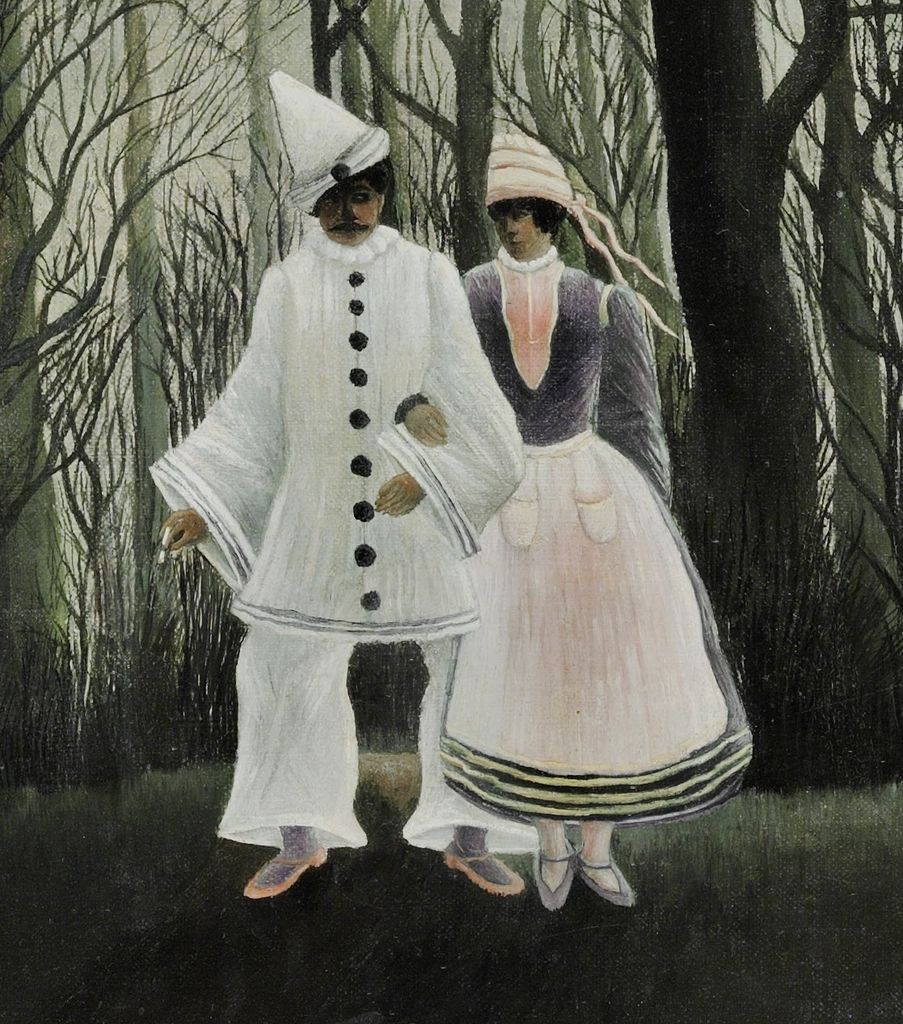
The figure on the left wears a pointed cap and a pale costume with a conspicuous row of dark buttons. A broad collar and the spreading outline of the upper garment enlarge the shoulders. The legs below are narrow, the feet set apart. Beside this figure, a companion wears a pale, bell-shaped skirt and a darker upper garment, with blue and warm yellow accents. The two stand close enough for their contrasting silhouettes to read as a single small group.
Their clothes invite thoughts of theatre and masquerade, but an exact cast of characters would narrow the picture prematurely. Hoog suggested that the costumes might derive from Watteau or from an advertisement; he offered alternatives rather than an identified source.[12] The visible scene supports a description of a costumed pair. It does not give us names, a securely identified theatrical role or a documented relationship between them.
Their closeness can suggest companionship. The placement of the heads encourages us to look for an exchange, though there is little legible action to develop it into a story. At this scale the faces do not carry the scene through expressive detail. The costumes, their positions and the surrounding silence do more of that work. Rousseau makes us attentive to the pair while withholding the kind of incident that might explain why we should watch them.
The open strip of ground is equally restrained. It gives the figures a footing and separates them from the dense growth behind. Beyond that narrow space, the trunks begin almost immediately. There is no broad avenue leading us through the wood. The clearing therefore resembles a shallow platform: enough room for an appearance, little room for escape into depth. Read as an effect of composition, this helps explain the sense of a staged encounter without requiring a real stage as the painting’s setting.
Colour reinforces the separation. The costumes are among the lightest things in the lower half, where the ground and the bases of the trees gather into darkness. Their pale surfaces remain distinct even when the eye moves away from them. Small touches of colour prevent the clothing from becoming a single white patch, but those accents remain subordinate to the larger contrast between the pair and the forest.

Carnival Evening — Henri Rousseau.
A moon that does not explain the light
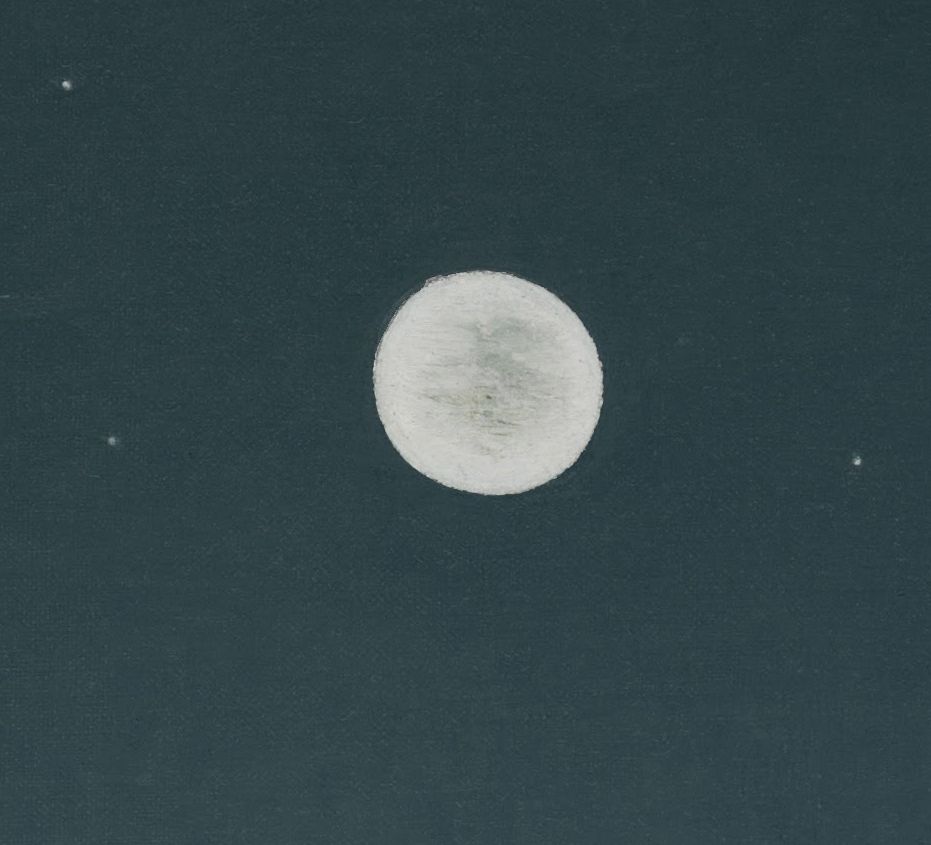
The moon is a clear, round disc in the upper right. Its compact shape stands apart from the irregular edges of the clouds and the innumerable turns of the branches. It gives the sky a definite point of brightness, yet it does not organise the scene below into a consistent pattern of illumination. Philadelphia’s interpretation makes precisely this distinction between the shining figures and the unlit wood.[1]
Looking from the moon to the costumes, we can feel the distance between two separate kinds of brightness. The disc belongs to the vast upper space; the white clothing concentrates attention near the ground. Between them stretches a forest whose dark outlines remain emphatically visible. The picture can be read at a glance, but its light becomes harder to reconcile the longer we study it.
The sky itself has several registers. A low band of clouds crosses behind the trees, with pale edges that lift away from darker masses. Higher on the left, a few isolated clouds hover beside the slender trunks. Above these, the expanse is relatively open. That change from crowded lower branches to spacious upper sky lets the eye breathe, while the moon’s position prevents the emptiness from becoming neutral background.
The branches are crucial to this balance. On the left, slender trunks stretch upward in close company. Near the middle, a larger tree opens into a more spreading structure; to the right, curved limbs fork and interlace across one another. Their differences keep the wood from resolving into a mechanically repeated screen. At the same time, the accumulation of fine dark lines creates an almost continuous patterned surface.
Each branch seems sharply available to the eye. Darkness has not swallowed the trees or softened their edges into a general blur. Instead, it brings out their linear organisation. The scene is nocturnal in colour and atmosphere while remaining extraordinarily explicit in its drawing. That combination helps account for the painting’s peculiar stillness: the night feels deep, but the eye is held near the surface by details it can continue to follow.
The bare trees also give the costumes a seasonal setting. Their stripped shapes make the festive dress seem more vulnerable and more conspicuous. Fabric spreads where foliage is absent; the rounded skirt and pointed cap interrupt a world of thin, branching lines. The couple’s presence is brief and particular against the much larger extent of the wood.
The hut, the face and the street lamp
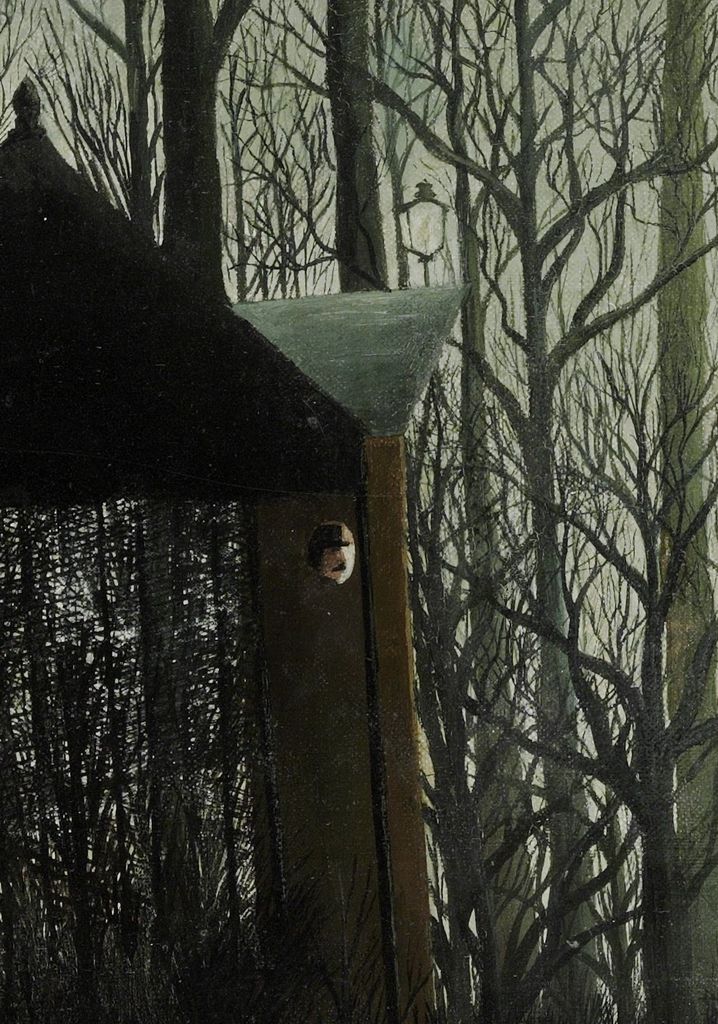
At the lower left, a dark roof introduces a simple geometric shape among the irregular trees. The hut is close to the couple, yet its interior remains difficult to read. Its pointed roof can be registered immediately; the space underneath takes more effort. This difference in visibility draws the eye back to the building after the brighter costumes have first claimed attention.
Philadelphia’s museum commentary identifies an unexplained face looking out from the otherwise empty hut. It also notes an unexpected street lamp glowing nearby.[1] These are useful observations because they bring the mystery down to specific, easily overlooked details. A face implies another presence, while a street lamp introduces a familiar human provision into a place dominated by trees. Neither detail supplies a clear account of the scene.
The face changes the balance of looking. Initially, we watch the two figures; once we know to search the hut, the possibility of someone else watching enters the picture. The building becomes less passive. Yet the small scale and obscurity of the detail resist a confident description of who or what is there. Calling it a particular mask, spirit or named character would give the image an explanation its evidence does not secure.
The lamp poses a different question. A moon, a street lamp and apparently luminous clothes bring several suggestions of light into one landscape. They do not combine into an easily understood lighting scheme. The lamp’s presence also complicates the separation between forest and inhabited place. The hut and the artificial light hint at an organised human environment just where the trunks seem most enclosing.
These details reward a slow second look. The painting’s largest elements are easy to remember: couple, forest, moon. Its smaller ones disturb that arrangement. The resulting uncertainty comes from how the scene is put together, rather than from an elaborate story that a viewer must learn before looking.
Annotated Details from Carnival Evening
The numbered points identify visible features discussed in this article. Return from each detail to the whole composition. Henri Rousseau, Carnival Evening, 1886. Philadelphia Museum of Art, The Louis E. Stern Collection, 1963, 1963-181-64. Google Art Project reproduction published on Wikimedia Commons in 2022. Image source. Public domain. Numbers added to the overview; details cropped from the published original. No recolouring or retouching.
Details from CARNIVAL EVENING
Compare the bright costumes with the moon above, then look for the hut's small face and lamp within the web of branches.
A pale pair in the clearing
The pointed cap and broad white costume contrast with a rounded pale skirt and darker bodice. The two figures remain sharply visible against the dark trees and narrow strip of ground.
The hut's face and nearby lamp
A small pale face interrupts the dark side of the hut. A slender lamp stands nearby among the trunks, adding another suggestion of light without explaining the scene's strange illumination.
A bright moon in an open sky
The pale round moon holds a clear place within the broad blue-green sky. Tiny light points surround it, while its compact outline differs from the irregular cloud and branch shapes below.
Branches against a low cloud band
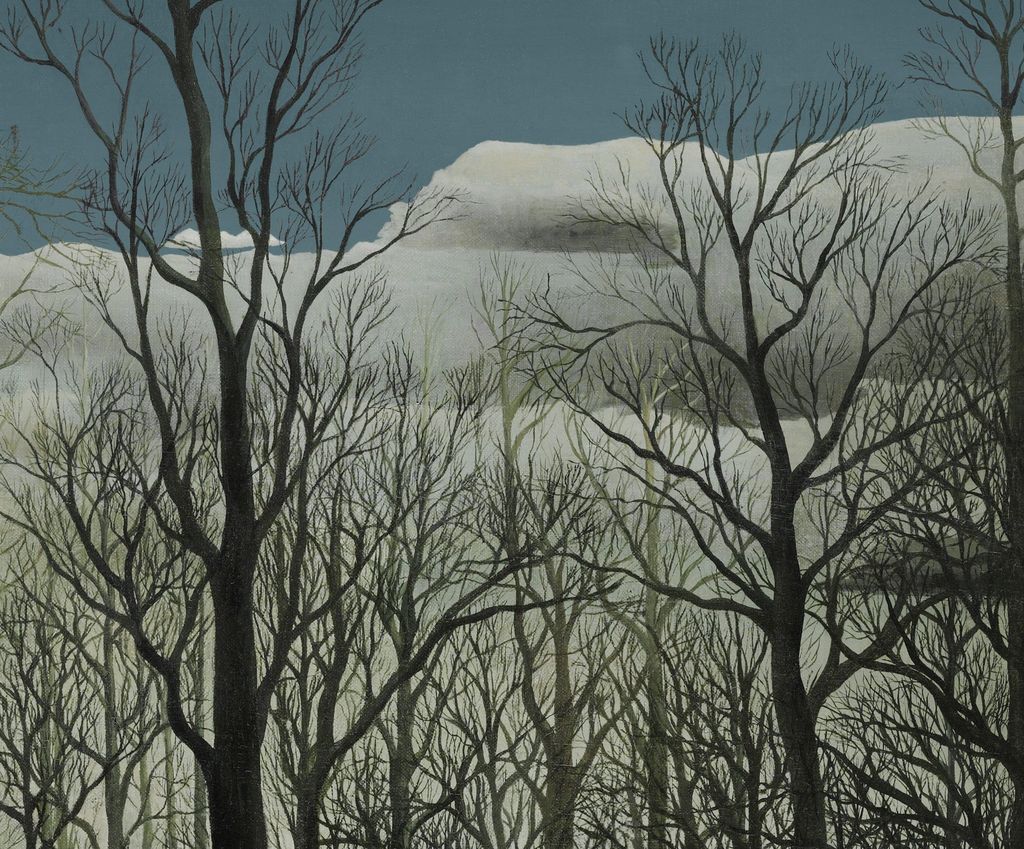
Dark trunks divide into curving and angular limbs against a pale low cloud bank. The branching screen varies from tree to tree while keeping the distant space difficult to enter.
Theatrical associations and early responses
Hoog compared the atmosphere to Friedrich and asked whether the setting might be understood in terms of a stage or pantomime. He also introduced his entry with lines from Verlaine about moonlight after a ball.[12] These associations offer ways of approaching the painting’s suspended action. The poem is a critic’s framing device in the catalogue; it should not be treated as Rousseau’s inscription or as proof that the painting illustrates Verlaine.
The theatrical comparison is especially persuasive at the level of arrangement. The couple stands near the front, the hut occupies a lateral position, and the trees form a dense background behind a small acting space. These features can make the setting feel prepared for an encounter. They leave open whether that effect arose from a particular theatrical source, a remembered image or Rousseau’s own construction of the landscape. Hoog’s alternative suggestions for the costumes preserve the same uncertainty.[12]
The painting’s unusual light was already a point of contention in the early criticism collected by the 1985 catalogue. A hostile notice in Le Soleil mocked a moon that failed to illuminate the forest. The review also used racist language to characterise the figures, a prejudice that provides no reliable basis for identifying them. Its observation about the lighting nevertheless shows how quickly the apparent contradiction attracted attention.[12]
A more appreciative response survives through a later report. Hoog cites Gustave Kahn’s account, published in Mercure de France on 1 August 1923, of Pissarro admiring the painting’s tonal relationships and colour. The date of Kahn’s publication matters: this is a retrospective report of Pissarro’s response, rather than a contemporary 1886 transcript.[12] Taken together, the two accounts suggest how the same features could prompt dismissal or admiration. The picture’s clear shapes did not make its visual decisions easy to accommodate.
Rediscovery and the Louis E. Stern Collection
The history after the 1886 exhibition contains a long gap. Philadelphia’s published provenance begins with Mrs Renée Fantauzzo in Montrouge, near Paris, and places the painting with Michel and Rose Kikoïne around 1933, with a question mark attached to the year. By 1933 it belonged to a consortium involving the Kikoïnes, Louis Ritman and Michael Brenner. The museum records a sale to Louis E. Stern in June 1934 and its eventual bequest to Philadelphia in 1963.[14]
The museum’s explanatory notes preserve several accounts of the reappearance. Henry Certigny’s catalogue raisonné is cited for a discovery by Michel Kikoïne in Montrouge between 1929 and 1934, at the home of an elderly nurse connected with his aunt. A statement by the Kikoïnes names Fantauzzo as the person from whom they acquired it, while the museum leaves her possible identification with the nurse uncertain.[14] The broad outline places its reappearance around the early 1930s; the exact circumstances remain less settled.
Stern’s own account adds another limit. In a letter written in connection with a 1951 loan, he said that the painting’s whereabouts had been unknown until 1933 and that he had never established the previous family’s name with certainty. Philadelphia also cites Brenner’s statement that Ritman brought it from Paris to the United States in September 1933. A later letter from the executor of Stern’s estate described a speculative purchase by a small group of artists, with uncertainty over the involvement of a French dealer.[14]
These details come to us through the museum’s account of the documents. They support the painting’s movement into an American collection while leaving its earlier chain of ownership incomplete. Philadelphia further records that Ritman gave Irene Hudson Stern, director of the Milch Galleries, an option to sell it in December 1933, before the documented June 1934 sale to Louis E. Stern.[14] The 1985 catalogue also lists exhibitions in Chicago and New York in 1942.[12] These later appearances are much firmer landmarks than the story of its intervening decades.
That uneven survival makes the 1886 painting itself particularly valuable. It presents an early Rousseau already able to sustain attention through a small number of concrete elements: festive clothes, bare trees, a building, a moon. Their relationships remain unsettled. After following the branches or searching the hut, the eye returns to the pale pair, still standing together in a clearing that offers no final explanation for their appearance.
Henri Rousseau artworks directory
This directory brings together works covered on this site and other works documented in the cited museum records and catalogues. Alternate titles share one entry; distinct versions remain separate. Historical dates for works without an article follow the cited catalogues. This is not a catalogue raisonné.
Frequently Asked Questions
It belongs to the Philadelphia Museum of Art, accession number 1963-181-64, in the Louis E. Stern Collection. The museum gives its unframed dimensions as 117.3 × 89.5 centimetres.[1]
The sources discussed here do not establish their identities. Michel Hoog proposed Watteau or an advertisement as possible sources for the costumes without identifying a proven model.[12]
Philadelphia identifies an unexplained face in the hut and a street lamp nearby. Its commentary does not give the face a secure identity or resolve its role in the scene.[1]
Discussion
Look again at the images and ideas explored in Carnival Evening. These editorial prompts invite your observations.
Reader Insights
How does the painting change when you begin with the moon and follow its light down towards the figures?
Which makes the scene feel more theatrical: the costumes, the shallow clearing or the wall of branches?
Does noticing the face in the hut alter your sense of who is watching whom?
Join the Conversation
Share a detail, comparison or question about Carnival Evening below.
References
- Philadelphia Museum of Art. Carnival Evening, object 59593, current collection metadata and interpretive label, accessed 23 October 2026. View source.
- Philadelphia Museum of Art, Carnival Evening,1963-181-64,object59593. View source.
- Musée de l’Orangerie / Juliette Degennes, Henri Rousseau,L’ambition de la peinture: Un artiste dans son époque (in French). View source.
- National Gallery, Surprised!, NG6421. View source.
- Musée d’Orsay, La Guerre,RF19461 (in French). View source.
- MoMA, The Sleeping Gypsy. View source.
- Philadelphia Museum of Art, The Merry Jesters, 1950-134-176, object51097. View source.
- Musée d’Orsay, La Charmeuse de serpents, RF 1937 7 (in French). View source.
- Musée de l’Orangerie, La Carriole du Père Junier, RF 1960 26 (in French). View source.
- Solomon R. Guggenheim Museum / Cornelia Lauf, The Football Players,60.1583: current collection record. View source.
- MoMA, The Dream, 252.1954. View source.
- Michel Hoog. “A Carnival Evening,” entry 1, in Henri Rousseau: Essays, Museum of Modern Art, 1985, p. 98; accompanying colour plate p. 99. English translation from the French by Richard Miller; authorship of plate notes specified on the preceding “Plates” page. View source.
- Museum of Modern Art. “Chronology,” in Henri Rousseau: Essays, 1985, pp. 91–92, entries concerning 1871, 1886 and 1893. View source.
- Philadelphia Museum of Art. Carnival Evening, object 59593, provenance and explanatory notes 1–2, including the museum’s accounts of the Kikoïne, Brenner, Stern and Pincus documents, accessed 23 October 2026. View source.
- The Museum of Modern Art, Henri Rousseau: Essays (1985), selected catalogue entries, chronology and notes on early devotees. View source. Selected entries, chronology (pp.91–95) and early-devotee notes (pp.262–264) were consulted. Historical collection credits do not establish present ownership.
- Daniel Catton Rich, Henri Rousseau (The Museum of Modern Art, 1942), selected drawings and landscape studies; historical catalogue. View source. The dated 1942 publication is used for the two Quai d’Auteuil ink views; its Malakoff date differs from the 1985 catalogue.
- MANAS, Laval, Henri Rousseau, dit le Douanier, urban landscapes and preparatory study (in French). View source.
- National Gallery of Art, Self-Portrait (1895), pen-and-ink drawing, accession 1995.47.66. View source.
- The Museum of Modern Art, War (published January 1895), lithograph, accession 684.1943. View source.
- Barnes Foundation, Landscape and Four Young Girls, object 5521, BF855. View source.


 Henri Rousseau.jpg)


 Henri Rousseau.jpg)