



 by Tom Gurney
Tom Gurney BSc (Hons) is an art history expert with over 20 years experience
Published on June 19, 2020 / Updated on October 29, 2026
Email: tomgurney1@gmail.com / Phone: +44 7429 011000
Charenton-le-Pont: Introduction
A broad bridge stretches across Henri Rousseau’s Charenton-le-Pont, its pale arch opening onto another, more distant view of the river. Trees crowd the near bank, a small person stands beside a basket, and rows of slender trunks draw the eye towards a second bridge. Above this closely fitted arrangement, separate groups of clouds occupy an enormous sky. The Pola Museum of Art dates the painting to about 1905–1910 and records its medium as oil on canvas.[1] Within a picture only a little over forty centimetres wide, Rousseau makes the bridge feel expansive while preserving the intimacy of a quiet riverside encounter.
At a Glance
- ArtistHenri Rousseau
- SubjectCharenton-le-Pont
- ExploreAn arch containing a second landscape; Water, a path and a person with a basket
This work across Henri Rousseau’s career
Carnival Evening
1886 [2]Charenton-le-Pont (current article)
c. 1905–1910 [7]The Merry Jesters
1906 [8]The Snake Charmer
1907 [9]Contents
- The painting and its date
- An arch containing a second landscape
- Water, a path and a person with a basket
- Trees interrupt the geometry
- The sky and its fine horizontal wires
- A landscape at the edge of the city
The painting and its date
The Pola Museum’s current collection record gives the dimensions as 32.5 × 40.8 cm. Its title identifies the subject as Charenton-le-Pont, but the record does not identify the particular bridge, an exact viewpoint or the person in the foreground.[1] The relationships between structure, water, trees and figure provide a clear route into the painting.
The date needs some care. In its 2016–17 exhibition Artists on the edges of Paris, the same museum reproduced Charenton-le-Pont with the earlier date 1896–1898.[7] Its current collection entry instead places it around 1905–1910.[1] The present record supplies the date used here; neither source explains the difference. The qualified range also matters: it does not establish that Rousseau painted the picture specifically in 1910.
An arch containing a second landscape
The bridge crosses almost the full width of the composition. At the right, its stone-coloured support reaches down to the water; at the left, trees conceal part of its approach. Between these uneven ends, a smooth pale curve rises above the river. Repeated diagonal members fill the space between that curve and the dark, nearly horizontal upper railing. Their open pattern makes the bridge seem both substantial and permeable: it divides the picture while allowing pieces of sky and distance to remain visible through it.
Rousseau distinguishes two kinds of repetition within the structure. The dark upper railing contains small, tightly packed crossing lines. Below it, larger pale diagonals create a slower succession of pointed openings. These rhythms meet along the bridge’s length, giving the eye a wealth of little shapes to follow. The broad arch then gathers them into one easily grasped form. Its sweep is strong enough to remain legible even when the smaller parts blur together at a distance.
Under that arch lies an entire second landscape. Tree-lined banks close towards the centre; pale buildings and warmer roofs appear beyond them; a narrow upright rises against the distant sky. A second, much lower bridge crosses the river close to the horizon. Its small repeated supports echo the pattern of the foreground span, but on a reduced scale. Looking through the nearer structure becomes a way of measuring distance. The large bridge serves as a frame, and the little bridge provides a destination within it.
The arrangement also has an unusual compression. Much of the far bank, buildings and second bridge fits into the low opening beneath the arch. The view feels deep because its elements diminish, yet it remains a tightly bounded strip. Rousseau keeps our attention moving between the large shape in front and the minute shapes beyond. Each makes the other more striking.
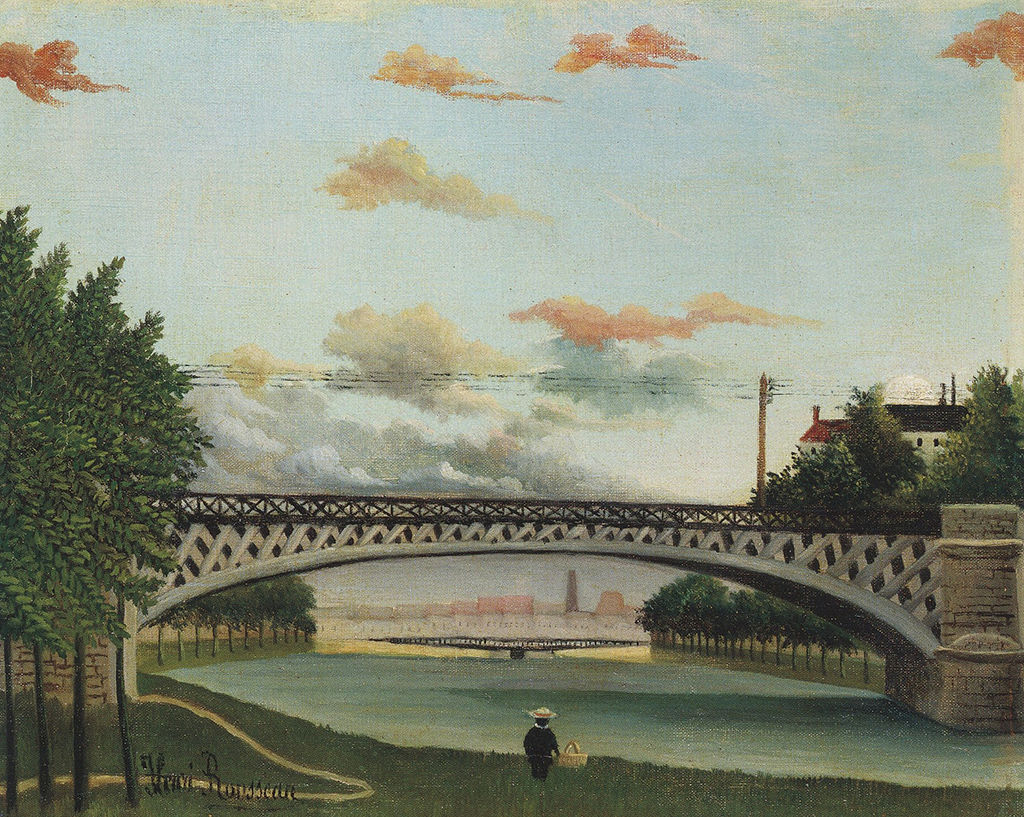
Charenton-le-Pont — Henri Rousseau.
Water, a path and a person with a basket
The river widens towards the foreground, where it occupies a long, pale band beneath the bridge. Its surface shifts between cool grey-green and darker green, with broad areas of colour suggesting the banks and structure above it. These relatively quiet horizontal passages give the intricate lattice somewhere to rest. They also make the distance legible: the water is narrow beneath the far bridge and opens out as it approaches us.
Along the left bank, a slender light-coloured path curves towards the bottom of the picture. Its line passes the near trees and turns in a rounded bend near Rousseau’s signature. This small curve answers the much larger curve of the bridge. One hangs above the river; the other lies flat on the grass. Together they soften a scene otherwise full of vertical trunks, upright masonry and repeated diagonals.
The person near the water is small enough to be overlooked at first. Dark clothing makes a compact silhouette, interrupted by a pale brimmed hat. Immediately beside the figure is a light basket with a curved handle. The contrast between the two small shapes makes them distinct even within the narrow foreground strip. Neither the basket nor the pose establishes the person’s occupation or reason for being there.
The figure offers a familiar measure against the bridge’s enormous reach and gives the empty bank a point of attention. Its placement slightly to the right of centre prevents the composition from settling into strict symmetry. From this low position, the eye can rise to the arch, move through its opening and continue towards the second bridge. A tiny presence helps connect the nearest ground with the farthest built forms.
Trees interrupt the geometry
The fullest trees rise along the left edge, where foliage extends above the level of the bridge. Leaves form dense clusters around dark trunks, and the irregular outer branches project into the open sky. At the bottom, individual trunks remain visible against grass and pale masonry. Higher up, their separate crowns merge into a thicker screen. The trees overlap both the near bank and the structure, making this corner feel close and crowded.
Across the river, trees behave differently. Their slender trunks form orderly rows leading towards the distance. On the right bank, a dark rounded canopy runs beneath the arch; on the left, a lighter row draws back from the near trees. The spacing of the trunks echoes the bridge’s repeated supports. Vegetation and construction share a pattern of intervals even though their outlines differ.
At the upper right, foliage partly hides buildings with pale walls and dark or reddish roofs. These architectural fragments are easy to miss because the bridge’s mass draws attention below them. They extend the inhabited setting above the river crossing and give the right-hand side another layer behind the trees. The heavy masonry at the edge, the buildings beyond it and the spreading foliage prevent the bridge from floating free of its surroundings. Its clean curve belongs to a landscape of overlapping, unequal parts.
The sky and its fine horizontal wires
Well over half the picture is given to the sky. Its pale blue-green field makes room around the dense lower scene, and the bridge sits low enough for its upper railing to become a firm boundary beneath that openness. The clouds have distinct silhouettes: small warm-toned patches near the top, softer yellow-grey forms higher in the middle, and a denser gathering close to the bridge. Their separation allows the colour of the sky to remain continuous between them.
Pink, ochre and grey bring warmth into this cool expanse. The low clouds have darker undersides and fuller shapes than several of those above, but the painting supplies no certain forecast. Their visible role is to vary the sky’s weight. The denser forms gather near the built landscape, while the upper patches remain isolated and widely spaced. This distribution helps the upper part of the canvas feel airy without making it empty.
A slim pole rises near the right-hand buildings. Fine wires pass horizontally across the sky, continuing towards the trees at the left. Their delicate, slightly uneven lines establish another crossing above the great bridge. They can be difficult to see in a small reproduction, yet they alter the character of the view: the open air contains traces of human infrastructure as well as clouds. The thick arch, thin wires and far bridge give three different scales to the act of spanning space.
A landscape at the edge of the city
The Pola Museum placed this work in the Rousseau section of its 2016–17 exhibition about the changing edges of Paris. Its account linked his suburban landscapes with an interest in modern structures and technologies, including bridges, the Eiffel Tower and flying machines.[7] In Charenton-le-Pont, that broader interest takes a concentrated form. An extensive engineered structure shares the scene with grass, trees, water and a solitary figure. The bridge is visually dominant, yet everyday life continues quietly below it.
The Musée de l’Orangerie’s 2026 exhibition account adds a useful perspective on scale. It describes Rousseau’s production of small landscapes and decorative pictures suited to modest budgets and interiors, and connects his views of the Paris surroundings with his own observations.[13] This provides context for a compact canvas such as Charenton-le-Pont, although it does not identify this painting’s buyer, commission or circumstances of execution. Its small size asks for close attention to details that a large reproduction can make seem obvious: the basket handle, the wires, the far bridge and the narrow gaps between tree trunks.
Within the wider range of Rousseau’s paintings, this landscape rewards a patient movement between scales. The great arch is apparent immediately; the second bridge and small person emerge through looking. The scene’s spaciousness depends on keeping those discoveries together. Its monumental crossing, distant buildings and modest patch of bank all occupy the same carefully contained view.
Henri Rousseau artworks directory
This directory brings together works covered on this site and other works documented in the cited museum records and catalogues. Alternate titles share one entry; distinct versions remain separate. Historical dates for works without an article follow the cited catalogues. This is not a catalogue raisonné.
Frequently Asked Questions
It is in the Pola Museum of Art collection. The current record identifies it as oil on canvas, measuring 32.5 × 40.8 cm.[1]
The small figure wears dark clothing and a pale brimmed hat, with a basket beside them. The museum’s current entry gives no identity; these visible details do not establish an occupation.[1]
The museum titles the painting Charenton-le-Pont but does not name the specific bridge in its current collection entry. The composition shows a large arched crossing with open diagonal supports and a smaller bridge in the distance.[1]
Discussion
Look again at the images and ideas explored in Charenton-le-Pont. These editorial prompts invite your observations.
Reader Insights
How does the landscape beneath the arch change your sense of the bridge’s size?
What difference do the fine wires make to the otherwise open sky?
Where does your eye travel after you notice the person and basket?
Join the Conversation
Share a detail, comparison or question about Charenton-le-Pont below.
References
- Pola Museum of Art. Charenton-le-Pont, current collection record, object 997-0002; accessed 23 October 2026. View source.
- Philadelphia Museum of Art, Carnival Evening,1963-181-64,object59593. View source.
- Musée de l’Orangerie / Juliette Degennes, Henri Rousseau,L’ambition de la peinture: Un artiste dans son époque (in French). View source.
- National Gallery, Surprised!, NG6421. View source.
- Musée d’Orsay, La Guerre,RF19461 (in French). View source.
- MoMA, The Sleeping Gypsy. View source.
- Pola Museum of Art. Artists on the edges of Paris: Le Douanier Rousseau, Foujita, and Atget, 2016–17, “Section I. Rousseau and Picasso: the transformation of urban Paris” and Charenton-le-Pont image caption. View source.
- Philadelphia Museum of Art, The Merry Jesters, 1950-134-176, object51097. View source.
- Musée d’Orsay, La Charmeuse de serpents, RF 1937 7 (in French). View source.
- Musée de l’Orangerie, La Carriole du Père Junier, RF 1960 26 (in French). View source.
- Solomon R. Guggenheim Museum / Cornelia Lauf, The Football Players,60.1583: current collection record. View source.
- MoMA, The Dream, 252.1954. View source.
- Musée de l’Orangerie. Henri Rousseau, l’ambition de la peinture, 25 March–20 July 2026, “Variations et déclinaisons. À la recherche du marché.” View source. (in French).
- The Museum of Modern Art, Henri Rousseau: Essays (1985), selected catalogue entries, chronology and notes on early devotees. View source. Selected entries, chronology (pp.91–95) and early-devotee notes (pp.262–264) were consulted. Historical collection credits do not establish present ownership.
- Daniel Catton Rich, Henri Rousseau (The Museum of Modern Art, 1942), selected drawings and landscape studies; historical catalogue. View source. The dated 1942 publication is used for the two Quai d’Auteuil ink views; its Malakoff date differs from the 1985 catalogue.
- MANAS, Laval, Henri Rousseau, dit le Douanier, urban landscapes and preparatory study (in French). View source.
- National Gallery of Art, Self-Portrait (1895), pen-and-ink drawing, accession 1995.47.66. View source.
- The Museum of Modern Art, War (published January 1895), lithograph, accession 684.1943. View source.
- Barnes Foundation, Landscape and Four Young Girls, object 5521, BF855. View source.


 Henri Rousseau.jpg)


 Henri Rousseau.jpg)