



 by Tom Gurney
Tom Gurney BSc (Hons) is an art history expert with over 20 years experience
Published on June 19, 2020 / Updated on October 29, 2026
Email: tomgurney1@gmail.com / Phone: +44 7429 011000
Exotic Landscape: Introduction
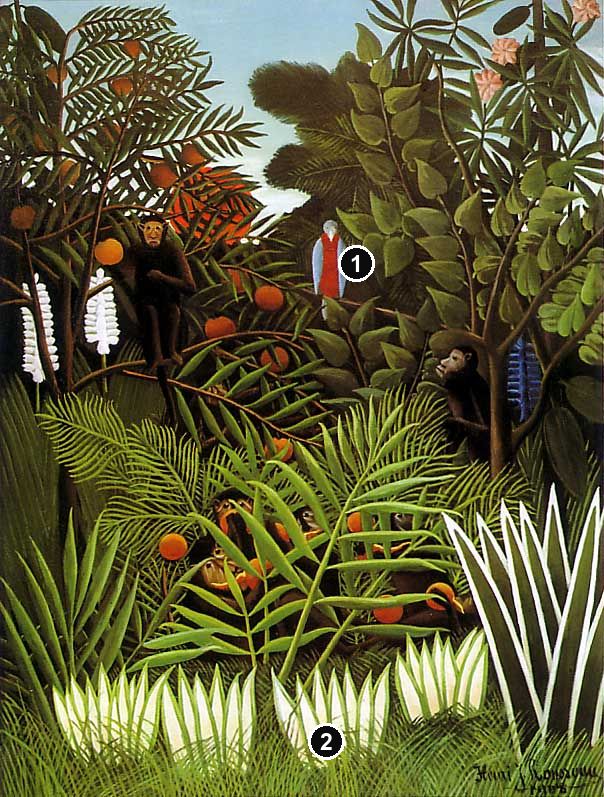
Bright white leaves rise across the foot of Henri Rousseau’s Exotic Landscape, catching the eye before the monkeys concealed above them. Behind this luminous barrier, long fronds cross orange fruit, dark bodies and watchful faces. A small bird, almost upright in the middle of the greenery, introduces a startling patch of red. The forest seems crowded, yet its inhabitants remain oddly still. Painted in 1908, this upright canvas brings the pleasure of discovery into a carefully ordered arrangement: looking into it means repeatedly finding an animal where a leaf or shadow first seemed to be.[1]
At a Glance
- ArtistHenri Rousseau
- SubjectExotic Landscape
- ExploreAn upright jungle; A forest built from distinct leaves
This work across Henri Rousseau’s career
Carnival Evening
1886 [2]The Merry Jesters
1906 [7]The Snake Charmer
1907 [8]Contents
- An upright jungle
- A forest built from distinct leaves
- Monkeys, fruit and a red-breasted bird
- The suggestion of a stage
- Parisian sources and an imagined environment
- A medieval analogy
- The historical collection record
- Annotated details
An upright jungle
The 1985 Museum of Modern Art catalogue identifies this Exotic Landscape as an oil painting on canvas measuring 116 × 89 centimetres, signed and dated “Henri J. Rousseau, 1908.” Its catalogue cross-references are JB 39 and DV 217. These details distinguish the particular painting behind a title that might otherwise describe many of Rousseau’s forests. The catalogue calls attention to its unusual vertical format among his jungle pictures.[1]
That shape matters from the first glance. The forest offers little room for the eye to travel sideways. Plants climb the edges, while successive groups of leaves and animals occupy the space between the bright foreground and the pale opening overhead. The viewer looks upward through the picture as well as inward. Even the sky feels enclosed: the foliage presses against it from either side, leaving an irregular opening rather than a broad horizon.
A red-orange disc appears through the branches towards the upper left. Its colour belongs with the round fruit distributed below, so the most distant part of the scene remains connected to the close vegetation. There is no clear path leading through these layers. Access comes through small visual discoveries, as a face, flower or piece of fruit separates itself from the mass around it.
A forest built from distinct leaves
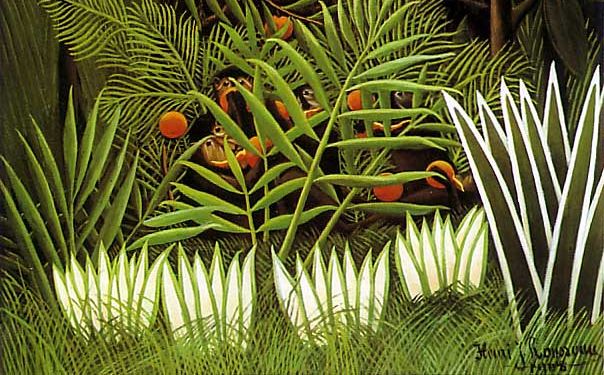
Rousseau gives the plants sharply different structures. Along the bottom, fine grass forms a close mesh of narrow green strokes. Above it, pale pointed leaves rise in a row, their bright interiors enclosed by darker edges. At the right, a much taller cluster extends long, white-lined blades upwards. Their dark centres allow this plant to remain connected to the surrounding shadow even as its pale outlines seem to shine.
Further back, the fronds have a different rhythm. A long central stem carries narrow leaves that branch out on either side, making a repeated, almost comb-like pattern. Some spread laterally; others cut across the centre at steep angles. Their crossings obstruct the animals, but their clean outlines also help the eye navigate the forest. A viewer can follow an individual stem through the crowd, then lose it where another shape passes in front.
Broad leaves on the right produce a slower movement. They overlap in rounded, heavy-looking groups, contrasting with the more restless pattern of the narrow fronds. Dark trunks hold these masses upright. Towards the upper right, small pink blossoms punctuate a network of slender branches and long leaves. At the left, white flowers stand in bright vertical spikes, while a blue flower on the other side brings a cooler accent into the shadow.
These plants do not merge into one general green. Yellow-green fronds project towards the viewer; deeper green leaves hold back; nearly black intervals make room for bodies and faces. White produces the strongest break, and its distribution prevents the thick vegetation from becoming visually continuous. The eye moves between illuminated edges and dark pockets, repeatedly adjusting to a different scale of detail.
The dense overlap creates depth without making the view easy to enter. A leaf can be perfectly clear in itself while concealing what lies immediately behind it. That tension gives the picture much of its fascination. Each form invites close inspection, yet the accumulation of forms keeps the forest difficult to grasp as a whole. Rousseau makes looking intimate while keeping physical passage uncertain.
Monkeys, fruit and a red-breasted bird
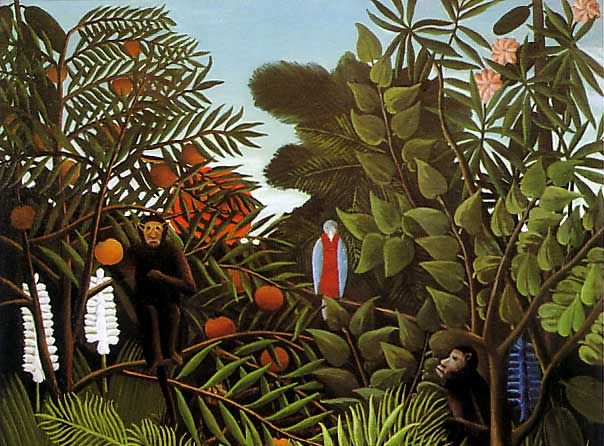
The monkeys take time to emerge. At the upper left, a dark body sits among branches and fruit, with a small light face directed outwards. On the right, a larger grey face appears beside a trunk. Below, other faces and limbs are interrupted by the spreading foreground fronds. The animals occupy different heights, and some are far more exposed than others. A quick glance gives the impression of a few watchful inhabitants; a slower one reveals how extensively they occupy the vegetation.
Their concealment also changes their apparent relationship with the viewer. The upper-left face is easy to meet directly, while the lower animals must be sought through the leaves. The grey face on the right catches attention through its contrast with a dark body and background. These differences keep the monkeys from becoming a row of equivalent motifs. Each has a particular place in the pattern of visibility and obstruction.
Orange fruit helps connect them. The rounded shapes appear at different heights and intervals, sometimes close to a face or hand, sometimes seemingly suspended among the crossing stems. Their warm colour stands away from the green and gives the eye a sequence of stepping stones across the picture. Faces, fruit and the distant coloured disc form a loose family of rounded accents against the many pointed leaves.
Near the upper centre, the bird is unusually easy to isolate. Its narrow upright body has pale blue and white sides and a brilliant red breast. Compared with the monkeys’ broken silhouettes, it appears almost complete. The red attracts attention immediately, but the bird’s stillness keeps it within the prevailing quiet. Its compact head and forward-facing pose answer the surrounding faces; its pale sides pick up the white flowers and leaves elsewhere in the composition.
The 1985 catalogue develops this resemblance between bird, monkey and flower as part of the painting’s play of repeated shapes and colours.[1] The comparison encourages a useful way of looking. An animal need not attract attention only because it is alive: its shape may also connect it to a plant. Conversely, a blossom can become as emphatic as a face. The forest gathers these different presences into a shared visual rhythm while preserving their individuality.
Annotated Details from Exotic Landscape
The numbered points identify visible features discussed in this article. Return from each detail to the whole composition. Henri Rousseau, Exotic Landscape, 1908. Private collection in the 1985 MoMA catalogue; present ownership unconfirmed. Image via Wikimedia Commons; original photographer unknown. Image source. Public domain. Numbers added to a separate resized overview. Two broad excerpts cropped directly from the published original without enlargement, sharpening, recolouring or retouching.
Details from EXOTIC LANDSCAPE
Compare the exposed animals in the upper forest with the faces and fruit partly hidden behind the bright foreground plants.
Animals appear above the crossing fronds
A monkey looks out from the branches at the left, while another face emerges beside the right-hand trunk. Between them, the bird’s red breast and pale sides stand clearly against the surrounding green.
White leaves form a bright foreground barrier
Pale, pointed leaves gather along the lower edge and climb the right side. Behind them, crossing fronds partly conceal faces and orange fruit, setting the brightest plants in front of a more crowded, shadowed layer.
The suggestion of a stage
The catalogue’s theatrical reading begins with the brightest plants. It compares the white, green-edged growth at the bottom to lights illuminating a stage, with the animals held in a pause before movement. It also describes a central organising line through the pale foreground leaf, the fruit and the narrow opening in the sky.[1]
The tall vegetation at either side can be seen as enclosing wings, while the illuminated lower edge establishes a threshold. Behind it, the monkeys appear at successive levels. Their interrupted bodies seem ready to shift, yet nothing resolves into a definite action. Even the fruit hangs with a peculiar weightlessness. The result resembles a scene that has been revealed to an audience and then held open for inspection.
This theatrical effect does not require an imagined plot. No visible attack or chase explains how the animals relate to one another. Their gestures can suggest activity, but the composition offers no certain sequence of events. Its suspense comes from held poses and partial concealment: the viewer keeps waiting for a figure to become clearer or for one of the still bodies to move.
The white foreground plants are especially important to that experience. They appear close enough to obstruct entry, yet bright enough to draw attention into the image. As the eye moves beyond them, it encounters overlapping fronds, fruit, animals and larger foliage before reaching the opening above. The upright format turns this succession into a gradual ascent. What first looks like abundance becomes an arrangement of thresholds.
Parisian sources and an imagined environment
The Musée de l’Orangerie’s 2026 exhibition account places Rousseau’s jungle imagery within a wide range of resources available in Paris: tropical plants in the Jardin des Plantes glasshouses, taxidermy in natural-history galleries, press illustrations and popular imagery associated with the colonial exhibitions. It also rejects the old story that his forests grew from military travel in Mexico.[13] This context, explored further in his biography, helps explain how close observation and imaginative assembly could coexist.
For Exotic Landscape, those general resources do not identify a particular model for a monkey, bird or plant. The painting itself offers no secure basis for assigning its vegetation to a single real region. Its interest lies in how different forms have been brought together. The plants possess emphatic individual features, but their scale, density and proximity create an environment governed by the picture’s own arrangement.
That combination can make the forest feel both familiar and strange. A viewer recognises grass, fruit, flowers and animals, then finds their relationships difficult to reconcile with ordinary space. Pale plants dominate the foreground; a small bird commands the centre through colour; a face emerges from vegetation that initially seemed impenetrable. The recognisable details make the scene persuasive at close range, even while the whole resists geographical description.
A medieval analogy
The 1985 catalogue compares the painting’s imaginative creatures and combinations with the playful imagery of late-medieval manuscripts. It also relates Rousseau’s concentrated attention to foliage and flowers to the detailed particularity associated with the International Style.[1] These comparisons describe affinities. They do not establish that Rousseau copied a medieval page or consciously adopted a historical style.
The analogy draws attention to the way large and small scales work together. From a distance, the painting presents a compact design of dark greens, white spikes and warm circular accents. Close up, its appeal depends on distinctions within that design: the edge of a leaf, a light face, the separate parts of a flower. The overall arrangement remains firm, but it accommodates numerous small discoveries. The viewer can return to the same area and find a relationship that escaped the first inspection.
The historical collection record
The documented collection history is brief. The 1985 catalogue lists Bernheim-Jeune, Paris, in the provenance and gives the painting’s location as a private collection. It also marks it for the New York exhibition only within that retrospective’s itinerary.[1] Those are historical records; they do not establish a present owner or permanent museum location.
Henri Rousseau artworks directory
This directory brings together works covered on this site and other works documented in the cited museum records and catalogues. Alternate titles share one entry; distinct versions remain separate. Historical dates for works without an article follow the cited catalogues. This is not a catalogue raisonné.
Frequently Asked Questions
This upright version is dated 1908. The 1985 MoMA catalogue records the signature and date as “Henri J. Rousseau, 1908,” and gives its dimensions as 116 × 89 centimetres.[1]
The 1985 catalogue lists a private collection and records Bernheim-Jeune, Paris, in its provenance. That historical entry does not establish the painting’s current owner or whereabouts.[1]
Monkeys occupy several levels of the vegetation, and a small bird with pale blue and white plumage and a bright red breast stands near the upper centre. Their appearance is described here without assigning exact species.
The Orangerie describes his jungle repertoire as drawing on Parisian botanical and natural-history collections as well as popular and colonial imagery. No particular real forest is established as the subject of this canvas.[13]
Discussion
Look again at the images and ideas explored in Exotic Landscape. These editorial prompts invite your observations.
Reader Insights
Which animal did you notice first, and what made it emerge from the leaves?
How would the scene change if the bright white foreground plants were dark green?
Does the upright format make the forest feel deeper, taller or more enclosed?
Join the Conversation
Share a detail, comparison or question about Exotic Landscape below.
References
- The Museum of Modern Art. Henri Rousseau, English-language edition, 1985, catalogue entry 48, “Exotic Landscape,” printed p. 208 (PDF p. 213); colour plate, printed p. 209 (PDF p. 214). View source.
- Philadelphia Museum of Art, Carnival Evening,1963-181-64,object59593. View source.
- Musée de l’Orangerie / Juliette Degennes, Henri Rousseau,L’ambition de la peinture: Un artiste dans son époque (in French). View source.
- National Gallery, Surprised!, NG6421. View source.
- Musée d’Orsay, La Guerre,RF19461 (in French). View source.
- MoMA, The Sleeping Gypsy. View source.
- Philadelphia Museum of Art, The Merry Jesters, 1950-134-176, object51097. View source.
- Musée d’Orsay, La Charmeuse de serpents, RF 1937 7 (in French). View source.
- Musée de l’Orangerie, La Carriole du Père Junier, RF 1960 26 (in French). View source.
- Solomon R. Guggenheim Museum / Cornelia Lauf, The Football Players,60.1583: current collection record. View source.
- The Museum of Modern Art, Henri Rousseau: Essays (1985), selected catalogue entries, chronology and notes on early devotees. View source. Selected entries, chronology (pp.91–95) and early-devotee notes (pp.262–264) were consulted. Historical collection credits do not establish present ownership.
- MoMA, The Dream, 252.1954. View source.
- Musée de l’Orangerie. Henri Rousseau, l’ambition de la peinture, exhibition texts, 25 March–20 July 2026, especially “Un style à soi.” View source. (in French).
- Daniel Catton Rich, Henri Rousseau (The Museum of Modern Art, 1942), selected drawings and landscape studies; historical catalogue. View source. The dated 1942 publication is used for the two Quai d’Auteuil ink views; its Malakoff date differs from the 1985 catalogue.
- MANAS, Laval, Henri Rousseau, dit le Douanier, urban landscapes and preparatory study (in French). View source.
- National Gallery of Art, Self-Portrait (1895), pen-and-ink drawing, accession 1995.47.66. View source.
- The Museum of Modern Art, War (published January 1895), lithograph, accession 684.1943. View source.
- Barnes Foundation, Landscape and Four Young Girls, object 5521, BF855. View source.


 Henri Rousseau.jpg)


 Henri Rousseau.jpg)