


 Henri Rousseau.jpg)
 by Tom Gurney
Tom Gurney BSc (Hons) is an art history expert with over 20 years experience
Published on June 19, 2020 / Updated on October 29, 2026
Email: tomgurney1@gmail.com / Phone: +44 7429 011000
The Family (La Famille): Introduction
A baby sits on a pink blanket in front of a gathering of formally dressed adults. Behind them, a vine spreads across a whitewashed house, its branches reaching between open windows. In Henri Rousseau’s The Family, the people seem ready to be looked at, yet the occasion remains elusive. The Barnes Foundation identifies a family gathering and suggests a celebration, while leaving its nature uncertain.[1]
At a Glance
- ArtistHenri Rousseau
- SubjectThe Family (La Famille)
- ExploreA small canvas with a crowded company; The barrel, the glasses and the unanswered occasion
This work across Henri Rousseau’s career
Carnival Evening
1886 [2]The Family (La Famille) (current article)
c. 1892–1900 [1]The Merry Jesters
1906 [7]The Snake Charmer
1907 [8]Contents
- A small canvas with a crowded company
- The barrel, the glasses and the unanswered occasion
- Why the baby holds the foreground
- A house that shapes the portrait
- Family portraiture and the picture’s history
- Annotated details
A small canvas with a crowded company
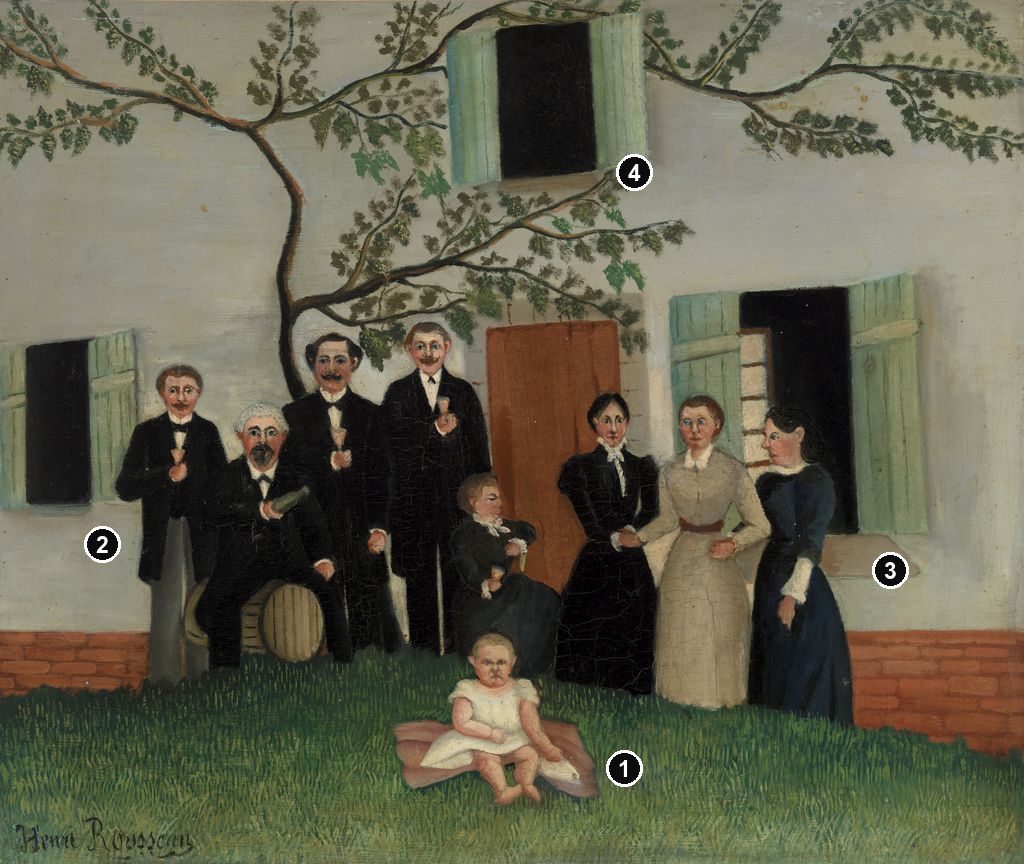
The Barnes Foundation dates The Family (La famille) to about 1892–1900. Painted in oil on canvas, it measures 46 × 55 cm and belongs to the foundation’s collection under the inventory number BF581. The current record does not assign the picture to a single year.[1] Its horizontal format accommodates a substantial company in a space only a little wider than it is high. The building fills the background, leaving no distant view to distract from the faces.
Rousseau sets the figures in an uneven band. Four men occupy the left: three stand upright, while a fourth, white-haired and bearded, sits or leans above the rounded end of a barrel. A smaller seated figure turns towards the right near the centre. Three more adults stand beside the large right-hand window. In front of this company, the baby occupies a separate patch of grass. The arrangement allows each face to remain visible, even where bodies overlap.
The groups differ in more than number. At the left, dark coats make a compact mass interrupted by white shirtfronts, hands and drinking vessels. At the right, a cream-coloured dress with a red waistband opens a light vertical passage between two dark dresses. The central seated figure joins the halves without making them symmetrical. Looking across the canvas becomes a sequence of encounters rather than a single sweep along a tidy row.
The barrel, the glasses and the unanswered occasion
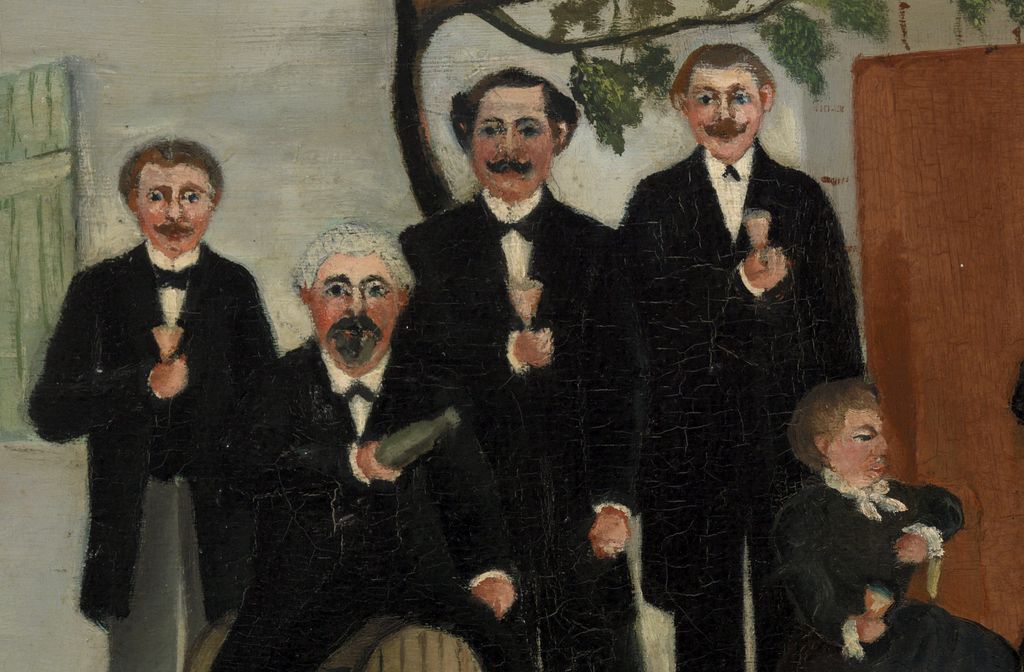
Small objects give this gathering its particular character. Several men hold narrow, stemmed cups. A green bottle appears against the dark clothing of the man above the barrel, while the barrel’s circular end faces the viewer. Its pale wooden staves and dark rim are easy to distinguish beneath the cluster of black coats. The combination makes drinking part of the occasion, although Rousseau shows little of the bustle of a party.
The Barnes Foundation proposes that these details may indicate a birth, a baptism or a wine harvest.[1] Each possibility draws attention to something visible: the baby, the shared drinks or the vine. No decisive clue chooses among them. The baby’s presence does not establish a baptism, and the leafy branches do not fix a harvest season. The people and their shared objects remain the clearest evidence of an occasion.
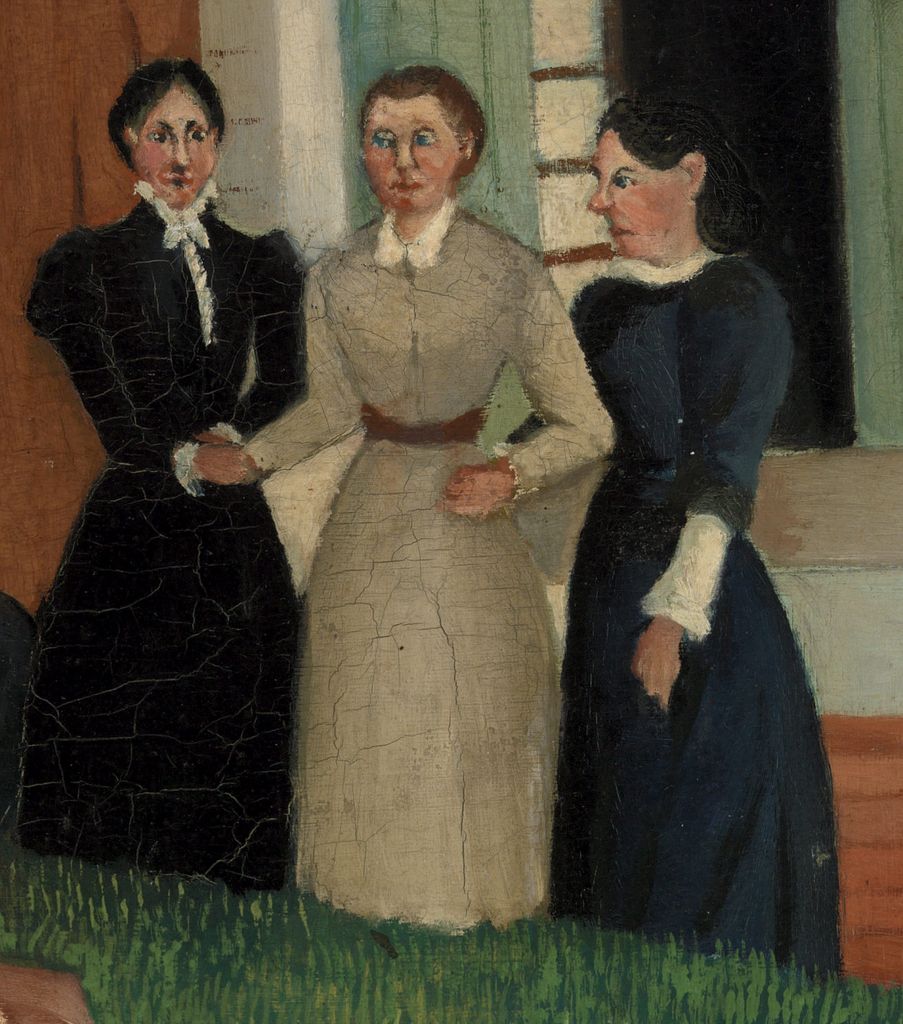
The men’s raised cups create small gestures within otherwise still poses. Their hands are held close to their bodies, where pale fingers stand out against black fabric. The white-haired man looks towards the viewer, as do the standing men behind him. These repeated frontal faces give the left group a collective address. On the other side of the picture, the outermost figure turns in profile towards the other two figures, redirecting attention into the gathering itself.
That difference in direction brings a little movement into the formal arrangement. Some figures face us, while others seem absorbed by someone beside them. There is no need to assign a conversation or a named relationship to feel this change. A turned head can establish a connection even when the painting withholds its story. The gathering alternates between public display and private company.
Why the baby holds the foreground
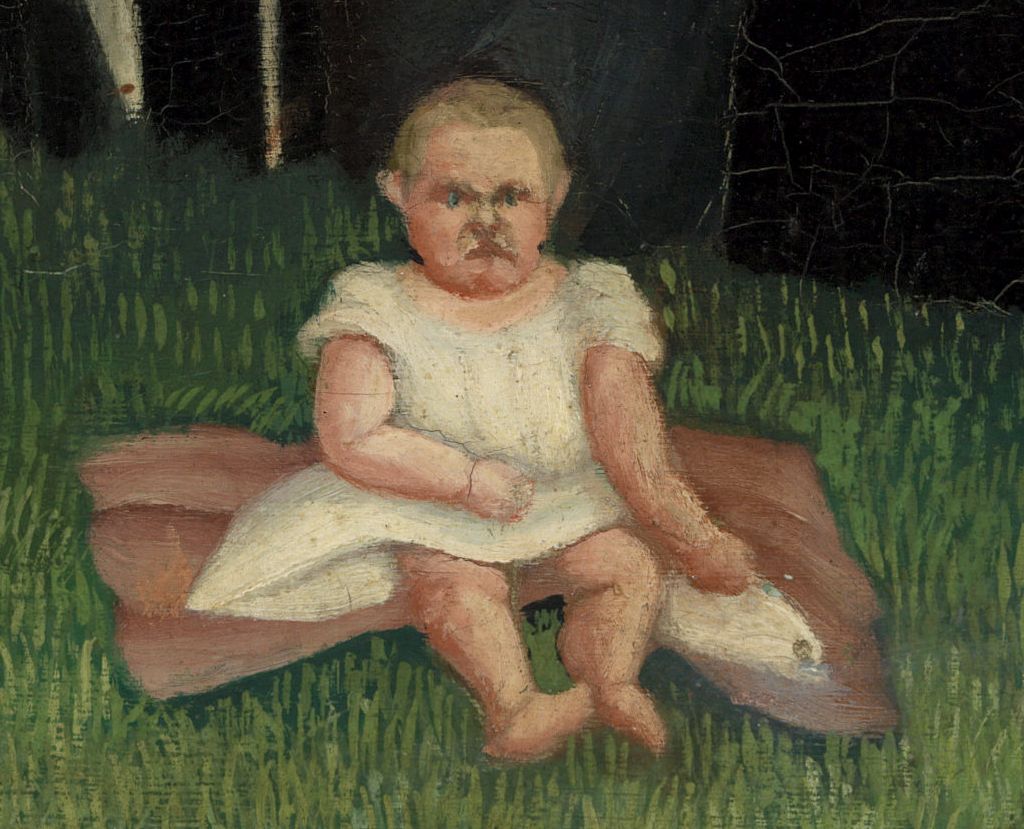
The baby is the lowest figure in the picture and one of the most immediately noticeable. A white dress spreads over the pink blanket, bare legs extend onto the grass, and a large, clear face looks out beneath short fair hair. The space surrounding the child gives this small body an independence that the adults, packed close together, do not possess. The blanket makes a distinct island of warm colour within the green foreground.
A band of grass separates the baby from the standing adults. This interval matters as much as the difference in their sizes. The child is physically closer to us, with no intervening figure, chair or table. The adults appear to form a background company for this foreground presence. That is a visual emphasis rather than proof that the gathering celebrates this particular child; the painting makes the baby prominent without explaining why everyone has assembled.
The white clothing also creates a connection across the composition. It answers the cream dress at the right and the smaller white collars, cuffs and shirtfronts above. Against the dark garments, these light passages lead the eye from one figure to another. The pink blanket and red waistband introduce two warmer accents at different heights. Rousseau gives the child a place within the group’s colour pattern while keeping the body spatially apart.
The faces can seem strikingly large in relation to the bodies, especially in the baby and the seated central figure. Hands and limbs sometimes meet at abrupt angles. These are useful things to notice without turning them into a diagnosis of the painter’s ability or a claim that he intended caricature. Here their effect is to keep the people sharply legible. Each figure asks for attention even within the crowded company.
A house that shapes the portrait
The house provides an unusually active background. A red-brick base runs along its foot, giving the pale wall a firm horizontal edge. Above it are three dark window openings, surrounded by pale green shutters, and a closed reddish-brown door near the centre. The doorway rises behind the seated figure and beside the right-hand group. These broad rectangles divide the surface into areas against which heads and shoulders can register clearly.
The windows remain black enough to offer very little information about the interior. The eye meets their dark shapes and returns to the people outside. At the right, the largest opening surrounds the standing group with another frame; at the left, a smaller window sits beyond the men. An upper window extends the composition above the heads. The building gives the gathering height without introducing another row of people.
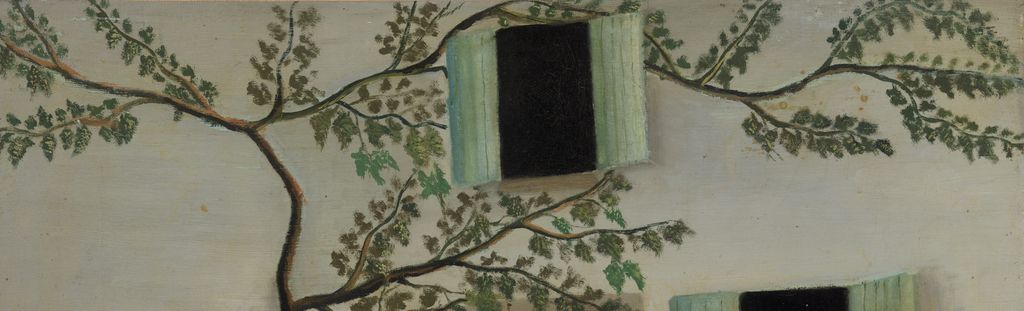
Across this regular structure grows the plant that the Barnes identifies as a treelike grapevine.[1] Its trunk rises behind the left group before dividing into long, irregular branches. One reaches across the upper part of the wall; another runs below the high window. Leaves gather in small clusters, allowing the plaster to remain visible between them. The vine connects areas that the architecture has divided.
This interplay of straight edges and curves makes the wall worth sustained attention. The shutters establish upright strips, the brickwork stretches sideways, and the branches take less predictable routes between them. Below, the grass is built from many short, upright strokes. Different kinds of repetition fill different parts of the picture: leaves above, grass below, and pale faces across the middle. The group inhabits a surface that is busy almost everywhere, despite the stillness of its poses.
Annotated Details from The Family
The numbered points identify visible features discussed in this article. Return from each detail to the whole composition. Henri Rousseau, The Family (La famille), c. 1892–1900. Barnes Foundation, Philadelphia, BF581. Museum-derived reproduction published on Wikimedia Commons in 2018. Image source. Public domain. Numbers added to the overview; details cropped from the published original. No recolouring or retouching.
Details from THE FAMILY
Begin with the baby, compare the drinking vessels and the right-hand figures, then follow the vine across the house.
A baby apart from the company
The white dress and pink blanket create a small island of light and warmth in the grass. Open space around the baby makes this foreground figure distinct from the closely gathered company behind.
Cups and a green bottle
Small stemmed vessels and pale hands punctuate the dark coats. The green bottle adds another sign of shared drinking, while leaving the precise occasion unsettled.
Three figures beside the right window
A pale dress and red waistband stand between two darker garments. One head turns in profile towards the others, bringing an inward direction to a gathering otherwise full of frontal faces.
A vine across the shuttered wall
Branches take irregular paths around the high window and across the pale plaster. Their curves and scattered leaves connect areas divided by the straight edges of shutters and openings.
Family portraiture and the picture’s history
The Musée de l’Orangerie’s 2026 exhibition text places Rousseau’s early portrait commissions within his social circle. It describes portraits associated with marriages, baptisms, births and Sunday outings, alongside more intimate works kept outside the art market.[12] This context helps explain why an ordinary gathering could sustain a complete painting. Clothes, familiar surroundings and a few shared possessions could give a portrait its subject, without the grandeur of an official ceremony.
That wider account does not identify the people in The Family or establish the circumstances of its commission. The Barnes description supplies neither their names nor their exact relationships.[1] The occasion is recognisable enough to invite curiosity, but individual details resist a complete reconstruction. We can see the care taken over a collar or the shape of a cup without recovering the sitter’s name.
The Orangerie also discusses Rousseau’s declared ambition for the portrait-landscape, a genre he claimed as his invention.[12] Readers following that interest can turn to his self-portrait. In The Family, the setting is especially close and enclosing. The white wall, shutters, vine and lawn give the company a shared place; the background contributes to the portrait as insistently as the figures do.
The Barnes exhibition history records the painting in the June 1923 Henri Rousseau exhibition at P. Rosenberg in Paris, as number 15. Its entry cites Henry Certigny’s 1984 catalogue for that information.[1] This supplies one documented point in the picture’s exhibition history, as reported by the owning institution. The present record gives no published provenance from which to establish an original buyer or a complete sequence of owners.[1] The intimate gathering has acquired a public history, while the lives represented within it remain largely beyond reach.
Henri Rousseau artworks directory
This directory brings together works covered on this site and other works documented in the cited museum records and catalogues. Alternate titles share one entry; distinct versions remain separate. Historical dates for works without an article follow the cited catalogues. This is not a catalogue raisonné.
Frequently Asked Questions
The Barnes Foundation currently dates the painting to about 1892–1900. The range should not be reduced to an exact execution year.[1]
The Barnes describes an outdoor family gathering but does not name the sitters or establish their precise relationships.[1]
A baptism is one possibility suggested by the Barnes, alongside a birth or a wine harvest. The barrel, bottle, cups and baby invite these readings, but the exact occasion remains uncertain.[1]
It belongs to the Barnes Foundation, inventory BF581. It is an oil painting on canvas measuring 46 × 55 cm.[1]
Discussion
Look again at the images and ideas explored in The Family (La Famille). These editorial prompts invite your observations.
Reader Insights
How does the space around the baby affect your reading of the adults behind it?
Follow the vine across the wall. Where does it connect groups or architectural features that initially seem separate?
Which detail most strongly suggests a celebration to you, and what does the picture leave unanswered?
Join the Conversation
Share a detail, comparison or question about The Family (La Famille) below.
References
- Barnes Foundation. The Family (La famille), Henri Rousseau, BF581, current collection record accessed 23 October 2026: identity fields, description, exhibition history and published-provenance field. The exhibition-history entry reports P. Rosenberg, Paris, June 1923, no. 15, citing Henry Certigny, Le Douanier Rousseau en son temps, vol. 1 (1984), p. 330. View source.
- Philadelphia Museum of Art, Carnival Evening,1963-181-64,object59593. View source.
- Musée de l’Orangerie / Juliette Degennes, Henri Rousseau,L’ambition de la peinture: Un artiste dans son époque (in French). View source.
- National Gallery, Surprised!, NG6421. View source.
- Musée d’Orsay, La Guerre,RF19461 (in French). View source.
- MoMA, The Sleeping Gypsy. View source.
- Philadelphia Museum of Art, The Merry Jesters, 1950-134-176, object51097. View source.
- Musée d’Orsay, La Charmeuse de serpents, RF 1937 7 (in French). View source.
- Musée de l’Orangerie, La Carriole du Père Junier, RF 1960 26 (in French). View source.
- Solomon R. Guggenheim Museum / Cornelia Lauf, The Football Players,60.1583: current collection record. View source.
- MoMA, The Dream, 252.1954. View source.
- Musée de l’Orangerie. Henri Rousseau, l’ambition de la peinture, 2026 exhibition text, section “Rousseau et son cercle. L’invention du portrait-paysage,” accessed 23 October 2026. View source. (in French).
- The Museum of Modern Art, Henri Rousseau: Essays (1985), selected catalogue entries, chronology and notes on early devotees. View source. Selected entries, chronology (pp.91–95) and early-devotee notes (pp.262–264) were consulted. Historical collection credits do not establish present ownership.
- Daniel Catton Rich, Henri Rousseau (The Museum of Modern Art, 1942), selected drawings and landscape studies; historical catalogue. View source. The dated 1942 publication is used for the two Quai d’Auteuil ink views; its Malakoff date differs from the 1985 catalogue.
- MANAS, Laval, Henri Rousseau, dit le Douanier, urban landscapes and preparatory study (in French). View source.
- National Gallery of Art, Self-Portrait (1895), pen-and-ink drawing, accession 1995.47.66. View source.
- The Museum of Modern Art, War (published January 1895), lithograph, accession 684.1943. View source.
- Barnes Foundation, Landscape and Four Young Girls, object 5521, BF855. View source.


 Henri Rousseau.jpg)


 Henri Rousseau.jpg)