



 by Tom Gurney
Tom Gurney BSc (Hons) is an art history expert with over 20 years experience
Published on June 19, 2020 / Updated on October 29, 2026
Email: tomgurney1@gmail.com / Phone: +44 7429 011000
Fight Between a Tiger and a Buffalo: Introduction
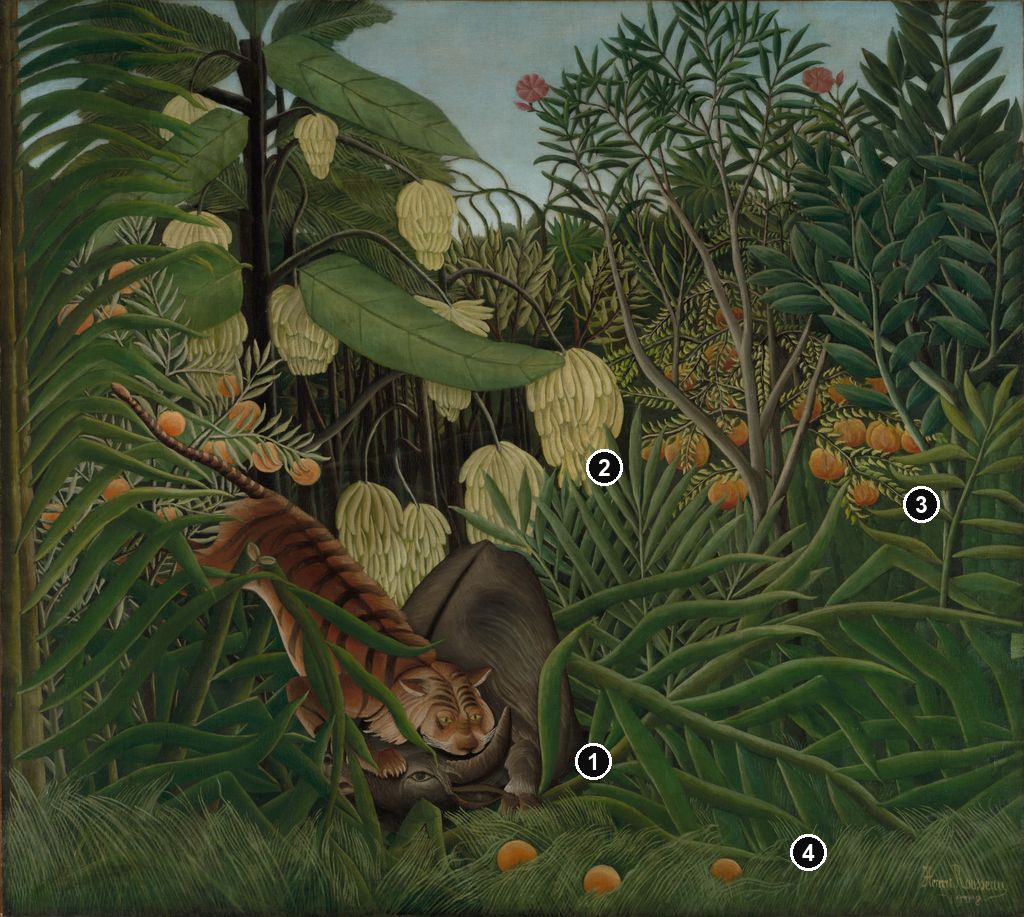
A tiger presses a buffalo into the bottom of Henri Rousseau’s jungle. Its striped back runs diagonally through the leaves; its face turns almost towards us above the dark animal it has caught. Everywhere around the struggle, plants continue their extravagant growth. Broad leaves, pointed blades and pale hanging fruit fill a canvas nearly two metres wide. In Fight Between a Tiger and a Buffalo, the violence feels inseparable from the vegetation enclosing it. Painted for the 1908 Salon des Indépendants, this large composition belongs to the Cleveland Museum of Art.[1]
At a Glance
- ArtistHenri Rousseau
- Date1908; already begun by December 1907
- MediumOil on canvas, catalogued by Cleveland as oil on fabric
- Size170 × 189.5 cm, unframed
- CollectionCleveland Museum of Art, Gift of the Hanna Fund
- Accession number1949.186
- First exhibitionSalon des Indépendants, Paris, March 1908, no. 5260[1][2]
This work across Henri Rousseau’s career
Carnival Evening
1886 [3]The Merry Jesters
1906 [8]The Snake Charmer
1907 [9]Contents
- A struggle at the foot of the forest
- Leaves, stripes and immense fruit
- Parisian resources and an animal image
- The unfinished painting and the spring Salon
- What the Salon spectator saw
- From Vollard to Cleveland
- Annotated details
A struggle at the foot of the forest
Rousseau places the attack surprisingly low. A first glance can wander among the enormous leaves and fruit before arriving at the animals, compressed into a narrow opening near the lower edge. The tiger comes from the left, its body descending towards the centre. The buffalo’s raised back forms a dark rounded mass behind its head. One visible eye looks out beneath the tiger, giving the encounter a point of contact with the spectator. Above them, the vegetation occupies most of the picture. The jungle seems capable of swallowing the entire incident.[1]
The tiger’s presence emerges in stages. Orange and black stripes become visible between green blades, then a paw and the broad face clarify the action. Long leaves pass across its body, interrupting the outline that would ordinarily make a predatory animal immediately legible. At the centre of the struggle, the pale muzzle and bright eyes remain unusually clear. This combination of concealment and frontal emphasis makes the tiger both absorbed in its prey and disturbingly available to our gaze.
The buffalo’s grey-brown body is comparatively plain, and its broad curve resists the repeated narrow stripes around it. That heavy curve supplies a visual counterweight to the tiger’s downward thrust. The two bodies appear locked together, with little room for either to escape. The attack has reached a moment of sustained pressure. The surrounding blades carry much of the movement that the animals themselves seem to have spent.
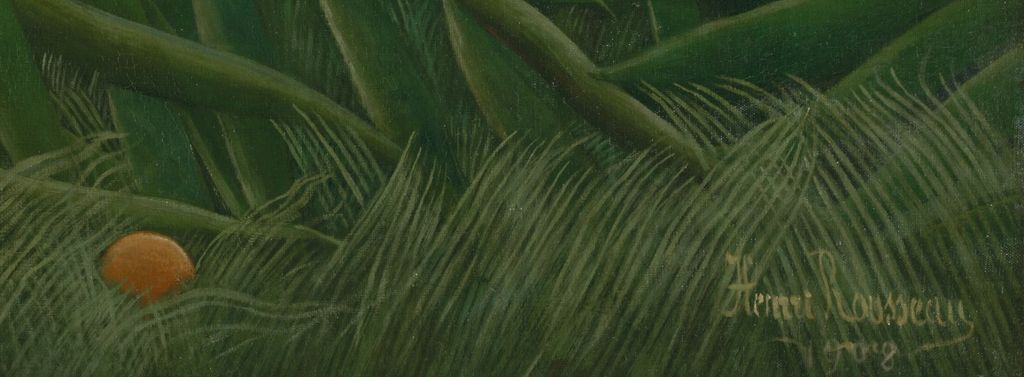
At Cleveland’s recorded dimensions of 170 × 189.5 centimetres, these relationships extend across a substantial painted surface. A reproduction reduces them to an intricate pattern that can be taken in at once. The original asks the eye to travel farther: from a small orange fruit at the bottom, through a mesh of blades, towards the animal faces, and then upwards into hanging clusters and branching stems. The size helps the plants acquire their disproportionate authority. Even the sky appears as a limited opening between taller forms. Rousseau signed and dated the canvas at the lower right, giving this elaborate invention its place in the work of 1908.[1]
Leaves, stripes and immense fruit
The left side is built around a dark upright stem and leaves broad enough to bridge substantial gaps in the composition. Pale banana clusters hang against and below them. Across the right side, finer branching stems support ranks of small pointed leaves. Orange fruit and touches of yellow break through the greens. Down in front, long blades cross one another at acute angles, creating a screen between the spectator and the animals. Each area has its own rhythm, from the heavy drooping clusters to the rapid, almost bristling divisions of the upper branches.
These differences prevent the abundant foliage from becoming an undifferentiated thicket. Large leaves give the eye places to rest; smaller ones keep it moving. Repeated curves pull attention from one patch to another, while the pointed foreground blades converge upon the fight. The vegetation can be read as several overlapping screens. Their overlaps suggest distance, yet the clear outlines and insistent patterns continually return attention to the surface. We can recognise which forms pass in front of others without finding an easy route through the forest.
Writing in 1942, the curator Daniel Catton Rich singled out this picture as evidence of Rousseau’s mature command of design. His discussion, reproduced in the 1985 Rousseau catalogue, emphasised the coordination of interlocking planes across the composition. Rich connected the tiger’s diagonal and stripes with the broken, angular stalks in front, and associated the buffalo’s weight with the heavy banana clusters. This reading offers a useful way to follow the picture: each animal has a counterpart in the vegetation, so the struggle’s opposing forces extend beyond the bodies themselves.[2]
Rich also stressed the emotional effect of magnification. Forms that could be modest in ordinary experience become enormous within Rousseau’s painted world. Cleveland makes a related observation in its description, calling attention to enlarged hothouse plants and bananas depicted growing upside down. The museum treats botanical freedom as part of the painting’s invention. The pale fruit can seem plentiful, almost luxurious, while its mass and proximity add to the pressure around the animals. Abundance becomes another form of confinement.[1][2]
The repetition is particularly striking near the ground. A tiger is striped by nature; Rousseau surrounds it with a world of stripes made from leaves, stalks and grass. We recognise the animal through that pattern, then watch the same pattern carry its energy across the jungle. Meanwhile the rounded fruit near the bottom offers a gentler visual pace. The eye keeps shifting between these small, calm shapes and the locked animal heads just above them. The painting’s disturbing character develops through such relationships as much as through the attack itself.
Annotated Details from Fight Between a Tiger and a Buffalo
The numbered points identify visible features discussed in this article. Return from each detail to the whole composition. Henri Rousseau, Fight Between a Tiger and a Buffalo, 1908. The Cleveland Museum of Art, 1949.186. Gift of the Hanna Fund. Image source. CC0 / Public domain. Numbers added to the overview; detail views cropped from the original. No recolouring or retouching.
Details from FIGHT BETWEEN A TIGER AND A BUFFALO
Compare the animal faces with the repeated shapes of fruit, leaves and foreground grass in the complete painting above.
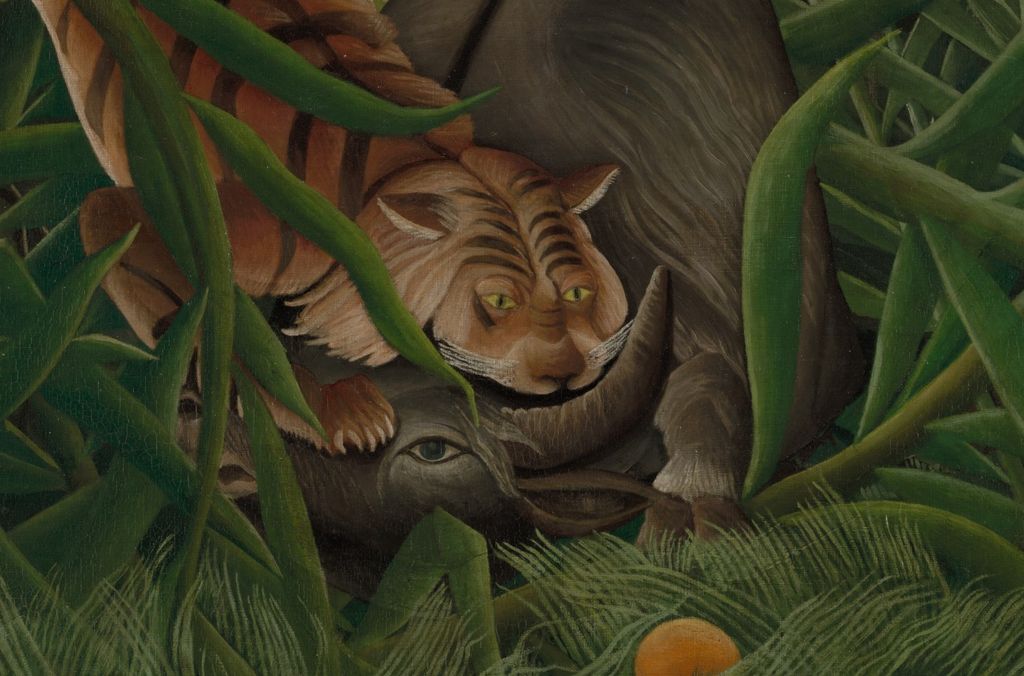
Two heads at the centre
The striped head leans over the buffalo’s face, and a pale paw presses across its muzzle. One open eye remains visible below the enclosing tangle of fur, horn and leaves.
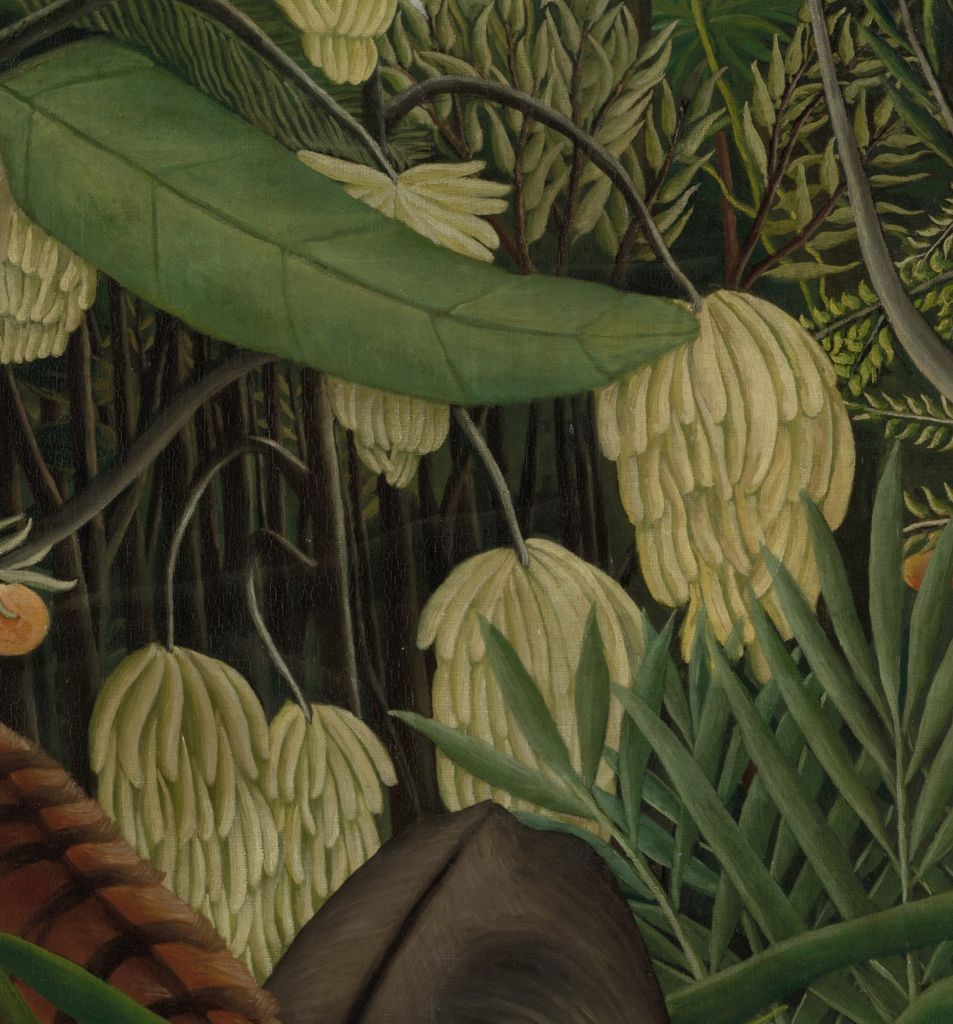
A curtain of pale fruit
Pale clusters interrupt the dark foliage in a descending run. Their separate ridged shapes make a repeated pattern that draws the eye towards the animals below.
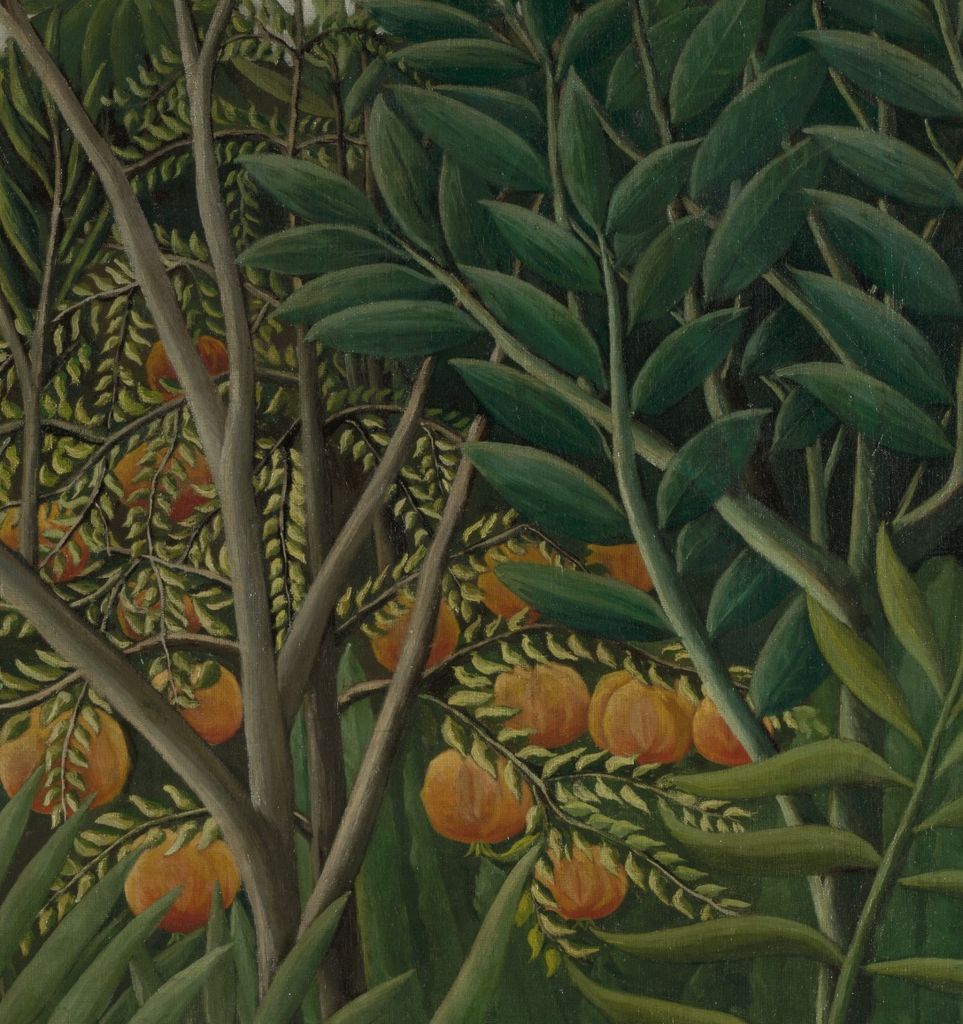
Crossing leaves and orange fruit
Long blade-shaped leaves cross finer stems, while round orange fruit punctuates the green. The separate contours remain clear even where several layers overlap.
Grass and the lower-right signature
Short strokes run diagonally through the foreground grass. At the lower right, the small signature and date sit close to this dense surface of separate marks.
Parisian resources and an animal image
Rousseau assembled his tropical worlds from resources available in France. The Musée de l’Orangerie’s account of his practice identifies the natural-history museum, the glasshouses of the Jardin des Plantes, illustrated newspapers and popular exotic imagery associated with colonial exhibitions. Cleveland likewise points to botanical gardens and travel books. These resources brought plants, animals and distant places before a Parisian viewer through specimens, displays and pictures. Rousseau’s jungle joins such separate encounters into an environment with its own scale and density.[13][1]
The animal group also has a more specific scholarly source history. The 1985 catalogue discusses a probable connection with an etching by Eugène Pirodon after the Belgian painter Charles Verlat. A. G. Kostenevich’s later Hermitage catalogue entry identifies Pirodon’s etching after Verlat’s Royal Tiger Attacking a Bull as the source of inspiration for both Rousseau versions. That relationship situates the pair within a tradition of animal combat imagery, even though the surrounding jungle gives Rousseau’s composition a very different character.[2][14]
Kostenevich distinguishes Verlat’s animal subject from Rousseau’s personal interpretation of the jungle. The distinction is valuable when looking at the Cleveland picture. The encounter gives the scene a concentrated action, but the plants determine how we approach it, how much of it we can see and how large the surrounding world feels. A borrowed arrangement could therefore become the centre of a composition whose atmosphere depends on transformations elsewhere. The source relationship does not establish an exact tracing procedure or a mechanical method of transfer.[14][2]
A brief comparison with Surprised!, Rousseau’s tiger painting of 1891, makes the later composition’s enclosure clearer. In that earlier work, diagonal rain, wind-bent branches and lightning spread agitation across the exposed sky. In the Cleveland canvas, the weather has withdrawn from the drama. The sky is pale, the surrounding plants retain their distinct shapes, and the struggle takes place deep within their ordered abundance. Both pictures use repetitions between tiger and foliage, but the later painting concentrates danger in a crowded, seemingly still environment.[5][1]
The unfinished painting and the spring Salon
The picture’s date of 1908 records its completed form, while a letter places its beginnings in the preceding year. During his detention in December 1907 in connection with a bank fraud, Rousseau worried about finishing a large painting for the spring Salon. On 28 December, he wrote to the judge asking for release so that he could resume the canvas he had already begun. In the letter translated in the 1985 catalogue, he estimated that its composition still required at least two months of work.[2]
The appeal brings the scale of the undertaking into focus. Rousseau needed time to complete this composition for a public occasion. His anxious request gives the dense jungle a practical history: the many forms and their relationships represented work still to be done against an exhibition deadline. The letter establishes an interruption and his wish to return to painting. It offers no basis for picturing him completing the jungle inside his prison cell.[2]
The 1985 catalogue considers the painting likely to have been finished in January and February after his release. It was ready for the March 1908 Salon des Indépendants, where it appeared as no. 5260 alongside The Football Players and two further paintings. The later trial belongs to January 1909, when Rousseau received a suspended sentence. By then, the painting had already faced its first public audience.[2]
Rousseau’s concern about the Salon fits his sustained pursuit of public recognition. The Orangerie’s exhibition account describes an artist who sent ambitious large compositions to the Indépendants and carefully preserved newspaper notices. Here, the 1907 letter makes that ambition concrete. This was a canvas he urgently wanted spectators to see. Its size and elaborate construction were directed towards an exhibition audience, even as its strange forms exposed it to the ridicule that had accompanied earlier appearances.[13][2]
What the Salon spectator saw
One response printed in Le Matin on 20 March 1908, and quoted in the 1985 catalogue, linked the jungle to another Rousseau picture nearby. The reviewer compared the attacking animal’s stripes to the clothing of the football players, while incorrectly calling the tiger a panther. The comparison is comic, yet it catches a real visual characteristic: a forceful pattern can organise the surface of an animal and the costume of a human figure with comparable insistence.[2]
The review invokes a “present-day Giotto,” rebukes ironic spectators and suggests that painters being laughed at might eventually teach their audience a lesson. These comments mingle extravagance, amusement and the possibility of future vindication. Read through the catalogue’s quotation, they show how unstable Rousseau’s reception could be. A reader could enjoy the joke while encountering an argument that immediate approval was a poor measure of artistic significance.[2]
Rich’s later discussion shifts attention towards the organisation of the canvas. Writing decades after the Salon, he explained how the detailed vegetation contributes to a unified design. His observations remain persuasive because they can be tested against the picture: follow a stripe into a blade, compare the weight of fruit and buffalo, or watch the right-hand leaves divide the space. The painting rewards precisely the sustained attention that an amused walk past a crowded exhibition wall might deny it.[2]
From Vollard to Cleveland
The Cleveland Museum of Art records that Ambroise Vollard bought the painting directly from Rousseau on 14 December 1909. John Quinn purchased it in October 1923; it entered his estate the following year. By 1926 it belonged to Mrs. John Alden Carpenter in Chicago. Its subsequent history includes Mrs. Patrick J. Hill and the Pierre Matisse Gallery in New York, where it was recorded in 1948. Cleveland acquired it on 14 June 1949, with the credit line Gift of the Hanna Fund.[1]
This sequence traces the large Salon picture from Rousseau’s hands, through a Paris dealer and American collections, into the museum that now holds it. Names and dates also help distinguish it from the smaller Battling Tiger and Buffalo in the State Hermitage Museum. Both works passed through Vollard, but the Hermitage painting followed a separate course through Sergei Shchukin’s collection. The Cleveland canvas is accession 1949.186; the Hermitage work is inventory 6536.[1][14]
The smaller painting measures 46 × 56 centimetres in the Hermitage’s 2014 catalogue. An artist-written label on its reverse identifies it as Rousseau’s reworking of the picture exhibited at the 1908 Indépendants. Its compact yellow hanging fruit, finer dark branches and differently distributed orange accents change the balance around the animals. Cleveland’s larger pale clusters and more conspicuous tiger face give the corresponding areas greater weight. The comparison reveals Rousseau adjusting the environment around a recurring encounter, with distinct effects at radically different sizes.[14]
Henri Rousseau artworks directory
This directory brings together works covered on this site and other works documented in the cited museum records and catalogues. Alternate titles share one entry; distinct versions remain separate. Historical dates for works without an article follow the cited catalogues. This is not a catalogue raisonné.
Frequently Asked Questions
The large 1908 painting is in the Cleveland Museum of Art, accession 1949.186, Gift of the Hanna Fund. It measures 170 × 189.5 centimetres without its frame.[1]
His letter of 28 December 1907 says he had begun the Salon picture and wanted release to continue it. The letter supports an interruption to work; it does not establish painting inside prison. The work was exhibited in March 1908, before the trial of January 1909.[2]
They are separate oil paintings by Rousseau. The Hermitage version is much smaller and has variations in its plants and fruit. Its reverse label connects it to the large composition shown at the 1908 Salon des Indépendants.[14]
Discussion
Look again at the images and ideas explored in Fight Between a Tiger and a Buffalo. These editorial prompts invite your observations.
Reader Insights
Which shapes first bring your eye to the animals, and which lead it away?
How does the pale hanging fruit change your response to the attack beneath it?
When you compare the Cleveland and Hermitage paintings, how does the surrounding vegetation alter the same encounter?
Join the Conversation
Share a detail, comparison or question about Fight Between a Tiger and a Buffalo below.
References
- Cleveland Museum of Art. Fight Between a Tiger and a Buffalo, 1908, accession 1949.186. Object details, description, inscriptions, provenance and exhibition history; current object page and embedded structured record consulted 23 October 2026. View source.
- The Museum of Modern Art. Henri Rousseau: Essays, 1985, chronology p. 94; catalogue entries 50–51, pp. 212–216, especially pp. 214–215. Includes the translated letter of 28 December 1907, the Le Matin review of 20 March 1908 and Daniel Catton Rich’s 1942 discussion; those earlier texts cited here through this catalogue. View source.
- Philadelphia Museum of Art, Carnival Evening,1963-181-64,object59593. View source.
- Musée de l’Orangerie / Juliette Degennes, Henri Rousseau,L’ambition de la peinture: Un artiste dans son époque (in French). View source.
- National Gallery, London. Surprised!, 1891, NG6421, object details and painting description. View source.
- Musée d’Orsay, La Guerre,RF19461 (in French). View source.
- MoMA, The Sleeping Gypsy. View source.
- Philadelphia Museum of Art, The Merry Jesters, 1950-134-176, object51097. View source.
- Musée d’Orsay, La Charmeuse de serpents, RF 1937 7 (in French). View source.
- Musée de l’Orangerie, La Carriole du Père Junier, RF 1960 26 (in French). View source.
- Solomon R. Guggenheim Museum / Cornelia Lauf, The Football Players,60.1583: current collection record. View source.
- MoMA, The Dream, 252.1954. View source.
- Musée de l’Orangerie. Henri Rousseau, l’ambition de la peinture, 25 March–20 July 2026, exhibition sections “L’ambition de la peinture officielle” and “Un style à soi.” View source. (in French).
- A. G. Kostenevich. Battle between Tiger and Bull (In a Tropical Forest), in The State Hermitage: Treasures from the Museum’s Collections, vol. 2, revised and expanded edition, 2014, entry 231, pp. 292–293, inventory 6536; contributor identification p. 8. View source.
- The Museum of Modern Art, Henri Rousseau: Essays (1985), selected catalogue entries, chronology and notes on early devotees. View source. Selected entries, chronology (pp.91–95) and early-devotee notes (pp.262–264) were consulted. Historical collection credits do not establish present ownership.
- Daniel Catton Rich, Henri Rousseau (The Museum of Modern Art, 1942), selected drawings and landscape studies; historical catalogue. View source. The dated 1942 publication is used for the two Quai d’Auteuil ink views; its Malakoff date differs from the 1985 catalogue.
- MANAS, Laval, Henri Rousseau, dit le Douanier, urban landscapes and preparatory study (in French). View source.
- National Gallery of Art, Self-Portrait (1895), pen-and-ink drawing, accession 1995.47.66. View source.
- The Museum of Modern Art, War (published January 1895), lithograph, accession 684.1943. View source.
- Barnes Foundation, Landscape and Four Young Girls, object 5521, BF855. View source.


 Henri Rousseau.jpg)


 Henri Rousseau.jpg)