



 by Tom Gurney
Tom Gurney BSc (Hons) is an art history expert with over 20 years experience
Published on June 19, 2020 / Updated on October 29, 2026
Email: tomgurney1@gmail.com / Phone: +44 7429 011000
The Flamingos: Introduction
Four flamingos stand beside a broad stretch of blue water, their bent necks and slender legs gathered into the lower right corner. Across from them, flowers rise on stems so tall that their pink, yellow and white heads seem to belong to another order of life. Three small people occupy a distant sandbank. Henri Rousseau gives the birds, flowers and figures the same clear presence, while making their relative sizes wonderfully difficult to reconcile. The open water holds these separate worlds together.
At a Glance
- ArtistHenri Rousseau
- TitleThe Flamingos, also known as Les Flamants
- DateAbout 1907 in the 1985 retrospective catalogue; 1910 in Christie’s 2023 catalogue
- MediumOil on canvas
- Dimensions113.8 × 162 cm, according to Christie’s 2023 record
- Signature“Henri Rousseau,” lower left
- Collection historyOffered from the Estate of Payne Whitney Middleton in 2023; the cited sale record does not identify a buyer or present owner.[1][2]
This work across Henri Rousseau’s career
Carnival Evening
1886 [3]The Merry Jesters
1906 [8]The Snake Charmer
1907 [9]The Flamingos (current article)
c. 1907 or 1910 [13] [1]Contents
- A broad river and an uncertain date
- Looking across the water
- Flowers larger than birds
- An imagined landscape assembled in Paris
- Other kinds of peace in the jungle
- From Uhde to the Whitney Payson family
- Annotated details
A broad river and an uncertain date
The Flamingos is a substantial horizontal canvas, measuring more than a metre high and roughly a metre and a half across. Its width gives the water room to spread between the near bank and the dark forest beyond. Christie’s recorded it in 2023 as an oil painting signed at the lower left, with dimensions of 113.8 × 162 cm. The signature identifies the painter; the catalogue does not record a date inscribed on the canvas.[1]
Published dates differ. The 1985 Museum of Modern Art retrospective catalogue placed it at about 1907, whereas Christie’s 2023 catalogue gave 1910 without explaining the change. Both datings place it within Rousseau’s mature jungle paintings, but the difference matters when locating it beside individual works. Its precise year remains unsettled between these published accounts.[1][2]
Its titles have also shifted. According to the exhibition history assembled by Christie’s, the painting appeared in the 1912 Rousseau exhibition at Galerie Bernheim-Jeune as La forêt vierge, or The Virgin Forest. A 1921 publication reproduced it as La berge aux flamants, the bank with flamingos. Those names draw attention to different parts of the same scene: the far forest, the near shore, and the birds that now provide its familiar English title.[1]
Looking across the water
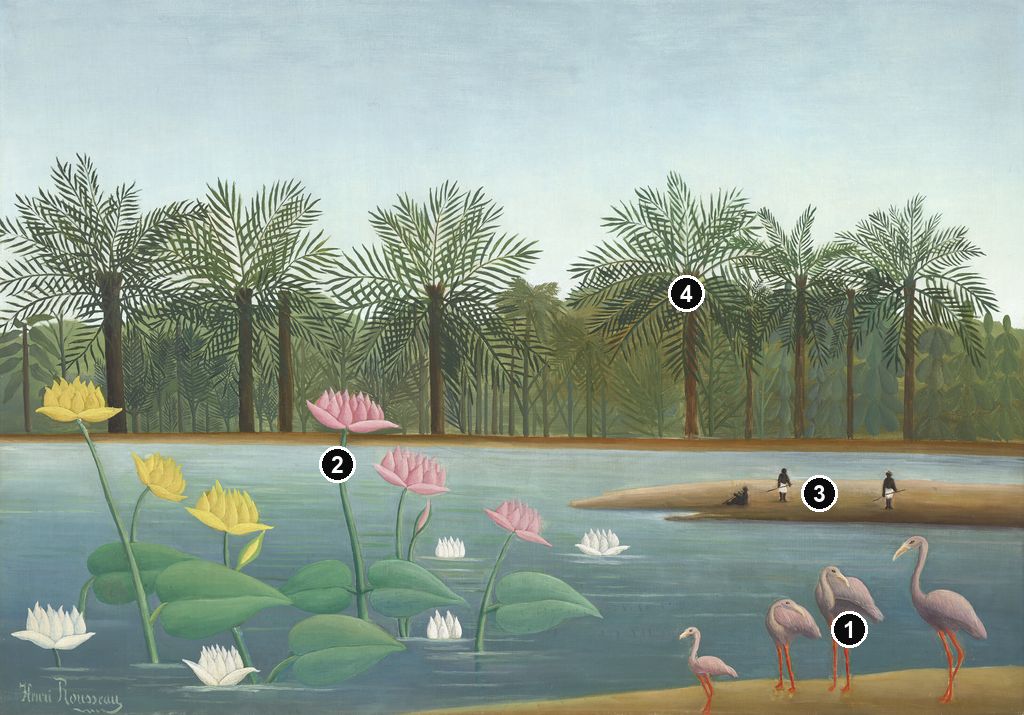
Rousseau arranges the landscape in long, distinct bands. A low strip of earth supports the flamingos at the bottom edge. Water fills the centre, interrupted by the projecting sandbank. The far shore forms a nearly continuous horizontal line, above which palms spread their sharply divided fronds. Finally the grey-blue sky opens over the whole scene. These divisions make the landscape easy to read even as its inhabitants challenge an ordinary sense of scale.
The water is the great interval in the picture. It gives the eye a path towards the three people, while allowing the flowers and birds to remain strikingly separate. Across its blue surface, darker strokes suggest small movements and changes of light. There is little of the tangle that usually makes a jungle difficult to penetrate. We can look a considerable distance into this scene without losing sight of its main shapes.
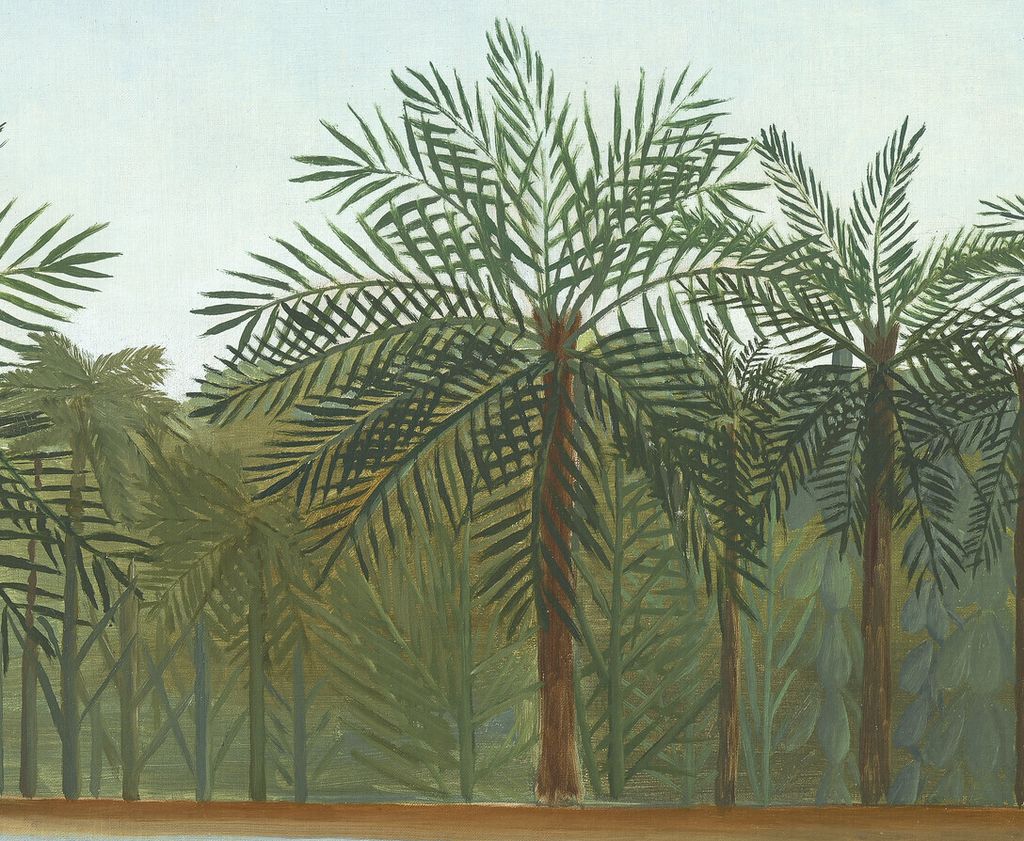
That openness gives the forest a particular presence. The palms stand together along the opposite bank like a closely spaced company of figures. Individual trunks remain visible, but their crowns overlap to form a screen. Brown and green alternate within it, and the thin lines of the fronds break up the solid mass. The forest marks the limit of the view. Beyond those trees, the eye has nowhere further to travel.
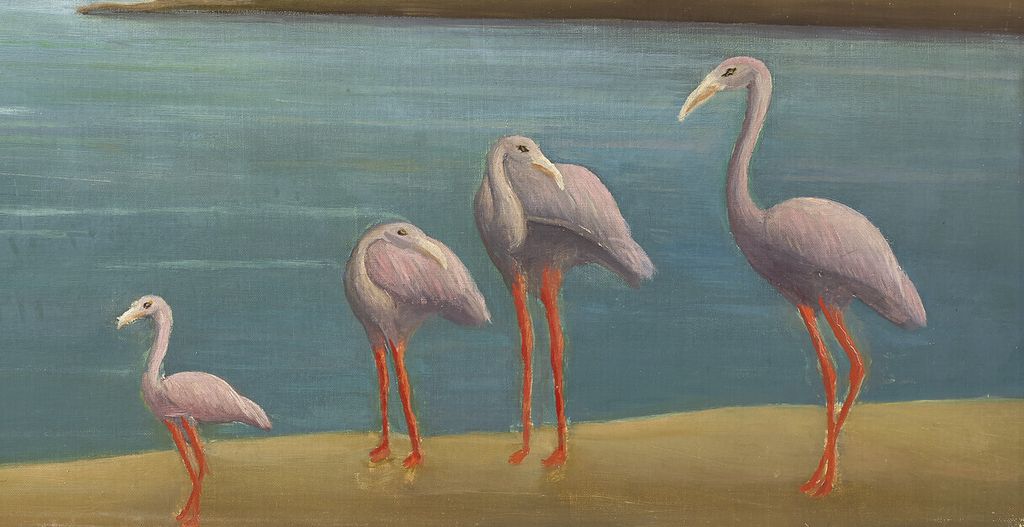
In the foreground, flexible curves work against these firm horizontal divisions. Flower stems lean and bow; broad leaves turn sideways; the flamingos curl their necks above narrow bodies. The smallest bird stands slightly apart from the other three, drawing the group towards the centre. Its reduced size makes the gathering less regular. The birds seem individually occupied, even though Rousseau binds them together through repeated necks, bills and red legs.
Their positions invite a slow inspection. One bends its head down close to its body, another carries its neck in a looser curve, and the rightmost bird rises higher against the water. Dark edging and changes of tone separate their wings and bodies. The long legs are especially effective because so little paint is needed to make them register against the bank. Their narrow red lines give the lower edge of the picture a small, persistent brightness.
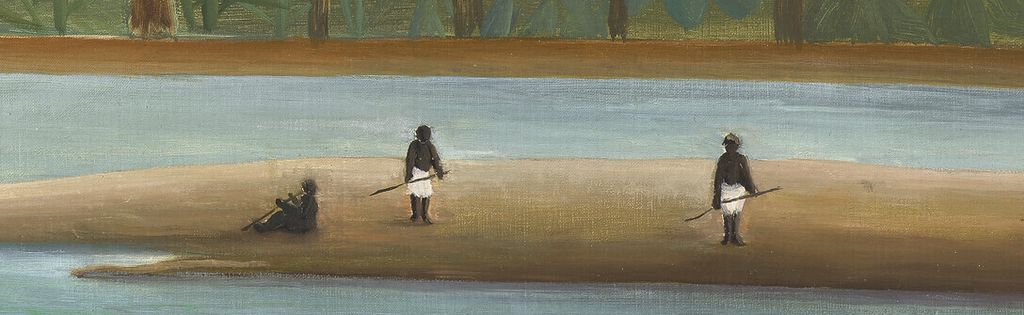
The people are much less immediately legible. They occupy the narrow tongue of sand, surrounded by a broad expanse of water, their small silhouettes broken by touches of light clothing. No facial expression can be read at this distance. Their activities remain open to the imagination. What matters most visibly is their smallness: the birds occupy our side of the river, while the human group supplies a measure of how far away the other bank appears.
Annotated Details from The Flamingos
The numbered points identify visible features discussed in this article. Return from each detail to the whole composition. Henri Rousseau, The Flamingos. Published dates differ: about 1907 in the 1985 retrospective catalogue; 1910 in the 2023 sale catalogue. Present owner unidentified. Image via Wikimedia Commons; published source: Christie’s. Image source. Public domain. Numbers added to a separate resized overview. Details cropped directly from the published original without enlargement, recolouring or retouching.
Details from THE FLAMINGOS
Compare the near birds with the enlarged flowers, then cross the open water towards the small figures and far palms.
Four birds gathered beside the water
Four bodies share the near bank, but their necks turn in different curves. The smallest bird stands apart at the left; narrow red legs carry the pink and grey bodies above the ochre shore.
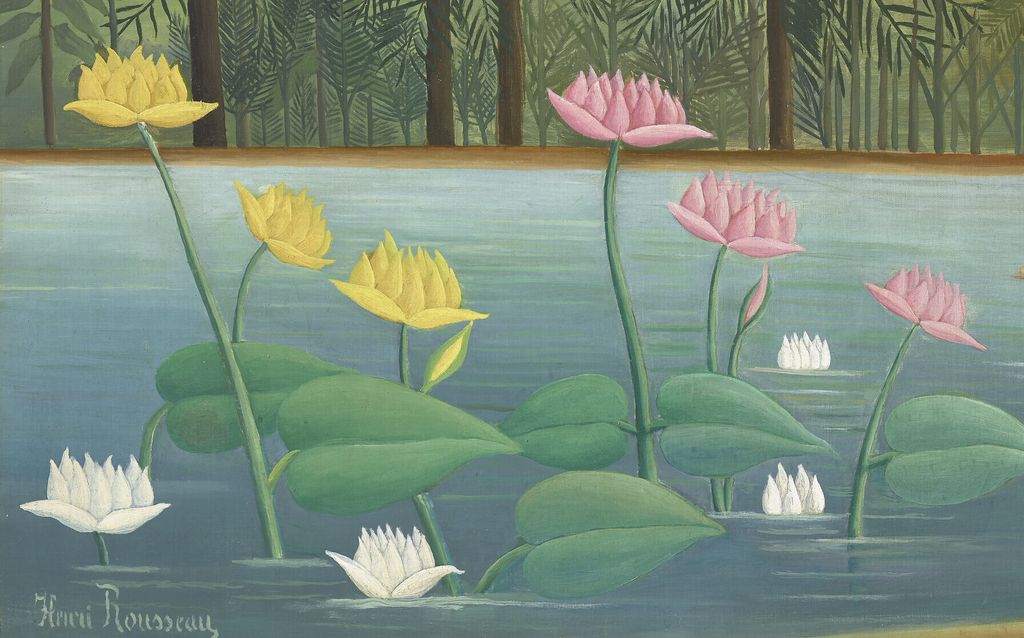
Great flowers carried on bending stems
Tall pink and yellow blossoms rise above broad overlapping leaves. The sloping stems carry their colour across the level bands of water, linking the low white flowers to the distant palms.
Three small figures on a sandbank
Two upright figures and one low seated shape occupy a narrow strip surrounded by water. Their small scale gives the river breadth without making their identities or activities certain.
Palms woven into a far shore
A strong upright trunk supports fronds that split into many narrow strokes. Their crossing lines make the far forest dense, while the pale sky remains visible between the tips.

The Flamingos — Henri Rousseau.
Flowers larger than birds
The flowers make that measure unstable. Their stems rise out of the near water, with immense leaves clustered beneath them. Some blossoms open into pointed crowns; others appear in profile, showing a cup or a fan of petals. White flowers sit close to the surface, while yellow and pink flowers rise much higher. This difference creates an upward movement through the left half of the painting, carrying the eye from the water to the palm crowns.
Placed beside the flamingos, the blossoms look enormous. The effect depends on proximity: both birds and flowers belong to the foreground, and the water between them supplies no convincing explanation for their disproportion. Rousseau makes the comparison unavoidable. The birds have familiar, recognisable bodies, while the flowers seem free to expand. Their scale helps turn a calmly ordered landscape into a place that obeys its own rules.
The 1985 catalogue responded to this effect by describing them as “dream flowers.” It also drew attention to their almost mouthlike petals and the delicate colour of the whole painting. These are poetic readings of the forms rather than botanical identifications. They catch something visible, however: the flower heads have an expressive presence, and their colours remain light against the dark trees without becoming harsh.[2]
The repetition of their shapes is as important as their strangeness. White, yellow and pink accents lead across the water at different heights. Leaf tips point towards the birds or towards the forest, and the stems cut diagonally through the horizontal river. Flowers that first look like decorative additions become structural parts of the composition. They connect its levels, interrupt its bands and keep the great open stretch of water from dividing the scene into two unrelated halves.
An imagined landscape assembled in Paris
The 1985 catalogue identifies the flamingos’ shapes with illustrations in Bêtes sauvages, an animal picture book. That identification concerns the motifs available to the painter; the birds’ new relationships to the huge flowers, distant people and broad water belong to the painted composition.[2]
An independent museum account helps place that borrowing within his wider practice. In its 2019 exhibition dossier, the Musée Maillol described Rousseau’s possession of an animal album published by Galeries Lafayette and his combination of several visual sources. The museum stressed his changes of scale and his bringing together of plants and animals that would not naturally inhabit the same environment. The Flamingos makes the creative possibilities of that process especially clear: familiar fragments become convincing inhabitants of an unfamiliar whole.[14]
Rousseau’s resources were close to home. The Musée de l’Orangerie’s 2026 exhibition text places his jungle imagery within the illustrated press, the natural-history collections and botanical glasshouses of Paris, and the exotic imagery circulated around the universal exhibitions. Those exhibitions were also displays of French colonial power, helping shape the images of distant places available to a Parisian audience. The museum rejects the old story that his jungles arose from military travel in Mexico.[15]
This setting changes how we look at the river. There is no need to identify an actual country behind the palms or to treat the people as witnesses to Rousseau’s travels. The painting brings an elsewhere into view through things he could encounter in Paris: specimens, plants and reproduced pictures. The result feels spacious because he makes room between its parts. A borrowed bird shape can acquire an entirely new character when it stands beneath an impossible flower across the water from three tiny people.
The 1985 catalogue also proposed a more distant comparison with the seventeenth-century Brazilian landscapes of Frans Post, noting that works by Post had been displayed in Paris during Rousseau’s lifetime. It offered a possible point of contact, rather than proof that Rousseau had studied or copied a particular painting. The suggestion places The Flamingos within a longer European history of picturing tropical landscapes, while leaving its individual sources an open question.[2]
Other kinds of peace in the jungle
Rousseau could make a jungle feel crowded and dangerous, but the absence of an attack is central to the experience of The Flamingos. The birds show no obvious alarm. The people occupy their distant sandbank. Neither group commands the whole scene. Much of the picture’s energy passes instead into the vegetation: the thrust of stems, the spread of palms and the extravagant size of the blossoms.
The comparison with The Snake Charmer brings that balance into focus. Both paintings open a view over water beside a wall of tropical vegetation. In The Snake Charmer, the standing musician is large enough to organise the scene around her body and instrument. In The Flamingos, the people withdraw into the distance. The foreground passes to birds and flowers, making the human presence one element among several. The 1985 catalogue discussed both works as unusually peaceful jungle compositions.[2]
Tropical Forest with Monkeys offers a different comparison. There the overlapping fronds and leaves conceal animals at several levels, and the eye must work through the vegetation to discover them. In The Flamingos, the broad river gives the principal creatures an open background. Both pictures allow quiet occupation within the jungle, but they distribute the viewer’s attention differently: one encourages searching inside the foliage, the other looking across a distance. The catalogue places the monkey painting in 1910 and contrasts such peaceful scenes with Rousseau’s jungle tragedies.[2]
From Uhde to the Whitney Payson family
The recorded history of The Flamingos begins close to Rousseau. Christie’s 2023 provenance lists Wilhelm Uhde as its first known owner, probably acquiring it directly from the artist in 1910 and retaining it until at least 1912. The word “probably” is significant: the direct transaction is qualified in the record. Its appearance at Bernheim-Jeune in 1912 places the canvas in a public exhibition soon after Rousseau’s death, under its earlier forest title.[1]
By 1926 it belonged to Paul and Charlotte, known as Lotte, von Mendelssohn-Bartholdy in Berlin. The provenance then lists Paul alone in 1927, followed by Elsa von Kesselstatt, who inherited it in 1935. These names trace the painting’s passage through private collections during the decades when it was also being reproduced and exhibited. Christie’s records its inclusion at Galerie Flechtheim in Berlin in 1926 and the Marie Harriman Gallery in New York in 1931.[1]
The next transactions are recorded more precisely. On 2 September 1949, M. Knoedler & Co. and Rudolf Heinemann acquired the painting through Walter Feilchenfeldt in Zurich. Charles S. and Joan Whitney Payson bought it the following month. It subsequently descended within the family, and Christie’s presented it in 2023 as property from the Estate of Payne Whitney Middleton. That catalogue establishes the family history leading to the auction; it does not name a buyer or establish who owns the painting today.[1]
Private ownership did not prevent the canvas from entering major public accounts of Rousseau. Its later exhibition history includes the Grand Palais and Museum of Modern Art retrospective of 1984–85 and Henri Rousseau: Jungles in Paris at Tate Modern and the National Gallery of Art in 2005–06, according to the 2023 catalogue. These appearances connect a painting long held in private hands with the exhibitions through which broader audiences encountered the range of Rousseau’s jungle imagery.[1]
Looking from the flamingos to the people establishes distance; looking from the flamingos to the blossoms disrupts scale. Rousseau lets both experiences coexist. The scene stays calm while the viewer continually adjusts to the world it presents.
Henri Rousseau artworks directory
This directory brings together works covered on this site and other works documented in the cited museum records and catalogues. Alternate titles share one entry; distinct versions remain separate. Historical dates for works without an article follow the cited catalogues. This is not a catalogue raisonné.
Frequently Asked Questions
Christie’s offered it from the Estate of Payne Whitney Middleton in 2023. Its catalogue traces ownership through the Whitney Payson family and leaves the present owner unidentified.[1]
Their size creates one of the painting’s strongest effects: birds that look familiar share the foreground with flowers that dwarf them. The Musée Maillol discusses changes of scale as part of Rousseau’s recombination of visual sources. No single documented explanation of his intention is needed to see how the oversized blossoms alter this landscape.[14]
Discussion
Look again at the images and ideas explored in The Flamingos. These editorial prompts invite your observations.
Reader Insights
How does the river change your experience of the forest beyond it?
When you compare the flowers, birds and people, which seems to provide the most convincing sense of scale?
How would the atmosphere change if the people were as large and close as the figure in The Snake Charmer?
Join the Conversation
Share a detail, comparison or question about The Flamingos below.
References
- Christie’s. Henri “Le Douanier” Rousseau, Les Flamants, 2023, 20th Century Evening Sale, auction 22043, lot 34 A: Details, Provenance, Literature, Exhibited and Lot Essay. View source.
- The Museum of Modern Art. Henri Rousseau, 1985, catalogue entry 37, The Flamingos, printed p. 184; comparison entries 36, The Snake Charmer, printed pp. 181–182, and 64, Tropical Forest with Monkeys, printed pp. 245–246. View source.
- Philadelphia Museum of Art, Carnival Evening,1963-181-64,object59593. View source.
- Musée de l’Orangerie / Juliette Degennes, Henri Rousseau,L’ambition de la peinture: Un artiste dans son époque (in French). View source.
- National Gallery, Surprised!, NG6421. View source.
- Musée d’Orsay, La Guerre,RF19461 (in French). View source.
- MoMA, The Sleeping Gypsy. View source.
- Philadelphia Museum of Art, The Merry Jesters, 1950-134-176, object51097. View source.
- Musée d’Orsay, La Charmeuse de serpents, RF 1937 7 (in French). View source.
- Musée de l’Orangerie, La Carriole du Père Junier, RF 1960 26 (in French). View source.
- Solomon R. Guggenheim Museum / Cornelia Lauf, The Football Players,60.1583: current collection record. View source.
- MoMA, The Dream, 252.1954. View source.
- The Museum of Modern Art, Henri Rousseau: Essays (1985), selected catalogue entries, chronology and notes on early devotees. View source. Selected entries, chronology (pp.91–95) and early-devotee notes (pp.262–264) were consulted. Historical collection credits do not establish present ownership.
- Musée Maillol. Du Douanier Rousseau à Séraphine: Les grands maîtres naïfs, press dossier, 2019, section 6, “Les Bêtes sauvages des Galeries Lafayette,” printed p. 17, Rousseau paragraph; exhibition curators Jeanne-Bathilde Lacourt and Àlex Susanna identified on printed p. 24. View source. (in French).
- Musée de l’Orangerie. Henri Rousseau, l’ambition de la peinture, exhibition text, 25 March–20 July 2026, section “Un style à soi.” View source. (in French).
- Daniel Catton Rich, Henri Rousseau (The Museum of Modern Art, 1942), selected drawings and landscape studies; historical catalogue. View source. The dated 1942 publication is used for the two Quai d’Auteuil ink views; its Malakoff date differs from the 1985 catalogue.
- MANAS, Laval, Henri Rousseau, dit le Douanier, urban landscapes and preparatory study (in French). View source.
- National Gallery of Art, Self-Portrait (1895), pen-and-ink drawing, accession 1995.47.66. View source.
- The Museum of Modern Art, War (published January 1895), lithograph, accession 684.1943. View source.
- Barnes Foundation, Landscape and Four Young Girls, object 5521, BF855. View source.


 Henri Rousseau.jpg)


 Henri Rousseau.jpg)