


 by Tom Gurney
Tom Gurney BSc (Hons) is an art history expert with over 20 years experience
Published on June 19, 2020 / Updated on October 29, 2026
Email: tomgurney1@gmail.com / Phone: +44 7429 011000
Jaguar Attacking a Horse: Introduction
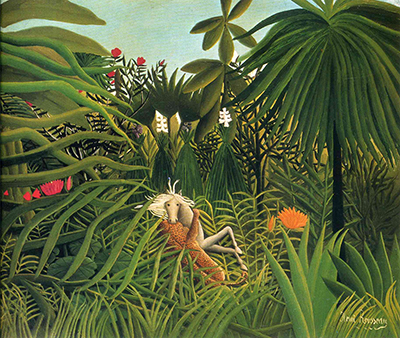
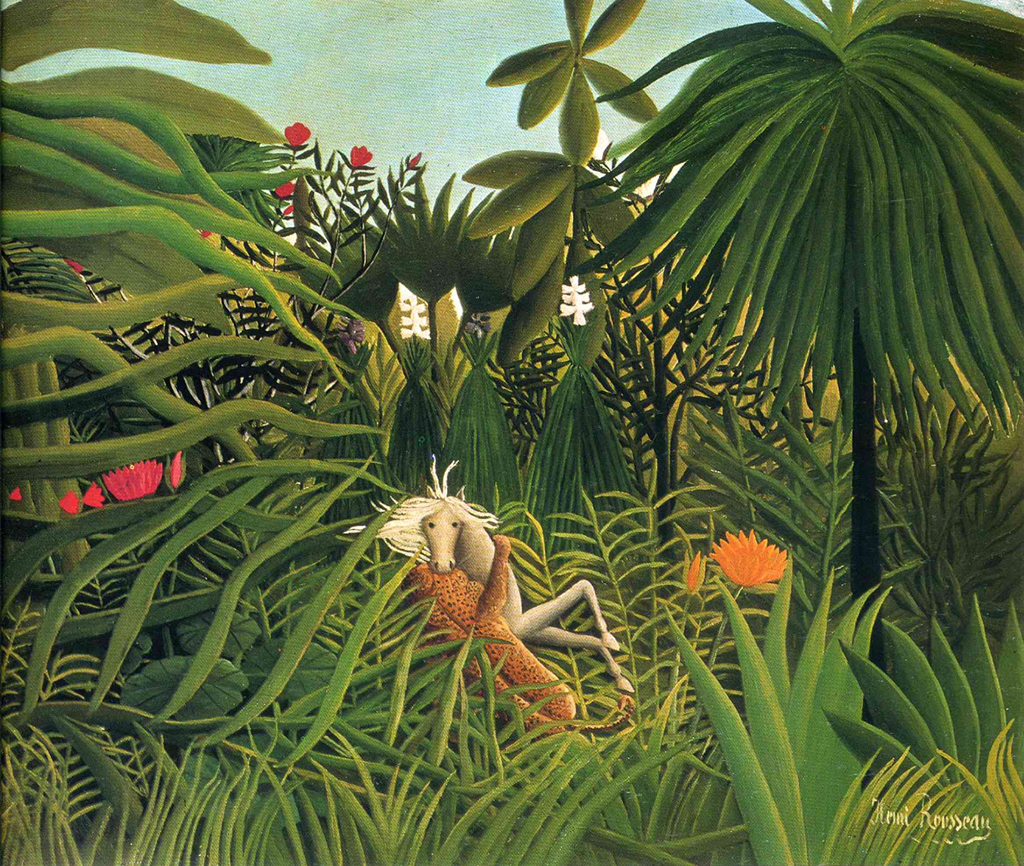
A white horse looks straight out from a thicket while a spotted jaguar grips its body. Around them, leaves turn, thrust and droop; a great orange flower rises almost level with the horse's head. Henri Rousseau's Jaguar Attacking a Horse gives a violent encounter a surprisingly small place within an immense abundance of plants. Painted in 1910, the oil on canvas measures 90 × 116 cm and belongs to the Pushkin State Museum of Fine Arts in Moscow.[1] Its drama begins with the animals, then spreads through the whole forest.
At a Glance
- ArtistHenri Rousseau
- SubjectJaguar Attacking a Horse
- ExploreThe horse at the centre of the struggle; A forest that presses inward
This work across Henri Rousseau’s career
Carnival Evening
1886 [2]The Merry Jesters
1906 [7]The Snake Charmer
1907 [8]Contents
- The horse at the centre of the struggle
- A forest that presses inward
- Flowers, colour and improbable scale
- The strange shape of the white horse
- A jungle imagined in Paris
- The March 1910 letter and receipt
- From Vollard to the Pushkin Museum
The horse at the centre of the struggle
The horse's pale face is the clearest point of entry. Its long muzzle, dark eyes and pricked ears stand against a deep green background, while fine strands of mane spring away from its head. The face is turned towards us even though the body is caught in a sideways struggle. That disagreement between head and body creates a peculiar stillness: the horse seems momentarily fixed before the viewer while its bent limbs indicate an unstable position.
The jaguar is harder to disentangle. Its golden, spotted body rises beneath the horse's head and curves through the lower centre of the picture. A forelimb reaches around the horse; a long curved tail reappears among the plants below. Dark markings distinguish the animal's coat, yet those same small marks join the surrounding patterns of leaves and stems. Following its outline takes time because foliage repeatedly interrupts it.
The two animals offer different kinds of visibility. We meet the horse through a face, with two black eyes looking towards our own position. The jaguar presents a much stronger expanse of patterned body, and its head is less readily separated from the point of contact. This imbalance can make the horse seem especially exposed. Fear and vulnerability are responses the image invites, rather than emotions that can be established from the animal's expression alone.
Little open ground surrounds the pair. Pale legs angle to the right, but there is no broad clearing into which the horse might escape. Long green blades cross the bodies, and upright stems divide the narrow spaces between them. The struggle feels close enough to inspect and difficult to reach. Rousseau makes the viewer look through a screen of growth, sharing the restricted view that gives the scene much of its tension.
A forest that presses inward
The large plant on the left sends broad, curling leaves towards the animals. Its repeated curves descend in loose tiers, becoming narrower and more tangled near the horse. Each leaf has an individual edge, but their combined direction matters as much as their separate shapes: they seem to carry a wave of movement into the centre. In his 1985 catalogue entry, Michel Hoog interpreted these bending plants as participants in the combat, their forms suggesting threatening blades or snakes.[12]
That reading grows from a visible feature of the composition. Almost every route towards the animals is occupied by something pointed or curving. Slender foreground leaves rise diagonally across the jaguar. Behind the horse, dark upright foliage creates a dense backing. On the right, enormous spear-shaped leaves push upwards beside the orange flower. The forest can therefore seem to amplify the attack even though it contains no single, unmistakable gesture of aggression.
The upper right introduces a different weight. A tall dark trunk supports a great fan of drooping leaves, whose numerous narrow divisions descend towards the fight. Its heavy rounded crown balances the left-hand leaves' more horizontal reach. Below it, a network of fine branches and fronds makes the background look crowded without filling it with a single undifferentiated green mass. Broad surfaces and thin lines remain distinct throughout.
Above this congestion, a patch of turquoise sky gives the eye room. There is far more air at the top than around the animals. The contrast makes their situation feel lower and more enclosed: the sky is visible, but reaching it offers no imaginable route out of the thicket. The canvas has breadth and a clear upper opening, yet its central action remains caught in a tight pocket of space.
Jaguar Attacking a Horse — Henri Rousseau.
Flowers, colour and improbable scale
The flowers pull attention away from the struggle and distribute it around the picture. Red blooms appear towards the left and against the upper sky; pale white clusters punctuate the darker middle distance. The orange flower on the right is particularly emphatic. Its narrow petals make a bright, serrated crown above a group of long pointed leaves. Looking from the horse to this flower briefly exchanges the white face for an equally insistent shape in a warmer colour.
Several leaves and blossoms look enormous beside the animals. This disproportion gives the vegetation authority over the scene: a horse and a large cat become small inhabitants of a world in which a single plant can dominate a corner. The Pushkin Museum's older commentary draws attention to the enlarged botanical details and their contribution to the painting's mysterious atmosphere.[13] The result is especially clear when the orange flower and white horse are considered together.
Green supplies the links between those bright interruptions. Some leaves have a yellowish edge, others a cool blue cast; deep dark areas separate neighbouring forms. These differences let us follow one blade past another even where the surface is tightly packed. Broad leaves carry long bands of lighter colour, while thin fronds make more delicate networks. Repeated changes of lightness and hue keep the plants legible.
The flowers also complicate the mood. Their clear colours and carefully separated forms remain attractive while the animals struggle below. Nothing in their appearance changes in response to the attack. A viewer can spend time admiring the plants, then suddenly return to the horse's predicament. This movement between pleasure in the painted surface and unease about the event helps the scene sustain attention beyond the first recognition of its subject.
The strange shape of the white horse
Hoog compared the frontal horse's head to a heraldic figure and interpreted part of the body extending to the right of the jaguar's paw as having a female shape. The Pushkin Museum's older commentary likewise proposed heraldic and feminine analogies.[12][13] These are interpretations of the unusual forms. They do not identify a particular coat of arms or establish that Rousseau intended a hidden human figure within the animal.
The heraldic comparison is useful because it draws attention to the head's isolated, almost emblematic presentation. The ears, eyes, mane and long muzzle can be read as a compact arrangement facing the viewer. Below, the bent pale limbs make a separate configuration of sharp angles and smooth curves. Head and body do not yield a single effortless account of movement. The viewer must keep adjusting between the recognisable horse and the strange arrangement of its parts.
That uncertainty belongs to the painting's experience. An awkward turn can appear more disturbing than a smoothly described action because it prevents us from settling into a familiar image of pursuit. The jaguar's patterned back supplies another kind of clarity, while the horse's body remains difficult to resolve. Rousseau sets these contrasting surfaces inside a forest whose leaves are often easier to trace than the animals they conceal.
A jungle imagined in Paris
The luxuriant setting was not a record of Rousseau's travels through a tropical forest. The Musée de l'Orangerie's 2026 exhibition text connects his jungle imagery with Parisian resources: the natural-history museum, the glasshouses of the Jardin des Plantes, illustrations in the press and the exotic imagery circulated around colonial exhibitions. It also rejects the story that his paintings arose from a Mexican journey.[14] The Pushkin's historical commentary places this picture within the same imaginative practice.[13]
Those resources explain how distant animals and plants could enter a painter's visual world while he worked in France. They do not by themselves establish a source for any particular leaf, flower or animal in this canvas. The scene offers no secure basis for assigning the whole forest to one real locality. Its huge overlapping forms make their own environment, with relationships governed by the needs of the picture.
The Orangerie also describes Rousseau's late repertoire as varying between combats and more peaceful jungles.[14] Jaguar Attacking a Horse shows how violence could be concentrated inside an elaborate decorative setting. Its energy comes from the meeting of two scales: the immediate contact between the animals and the much larger spread of vegetation. The plants occupy most of the view, yet the horse's small white face continues to command it.
The March 1910 letter and receipt
The picture has a probable connection with two documents involving the dealer Ambroise Vollard. Hoog's catalogue entry reports a letter of 5 March 1910 in which Rousseau said that The Dream was finished and that he was beginning a size-50 canvas showing a fight between a lion and a horse. The scholar Dora Vallier associated that letter with the present painting, partly because its format agrees with the stated canvas size.[12]
The animal named in the letter leaves a difficulty: it is a lion, whereas the Pushkin painting depicts the spotted cat identified as a jaguar in its title. Hoog considered possible explanations, but the identification remains an argument about the document rather than a certain statement by Rousseau naming this surviving canvas. The letter is valuable evidence for his work around this time without resolving every detail of its relationship to the painting.[12]
A receipt dated 22 March 1910, also reported in the catalogue, acknowledges 100 francs from Vollard for a picture of a combat between a jaguar and a horse. This description makes the association stronger. Even so, a payment date is not automatically a completion date. The two documents cannot establish that Rousseau painted the whole canvas during the seventeen days between them; Hoog himself cautioned against that conclusion.[12]
Read together, the documents provide a probable connection between the picture, Rousseau and Vollard in March 1910. They leave open the starting date, the stages of work and the exact moment at which the painted surface was complete. The sequence in which Rousseau painted the plants and animals cannot be established from either document.[12]
From Vollard to the Pushkin Museum
The 1985 catalogue records the painting's provenance through Vollard and the Moscow collector Sergei Shchukin. The Pushkin Museum's older record places it in Shchukin's collection before 1918 and subsequently in the State Museum of New Western Art before 1948. The current museum catalogue records its arrival at the Pushkin in 1948, under inventory number Ж-3351.[12][13][1] This establishes the main sequence without supplying an exact date for Shchukin's initial purchase.
The painting also had an early international exhibition history. Hoog lists it in New York in 1913 as number 382, in Chicago as number 359 and in Boston as number 192.[12] Those historical catalogue numbers help trace this particular composition beyond its changing English titles. The animal encounter, the sweeping leaves on the left and the heavy fan on the right give the object an equally distinctive visual identity.
The current Pushkin record gives the dimensions as 90 × 116 cm; the 1985 catalogue gave a height of 89 cm, with the same width.[1][12] The museum's present measurement is the appropriate one to use, while the earlier figure remains part of its published history. The discrepancy supplies no evidence that the canvas was altered.
Henri Rousseau artworks directory
This directory brings together works covered on this site and other works documented in the cited museum records and catalogues. Alternate titles share one entry; distinct versions remain separate. Historical dates for works without an article follow the cited catalogues. This is not a catalogue raisonné.
Frequently Asked Questions
It belongs to the Pushkin State Museum of Fine Arts in Moscow, inventory Ж-3351. The current record describes oil on canvas measuring 90 × 116 cm, height before width.[1]
Their exaggerated scale makes the animals appear engulfed by their surroundings. The Pushkin's historical commentary identifies enlarged leaves and flowers as an important part of the picture's mysterious effect; a specific symbolic explanation is not established.[13]
Discussion
Look again at the images and ideas explored in Jaguar Attacking a Horse. These editorial prompts invite your observations.
Reader Insights
Does the horse's frontal face make you feel addressed by the animal, or does it seem detached from the struggle?
Follow the edges of the largest leaves. Where do they guide your attention towards the animals, and where do they draw it away?
How would the scene change if the orange flower and the great drooping fan were removed?
Join the Conversation
Share a detail, comparison or question about Jaguar Attacking a Horse below.
References
- Pushkin State Museum of Fine Arts. Henri Rousseau, Jaguar Attacking a Horse, current electronic collection record, object 78263, inventory Ж-3351; metadata and official image, accessed 23 October 2026. View source. (in Russian).
- Philadelphia Museum of Art, Carnival Evening,1963-181-64,object59593. View source.
- Musée de l’Orangerie / Juliette Degennes, Henri Rousseau,L’ambition de la peinture: Un artiste dans son époque (in French). View source.
- National Gallery, Surprised!, NG6421. View source.
- Musée d’Orsay, La Guerre,RF19461 (in French). View source.
- MoMA, The Sleeping Gypsy. View source.
- Philadelphia Museum of Art, The Merry Jesters, 1950-134-176, object51097. View source.
- Musée d’Orsay, La Charmeuse de serpents, RF 1937 7 (in French). View source.
- Musée de l’Orangerie, La Carriole du Père Junier, RF 1960 26 (in French). View source.
- Solomon R. Guggenheim Museum / Cornelia Lauf, The Football Players,60.1583: current collection record. View source.
- MoMA, The Dream, 252.1954. View source.
- Michel Hoog. “Horse Attacked by a Jaguar,” in Carolyn Lanchner and William Rubin, Henri Rousseau, Museum of Modern Art, 1985, entry 65, printed p. 248 and colour plate p. 249 (PDF pp. 251–252); plate-note authorship credited on the plates divider (PDF p. 102). View source.
- Pushkin State Museum of Fine Arts. Jaguar Attacking a Horse: historical gallery commentary, Russian-language object text and provenance; site marked as no longer updated since spring 2018, accessed 23 October 2026. View source. (in Russian).
- Musée de l'Orangerie. Henri Rousseau, l'ambition de la peinture, exhibition texts, 25 March–20 July 2026, section “Un style à soi,” accessed 23 October 2026. View source. (in French).
- The Museum of Modern Art, Henri Rousseau: Essays (1985), selected catalogue entries, chronology and notes on early devotees. View source. Selected entries, chronology (pp.91–95) and early-devotee notes (pp.262–264) were consulted. Historical collection credits do not establish present ownership.
- Daniel Catton Rich, Henri Rousseau (The Museum of Modern Art, 1942), selected drawings and landscape studies; historical catalogue. View source. The dated 1942 publication is used for the two Quai d’Auteuil ink views; its Malakoff date differs from the 1985 catalogue.
- MANAS, Laval, Henri Rousseau, dit le Douanier, urban landscapes and preparatory study (in French). View source.
- National Gallery of Art, Self-Portrait (1895), pen-and-ink drawing, accession 1995.47.66. View source.
- The Museum of Modern Art, War (published January 1895), lithograph, accession 684.1943. View source.
- Barnes Foundation, Landscape and Four Young Girls, object 5521, BF855. View source.
 Henri Rousseau.jpg)
 Henri Rousseau.jpg)