



 by Tom Gurney
Tom Gurney BSc (Hons) is an art history expert with over 20 years experience
Published on June 19, 2020 / Updated on October 29, 2026
Email: tomgurney1@gmail.com / Phone: +44 7429 011000
Jungle Sunset: Introduction
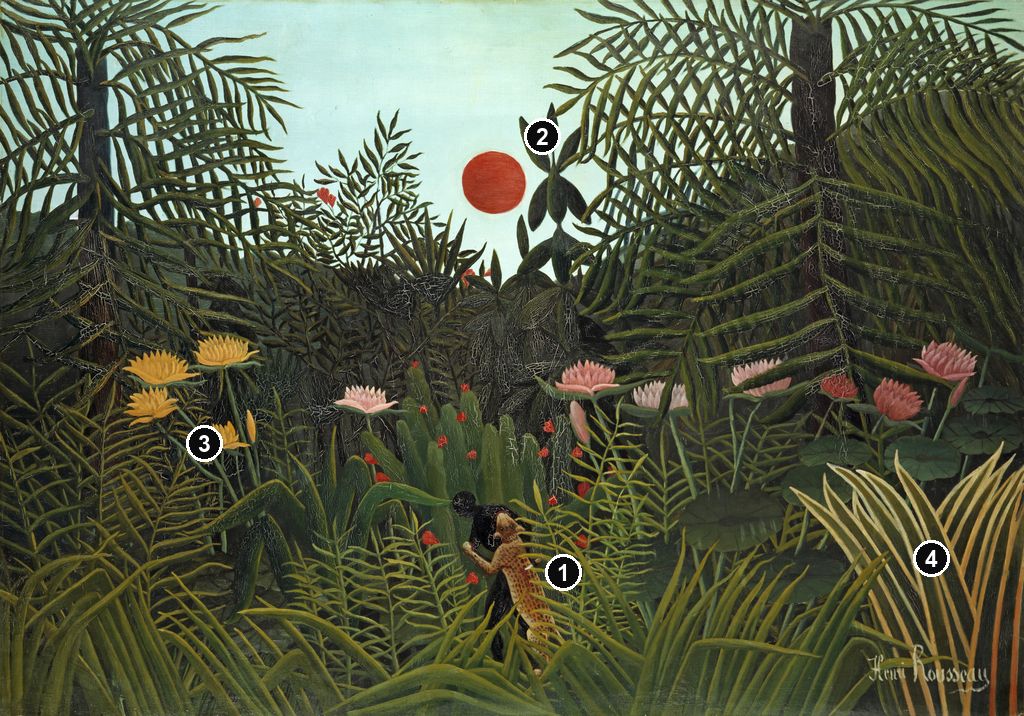
A red sun hangs above a forest so thick that its smallest drama is easy to miss. Near the bottom of Henri Rousseau’s Jungle Sunset, a man and a spotted cat struggle among the leaves. Huge flowers rise above them; palms close around the sky. The picture belongs to the Kunstmuseum Basel, which dates it to about 1910. The bright circle catches the eye before the dangerous encounter emerges from the green.[1]
At a Glance
- ArtistHenri Rousseau
- SubjectJungle Sunset
- ExploreThe painting in Basel; A sun held inside the leaves
This work across Henri Rousseau’s career
Carnival Evening
1886 [2]The Merry Jesters
1906 [7]The Snake Charmer
1907 [8]Contents
- The painting in Basel
- A sun held inside the leaves
- How the forest builds its depth
- Flowers larger than the danger
- Discovering the man and the cat
- An imagined jungle and a proposed photograph
- From private collections to Basel
- Annotated details
The painting in Basel
The museum calls the work Urwaldlandschaft mit untergehender Sonne. It also appears in English as Forest Landscape with Setting Sun, the title used in the 1985 Rousseau exhibition catalogue. Both names belong to the composition with a red sun above yellow and pink flowers and a small confrontation below. The canvas is a broad horizontal rectangle, measuring 113.6 × 162.3 cm according to the museum’s current collection highlights.[1][12]
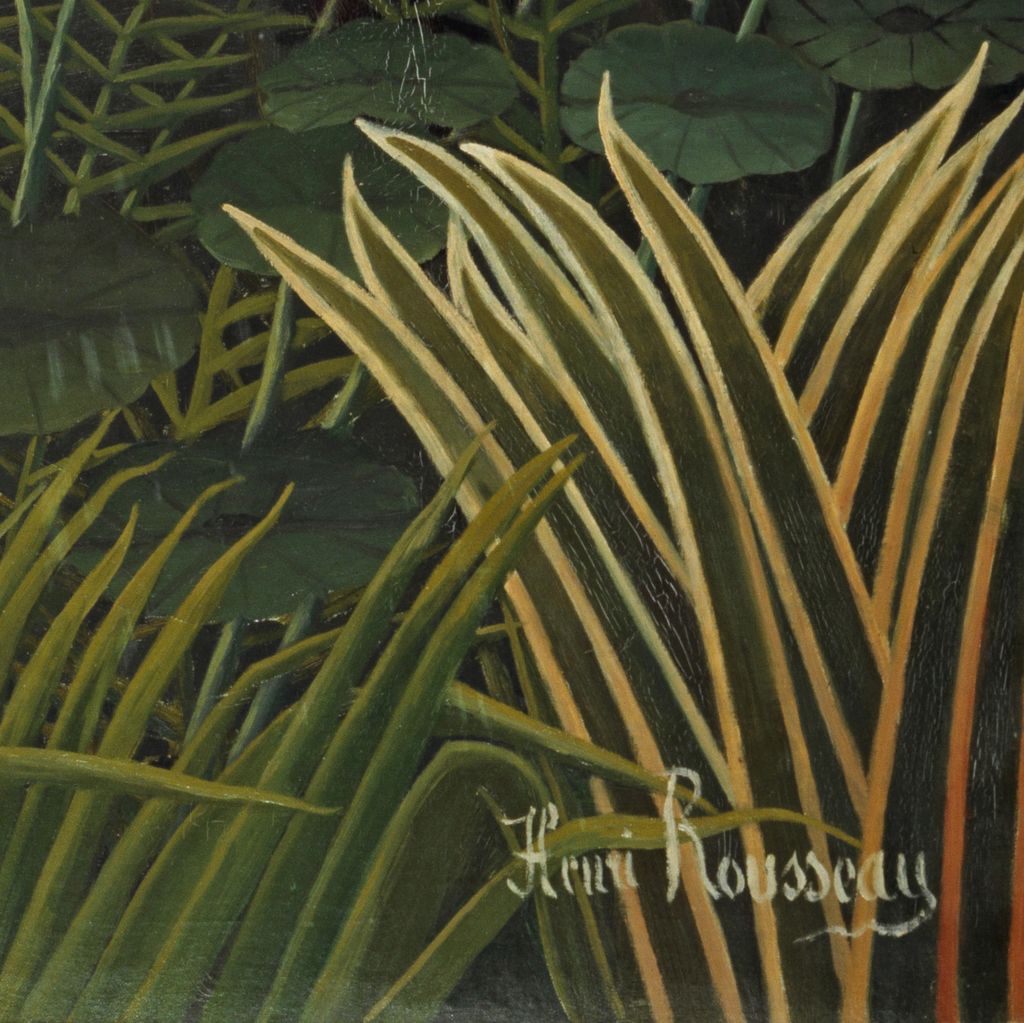
Rousseau painted it in oil on canvas. A light signature sits low on the right, threaded into the pointed leaves. The museum’s present dimensions differ from the 116 × 162.5 cm given in the older catalogue. Both sources date the painting to around 1910.[1][12]
A sun held inside the leaves
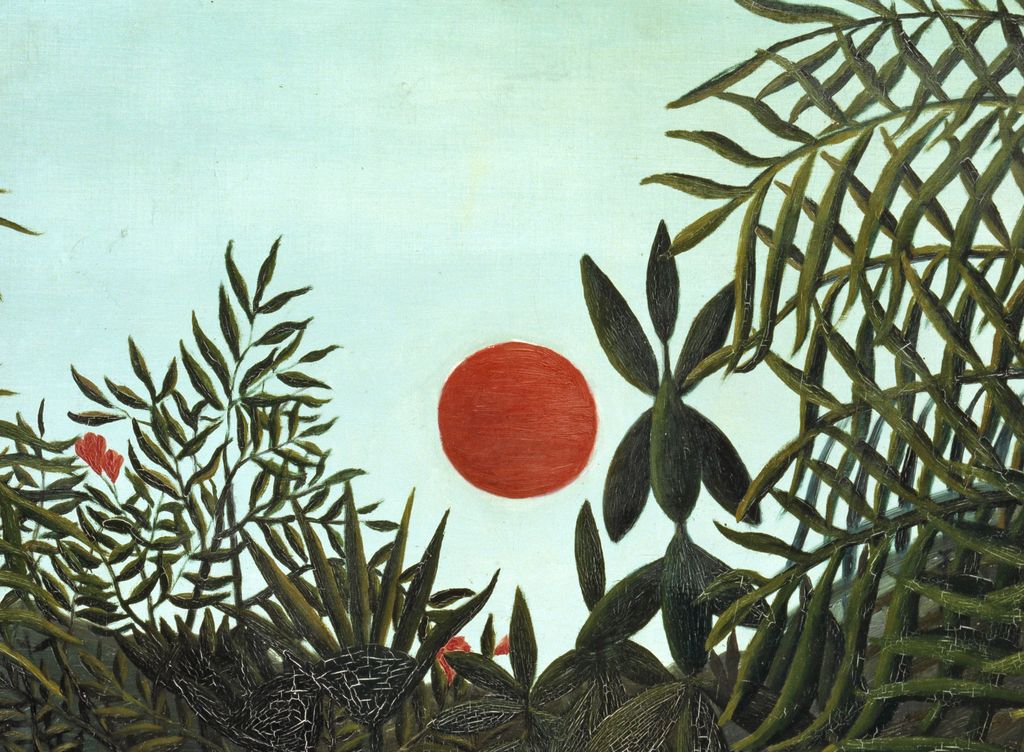
The sun is remarkably simple beside everything surrounding it. Its round red surface has little internal variation in the museum’s reproduction. Against the pale sky, that compact patch of colour can be taken in immediately. The foliage requires a slower kind of attention: individual leaflets, crossing stems, overlapping blades and separate flower heads compete for recognition. One shape arrests the eye; hundreds of smaller shapes hold it.
The opening is widest at the top. On either side, fronds lean inward, while smaller pointed leaves rise towards the sun from below. Their silhouettes enclose the sky like an irregular window. The sun sits a little left of the picture’s centre, balanced by the strong dark growth to its right. It appears suspended within that leafy surround. There is no long, open horizon leading the eye away into a distant landscape.
Below, the man and animal occupy roughly the same central region. Michel Hoog, writing the 1985 catalogue entry, draws attention to the organising relationship between the sun and the struggle, and to the composition’s tendency towards symmetry.[12] The alignment gives the small figures a place within the whole painting even before their action is clear. Yet the balance remains uneven enough to invite looking across the surface: yellow flowers cluster on one side, pink ones spread more widely on the other, and the largest pale blades gather at the lower right.
How the forest builds its depth
The plants form a succession of screens. Broad curved leaves stretch across the foreground. Beyond them come slender upright stems and their regularly spaced leaflets; farther back are flat green lobes dotted with red flowers. Darker masses and tree trunks carry the forest upwards, where fine fronds spread against the sky. These layers provide intervals through which the eye can move, although they leave very little empty ground.
A leaf often overlaps the next plant without opening a clear path between them. The foreground therefore feels close to the viewer, almost within reach, while the space behind it remains difficult to enter. The tiny figures seem caught inside this arrangement. Their bodies are visible in fragments between stems, and the long green forms crossing below them prevent the encounter from becoming a neatly isolated scene.
Hoog describes an arrangement of planes and a downward progression towards darker greens.[12] That observation helps explain why the forest has depth despite the insistently clear outlines of its separate parts. Some plants have a similar size and shape wherever they occur; differences of tone and overlap do much of the work of distinguishing one layer from another. The result is a dense space whose construction remains visible.
Different kinds of leaves establish different rhythms. The tall fronds have fine, almost comb-like divisions. The low broad leaves bend in slower arcs. At the right, long pale edges form a conspicuous fan, drawing light into the darkest part of the picture. Hoog compares those yellow-green plants with foliage occupying a similar position in The Snake Charmer.[12] His comparison offers a useful way to follow Rousseau’s reuse of plant forms while noticing the work each cluster performs in its particular setting.
Flowers larger than the danger
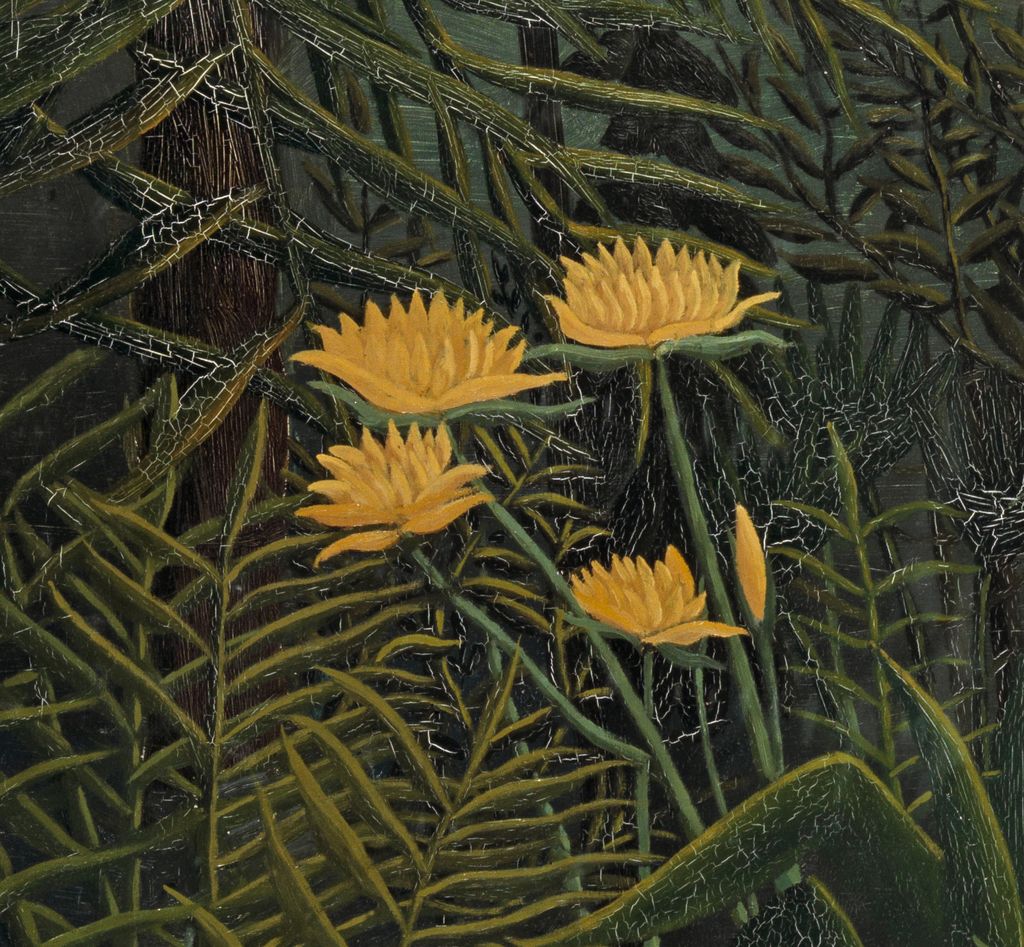
The flower heads run across the middle of the forest like a scattered band of colour. Yellow blooms gather at the left; pink and pale pink blooms extend towards the right. Between them, small red flowers punctuate the upright green lobes. Their red connects visually with the sun, bringing its isolated colour down into the crowded vegetation.
The flowers are startlingly large beside the man. Some open heads appear broad enough to rival his upper body. Their exaggerated scale makes the forest feel abundant and the encounter beneath them vulnerable. A viewer can enjoy the repeated petals and carefully separated stems before recognising what is happening lower down. That delay is part of the picture’s unsettling effect: beauty occupies far more space than the violence it surrounds.
Hoog likewise emphasises the oversized flowers and their central placement.[12] They help organise a painting in which there is otherwise no broad clearing to divide one region from another. Moving between the yellow group, the central red accents and the pink group gives the eye a route across the canvas. Following the stems downward then brings it towards the figures. Colour becomes a guide through the forest, even as the leaves obstruct the imagined passage of a body.
Discovering the man and the cat
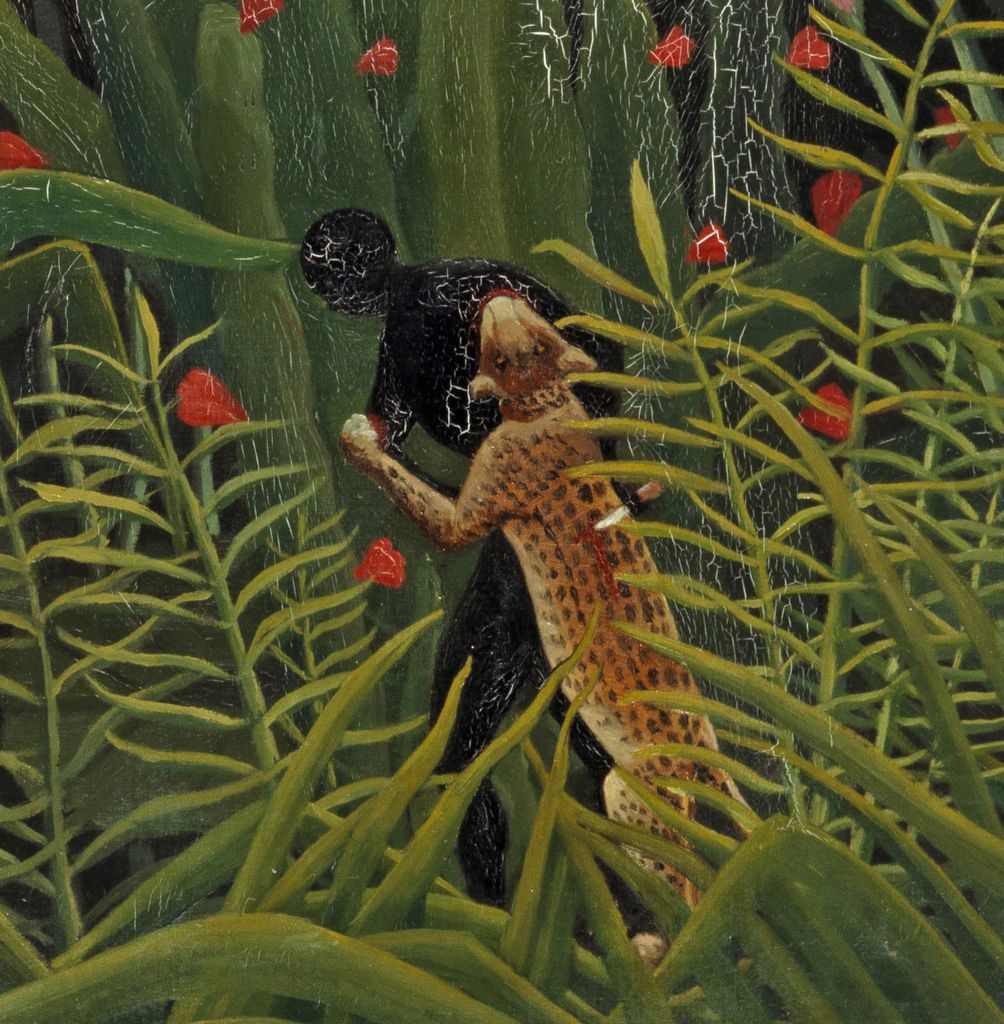
The animal rises almost upright, showing a pale spotted flank. The man bends his dark head forward; his upper body meets the animal at close quarters. Leaves surround their legs and cut across the space below. Their small size makes the action unusually intimate for something that could have dominated a whole painting. There is no assembly of spectators and no open stage around the pair.
Hoog identifies the animal as a jaguar and describes the man stabbing it with his left hand, with blood visible on the beast.[12] That account supplies a more specific reading of the struggle than a small reproduction can securely establish by itself. The visible encounter is clear; the exact gesture calls for closer attention. The cat’s elongated spotted body is easier to distinguish than the small details of the man’s hand.
Its upright posture also creates an unexpected visual resemblance between the two opponents. Both are caught among vertical stalks, their bodies pressed together inside a narrow gap. Around them the foliage continues its orderly patterns. The flowers do not bend towards the action, and the sun offers no obvious response. For a viewer, that imbalance can make the forest seem indifferent to the struggle. It is an effect of scale and arrangement, rather than evidence of a recorded programme Rousseau set out to illustrate.
Annotated Details from Jungle Sunset
The numbered points identify visible features discussed in this article. Return from each detail to the whole composition. Henri Rousseau, Forest Landscape with Setting Sun (Jungle Sunset), c.1910. Kunstmuseum Basel, inventory 2225. Image via Wikimedia Commons; Kunstmuseum Basel, Martin P. Bühler. Image source. Public domain. Numbers added to a separate resized overview. Four details cropped directly from the 300 dpi published original without enlargement, sharpening, recolouring, cleaning or retouching.
Details from JUNGLE SUNSET
Find the small struggle, return to the red sun, then compare the oversized flowers with the pale fan of leaves at the lower right.
A man and a spotted cat among the stems
The figures meet in a narrow opening within the plants. The cat’s pale spotted body stands against the dark man, while surrounding stems and broad leaves interrupt the space around their legs.
The red sun inside a leafy opening
A simple red circle stands clear against the pale sky. Fine fronds and pointed leaves close around the opening, setting the sun’s compact shape against the forest’s many smaller divisions.
Yellow flowers stand above the fronds
Large yellow heads spread above thin stems and divided green fronds. Their open petals introduce a broad, bright rhythm within the more tightly repeated leaf patterns.
Pale edges gather in a lower-right fan
Long pale borders trace the upward sweep of the leaves. Repeated bends create a bright fan within the darker foreground, while broader green forms cross below and beside it.
An imagined jungle and a proposed photograph
The catalogue proposes a concrete source for the rearing jaguar: a photograph in Bêtes sauvages, an album issued by the Galeries Lafayette around 1910. According to Hoog, the photograph showed the animal rising at its trainer, whose lowered head provided a further parallel with the painted man.[12] The proposed connection concerns a pose and gesture; it leaves open how extensively Rousseau transformed the photographic scene.
The proposal is valuable because it directs attention to the construction of the encounter. A photographed performance could provide a pose that acquired a different setting and emotional force inside Rousseau’s vegetation. The small human figure would then belong to a scene assembled from more than one kind of visual material. The account does not establish a witnessed battle in a particular forest, and the painting supplies no secure geographical location.
The Musée de l’Orangerie’s 2026 exhibition text places Rousseau’s jungle imagery within resources available in Paris: botanical glasshouses, natural-history displays, illustrated newspapers and the exotic imagery circulated through colonial exhibitions.[13] That broader context leaves room for close observation and imaginative combination. In Jungle Sunset, finely differentiated plants coexist with flowers on a startling scale and figures compressed into a small patch of space. Each element may be legible on its own while their assembly creates a forest that feels governed by the picture’s needs.
From private collections to Basel
The 1985 catalogue lists an earlier ownership sequence through A. Flechtheim in Düsseldorf, Mendelssohn-Bartholdy in Berlin and Dr Charles Bernoulli in Basel. It also records a Berlin exhibition in 1926, where the painting appeared as number 28.[12] These entries trace part of its movement through European collections, although the abbreviated provenance leaves the dates of individual transfers unspecified. Its ownership history includes gaps that this short list cannot resolve.
The museum’s own later documentation makes the acquisition more precise. A German decision published by the Kunstmuseum Basel and its Kunstkommission in December 2023 states that the museum purchased Urwaldlandschaft mit untergehender Sonne in December 1948 through Feilchenfeldt and Bernoulli for 105,000 Swiss francs. It identifies the painting as inventory number 2225. The passage cites museum commission minutes from November and December 1948.[14] The current collection highlights independently give 1948 as the acquisition year.[1]
This documented history anchors the painting in Basel while its composition continues to withhold an easy narrative resolution. The eye can return to the bright sun after discovering the struggle and find that the red circle has changed in feeling. Its shape remains calm and complete; below it, the figures are caught in an unfinished action. Across the canvas, the patient repetition of leaves holds those two experiences together. Among Rousseau’s jungle paintings, this is a scene in which the forest controls how much of the human drama we see, and how slowly we discover it.
Henri Rousseau artworks directory
This directory brings together works covered on this site and other works documented in the cited museum records and catalogues. Alternate titles share one entry; distinct versions remain separate. Historical dates for works without an article follow the cited catalogues. This is not a catalogue raisonné.
Frequently Asked Questions
Kunstmuseum Basel dates it to about 1910. The qualification matters: the museum does not give a firmly established single year.[1]
It belongs to the Kunstmuseum Basel. The museum’s current dimensions are 113.6 × 162.3 cm. It is an oil painting on canvas.[1]
A man struggles with a rearing spotted cat. Michel Hoog’s catalogue entry identifies a jaguar and reads the action as the man stabbing the animal. The encounter is small within the much larger expanse of plants.[12]
Discussion
Look again at the images and ideas explored in Jungle Sunset. These editorial prompts invite your observations.
Reader Insights
What did you notice first: the sun, the flowers or the figures? How did discovering the struggle change the rest of the painting?
Which overlaps make the forest feel deep, and which plant shapes keep your attention on its surface?
How would the picture’s mood change if the man and animal were twice their present size?
Join the Conversation
Share a detail, comparison or question about Jungle Sunset below.
References
- Kunstmuseum Basel. Collection highlights: Henri Rousseau, Urwaldlandschaft mit untergehender Sonne, current Rousseau caption and accompanying image, accessed 23 October 2026. View source. (in German).
- Philadelphia Museum of Art, Carnival Evening,1963-181-64,object59593. View source.
- Musée de l’Orangerie / Juliette Degennes, Henri Rousseau,L’ambition de la peinture: Un artiste dans son époque (in French). View source.
- National Gallery, Surprised!, NG6421. View source.
- Musée d’Orsay, La Guerre,RF19461 (in French). View source.
- MoMA, The Sleeping Gypsy. View source.
- Philadelphia Museum of Art, The Merry Jesters, 1950-134-176, object51097. View source.
- Musée d’Orsay, La Charmeuse de serpents, RF 1937 7 (in French). View source.
- Musée de l’Orangerie, La Carriole du Père Junier, RF 1960 26 (in French). View source.
- Solomon R. Guggenheim Museum / Cornelia Lauf, The Football Players,60.1583: current collection record. View source.
- MoMA, The Dream, 252.1954. View source.
- Michel Hoog. “Forest Landscape with Setting Sun,” entry 63, in Henri Rousseau, Museum of Modern Art, 1985, printed pp. 242–244 (PDF pp. 245–247); plate p. 243, provenance and exhibition list p. 244. View source.
- Musée de l’Orangerie. Henri Rousseau, l’ambition de la peinture, exhibition texts, 25 March–20 July 2026, section “Un style à soi.” View source. (in French).
- Kunstmuseum Basel / Kunstkommission. German decision of 19 December 2023, p. 30 and footnote 104, acquisition of Urwaldlandschaft mit untergehender Sonne, inventory 2225. View source. (in German).
- The Museum of Modern Art, Henri Rousseau: Essays (1985), selected catalogue entries, chronology and notes on early devotees. View source. Selected entries, chronology (pp.91–95) and early-devotee notes (pp.262–264) were consulted. Historical collection credits do not establish present ownership.
- Daniel Catton Rich, Henri Rousseau (The Museum of Modern Art, 1942), selected drawings and landscape studies; historical catalogue. View source. The dated 1942 publication is used for the two Quai d’Auteuil ink views; its Malakoff date differs from the 1985 catalogue.
- MANAS, Laval, Henri Rousseau, dit le Douanier, urban landscapes and preparatory study (in French). View source.
- National Gallery of Art, Self-Portrait (1895), pen-and-ink drawing, accession 1995.47.66. View source.
- The Museum of Modern Art, War (published January 1895), lithograph, accession 684.1943. View source.
- Barnes Foundation, Landscape and Four Young Girls, object 5521, BF855. View source.


 Henri Rousseau.jpg)


 Henri Rousseau.jpg)