


 by Tom Gurney
Tom Gurney BSc (Hons) is an art history expert with over 20 years experience
Published on June 19, 2020 / Updated on October 29, 2026
Email: tomgurney1@gmail.com / Phone: +44 7429 011000
Jungle: Introduction
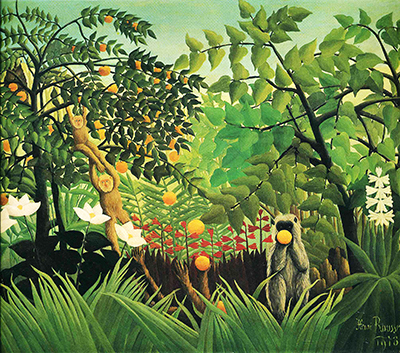
Oranges glow among the leaves of Henri Rousseau’s Jungle. Monkeys stretch through the branches, a pair of hands rises from the grass, and a large grey animal holds a fruit against its dark face. The painting is identifiable as the Exotic Landscape dated 1910 and reproduced under that title in the Museum of Modern Art’s 1942 Rousseau catalogue.[1] Small acts of play unfold inside an immense screen of plants.
The Norton Simon Museum’s current collection record confirms the painting as Exotic Landscape, dated 1910. It gives the medium as oil on canvas, the dimensions as 130.2 × 162.6 cm and the accession number as F.1971.3.P, with the credit The Norton Simon Foundation. Its provenance records the Foundation’s purchase at Sotheby’s in New York on 21 October 1971, lot 90.[2]
At a Glance
- ArtistHenri Rousseau
- SubjectJungle
- ExploreA title and a painted world; Following the oranges
This work across Henri Rousseau’s career
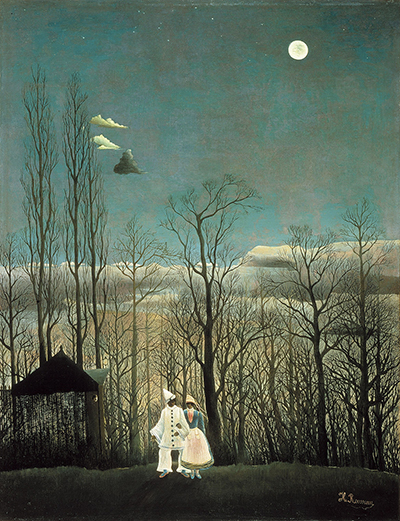
Carnival Evening
1886 [3]The Merry Jesters
1906 [8]The Snake Charmer
1907 [9]Contents
- A title and a painted world
- Following the oranges
- Leaves that make the space
- Play within an enclosed forest
- A forest imagined in Paris
- Annotated details
A title and a painted world
The short title Jungle describes the setting; Exotic Landscape connects this particular arrangement with its published history. In 1942 Daniel Catton Rich’s catalogue reproduced this horizontal composition with a caption giving the date as “1910 (dated),” the medium as oil and the dimensions as 51 × 64 inches. It identified the collection as that of Colonel Robert R. McCormick. The caption records its place in the McCormick collection in 1942.[1]
A second useful identification appears in MoMA’s 1985 Rousseau catalogue. Discussing another monkey painting, the text compares it with an Exotic Landscape, catalogue number DV 252, of the same size, whose monkeys play with oranges in the trees. The collection named there is the Norton Simon Foundation, Los Angeles. The orange play is a particularly useful distinguishing feature: a general title such as Jungle could fit many Rousseau paintings, whereas this combination of title, size and action connects the description to the image.[14]
The arching tree supports the monkeys’ bodies, and the grass conceals them. Almost every part of the setting helps shape their activity. There is little unoccupied ground and no broad view into the distance. We stand close to a wall of growth, looking for inhabitants in the gaps.
Following the oranges
The eye finds the fruit before it resolves every animal. Small orange circles shine through the dark upper branches on the left. Larger circles descend towards the centre and lower edge, where fruit is held close to bodies or lifted above the grass. Against the many greens, these warm spots are exceptionally easy to follow. They turn an otherwise crowded scene into a sequence of small discoveries.
On the left, two yellow-brown monkeys hang along the curving diagonal of a tree. Their pale faces stand out, although their slender limbs can be harder to disentangle from the branches. The upper figure stretches upwards; the lower one extends through the foliage beneath it. Their long arms repeat the tree’s curves, so that the same kind of line can belong to a plant or an animal. This visual kinship helps the monkeys seem at home in the thicket even when their poses look improbable.
The central foreground introduces a different kind of presence. Two arms reach out of the grass, one lifting an orange. The rest of the body remains screened. Because we cannot see the whole creature, the gesture becomes the subject: a hand, a round fruit and an upward reach. The concealment adds humour, but also slows our reading. We have to assemble the scene from fragments instead of counting a row of plainly displayed animals.
At the lower right, the grey figure provides a heavier, quieter counterpart to the hanging monkeys. Its broad body sits behind the pointed leaves, and an orange is held close to its mouth. The dark face and pale surrounding fur make a strong contrast within the figure itself. Its near-vertical posture steadies the composition against the diagonal movement on the opposite side. The tree and suspended bodies pull the eye upwards and left; this substantial animal brings it back down.
A small dark face also peers through the upper-left foliage. It can easily be missed among the dark branches and leaf shadows. Rousseau varies the degree of visibility from one figure to another: a face without a clear body, elongated hanging bodies, hands without a visible owner, and the more exposed grey animal. The pleasure of finding them belongs to the painting’s construction. The plants actively determine what we can see.
Annotated Details from Exotic Landscape (Jungle)
The numbered points identify visible features discussed in this article. Return from each detail to the whole composition. Henri Rousseau, Exotic Landscape, 1910. The Norton Simon Foundation, F.1971.3.P; Norton Simon Museum. Image via Wikimedia Commons; listed source: 1000 Museums. Image source. Public domain. Numbers added to a separate resized overview. Four details cropped directly from the 300 dpi published original without enlargement, sharpening, recolouring or retouching.
.jpg)
Details from EXOTIC LANDSCAPE (JUNGLE)
Follow the hanging bodies and the partly hidden hands, then compare the grey fruit-holder with the pale flowers at the right edge.
Two monkeys hang between branches
The monkeys’ long arms and suspended bodies follow the curving lines of the tree. Their pale faces emerge from the smaller dark leaves, while oranges repeat the warm colour of the surrounding bodies.
 Detail 01 two-monkeys-hang-between-branches.jpg)
Hands and fruit rise above the grass
Pointed blades conceal the body beneath these raised arms. A round orange stands clear of the spread fingers, concentrating attention on the gesture and the small interval around the fruit.
 Detail 02 hands-and-fruit-rise-above-the-grass.jpg)
A grey figure holds an orange at its mouth
The broad grey body provides a quieter, heavier presence beside the hanging monkeys. Pale fur surrounds a dark face, and the bright orange makes the mouth the centre of attention.
 Detail 03 a-grey-figure-holds-an-orange-at-its-mouth.jpg)
A white flower spike among broad leaves
The tall white cluster interrupts the greens near the right edge. Its repeated pale forms climb beside a dark trunk, contrasting with the large leaves spreading across the upper growth.
 Detail 04 a-white-flower-spike-among-broad-leaves.jpg)
Leaves that make the space
The foreground is a dense fan of pointed green blades. Some rise almost straight; others bend and cross, forming a serrated barrier along the bottom of the picture. Fine lines run along their surfaces, giving them a directional pull towards their tips. They hide the animals’ lower bodies and deny us a simple patch of ground on which to place them. We can recognise a foreground through overlap, while finding it difficult to judge how far anything stands behind it.
Above this barrier, a band of slender red flowers travels across the middle of the painting. Their repeated upright stems and small red shapes interrupt the larger green masses. They also bring the two halves of the canvas into relation: the monkeys on the left and the grey figure on the right share a floral backdrop. The red is less commanding than the oranges, but its repetition carries the eye sideways through the scene.
The pale flowers offer another contrast. Broad cream blooms open near the lower left, while a tall white flower spike rises close to the right edge. Their clean, light shapes are easy to distinguish against the surrounding greens. The left flowers spread outwards; the right cluster climbs. These different directions make them useful visual markers in a forest whose leaves otherwise overlap almost continuously.
The upper growth changes character as we move across it. On the left, small leaves and nearly black branches form a fine, restless mesh around the oranges and monkeys. On the right, much larger yellow-green leaves spread along darker stems. The change of scale gives the two sides distinct textures. It also prevents the vegetation from becoming an even pattern: the eye alternates between picking through many small shapes and taking in a few broad ones.
Only narrow fragments of pale blue-green sky remain between the upper leaves. Those openings give the canopy an outer edge, but they offer little escape from the enclosure below. Much of the painting’s space is made by one shape covering another. A dark stem crosses a light leaf; a flower cuts across a trunk; a pointed blade hides a body. Looking into this jungle means following those overlaps. Its depth is felt as successive layers, each carefully visible, rather than as a clear route leading towards a horizon.
Play within an enclosed forest
The oranges connect the animals through a shared activity, yet the painting leaves the precise story open. A raised fruit might be offered, caught or displayed. The hanging figures could be reaching towards it or attending to fruit elsewhere in the tree. We can enjoy the suggestion of a game without deciding that Rousseau has illustrated a particular instant with a fully recoverable sequence of actions.
There is an engaging tension between this lively activity and the plants’ stillness. Arms stretch and bodies hang, while each leaf holds its place in an intricate arrangement. The animals are absorbed into the same repeated curves and upright accents as the vegetation, but the bright fruit keeps their actions legible. The scene invites a leisurely search, with another hand or face emerging as we return to an area already examined.
This is one reason the 1985 catalogue’s comparison with Tropical Forest with Monkeys is useful. The authors describe the two paintings as similar in spirit and equal in size, specifically identifying the orange-playing monkeys in Exotic Landscape. The comparison appears within their discussion of Rousseau’s more peaceful jungle scenes.[14] Here, the close contact between animals and vegetation sustains play and concealment.
A forest imagined in Paris
Rousseau’s resources for imagining such worlds included the tropical glasshouses and natural-history collections of Paris, alongside press illustrations and the exotic imagery circulating through French colonial exhibition culture. The Musée de l’Orangerie’s 2026 exhibition account places these sources behind his jungle repertoire and describes his late variations between scenes of combat and quieter forests inhabited by mischievous monkeys.[15] That context suits this picture’s combination of recognisable forms and invented relationships.
It does not identify a particular model for every leaf or animal here. The canvas itself offers the more immediate explanation of its effect: plants of emphatically different sizes have been brought into a continuous enclosure, and the monkeys’ gestures have been fitted through it. A large leaf can rival an animal’s body, while an orange can command attention across a considerable stretch of green. Scale serves the clarity of the arrangement and the rhythm of looking.
Even the smallest openings matter. A gap between leaves makes room for a face; a break above the grass lets a hand emerge. We become alert to the dark spaces as well as the bright shapes. The orange held at a mouth and the orange lifted into the air keep directing us back to the forest’s concealed inhabitants.
Henri Rousseau artworks directory
This directory brings together works covered on this site and other works documented in the cited museum records and catalogues. Alternate titles share one entry; distinct versions remain separate. Historical dates for works without an article follow the cited catalogues. This is not a catalogue raisonné.
Frequently Asked Questions
The painting was reproduced as Exotic Landscape, “1910 (dated),” in MoMA’s 1942 catalogue. The date also appears beside Rousseau’s signature at the lower right.[1]
They hang among branches and hold oranges. MoMA’s 1985 catalogue identifies the composition as one in which monkeys play with oranges in the trees. Some bodies are hidden, so individual gestures are easier to recognise than a complete sequence of action.[14]
They are separate works. The 1985 catalogue discusses Tropical Forest with Monkeys as DV 253 and compares it with this Exotic Landscape, DV 252. The oranges distinguish the composition shown here.[14]
Discussion
Look again at the images and ideas explored in Jungle. These editorial prompts invite your observations.
Reader Insights
Which do you notice first: the monkeys, the oranges or the flowers? How does that first discovery guide your next look?
How does hiding most of an animal behind leaves change the mood of the painting?
What happens to the sense of movement if you follow the tree branches and the monkeys’ arms as one continuous pattern?
Join the Conversation
Share a detail, comparison or question about Jungle below.
References
- Daniel Catton Rich / Museum of Modern Art. Henri Rousseau, 1942, printed p. 72 (PDF p. 77), complete plate and caption for Exotic Landscape. View source.
- Norton Simon Museum, Exotic Landscape, 1910, F.1971.3.P, current collection record, “Details” and “Provenance”; accessed 24 October 2026. The museum image was compared with the composition reproduced in the historical catalogues. View source.
- Philadelphia Museum of Art, Carnival Evening,1963-181-64,object59593. View source.
- Musée de l’Orangerie / Juliette Degennes, Henri Rousseau,L’ambition de la peinture: Un artiste dans son époque (in French). View source.
- National Gallery, Surprised!, NG6421. View source.
- Musée d’Orsay, La Guerre,RF19461 (in French). View source.
- MoMA, The Sleeping Gypsy. View source.
- Philadelphia Museum of Art, The Merry Jesters, 1950-134-176, object51097. View source.
- Musée d’Orsay, La Charmeuse de serpents, RF 1937 7 (in French). View source.
- Musée de l’Orangerie, La Carriole du Père Junier, RF 1960 26 (in French). View source.
- Solomon R. Guggenheim Museum / Cornelia Lauf, The Football Players,60.1583: current collection record. View source.
- MoMA, The Dream, 252.1954. View source.
- Daniel Catton Rich, Henri Rousseau (The Museum of Modern Art, 1942), selected drawings and landscape studies; historical catalogue. View source. The dated 1942 publication is used for the two Quai d’Auteuil ink views; its Malakoff date differs from the 1985 catalogue.
- Museum of Modern Art. Henri Rousseau, 1985, catalogue entry 64, printed pp. 245–246 (PDF pp. 248–249), especially the comparative paragraph on Exotic Landscape, DV 252, printed p. 246. View source.
- Musée de l’Orangerie. Henri Rousseau, l’ambition de la peinture, exhibition texts, 25 March–20 July 2026, section “Un style à soi.” View source. (in French).
- The Museum of Modern Art, Henri Rousseau: Essays (1985), selected catalogue entries, chronology and notes on early devotees. View source. Selected entries, chronology (pp.91–95) and early-devotee notes (pp.262–264) were consulted. Historical collection credits do not establish present ownership.
- MANAS, Laval, Henri Rousseau, dit le Douanier, urban landscapes and preparatory study (in French). View source.
- National Gallery of Art, Self-Portrait (1895), pen-and-ink drawing, accession 1995.47.66. View source.
- The Museum of Modern Art, War (published January 1895), lithograph, accession 684.1943. View source.
- Barnes Foundation, Landscape and Four Young Girls, object 5521, BF855. View source.
 Henri Rousseau.jpg)
 Henri Rousseau.jpg)