


 Henri Rousseau.jpg)
 by Tom Gurney
Tom Gurney BSc (Hons) is an art history expert with over 20 years experience
Published on June 19, 2020 / Updated on October 29, 2026
Email: tomgurney1@gmail.com / Phone: +44 7429 011000
The Laundry Boat of Pont de Charenton: Introduction
A pale laundry boat occupies the left bank with the weight of a small public building. Its long grey roof slopes towards the water; dark upright stacks punctuate its silhouette. Across the river, a row of cream houses follows a strict horizontal line. Between these settled structures, a fisherman and tiny figures in boats seem to belong to different scales. Henri Rousseau’s The Laundry Boat of Pont de Charenton makes an ordinary riverside view quietly difficult to measure. The Barnes Foundation, which holds the painting, calls it The Great Laundry Boat at Charenton Bridge (Le Grand Bateau-Lavoir du Pont de Charenton).[1]
At a Glance
- ArtistHenri Rousseau
- Current museum titleThe Great Laundry Boat at Charenton Bridge (Le Grand Bateau-Lavoir du Pont de Charenton)
- Datec. 1897–1903
- MediumOil on canvas
- Dimensions46 × 55.4 cm
- CollectionBarnes Foundation, Philadelphia
- Inventory numberBF856[1]
This work across Henri Rousseau’s career
Carnival Evening
1886 [2]The Merry Jesters
1906 [7]The Snake Charmer
1907 [8]Contents
- A riverside view with a precise identity
- The laundry boat as a painted building
- Two banks and two ways into the picture
- The fisherman and the miniature company
- Dark water beneath an open sky
- Work and leisure on the same shore
- Annotated details
A riverside view with a precise identity
The Barnes dates this canvas to approximately 1897–1903. The date range acknowledges uncertainty about its execution; the dimensions establish a small, horizontal painting. Its expansive sky and long waterfront give an impression of breadth within those modest limits. The fuller museum title also identifies the large floating structure as the picture’s principal subject: a grand bateau-lavoir, or great laundry boat, associated with Charenton Bridge.[1]
The place-name gives the scene an anchor, although the painting offers its own arrangement of buildings, trees and water. Reading it begins with the relationships visible on the canvas. The laundry boat sits close to the viewer, the opposite bank stretches across the middle distance, and a mass of trees rises behind both. A tall smoking chimney appears among the greenery on the left. These distinct pieces make a place that feels inhabited and usable, even as the changes in scale prevent it from becoming an entirely straightforward prospect.
The laundry boat as a painted building
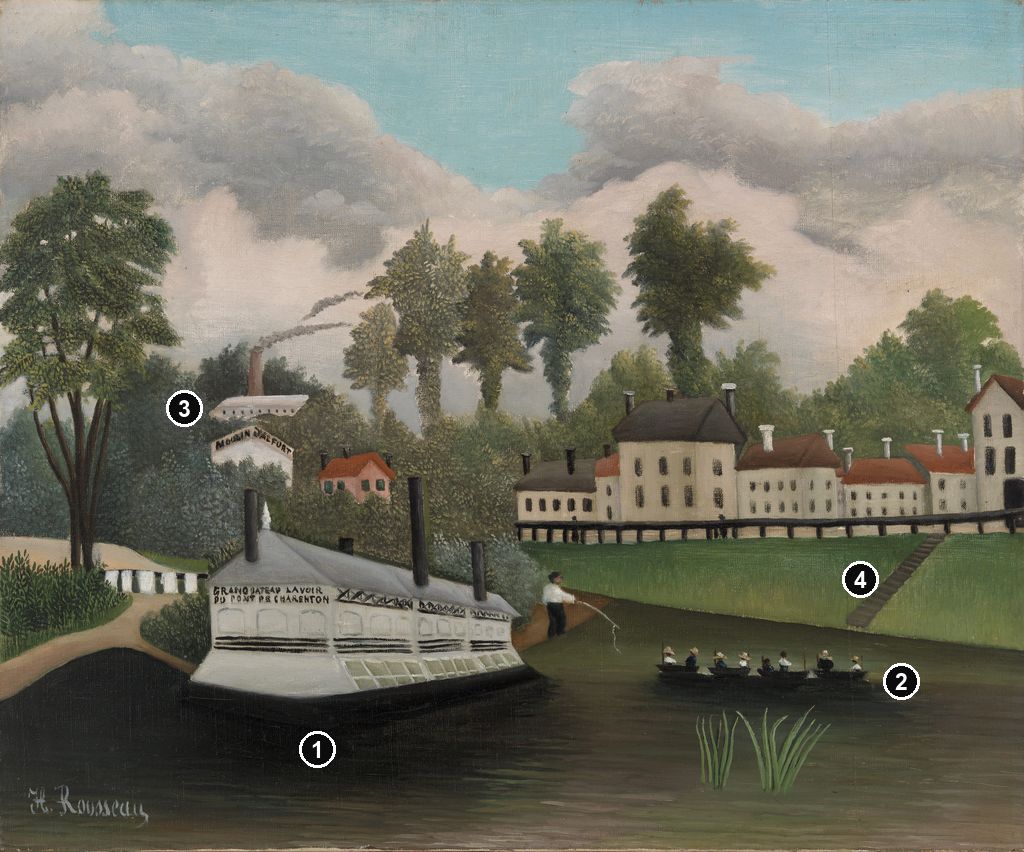
The boat is the largest single object in the lower half of the picture. Its light surfaces draw the eye immediately out of the dark water. Rousseau gives it a broad, low roof, then turns the front and side away from one another, so that the structure projects diagonally into the river. A dark hull underlines this pale mass. Along its near edge, sloping panels form a segmented apron above the water, each division contributing to the impression of something carefully assembled.
The front carries black lettering identifying the laundry boat and its connection with the Pont de Charenton. Beneath it, a sequence of shallow arched compartments establishes a slower, decorative rhythm. On the long side, dark openings or marks run below the roofline. Writing, repeated divisions and a pronounced silhouette give the vessel a character recognisable at a glance. The lettering sits prominently on the face presented to us, making its description part of its design.
Three tall, dark stacks rise against the trees and sky. Their emphatic verticals help the low vessel hold its own against the taller landscape behind it. The roof planes, meanwhile, do not dissolve into atmosphere. They remain firm grey shapes, with edges that make the laundry boat appear almost sculptural. Rousseau lets us see a floating object and a building at once. That slight ambiguity matters to the scene’s stability: the largest mass rests on water, while much smaller buildings line the solid bank beyond it.
Two banks and two ways into the picture
At the far left, a pale path curves beneath a group of tall trunks. Its bend takes the eye behind the laundry boat, towards a short striped barrier and the dense vegetation. The narrow path’s light colour makes it a clear route through the closely packed green. A small red-roofed house appears farther back, partly enclosed by foliage. Behind it, a white building bears the words Moulin à vapeur, with a chimney sending a thin stream of smoke across the sky.
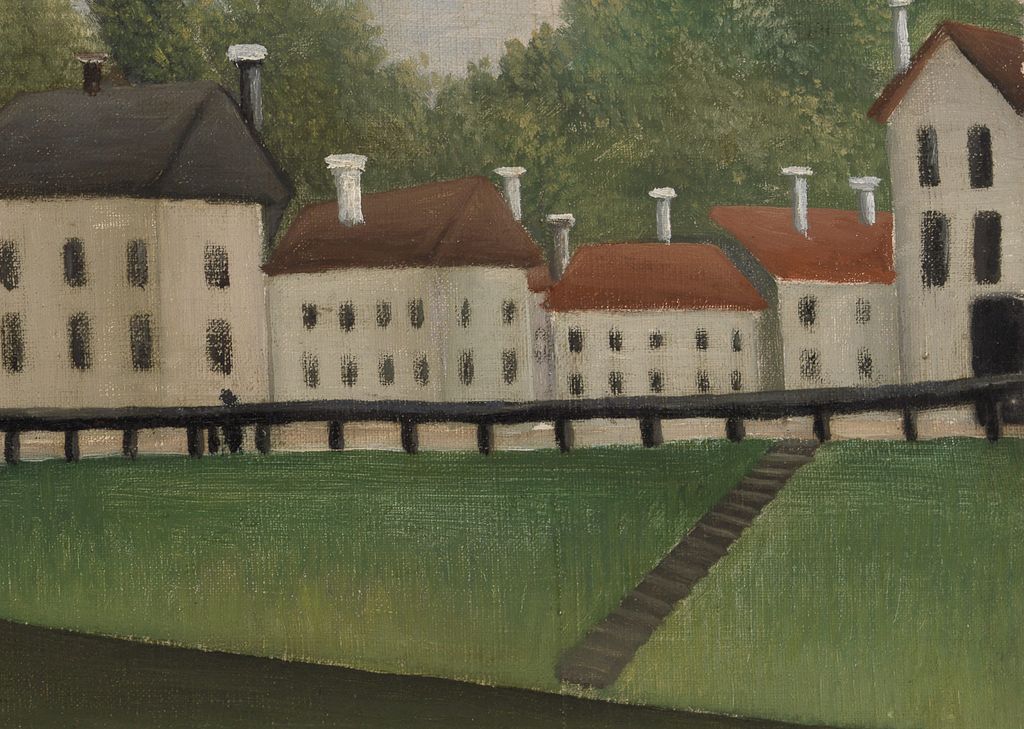
Across the water, the architecture follows a different order. Cream façades, rows of dark windows and red roofs form a continuous band. A taller central block with a dark roof interrupts the lower houses; at the far right, a white gable gives the sequence another upright accent. In front of these buildings, a long dark railing runs almost horizontally across the scene. Its repeated supports echo the repeated windows above, making the far bank feel ruled and measured.
A flight of steps cuts diagonally down the green slope on the right. It answers the curved path on the opposite side, offering a second imagined approach to the water. One route winds beneath trees; the other descends in a direct, stepped line. Neither contains a prominent pedestrian. Their usefulness is suggested by their shape, allowing the viewer to picture movement through a scene whose actual inhabitants are remarkably still.
The fisherman and the miniature company
Beside the laundry boat stands a figure in a pale shirt and dark trousers, holding a fishing rod over the water. The rod and line extend as fine, curving marks. His upright body provides a human measure against the vessel’s long roof and the bank behind him. Farther to the right, a small company occupies low dark boats. Pale faces, light shirts and hats pick out the figures, but their bodies remain tiny beside the man on the bank.
The Barnes specifically draws attention to this disparity. Its account describes the scene’s initial appearance as a simple view of a laundry boat and fishermen, then points out how strangely small the boat figures are in relation to the figure ashore.[1] Distance offers part of the visual explanation: the company sits farther across the water. Yet the difference remains conspicuous enough to unsettle the otherwise orderly arrangement.
The larger fisherman and the little group also encourage different kinds of looking. We can follow his gesture from shoulder to rod to line. The smaller figures register collectively, as a succession of pale touches above a nearly continuous dark shape. Their closeness to one another gives them the air of a procession passing through the still water. There is no need to assign each a separate occupation or story. The contrast between an individual action and a compact company already gives the painting a human rhythm.
Dark water beneath an open sky
The foreground water is brown-green and almost black beneath the laundry boat. Fine horizontal streaks break its surface. Reflections remain small and subdued, giving the floating building a dark foundation without producing a second, mirror-like version of it. The boats likewise merge with the surrounding shadow. They are clearest where their pale occupants rise above the hulls.
Two clumps of green reeds interrupt the lower centre-right. Their long blades curve upwards, opening into narrow fans. Placed so close to the picture’s edge, they seem unexpectedly large beside the distant people. They bring another shift of scale into the foreground and soften the water’s horizontal marks with thin, flexible arcs. The reeds, fishing line and drifting smoke are among the lightest forms in a composition dominated by solid blocks.
Above, blue sky appears between broad banks of white and grey cloud. The sky occupies a generous area, lifting the view beyond the tightly arranged shore. Rousseau varies the trees beneath it: some crowns spread broadly, others rise in slender clusters, and their trunks remain intermittently visible. The irregular foliage and cloud edges counter the ruler-like railing, façades and rooflines. Calm emerges from this balance of repeated structures and changing organic shapes, rather than from an absence of detail.
Annotated Details from The Laundry Boat of Pont de Charenton
The numbered points identify visible features discussed in this article. Return from each detail to the whole composition. Henri Rousseau, The Great Laundry Boat at Charenton Bridge (Le Grand Bateau-Lavoir du Pont de Charenton), c. 1897–1903. Barnes Foundation, Philadelphia, BF856. Museum-derived reproduction published on Wikimedia Commons in 2018. Image source. Public domain. Numbers added to the overview; details cropped from the published original. No recolouring or retouching.
Details from THE LAUNDRY BOAT OF PONT DE CHARENTON
Read the laundry boat’s front, compare the people’s scale, then look for the steam mill and the steps on the opposite bank.
A floating building with its own name
Black lettering identifies the laundry boat across its pale front. Firm roof planes, tall dark stacks and the segmented sloping apron make the vessel read as a carefully assembled building resting on water.
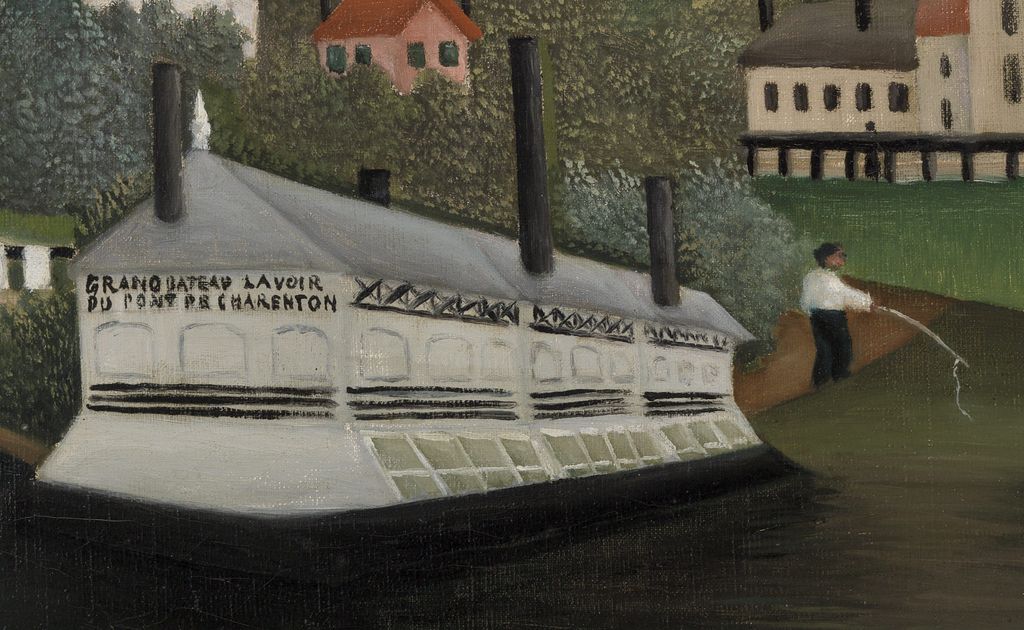
A fisherman and a miniature company
The figure ashore holds a fine rod and line beside the large vessel. The much smaller people in low dark boats gather into a compact band of pale faces, shirts and hats.
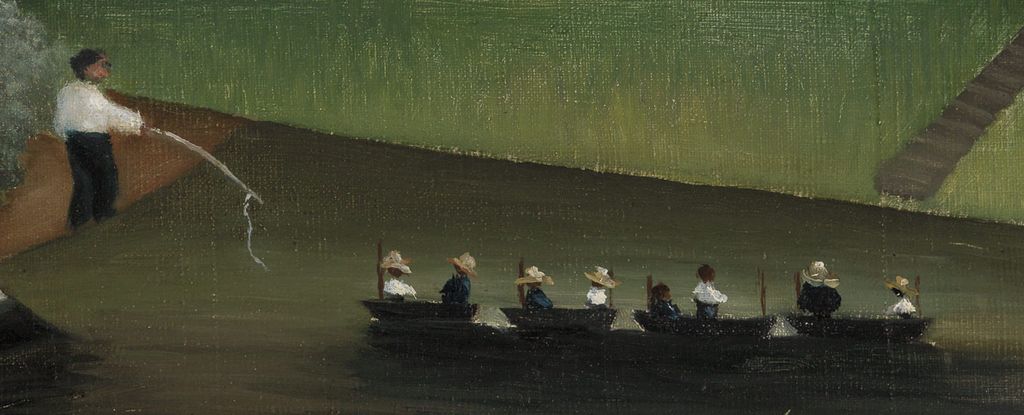
Steam-mill lettering and drifting smoke
The words Moulin à vapeur appear on a pale front among the trees. Above it, a tall chimney sends narrow smoke trails across the lighter sky, adding an industrial presence behind the riverbank.
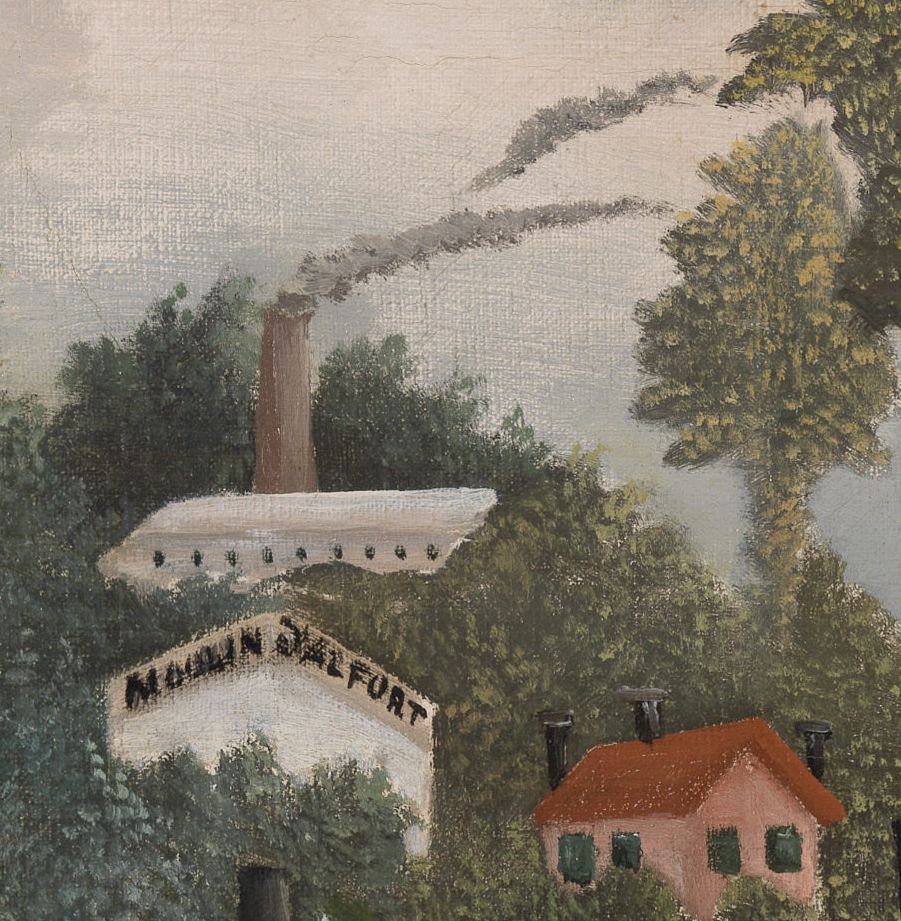
A measured bank and descending steps
Cream façades and repeated windows stand behind a long dark railing. Steps cut diagonally down the green slope, providing a direct route towards the water opposite the winding path on the left.
Work and leisure on the same shore
The scene places evidence of work beside the unhurried gesture of fishing. The laundry boat is named on its own façade; the building marked Moulin à vapeur and the smoking chimney introduce another industrial presence. Yet no washing activity is visible inside the vessel. The picture concentrates on the exterior form, the surrounding banks and the people on the water. Its title supplies a purpose for the floating structure without explaining its machinery or the lives of those who used it.
The Barnes places the painting among Rousseau’s views of ordinary Paris and its environs, observing that he favoured such subjects over celebrated attractions. It also connects the strangeness of these city scenes, alongside his imagined jungles, with the enthusiasm of the Parisian avant-garde.[1] This gives the canvas a useful place within Rousseau’s paintings: the familiar surroundings sustain the kind of visual surprise often associated with his more fantastic subjects. Here, that surprise begins with a laundry boat, a fisherman and a river whose distances remain gently elusive.
Henri Rousseau artworks directory
This directory brings together works covered on this site and other works documented in the cited museum records and catalogues. Alternate titles share one entry; distinct versions remain separate. Historical dates for works without an article follow the cited catalogues. This is not a catalogue raisonné.
Frequently Asked Questions
The Barnes Foundation currently dates it c. 1897–1903. The qualified range should be retained rather than replaced with a single exact year.[1]
It is in the Barnes Foundation, Philadelphia, under inventory number BF856. The museum’s full title is The Great Laundry Boat at Charenton Bridge (Le Grand Bateau-Lavoir du Pont de Charenton).[1]
They occupy a more distant part of the scene, but their difference in size from the fisherman ashore is unusually pronounced. The Barnes identifies this scale relationship as a source of the painting’s strangeness.[1]
Discussion
Look again at the images and ideas explored in The Laundry Boat of Pont de Charenton. These editorial prompts invite your observations.
Reader Insights
Which seems to establish the scene’s scale most strongly: the laundry boat, the fisherman or the foreground reeds?
Follow the path on the left and the steps on the right. How do these two routes change your imagined position beside the water?
How would the atmosphere change if the water reflected as much blue as the sky contains?
Join the Conversation
Share a detail, comparison or question about The Laundry Boat of Pont de Charenton below.
References
- Barnes Foundation. The Great Laundry Boat at Charenton Bridge (Le Grand Bateau-Lavoir du Pont de Charenton), current collection record BF856; title, date, medium, dimensions and short description, accessed 23 October 2026. View source.
- Philadelphia Museum of Art, Carnival Evening,1963-181-64,object59593. View source.
- Musée de l’Orangerie / Juliette Degennes, Henri Rousseau,L’ambition de la peinture: Un artiste dans son époque (in French). View source.
- National Gallery, Surprised!, NG6421. View source.
- Musée d’Orsay, La Guerre,RF19461 (in French). View source.
- MoMA, The Sleeping Gypsy. View source.
- Philadelphia Museum of Art, The Merry Jesters, 1950-134-176, object51097. View source.
- Musée d’Orsay, La Charmeuse de serpents, RF 1937 7 (in French). View source.
- Musée de l’Orangerie, La Carriole du Père Junier, RF 1960 26 (in French). View source.
- Solomon R. Guggenheim Museum / Cornelia Lauf, The Football Players,60.1583: current collection record. View source.
- MoMA, The Dream, 252.1954. View source.
- The Museum of Modern Art, Henri Rousseau: Essays (1985), selected catalogue entries, chronology and notes on early devotees. View source. Selected entries, chronology (pp.91–95) and early-devotee notes (pp.262–264) were consulted. Historical collection credits do not establish present ownership.
- Daniel Catton Rich, Henri Rousseau (The Museum of Modern Art, 1942), selected drawings and landscape studies; historical catalogue. View source. The dated 1942 publication is used for the two Quai d’Auteuil ink views; its Malakoff date differs from the 1985 catalogue.
- MANAS, Laval, Henri Rousseau, dit le Douanier, urban landscapes and preparatory study (in French). View source.
- National Gallery of Art, Self-Portrait (1895), pen-and-ink drawing, accession 1995.47.66. View source.
- The Museum of Modern Art, War (published January 1895), lithograph, accession 684.1943. View source.
- Barnes Foundation, Landscape and Four Young Girls, object 5521, BF855. View source.


 Henri Rousseau.jpg)


 Henri Rousseau.jpg)