



 by Tom Gurney
Tom Gurney BSc (Hons) is an art history expert with over 20 years experience
Published on June 19, 2020 / Updated on October 29, 2026
Email: tomgurney1@gmail.com / Phone: +44 7429 011000
Liberty Inviting Artists to Take Part in the 22nd Exhibition of the Société des Artistes Indépendants: Introduction
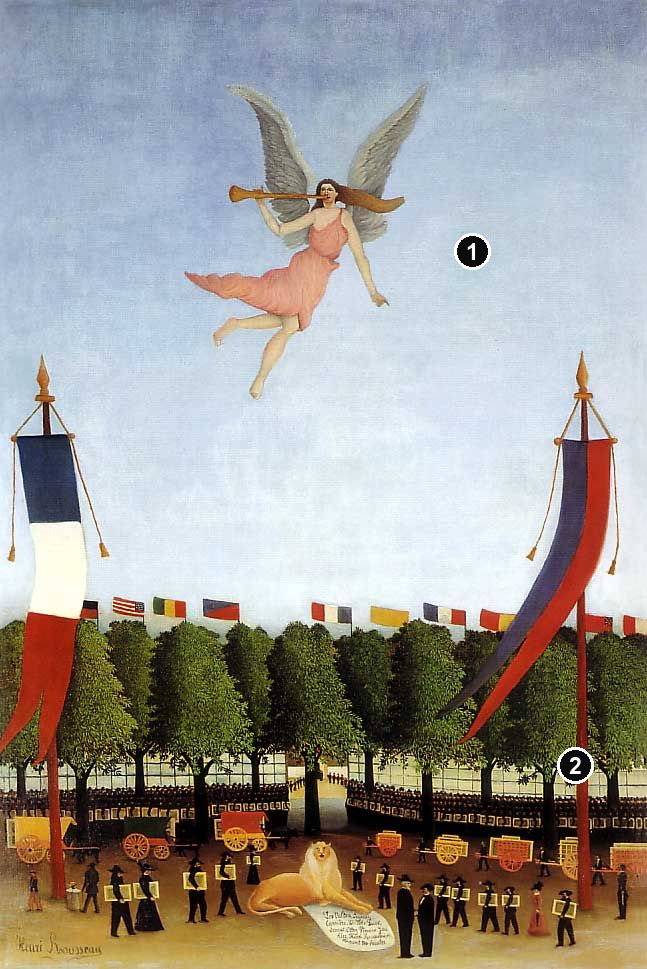
A winged woman blows a golden trumpet over a gathering of artists. Beneath her, pictures arrive under people's arms and in small wheeled carts, while a pale lion presides over the foreground. Henri Rousseau's Liberty Inviting Artists to Take Part in the 22nd Exhibition of the Société des Artistes Indépendants makes an exhibition opening into a public celebration. The oil painting dates from 1905–06 and belongs to the National Museum of Modern Art, Tokyo. Its tall canvas, 175 × 118 cm, gives an extraordinary amount of room to the sky and to the single airborne figure who announces the occasion.[1]
The invitation is enacted at several scales. Liberty sounds her call above the trees; large flags frame the assembly; an open entrance waits beyond the crowd. Near the lower edge, artists carry little rectangles that repeat the shape of the very painting we are looking at. The result brings the public language of monuments and allegory into contact with the practical business of getting a picture to an exhibition.
At a Glance
- ArtistHenri Rousseau
- SubjectLiberty Inviting Artists to Take Part in the 22nd Exhibition of the Société des Artistes Indépendants
- ExploreAn exhibition celebrates itself; The great open sky
This work across Henri Rousseau’s career
Carnival Evening
1886 [2]Liberty Inviting Artists to Take Part in the 22nd Exhibition of the Société des Artistes Indépendants (current article)
1905–1906 [1] [7]The Merry Jesters
1906 [8]The Snake Charmer
1907 [9]Contents
- An exhibition celebrates itself
- The great open sky
- Flags, trees and an open entrance
- A lion among the artists
- Liberty and the image of Fame
- From the 1906 Salon to Tokyo
- Annotated details
An exhibition celebrates itself
Rousseau painted the work during the winter of 1905–06 and exhibited it at the Indépendants in March 1906, according to the Tokyo museum's collection commentary. A painting that celebrates participation was therefore itself a participant in the event it names. The long title provides its occasion with unusual precision: this is an invitation to the society's twenty-second exhibition, rather than a general assembly of painters in an imaginary paradise.[7]
The society mattered to Rousseau's career. The 1985 Museum of Modern Art catalogue explains that the Salon des Indépendants had been created in 1884 as an open alternative for artists excluded from the official Salons. It reads this canvas as his tribute to an institution that had allowed his work to reach the public. Tokyo's commentary records his almost annual participation from 1886. Together, these accounts give the celebration a particular personal weight, while the painting itself presents that gratitude through a collective gathering.[13][7]
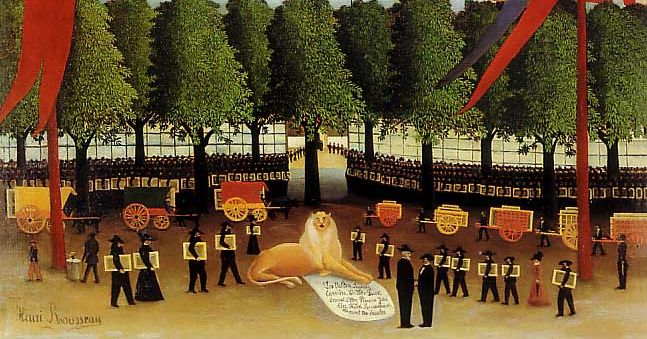
The carried pictures identify the crowd as artists before we know anything about the individual figures. Some canvases are carried upright against dark clothes, others held lower; carts stand behind the foremost figures. The MoMA catalogue notes that Rousseau himself had transported work by handcart on many occasions. That reported habit connects the humble vehicles with the artist's own experience, though the composition is much more arranged than an incidental record of an arrival.[13]
Several women appear among the contributors, a point also noticed in the catalogue. The figures are distributed in small groups, with gaps between them and differences of dress and bearing. These intervals give each encounter room within the assembly. Two prominent men pause together near the lion; further back, the carrying of canvases continues. Conversation, movement and waiting coexist. The exhibition emerges as a place people make together, through the accumulation of separate journeys and individual works.[13]
The great open sky
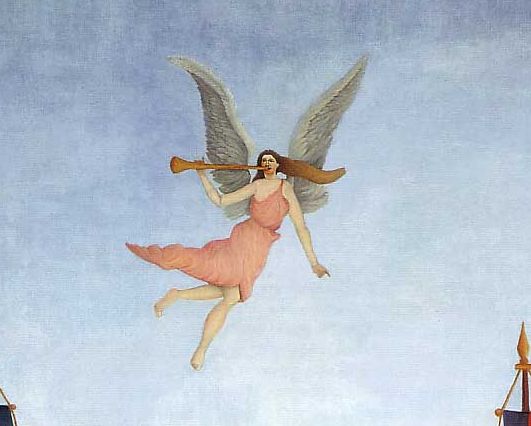
Most of the canvas lies above the trees. In the Tokyo reproduction, its colour moves through violet and lavender, with soft variations that prevent the immense expanse from becoming a uniform backdrop. Against this atmosphere, the pink dress, pale limbs, brown hair and dark feathered wings of the airborne figure remain clearly distinct. Her trumpet extends to the left; her free arm reaches down and out to the right. The two gestures open her body across the sky.
Her pose is full of small directional changes. One leg bends back, the other hangs lower, and the dress lifts away to the left in a pointed fold. The hair streams towards the right. These movements keep her suspended between ascent and descent. She appears to hover over the exact place where the trees part and the entrance recedes. The painting offers no visible support for her body, yet gives her a firm compositional place above the public below.
On either side, the enormous flag standards almost reach her feet. Each has a spear-shaped finial and a triangular arrangement of cords, with little tassels hanging at the corners. Their uprights bring the earthbound ceremony into the sky. The long cloth banners then sweep down towards the crowd, connecting the upper and lower parts of the painting through colour and motion. Their curved edges respond to the floating dress, while the straight poles answer the vertical trunks beneath them.
This difference between a single large figure above and many small figures below establishes the painting's rhythm. The crowd occupies a narrow band, made busy by heads, hats, frames and wheels. Liberty has room to turn and breathe. Looking from one zone to the other changes the pace of attention: a sweeping gesture gives way to a succession of little actions. The large canvas makes both kinds of looking possible, holding a ceremonial announcement and the ordinary work of attendance within one view.
Flags, trees and an open entrance
Tokyo's commentary identifies the great banner on the left with France and the one on the right with the city of Paris. The smaller flags above the tree crowns create another level of ceremony. The MoMA catalogue distinguishes recognisable national flags, including those of the United States and Great Britain, from others Rousseau invented. Their variety suits the painting's invitation, but should not be treated as a literal register of participating countries.[7][13]
The smaller flags form a broken horizon of coloured rectangles. Beneath them runs a much denser band of foliage: rounded crowns, closely spaced, with dark centres and lighter edges. Their repetition gives the scene an ordered boundary. Below the leaves, thin trunks expose glimpses of a pale structure and repeated horizontal lines. The viewer is allowed to look between the trees, but the building never becomes as commanding as the gateway or the flags.
The museum commentary identifies the venue as the Horticultural Palace built for the Paris Exposition of 1900 and used by the Indépendants from 1901. Rousseau compresses this setting behind the trees and fence-like divisions. The historical place anchors the occasion, while its reduced visibility leaves the ceremony in front of it to dominate. There is enough architecture to suggest an exhibition destination without turning the canvas into a detailed architectural portrait.[7]
At the centre, the boundary opens. Pale gate leaves and a light passage make a conspicuous interruption in the dark horizontal band. The entrance is small compared with Liberty, yet it has a strong visual pull because it offers the clearest route through the otherwise continuous enclosure. People and paintings are gathered on our side of it, with the exhibition waiting beyond. The title's invitation is thus given a practical destination: participation means crossing an opening, carrying a work inside, and joining the others.
The carts reinforce that movement towards the venue. Their yellow and reddish bodies, large circular wheels and long handles repeat across the lower middle distance. They supply a second procession behind the walkers. The visible pictures are mostly too small to disclose subjects, so attention falls on their shared status as things carried and submitted. Rousseau fills his tribute with the material apparatus of exhibiting, giving the ceremonial scene an unusually tangible foundation.
A lion among the artists
The lion stretches across the foreground just left of centre. Its long pale body forms a low horizontal shape beneath the upright trunks, flagpoles and black-coated men. Its head rises towards the viewer, with the mane framing the face; the front paws reach forward over a sloping inscription board. Close by, human figures appear small enough to make the animal feel monumental, although it occupies the same brown ground as the gathering.
The MoMA catalogue proposes a specific source for this motif: Bartholdi's Lion of Belfort, more precisely its reproduction at the Place Denfert-Rochereau in Paris. Its comparison photograph shows a reclining lion on a substantial plinth. The painting and the monument share the combination of a long, weighty body, raised head and extended paws. Rousseau's pale animal, however, has its own proportions and frontal address; the proposed source helps explain the monumental character without making the painted lion an exact transcription.[13]
The catalogue connects the monument with the siege of Belfort in 1870–71 and interprets Rousseau's lion as an emblem of courage and independence. This is an interpretation of the painting's public symbolism, rather than a surviving explanation by the artist. Within the scene, it is persuasive because the lion is calm, centrally placed and associated with a written dedication. Its presence gives the artists a guardian-like figure and introduces the solemnity of a civic monument into their meeting.[13]
The inscription board is also important as a shape. It tips towards the viewer, breaking the horizontal spread of the body and drawing the eye down to the front of the scene. The catalogue transcribes a list of Salon contributors on it, including Signac, Luce, Seurat, Pissarro and Rousseau himself. These names bring the collective into the foreground in another form: the crowd supplies bodies, the carried canvases supply works, and the inscription supplies a roll of artists. The list's full meaning need not depend on identifying every miniature face.[13]
Two tall men stand immediately to the lion's right. Their black clothes make strong vertical accents beside its light body. Published identifications require caution. Tokyo's 1984 commentary identifies Rousseau as the man on the right in the facing pair; the 1985 MoMA catalogue tentatively suggests Signac for the very tall figure. These accounts do not establish an agreed set of portraits. The encounter can be understood visually as a conspicuous exchange between artists without making a confident identification of both men.[7][13]
Annotated Details from Liberty Inviting Artists
The numbered points identify visible features discussed in this article. Return from each detail to the whole composition. Henri Rousseau, Liberty Inviting Artists to Take Part in the 22nd Exhibition of the Société des Artistes Indépendants, 1905–06. The National Museum of Modern Art, Tokyo, O00751. Image via Wikimedia Commons. Image source. Public domain. Numbers added to a separate resized overview. Details cropped directly from the published original without enlargement,sharpening,recolouring,cleaning or retouching.
Details from LIBERTY INVITING ARTISTS
Compare the airborne invitation with the broad foreground of artists, carts, lion and open gate. Follow the sweeping gesture above, then the repeated movements of people carrying paintings below.
An airborne call above the gathering
The broad view keeps the full wings, trumpet, streaming dress and bent legs together. Their changing directions animate a figure suspended in a large expanse of sky.
Pictures arriving beneath the trees
The open gate interrupts the tree-lined enclosure. Artists carry pale framed rectangles past small carts, while the reclining lion and sloping inscription board anchor the foreground. At this scale, the gathering is clearer than individual faces or names.
Liberty and the image of Fame
The title calls the hovering woman Liberty, while her trumpet and wings also belong to the traditional imagery of Fame. The MoMA catalogue draws attention to this overlap and places a photograph of Coysevox's Fame, dated 1701–02, beside the entry. The sculpture presents a trumpet-blowing figure mounted on a winged horse, a much more elaborate grouping than Rousseau's solitary woman. The comparison concerns a shared ceremonial vocabulary, with the catalogue proposing classical sculpture as a source of inspiration.[13]
This overlap enriches the invitation. Liberty names the freedom to participate; the trumpet gives that freedom a public voice. The figure's isolation against the sky lets the announcement appear to reach beyond the people already present. Her extended arm and floating dress make the call feel expansive, while the grounded arrangements below show the response taking shape through people, pictures and vehicles. The allegory and the genre scene explain one another.
The same catalogue connects her attitude with the figure in Rousseau's War. The comparison suggests how a mobile allegorical body could serve different subjects. Here the figure announces an occasion of artistic fellowship, and her flight is received by a gathering. The painting's expressive force comes from bringing an impossible visitor into an otherwise recognisable public activity. Its everyday details give the allegory somewhere to act, while the extraordinary figure lifts a familiar exhibition routine into a ceremony.[13]
From the 1906 Salon to Tokyo
The current museum record places the painting with Courteline in 1906 and Paul Rosenberg from 1913/14. It then names the Mendelssohn-Bartholdy collection with an uncertain starting date and a 1922 reference, followed by the Hamburger Kunsthalle in 1969 and Marian von Castelberg's collection in 1972. These are published provenance milestones, with gaps and qualifications; they do not by themselves explain each intervening transfer. The National Museum of Modern Art, Tokyo, purchased the painting in 1978 and records it as O00751.[1]
The museum's exhibition history also traces a wider public life after the original Salon. It lists the painting in the 1926 Rousseau exhibition at Galerie Flechtheim in Berlin and the 1951 exhibition at Sidney Janis in New York. Later appearances include the 2005–06 Henri Rousseau: Jungles in Paris exhibition at Tate Modern, followed by its Paris and Washington venues. Such appearances show this institutional allegory travelling alongside the works through which Rousseau is more often recognised, while retaining its very particular occasion.[1]
Its small painted canvases remain an apt point of return. At the beginning of their journey, the artists in the foreground are bringing works towards an open gate. Rousseau turns that practical act into the subject of an ambitious exhibition painting of his own. The sheer height of the sky, the solemn lion and the airborne trumpeter confer grandeur on the arrival, but the pictures still need to be carried. That balance between public aspiration and visible effort gives the celebration its human scale.
Henri Rousseau artworks directory
This directory brings together works covered on this site and other works documented in the cited museum records and catalogues. Alternate titles share one entry; distinct versions remain separate. Historical dates for works without an article follow the cited catalogues. This is not a catalogue raisonné.
Frequently Asked Questions
It belongs to the National Museum of Modern Art, Tokyo, which purchased it in 1978. Its accession number is O00751.[1]
The 1985 MoMA catalogue interprets it as courage and independence and proposes Bartholdi's Lion of Belfort reproduction in Paris as its source. The calm, monumental animal presides over the contributors and their written names.[13]
Discussion
Look again at the images and ideas explored in Liberty Inviting Artists to Take Part in the 22nd Exhibition of the Société des Artistes Indépendants. These editorial prompts invite your observations.
Reader Insights
How does the large empty sky change your experience of the small crowd below?
Which makes the invitation most tangible: the trumpeter, the open gates or the carried paintings?
How does the lion change the mood of this gathering of artists?
Join the Conversation
Share a detail, comparison or question about Liberty Inviting Artists to Take Part in the 22nd Exhibition of the Société des Artistes Indépendants below.
References
- Independent Administrative Institution National Museum of Art, Japan. Liberty Inviting Artists to Take Part in the 22nd Exhibition of the Société des Artistes Indépendants, current collection record, National Museum of Modern Art, Tokyo, O00751; object details, provenance and exhibition history, accessed 23 October 2026. View source.
- Philadelphia Museum of Art, Carnival Evening,1963-181-64,object59593. View source.
- Musée de l’Orangerie / Juliette Degennes, Henri Rousseau,L’ambition de la peinture: Un artiste dans son époque (in French). View source.
- National Gallery, Surprised!, NG6421. View source.
- Musée d’Orsay, La Guerre,RF19461 (in French). View source.
- MoMA, The Sleeping Gypsy. View source.
- National Museum of Modern Art, Tokyo. Henri Rousseau: Liberty Inviting Artists, Japanese collection commentary republished by the National Museums of Art, from 近代日本の美術 東京国立近代美術館所蔵作品選, 1984, p. 232. View source. (in Japanese).
- Philadelphia Museum of Art, The Merry Jesters, 1950-134-176, object51097. View source.
- Musée d’Orsay, La Charmeuse de serpents, RF 1937 7 (in French). View source.
- Musée de l’Orangerie, La Carriole du Père Junier, RF 1960 26 (in French). View source.
- Solomon R. Guggenheim Museum / Cornelia Lauf, The Football Players,60.1583: current collection record. View source.
- MoMA, The Dream, 252.1954. View source.
- Museum of Modern Art. Henri Rousseau, 1985, catalogue entry 32, pp. 170–172, with painting plate p. 171 and comparison illustrations p. 170. View source.
- The Museum of Modern Art, Henri Rousseau: Essays (1985), selected catalogue entries, chronology and notes on early devotees. View source. Selected entries, chronology (pp.91–95) and early-devotee notes (pp.262–264) were consulted. Historical collection credits do not establish present ownership.
- Daniel Catton Rich, Henri Rousseau (The Museum of Modern Art, 1942), selected drawings and landscape studies; historical catalogue. View source. The dated 1942 publication is used for the two Quai d’Auteuil ink views; its Malakoff date differs from the 1985 catalogue.
- MANAS, Laval, Henri Rousseau, dit le Douanier, urban landscapes and preparatory study (in French). View source.
- National Gallery of Art, Self-Portrait (1895), pen-and-ink drawing, accession 1995.47.66. View source.
- The Museum of Modern Art, War (published January 1895), lithograph, accession 684.1943. View source.
- Barnes Foundation, Landscape and Four Young Girls, object 5521, BF855. View source.


 Henri Rousseau.jpg)


 Henri Rousseau.jpg)