


 by Tom Gurney
Tom Gurney BSc (Hons) is an art history expert with over 20 years experience
Published on June 19, 2020 / Updated on October 29, 2026
Email: tomgurney1@gmail.com / Phone: +44 7429 011000
Pierre Loti (Portrait de Monsieur X): Introduction
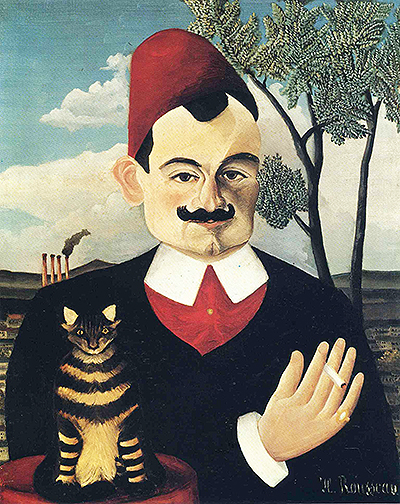
A man in a red fez fills almost the whole canvas. His dark jacket spreads behind a seated cat, while a pale hand rises across his chest holding a cigarette. The cat meets our gaze as steadily as the man does. Behind them, trees, factory chimneys and tiny distant figures occupy the narrow spaces left around his shoulders. Each detail is plainly stated, yet their conjunction makes an unusually elusive portrait.
Kunsthaus Zürich calls Henri Rousseau’s painting Portrait de Monsieur X (Pierre Loti), assigns it to 1906, and records oil on canvas, 61 × 50 cm, inventory 2508. The sitter remains uncertain.[1]
At a Glance
- ArtistHenri Rousseau
- SubjectPierre Loti (Portrait de Monsieur X)
- ExploreA name that remains a question; A face built from unequal parts
This work across Henri Rousseau’s career
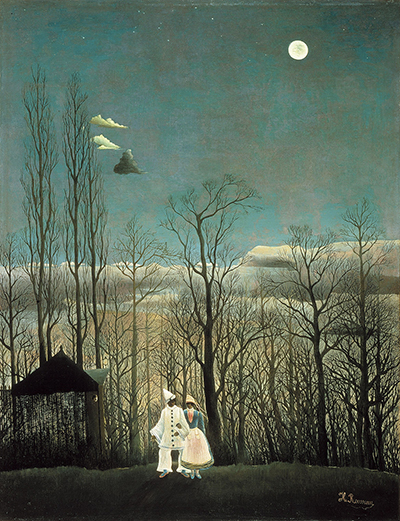
Carnival Evening
1886 [2]The Merry Jesters
1906 [7]Pierre Loti (Portrait de Monsieur X) (current article)
1906 (dating uncertain) [1]The Snake Charmer
1907 [8]Contents
- A name that remains a question
- A face built from unequal parts
- Red, white and a broad field of black
- The raised hand and its small objects
- The cat as a second sitter
- A landscape kept at the edges
- Nearness, distance and the portrait’s history
A name that remains a question
The museum traces the Loti title to Wilhelm Uhde’s 1914 German monograph. Pierre Loti was the pen name of writer and naval officer Julien Viaud. Edmond-Achille Frank claimed in 1952 that the portrait represented him. The museum leaves the identification unresolved and also acknowledges uncertainty over dating, despite its current 1906 assignment.[1]
Looking at the picture without settling that question makes its particular choices more apparent. The hat, moustache, ring and cigarette give the man an emphatic appearance, but none supplies a name. His costume may encourage a viewer to imagine a personal history. The painting itself offers no account of where he has been, whom he knows or why he is here. What it gives us is a carefully distributed set of shapes: a red crown above the face, a red patch below it, a broad black body and two smaller presences, hand and cat, near the bottom. The uncertainty belongs to the identification; the visible arrangement is remarkably definite.
A face built from unequal parts
The head dominates even before we register the fez. Its outline moves from a conspicuous pink ear on the left through the pale cheek and chin to the darker cheek on the right. This difference in tone keeps the face from becoming a flat oval. The shadowed side narrows and deepens, while the lighter side spreads outward. Across this uneven surface, the eyes form a nearly level pair. Their heavy upper lids and small exposed areas of white slow the exchange with the viewer. The gaze seems sustained rather than momentary.
Above the eyes, the eyebrows rise in separate arcs. Below them, the moustache is a dense black shape with tightly lifted ends. Its crisp silhouette stands away from the softer pinks around the nose and mouth. The mouth itself is almost tucked beneath it, a small red interval between black hair and pale chin. Looking closely reverses the usual order of attention: the moustache catches us first, then the much quieter mouth becomes visible. Expression comes through these differences in emphasis. A description of the man as solemn or amused would depend on which feature we allowed to lead.
The hair adds another black curve at the top of the forehead, curling forward beneath the fez. It answers the moustache without simply repeating it. One curve hangs downward, the others turn upward. Between them lies the long pale forehead, with its slight central changes of colour. The hat’s rounded top gives this sequence one larger enclosing arc. Face, hair and headwear therefore have several kinds of curvature, each sharply legible. Their variety prevents the frontal head from feeling mechanically symmetrical.
Red, white and a broad field of black
Three red areas carry the eye through the composition. The fez occupies the upper centre; the garment below the collar forms an angular patch around a small gold-coloured button; the cat’s rounded support spreads along the lower left edge. They differ in size, contour and position. The upper shape is tall and closed, the central one tapers, and the lowest extends sideways beyond the cat. Colour links objects that would otherwise remain separated by the dark jacket. Following those reds takes us from the man’s head through his chest to the animal beside him.
White supplies a second sequence. The collar opens into two large pointed wings, and its sharp corners make the neck seem firmly enclosed. At lower right, the cuff wraps around the wrist in a broad pale band. The face and hand carry related light tones, though both are warmer and more varied. Seen together, these pale areas measure the black garment around them. The jacket has internal changes of tone, but its strongest effect is a continuous dark expanse. Against it, a small change in the edge of a collar or finger becomes easy to notice.
This is one way to approach Rousseau’s style and technique: follow the work done by an outline before asking how completely it describes volume. The pointed collar, curved cuff and sloping shoulders each have a different rhythm. They establish the man’s bearing through an arrangement of boundaries. The black clothing also gives the painting a quieter centre, allowing the patterned cat, pale foliage and coloured face to remain distinct without competing everywhere at once.
The raised hand and its small objects
The hand opens diagonally across the lower right. Its palm is broad, and the fingers rise to different heights, each ending in a rounded pink nail. A cigarette crosses near the upper fingers, its pale shaft interrupted by a dark and reddish tip. Farther down, a bright ring catches the eye on the lowest outward finger. These two small objects break up the large expanse of flesh colour. They also reward a second look: the hand first reads as a single pale shape, then resolves into separate fingers, nail shapes, cigarette and ring.
Its scale is striking. The hand occupies enough of the foreground to become a second centre of attention below the face. The cuff turns around the wrist like a hinge between the flesh and the jacket. From there, the hand tilts outward, presenting a different angle from the upright head. The man’s shoulders and face hold their frontal position while this diagonal gives the lower half a measured movement. Nothing needs to happen next for the gesture to have force. The raised hand is already an event within an otherwise still arrangement.
The cigarette and the distant smoking chimney offer a small visual correspondence. One belongs to the near foreground and is held at an angle; the other rises vertically beyond the left shoulder. The chimney has a dark plume, while no comparable plume is clearly visible from the cigarette. The resemblance rests in the objects and their places in the picture, not in a known message from the painter. It draws attention to the enormous distance compressed between a fingertip and the industrial structures beyond the man.
The cat as a second sitter
The cat sits upright on a red rounded support, its forelegs straight and its paws resting near the front edge. Its head is small beside the man’s, yet it has a comparable frontal clarity. The ears form two pale triangles above a striped forehead. Yellow-green eyes, dark outlines and a small muzzle make the face readable even within the surrounding black. The cat occupies the lower left as decisively as the raised hand occupies the lower right. Both interrupt the jacket, but they do so in different ways: the hand extends across it, while the cat stands before it.
Bands of dark and warm brown run around the animal’s chest and legs. A long pale area descends through the middle of the body, widening towards the paws. These markings give the cat a detailed surface where the man’s torso has comparatively little variation. The animal is therefore more than an incidental companion in the design. Its stripes introduce repeated horizontal beats; its pointed ears answer the collar’s angular tips; its compact upright stance offers a smaller counterpart to the man’s large, nearly frontal head. We can see those relationships without deciding what the cat meant to the sitter.
The two faces hold our attention differently. The cat’s ears, eyes and muzzle gather into a compact triangle. The man’s features spread across a much larger, irregularly shaded area, with the ear projecting conspicuously to one side. Moving between them changes the pace of looking. We pass from the animal’s small, concentrated mask to the broad human face and back again. Their shared outward gaze gives the animal a presence distinct from the man’s.
A landscape kept at the edges
Beyond the left shoulder, four slender reddish chimneys rise above dark horizontal ground. One sends a plume diagonally into the sky. On the opposite side, tall trees branch upward into rounded groups of individually marked leaves. The chimneys remain below the man’s head; the trees reach to the upper edge. This unequal balance gives each side of the portrait its own character. The left opens towards clouds and low distance. The right is more closely occupied by trunks, branches and foliage, with one small crown fitting into the space beside the man’s cheek.
The distant land is arranged in narrow horizontal strips. Tiny dark strokes populate its lighter bands, and small buildings appear at the margins. These marks suggest activity without yielding a continuous story. Their minuteness makes the sitter’s scale more imposing. His shoulders hide the central connection between the two sides, so our eye has to imagine a landscape continuing behind him. The foreground figure joins the canvas physically while dividing its visible background into separate glimpses.
Above this low world, cream and grey-white clouds spread across a blue-green sky. The hat’s saturated red holds its outline against that cooler field. At the right, fine pale leaves create a much busier edge between tree and sky. The painting sets these two kinds of boundary close together: the hat has a broad, uninterrupted contour, while the foliage is assembled from many small points. That difference allows the surrounding landscape to remain active even though the man occupies so much of the surface.
Nearness, distance and the portrait’s history
The picture’s space becomes clearest when we compare three scales: the hand near the lower edge, the cat immediately beside the body and the tiny marks beyond the shoulders. Each is easy to recognise locally. Their combined proportions are less easy to fit into a single imagined view. The man seems very near, the cat has its own firmly stated little platform, and the background recedes abruptly. That compression contributes to the portrait’s arresting stillness. Our eye moves readily across the painted surface, even where it hesitates to reconstruct a fully continuous space behind it.
The signature at lower right supplies a fine sequence of marks across the dark clothing. Its light strokes sit near the hand and counter the cat’s busy pattern across the canvas. The work sustains attention through the exact places where pale meets dark, where a curve turns into a point, and where a large form is interrupted by something unexpectedly small.
The recorded ownership begins with Georges Courteline, probably in 1906, and includes Paul Rosenberg, Paul and Lotte Mendelssohn-Bartholdy, Charlotte von Wesdehlen and Claus Vogel. Kunsthaus Zürich purchased the portrait in 1940 for CHF 22,000. Its provenance report, marked 11 January 2022, says the history remains under review.[12]
Henri Rousseau artworks directory
This directory brings together works covered on this site and other works documented in the cited museum records and catalogues. Alternate titles share one entry; distinct versions remain separate. Historical dates for works without an article follow the cited catalogues. This is not a catalogue raisonné.
Frequently Asked Questions
Its upright pose and direct gaze make it a second point of encounter. Stripes, pale ears and bright eyes remain especially clear against the man’s dark jacket.
Red links the fez, chest and cat’s support. Pale tones connect face, collar, cuff and hand, while the broad black jacket surrounds them. These repeated colours help the eye travel between otherwise separate objects.
Discussion
Look again at the images and ideas explored in Pierre Loti (Portrait de Monsieur X). These editorial prompts invite your observations.
Reader Insights
Does your reading of the man’s expression change when you look first at his eyes, moustache or mouth?
How does covering the cat alter the balance between the lower left and the raised hand?
Which makes the sitter seem larger: the narrow landscape at the sides or the tiny distant marks within it?
Join the Conversation
Share a detail, comparison or question about Pierre Loti (Portrait de Monsieur X) below.
References
- Kunsthaus Zürich. Portrait de Monsieur X (Pierre Loti), object 2194, inventory 2508; commentary from the 2007 collection catalogue, p. 241. View source.
- Philadelphia Museum of Art, Carnival Evening,1963-181-64,object59593. View source.
- Musée de l’Orangerie / Juliette Degennes, Henri Rousseau,L’ambition de la peinture: Un artiste dans son époque (in French). View source.
- National Gallery, Surprised!, NG6421. View source.
- Musée d’Orsay, La Guerre,RF19461 (in French). View source.
- MoMA, The Sleeping Gypsy. View source.
- Philadelphia Museum of Art, The Merry Jesters, 1950-134-176, object51097. View source.
- Musée d’Orsay, La Charmeuse de serpents, RF 1937 7 (in French). View source.
- Musée de l’Orangerie, La Carriole du Père Junier, RF 1960 26 (in French). View source.
- Solomon R. Guggenheim Museum / Cornelia Lauf, The Football Players,60.1583: current collection record. View source.
- MoMA, The Dream, 252.1954. View source.
- Kunsthaus Zürich. Portrait de Monsieur X (Pierre Loti): object and provenance report, pp. 2–4, research dated 11 January 2022. View source.
- The Museum of Modern Art, Henri Rousseau: Essays (1985), selected catalogue entries, chronology and notes on early devotees. View source. Selected entries, chronology (pp.91–95) and early-devotee notes (pp.262–264) were consulted. Historical collection credits do not establish present ownership.
- Daniel Catton Rich, Henri Rousseau (The Museum of Modern Art, 1942), selected drawings and landscape studies; historical catalogue. View source. The dated 1942 publication is used for the two Quai d’Auteuil ink views; its Malakoff date differs from the 1985 catalogue.
- MANAS, Laval, Henri Rousseau, dit le Douanier, urban landscapes and preparatory study (in French). View source.
- National Gallery of Art, Self-Portrait (1895), pen-and-ink drawing, accession 1995.47.66. View source.
- The Museum of Modern Art, War (published January 1895), lithograph, accession 684.1943. View source.
- Barnes Foundation, Landscape and Four Young Girls, object 5521, BF855. View source.
 Henri Rousseau.jpg)
 Henri Rousseau.jpg)