



 by Tom Gurney
Tom Gurney BSc (Hons) is an art history expert with over 20 years experience
Published on June 19, 2020 / Updated on October 29, 2026
Email: tomgurney1@gmail.com / Phone: +44 7429 011000
Portrait of Léon-Paul Fargue: Introduction
A red curtain opens beside a man holding a pipe. Behind his shoulder, a miniature train crosses the landscape, sending a white trail towards his head. Henri Rousseau’s Portrait of Léon-Paul Fargue brings these three elements into an unusually close encounter. The sitter occupies almost the whole foreground, yet the narrow world around him remains insistently active: water, houses, a sail and distant architecture surround the dark shape of his coat.
At a Glance
- ArtistHenri Rousseau
- SubjectPortrait of Léon-Paul Fargue
- ExploreA portrait recovered; The curtain and the edge of the room
This work across Henri Rousseau’s career
Carnival Evening
1886 [1]The Merry Jesters
1906 [7]The Snake Charmer
1907 [8]Contents
- A portrait recovered
- The curtain and the edge of the room
- A face built around a pointed beard
- The raised hand and the pipe
- A train behind the shoulder
- The small world around a large figure
- Memory and the painted encounter
- Annotated details
A portrait recovered
Laurent de Freitas identifies the work as an oil painting on canvas dated 1896 and reports its reappearance in November 2000. He connects it with Fargue’s account in Le Piéton de Paris of 1939, in which the writer remembered being painted with a pointed beard and a railway behind him.[5]
That combination makes the picture immediately recognisable. The beard descends towards the tie; the train passes just below the level of the mouth. Between them, a large black jacket supplies the painting’s central mass. Before the details resolve, the arrangement reads as a dark, upright figure set against a pale, horizontally divided landscape. The curtain introduces a second tall shape at the opposite edge from the raised hand. These broad divisions give a firm framework to a scene crowded with small incidents.
The curtain and the edge of the room
The curtain takes up much of the left side. Its red fabric hangs in long, uneven folds before gathering at a low tie. Above that fastening, the material swells towards the edge, then curves inward as it rises. Below, it drops out of the picture. Deep dark channels between the folds give the red a heavy, gathered appearance, quite different from the thin horizontal bands of the landscape beyond.
This is the clearest sign of an interior, although the room itself scarcely appears. There is no substantial wall to set the figure securely inside, and no broad sill to explain where the outdoor view begins. The curtain lets us imagine a window while leaving the architecture incomplete. The open space beside the fabric therefore feels exceptionally wide. A small stretch of pale sky can seem to lead directly from the room into the distance.
Look at the curtain’s inner edge as it approaches the sitter’s shoulder. The red and black nearly meet, leaving a narrow wedge of landscape between them. That sliver matters: it allows the outer world to remain continuous around the figure. The head seems to stand in open air, although the drapery keeps suggesting shelter. The portrait’s setting depends on this alternation between enclosure and exposure.
A face built around a pointed beard
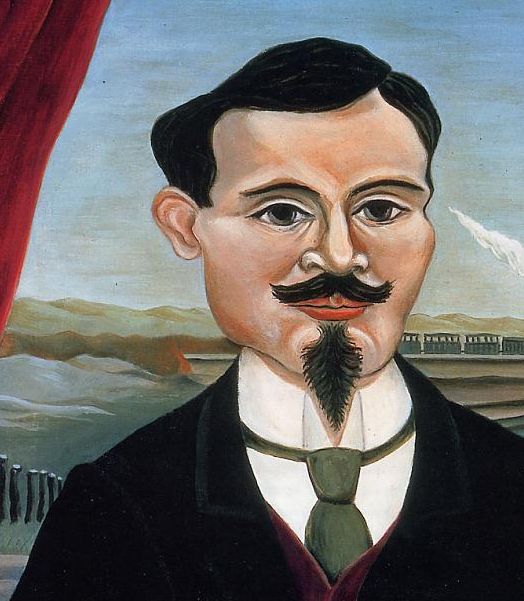
The hair forms a smooth dark cap with a pronounced sweep across the forehead. Beneath it, the eyebrows and eyes make a second, more intricate pattern of curves. The two sides are not exact reflections of each other. One brow rises differently, the eyelids take unequal shapes, and the nose divides the face without creating two matching halves. These small discrepancies prevent the frontal arrangement from becoming a simple emblem.
Warm areas across the cheeks, forehead and nose stand out against the cool sky. Lighter passages along the nose and near the eyes sharpen the features, while darker lines give the nostrils and mouth a definite place. The moustache spreads across the upper lip in two curved wings. Below, the pointed beard draws the eye down into the costume. Its narrow tip continues the direction established by the nose, giving the centre of the face a strong descending movement.
The clothing takes up that movement with a sequence of related shapes. Two white collar points open beside the neck. Between them sits a dark green tie, with a rounded knot and a longer pendant below. A glimpse of deep burgundy waistcoat continues farther down the chest. The result is a chain of small, clear forms within the much larger black coat: face, beard, collar, tie and waistcoat lead the eye from the head towards the bottom of the painting.
The jacket is comparatively quiet. Its darkness absorbs details that would compete with the features, yet the shoulder slopes and lapel edges remain readable. A slight difference between the two shoulders makes room for the raised arm. The figure’s apparent solidity comes partly from this large expanse of dark paint, which gives the more brightly articulated face and hand something substantial to belong to.
The raised hand and the pipe
At the right, the hand rises into the pale background. Long fingers gather around a short, curved pipe, whose warm brown-orange colour is close enough to the flesh to require attentive looking. The pipe is a small object in relation to the hand, and the fingers do not close into a tight fist. Their open arrangement leaves little gaps through which the setting remains visible.
The cuff makes a brilliant white border between the wrist and the black sleeve. That clean separation helps the hand appear lifted away from the coat. Farther down, the forearm merges into the dark body of the jacket, so the visible gesture seems to emerge abruptly from its broad surface. We can follow the bend, but the painting gives more emphasis to the raised extremity than to the mechanics of the arm.
This hand also changes our sense of distance. It stands beside rows of tiny buildings and above the thin bands of the water, bringing the sitter’s bodily scale into immediate contact with the far smaller scale of the setting. A finger can occupy as much space as a house. The comparison happens within a tiny area of the image, making the difference between foreground and distance especially vivid.
The gesture leaves the mouth unobstructed. Face and pipe remain separate points of attention, joined by the direction of the arm and by their warm colours. The curved pipe and the curled ends of the moustache offer a further small resemblance. Seen together, they introduce rounded, horizontal accents beside the sharper downward points of beard and tie.
A train behind the shoulder
The railway cuts across the view as a narrow horizontal strip. Its small dark shapes could almost disappear among the other bands were it not for the white steam rising above them. The cloud narrows towards the engine and widens as it travels diagonally up and left. Against the blue-grey sky, this pointed, irregular shape has a clarity that the train itself lacks.
Its direction brings it close to the side of the head. The body of the train remains distant, while its steam appears to reach towards the sitter. That visual connection gives a minor background object an unusually strong relationship with the portrait. The railway gains prominence as we follow the white diagonal to its end.
The contrast with the curtain is especially effective. The fabric makes a broad, mostly vertical sweep on the left; the steam draws a much narrower slant on the right. One descends with the weight of folded cloth, while the other tapers into an airborne trail. Between these opposed movements, the head appears steady. The portrait gathers much of its animation around the sitter rather than making his body demonstratively active.
Lola San Martín Arbide reads the curtain and Parisian setting as an urban stage, linking the painting to Fargue’s writing about the city. She also invites the viewer to imagine the engine’s sound.[12] This is a later interpretation, and a productive way of looking: the conspicuous white trail can suggest an interruption even though the painted scene remains still.
Annotated Details from Portrait of Léon-Paul Fargue
The numbered points identify visible features discussed in this article. Return from each detail to the whole composition. Henri Rousseau, Portrait of Léon-Paul Fargue, 1896. Current collection unestablished. Image via Wikimedia Commons. Image source. Public domain. Numbers added to a separate resized overview. Details cropped directly from the published original without enlargement, sharpening, recolouring, cleaning or retouching.
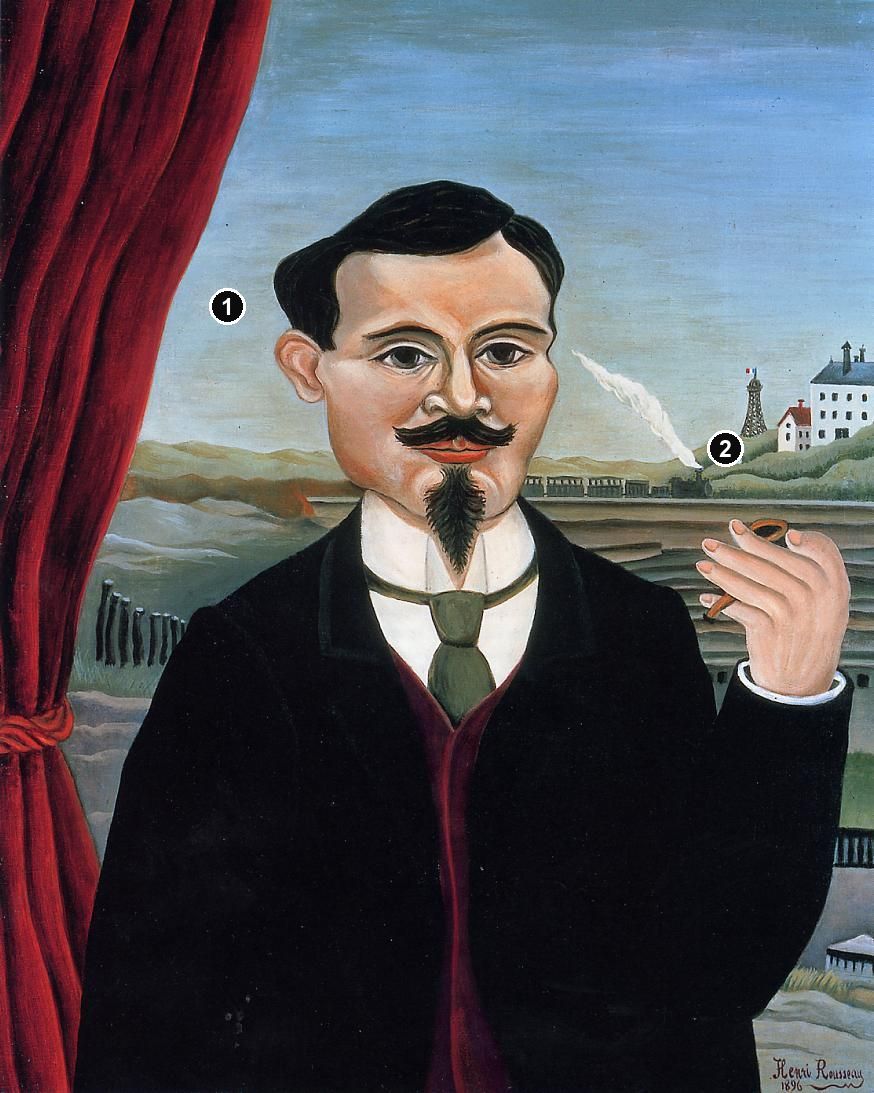
Details from PORTRAIT OF LÉON-PAUL FARGUE
Compare the downward sequence of face, beard and tie with the raised hand and the train’s diagonal trail of steam.
A face leading into beard and tie
The pointed beard continues the face’s downward movement towards the white collar and green tie. Their small, sharply separated shapes stand out within the large dark coat.
A pipe beside the railway
The raised hand holds its pipe away from the mouth. Behind it, the miniature train sends a white trail towards the head, bringing a distant journey into close visual contact with the still foreground figure.
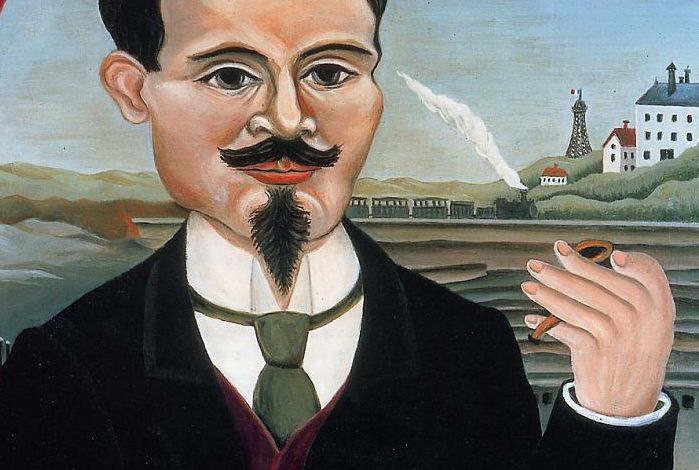
The small world around a large figure
The skyline is unevenly distributed. Much of the space to the left of the head stays open, while buildings accumulate towards the right. Small pale houses with red roofs give way to a taller white block, and the distant Eiffel Tower helps identify the city.[5] The view becomes denser as it approaches the edge, giving the raised hand a busy, patterned setting.
Dark horizontal marks repeatedly divide this world. The railway, terraces and waterside edges establish successive levels, while upright posts near the lower left create a short rhythm of their own. Their repetition makes the landscape legible without requiring every strip to be assigned an exact physical function. The eye recognises a sequence of banks, barriers and built structures, then carries those divisions behind the figure where they disappear.
That disappearance is an important part of the composition. The broad coat blocks most of the lower centre, leaving the view to be assembled from fragments on either side. We mentally connect the water across the body, even though we cannot see it continue. The setting feels extensive because it seems to carry on behind the sitter, whose scale prevents us from surveying it all at once.
Colour provides another set of connections. Red returns in the curtain, the waistcoat, small roofs and a tiny sail. These patches vary enormously in size. The curtain is a commanding field of colour, whereas the sail is only a small accent among muted greys and greens. Their resemblance encourages the eye to travel between near and far, giving the scattered details a shared place in the picture.
Following these boundaries offers a useful introduction to Rousseau’s style and technique. Here, the point where a sleeve crosses the landscape or a pale cheek meets the sky can be as expressive as a carefully described object. The portrait’s space takes shape through these encounters, with each clear edge adjusting our sense of what lies in front of what.
Memory and the painted encounter
Fargue’s later recollection associated the encounter with Alfred Jarry and Rousseau’s studio near the railway on the avenue du Maine. Freitas also discusses a Rousseau letter dated 26 June 1894, complicating a literal reading of the remembered chronology.[5] The memoir was written decades after the painting; its remembered conversation cannot supply a contemporary transcript or a precise timetable of sittings.
The image itself gives us a more immediate relationship to examine. The face addresses the viewer, the hand holds its small object aside, and the landscape offers several possible diversions. Attention can settle on the eyes, descend through the beard and tie, move out to the pipe, then follow the steam back towards the head. Each route begins with a tangible detail and brings us into contact with another part of the picture.
This circulation gives the portrait its particular liveliness. A concentrated human presence occupies the foreground, while the world glimpsed around him contains passages and departures: the opened curtain, the railway, the water and the small sail. The sitter remains available to our gaze as these other movements unfold beside him. His stillness gains definition from the activity Rousseau has fitted into the narrow spaces around his shoulders.
Henri Rousseau artworks directory
This directory brings together works covered on this site and other works documented in the cited museum records and catalogues. Alternate titles share one entry; distinct versions remain separate. Historical dates for works without an article follow the cited catalogues. This is not a catalogue raisonné.
Frequently Asked Questions
Freitas identifies the painting as dated 1896.[5]
Its thin horizontal bands contrast with the large foreground body. The train’s white steam introduces a diagonal close to the head, while the red curtain supplies a strong vertical at the opposite side.
He holds a pipe away from his face. The visible white trail belongs to the distant train, so it should not be confused with smoke rising from the pipe.
The gathered red drapery resembles an opened stage curtain. San Martín Arbide develops this resemblance through her reading of Fargue’s city as a stage.[12]
Discussion
Look again at the images and ideas explored in Portrait of Léon-Paul Fargue. These editorial prompts invite your observations.
Reader Insights
Follow the painting’s red accents from the curtain into the distance. How do their changing sizes affect the space?
Cover the white steam with a finger. What changes in the relationship between the sitter and his surroundings?
Which edge most strongly places the figure in front of the view: the head, the shoulder or the raised hand?
Join the Conversation
Share a detail, comparison or question about Portrait of Léon-Paul Fargue below.
References
- Philadelphia Museum of Art, Carnival Evening,1963-181-64,object59593. View source.
- Musée de l’Orangerie / Juliette Degennes, Henri Rousseau,L’ambition de la peinture: Un artiste dans son époque (in French). View source.
- National Gallery, Surprised!, NG6421. View source.
- Musée d’Orsay, La Guerre,RF19461 (in French). View source.
- Laurent de Freitas. “Léon-Paul Fargue et Alfred Jarry : autour d’une même passion pour la peinture, 1892–1894”, L’Étoile-Absinthe, nos. 103–104, hiver 2004, published 2005, pp. 26–28, within article pp. 7–30. Includes Fargue’s 1939 recollection. View source. (in French).
- MoMA, The Sleeping Gypsy. View source.
- Philadelphia Museum of Art, The Merry Jesters, 1950-134-176, object51097. View source.
- Musée d’Orsay, La Charmeuse de serpents, RF 1937 7 (in French). View source.
- Musée de l’Orangerie, La Carriole du Père Junier, RF 1960 26 (in French). View source.
- Solomon R. Guggenheim Museum / Cornelia Lauf, The Football Players,60.1583: current collection record. View source.
- MoMA, The Dream, 252.1954. View source.
- Lola San Martín Arbide. “Music and the City: The Parisian Soundscape in the Early 20th Century”, New Europe College Yearbook 2024–2025, vol. 2, 2025, pp. 332–333. View source.
- The Museum of Modern Art, Henri Rousseau: Essays (1985), selected catalogue entries, chronology and notes on early devotees. View source. Selected entries, chronology (pp.91–95) and early-devotee notes (pp.262–264) were consulted. Historical collection credits do not establish present ownership.
- Daniel Catton Rich, Henri Rousseau (The Museum of Modern Art, 1942), selected drawings and landscape studies; historical catalogue. View source. The dated 1942 publication is used for the two Quai d’Auteuil ink views; its Malakoff date differs from the 1985 catalogue.
- MANAS, Laval, Henri Rousseau, dit le Douanier, urban landscapes and preparatory study (in French). View source.
- National Gallery of Art, Self-Portrait (1895), pen-and-ink drawing, accession 1995.47.66. View source.
- The Museum of Modern Art, War (published January 1895), lithograph, accession 684.1943. View source.
- Barnes Foundation, Landscape and Four Young Girls, object 5521, BF855. View source.


 Henri Rousseau.jpg)


 Henri Rousseau.jpg)