



 by Tom Gurney
Tom Gurney BSc (Hons) is an art history expert with over 20 years experience
Published on June 19, 2020 / Updated on October 29, 2026
Email: tomgurney1@gmail.com / Phone: +44 7429 011000
Portrait of the Second Wife of the Artist: Introduction
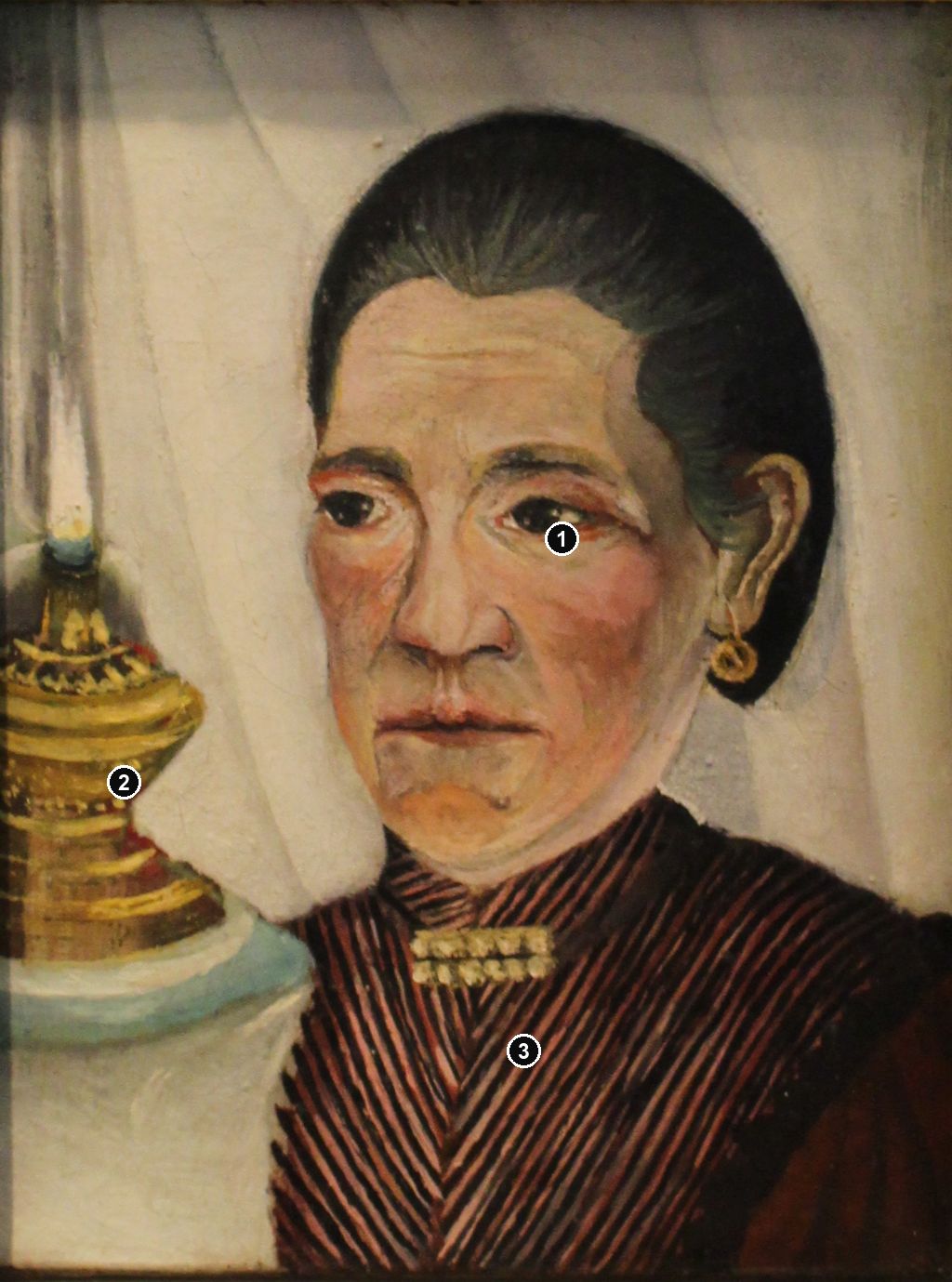
A woman's dark hair rises in a smooth arch against a pale curtain. Beside her, an oil lamp presses into the narrow space, its golden fittings almost level with her face. In Portrait of the Second Wife of the Artist, Henri Rousseau brings a person and a household object so close together that each helps us see the other: the lamp's regular bands sharpen the irregular contours of the face, while the small gold ornaments on the woman draw its brightness across the canvas.
At a Glance
- ArtistHenri Rousseau
- SubjectPortrait of the Second Wife of the Artist
- ExploreA portrait on an intimate scale; The face and its uneven planes
This work across Henri Rousseau’s career
Carnival Evening
1886 [1]The Merry Jesters
1906 [7]The Snake Charmer
1907 [8]Contents
- A portrait on an intimate scale
- The face and its uneven planes
- A gown drawn with narrow stripes
- The lamp, the curtain and the missing room
- Two portraits seen together
- The title and the portrait's later history
- Annotated details
A portrait on an intimate scale
The Musée national Picasso-Paris records the work as Portrait de la seconde femme de Rousseau, dates it to [1903], and identifies it as oil on canvas, 24 × 19.2 cm, inventory MP2017-38. Its acquisition credit is Donation Picasso, 1978.[6] These modest dimensions matter to the encounter. The head fills much of the picture, but the painting itself asks for close attention. A crease across the forehead and a few pale marks along the hairline belong to a small field of looking.
The crop gives little room to imagine the rest of the body. The shoulders reach towards the sides, and the striped garment continues beyond the lower edge. At the left, the lamp is cut by the frame; its long glass chimney also runs upwards out of sight. Person and object therefore seem to occupy more space than the picture can comfortably contain. The effect is concentrated, with no distant view to release the eye and no hands to introduce a separate action. Looking returns repeatedly to the face.
The curtain supplies just enough setting to make this closeness legible. Its pale folds pass behind the head, offering a softly varied ground against which the hair becomes a firm dark shape. Nothing in the visible room tells a story through an accumulation of possessions. Instead, Rousseau gives extraordinary weight to the few things admitted into the frame. The lamp takes up space that another portrait might reserve for an arm, a chair or an open background.
The face and its uneven planes
The woman's head turns slightly towards the left of the picture. Both eyes remain visible, yet they do not sit within two matching halves of a face. The cheek on the viewer's right opens into a broad pink plane, while the opposite side is narrower and more closely enclosed by the nose and the edge of the head. The eyes also look leftwards, away from a direct exchange with the viewer. This modest displacement animates a pose that otherwise feels held still.
Rousseau gives the brows, eyelids and nose strong edges, then lets patches of colour complicate that drawing. Red gathers beneath the eyes and spreads across the cheeks. Pale passages run along the nose, mouth and chin, with darker accents defining the nostrils and the corners of the closed lips. The changes are abrupt enough to be noticed separately. At the same time, they join into a face with a particular breadth, unevenness and weight. The portrait rewards following these small transitions rather than fixing immediately on a single expression.
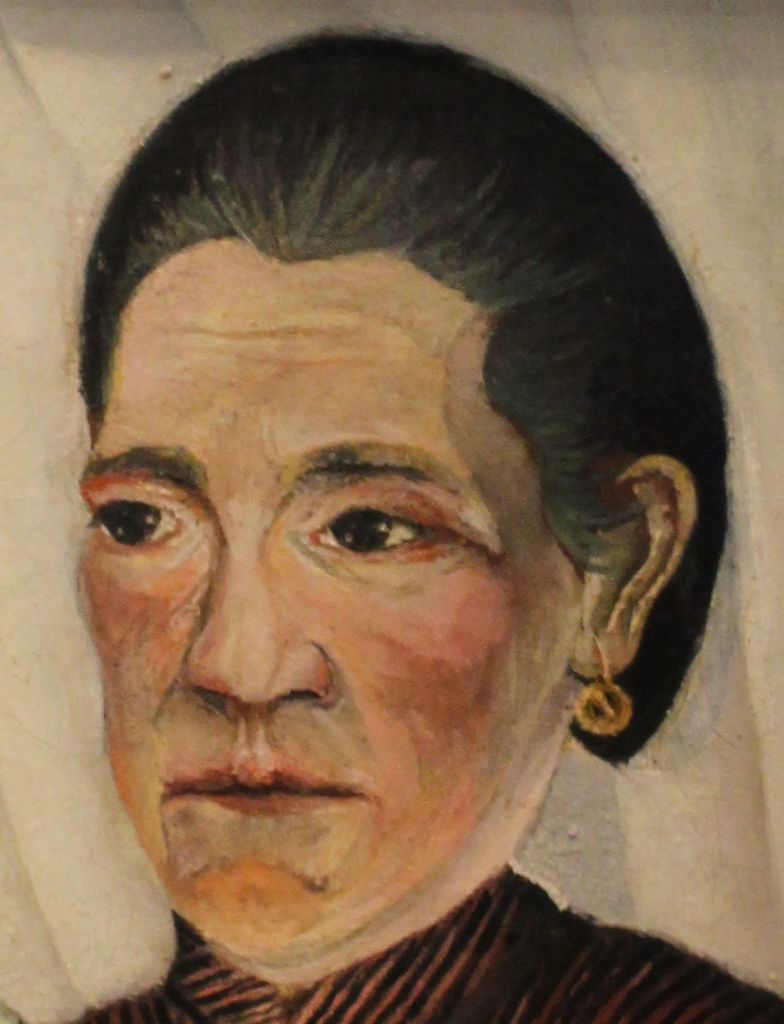
The forehead has its own quieter pattern. Several horizontal creases interrupt its pale surface, answering the curved boundary of the hair above. Fine grey strokes emerge where the dark hair has been swept back from the face. Farther round, its rounded mass encloses an exposed ear and ends close to the neck. The hair combines a broad, almost continuous silhouette with fine marks that make its direction readable.
The 1985 catalogue describes the woman's portrait as more heavily worked than its companion, with bright paint and delicate pale tones.[12] In reproduction, the light strokes along the forehead and chin invite close looking, although the physical relief of the surface is harder to judge.
The gold hoop at the visible ear is a particularly economical detail. It hangs against the dark hair, clear enough to register as an ornament without taking attention away from the eye above it. Its little circle also introduces a shape that the face itself lacks. Looking from the hoop to the broad cheek, then to the pointed folds of the collar, reveals how much variety Rousseau has fitted into this restricted space.
A gown drawn with narrow stripes
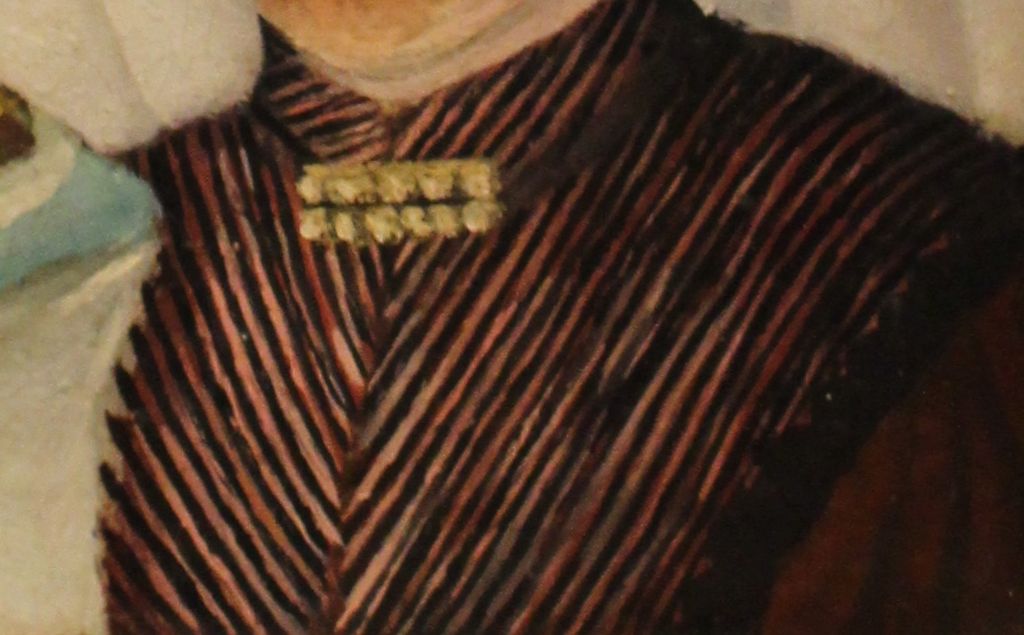
Below the chin, the garment becomes a dense pattern of reddish lines across a very dark ground. Its stripes run diagonally and change direction where the fronts cross. They carry the eye downwards, but their meeting also makes a pointed structure immediately beneath the throat. The face has broad areas of colour; the clothing is divided into many narrow intervals. Their juxtaposition gives the head greater visual openness even though the high neckline leaves little skin exposed.
A small rectangular gold ornament fastens or decorates the neck. Its gridded lights interrupt the flowing diagonals, holding the centre of the costume with a short horizontal accent. The rectangle looks especially compact beneath the long face. Its bright divisions can be counted and inspected, whereas the surrounding stripes seem capable of continuing indefinitely beyond the picture. It is a tiny stopping point within a larger pattern.
The stripes also help distinguish the two sides of the upper body. On one side they form an insistent field of parallel marks; towards the outer shoulder they recede into a darker, less articulated area. This variation keeps the garment from becoming a flat decorative sample. The lines suggest the construction and turn of clothing, yet retain their own graphic rhythm. They contribute to the portrait's character as strongly as the hoop or the carefully arranged hair.
Gold travels through the composition in three different sizes: the small earring, the wider neck ornament and the substantial fittings of the lamp. Each is isolated against a contrasting colour. The connections are easy to overlook when concentrating on the face, but they bind the lower part of the portrait to its left edge. The lamp feels incorporated into the arrangement through these small echoes.
The lamp, the curtain and the missing room
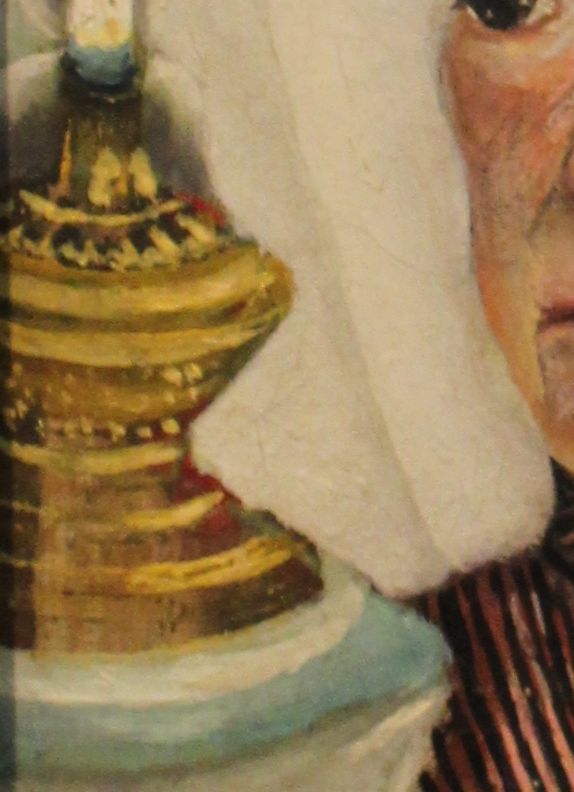
The lamp's rounded metal reservoir and fittings stand on a pale blue and white support. Dark bands, red accents and small bright marks divide its gold surface. Above them, the glass chimney becomes a narrow upright strip, its transparency suggested by the pale background showing through. The object alternates solid and translucent passages, broad curves and tight rings. Its visual complexity gives it a presence almost equal to that of the woman.
There is a striking difference between the lamp's orderly construction and the face beside it. The lamp is built around an upright axis, with horizontal rings stepping outwards and inwards. The face, though similarly elongated, is full of unequal turns. A cheek projects, one side of the mouth catches more light, and the ear emerges at the far edge. Placed together, these two structures make regularity and variation unusually easy to compare. The lamp offers a stable measure against which the head's slight turn becomes more apparent.
The pale support cuts across the lower left as a broad, cool shape, quite unlike the thin warm lines of the gown. Its curved rim draws the eye towards the woman's shoulder, while the chimney leads upwards beside her head. These movements create a route around the face. The lamp occupies the edge of the picture but repeatedly sends attention back towards its human subject.
The curtain's folds soften this close arrangement without opening it into deep space. Their oblique lines pass behind the rounded hair, where pale and dark meet most decisively. We can recognise a material hanging in a room while knowing very little about the room itself. The painting invites an impression of proximity through this partial setting: a curtain, a lamp and a person are enough to establish a shared interior.
Annotated Details from Portrait of the Second Wife of the Artist
The numbered points identify visible features discussed in this article. Return from each detail to the whole composition. Henri Rousseau, Portrait de la seconde femme de Rousseau, [1903]. Musée national Picasso-Paris, MP2017-38. Photograph: Arthur Crbz, Wikimedia Commons. Image source. Public domain. Numbers added to a separate resized overview. Details cropped directly from Arthur Crbz’s published photograph without enlargement, recolouring, geometric correction or retouching.
Details from PORTRAIT OF THE SECOND WIFE OF THE ARTIST
Compare the broad shape of the head with the lamp’s regular bands and the narrow repeated lines of the gown.
The face, swept hair and gold hoop
The dark hair makes a broad arch around the uneven planes of the face. At the visible ear, a small gold hoop provides a bright round accent against that dark shape.
Gold fittings beside a pale blue ring
Dark bands and small bright marks divide the lamp’s rounded metal fittings. The pale blue ring below gives the gold a cool boundary beside the woman’s striped clothing.
A neck ornament within crossing stripes
The compact gold rectangle interrupts the gown’s narrow reddish diagonals. Where the fronts meet, the stripes change direction, giving the garment a pointed structure below the throat.
Two portraits seen together
The 1985 Rousseau catalogue treats this painting and a small portrait of the artist as a pair, noting their reproduction together in the 1912 Blaue Reiter almanac.[12] Seen side by side, the two pictures have an immediate visual conversation. The man's lamp stands at the right of his picture; the woman's occupies the left of hers. In that arrangement, the objects lie near the facing edges, while the two heads remain separately enclosed by pale curtains. Each portrait has its own compact interior.
The man's dark jacket surrounds a light shirt front, opening a broad white shape beneath his face. In the woman's picture, the striped fabric closes high around the throat. His moustache spreads sideways across the lower face; her swept hair establishes a larger curve above it. These differences prevent the pairing from becoming a simple repetition. Shared ingredients provide the framework, and the distinct shapes of costume, hair and features give each sitter an independent presence.
Wilhelm Uhde's 1911 reading, quoted in the later catalogue, associated the lamps with domestic contentment.[12] That is one historical response to their quiet household setting. Looking at the pair also reveals how assertively the lamps organise the pictures. Their size, cropped edges and contrasting surfaces make them active parts of the compositions. They place the heads within a recognisable environment while withholding almost everything beyond it.
The title and the portrait's later history
The woman's identity has a history of disagreement. The 1985 catalogue records competing identifications as Rousseau's first or second wife; today's Picasso museum title identifies the second.[12][6] The title provides a way of placing the portrait within the artist's life, while the painted details remain more particular than a family relationship alone can explain. The glance to the side, swept hair and closely patterned gown are the means by which this individual presence takes form.
The older catalogue lists Robert Delaunay, Galerie Bing, L. Neumann, Paul Rosenberg and Picasso in the portraits' provenance.[12] Within the woman's portrait, the encounter stays small and immediate. A narrow rectangle holds the brightly divided lamp, the dark oval of hair and the pale curtain together. Returning to those relationships brings the eye back from the painting's public history to its concentrated act of looking.
Henri Rousseau artworks directory
This directory brings together works covered on this site and other works documented in the cited museum records and catalogues. Alternate titles share one entry; distinct versions remain separate. Historical dates for works without an article follow the cited catalogues. This is not a catalogue raisonné.
Frequently Asked Questions
It is in the Musée national Picasso-Paris, under inventory MP2017-38.[6]
The museum gives the date as [1903].[6]
It occupies much of the left edge and rises beside the head. Its pale support, gold rings and glass chimney introduce contrasting shapes and surfaces, while gold details in the woman's jewellery carry its brightness across the portrait.
Discussion
Look again at the images and ideas explored in Portrait of the Second Wife of the Artist. These editorial prompts invite your observations.
Reader Insights
How does your attention move between the woman's face and the lamp?
What changes when you look at the portrait's broad colour shapes before examining the stripes, creases and ornaments?
How would removing the curtain or the lamp alter the sense of closeness?
Join the Conversation
Share a detail, comparison or question about Portrait of the Second Wife of the Artist below.
References
- Philadelphia Museum of Art, Carnival Evening,1963-181-64,object59593. View source.
- Musée de l’Orangerie / Juliette Degennes, Henri Rousseau,L’ambition de la peinture: Un artiste dans son époque (in French). View source.
- National Gallery, Surprised!, NG6421. View source.
- Musée d’Orsay, La Guerre,RF19461 (in French). View source.
- MoMA, The Sleeping Gypsy. View source.
- Musée national Picasso-Paris. Portrait de la seconde femme de Rousseau, current collection record, MP2017-38, accessed 23 October 2026. View source. (in French).
- Philadelphia Museum of Art, The Merry Jesters, 1950-134-176, object51097. View source.
- Musée d’Orsay, La Charmeuse de serpents, RF 1937 7 (in French). View source.
- Musée de l’Orangerie, La Carriole du Père Junier, RF 1960 26 (in French). View source.
- Solomon R. Guggenheim Museum / Cornelia Lauf, The Football Players,60.1583: current collection record. View source.
- MoMA, The Dream, 252.1954. View source.
- The Museum of Modern Art. Henri Rousseau: Essays, 1985, catalogue entries 23–24, pp. 151–152; paired colour plate, p. 153. View source.
- The Museum of Modern Art, Henri Rousseau: Essays (1985), selected catalogue entries, chronology and notes on early devotees. View source. Selected entries, chronology (pp.91–95) and early-devotee notes (pp.262–264) were consulted. Historical collection credits do not establish present ownership.
- Daniel Catton Rich, Henri Rousseau (The Museum of Modern Art, 1942), selected drawings and landscape studies; historical catalogue. View source. The dated 1942 publication is used for the two Quai d’Auteuil ink views; its Malakoff date differs from the 1985 catalogue.
- MANAS, Laval, Henri Rousseau, dit le Douanier, urban landscapes and preparatory study (in French). View source.
- National Gallery of Art, Self-Portrait (1895), pen-and-ink drawing, accession 1995.47.66. View source.
- The Museum of Modern Art, War (published January 1895), lithograph, accession 684.1943. View source.
- Barnes Foundation, Landscape and Four Young Girls, object 5521, BF855. View source.


 Henri Rousseau.jpg)


 Henri Rousseau.jpg)