



 by Tom Gurney
Tom Gurney BSc (Hons) is an art history expert with over 20 years experience
Published on June 19, 2020 / Updated on October 29, 2026
Email: tomgurney1@gmail.com / Phone: +44 7429 011000
Quai d'Ivry: Introduction
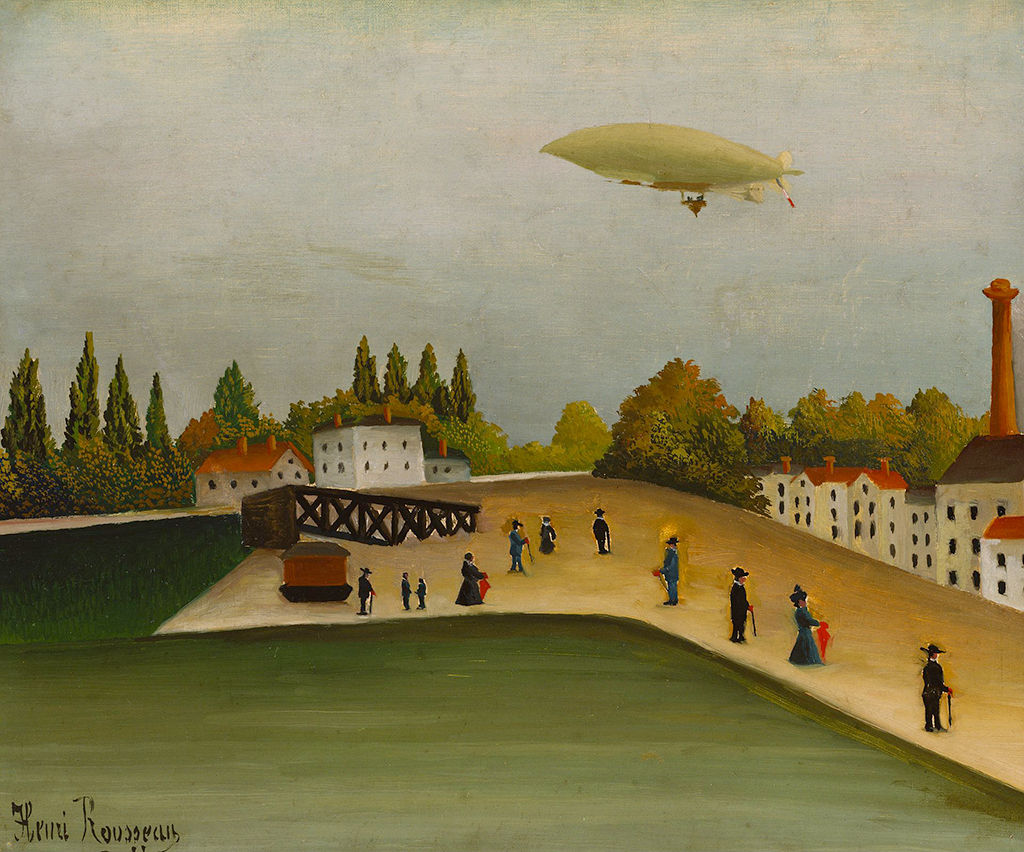
A pale airship hangs above a riverfront where people stand at intervals along a sandy quay. Below it, a metal bridge cuts across the water, houses crowd the far edges, and a tall orange chimney rises almost to the aircraft's level. Henri Rousseau's Quai d'Ivry brings these very different scales together in a small canvas: a promenade, an industrial skyline and an expanse of air that feels much larger than either. The Artizon Museum dates the oil painting to circa 1907 and records its dimensions as 46.1 × 55.0 cm.[1]
The airship attracts attention immediately, yet the shape of the shore determines how the whole picture unfolds. Its long curve gathers the scattered figures into a sequence, taking the eye from the near right corner towards the bridge on the left. Looking slowly reveals a composition whose apparent simplicity depends on an unusually precise distribution of empty space.
At a Glance
- ArtistHenri Rousseau
- SubjectQuai d'Ivry
- ExploreFollowing the bend of the quay; The bridge and the small wooden hut
This work across Henri Rousseau’s career
Carnival Evening
1886 [2]The Merry Jesters
1906 [7]The Snake Charmer
1907 [8]Quai d'Ivry (current article)
c. 1907 [9]Contents
- Following the bend of the quay
- The bridge and the small wooden hut
- People placed across an open surface
- Houses, trees and an orange chimney
- An airship suspended in the sky
- The painting's title and later collection
- Annotated details
Following the bend of the quay
The water occupies a generous area across the bottom of the painting. Its green surface meets the pale ground along an edge that changes direction several times: sweeping in from the lower right, flattening beneath the people at the centre, then turning back towards the bridge. This broken curve gives the quay a projecting, almost peninsula-like form. We see a broad surface to walk on, while the water runs beside it and reappears beyond its left edge.
That arrangement makes the foreground feel close without offering a conventional entrance. There is no path leading straight from the viewer's feet into the scene. Water lies between us and the promenade. We can trace its perimeter and imagine following the walkers, but our first position remains across the river from them. The separation helps make each figure legible as a small, detached presence against the uninterrupted pale ground.
The quay widens dramatically towards the right, where it reaches the edge of the canvas. Towards the centre it narrows between the water and the distant trees. On one side, this large sandy shape appears to recede; on the other, it spreads towards us. Rousseau keeps both effects active. The promenade can read as an immense open area and as a thin shape pressed between two greens, the river below and the foliage behind.
Across the lower water, muted horizontal touches vary the colour without breaking its continuity. The strongest green is concentrated in the channel to the left of the bridge. The near stretch is paler and greyer, offering a broad interval before the darker shoreline. These changes carry much of the foreground's interest. There are no large reflections competing with the quay's edge, and the water holds the lower part of the picture together. Low in the left corner, the dark signature interrupts this open field. Its fine, irregular strokes are quite unlike the bridge's thick bars. Set so far from the people and buildings, it draws attention to how much of the canvas Rousseau has left for the water.
The bridge and the small wooden hut
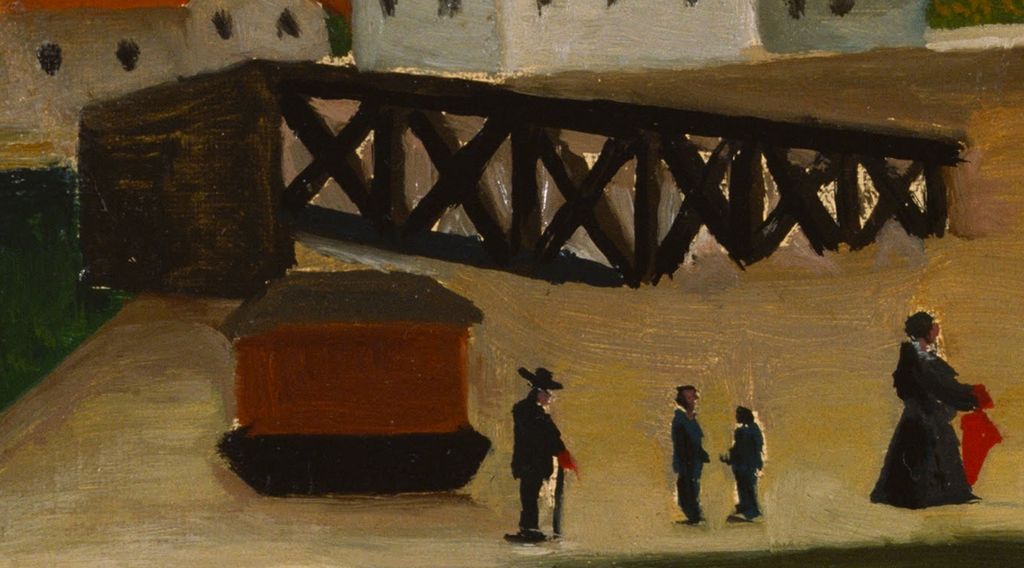
At the left, the bridge introduces a compact piece of visual machinery. Its dark upper and lower edges enclose a succession of crossing diagonal bars. Those repeated triangles give the structure a density quite different from the surrounding open surfaces. Water, ground and sky spread out; the bridge draws a narrow strip of space into a tight pattern.
Its angle also matters. The bridge extends into the scene from the left towards the centre, where it seems to meet the quay. From there, the broad bank carries the eye back towards the right. The two forms create a turn in our route through the picture. Following them resembles moving around a corner, though their geometry is simplified enough to remain readable at a glance.
A brown rectangular hut stands below the bridge on a dark base. Its warm front is plain, its roof only slightly differentiated, and its squat outline gives the left side a weight that the thin human figures cannot supply. The hut, the bridge and the white building behind them form a stack of contrasting shapes: a low brown box, a black lattice and a larger pale block with rows of windows.
This is a particularly rewarding corner to examine after looking at the airship. The aircraft is isolated against the sky, while the hut sits amid overlapping objects and changing directions. One seems to float free; the other is tightly anchored. Their difference helps explain why the composition feels both spacious and firmly assembled.
Quai d'Ivry — Henri Rousseau.
People placed across an open surface
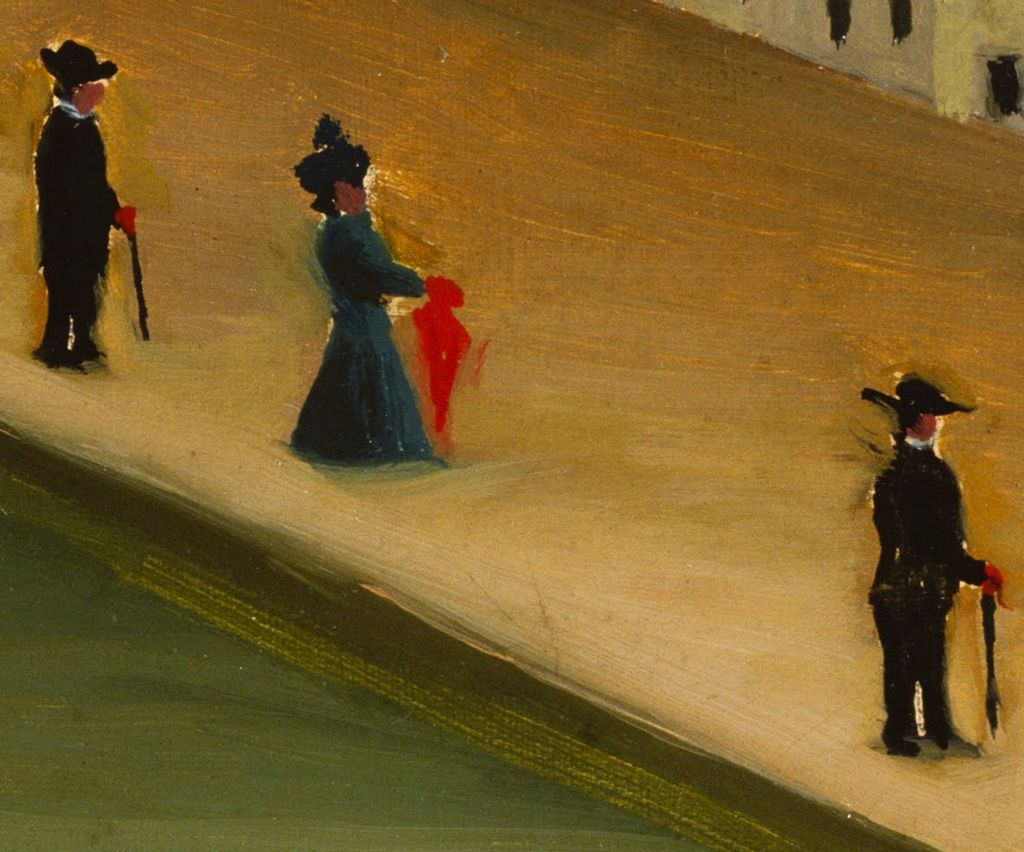
The people along the bank are small enough to require a second look. Dark hats, long dresses, narrow legs and bright accessories distinguish them with very few marks. Their spacing varies. Several gather near the hut on the left; others occupy separate positions across the centre; towards the right, the figures become larger and stand farther apart.
Two especially small forms beside the hut make the nearby adults look taller. A dark-skirted figure with a red accent stands just to their right. Farther across the bank, a blue-clad person turns into a thin vertical stroke, while the black clothing of the man beyond supplies a sharper interruption. The painting offers enough detail to invite recognition of gestures and dress, while leaving the relationships between these individuals open.
The red shapes are crucial to this miniature human world. Beside the larger woman in blue-grey near the right, a bright red parasol or umbrella makes a wedge against the pale ground. Similar touches appear beside dark figures elsewhere. They are tiny in relation to the painting, but their brightness lets the eye pick them out from a distance. Following these accents produces a second, less regular route along the shore.
No clear collective gesture gathers the figures into a crowd of spectators watching the airship. Their poses leave attention dispersed across the promenade. That leaves the aircraft available to us without making it the centre of a clearly narrated incident. We can consider what it contributes to the landscape before imagining what any particular person might think of it.
The figures also complicate the scale of the buildings. The people on the nearer bank are clearly large enough to be seen, while the distant windows are compressed into dark marks. The ground between them is broad and relatively bare. Distance is communicated through this separation, through overlap and through the changing size of forms, with each element retaining its own clear outline. The broader discussion of Rousseau's style and technique offers a way to pursue this relationship between readable shapes and constructed space.
Houses, trees and an orange chimney
The buildings on the two sides create very different rhythms. At the left, a low red roof leads towards a larger white rectangular house. Its windows are arranged in short rows, and a small extension joins it at ground level. Tall, pointed trees rise behind this group. Their repeated upward thrusts continue beyond the roofline, making a close-knit cluster of masonry and foliage.
Along the right edge, pale façades form a longer procession. Dark windows punctuate their walls; successive red roofs step through the trees towards the foreground. The buildings become larger as they approach the edge, until the nearest one is cropped. Their close spacing makes this side of the scene feel inhabited even though there is no busy street full of traffic.
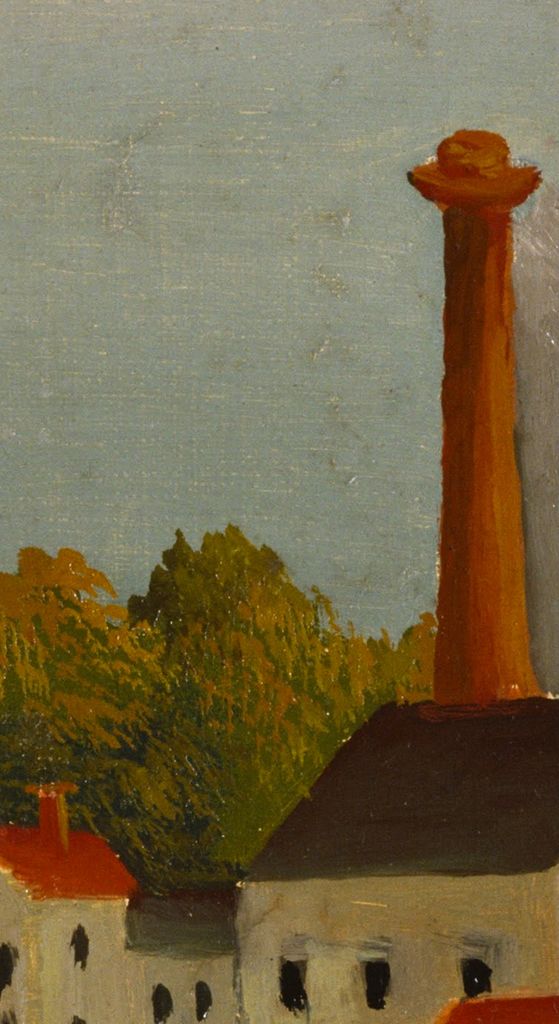
The orange chimney provides the tallest single architectural accent. A dark roof cuts across its foot, and its rounded top stands against a light patch of sky. The colour links it to the roofs, yet its unusually long, unbroken shaft singles it out. Placed so close to the right border, it also checks the outward sweep of the quay: a strong vertical beside the bank's descending diagonal.
Between the two groups of houses, the trees vary in height, outline and colour. Slender spires at the left give way to rounder masses across the centre and right. Small yellow and orange touches enliven the green, with a larger warm crown rising near the middle. These differences prevent the foliage from becoming a continuous backdrop. The treetops make their own uneven horizon, through which roofs and chimney emerge.
An airship suspended in the sky
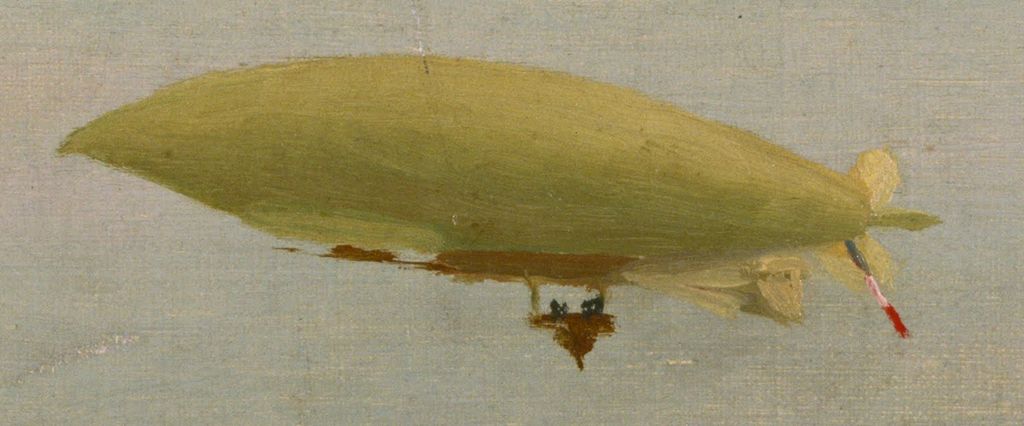
The airship sits above the central-right part of the landscape, far from both the treetops and the upper edge of the canvas. Its pale ochre body is pointed at the left and broader through the middle, with small fins towards the right. A tiny gondola hangs beneath it. The muted colour gives the large form a surprisingly gentle presence: it is easy to notice, yet it does not cut into the sky with the force of the black bridge below.
The surrounding sky is richly variable within a narrow range of light tones. Soft grey bands pass behind the aircraft, while warmer and cooler areas spread towards the edges. The clouds supply no sharp silhouette to compete with it. The airship therefore becomes the clearest shape within an immense field whose changes remain quiet and diffuse.
In the 1985 Museum of Modern Art catalogue, the identification of this craft as the Patrie is attributed to the Rousseau scholar Dora Vallier. Her argument used the airship's fins as a dating clue. The catalogue also cautioned that neither an exact location nor Rousseau's having witnessed such a flight could be established.[13]
Its relation to the chimney is especially striking. Both occupy the right half, both carry warm colour into a pale setting, and both have distinct small terminations: the chimney's cap and the aircraft's tail. But their directions diverge. One climbs almost vertically from the buildings, while the other stretches horizontally across open air. Together with the angled bridge, they give the scene three clear structural directions.
Annotated Details from Quai d’Ivry
The numbered points identify visible features discussed in this article. Return from each detail to the whole composition. Henri Rousseau, Quai d’Ivry, c. 1907. Artizon Museum, Ishibashi Foundation, Tokyo. Google Art Project reproduction via Wikimedia Commons. Image source. Public domain. Numbers added to a separate resized overview. Details cropped directly from the published original without enlargement, recolouring or retouching.
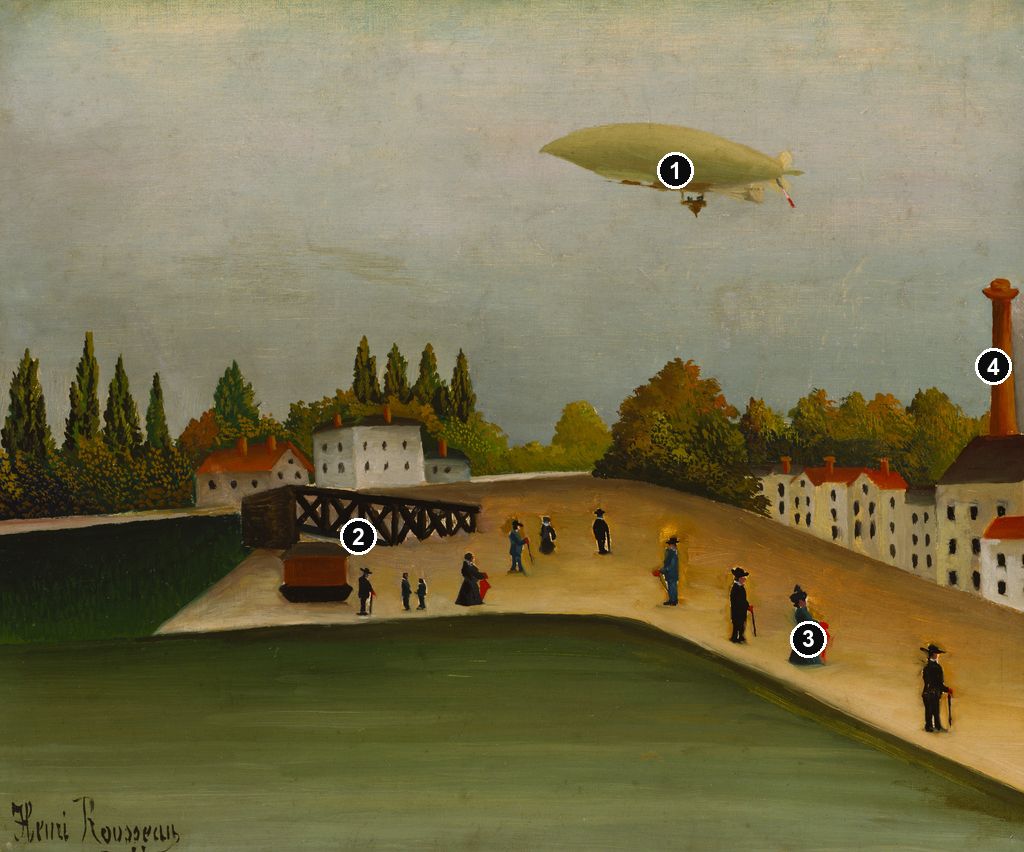
Details from QUAI D’IVRY
Compare the floating airship with the bridge, scattered walkers and chimney that give the riverfront its structure.
An airship suspended above the riverfront
A tiny gondola hangs beneath the pale envelope, with fins and a small red accent at the tail. The isolated horizontal form has room around it in the softly varied sky.
A lattice bridge above a wooden hut
Crossing black bars concentrate the bridge into a narrow band. Below it, the brown hut supplies a low solid mass beside the open water and quay.
Larger walkers and bright red accessories
Black coats and blue clothing distinguish the nearer walkers. Red umbrellas or accessories stand out against the pale ground, while the changing heights of the figures help organise the bank.
An orange chimney beside the pale sky
The long orange shaft rises from a dark roof and ends in a rounded cap. Its strong vertical gives the right edge a direction quite different from the airship’s horizontal stretch.
The painting's title and later collection
The title also has a history. According to the 1985 catalogue, Wilhelm Uhde first used Quay of Ivry for this picture in 1914. That catalogue listed it as 1908, with the Bridgestone Museum of Art, Tokyo, Ishibashi Foundation.[13] The Artizon Museum's 2025 checklist uses circa 1907 and the present institutional designation, Artizon Museum, Ishibashi Foundation.[1]
Artizon identifies the Japanese artist Hazama Inosuke as a former collector of Quai d'Ivry. Its 2025 Hazama retrospective brought the painting into the account of his engagement with Western art; the exhibition ran from 1 March to 1 June. The museum does not give a purchase date or price for his acquisition in that account.[9]
Henri Rousseau artworks directory
This directory brings together works covered on this site and other works documented in the cited museum records and catalogues. Alternate titles share one entry; distinct versions remain separate. Historical dates for works without an article follow the cited catalogues. This is not a catalogue raisonné.
Frequently Asked Questions
The Artizon Museum's 2025 checklist dates it to circa 1907.[1]
It belongs to the Artizon Museum, Ishibashi Foundation, in Tokyo.[1]
Dora Vallier identified it as the Patrie, an attribution reported in the 1985 MoMA catalogue.[13]
The 1985 catalogue treats the exact location as uncertain.[13] The title alone cannot fix every painted feature to a verified viewpoint.
Discussion
Look again at the images and ideas explored in Quai d'Ivry. These editorial prompts invite your observations.
Reader Insights
Follow the edge of the water from right to left. Where does the sense of depth become strongest?
How does the airship's pale colour affect its relationship to the much darker bridge?
Which small red accents connect the people, architecture and sky?
Join the Conversation
Share a detail, comparison or question about Quai d'Ivry below.
References
- Artizon Museum, Ishibashi Foundation. HAZAMA Inosuke: list of works, 2025, explanatory notes p. 1; p. 5, no. 045. View source.
- Philadelphia Museum of Art, Carnival Evening,1963-181-64,object59593. View source.
- Musée de l’Orangerie / Juliette Degennes, Henri Rousseau,L’ambition de la peinture: Un artiste dans son époque (in French). View source.
- National Gallery, Surprised!, NG6421. View source.
- Musée d’Orsay, La Guerre,RF19461 (in French). View source.
- MoMA, The Sleeping Gypsy. View source.
- Philadelphia Museum of Art, The Merry Jesters, 1950-134-176, object51097. View source.
- Musée d’Orsay, La Charmeuse de serpents, RF 1937 7 (in French). View source.
- Artizon Museum, Ishibashi Foundation. HAZAMA Inosuke, exhibition page, 1 March–1 June 2025, “About this exhibition” and artwork listing. View source.
- Musée de l’Orangerie, La Carriole du Père Junier, RF 1960 26 (in French). View source.
- Solomon R. Guggenheim Museum / Cornelia Lauf, The Football Players,60.1583: current collection record. View source.
- MoMA, The Dream, 252.1954. View source.
- Museum of Modern Art. Henri Rousseau: Essays, 1985, catalogue entry 42, “The Quay of Ivry,” p. 196 (PDF p. 201); reports Vallier's 1970 identification. View source.
- The Museum of Modern Art, Henri Rousseau: Essays (1985), selected catalogue entries, chronology and notes on early devotees. View source. Selected entries, chronology (pp.91–95) and early-devotee notes (pp.262–264) were consulted. Historical collection credits do not establish present ownership.
- Daniel Catton Rich, Henri Rousseau (The Museum of Modern Art, 1942), selected drawings and landscape studies; historical catalogue. View source. The dated 1942 publication is used for the two Quai d’Auteuil ink views; its Malakoff date differs from the 1985 catalogue.
- MANAS, Laval, Henri Rousseau, dit le Douanier, urban landscapes and preparatory study (in French). View source.
- National Gallery of Art, Self-Portrait (1895), pen-and-ink drawing, accession 1995.47.66. View source.
- The Museum of Modern Art, War (published January 1895), lithograph, accession 684.1943. View source.
- Barnes Foundation, Landscape and Four Young Girls, object 5521, BF855. View source.


 Henri Rousseau.jpg)


 Henri Rousseau.jpg)