



 by Tom Gurney
Tom Gurney BSc (Hons) is an art history expert with over 20 years experience
Published on June 19, 2020 / Updated on October 29, 2026
Email: tomgurney1@gmail.com / Phone: +44 7429 011000
Sawmill, Outskirts of Paris: Introduction
The road takes a long way round. Entering at the lower left of Henri Rousseau’s Sawmill, Outskirts of Paris, it sweeps beneath a hedge, bends towards a brick gatepost and carries the eye to a small group beside a tree. The Art Institute of Chicago dates the painting to about 1893–95.[1] Its modest building occupies one end of a surprisingly intricate landscape: pale heaps descend from its walls, a second stack stretches towards the gate, and red fruit punctuates the branches overhead. Almost everything seems still, yet the picture gives our eyes several routes to follow.
At a Glance
- ArtistHenri Rousseau
- SubjectSawmill, Outskirts of Paris
- ExploreThe mill above the pale stacks; Following the bend in the road
This work across Henri Rousseau’s career
Carnival Evening
1886 [2]Sawmill, Outskirts of Paris (current article)
c. 1893–1895 [1]The Merry Jesters
1906 [7]The Snake Charmer
1907 [8]Contents
- The mill above the pale stacks
- Following the bend in the road
- A tree with room around its branches
- The people at the gate
- Colour across a quiet skyline
- From a private collection to Chicago
- Annotated details
The mill above the pale stacks
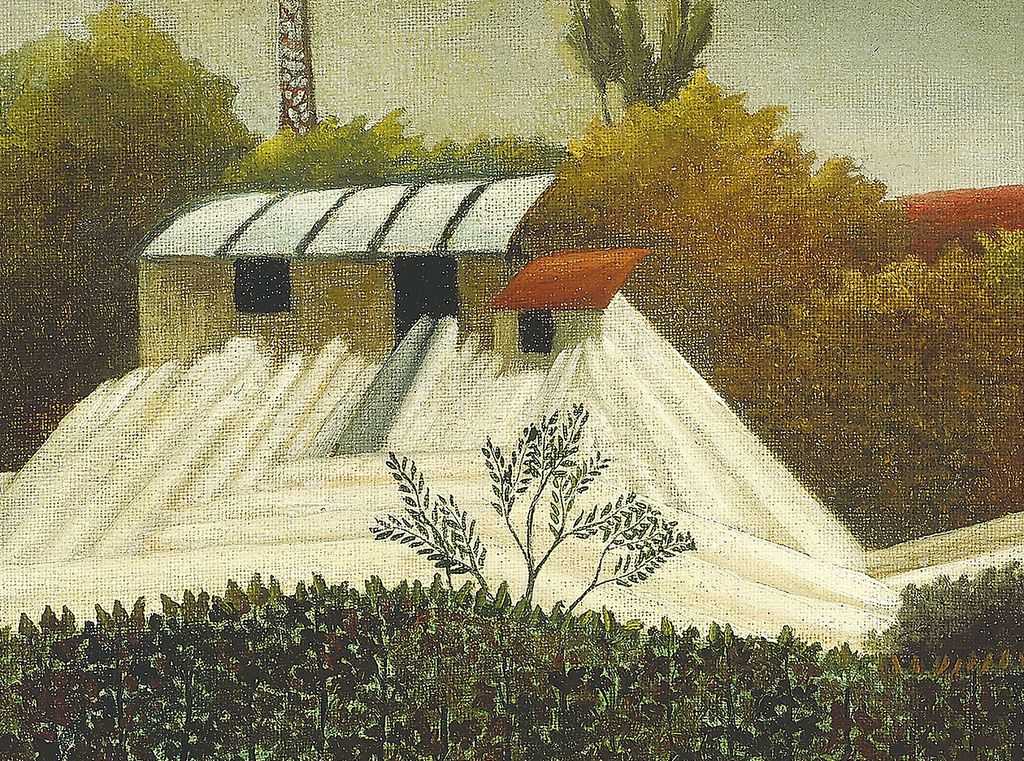
Rousseau places the building high on the left, leaving its base largely concealed. Brown walls hold dark openings; above them, a pale curved roof is divided into sections by strong dark bands. A small red canopy projects beside the larger structure. These are economical shapes, but their differences matter. The roof arches gently, the walls stand upright, and the canopy cuts a short diagonal across the foliage. Seen against the grey sky and rounded treetops, the building is easy to locate without occupying much of the canvas.
The pale material beneath it gives this corner its force. Long sloping forms, apparently stacks of timber or boards, descend towards the hedge. Their upper edges make a succession of narrow ridges, with darker channels running between them. One slope meets a dark opening in the building, so that the eye can connect the stored material with the structure behind it. Towards the centre, another elongated pale stack lies lower and reaches across the picture. Its narrow crest catches the same light colour as the heaps on the left.
These stacks can look almost mountainous when the picture is seen small. Look longer and the repeated edges suggest something arranged and piled. The title supplies a context for reading them as timber, while the painting concentrates on their visible mass and direction. There is little description of work being performed: the building’s openings are dark, and no moving machinery explains what happens inside. Our attention settles on the material accumulated outside and on the curious shapes it makes against growing vegetation.
The pale surfaces are especially striking because their neighbours are so dark. Foliage runs behind them and a dense hedge cuts across their lower edges. Their creamy colour breaks the landscape into separate reaches: high slopes beneath the mill, a lower length towards the centre, and the road crossing below. Each catches the eye with a similar brightness. The heaps alone cannot tell us the season; the green ground and red fruit deserve equal attention.
Following the bend in the road
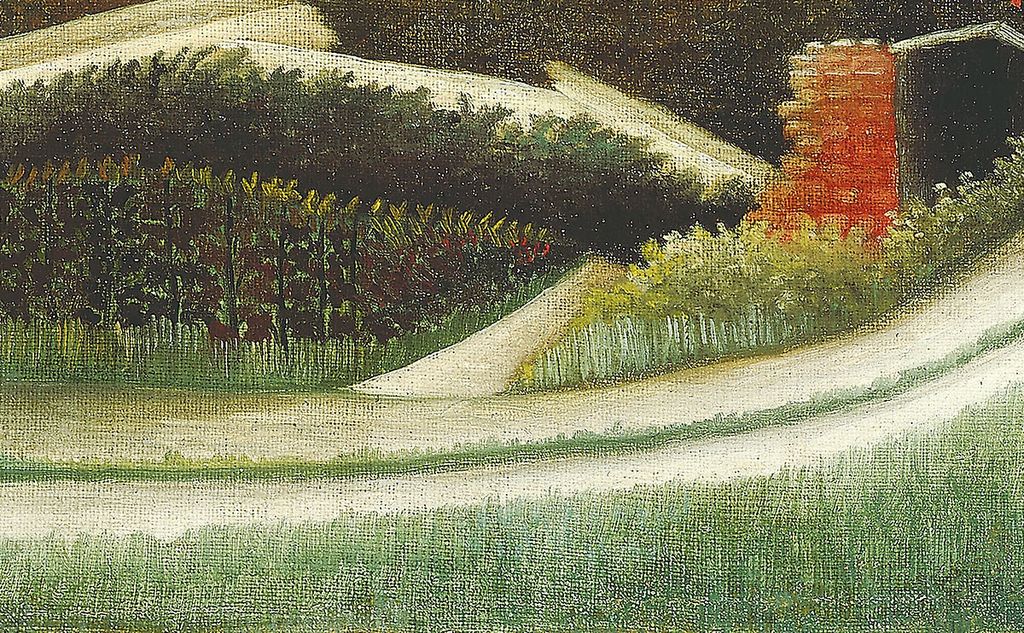
The road is the largest continuous light shape in the lower half. Its two pale tracks are separated by a thin strip of green, which follows the bend almost to the figures. At the left edge the tracks seem broad enough to enter. As they turn right they narrow, rise and disappear beyond the gate. The sweep gives the scene a patient rhythm: we pass the whole length of the hedge before reaching the place where people stand.
A smaller pale route breaks away near the centre and approaches the brick post from the other side. This junction matters. It gathers the scattered spaces of the landscape into one point, connecting the area before the timber stacks with the road outside. The gatepost becomes a hinge between the two. Its red masonry is easy to miss beside the much larger tree, yet it helps explain how the roads and boundaries fit together.
The curves also change our sense of distance. The hedge runs almost straight across much of the canvas, while the road bows towards us and then slips away. We see enough of its surface to imagine walking along it, but the distant turn arrives quickly. Building, stacks, hedge and gate are pressed into a shallow stretch beneath the skyline. This makes the journey feel both legible and oddly compact, as though the road has been bent to bring all its destinations within view.
The picture is an oil on canvas only 25.5 by 45.5 centimetres, with Rousseau’s name inscribed at the lower left.[1] Its wide proportions allow the road to travel horizontally before it turns. In a taller format, the left-hand building and right-hand tree might read as separate subjects. Here the pale arc continually joins them, carrying the eye beneath the intervening hedge. The small signature sits close to the road’s entrance, in the narrow foreground strip where the view seems nearest to us.
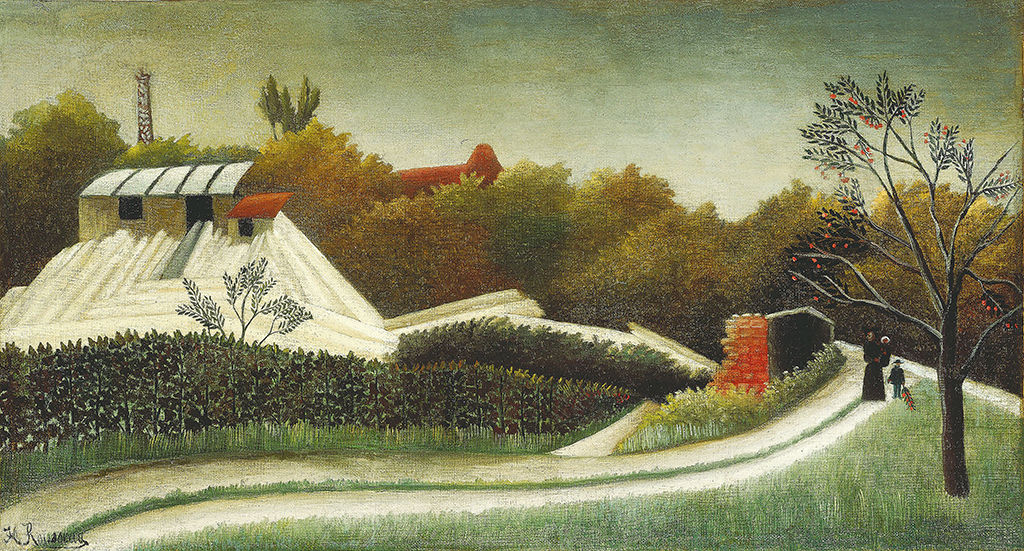
Sawmill, Outskirts of Paris — Henri Rousseau.
A tree with room around its branches
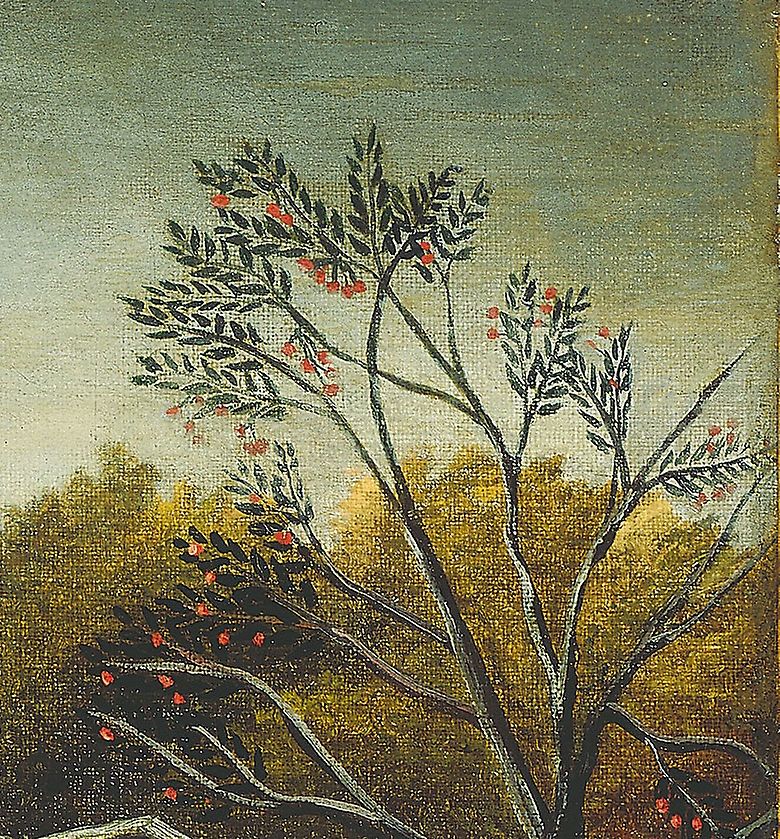
The right-hand tree answers the mill across the width of the painting. Its trunk rises from open green ground, forks into several grey limbs and spreads across the sky. Small groups of narrow leaves cluster at the branch tips. Red fruit hangs between them, sometimes singly, sometimes in little groups. Because the foliage is sparse, the branching structure remains visible. The tree has the clarity of a drawn outline without losing the irregularities that make the eye move from one limb to the next.
Its position introduces another kind of scale. The trunk stands much nearer than the people, and its crown reaches well above the roof on the opposite side. A branch stretches across the area above the figures, framing their approach to the gate. Other branches reach towards the edge of the canvas and seem to continue beyond it. The mill is held within its enclosing foliage; the tree opens out towards the viewer and the surrounding air.
A smaller sapling rises behind the hedge on the left. Its thin, light branches are easy to overlook against the pale stacks. Once noticed, it changes the balance of the painting: the large foreground tree now has a delicate counterpart near the building. Both show leaves as distinct little strokes, while the background trees merge into broad rounded crowns. Rousseau makes growth visible at several distances by varying how much of each plant we can pick out.
That variation is part of the pleasure of looking closely. The hedge is crowded with upright marks and small green and reddish touches. The grass below it has a finer, more even grain. Above, the distant foliage gathers into ochre and brown masses. These different surfaces share a narrow strip of land but ask to be seen at different speeds. The path offers an immediate, sweeping line; the hedge makes us pause over many small interruptions. More on this handling of outlines and repeated marks appears in Rousseau’s style and technique.
The people at the gate
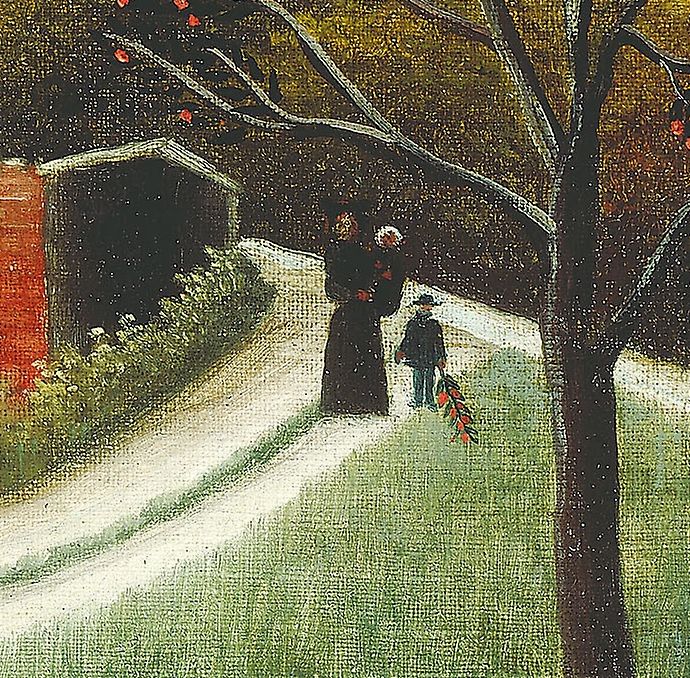
The small group appears where several lines converge: the road’s bend, the dark gate and the lower branches of the tree. The larger figure wears a long black dress. A small round white form sits close to the shoulder, and another small figure stands to the right. Their arrangement invites a domestic reading, but the image does not establish their names or relationships. The white form remains particularly difficult to describe confidently at this size.
Rousseau gives them very little space and considerable visual weight. The black dress stands out against the pale road; the white round shape catches the eye within that dark accent. Nearby, the brick post adds a warmer block of colour. Together they make a small concentrated passage after the long green and cream sweep across the foreground. The people seem within reach of the gate, although their precise action remains suspended.
They also alter how the mill is experienced. Without them, the road might feel like an arrangement of pale ribbons around stored timber. Their presence supplies a human measure for the journey. We can imagine the length of the hedge in relation to their small bodies and the height of the fruiting tree above them. The landscape accommodates people passing through it, while keeping its largest spaces for grass, material, branches and sky.
Annotated Details from Sawmill, Outskirts of Paris
The numbered points identify visible features discussed in this article. Return from each detail to the whole composition. Henri Rousseau, Sawmill, Outskirts of Paris, c. 1893–95. Art Institute of Chicago, 1950.133. Bequest of Kate L. Brewster. Museum image published on Wikimedia Commons in 2018. Image source. CC0 / Public domain. Numbers added to the overview; details cropped from the complete published original. No recolouring or retouching.
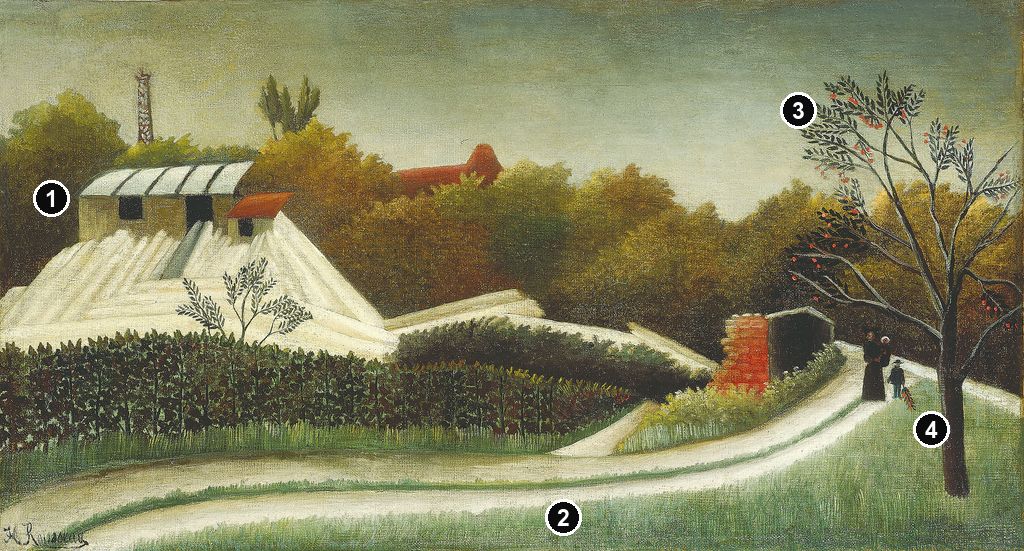
Details from SAWMILL, OUTSKIRTS OF PARIS
Follow the pale stacks and bending road, then compare the open fruiting branches with the small group waiting by the gate.
Pale stacks beneath a divided roof
Dark bands divide the curved roof, while narrow ridges run down the pale stacks below. A small red canopy adds a warm accent among the cream slopes and dark openings.
Two tracks around the hedge
A thin green strip separates the pale road tracks as they curve towards the gate. A smaller route joins them beside the brick post, gathering several directions into one compact junction.
Red fruit among open branches
Small red forms hang between narrow leaves. Gaps in the foliage expose the branching structure against the sky, giving this tree a more open outline than the rounded crowns behind the mill.
A small group beside the gate
The long dark dress stands out against the pale road, with a smaller companion close by. The pale round form near the shoulder remains difficult to identify; their names and relationships are unknown.
Colour across a quiet skyline
Red travels through this restrained painting in small instalments. The canopy beside the mill, the roof visible above the distant foliage, the brick gatepost and the fruit on the right make a loose chain across the canvas. Each belongs to a different kind of object. Their shared warmth helps the eye find connections across the much larger fields of olive, brown and grey, without making every red touch equally prominent.
Above the building, a narrow lattice structure and two tall, slender tree forms interrupt the sky. Farther right, the red roof has an unusual raised shape at one end. Rousseau leaves much of the surrounding architecture hidden behind foliage, giving these fragments particular emphasis. We see an upper edge here, a vertical there, enough to feel that more continues beyond the immediate enclosure. The wide grey sky gives these small protrusions room to register.
Writing in 1942, Daniel Catton Rich placed this painting among Rousseau’s suburban subjects and connected it with an increasing coherence of shape and variety of texture.[12] The visible contrasts reward that approach: the divided roof, ridged stacks, dense hedge and open branches each keep their own character. Their arrangement makes a close-knit scene whose parts remain unusually easy to distinguish.
From a private collection to Chicago
The Art Institute’s provenance places the painting with Paul Guillaume by 1927, Valentine Dudensing in New York in 1929, and Walter and Kate Brewster by 1933. It entered the museum through Kate L. Brewster’s bequest in 1950, becoming accession 1950.133.[1] Rich’s 1942 catalogue reproduced it while it was still in the Brewster collection.[12]
That older reproduction preserves the same distinctive arrangement: the pale slopes beneath the roof, low central stack, curving foreground road and solitary branching tree. These features make the painting recognisable even without colour. In the colour image, however, the red canopy, post and fruit add another set of connections. The scene can be followed as an almost diagrammatic pattern of dark and light, then explored again through its scattered warm accents and carefully differentiated greenery.
Henri Rousseau artworks directory
This directory brings together works covered on this site and other works documented in the cited museum records and catalogues. Alternate titles share one entry; distinct versions remain separate. Historical dates for works without an article follow the cited catalogues. This is not a catalogue raisonné.
Frequently Asked Questions
The Art Institute of Chicago gives about 1893–95; its structured record also carries the broader range 1888–1895.[1]
They appear to be timber or boards arranged in sloping stacks, a reading supported by the sawmill title. Their pale colour by itself does not establish snow or winter.
The larger figure wears a long dark dress, with a small pale round form near the shoulder and a smaller companion to the right. The image does not establish their identities or relationships.
Discussion
Look again at the images and ideas explored in Sawmill, Outskirts of Paris. These editorial prompts invite your observations.
Reader Insights
How does the long bend in the road change the way you approach the small group at the gate?
Which details connect the fruiting tree with the mill across the canvas?
How does the scene change when you concentrate on its dark and light shapes instead of its colours?
Join the Conversation
Share a detail, comparison or question about Sawmill, Outskirts of Paris below.
References
- Art Institute of Chicago. Sawmill, Outskirts of Paris, 1950.133, current object record, metadata and provenance; accessed 23 October 2026. View source.
- Philadelphia Museum of Art, Carnival Evening,1963-181-64,object59593. View source.
- Musée de l’Orangerie / Juliette Degennes, Henri Rousseau,L’ambition de la peinture: Un artiste dans son époque (in French). View source.
- National Gallery, Surprised!, NG6421. View source.
- Musée d’Orsay, La Guerre,RF19461 (in French). View source.
- MoMA, The Sleeping Gypsy. View source.
- Philadelphia Museum of Art, The Merry Jesters, 1950-134-176, object51097. View source.
- Musée d’Orsay, La Charmeuse de serpents, RF 1937 7 (in French). View source.
- Musée de l’Orangerie, La Carriole du Père Junier, RF 1960 26 (in French). View source.
- Solomon R. Guggenheim Museum / Cornelia Lauf, The Football Players,60.1583: current collection record. View source.
- MoMA, The Dream, 252.1954. View source.
- Daniel Catton Rich. Henri Rousseau, Museum of Modern Art, 1942, printed pp. 20–21 (PDF pp. 25–26), including reproduction and caption on p. 21. View source.
- The Museum of Modern Art, Henri Rousseau: Essays (1985), selected catalogue entries, chronology and notes on early devotees. View source. Selected entries, chronology (pp.91–95) and early-devotee notes (pp.262–264) were consulted. Historical collection credits do not establish present ownership.
- Daniel Catton Rich, Henri Rousseau (The Museum of Modern Art, 1942), selected drawings and landscape studies; historical catalogue. View source. The dated 1942 publication is used for the two Quai d’Auteuil ink views; its Malakoff date differs from the 1985 catalogue.
- MANAS, Laval, Henri Rousseau, dit le Douanier, urban landscapes and preparatory study (in French). View source.
- National Gallery of Art, Self-Portrait (1895), pen-and-ink drawing, accession 1995.47.66. View source.
- The Museum of Modern Art, War (published January 1895), lithograph, accession 684.1943. View source.
- Barnes Foundation, Landscape and Four Young Girls, object 5521, BF855. View source.


 Henri Rousseau.jpg)


 Henri Rousseau.jpg)