



 by Tom Gurney
Tom Gurney BSc (Hons) is an art history expert with over 20 years experience
Published on June 19, 2020 / Updated on October 29, 2026
Email: tomgurney1@gmail.com / Phone: +44 7429 011000
Seine and Eiffel Tower in the Sunset: Introduction
The Eiffel Tower rises out of a bank of trees, its open framework caught against a pale evening sky. Beside it hangs a small, perfectly round sun. Below, a bridge cuts across the picture and divides the glowing river into separate openings. Henri Rousseau gives each of these familiar things a firm, memorable shape, then binds them together through the warm light running across the scene.
Known here as Seine and Eiffel Tower in the Sunset, the painting belongs to the Pola Museum of Art, which calls it View of the Eiffel Tower and the Trocadero. The museum dates this oil on canvas to 1896–1898 and records dimensions of 49.7 × 65.5 cm.[1] Its sunset is expansive, yet the space available to the viewer feels surprisingly intimate: trees close in at either side, while a great block of stone occupies the near right corner.
At a Glance
- ArtistHenri Rousseau
- SubjectSeine and Eiffel Tower in the Sunset
- ExploreA tower among the trees; A sunset built in bands
This work across Henri Rousseau’s career
Carnival Evening
1886 [2]The Merry Jesters
1906 [7]The Snake Charmer
1907 [8]Contents
- A tower among the trees
- A sunset built in bands
- The bridge and its small repetitions
- Boats, figures and the near bank
- The stone at the edge of the picture
- Looking across the whole scene
- Annotated details
A tower among the trees
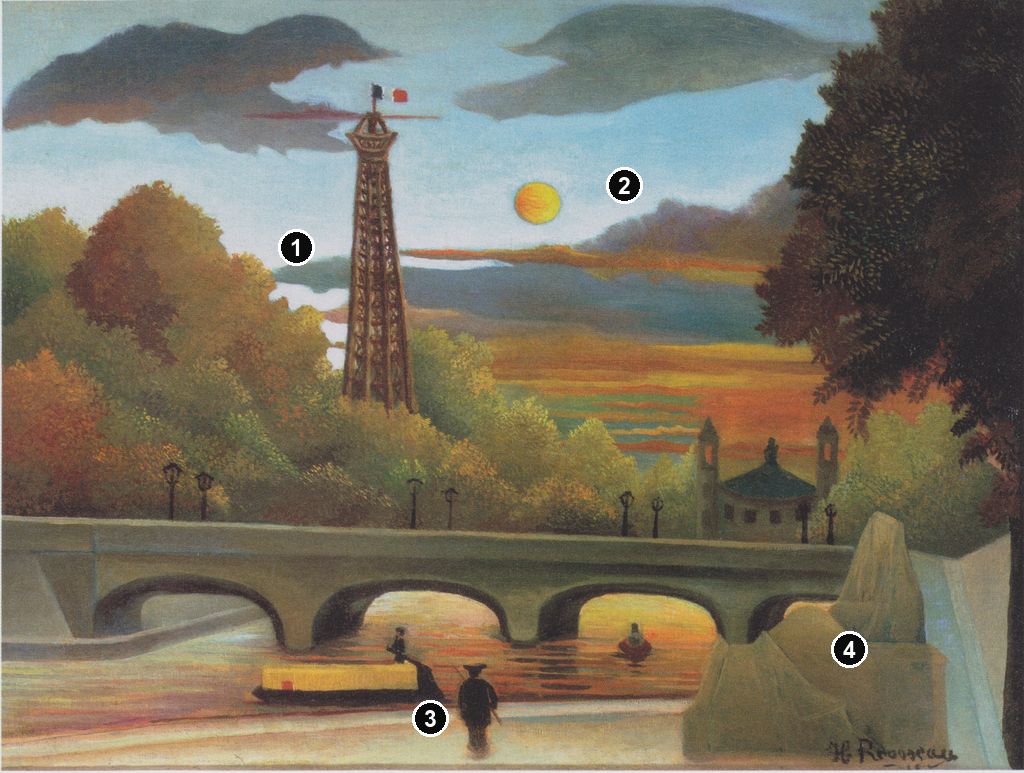
Rousseau places the tower to the left of centre, leaving room for the sun and the low building beyond the bridge. Its brown and gold lattice is a narrow, intricate structure amid rounded foliage. A small tricolour flies at the top. The tower's legs disappear into the leaves, so that the familiar monument seems to grow from the same dense bank as the trees. These details can be seen particularly clearly in the institutional reproduction published by Nerima City in 2017.[12]
The foliage hides much of the tower's base, but its height remains unmistakable. Its taper carries the eye through several different zones of the painting: yellow-green leaves, a cooler strip of distance, the pale sky and finally the dark clouds. This upward route makes a useful first journey through the composition. Looking down again, the viewer meets the dense network of diagonals within the tower, whose small repeated compartments offer a different kind of intricacy from the flecked surfaces of the trees.
At the summit, a thin red horizontal mark extends into the sky. Close by, the little flag adds another abrupt touch of colour. Both are tiny in relation to the surrounding clouds, yet they keep the highest part of the structure sharply legible. The monument has a precise ending; the neighbouring tree crowns spread irregularly. That difference gives the tower an almost diagrammatic clarity without detaching it from the landscape.
Its position also matters. Had the tower stood in the middle, the whole scene might have gathered around a single vertical axis. Here, the circular sun sits to its right and the dark tree presses in from the far edge. The viewer moves among three unequal shapes: a slender structure, an isolated disc and an immense leafy mass. Their spacing gives the upper half of the painting an alert, slightly unsettled balance.
A sunset built in bands
The sun is a compact yellow-orange circle surrounded by comparatively pale sky. Its clear outline makes it seem still, even as the clouds spread and change direction around it. The warmest colour lies lower down, in long orange and coral bands above the bridge. Rousseau has separated the luminous disc from much of the fiery colour we might expect immediately around it. The distance between the two encourages the eye to travel across the sky rather than settle on the sun alone.
Above, grey-blue clouds reach inward from the left and hover across the upper centre. Their broad shapes have dark rounded tops and softer undersides. The gap between them opens around the tower's summit. Farther down, narrow cloud strips run horizontally, crossing behind the monument and disappearing into the trees on the right. The sky contains several different scales of movement: large overhead masses, long thin streaks and small changes of colour near the horizon.
These layers give the evening a measured pace. The tower rises through them, while the bridge repeats their horizontal direction below. Even the river participates, carrying short coloured strokes across its surface. Sky and water consequently seem related without becoming mirror images. The clouds retain broad, continuous shapes; the river breaks its light into bars and interrupted patches.
The colour also changes the apparent weight of things. The pale sky opens a large space behind the tower, whereas the yellow and ochre leaves gather into a solid belt below. On the right, the dark crown of the near tree makes the evening brightness look more intense. The warm glow is strongest where it meets something darker: foliage, a bridge arch, a boat or the shadowed side of a stone. Light becomes a way of articulating the separate parts of the scene.
The bridge and its small repetitions
The bridge sits low in the picture, stretching almost across the whole width of the canvas. Its pale upper edge forms a long line beneath the foliage. Below that line, the masonry divides into piers and dark arch openings. Four openings are visible, although the one at the right is partly interrupted by the large foreground stonework. Each offers a separate glimpse of the coloured water beyond.
Rousseau varies those glimpses. The left opening contains paler water and a curving light bank. The central openings reveal warmer orange reflections and darker horizontal marks. At the right, the near stone closes off part of the view. The arches therefore create a sequence without giving us four identical units. Moving along them, the eye experiences small adjustments in colour, visibility and depth.
The lamps along the parapet supply another rhythm. Thin dark stems rise above the bridge, ending in small curls and rounded shapes. Set against light foliage, they remain individually readable. Their delicacy is striking beside the heavy piers below. The bridge combines a substantial continuous body with these fragile upright accents; the picture repeatedly asks us to change the scale at which we look.
Behind the bridge, to the right of centre, a pale building appears between the trees. Two slender towers flank its low green roof, and a small dark form rises above the middle. The building is much less commanding than the Eiffel Tower, but it has a similar capacity to catch the eye through silhouette. Its paired uprights answer both the lamps and the tower's taper, introducing a cluster of vertical shapes near the opposite side of the canvas.
The Pola Museum identifies the bridge as the Pont des Invalides and connects the two distant monuments with the Paris exhibitions of 1878 and 1889: the Trocadéro Palace with the earlier exhibition, the Eiffel Tower with the later one.[13] These names give the view a historical setting. Within the painting, their relationship is experienced first through height, breadth and the trees that separate them.
Boats, figures and the near bank
Under the bridge, the scene becomes inhabited. A low boat with a yellow covering lies toward the left, its long dark hull riding across the bright water. A small black figure appears above its right end. Farther back, a reddish boat carries a pale figure near one of the central arches. Their different sizes help establish a distance that the broad colour bands might otherwise flatten.
The near figure draws attention through its dark clothes and black hat. This person faces into the scene, close to the centre of the lower edge. The head and shoulders are clearly separated from the warm water, while the lower body meets a pale area of bank. The figure's turned back offers a quiet parallel to our own act of looking across the river.
Its position brings a subtle pause into the composition. Around it, the boats extend sideways and the reflection strokes run horizontally; above it, the arches carry the eye along the bridge. The standing body interrupts those movements with a short vertical. It repeats, at a much smaller scale, the upward direction of the tower. The city contains human presences, but their scale remains modest beside the architecture and trees.
The two boats also give the river more than a decorative function. One occupies the near stretch of water; the other sits farther away beneath the bridge's span. Between them, dark strokes mark the bright surface without describing every ripple. The river becomes a space through which these small craft could move, even though the painted moment feels suspended. Its warmth joins distant sky to near bank while the vessels supply distinct points of occupation.
Annotated Details from Seine and Eiffel Tower in the Sunset
The numbered points identify visible features discussed in this article. Return from each detail to the whole composition. Henri Rousseau, View of the Eiffel Tower and the Trocadero, 1896–1898. Pola Museum of Art, collection entry 006-0369. Image via WikiArt. Image source. Public domain. Numbers added to a separate resized overview. Details cropped directly from the published original without enlargement, sharpening, recolouring, cleaning or retouching.
Details from SEINE AND EIFFEL TOWER IN THE SUNSET
Follow the tower into the sky, then cross the bridge and return to the boats and near stone. Each detail changes the scale at which the city is seen.
A tower rising through the leaves
The tower’s taper and lattice make a narrow vertical among rounded tree crowns. Its lower legs disappear into foliage, while the small flag gives its summit a precise ending against the clouds.
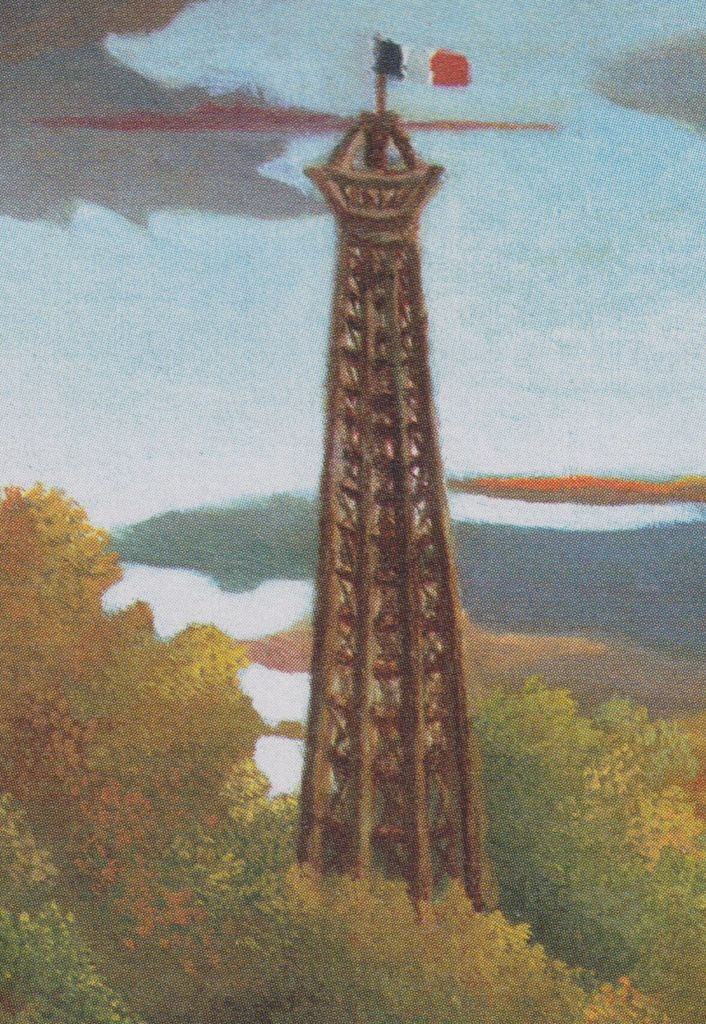
The sun between bands of cloud
The round yellow-orange disc sits apart from the strongest warm band below. Broad clouds and long horizontal strips give the sky several different rhythms around that compact circle.
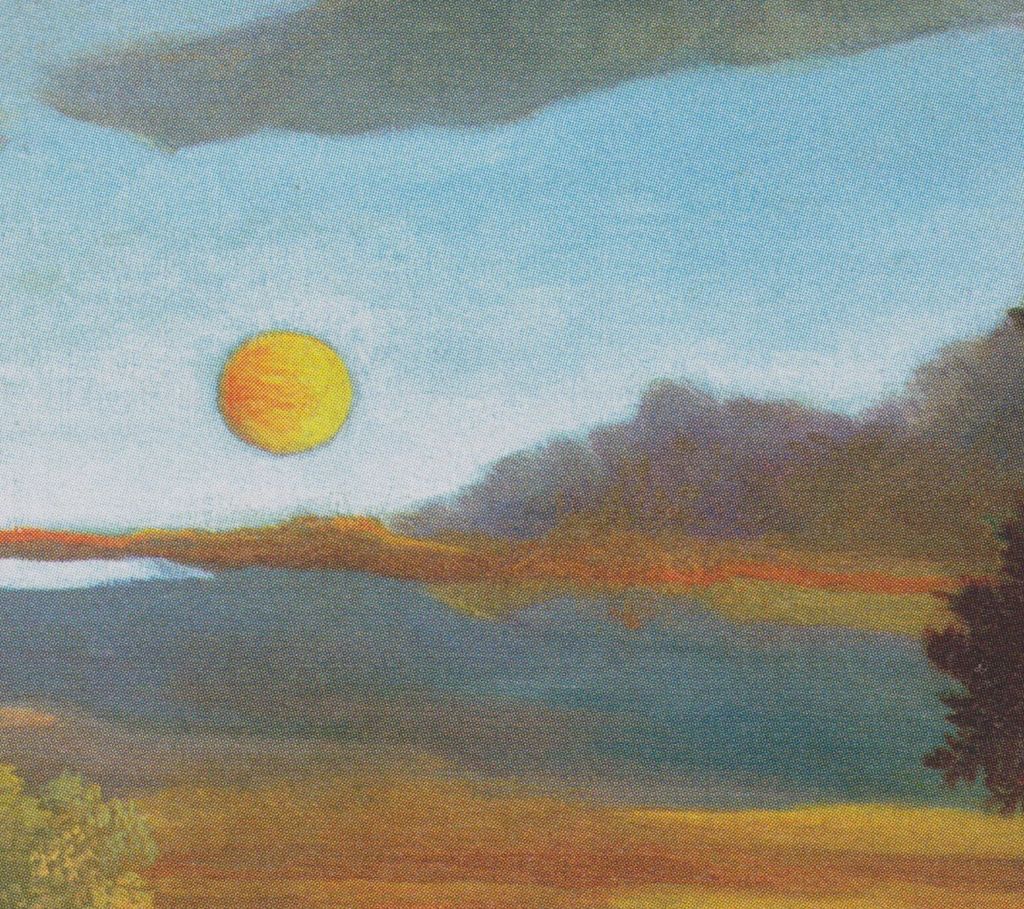
Boats and figures beneath the arches
Dark arches separate glimpses of the bright water. The covered boat and smaller distant craft establish different depths, while the near figure interrupts their sideways movement with a short upright shape.
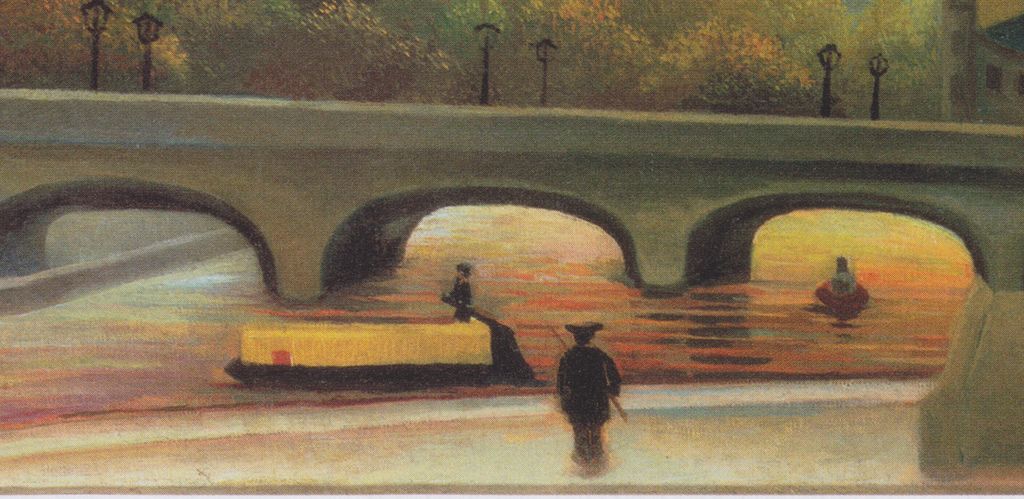
Distant towers behind near stone
The small paired towers rise beyond the bridge, but the large angular stonework presses into the foreground. Their difference in scale makes the river view feel both open and partly obstructed; the signature rests near the lower edge.
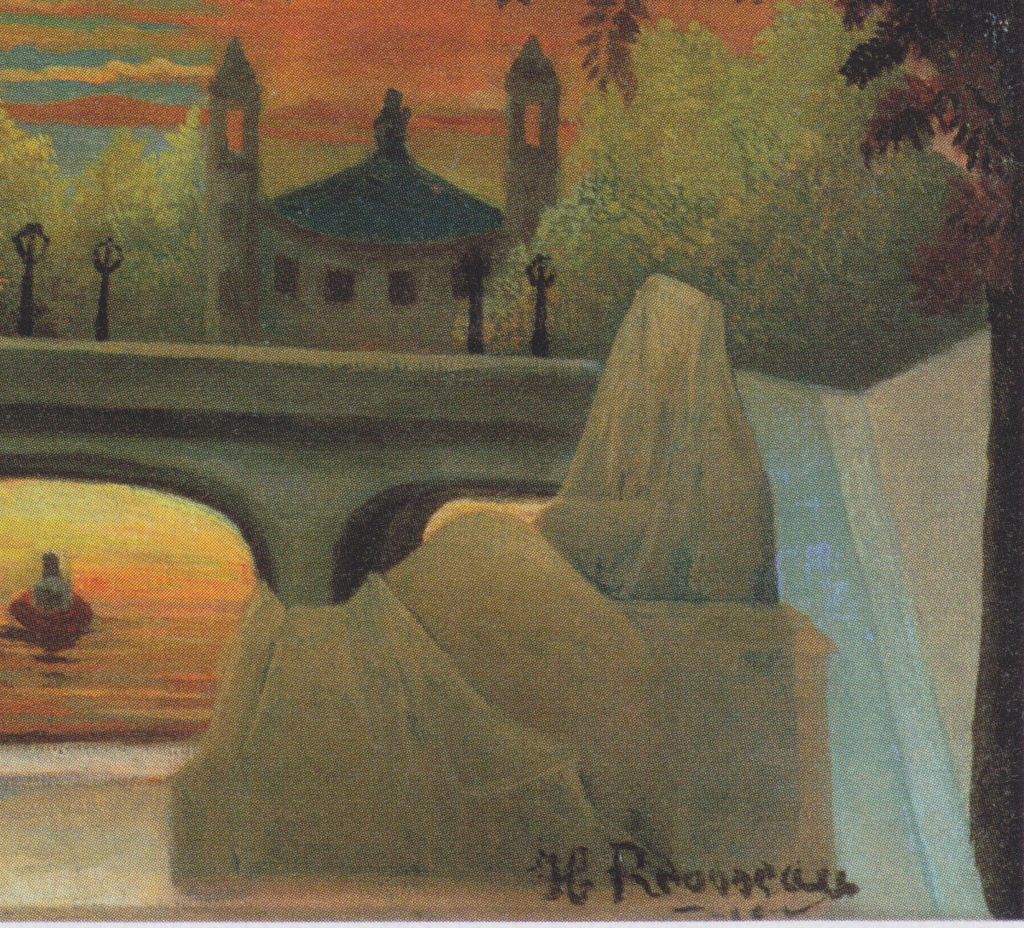
The stone at the edge of the picture
The foreground stonework on the right is one of Rousseau's boldest decisions. A large angular mass projects into the river view, topped by a narrower upright block. Its sloping planes catch different shades of pale ochre and green-grey. Beyond it, a light wall runs to the edge of the canvas. These hard surfaces contrast with the small rounded leaves immediately above them.
This is the nearest substantial object in the scene, and it conceals a considerable amount. It blocks part of the rightmost arch and cuts across the water. The viewer must look past it to reach the distant building. That obstruction gives the riverbank a physical presence: the scene seems encountered from beside a solid parapet, with stone close enough to dominate one corner. The exact place from which the landscape was constructed remains uncertain.
The tree above performs a related function. Its trunk is largely outside the picture, but its dense crown spreads inward and downward, carrying a few hanging sprigs toward the building. At the left, a lighter bank of trees closes the other side. The two edges differ in colour, height and proximity. Together they contain the open sky and guide the view toward the tower, sun and bridge.
Rousseau's signature sits low on the right against the pale foreground. In this small area, the picture brings several different kinds of mark together: angled stone divisions, a light strip of bank, dark lettering and the almost black edge of the framing tree. The corner rewards inspection after the more conspicuous tower and sun have drawn the first glance.
Looking across the whole scene
The painting's effect depends on how these clear forms coexist. The sun is round, the tower tapers, the bridge stretches, and the stone projects. Each can be grasped quickly. Looking longer reveals that each also complicates the space around it: the sun floats between cloud layers, the tower loses its feet in foliage, the bridge reveals distance through dark openings, and the foreground block hides the river it helps to locate.
Readers exploring Rousseau's style and technique can see here how much the composition gains from such distinct boundaries. Leaves remain richly varied within their larger masses; architecture retains its silhouette; small people and lamps remain visible against broad areas of colour. The surface has abundant detail, but the main shapes continue to hold it together.
The picture was reproduced prominently on Nerima City's 11 April 2017 newsletter front page for a Paris exhibition at Nerima Art Museum, held from 16 April to 4 June that year.[12] At that scale, the tower and sun register immediately, while the small boats, lamps and arches reward a closer approach. The sunset offers a recognisable city held in a quietly unusual arrangement, where the largest landmark shares attention with a person looking out from the bank.
Henri Rousseau artworks directory
This directory brings together works covered on this site and other works documented in the cited museum records and catalogues. Alternate titles share one entry; distinct versions remain separate. Historical dates for works without an article follow the cited catalogues. This is not a catalogue raisonné.
Frequently Asked Questions
The Pola Museum dates it to 1896–1898.[1]
The owning museum uses View of the Eiffel Tower and the Trocadero.[1]
Follow the line of the bridge. Its lamps, arch openings and changing patches of reflected light connect the distant monuments to the boats and the small foreground figure.
Discussion
Look again at the images and ideas explored in Seine and Eiffel Tower in the Sunset. These editorial prompts invite your observations.
Reader Insights
How does the composition change when you begin with the foreground figure instead of the tower?
Which creates the stronger sense of depth: the arches and boats, or the large stone and tree at the right?
How does the sun's simple circular outline affect the more irregular clouds and foliage around it?
Join the Conversation
Share a detail, comparison or question about Seine and Eiffel Tower in the Sunset below.
References
- Pola Museum of Art. View of the Eiffel Tower and the Trocadero, collection entry 006-0369, metadata. View source.
- Philadelphia Museum of Art, Carnival Evening,1963-181-64,object59593. View source.
- Musée de l’Orangerie / Juliette Degennes, Henri Rousseau,L’ambition de la peinture: Un artiste dans son époque (in French). View source.
- National Gallery, Surprised!, NG6421. View source.
- Musée d’Orsay, La Guerre,RF19461 (in French). View source.
- MoMA, The Sleeping Gypsy. View source.
- Philadelphia Museum of Art, The Merry Jesters, 1950-134-176, object51097. View source.
- Musée d’Orsay, La Charmeuse de serpents, RF 1937 7 (in French). View source.
- Musée de l’Orangerie, La Carriole du Père Junier, RF 1960 26 (in French). View source.
- Solomon R. Guggenheim Museum / Cornelia Lauf, The Football Players,60.1583: current collection record. View source.
- MoMA, The Dream, 252.1954. View source.
- Nerima City. Nerima City Newsletter, no. 1788, 11 April 2017, p. 1, exhibition announcement, reproduction and caption. View source. (in Japanese).
- Pola Museum of Art. エッフェル塔とトロカデロ宮殿の眺望, entry 006-0369, commentary reproduced from its 2010 Rousseau exhibition catalogue. View source. (in Japanese).
- The Museum of Modern Art, Henri Rousseau: Essays (1985), selected catalogue entries, chronology and notes on early devotees. View source. Selected entries, chronology (pp.91–95) and early-devotee notes (pp.262–264) were consulted. Historical collection credits do not establish present ownership.
- Daniel Catton Rich, Henri Rousseau (The Museum of Modern Art, 1942), selected drawings and landscape studies; historical catalogue. View source. The dated 1942 publication is used for the two Quai d’Auteuil ink views; its Malakoff date differs from the 1985 catalogue.
- MANAS, Laval, Henri Rousseau, dit le Douanier, urban landscapes and preparatory study (in French). View source.
- National Gallery of Art, Self-Portrait (1895), pen-and-ink drawing, accession 1995.47.66. View source.
- The Museum of Modern Art, War (published January 1895), lithograph, accession 684.1943. View source.
- Barnes Foundation, Landscape and Four Young Girls, object 5521, BF855. View source.


 Henri Rousseau.jpg)


 Henri Rousseau.jpg)