


 Henri Rousseau.jpg)
 by Tom Gurney
Tom Gurney BSc (Hons) is an art history expert with over 20 years experience
Published on June 19, 2020 / Updated on October 29, 2026
Email: tomgurney1@gmail.com / Phone: +44 7429 011000
Myself, Portrait–Landscape (1890): Introduction
Henri Rousseau stands above the Paris riverfront with a palette in one hand and a brush in the other. His black clothes form a tall, almost unbroken silhouette; behind him, a ship’s flags punctuate the city with small squares of colour. In Myself, Portrait–Landscape, the painter gives himself a commanding place within a busy modern world. Dated 1890, this oil on canvas belongs to the National Gallery Prague. The Musée de l’Orangerie’s 2026 documentation records its dimensions as 146 × 113 cm and its Prague inventory number as O 3221.[1]
At a Glance
- ArtistHenri Rousseau
- SubjectMyself, Portrait–Landscape (1890)
- ExploreA painter presents himself; The ground beneath his feet
This work across Henri Rousseau’s career
Carnival Evening
1886 [2]The Merry Jesters
1906 [6]The Snake Charmer
1907 [7]Contents
- A painter presents himself
- The ground beneath his feet
- Paris after the World’s Fair
- The names on the palette
- What did “portrait–landscape” mean to Rousseau?
- An exhibiting artist with official ambitions
- How the portrait reached Prague
- Annotated details
A painter presents himself
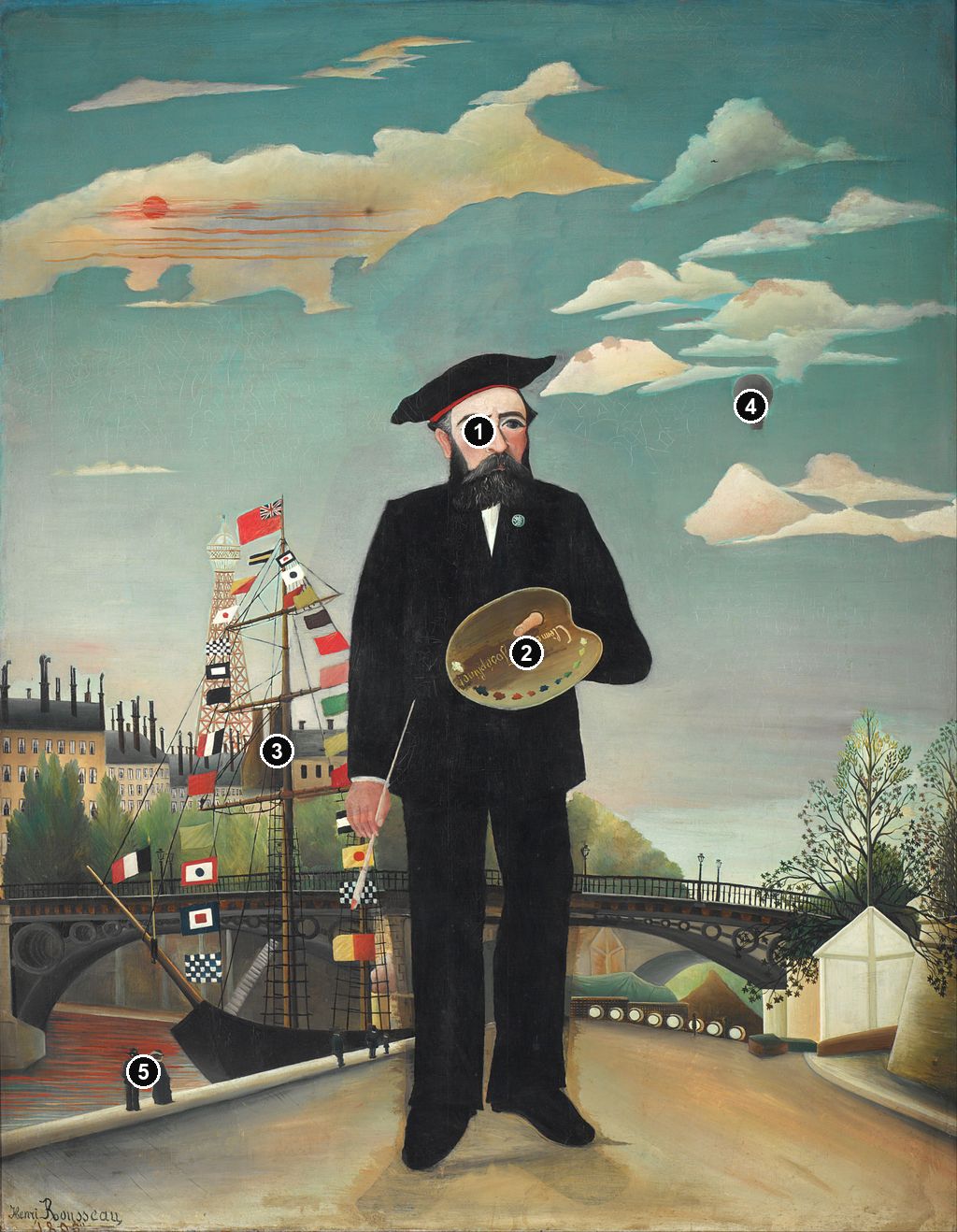
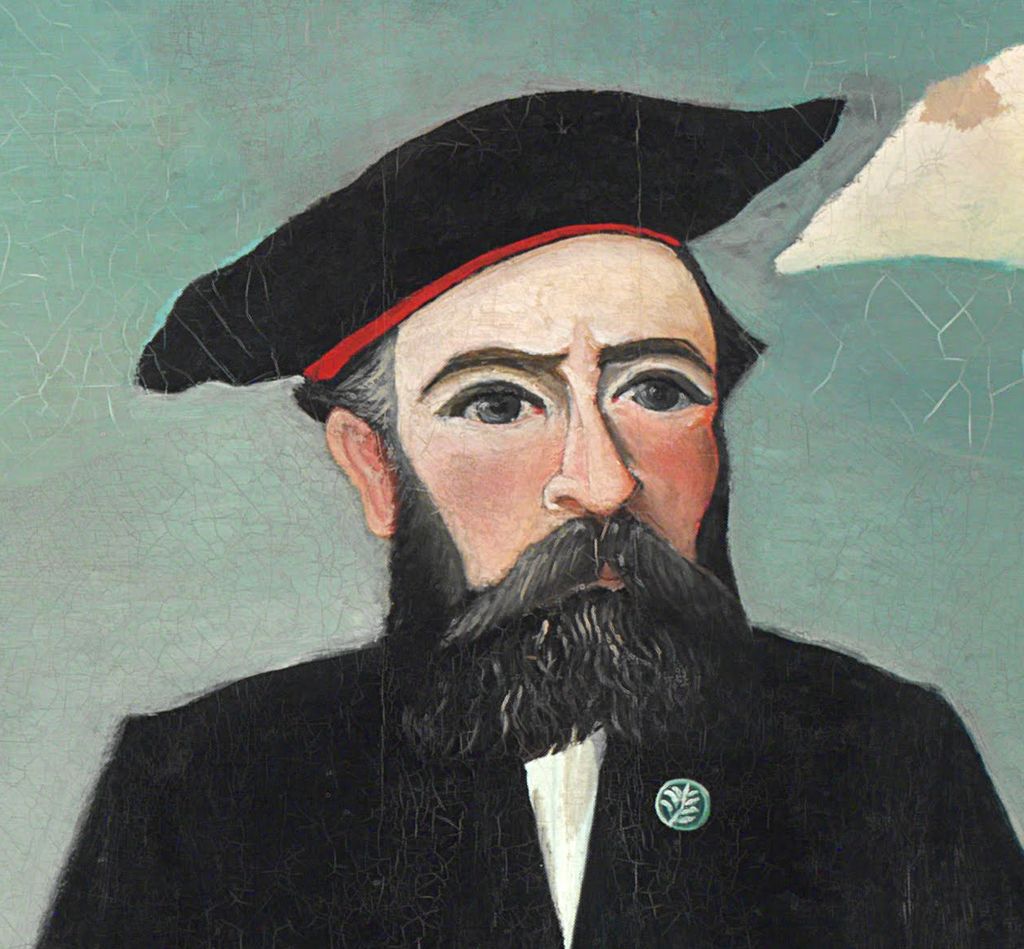
Rousseau faces the viewer with his feet planted apart, his head slightly turned and his shoulders held square. A dark beret tilts across his forehead. His beard spreads over the upper part of his coat, enclosing the pale face between two broad areas of black. The small white triangle at his throat and the light mark on his lapel interrupt this darkness. Far below his brush hand, two people stand beside the river. Their diminutive bodies make the artist’s solitary figure feel still larger.
The palette offers the clearest statement of his occupation. Held before his torso, its warm brown oval stands out against the black coat, with coloured dabs following its lower curve. The brush points down towards the ground. Rousseau has brought the tools of work into view without showing himself in the act of applying paint. His body is available for inspection, as though he has paused to present both himself and the evidence of his profession.
Michel Hoog, writing in the Museum of Modern Art’s 1985 catalogue, compares this arrangement with an official portrait commissioned by the sitter from himself. The full-length format carried associations with public office and social distinction. Rousseau appropriates that standing presence while making the beret, palette and brush central to his identity.[11] The little badge-like mark on the coat contributes to the ceremonious effect, although a painted sign of distinction cannot establish that he actually received an award.
This insistence on being seen as a painter also informs the signed name. Hoog records “Henri Rousseau 1890” at the lower left.[11] Juliette Degennes, curator at the Orangerie, places Rousseau’s signatures, self-portraits and occasional appearances in group portraits within a broader assertion of artistic identity. She observes that he principally signed with forms of his own name, rather than the nickname Douanier that others attached to him.[1] Here the inscription and the standing figure work together: the name identifies the maker, and the body gives that maker a public presence.
The ground beneath his feet
The large figure initially attracts so much attention that the pavement can seem incidental. Follow its edges, however, and the whole construction becomes more complicated. A pale diagonal climbs from the lower left towards the artist’s legs. To the right, a broad ochre road curves back towards the bridge. The two sides offer different routes into the distance, meeting beneath a man who appears unusually close to the picture’s surface.
His shoes provide two dark points of contact with the pale ground. Above them, the trouser legs descend in relatively straight bands, while the coat expands around the hips and elbows. The head, hands and palette are much smaller islands of detail within this dark structure. Across the canvas, the figure holds its shape more firmly than the shifting bands of road, water and sky. Even where the city seems to open behind him, his silhouette keeps bringing the eye forward.
The bridge introduces another scale. Its dark parapet passes behind the lower body, carrying a row of fine uprights across the picture. Curved openings and pale circular decorations create a more elaborate pattern below. At the right, a small light-coloured structure with a pointed roof stands beside a tree. The tree’s many thin branches and scattered leaves spread outwards, counterbalancing the compact rigging on the opposite side. Each part remains sharply legible, yet their proportions produce a strange intimacy: a large man, a miniature city and an expansive sky occupy the same shallow field.
There is plenty of information about distance. The river lies below the quay, the ship rises from it, and buildings gather behind the bridge. The little figures by the water provide a particularly strong measure of recession. Yet these clues coexist with areas that read as flat arrangements of colour. The ship’s rigging makes a mesh against the sky; the artist’s coat forms a single dark mass; the clouds spread in separate pale shapes. Looking moves continually between recognising a place and following the design across the canvas.
This tension gives the portrait much of its authority. Rousseau’s body does not disappear into a convincing stretch of riverbank. It remains conspicuous, confronting us while the surrounding city offers increasingly small details. The difference in scale can feel both stately and disconcerting. It permits a reading of the figure as an emblem of the painter’s importance without requiring a claim about what he consciously intended at every point.
 in Detail Henri Rousseau.jpg)
Myself, Portrait–Landscape (1890) — Henri Rousseau.
Paris after the World’s Fair
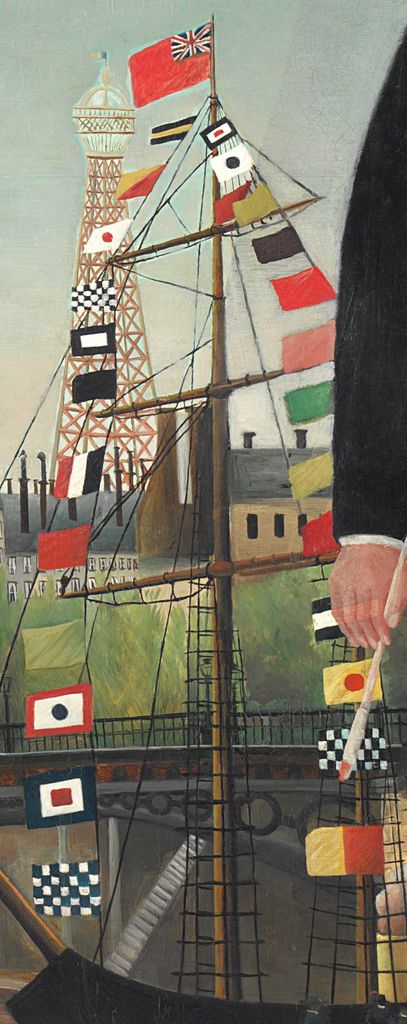
The background is specific enough to make modern Paris part of Rousseau’s self-presentation. Hoog identifies the river as the Seine and draws attention to the distant Eiffel Tower, built for the World’s Fair of 1889. When Rousseau dated his portrait the following year, the structure was still a recent addition to the city.[11] Its narrow form is easy to overlook beside the tall artist, yet its presence gives the view a clear historical horizon.
The tower appears among buildings and chimneys, close to the edge of the figure. Rousseau’s dark body nearly absorbs it into the surrounding shapes. A familiar landmark consequently has to be discovered through looking. The city’s newest monument occupies only a little of the painted surface, while the man with the palette claims its centre. That imbalance makes the setting more interesting than a backdrop chosen simply for recognisability.
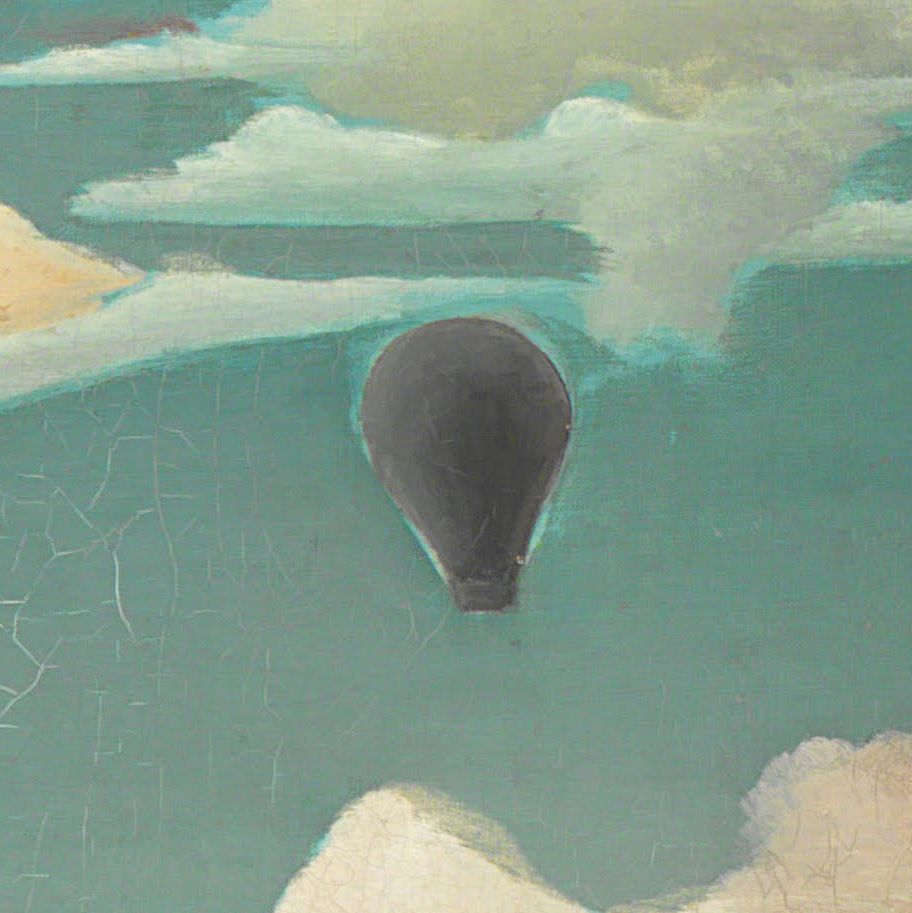
Above the bridge on the right, a balloon hangs between pale clouds. Its small rounded envelope offers a counterpart to the rigid verticals of masts and chimneys. Hoog connects this aerial detail with Rousseau’s interest in technological subjects.[11] In the painting itself, the balloon also extends the inhabited world upwards. Activity reaches beyond the road and river into an open sky that occupies a remarkably large share of the canvas.
The clouds have their own restless structure. A broad illuminated bank stretches beneath the red sun at the upper left, while other formations rise in pointed, swelling profiles. Smaller white fragments travel across the blue-green field. Their varied outlines keep the sky from becoming an empty space above the portrait. Although the artist stands still, the shapes around him suggest several kinds of movement: drifting clouds, a floating balloon and the angled lines of a ship prepared for travel.
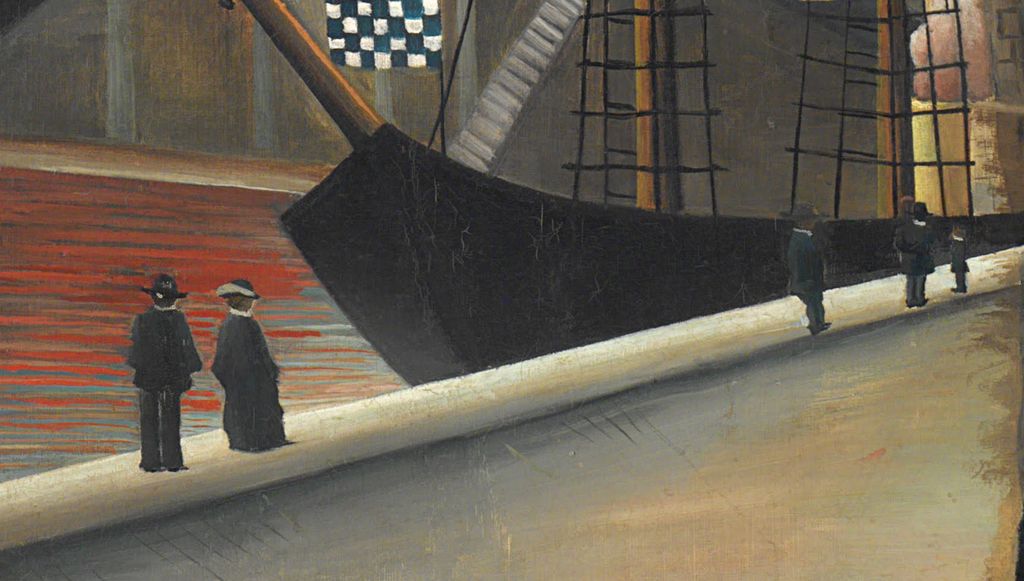
The vessel is the most densely organised part of the riverfront. Mast, ropes and spars cross one another above a black hull. Strings of coloured flags produce bright interruptions in this web. Hoog describes a mixture of maritime signals and invented flags, and identifies British colours at the masthead.[11] Their effect is partly descriptive and partly decorative. Reds, whites, yellows and greens establish a lively vertical strip beside the painter’s black coat, answering the smaller spots of paint on his palette.
The ship also connects the river to the street through diagonals. Its long projecting spar points towards the left bank; the quay rises towards the foreground; the bridge stretches behind the man. These lines organise the city around the central body without enclosing it symmetrically. The scene has the air of a public occasion, though the flags alone do not identify a particular celebration. Its combination of infrastructure, transport and aerial novelty gives Rousseau a setting fully engaged with his own time.
Annotated Details from Myself, Portrait–Landscape
The numbered points identify visible features discussed in this article. Return from each detail to the whole composition. Henri Rousseau, Myself, Portrait–Landscape, 1890. National Gallery Prague, O 3221. Google Art Project reproduction via Wikimedia Commons. Image source. Public domain. Numbers added to a separate resized overview. Details cropped directly from the published original without enlargement, recolouring or retouching.
Details from MYSELF, PORTRAIT–LANDSCAPE
Move from the painter’s face and tools to the riverfront details that establish his place and scale within modern Paris.
A painter in beret and black coat
The dark beret, spreading beard and black coat frame a pale face turned slightly towards the viewer. A white shirt and small coat emblem interrupt the solemn silhouette.
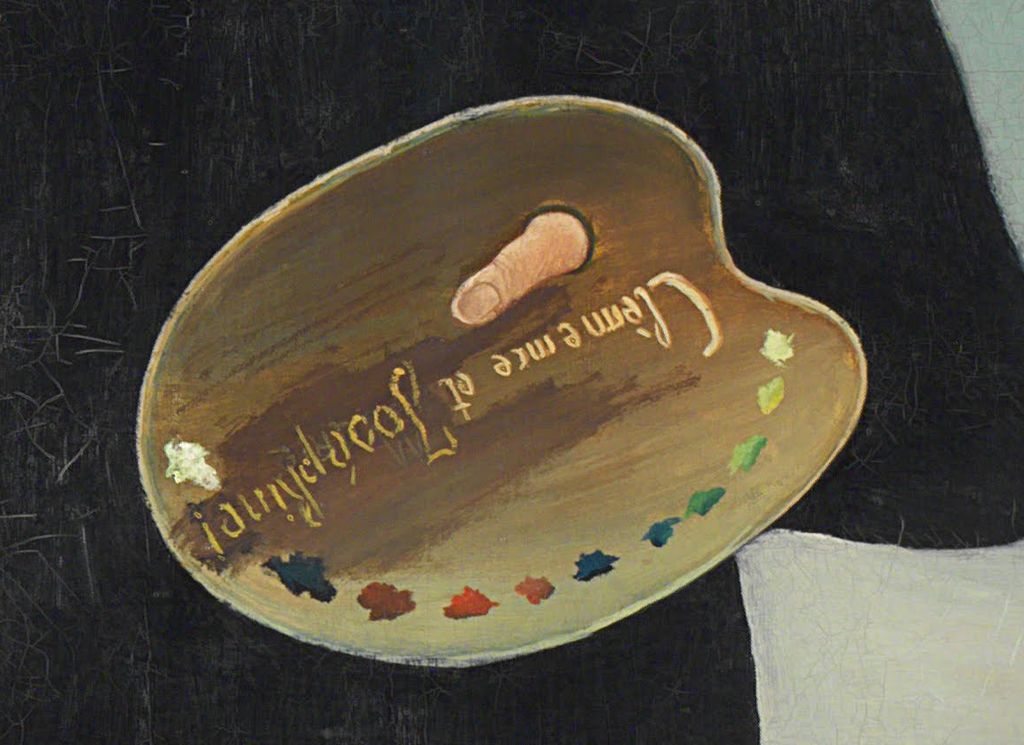
Names across the palette
Paint dabs follow the palette’s lower curve while names cross its wooden surface. The inscription makes the professional attribute carry a personal history, including the alteration discussed in the article.
Flags, rigging and the Eiffel Tower
Bright flags interrupt the fine dark lines of the ship’s rigging. Behind them the Eiffel Tower rises as a narrow lattice, bringing a recent Paris landmark into the painter’s riverfront setting.
A balloon among shaped clouds
A small dark balloon hangs in the open sky above the bridge. Its rounded shape and the surrounding banks of cloud offer another kind of movement beside the ship’s rigid masts.
Two small people beside the ship
Two figures stand on the quay below the ship’s hull. Their small scale makes Rousseau’s own standing body seem still larger, while the pale embankment carries the eye towards them.
The names on the palette
The palette carries a more intimate history within this public image. Hoog records the name Clémence, Rousseau’s first wife, together with Joséphine, his second wife. He reports that Joséphine replaced another name which had been effaced.[11] The object in the painter’s hand therefore joins colour, work and personal attachment in a remarkably small space.
The dates require care. The catalogue’s chronology places Clémence’s death in 1888 and Rousseau’s marriage to Joséphine Noury in 1899.[11] The canvas is dated 1890, but the reported changes to the palette mean its inscriptions cannot all be treated as an unchanged record of that year. The evidence supports later alteration without supplying a complete timetable for every letter or an identification of the erased name.
That distinction changes the experience of looking. We tend to meet a self-portrait as a statement fixed at one moment: this is how the artist wished to appear at a particular age. Here a detail was revisited as personal circumstances developed. The broad standing image could remain while a name on an attribute was changed. The surface brings together the dated public declaration and a less straightforward history of private remembrance.
The inscriptions also reward a different pace of attention from the figure. The black body and pale face can be grasped at once; names require us to move closer and read. The palette becomes a point where the picture shifts from an image seen across a room to something approached almost as a document. Set against the dark coat, it gathers these different readings into the same small area of the portrait.
What did “portrait–landscape” mean to Rousseau?
The compound title belongs to Rousseau himself. Hoog records his later claim, made during the trial of 1908–09, to have invented the portrait–landscape.[11] The phrase gives unusual weight to the relationship between person and surroundings. It asks us to consider the city as part of the subject’s identity, rather than as an interchangeable setting behind a likeness.
The Orangerie’s 2026 exhibition places this self-portrait at the beginning of a recurring approach in which figures stand against landscapes carrying clues about who they are. Its account connects Rousseau’s practice with Italian and Flemish portraits seen in the Louvre as well as with his own developing pictorial vocabulary.[12] His declaration of invention belongs to his presentation of a distinctive artistic achievement; it cannot establish that no earlier painter had combined a portrait and a landscape.
In this particular work, the relationship is unusually expansive. The palette identifies a painter, while the riverfront locates him within a city of working vessels, pedestrians, buildings and new technologies. The low bridge and distant tower supply a public environment against which his scale becomes striking. Trees and clouds give the scene softer forms, but streets, embankments and engineered structures provide much of its framework.
The city also remains available for looking independently of the sitter. One can follow the rigging, trace the bridge or inspect the tiny people without needing to reconstruct an anecdote about Rousseau’s life. This independence matters. The landscape contributes its own rhythms and attractions, giving the title’s two halves a real pictorial relationship. They coexist through differences of scale, density and direction: a still central body beside a world of narrow lines and small incidents.
Other large portraits, including Portrait of Madame M., offer further opportunities to examine how Rousseau makes a figure dominate its surroundings. Here, however, the sitter’s profession gives that dominance a particular force. The person who constructed the painted world stands conspicuously within it, holding the means by which such a world could be made.
An exhibiting artist with official ambitions
In 1890 Rousseau was still employed by the Paris octroi, the municipal toll-collecting service he had joined in 1871. He resigned in December 1893. By then painting already had a public place in his life: his first submission to the Salon des Indépendants had been in 1886, and the 1985 catalogue lists this self-portrait in the 1890 exhibition as number 660.[11][12] The canvas belongs to the years when paid employment and an exhibiting career overlapped.
Its dignified presentation fits a wider pursuit of recognition. The Orangerie documents Rousseau’s unsuccessful entries in competitions to decorate the town halls of Bagnolet in 1893, Vincennes in 1898 and Asnières in 1900. It also describes his attention to official painters and his repeated efforts to obtain state support.[12] These ambitions help explain why a ceremonious full-length portrait mattered to him as a form. He could seek an independent place in art while valuing the visibility attached to public institutions.
His own 1895 autobiographical note, reproduced by the Orangerie, similarly emphasises his progress as an artist and his association with the Indépendants. It describes learning from nature with some advice from Gérôme and Clément.[12] Read beside the portrait, the note reveals a consistent concern with how a painter’s identity is put before an audience. The image relies on stance, tools and scale; the written account supplies a story of effort and development. The broader sequence of his working life is explored in the biography.
How the portrait reached Prague
The painting’s public standing took another turn in 1923. The National Gallery Prague relates that the Czechoslovak government bought it at an exhibition of French art in Prague. The choice was made by Vincenc Kramář, then director of the Picture Gallery of the Society of Patriotic Friends of the Arts.[13] The Orangerie’s 2026 credit identifies the purchase as coming from the collection of Walther Halvorsen.[1]
The owning museum’s account preserves an important difficulty within that acquisition. Kramář’s responsibility was for older art, and colleagues criticised his use of state funds to buy modern works. According to the museum, Rousseau’s self-portrait then spent five years in storage.[13] The episode describes an institutional disagreement around a particular purchase. It gives no basis for turning that disagreement into a story of universal rejection by a city or country.
The purchase nevertheless brought the painting into a national collection. Its journey from an exhibiting artist’s self-image to a debated state acquisition gives the initial pose an unexpected afterlife. The man who had painted himself with the standing presence of a public figure became the subject of decisions about what a public gallery should collect. The work’s professional claim could now be considered through the authority of the institution that owned it, even while its immediate place on the walls remained unsettled.
Henri Rousseau artworks directory
This directory brings together works covered on this site and other works documented in the cited museum records and catalogues. Alternate titles share one entry; distinct versions remain separate. Historical dates for works without an article follow the cited catalogues. This is not a catalogue raisonné.
Frequently Asked Questions
It belongs to the National Gallery Prague, under inventory number O 3221. The Orangerie’s 2026 documentation records an oil on canvas measuring 146 × 113 cm, purchased from the Walther Halvorsen collection in 1923.[1]
He holds a palette and a brush, the principal attributes of his profession in the portrait. The palette also carries personal names: Michel Hoog records Clémence and Joséphine, with Joséphine substituted for an effaced name.[11]
That cannot be assumed. The work bears the date 1890, while Rousseau’s second marriage took place in 1899, and the catalogue reports alteration of a palette inscription. A complete chronology of the changes is not established by that account.[11]
Rousseau’s title brings the full-length self-image and the surrounding Paris view together as a combined subject. He later claimed to have invented the formula. The Orangerie places that claim within his artistic ambition and connects his portraits with earlier Italian and Flemish traditions.[11][12]
Discussion
Look again at the images and ideas explored in Myself, Portrait–Landscape (1890). These editorial prompts invite your observations.
Reader Insights
How do the tiny people beside the river change your impression of Rousseau’s body?
What does the background contribute to the identity announced by the palette and brush?
How does knowing that a palette inscription was altered affect your sense of the portrait as a moment in time?
Join the Conversation
Share a detail, comparison or question about Myself, Portrait–Landscape (1890) below.
References
- Juliette Degennes, Musée de l’Orangerie. Henri Rousseau, L’ambition de la peinture: Un artiste dans son époque, 2026, video transcript, p. 2 on signatures, self-portraits and professional identity; p. 3, credit for Moi-même, portrait-paysage, 1890, National Gallery Prague, O 3221, dimensions and 1923 purchase. View source. (in French).
- Philadelphia Museum of Art, Carnival Evening,1963-181-64,object59593. View source.
- National Gallery, Surprised!, NG6421. View source.
- Musée d’Orsay, La Guerre,RF19461 (in French). View source.
- MoMA, The Sleeping Gypsy. View source.
- Philadelphia Museum of Art, The Merry Jesters, 1950-134-176, object51097. View source.
- Musée d’Orsay, La Charmeuse de serpents, RF 1937 7 (in French). View source.
- Musée de l’Orangerie, La Carriole du Père Junier, RF 1960 26 (in French). View source.
- Solomon R. Guggenheim Museum / Cornelia Lauf, The Football Players,60.1583: current collection record. View source.
- MoMA, The Dream, 252.1954. View source.
- Michel Hoog. “Myself, Portrait-Landscape,” in Henri Rousseau: Essays, The Museum of Modern Art, 1985, entry 5, pp. 106 and 108; chronology, pp. 91–93; notes-to-plates authorship credit, PDF p. 102. English translations from the French by Richard Miller. The entry’s older dimensions, 143 × 110 cm, differ from the 2026 credit used here. View source.
- Musée de l’Orangerie. Henri Rousseau, l’ambition de la peinture, exhibition 25 March–20 July 2026, sections “Moi-même, peintre,” “Rousseau et son cercle. L’invention du portrait-paysage,” “L’ambition de la peinture officielle” and “Aux origines d’un style”; includes Rousseau’s autobiographical note dated 10 July 1895. Accessed 23 October 2026. View source. (in French).
- National Gallery Prague. International Customs Day | Customs Official Rousseau, owning-museum article, account of the 1923 French-art exhibition purchase, Vincenc Kramář and the subsequent five years in storage; image identification dates the portrait to 1890. Accessed 23 October 2026. View source.
- The Museum of Modern Art, Henri Rousseau: Essays (1985), selected catalogue entries, chronology and notes on early devotees. View source. Selected entries, chronology (pp.91–95) and early-devotee notes (pp.262–264) were consulted. Historical collection credits do not establish present ownership.
- Daniel Catton Rich, Henri Rousseau (The Museum of Modern Art, 1942), selected drawings and landscape studies; historical catalogue. View source. The dated 1942 publication is used for the two Quai d’Auteuil ink views; its Malakoff date differs from the 1985 catalogue.
- MANAS, Laval, Henri Rousseau, dit le Douanier, urban landscapes and preparatory study (in French). View source.
- National Gallery of Art, Self-Portrait (1895), pen-and-ink drawing, accession 1995.47.66. View source.
- The Museum of Modern Art, War (published January 1895), lithograph, accession 684.1943. View source.
- Barnes Foundation, Landscape and Four Young Girls, object 5521, BF855. View source.


 Henri Rousseau.jpg)


