


 by Tom Gurney
Tom Gurney BSc (Hons) is an art history expert with over 20 years experience
Published on June 19, 2020 / Updated on October 29, 2026
Email: tomgurney1@gmail.com / Phone: +44 7429 011000
Tropics: Introduction
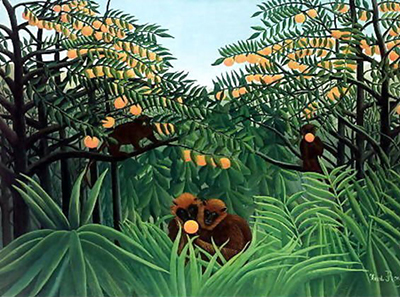
Four monkeys occupy a forest crowded with pointed leaves and round orange fruit. Two sit close together near the lower edge, while two others sit or move along branches above them. In Henri Rousseau’s Tropics, this simple arrangement produces an intricate experience of looking. The animals appear among the foliage by degrees: a dark face, a warm patch of fur, a fruit held before a face. Each discovery changes the surrounding greenery from a pattern into a place inhabited by living bodies.
At a Glance
- ArtistHenri Rousseau
- SubjectTropics
- ExploreThe painting and its earlier collection; Two monkeys close together
This work across Henri Rousseau’s career
Carnival Evening
1886 [1]The Merry Jesters
1906 [6]The Snake Charmer
1907 [7]Tropics (current article)
Not recorded [11]Contents
- The painting and its earlier collection
- Two monkeys close together
- The animals on the branches
- Orange circles among pointed leaves
- Leaves at three scales
- An opening overhead
- A different rhythm from the storm
- The reported sale in 1972
The painting and its earlier collection
The Metropolitan Museum of Art reproduced Tropics in its 1970 Masterpieces of Painting. The entry records oil on canvas, measuring 43¾ × 64 inches, with Henri Rousseau’s signature at the lower right. It identifies the work as the bequest of Adelaide Milton de Groot, under accession number 67.187.98. This is a record of the painting’s former place in the Metropolitan’s collection.[11]
The broad canvas gives the vegetation room to spread across the two sides. The encounter with the foreground pair occupies only a small part of its surface. The adjoining monkeys sit low, beneath the branching trees, almost submerged in leaves. Their position makes the scale of the surrounding growth palpable: overhead branches extend across much of the picture, and individual foreground blades rise almost as high as the animals. Looking for the monkeys means encountering the forest’s architecture along the way.
Two monkeys close together
The foreground pair form the painting’s strongest concentration of warm colour. Reddish and rusty browns gather into a compact shape against the greens. Within it, the faces are almost black, edged by brighter fur around the heads. These small dark centres encourage a much closer look than the larger, more immediately legible leaves. The eye moves from the outline of the shared brown mass towards the difficult details within it.
The monkey on the right inclines its head towards its companion. Their bodies overlap, so that the division between them is less clear than the distinction between their heads. A round orange fruit sits before the left animal’s face, adding a bright point to the group. Around it, hands, fur and narrow leaves gather densely. The close placement of the two heads gives the scene an intimacy that a line of separated animals would not have.
That intimacy leaves room for several responses. A viewer may find the pair companionable, guarded or absorbed in what they hold. The image offers proximity and posture; the emotional life of the animals remains open. Their dark faces have a concentrated presence without supplying an unequivocal human expression. The bent head becomes particularly noticeable because it departs from the more upright face beside it.
Leaves conceal much of the lower bodies. It is difficult to trace each limb all the way to its end, and there is no clear patch of ground beneath them. This partial visibility keeps the encounter close. We see enough to recognise two adjoining bodies, while the vegetation prevents us from surveying them as isolated specimens. The forest remains between the animals and the viewer even at the point of greatest approach.
The animals on the branches
The two smaller monkeys establish another way of inhabiting the picture. On the left, a dark brown animal stretches horizontally along a branch towards the centre. Its body follows the direction of its support, giving that portion of the tree a momentary sense of movement. On the right, an upright monkey occupies a more vertical shape, with an orange fruit held before its face. These positions distinguish the animals at once, despite their small scale and similar colouring.
Their separation creates a wide span across the middle of the canvas. Following one branch monkey to the other takes the eye over the dense foliage above the central pair. The four animals therefore make an irregular arrangement: two gathered below, two apart above. Their placement gives the forest several centres of activity while preserving the special weight of the foreground group.
The branch monkeys are also easier to lose among the trees. Their dark bodies approach the colour of the branches, and fine leaves cross the spaces around them. Recognition can begin with a small interruption in the vegetation’s rhythm. The orange circle in front of the right-hand monkey is especially effective: it catches attention before the body becomes fully apparent. The fruit connects a creature partly hidden in shadow to the bright clusters hanging overhead.
Orange circles among pointed leaves
Fruit runs through the upper half of Tropics in clusters and scattered points. Some circles are fully exposed against darker greenery; others are interrupted by stems or narrow leaves. The repeated colour keeps the eye moving sideways, from one tree into the other. Because the fruits differ slightly in size, spacing and angle, the pattern has enough variation to sustain looking. It feels abundant without becoming an even dotted border.
Orange and yellow have particular force amid the greens. A leaf may merge with neighbouring leaves of a similar value, while a small fruit remains distinctly visible. Rousseau can give a tiny shape considerable visual weight through this contrast. The effect is clearest where several orange forms hang together: the branches seem to carry a line of small lights through the canopy, each bounded by dark stems and pointed leaflets.
Closer to the monkeys, the same circular shape changes its role. Fruit hanging in a cluster belongs to the spread of the tree; fruit held before a face becomes part of a small action. A repeated element links the forest’s abundance to the animals’ immediate activity. The foreground circle also makes the surrounding dark faces more noticeable. Rounded fruit and rounded faces sit close together, though their colours pull in opposite directions.
These circles stand out all the more because so much of the foliage ends in points. Upper leaves extend in narrow paired shapes from fine stems. Beneath them, longer blades converge, rise or sweep across the foreground. Roundness is scarce in this thicket of tapers and edges. The fruit therefore supplies both a colour accent and a different kind of contour, briefly arresting the movement from one pointed leaf to the next.
Leaves at three scales
The vegetation changes character as it moves towards us. High in the trees, thin branches support small, clearly separated leaves. In the middle distance, larger masses fill the space behind the monkeys. Across the bottom, enormous blades overlap in broad fans and long curves. This progression gives the forest depth while allowing each zone to have its own pattern. The smallest leaves invite us to follow a stem; the largest can be read from base to tip as a single sweeping form.
At the lower left, a broad fan of leaves spreads across a substantial area. Pale central lines help separate neighbouring blades even where their colours are close. The leaves expand outward and downward, bringing their tips towards the edge of the canvas. Beside the slim stems overhead, their width feels exaggerated and bodily. They give the foreground a weight that the branching canopy, for all its density, does not possess.
On the right, long feather-like fronds bend across and into the scene. Their repeated narrow divisions create a more open screen than the broad left-hand leaves. Slivers of darker vegetation remain visible between them. Near the lower centre, upright blades cross in front of the monkeys, interrupting the warm brown forms. This mixture of broad covering shapes and finer, penetrable screens makes concealment vary across the picture.
The layering is legible through these interruptions. A blade passes in front of another; a branch disappears behind a leaf; an animal’s outline resumes after a green shape cuts across it. Each small overlap establishes a local order of near and far. Across the canvas, the accumulation is so dense that the eye rarely travels uninterrupted into the distance. Depth emerges through successive obstructions, with the foreground remaining insistently close.
This is also where the picture rewards attention to Rousseau’s style and technique. Clear contours make individual forms easy to recognise, while their multiplication makes the whole forest difficult to disentangle. The shapes are distinct enough to inspect one by one, yet interconnected enough to resist a quick inventory. Looking closely reveals more divisions without dissolving the impression of a continuous green enclosure.
An opening overhead
The pale blue-grey sky offers a respite from the accumulated leaves. It is widest at the top centre. Branches and leaf tips press inward from both sides, reducing the gap as it descends towards the middle of the picture. The sky has very little internal detail, so its broad, quiet surface contrasts with the small repeated marks of the trees. It is one of the few places where the eye can rest without following an edge.
The two sides approach one another unevenly. Individual stems project into the opening, and the outline breaks into narrow points rather than forming a smooth arch. This irregularity keeps the empty space connected to the particular branches around it. Below, dense green growth closes the view again. The opening gives us a sense of air above the animals while offering little view of what lies beyond their immediate surroundings.
There is no visible path leading through this space. The viewer faces a bank of vegetation, with the monkeys occupying its limited clearings. That arrangement can feel protective, enclosing the animals within a plentiful world; it can also feel restrictive, with foliage surrounding them at every turn. Both readings begin with the same visible relationship between open sky, crowded branches and screened bodies. Neither requires a story about where the animals have come from or what will happen next.
A different rhythm from the storm
A comparison with Surprised! brings the stillness of Tropics into sharper focus. In the tiger painting, slanting rain and angled vegetation carry movement across the scene, while the animal’s extended body presses through the grass. Tropics spreads attention among four smaller presences. Its leaves bend in several directions, and the fruit creates pauses along the branches. There is time to discover one monkey, then another, before returning to the pair below.
The pictures also differ in the way a body meets its surroundings. The tiger’s stripes remain conspicuous even as vegetation passes before it. Here, brown fur and dark faces can blend into the wooded background, and green blades divide the largest group. The forest becomes a place of repeated, incomplete encounters. Concealment is as important to its effect as the bright colour that first draws us in.
The reported sale in 1972
The painting’s museum history continued beyond its appearance in the 1970 book. In October 1972, TIME reported that the Metropolitan had sold Rousseau’s The Tropics, together with Van Gogh’s The Olive Pickers, to Marlborough Fine Art’s Liechtenstein branch that May.[12]
Henri Rousseau artworks directory
This directory brings together works covered on this site and other works documented in the cited museum records and catalogues. Alternate titles share one entry; distinct versions remain separate. Historical dates for works without an article follow the cited catalogues. This is not a catalogue raisonné.
Frequently Asked Questions
Four are visible. Two adjoining monkeys occupy the lower centre, and two smaller animals appear separately on branches to either side.
The painting contains many rounded orange and golden fruits. Their exact botanical identity is not established here; their repeated colour and shape are central to the composition.
Their closeness is visible, but their relationship is not established. The painting does not identify their sex, age or family connection.
It formerly belonged to the Metropolitan; TIME reported its sale in 1972.[12]
Discussion
Look again at the images and ideas explored in Tropics. These editorial prompts invite your observations.
Reader Insights
Which monkey did you notice first, and which colour or outline helped you find it?
Does the foliage around the foreground pair feel sheltering, restrictive, or both? Which overlapping forms shape your response?
How would the composition change if the orange fruit disappeared?
Join the Conversation
Share a detail, comparison or question about Tropics below.
References
- Philadelphia Museum of Art, Carnival Evening,1963-181-64,object59593. View source.
- Musée de l’Orangerie / Juliette Degennes, Henri Rousseau,L’ambition de la peinture: Un artiste dans son époque (in French). View source.
- National Gallery, Surprised!, NG6421. View source.
- Musée d’Orsay, La Guerre,RF19461 (in French). View source.
- MoMA, The Sleeping Gypsy. View source.
- Philadelphia Museum of Art, The Merry Jesters, 1950-134-176, object51097. View source.
- Musée d’Orsay, La Charmeuse de serpents, RF 1937 7 (in French). View source.
- Musée de l’Orangerie, La Carriole du Père Junier, RF 1960 26 (in French). View source.
- Solomon R. Guggenheim Museum / Cornelia Lauf, The Football Players,60.1583: current collection record. View source.
- MoMA, The Dream, 252.1954. View source.
- Edith A. Standen and Thomas M. Folds, The Metropolitan Museum of Art. Masterpieces of Painting in The Metropolitan Museum of Art, 1970, Tropics, printed p. 88 (PDF p. 89), entry and colour plate. View source.
- TIME. “Art: Breach of Trust”, 16 October 1972, pp. 1–2, contemporary report. View source.
- The Museum of Modern Art, Henri Rousseau: Essays (1985), selected catalogue entries, chronology and notes on early devotees. View source. Selected entries, chronology (pp.91–95) and early-devotee notes (pp.262–264) were consulted. Historical collection credits do not establish present ownership.
- Daniel Catton Rich, Henri Rousseau (The Museum of Modern Art, 1942), selected drawings and landscape studies; historical catalogue. View source. The dated 1942 publication is used for the two Quai d’Auteuil ink views; its Malakoff date differs from the 1985 catalogue.
- MANAS, Laval, Henri Rousseau, dit le Douanier, urban landscapes and preparatory study (in French). View source.
- National Gallery of Art, Self-Portrait (1895), pen-and-ink drawing, accession 1995.47.66. View source.
- The Museum of Modern Art, War (published January 1895), lithograph, accession 684.1943. View source.
- Barnes Foundation, Landscape and Four Young Girls, object 5521, BF855. View source.
 Henri Rousseau.jpg)
 Henri Rousseau.jpg)