


 Henri Rousseau.jpg)
 by Tom Gurney
Tom Gurney BSc (Hons) is an art history expert with over 20 years experience
Published on June 19, 2020 / Updated on October 29, 2026
Email: tomgurney1@gmail.com / Phone: +44 7429 011000
Unpleasant Surprise: Introduction
A woman stands beside a lake with both hands raised. A bear has turned towards her, showing its teeth and pale, curved claws. Almost lost in the darkness at the left, a hunter brings a long gun into the encounter. Henri Rousseau gives us the ingredients of a rescue story, then makes them difficult to read: the endangered woman looks outward, the animal occupies the foreground, and the supposed rescuer is the least conspicuous figure of all.
Unpleasant Surprise, or Mauvaise surprise, belongs to the Barnes Foundation, which dates it to 1899–1901. Painted in oil on canvas, it measures 194.5 × 129.5 centimetres: the upright woman inhabits a picture nearly two metres high. That scale gives a seemingly simple woodland incident the presence of a public spectacle.[1]
At a Glance
- ArtistHenri Rousseau
- SubjectUnpleasant Surprise
- ExploreA bather, a bear and a hunter; A narrow stage opening onto distant water
This work across Henri Rousseau’s career
Carnival Evening
1886 [2]Unpleasant Surprise (current article)
1899–1901 [1]The Merry Jesters
1906 [7]The Snake Charmer
1907 [8]Contents
- A bather, a bear and a hunter
- A narrow stage opening onto distant water
- The rescue story and its unanswered questions
- Renoir's reported admiration
- From exhibition picture to the Barnes collection
- Caring for the painted surface
- Annotated details
A bather, a bear and a hunter
The woman is the easiest figure to see. Her pale body stands against a dark tree trunk on the right, with a strip of warm brown fabric hanging beside her and smaller articles lying on the bank below. Those clothes, together with the water behind her, encourage us to understand her as a bather interrupted before she can dress. Rousseau leaves a narrow margin between her body and the edge of the picture. Even before we look closely at the bear, her position feels constrained.
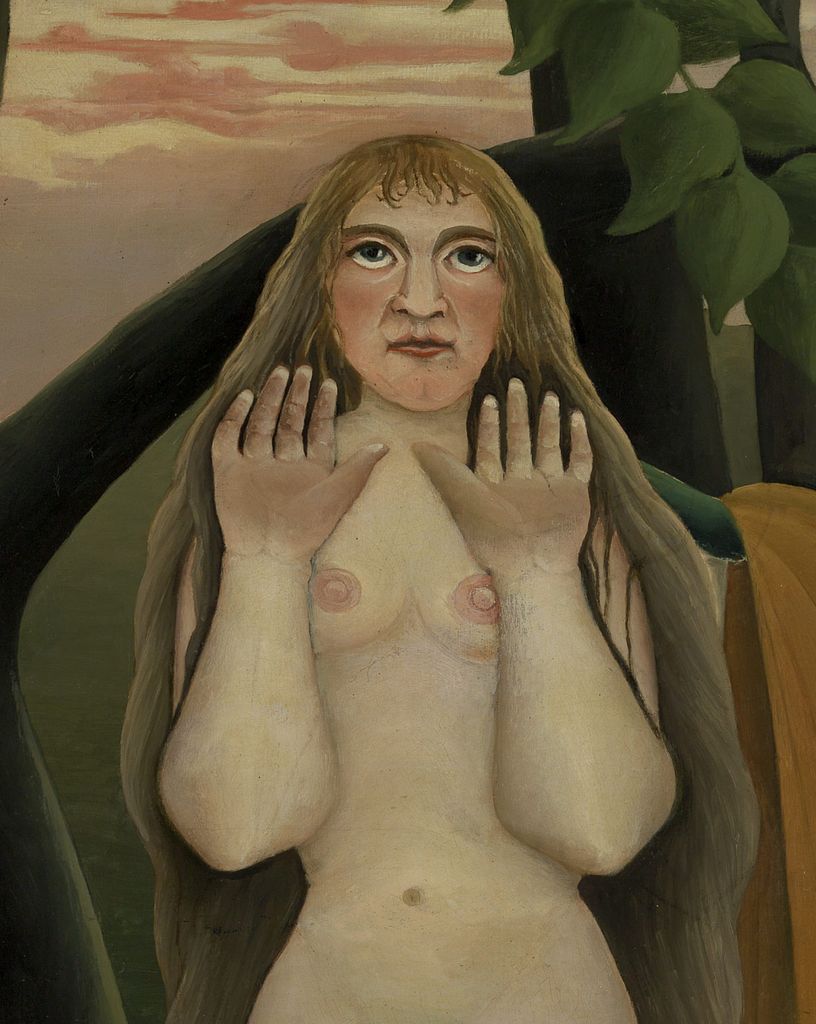
Her hands rise to either side of her face, palms turned towards us. The bent elbows could signal alarm, surrender or an appeal to someone outside the scene. Yet the gesture has little of the abrupt, unbalanced movement we might expect from a person trying to escape. Her shoulders remain level. Her head stays upright. Her legs hold her in a tall, composed silhouette. The Barnes describes the figure's attitude as calm surrender, drawing particular attention to her dirty palms. It also suggests that the familiar pattern of a woman rescued by a hunter becomes stranger as we examine it.[1]
The dark marks on those outward-facing hands interrupt the body's light colour. They also make the hands more noticeable than their small size might suggest. We register both palms at once, almost as a pair of signs displayed beside the head. Their symmetry is imperfect, but the two gestures create a still frame around the woman's face. Her expression permits both fright and a sense of remote composure. The title supplies a sudden event, while the figure's posture stretches the moment into something more prolonged.
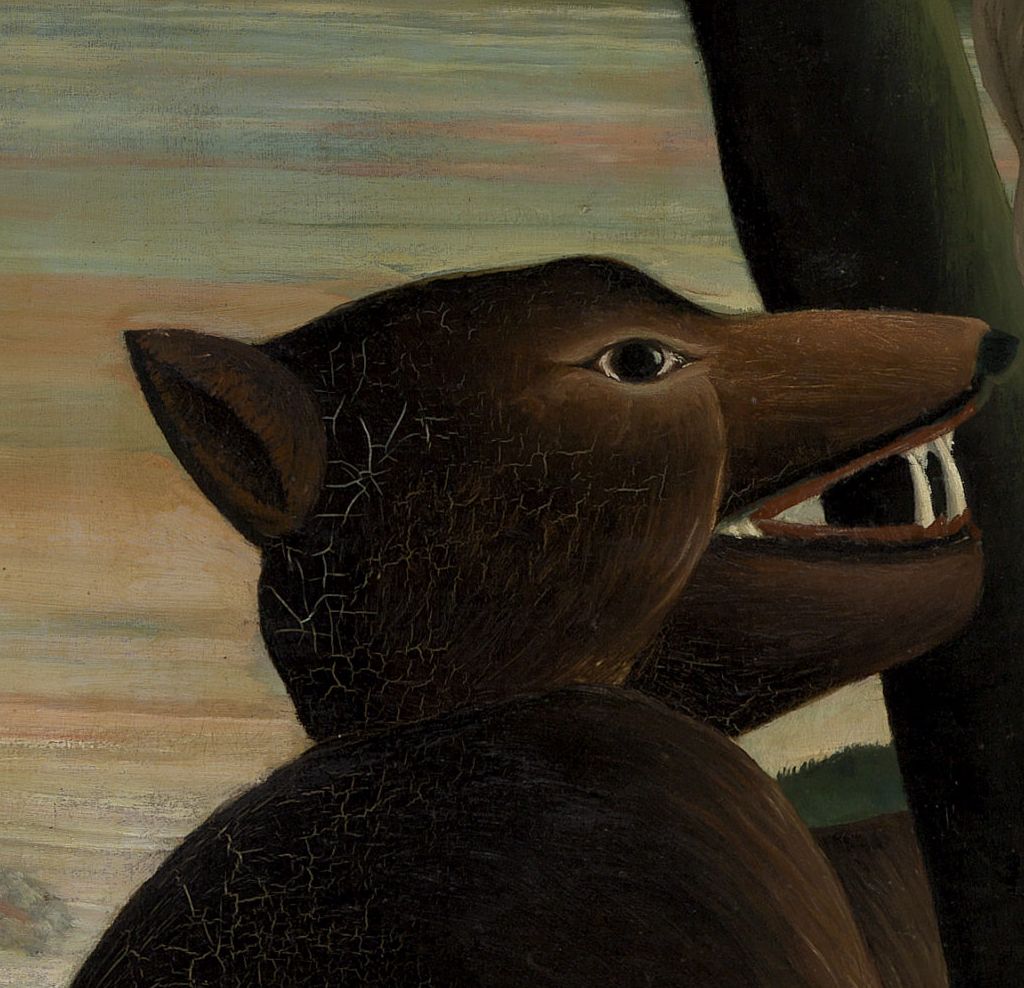
The bear is far less still in its construction. Its heavy body rises from the lower centre, its head twists to the right, and one forelimb reaches towards the bank beneath the woman's feet. The light claws make an emphatic fan against the surrounding dark paint. Its open mouth has a similar effect: teeth and muzzle bring a sharp, readable edge to an otherwise massive brown form. Rousseau makes the threat clear through these local accents, even where the animal's lower body merges with the rocks and shadows.
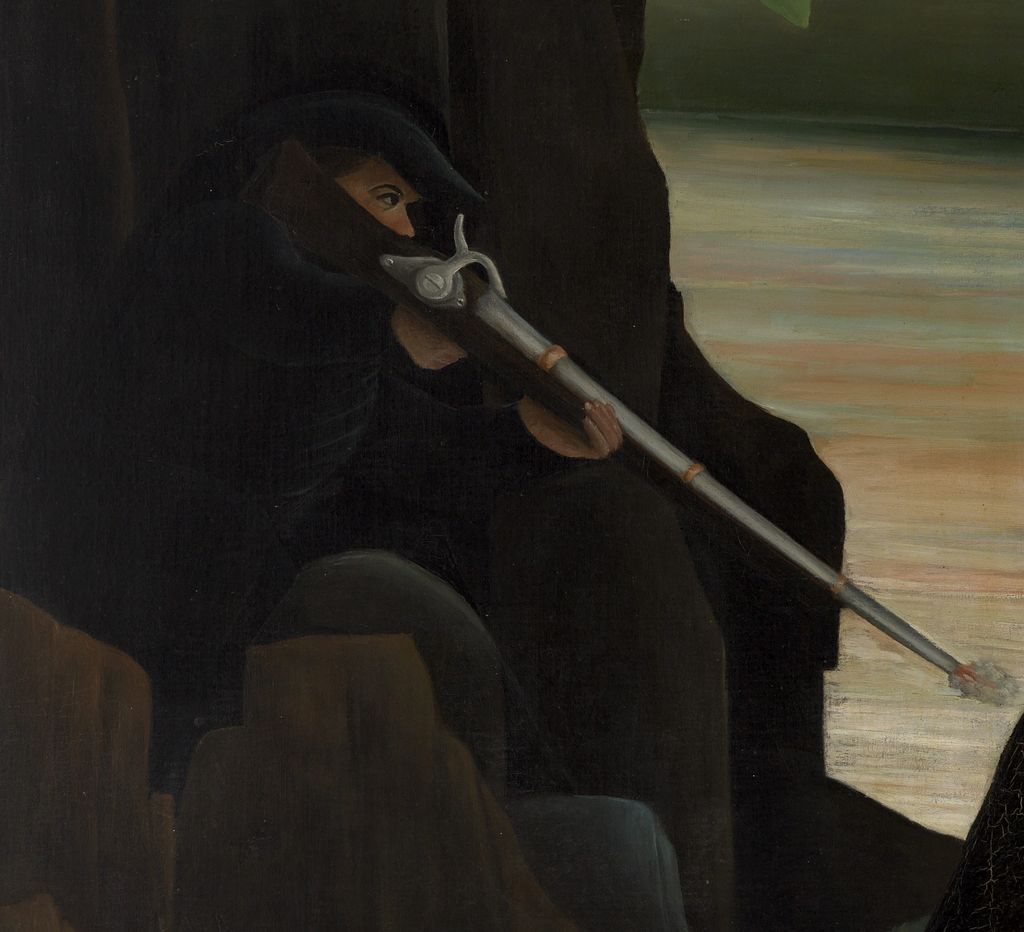
The hunter requires a second look. He crouches or stands low in the darkness at the left, partly obscured by the great trunk that borders the opening onto the lake. Face, hands and weapon emerge in fragments. The long gun crosses diagonally into the space occupied by the bear, linking the concealed man to the central action. In the Barnes interpretation, he is firing to rescue the bather.[1] The arrangement invites that account, although it gives us little help in reconstructing the precise timing of the shot. Our eyes must discover the person who would ordinarily control the story.
This unequal visibility matters. The woman receives the strongest light, the animal the most imposing position, and the man the least available space. We can follow the apparent action from hunter to bear to bather, yet the painting first attracts us in almost the reverse order. Rousseau lets recognition develop unevenly. The image can appear at a glance to be a nude beside an animal; only gradually does it unfold into a three-part encounter.
A narrow stage opening onto distant water
The landscape offers a remarkable change of pace. Beyond the dark foreground lies a quiet stretch of water, with low green hills and a softly coloured sky. Pale horizontal bands carry the eye into the distance. Nothing there seems to share the urgency of the raised hands, exposed teeth and gun. The lake is broad enough to suggest open space, but the principal figures have been crowded onto its near edge.
Tree trunks divide that view into separate openings. The largest rises near the centre and sends dark branches across the upper half of the canvas. It separates the woman from the hunter while allowing the water to remain visible behind the bear's head. At the left, another heavy trunk nearly swallows the man. On the right, the tree behind the nude reinforces her upright posture. The trees act as barriers and supports, making the scene feel enclosed even as the horizon recedes.
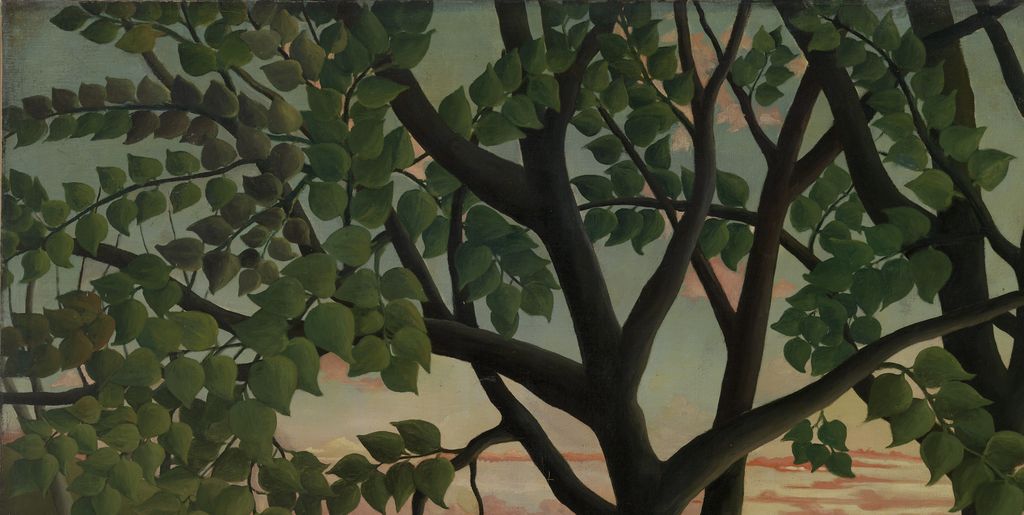
Rousseau has given the leaves a different rhythm from the trunks. Small, rounded leaflets hang in repeated groups across the upper and left portions of the picture. Some stand out as individual shapes; others gather into thicker curtains. Their repetition slows the eye and lends the vegetation an orderly, almost patterned character. Through these measured clusters we look towards an incident whose meaning remains unsettled. The woodland appears carefully arranged around the disruption.
There are echoes between the figures and their setting. The woman's arms branch outward from the torso, answering the divisions of the tree above. The hunter's gun introduces a thin diagonal among thicker dark limbs of wood. The bear's lifted forelimb cuts across the lower scene and makes the gap between animal and woman feel precariously small. These correspondences do not turn the figures into decorations. They bind the action to the structure of the whole canvas, so that the encounter cannot easily be detached from the landscape containing it.
The contrast between the woman's vertical body and the bear's broad, angled mass is especially forceful. One form is narrow, pale and exposed; the other is dark, weighty and close to the viewer. The hunter, though carrying the weapon, seems diminished by the enclosing trees. Scale becomes part of the suspense. We are not given an evenly balanced group of actors standing on a clearly measured floor. Their differing sizes and degrees of visibility make the scene feel at once explicit and difficult to inhabit.
Look finally at the foreground rocks. Their blunt, dark shapes overlap the lower edge of the bear and form a rough threshold between the viewer and the action. They offer no inviting path into the picture. The eye can travel easily across the distant water, but the body seems blocked at the front. That difference helps explain the painting's curious distance: we see the danger with great clarity while remaining uncertain where we could stand within its space.
Annotated Details from Unpleasant Surprise
The numbered points identify visible features discussed in this article. Return from each detail to the whole composition. Henri Rousseau, Unpleasant Surprise, 1899–1901. Barnes Foundation, Philadelphia, BF281. This museum-derived reproduction was published on Wikimedia Commons in 2018, before the extensive conservation treatment completed in 2024. Barnes Foundation, Philadelphia, BF281. Image source. Public domain. Numbers added to the overview; details cropped from the historical published original. No recolouring or retouching.
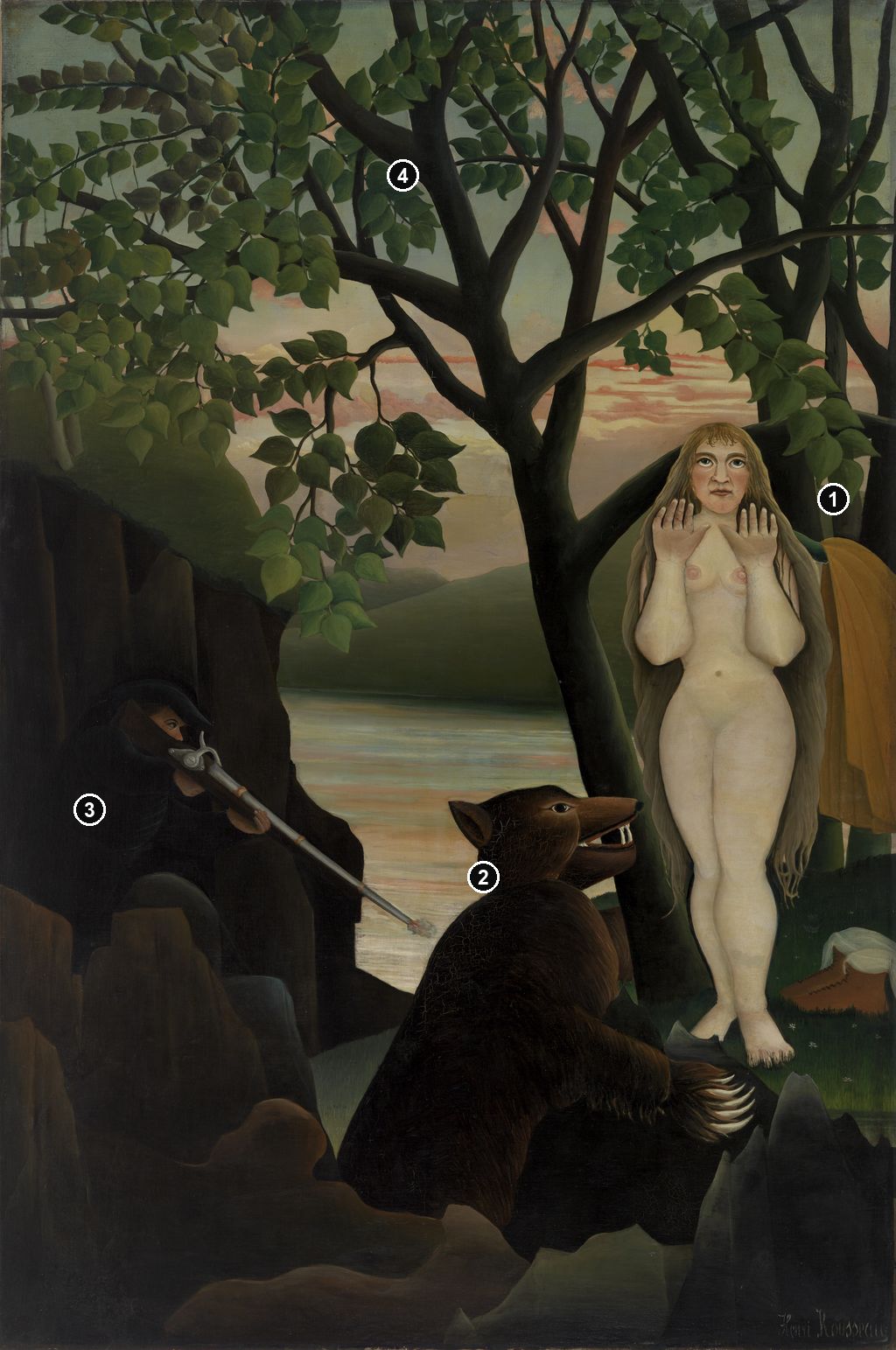
Details from UNPLEASANT SURPRISE
Look closely at the raised hands, the bear’s turned head and the hunter’s diagonal gun, then compare their tension with the repeated canopy above.
Raised palms and a forward gaze
The hands rise beside the face with their palms facing the viewer. The broadly balanced gesture and steady outward gaze make the figure’s response less abrupt than the threatening encounter around her.
The bear’s turned head and exposed teeth
The dark head turns towards the bather. A pale eye, long muzzle and bright teeth make small but decisive points of focus against the heavy trunk and the much softer distance behind.
The hunter concealed beside the trunk
Face, hands and the long gun emerge from the dark left side. The diagonal weapon links the partly hidden figure to the bear, while the tree and foreground rocks restrict how much of his body we can see.
Branching trunks and repeated leaf clusters
Heavy dark branches divide the upper field into openings of sky. Rounded leaves repeat along finer stems, creating a measured canopy above the much less settled human and animal encounter.
The rescue story and its unanswered questions
The Barnes's comparison with a conventional damsel-in-distress story gives a useful starting point. A vulnerable woman, an attacking animal and an armed man seem to assign the roles immediately. Yet the woman's frontal pose redirects our attention away from the hunter. She does not turn towards him in visible gratitude, nor does she twist her whole body away from the bear. The composition holds her in a presentation to the viewer, even while the other figures establish a dramatic event around her.[1]
That frontality makes the title unusually open. Whose surprise are we watching? The bather has apparently been interrupted; the bear has turned its head; the hidden hunter becomes a surprise for anyone who initially misses him. These are possibilities raised by the arrangement, rather than identities fixed by a written explanation. Rousseau supplies enough information for us to begin a story and enough resistance to keep us from finishing it with confidence.
Nor does the setting provide a precise location. The water, hills and dense trees make a plausible place for the encounter, but they do not identify a named landscape. The woman's nudity can recall the long pictorial tradition of bathers, while her raised hands suggest a dramatic interruption. Neither observation establishes a particular mythological heroine. The immediate experience of the painting depends on the bodies, gestures and spaces we can see, without requiring a recovered name for the woman.
Rousseau explored other uneasy meetings between people and animals. In The Sleeping Gypsy, the lion bends over a reclining sleeper, whose closed eyes prevent any visible exchange with it. Here the woman is awake and upright, and the bear's exposed teeth and claws bring danger to the surface. The hunter adds the prospect of intervention. Comparing the two pictures makes the extraordinary calm of the bather more apparent: wakefulness has not produced the flight or struggle we might anticipate.
In The Dream, a reclining nude occupies a densely planted setting with animals looking out through the leaves. Her ease and the elaborate vegetation give that encounter a different balance. Together these pictures show how much Rousseau could change the relationship between a human figure and surrounding creatures through posture and placement alone. They need not be understood as successive stages of one composition. Each establishes its own conditions for looking, waiting and imagining an event.
The title also deserves care when moving between Rousseau's paintings. Unpleasant Surprise is this upright Barnes canvas with the woman, bear and hunter. The tiger under driving rain belongs to Surprised!, a separate composition. Their related English titles can obscure how differently the pictures organise alarm: this one leaves a conspicuously calm figure at the centre of a threatening incident.
Renoir's reported admiration
A historical account of the painting's reception brings attention back to the nude and the colour of the whole picture. In his 1942 MoMA book on Rousseau, Daniel Catton Rich relayed Ambroise Vollard's report that Renoir admired its tonal qualities and suggested that even Ingres would have appreciated the female figure. This is retrospective testimony transmitted through Vollard and then Rich, rather than a contemporary review or a verified transcript of Renoir speaking.[12]
The comparison is suggestive because it asks us to look beyond the incident. The woman's body is carefully bounded against the darkness, and its long, closed silhouette commands the canvas. Her raised arms interrupt that outline without breaking its overall balance. Pale flesh, brown animal, black-green trees and the muted lake form a concentrated range of colours. The scene can feel startling in subject while remaining remarkably controlled in its large areas of light and shade.
Rich also connected the work with the monumental, dreamlike character of The Sleeping Gypsy. His language belongs to an influential historical reading of Rousseau, and his book retains an older dating of Unpleasant Surprise to 1891 in a footnote.[12] The Barnes now dates the canvas to 1899–1901.[1] Keeping that distinction allows the older response to remain valuable without making its chronology the basis of the painting's present identification.
From exhibition picture to the Barnes collection
The Barnes records Unpleasant Surprise at the Salon des Artistes Indépendants in Paris in 1901, under catalogue number 867. It appeared again in the Rousseau retrospective at the 1911 Salon, as number 18. Those two appearances place the canvas within both the artist's public exhibition activity and an early retrospective presentation of his work.[1] Its scale makes sense in that public context: the bather's pale figure and the bear's great mass can announce themselves across a room before their narrative becomes legible.
The Musée de l'Orangerie's 2026 gallery booklet summarises the painting's collecting history by naming Gabriële Buffet-Picabia as an earlier purchaser and Albert Barnes as its buyer in 1924.[13] This gives two important stages in its passage into the collection. The summary does not establish when Buffet-Picabia acquired it or supply every intervening transaction. What it does show is the painting's movement from Rousseau's exhibition world into the collecting history through which many viewers now encounter him.
The painting also travelled with the exhibition Great French Paintings from the Barnes Foundation, shown at venues in North America, Europe and Japan between 1993 and 1995. More recently, it was included in the Barnes's Henri Rousseau: A Painter's Secrets in 2025–26 and the related Orangerie exhibition in 2026.[1] Those later exhibitions belong to the continuing examination of a painting whose readily described subject has never made its visual effect simple.
Caring for the painted surface
Recent work at the Barnes has also addressed the physical painting. The foundation's FY25 annual report records high-resolution X-ray fluorescence scanning of Unpleasant Surprise, identified by its collection number BF281. It separately reports the completion of an extensive conservation treatment in 2024. The treatment secured unstable paint, removed discoloured or mismatched retouching, reduced discoloured and uneven varnish layers, and filled and inpainted areas of paint loss.[14]
Each part addresses a different aspect of the surface through which we see the image. Securing unstable paint protects material at risk of detaching. Work on old retouching and uneven varnish concerns later interventions and coatings that can interfere with the reading of colour and form. Filling and inpainting losses helps damaged passages join the surrounding image visually. The Barnes's published account describes this sequence of care; it does not publish a named pigment discovery or the identification of a concealed composition for this canvas.[14]
Such attention is particularly relevant to a picture that relies on small distinctions within large dark areas. The hunter must emerge from the tree's shadow; the bear's body must remain distinguishable from the rocks; the pale hands must register against the branches and sky. Conservation concerns the survival and legibility of those relationships. The story itself remains suspended before us, held between the woman's outward gaze, the animal's turn and the long diagonal of the gun.
Henri Rousseau artworks directory
This directory brings together works covered on this site and other works documented in the cited museum records and catalogues. Alternate titles share one entry; distinct versions remain separate. Historical dates for works without an article follow the cited catalogues. This is not a catalogue raisonné.
Frequently Asked Questions
A nude woman stands by water as a bear turns towards her and a hunter handles a long gun at the left. The Barnes interprets the man as rescuing the bather, while stressing how her calm gesture complicates that apparently familiar story.[1]
It belongs to the Barnes Foundation and is catalogued as BF281. The oil-on-canvas painting measures 194.5 × 129.5 centimetres.[1]
Discussion
Look again at the images and ideas explored in Unpleasant Surprise. These editorial prompts invite your observations.
Reader Insights
When did you first notice the hunter, and how did finding him change your reading of the woman and the bear?
Do the woman's raised hands suggest alarm, surrender or a different response? Which visible details support your choice?
How does the quiet lake alter the effect of the threatening foreground?
Join the Conversation
Share a detail, comparison or question about Unpleasant Surprise below.
References
- Barnes Foundation. Unpleasant Surprise (Mauvaise surprise), object 5434, BF281: current object metadata, interpretive description and exhibition history, accessed 23 October 2026. View source.
- Philadelphia Museum of Art, Carnival Evening,1963-181-64,object59593. View source.
- Musée de l’Orangerie / Juliette Degennes, Henri Rousseau,L’ambition de la peinture: Un artiste dans son époque (in French). View source.
- National Gallery, Surprised!, NG6421. View source.
- Musée d’Orsay, La Guerre,RF19461 (in French). View source.
- MoMA, The Sleeping Gypsy. View source.
- Philadelphia Museum of Art, The Merry Jesters, 1950-134-176, object51097. View source.
- Musée d’Orsay, La Charmeuse de serpents, RF 1937 7 (in French). View source.
- Musée de l’Orangerie, La Carriole du Père Junier, RF 1960 26 (in French). View source.
- Solomon R. Guggenheim Museum / Cornelia Lauf, The Football Players,60.1583: current collection record. View source.
- MoMA, The Dream, 252.1954. View source.
- Daniel Catton Rich. Henri Rousseau, Museum of Modern Art, 1942, printed p. 38 (PDF p. 43), including the report attributed to Ambroise Vollard and the older dating in footnote 1. View source.
- Musée de l'Orangerie. Henri Rousseau, l'ambition de la peinture: gallery booklet, March 2026, p. 7, “Les tableaux manifestes.” View source. (in French).
- Barnes Foundation. FY25 Annual Report, 2025, printed p. 27 (PDF p. 15), “Conservation and Exhibitions: Henri Rousseau.” View source.
- The Museum of Modern Art, Henri Rousseau: Essays (1985), selected catalogue entries, chronology and notes on early devotees. View source. Selected entries, chronology (pp.91–95) and early-devotee notes (pp.262–264) were consulted. Historical collection credits do not establish present ownership.
- Daniel Catton Rich, Henri Rousseau (The Museum of Modern Art, 1942), selected drawings and landscape studies; historical catalogue. View source. The dated 1942 publication is used for the two Quai d’Auteuil ink views; its Malakoff date differs from the 1985 catalogue.
- MANAS, Laval, Henri Rousseau, dit le Douanier, urban landscapes and preparatory study (in French). View source.
- National Gallery of Art, Self-Portrait (1895), pen-and-ink drawing, accession 1995.47.66. View source.
- The Museum of Modern Art, War (published January 1895), lithograph, accession 684.1943. View source.
- Barnes Foundation, Landscape and Four Young Girls, object 5521, BF855. View source.


 Henri Rousseau.jpg)


 Henri Rousseau.jpg)