



 by Tom Gurney
Tom Gurney BSc (Hons) is an art history expert with over 20 years experience
Published on June 19, 2020 / Updated on October 29, 2026
Email: tomgurney1@gmail.com / Phone: +44 7429 011000
Woman Walking in an Exotic Forest: Introduction
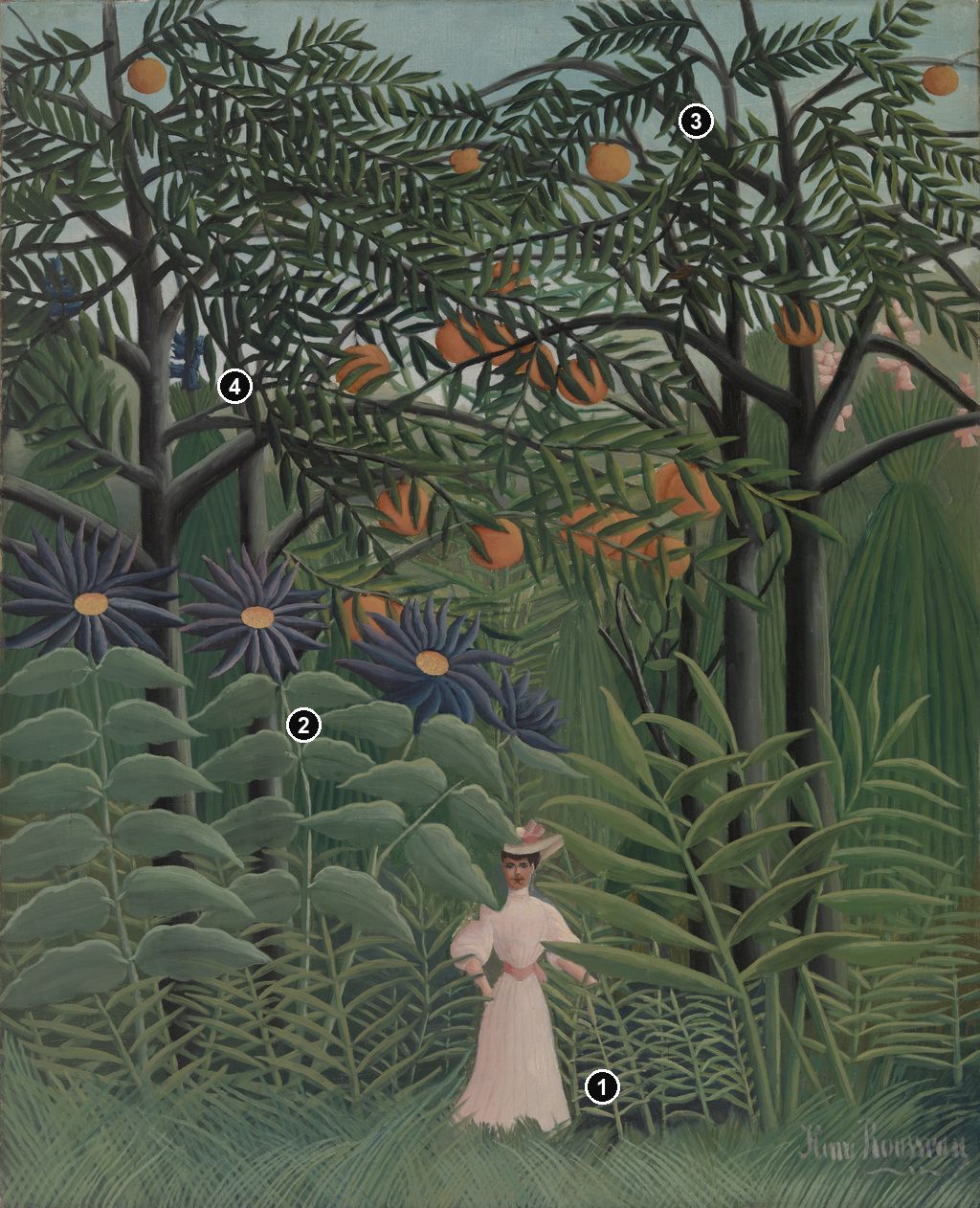
A woman in a pale pink dress stands low in Henri Rousseau’s Woman Walking in an Exotic Forest, beneath a roof of tangled branches. Her hat can almost disappear among the leaves. A moment later, the pale shape of her skirt brings her forward again. Looking at her involves a small act of searching: the forest keeps offering other things to see, from orange fruit high overhead to the dark, curling points of enormous flowers on the left.
The Barnes Foundation in Philadelphia dates the painting to about 1910 and records it as oil on canvas, measuring 100 × 81 cm, inventory BF388. Its French title is Femme se promenant dans une forêt exotique.[1] Within that upright rectangle, the woman occupies only a narrow opening. Much of the painting’s fascination lies in how firmly she is presented and how little space the vegetation gives her.
At a Glance
- ArtistHenri Rousseau
- SubjectWoman Walking in an Exotic Forest
- ExploreFinding the woman; Two different kinds of green enclosure
This work across Henri Rousseau’s career
Carnival Evening
1886 [2]The Merry Jesters
1906 [7]The Snake Charmer
1907 [8]Contents
- Finding the woman
- Two different kinds of green enclosure
- Flowers that face us
- Circles caught among the branches
- Small openings and uncertain distances
- Reading the encounter
- Annotated details
Finding the woman
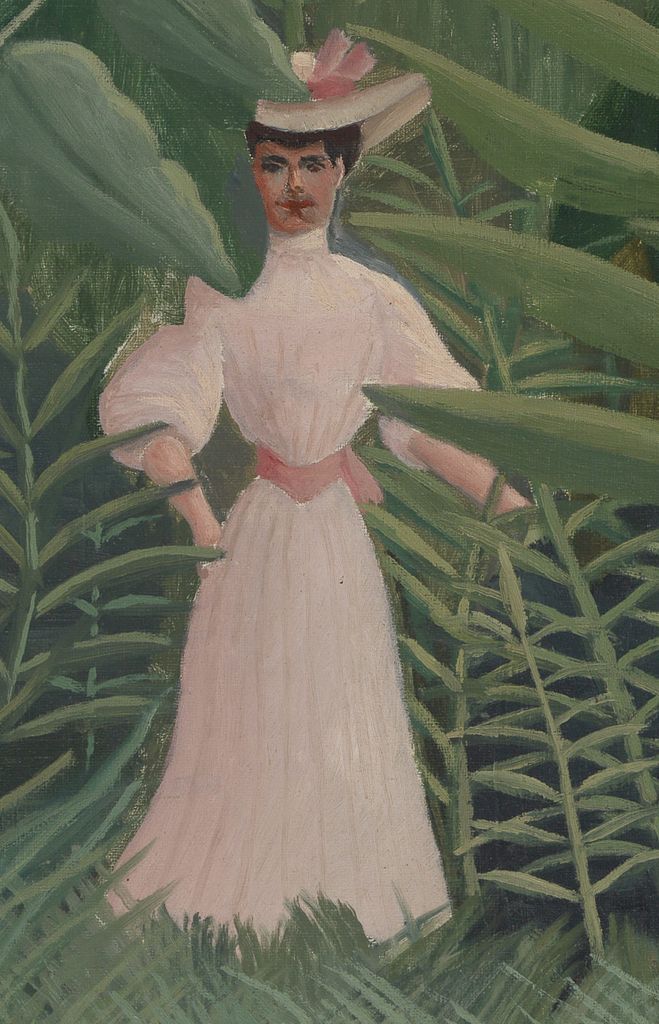
The dress is the broadest pale shape in the lower half. Its long skirt widens gently toward the grass, while a deeper pink band draws the waist inward. Above it, the sleeves swell outward before the arms emerge. These changes of width give the body a clear outline even though slender green stems cross the surrounding space. The figure has a compact, almost emblematic shape, held together by the repeated pink of skirt, bodice, waist and hat decoration.
Her arms complicate that neat arrangement. The arm on the viewer’s left bends down toward her hip, making a small angular enclosure against the dress. The other reaches sideways into the greenery, ending in a light hand. Its direction carries our attention toward the long leaves on the right. We can see the gesture, but assigning it a purpose is harder: the painting supplies neither an object she is unmistakably reaching for nor another person receiving a signal.
Her face is small, with dark eyes and hair sharply set against lighter skin. She faces outward while her arms make unequal movements. That combination holds two kinds of attention together. The face meets our gaze; the limbs belong to the space around her. It is tempting to turn the pose into the beginning of a story, yet she remains poised between several possible actions. Even the walking promised by the title is difficult to follow through the grass, which hides her feet.
The hat adds another interruption. Its pale brim spreads across the dark hair, with a pink accent rising above it. Just overhead, a large slanting leaf occupies much more room than the hat. The close encounter between these two shapes makes the head seem particularly vulnerable to being lost in the pattern. Once found, however, the face becomes a steady point to which the eye can return after exploring the surrounding branches.
Two different kinds of green enclosure
Rousseau gives the lower and upper parts of the forest different structures. Along the bottom edge, fine blades cross one another in a dense sloping weave. Their directions meet in shallow fans and wedges, giving the foreground a restless surface. They are so closely spaced that the eye reads them first as a continuous texture, then begins picking out individual lines. The hem of the dress meets this texture without a patch of bare ground separating them.
Behind the woman, little stems rise in rows, each with paired, pointed leaves. Their repetition makes a delicate fence around her body. Farther to the right, longer blades sweep upward and inward. These larger forms spread across the smaller ones, changing the pace of looking: a succession of short marks gives way to a few sustained curves. The forest feels dense partly because several different rhythms occupy the same small area.
The upper half works through forks and crossings. Dark trunks rise near both sides, divide, and send branches toward the centre. Some limbs arch; others lean across them. Slender leaves run along these branches in repeated pairs, producing many small openings through which pale sky appears. Following a single branch soon means choosing between intersecting lines. The eye can trace a direction for a while before another limb or cluster of leaves takes it elsewhere.
This upper lattice and the fine weave below surround a figure whose own outline is comparatively simple. Her sleeves, waist and skirt can be grasped quickly; the branches require a slower, wandering inspection. We recognise a person almost at once, but understanding her place in the forest takes longer. Here a characteristic of Rousseau’s style and technique becomes especially tangible: following the paired leaves across the sky takes far longer than tracing the pale dress beneath them.
Flowers that face us
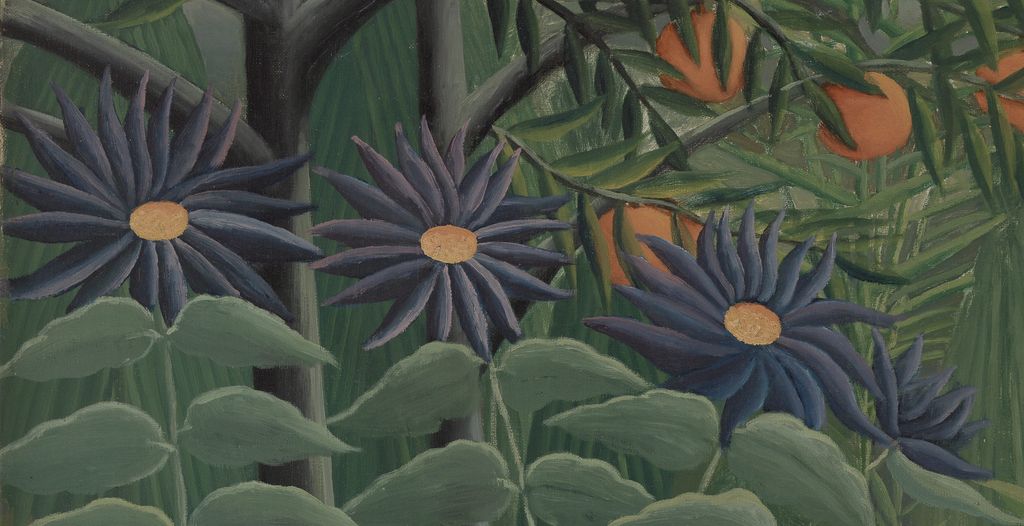
On the left, the purple-blue flowers interrupt the mesh of green with broad, radiating shapes. Their warm round centres are surrounded by long petals that curve, twist and taper. Several blooms face almost directly outward. One tilts away, narrowing the visible circle and showing how different the same radial arrangement can look when turned. Their dark colour also gives them weight against the softer greens of the leaves below.
Each bloom offers a centre from which the eye can travel outward. A petal begins near the yellow disc, swells into a curved length, then ends in a sharp point. Some points turn toward neighbouring petals; others reach into the surrounding green. The movement is more varied than a simple star. Within a single flower, the alternating curves give the impression of something slowly opening or rotating, although the painted contours themselves remain still.
Below these flowers, broad leaves form overlapping shelves. Some are rounded, others more distinctly heart shaped. Pale rims and ribs help one surface stand apart from the next. A leaf can feel substantial because its edge stays visible against a darker leaf behind it, even when the space between them is difficult to measure. Here the forest’s depth emerges through a succession of small overlaps rather than one long view into a distance.
The flowers and leaves also divide the left side into different kinds of attention. The blooms are easy to count and recognise as separate events. Beneath them, the green shelves accumulate into a larger mass. Then the fine stems at their feet break that mass into small repeated units again. Moving down this side of the painting means changing the scale of observation several times before reaching the foreground grass.
Circles caught among the branches
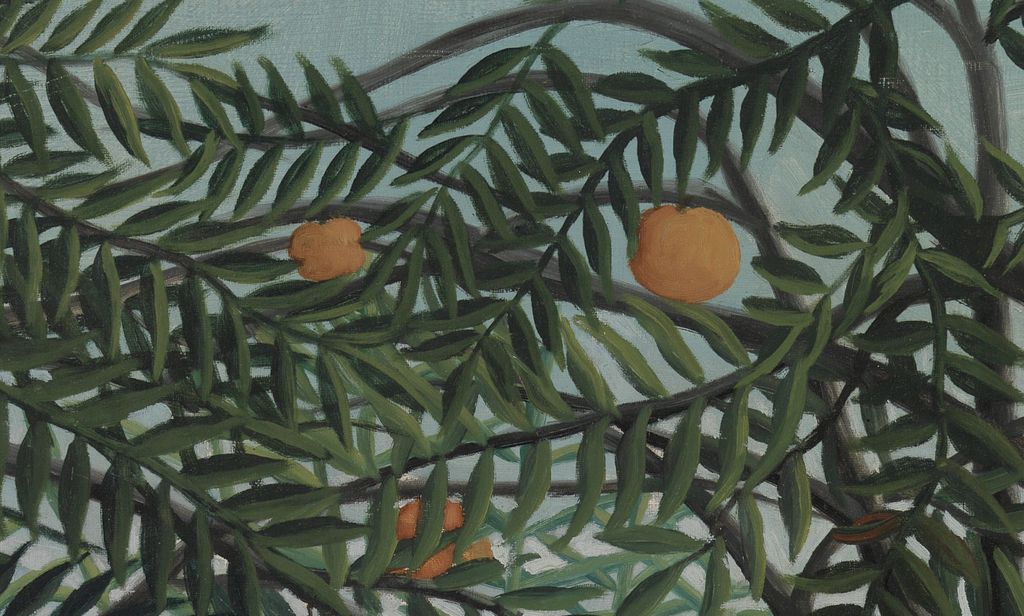
Orange fruit punctuates the canopy. Some pieces hang against open sky, while others are partly covered by narrow leaves. The clear fruit at the upper left reads quickly as a round shape. Lower down, branches and hooked leaf tips divide the orange into fragments. Our recognition of the whole fruit must bridge these interruptions. The canopy alternates between circles plainly offered to view and circles we assemble from glimpses.
Their spacing matters as much as their brightness. A fruit near the upper right balances the one at the upper left, but the heavier concentration falls farther inward and down. This keeps the canopy from settling into a regular border. The orange patches lead the eye across and through the branches, sometimes drawing attention to an open interval, sometimes making a crowded crossing more noticeable. They give the upper half a scattered set of warm accents.
The yellow centres of the flowers below answer those orange discs without matching them exactly. Both colours sit within darker surrounding forms, and both create points of concentration. The flower centres belong to expansive stars of petals; the fruit is enclosed by thin green strokes. The same basic roundness produces different effects because of what surrounds it. One spreads outward, the other seems caught inside the branching network.
Pink creates a quieter connection across the canvas. The woman’s dress occupies the lower centre, while a small pale pink cluster appears through the trunks on the right. That distant patch is broken into pieces and partly obscured. It carries a trace of her colour into another part of the forest without providing a clear destination. The dress stays distinct, but its colour no longer belongs to the figure alone.
Annotated Details from Woman Walking in an Exotic Forest
The numbered points identify visible features discussed in this article. Return from each detail to the whole composition. Henri Rousseau, Woman Walking in an Exotic Forest, c. 1910. Barnes Foundation, Philadelphia, BF388. Original museum-derived photograph published on Wikimedia Commons in 2018. Image source. Public domain. Numbers added to the overview; details cropped from the original published photograph. No recolouring or retouching.
Details from WOMAN WALKING IN AN EXOTIC FOREST
Find the small pink figure, compare the flowers with the orange shapes overhead, then look through the trunks for the pale and blue fragments beyond.
The pink figure within the stems
The pale dress, broad hat and unequal arm movements make a compact figure among the greenery. Fine stems crowd her outline, and the original grass conceals her feet and any clear route onwards.
Radiating flowers above broad leaves
Warm round centres gather long purple-blue petals into outward-facing forms. One flower turns sideways, while the broad overlapping leaves below give their curling points a different kind of green boundary.
Orange forms among paired leaves
Round orange shapes punctuate the network of narrow leaves and dark branches. Some remain clear against the pale sky; others appear only in pieces through the surrounding growth.
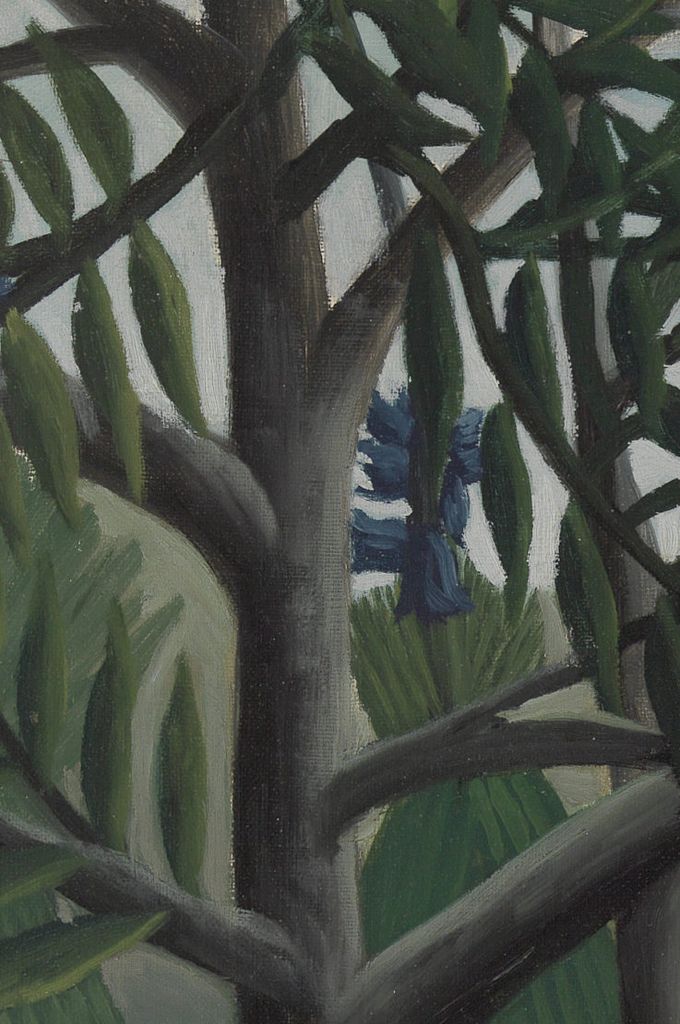
Blue-and-white glimpses between trunks
Blue and pale fragments interrupt the greens behind the dark trunks. Their limited visibility makes a small opening conspicuous without establishing what form lies beyond the branches.
Small openings and uncertain distances
The painting contains slivers of a world beyond its immediate plants. On the left, a small blue-and-white fragment appears between the trunks. Dark branches and narrow leaves interrupt it, leaving too little visible to identify the form securely. Its importance within the composition is more immediate. The cooler blue and pale intervals make a brief contrast with the surrounding greens before the foliage closes around them again.
Other openings reveal pale blue-green sky. These gaps occur at different heights and in different sizes, so daylight seems distributed throughout the canopy. They do not combine into a broad horizon against which we could easily judge distance. Instead, the forest gives us many small views beyond individual branches. Each gap loosens the surface locally while the surrounding foliage keeps the larger enclosure intact.
Tall green forms behind the foreground plants are drawn in close, descending lines. Their narrow tops and widening bodies can resemble fountains of foliage. They offer a quieter background to the sharply edged branches and leaves in front. Looking from one layer to another, we encounter changes in texture more readily than a continuous stretch of ground. The woman consequently seems held among separate screens of vegetation, with few clues about the distance between them.
Her open hand is a particularly effective point from which to test that space. It appears between the pale sleeve and a long green leaf, surrounded by smaller stems. The hand is legible, but the route her body would take through those stems remains unclear. Trying to imagine a next step sends the eye downward to the hidden feet, then outward to the plants. The picture makes movement a question that we explore by looking.
Reading the encounter
Martha Lucy, writing in the Barnes’s Masterworks, interprets the woman as incongruously placed and tentatively surprised. Her account emphasises the uncertainty of an ordinary walk transferred into this setting.[1] That reading is persuasive as an account of the encounter, while the tiny painted face leaves room for other responses. The outward gaze could also seem composed, watchful or simply difficult to decipher.
The uncertainty extends beyond expression. Nothing in the visible scene establishes who the woman is, where she has come from or what will happen next. Her familiar clothes stand out within a space that resists easy navigation. The fragments beyond the trunks give us glimpses through the vegetation without resolving into a specific setting or adventure. Much can be seen clearly while the relationships remain unsettled.
Returning to the whole painting after examining its parts changes the woman’s role. At first she may seem the obvious subject, with the forest supplying her surroundings. After following the many stems, petals and branches, the vegetation claims equal attention. Her pale silhouette gives us a measure against which to experience that abundance. The forest, in turn, makes a small figure, an extended hand and a strip of pink cloth feel unusually consequential.
Henri Rousseau artworks directory
This directory brings together works covered on this site and other works documented in the cited museum records and catalogues. Alternate titles share one entry; distinct versions remain separate. Historical dates for works without an article follow the cited catalogues. This is not a catalogue raisonné.
Frequently Asked Questions
The Barnes Foundation currently dates it to about 1910.[1]
Her identity is not established in the Barnes record. The painting alone cannot supply a name or personal history.[1]
No visible attack fixes the scene as a moment of danger. The obscuring plants and hidden ground can suggest difficulty or uncertainty, but those responses depend on how we read the encounter.
Discussion
Look again at the images and ideas explored in Woman Walking in an Exotic Forest. These editorial prompts invite your observations.
Reader Insights
Does the woman’s outward gaze make her seem more securely present, or make her position among the plants harder to explain?
How does your sense of distance change when you move from the large flowers to the small blue-and-white fragment between the trunks?
Which holds your attention longer: the pale figure or the repeated patterns around her?
Join the Conversation
Share a detail, comparison or question about Woman Walking in an Exotic Forest below.
References
- Barnes Foundation. Woman Walking in an Exotic Forest (Femme se promenant dans une forêt exotique), BF388, current collection record; includes Martha Lucy, The Barnes Foundation: Masterworks (2012), pp. 199–200. Accessed 23 October 2026. View source.
- Philadelphia Museum of Art, Carnival Evening,1963-181-64,object59593. View source.
- Musée de l’Orangerie / Juliette Degennes, Henri Rousseau,L’ambition de la peinture: Un artiste dans son époque (in French). View source.
- National Gallery, Surprised!, NG6421. View source.
- Musée d’Orsay, La Guerre,RF19461 (in French). View source.
- MoMA, The Sleeping Gypsy. View source.
- Philadelphia Museum of Art, The Merry Jesters, 1950-134-176, object51097. View source.
- Musée d’Orsay, La Charmeuse de serpents, RF 1937 7 (in French). View source.
- Musée de l’Orangerie, La Carriole du Père Junier, RF 1960 26 (in French). View source.
- Solomon R. Guggenheim Museum / Cornelia Lauf, The Football Players,60.1583: current collection record. View source.
- MoMA, The Dream, 252.1954. View source.
- The Museum of Modern Art, Henri Rousseau: Essays (1985), selected catalogue entries, chronology and notes on early devotees. View source. Selected entries, chronology (pp.91–95) and early-devotee notes (pp.262–264) were consulted. Historical collection credits do not establish present ownership.
- Daniel Catton Rich, Henri Rousseau (The Museum of Modern Art, 1942), selected drawings and landscape studies; historical catalogue. View source. The dated 1942 publication is used for the two Quai d’Auteuil ink views; its Malakoff date differs from the 1985 catalogue.
- MANAS, Laval, Henri Rousseau, dit le Douanier, urban landscapes and preparatory study (in French). View source.
- National Gallery of Art, Self-Portrait (1895), pen-and-ink drawing, accession 1995.47.66. View source.
- The Museum of Modern Art, War (published January 1895), lithograph, accession 684.1943. View source.
- Barnes Foundation, Landscape and Four Young Girls, object 5521, BF855. View source.


 Henri Rousseau.jpg)


 Henri Rousseau.jpg)