 Buy Art Prints Now
from Amazon
* As an Amazon Associate I earn from qualifying purchases.
 by Tom Gurney
Tom Gurney BSc (Hons) is an art history expert with over 20 years experience
Published on June 19, 2020 / Updated on October 16, 2026
Email: tomgurney1@gmail.com / Phone: +44 7429 011000
Portrait of Émilie Sériziat and Her Son: Introduction
Portrait of Émilie Sériziat and Her Son is one of Jacques-Louis David's warmest portraits from the difficult year after the Terror. The Louvre records the painting under the fuller title Portrait d'Émilie Sériziat, née Pécoul, et de son fils Émile, and identifies the sitters as David's sister-in-law and nephew. The museum dates the work to 1795, catalogues it as RF 1282 in the Department of Paintings, and currently displays it in the Denon wing, Salle 702. [1]
The portrait is inseparable from its pendant, Portrait of Pierre Sériziat. Together the two paintings show the family who received David during a period of illness, political danger and personal recovery. The result is not a grand Revolutionary statement, but it is one of the clearest images of David finding his way back toward painting after imprisonment and public upheaval. [1]
At a Glance
- ArtistJacques-Louis David [1]
- Louvre TitlePortrait d'Émilie Sériziat, née Pécoul, et de son fils Émile [1]
- Active URL/jacques-louis-david/portrait-of-emilie-seriziat-and-her-son/ [1]
- Date1795 [1] [5]
- MediumOil on wood in the Louvre record; canvas appears in some secondary routes [1] [3] [5]
- CollectionMusée du Louvre, Department of Paintings [1]
- InventoryRF 1282 [1] [2] [3]
- Dimensions1.31 m by 0.96 m [1]
- SittersÉmilie Sériziat, née Pécoul, and her son Émile [1]
- Family RelationDavid's sister-in-law and nephew [1]
- DisplayDenon wing, Salle 702 [1]
- PendantPortrait of Pierre Sériziat, RF 1281 [1]
- SalonShown at the Salon of 1795, opened 2 October [1]
- ProvenanceSériziat family descent; Pierre-Emmanuel Sériziat; Joseph Sosthène Moreau; Louvre purchase in 1902 [1]
- Image CautionLouvre/GrandPalaisRmn route and Commons file candidates remain amber for later image review [1] [3] [4]
Contents
- Introduction
- Object Identity
- David at Saint-Ouen
- Looking at the Portrait
- A Pendant to Pierre Sériziat
- Directoire and Post-Terror Context
- Provenance and Image Caveats
- Image and Source Cautions
- Why the Portrait Matters
Object Identity
The active English title, Portrait of Émilie Sériziat and Her Son, is readable and route-stable, but the sitter's fuller identity should not disappear. The Louvre identifies her as Émilie Sériziat, née Pécoul, born around 1770 and dead in 1804. Her son is named Émile, born in 1793 and recorded by the museum as having died in infancy. The title also states the family relationship directly: Émilie was David's sister-in-law, and the child was his nephew. [1] [2] [3]
The Louvre gives the painting's dimensions as 1.31 m high by 0.96 m wide and records the medium as oil on wood. For object facts, the Louvre's current record is the safest anchor. Some secondary records describe the work as oil on canvas, so the medium is best handled with that institutional distinction in mind. [1] [2] [3]
The painting's history is unusually helpful. According to the Louvre, David painted it with its pendant during two stays at the property of his brother-in-law Pierre Sériziat at Saint-Ouen, Favières, north of Tournan-en-Brie, from late April to late May and again in August 1795. The pair was shown at the Salon of 1795, which opened on 2 October. The work remained with the sitters and their family, passed through the surviving son Pierre-Emmanuel Sériziat, then entered the Louvre in 1902 after purchase with its pendant. [1] [2] [3]
David at Saint-Ouen
The Saint-Ouen setting matters because 1795 was a turning point in David's life. He had been closely tied to Jacobin politics and had suffered imprisonment after the fall of Robespierre. The Seriziat property gave him a place of shelter and convalescence. Painting Émilie, her son and Pierre was therefore an act of family gratitude as much as a professional commission. [1] [5]
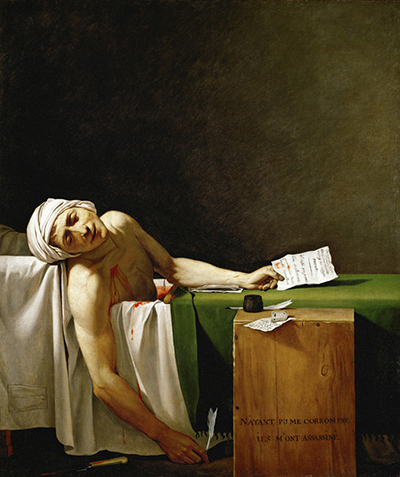
This context should not turn the portrait into an illness anecdote, but it does explain the work's emotional register. David had made some of the most severe public images of the Revolutionary decade, including The Death of Marat and The Death of Young Bara. In the Seriziat portraits, the tone is different. The figures are not martyrs or exemplars of antique duty. They are relatives, hosts and witnesses to a fragile personal recovery. [1] [5]
The 1795 Salon also gives the painting public weight. Showing the pendant portraits there allowed David to reappear as a practicing painter after political reversal. The Louvre's history and the Web Gallery of Art's summary both connect the portraits with this moment of return. The work is therefore intimate and social, but not merely private. [1] [5]
Looking at the Portrait
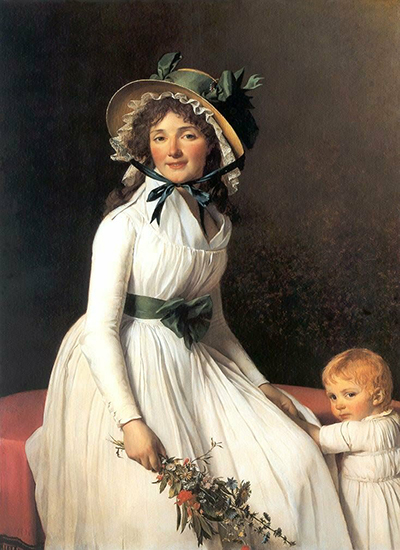
David shows Émilie Sériziat seated indoors, turned toward the viewer with her young son at her side. She wears a pale dress, a dark bow or sash at the waist, and a hat whose form adds height and playfulness to the composition. In one hand she holds a small bouquet of flowers. The child stands close to her, looking outward and helping to pull the viewer into the family scene. [1] [3] [4] [5]
The effect is unusually fresh for David. The sitter's cheeks, hat, flowers and relaxed posture make the portrait feel close to the pleasures of a walk or country stay. Yet David's control remains clear. The figure is carefully organised, the chair and body create a stable structure, and the pale clothing is balanced by the darker accents at the waist and hat. Nothing is casually placed, even when the mood seems easy. [1] [3] [4] [5]
The flowers are important because they shift the image away from official status. They are small, immediate and tactile. They make Émilie appear not as a remote social emblem but as someone momentarily returned from the outside world. The portrait's charm comes from that mixture: domestic affection, outdoor freshness and David's disciplined sense of form. [1] [3] [4] [5]
The child's presence changes the painting from a fashionable likeness into a family portrait. Émile is not treated as an ornamental addition. He belongs to the composition's emotional centre, and the museum title makes his identity part of the record. Because the Louvre notes that he died in infancy, the portrait has a retrospective poignancy that should be handled quietly. The image preserves a child whose life was brief, without turning the painting into a memorial scene. [1] [3] [4] [5]
A Pendant to Pierre Sériziat
The pendant relationship with Portrait of Pierre Sériziat is central. Pierre's portrait shows him outdoors, wearing informal riding clothes and carrying hunting gear, while Émilie's portrait brings wife, child, flowers and interior setting into the pair. The two works should be understood as companion images of a household rather than isolated decorative portraits. [1] [2]
This pairing also helps explain David's choices. Pierre's image stresses active country leisure and masculine informality. Émilie's image stresses maternal presence, sociability and fresh elegance. Both works replace Revolutionary theatricality with a new language of private life. They show David looking at people close to him, people connected by marriage, hospitality and recovery. [1] [2]
The paired portraits are also useful for understanding David's wider portrait practice. In Portrait of Jacobus Blauw, David turns a diplomat's working papers into political identity. In Madame de Pastoret and Her Son, motherhood is shadowed by Revolutionary division. In the Seriziat pair, family affection and rural sociability become the language of repair. [1] [2]
Directoire and Post-Terror Context
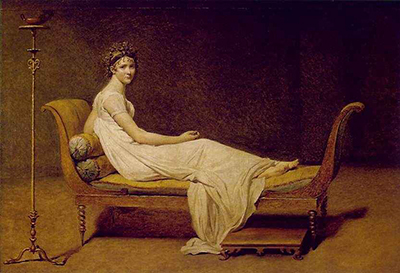
The Seriziat portrait belongs to the same broad post-Terror period as Portrait of Madame de Verninac and Madame Récamier, though it is earlier and more domestic in mood. By the late 1790s, David's art was searching for forms that could survive the collapse of Jacobin certainty. Portraiture became one of those forms. [1] [5]
This does not mean that Émilie Sériziat should be read as an allegory of France, motherhood or reconciliation unless a source says so directly. The safer reading is more grounded. David made a portrait of a woman he knew, with her child, in a family setting shaped by his own recovery. The larger historical meaning comes from that specificity, not from forcing the sitter into a symbolic scheme. [1] [5]
Even so, the work's date matters. A portrait made in 1795 carried a different charge from a similar family picture painted before 1789. After imprisonment, executions and shifting loyalties, a calm family image could itself feel like a return to ordinary life. David's skill lies in making that return appear graceful without denying the discipline behind it. [1] [5]
Provenance and Image Caveats
The Louvre record leads the painting's object facts. It gives the title, date, RF number, dimensions, medium, family relationship, pendant relationship, Saint-Ouen context, Salon display, family provenance and Louvre acquisition. Wikimedia Commons provides a helpful category for RF 1282 and files connected to the Louvre work, while Web Gallery of Art gives a useful secondary summary of David's illness, Saint-Ouen stay and Salon return. [1] [2] [3] [4] [5]
The best public identity for the painting is therefore not difficult, but it does need precision. The Louvre title preserves Émilie's maiden name, her relationship to David and the child's identity. The shorter English title remains useful for readers, while the fuller French title keeps the article tied to the museum record. [1] [2] [3] [4] [5]
The page title should preserve the familiar English form while acknowledging the accents in Émilie Sériziat and Pécoul. The URL is already clean and active, so there is no reason to disturb it. The article body can carry the richer French title and sitter details while the address remains stable for readers. [1] [2] [3] [4] [5]
Image and Source Cautions
Image reference: the page image follows the Louvre RF 1282 object route, while Commons provides several useful file candidates rather than one single licence decision. The Louvre record includes GrandPalaisRmn, musée du Louvre and Franck Raux credit language, so image credit should stay tied to the selected Louvre or Commons source. The lower-resolution WGA-derived Commons file is useful as a metadata cross-check, but the Louvre object record remains the safest authority for title, medium, inventory and provenance. [1] [2] [3] [4] [5]
Why the Portrait Matters
Portrait of Émilie Sériziat and Her Son matters because it gives David's post-Terror recovery a human face. It is not a painting of public ceremony, martyrdom or classical heroism. It shows family shelter, maternal presence and the possibility of painting again after political crisis. That makes it one of the most approachable works in the David cluster, but also one of the most historically delicate. [1] [5]
The portrait also deepens the cluster's treatment of women and family in David's art. It belongs beside Madame David, Portrait of Madame Marie-Louise Trudaine, Portrait of Madame de Verninac and Madame Récamier as evidence that David's portraits could carry as much historical feeling as his more famous public scenes. [1] [5]
For David's full career, see the Jacques-Louis David biography. For the wider artwork sequence, use the David paintings hub. Portrait of Émilie Sériziat and Her Son is best read with its pendant, Portrait of Pierre Sériziat, but it also stands on its own as a luminous image of family closeness at a moment when David badly needed signs of continuity. [1] [5]
Frequently Asked Questions
Discussion
Portrait of Émilie Sériziat and Her Son turns David's post-Terror recovery into a family image rather than a public monument.
Use the prompts below to think about how maternal presence, pendant portraiture and historical recovery work together.
Reader Insights
How does knowing that Émilie was David's sister-in-law change the tone of the portrait?
What does this portrait gain when read beside Pierre Sériziat's outdoor companion image?
Where does the painting feel like a private refuge after public political crisis?
Join the Conversation
Share your reading of Portrait of Émilie Sériziat and Her Son below.
References
- Louvre Collections, Portrait d'Émilie Sériziat, née Pécoul, et de son fils Émile, RF 1282, accessed 27 July 2026.
- Louvre Collections JSON, Portrait d'Émilie Sériziat, née Pécoul, et de son fils Émile, accessed 27 July 2026.
- Wikimedia Commons category, Madame Seriziat and Her Son - Jacques-Louis David - Louvre RF 1282, accessed 27 July 2026.
- Wikimedia Commons file, Portrait of Emilie Sériziat and her Son - WGA6075.jpg, accessed 27 July 2026.
- Web Gallery of Art, Portrait of Emilie Sériziat and her Son, accessed 27 July 2026.