by Tom Gurney
Tom Gurney BSc (Hons) is an art history expert with over 20 years experience
Published on June 19, 2020 / Updated on October 22, 2026
Email: tomgurney1@gmail.com / Phone: +44 7429 011000
Grande Odalisque
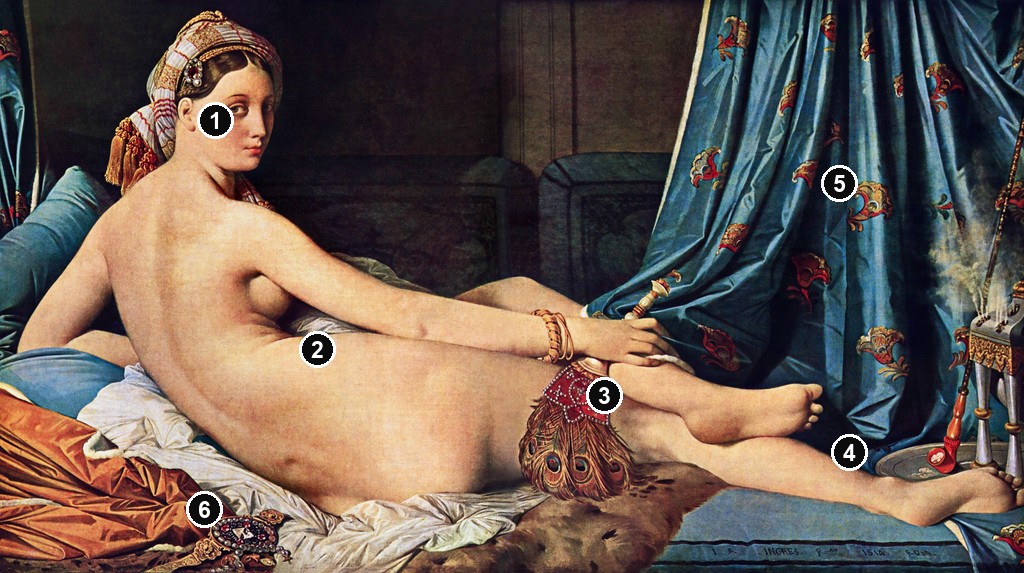
The first surprise in Grande Odalisque is how far the eye has to travel. From the turned head at the left, the shoulder opens into an unusually long back; an arm reaches across the body towards folded legs, while a blue curtain rises above them. Everything seems held in place by a few flowing curves. Then the small, sharply directed glance catches us looking.
Ingres painted the canvas in Rome in 1814 for Caroline Murat. [1] A royal commission became a disputed public painting and, eventually, a museum possession. Between them lies the question that still makes the picture compelling: how can a body look so carefully described and so freely invented at once?
At a Glance
- ArtistJean-Auguste-Dominique Ingres
- TitleUne odalisque, dite La grande odalisque; usually Grande Odalisque in English
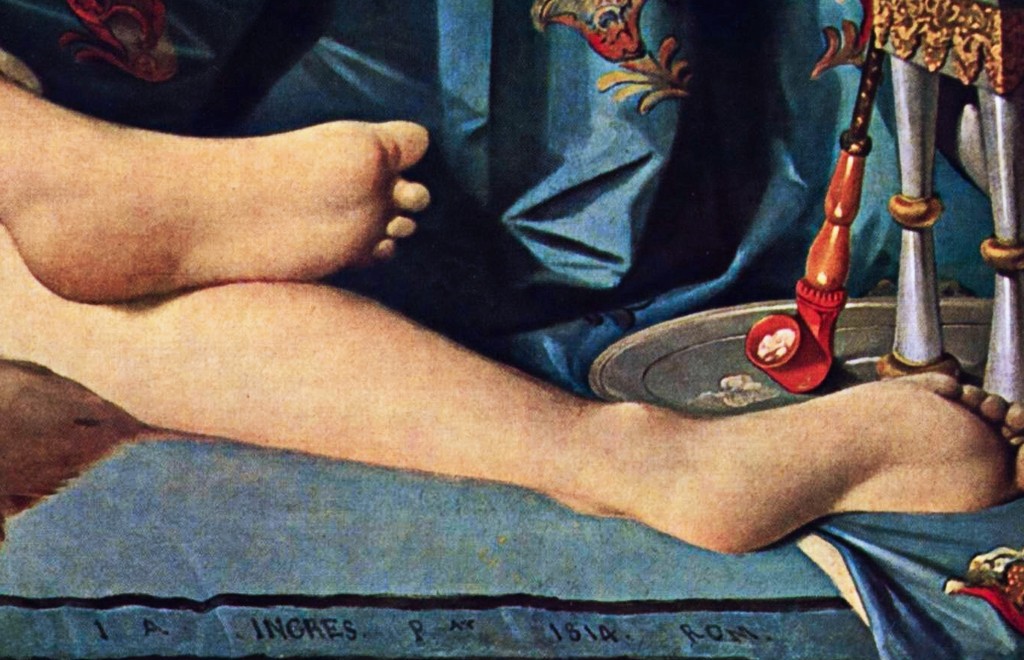
- Date and place1814, Rome; signed and dated on the canvas
- Medium and dimensionsOil on canvas, 91 × 162 cm
- Intended patronCaroline Murat, Queen of Naples
- Public exhibitionParis Salon, 1819
- CollectionMusée du Louvre, Paris, RF 1158; purchased in 1899
Object details follow the Louvre’s collection record. [1]
This work across Ingres’s career
Agamemnon’s Ambassadors
1801 (competition)Louis XIII’s Vow
1824Monsieur Bertin
1832The Princesse de Broglie
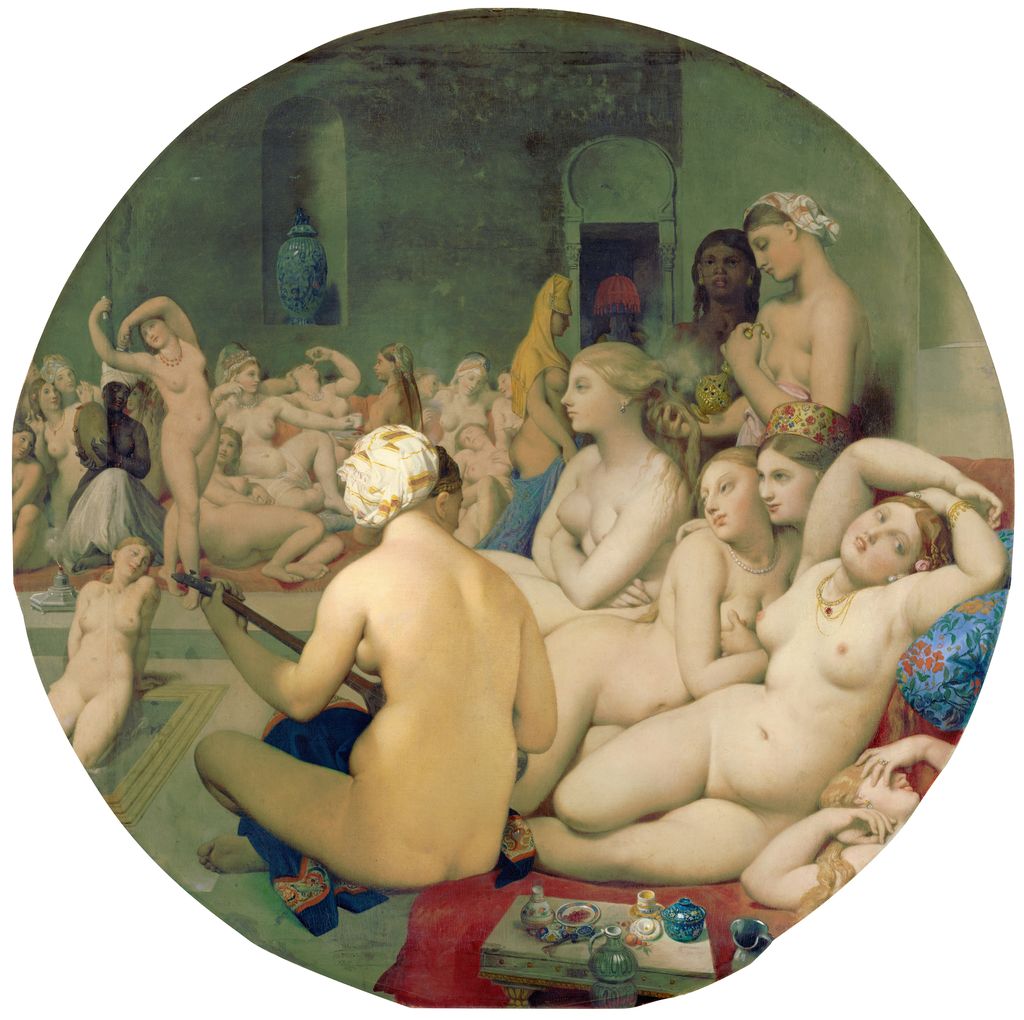
1851–1853The Turkish Bath
1859–1862Contents
- Following the curves through the picture
- A queen’s commission and a missing companion
- What does “odalisque” mean here?
- Renaissance memories in a new setting
- The long back and the “extra vertebrae” story
- Drawing, colour and the appearance of finish
- An imagined interior and the position of the viewer
- From the Salon of 1819 to the exhibition of 1855
- The grisaille and the artist’s own lithograph
- Annotated details
Following the curves through the picture
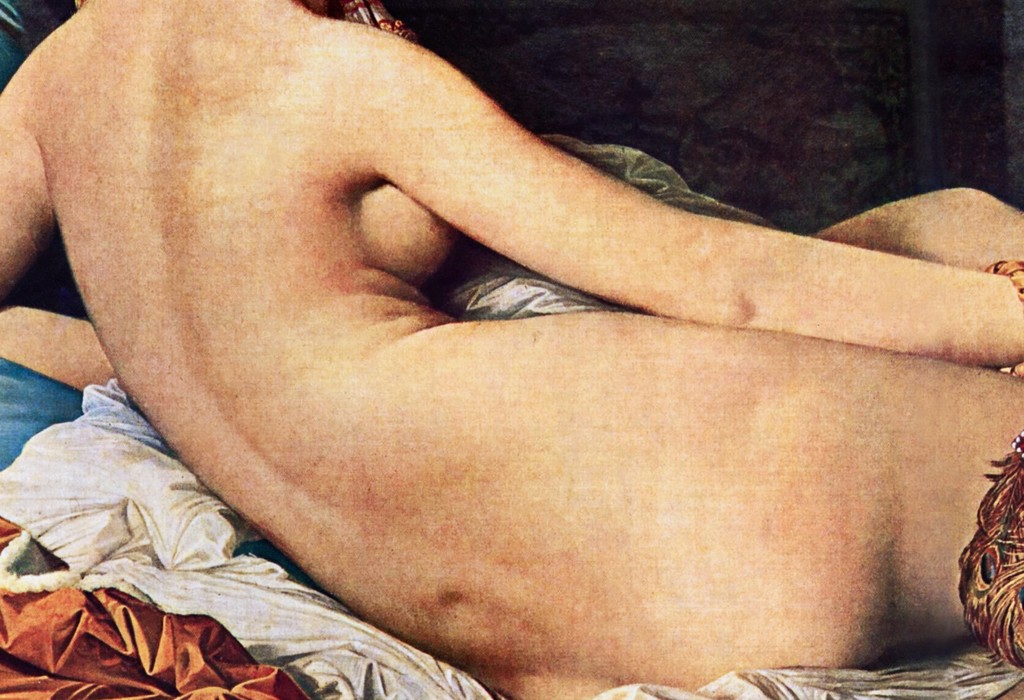
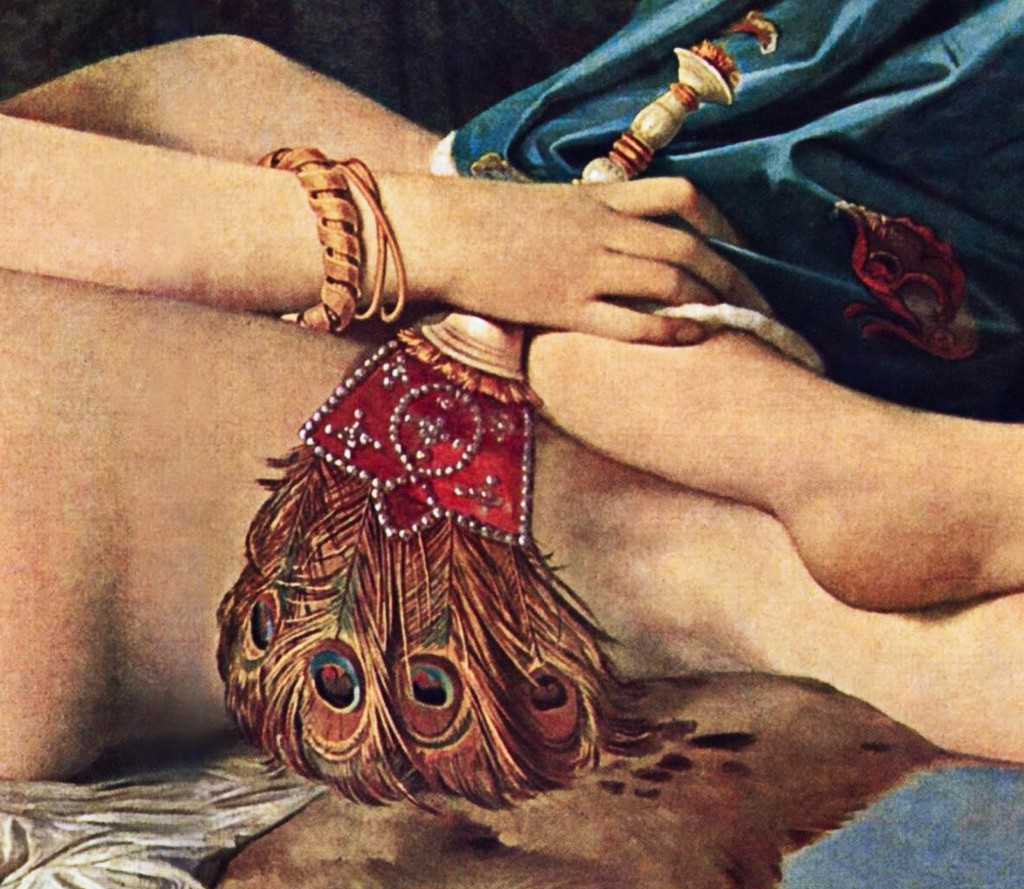
The Louvre identifies the left elbow on cushions and the right hand holding a peacock-feather fan against the bent left leg. [1] At first the back reads as a single expanse of illuminated flesh. Looking longer, we see how gradually the shoulder blade, waist and hip emerge. Shadow changes the surface without breaking it into strongly separated muscles. The contour dips beneath the shoulder, sweeps through the waist and broadens around the hip. In the absence of a sharply articulated skeleton, that continuous line carries an unusual amount of the work of making the body intelligible.
The outstretched right arm supplies a second long movement. It crosses the picture above the lower body and draws the eye towards the fingers, fan handle and ankle. The wrist bracelets make a brief interruption: a little concentration of metal and reflection on an otherwise extended passage of flesh. Beyond them, the fingers and folded leg form a knot of overlaps. The eye can slide through the composition easily before it has quite worked out how its parts connect.
That difference between fluent looking and uncertain reconstruction is central to the painting. Seen at a distance, the reclining figure is almost a long, pale island surrounded by textiles. Seen closely, the arm, torso and legs compete to explain her position. The picture accommodates both experiences without resolving them into a single anatomical diagram.
A curtain that shapes the body
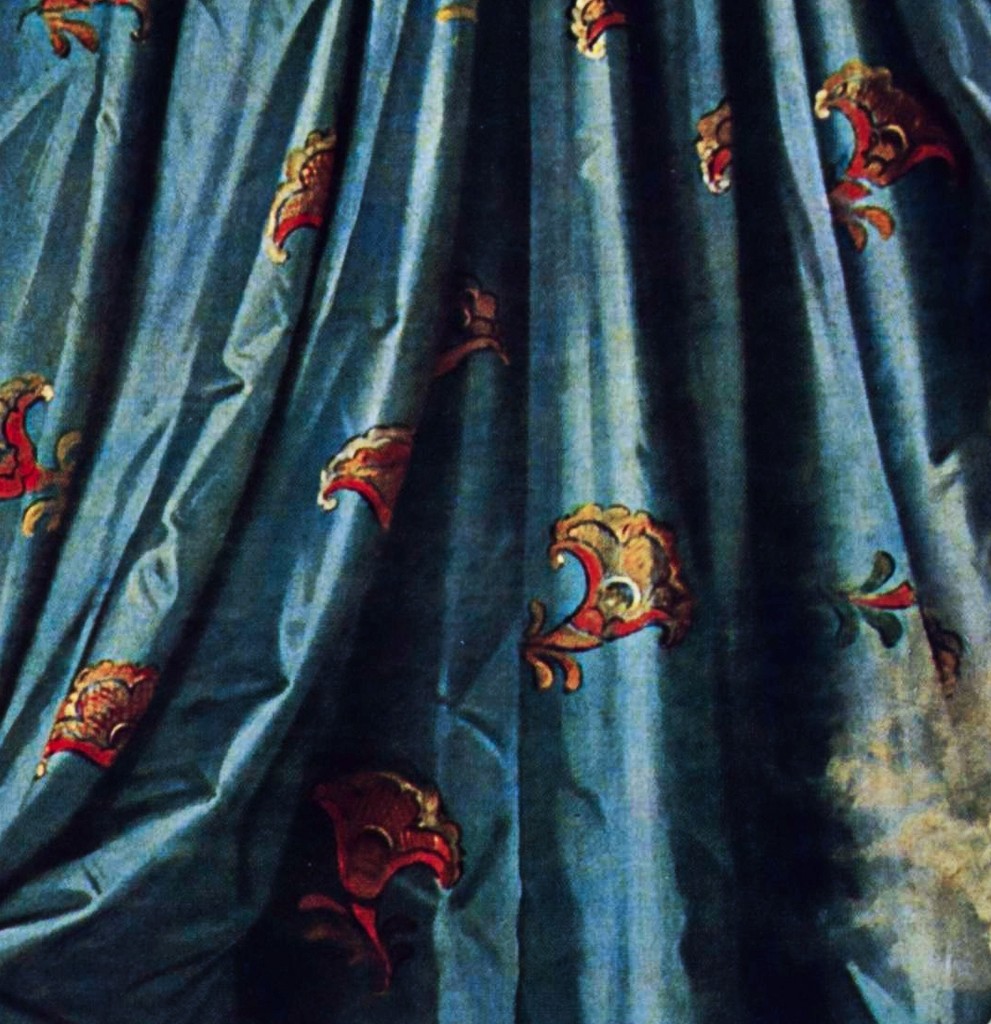
The blue curtain occupies much of the right-hand side. Its folds fall steeply, changing from near-black creases to narrow strips of light. Repeated red and gold motifs sit on those folds, alternately clear and half swallowed by shadow. The cloth has its own small-scale activity, set against the broader, quieter surface of the back.
The curtain does more than supply a sumptuous background. Its descending diagonal leads towards the wrist and legs, gathering the eye into the same area as the arm. Along its lower edge, dark blue meets pale flesh in a particularly clear boundary. The body becomes easier to see as an outline precisely where the position of the limbs becomes more complicated.
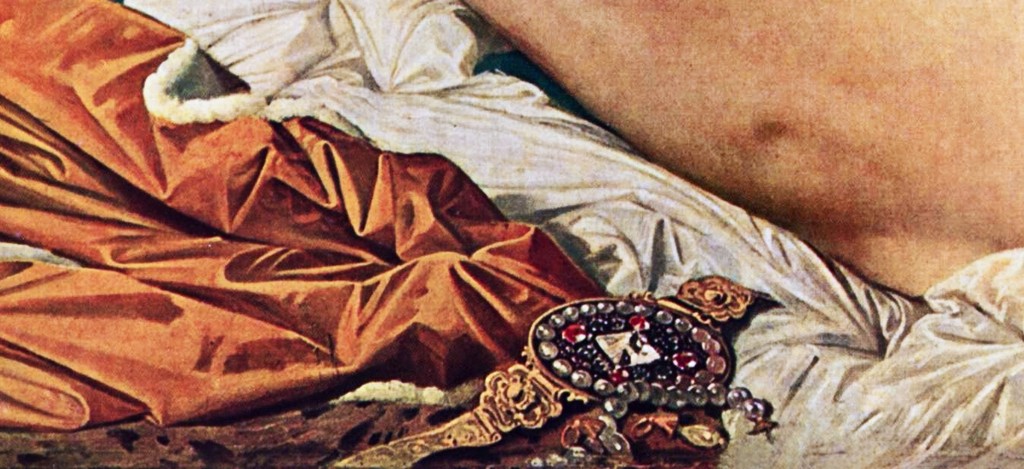
Blue also appears at the opposite end, in the cushion beneath the left arm. That repetition carries the colour around the figure. Below, the crumpled white sheet is broken into small, angular folds, and the orange-gold textile at the lower left introduces a warmer, sharper brilliance. The fabrics offer several different kinds of movement: the hanging sweep of the curtain, the yielding cushions and the compressed folds of bedding. The body passes among all three.
The fan makes another link between decoration and figure. Its feather eyes repeat the little ornaments of the curtain in a looser, more organic pattern. The feathers hang down towards the foreground; the handle rises into the hand. It is both a recognisable object and a way of interrupting the large pale area without imposing a heavy barrier across it.
The head and the withheld room
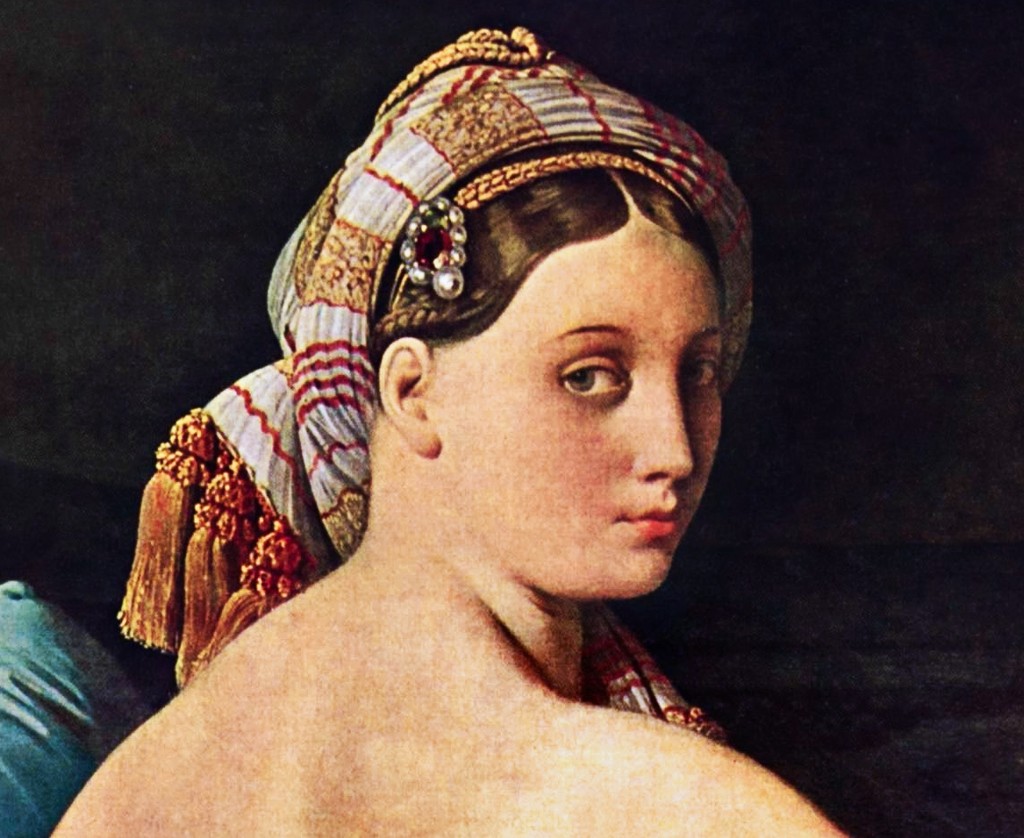
The head is the picture’s most concentrated passage. The striped headcloth coils around it, with jewels, gold edging and a tasselled end. Against that elaborate wrapping, the face has comparatively few distractions. The eye, nose and closed mouth hold attention after the larger curves have carried it elsewhere.
A glance directed towards us can feel startlingly personal. Yet the painting supplies little of the information through which we would ordinarily understand a person’s situation. There is no named sitter, conversation or action to explain the encounter. We can describe the turned head and the direction of the eyes more securely than we can name an emotion. Confidence, indifference, curiosity and reserve are possible responses in a viewer; none establishes what the depicted woman is thinking.
Behind her, the dark wall and cushions allow only a shallow sense of recession. There is no open doorway or distant prospect to lead us out. At the far right, smaller furnishings and a rising wisp of smoke add incident without opening the space. We are shown an intensely furnished fragment of a room, concentrated around the reclining body.
This restricted setting makes the fabrics unusually consequential. They tell us much more about the pictorial world than its architecture does. Their patterns, sheen and folds create a place that feels specified in detail while remaining difficult to locate. The result is an interior persuasive as painting, with very little evidence by which to identify an actual room.
Annotated Details from Grande Odalisque
The numbered points identify visible features discussed in this article. Return from each detail to the whole composition. Grande Odalisque. Louvre, RF 1158. Image source. CC0 / Public domain.
Details from GRANDE ODALISQUE
Compare the long contours of the body with the smaller patterns, objects and folds around it.
The turning head and turban
The face turns towards the viewer while the striped turban turns around the head. Jewellery, tassels and folds gather sharply described shapes beside the smoother cheek.
The long sweep of the back
Follow the outer contour from the shoulder into the hip. A broad passage of pale skin holds together several changes in direction, while the shadow beside the arm separates one curve from another.
The hand, bracelets and fan
The fingers extend over the leg beside the fan handle. Compare their slim outlines with the rigid bracelets and the many small eyes of the feathers below.
The feet against the blue cloth
The bent and extended legs end in different positions against the cloth. Follow the toes and heels back into the larger diagonals of the legs.
Pattern across the curtain
Small coloured motifs recur across the blue curtain. Deep folds interrupt the pattern, creating narrow dark channels within this large area of colour.
Jewellery and gathered fabrics
A bright ornament lies among white and orange folds at the lower edge. These tightly packed changes of colour and texture contrast with the broad unbroken areas of skin above.
A queen’s commission and a missing companion
Grande Odalisque began as part of a pair. Henri Delaborde’s posthumous account of Ingres records a commission from Caroline Murat in 1813, intended to accompany another painting by the artist already owned by her husband, Joachim Murat. The earlier work showed a sleeping woman and is generally known as the Sleeping Woman of Naples or Dormeuse de Naples. It is lost. [2]
A letter to Ingres’s friend Marcotte, dated 26 May 1814 and printed by Delaborde, makes the relationship particularly clear. Ingres says he has just completed a small full-length portrait of the Queen of Naples and is finishing the companion to a sleeping female figure that the king had bought five years earlier. He also mentions the prospect of further portraits of the royal family, while acknowledging their dependence on political circumstances. The letter places the nude within an active relationship with a court patron, alongside portrait commissions. [2]
A pendant is a picture intended to accompany another, usually through a relationship of size, subject or composition. Here the connection means that the odalisque was conceived for a collection containing another reclining nude by Ingres. The lost painting limits what can be said about their full effect together. We can establish the intended pairing without pretending that a surviving study or later reconstruction lets us recover every feature of the missing original.
The Valpinçon Bather is sometimes drawn into this history because it also presents a female back. It is an illuminating comparison, but it was not the picture identified as the pendant in the letter. The sleeping woman bought by Joachim Murat and the seated bather are distinct works. [2]
The royal destination also complicates a familiar assumption about the painting: its documented patron was a woman. Caroline’s commission belongs to the history of elite collecting and the display of the nude, as well as to that of erotic imagery. Her involvement does not tell us how every intended spectator would have looked at the pair, or remove the unequal relations implied by the harem subject. It does prevent us from replacing the actual circumstances with an invented transaction between a male patron and a painter.
When the painting failed to reach Naples
The political circumstances anticipated in the letter soon overwhelmed the commission. With the Murats’ loss of power in 1815, the picture failed to reach its intended destination. Delaborde describes the completed odalisque remaining with Ingres before finding another purchaser. His account turns a court commission into the story of a painting for which the artist had to find a different home. [2]
Writing in 1870, Delaborde records a sale to the comte de Pourtalès for 800 francs. He then traces ownership through Goupil and Fau to Baron Seillière. Those details belong to his historical account; his statement about its owner “today” refers to the time of his book. [2] The Louvre acquired it in 1899. [1]
There is a revealing contrast between the commissioned object and the picture’s subsequent fame. The painting was intended to answer an existing nude in a royal interior. Its independent public life allowed it to become an argument about Ingres’s art in its own right. Modern viewers usually encounter it without the companion whose presence helped generate it.
What does “odalisque” mean here?
In Ottoman usage, an odalisque was an enslaved servant of a harem’s women. The Louvre describes Ingres’s setting as imaginary. [3] That difference matters. A harem was a household setting with social relationships and rules; the canvas offers a highly selective European fantasy. Its richly wrapped head, fan, jewellery and curtain encourage a geographical association, but they cannot authenticate the place or the woman’s status. No individual Ottoman woman is identified by the picture’s title.
Ingres made the painting in Rome, and the Louvre notes that he had never travelled to North Africa or the Ottoman Empire. [3] The objects and costume thus work as mediators of distance. They allow a familiar tradition of European nude painting to appear in a setting imagined as elsewhere. The painting’s abundance of particular details can make that imaginative construction easy to overlook.
The title also changes how we interpret the visible stillness. Without it, we might describe a woman resting on a bed. With it, the same scene becomes associated with seclusion, service, sexuality and possession. Those associations belong to the cultural work of the image. They are not observations that can be read directly from a wrist, facial expression or patch of skin.
Renaissance memories in a new setting
The horizontal nude on a bed recalls the Renaissance tradition of reclining Venuses. The Louvre connects Ingres’s composition with Venetian examples, including Titian’s Venus of Urbino. [3] The useful comparison concerns the arrangement of a body for sustained looking: a broad horizontal format, cushions and bedding, and an interior that frames the exposed figure.
Ingres’s view from behind changes that inherited arrangement. The odalisque turns her face towards us while keeping the broad plane of her back in view. The body and the gaze seem to move in different directions. The pose allows the head to retain the address of a facing figure while the torso supplies a long, largely uninterrupted surface.
The headcloth introduces another kind of artistic memory. Robert Rosenblum, in his introduction to the Metropolitan Museum’s Portraits by Ingres, links the coiled headdress recurring in Ingres’s bathers and odalisques with Raphael’s Madonna della Sedia and La Fornarina. His point belongs to a larger account of how Ingres carried Renaissance forms between different subjects. [4]
Such a relationship is more interesting than a search for a single copied source. A headdress could recall Italian painting while helping to suggest an imagined eastern interior. A reclining pose could retain the prestige of Venus while changing the depicted woman’s identity and circumstances. The picture brings those associations together rather than making its ancestry invisible.
Look again at the turban in relation to the curtain. Both consist of folds, stripes or patterns wound around a larger shape. The headcloth compresses those details into a small area; the curtain spreads them over a large one. Between them lies the comparatively unpatterned body. The inherited motif becomes part of an immediate pictorial relationship that can be seen even without recognising Raphael.
The long back and the “extra vertebrae” story
The extended torso is the painting’s most famous feature, but it is worth looking before counting. The distance from shoulder to hip feels ample; the long right arm carries a corresponding stretch across the image. Meanwhile the folded legs gather the lower body into a much tighter group. Expansion in one area and compression in another give the pose its distinctive rhythm.
The unusual proportions are particularly noticeable because of the finish. Textiles, jewellery and features invite confidence in the painter’s powers of description. When the body is less easily reconciled with ordinary experience, that confidence becomes a question. The painting offers no change of manner to announce where observation gives way to invention.
What the medical study actually measured
The remark about three extra vertebrae comes through Amaury-Duval’s later studio memoir, attributed to Kératry. Jean-Yves Maigne, Gilles Chatellier and Hélène Norlöff investigated it in 2004. [5] They compared nine tall women, posed as closely as possible to the figure, with a reproduction. Head height supplied a proportional unit; photographs supplied perspective corrections. The estimated excess across the lower back and pelvis together amounted to roughly five lumbar vertebrae in height. This is a length equivalent within their model, rather than five additional bones visible in the painting. [5] The result depends on the sample, landmarks, head-size estimate and perspective assumptions. It cannot establish Ingres’s intention. The authors’ suggestion of a psychological division between head and body is a separate interpretive hypothesis. [5]
Proportion as an experience of looking
A painted figure has no hidden skeleton waiting to be recovered. What we can examine is the effect of the proportions on the surface before us. Here the long torso creates room for a sweeping curve, while the arm repeats its extension more directly. The head becomes a small, concentrated point at one end of an expansive figure.
The hand and ankle are especially useful places to pause. Together they appear to anchor the long arm and the folded leg. They make the pose seem connected, yet their very closeness encourages us to reconsider how far the arm has travelled and how the leg turns back. The painting is full of such local assurances and larger uncertainties.
Calling the figure a mistake leaves that experience unexplained. Calling every discrepancy a precisely documented decision goes beyond the evidence. We can say more concretely that the visible relationships sustain the composition: shortening the torso in imagination would alter the broad sweep of the back, the position of the arm and the balance between head and hip. The proportions are inseparable from the picture we actually see.
Drawing, colour and the appearance of finish
The long outline is only one part of the painting’s construction. The broad back also depends on slow transitions from light to shadow, and on changes of hue that distinguish it from the cloth. A contour may establish where the body ends, but the light across it makes that boundary belong to a rounded form.
Ingres’s own published statements help explain why drawing meant more to him than tracing an edge. “Drawing does not simply mean reproducing contours,” he says in the notes assembled by Delaborde after his death; this is our translation of the French. In the surrounding passage, he includes expression, inner form, planes and modelling within drawing. His further statement that “Drawing includes everything except tint” belongs to that expansive definition. [2]
Read beside the painting, those words direct attention towards the organisation of the whole figure. The surface of the back, the turn of the shoulder and the small shadows around the fingers are all means of defining form. The drawing can be active where no dark outline is visible. A change in the direction of a lit plane may carry as much information as a firm boundary.
Colour, meanwhile, is impossible to detach from the encounter. The dense blue makes the body look warmer. The white sheet provides a lighter, more fragmented passage beneath it. Gold, orange and red collect around the headcloth, bracelets, fan and foreground fabric. Small points of brilliance pull attention towards details, while the large blue and flesh-coloured areas hold the overall arrangement together.
Try imagining the curtain in a subdued brown. The silhouette would survive, but the exchange between warm figure and cool setting would change dramatically. Or imagine the foreground cloth as the same blue as the cushion: the lower left would lose an important concentration of warmth. These simple comparisons show how much the composition asks colour to do, alongside its more conspicuous curves.
The visible finish also contributes to the sense of a contained world. Brushwork does not compete insistently with the represented surfaces. Cloth appears to fold, metal to catch light and flesh to turn towards shadow. The viewer is encouraged to follow those differences in material. Yet the body’s broad, subdued modelling is less broken up than the densely patterned surroundings, giving it a different degree of visual stillness.
These observations concern what the painting presents to the eye. They do not tell us the precise sequence of its underdrawing, grounds or paint layers. The finished appearance should not be converted into an invented account of the tools or hidden stages used to achieve it. Its interest is already substantial at the visible level: a carefully unified surface can accommodate a figure whose physical proportions remain elusive.
An imagined interior and the position of the viewer
The abundance of cloth creates an impression of privilege. Nothing in the immediate foreground suggests labour, and the reclining figure appears surrounded by objects selected for comfort, display or ornament. The title places that leisure within an imagined system of captivity. Luxury and freedom are different questions, even when a painting makes them easy to confuse.
The contradiction becomes clearer in a related work. The Walters Art Museum’s Odalisque of 1842, catalogued as the work of Ingres and Jean-Paul Flandrin, places a reclining woman with a darker-skinned female musician and a Black male guard. The museum interprets that arrangement through hierarchies of race, gender and labour within a European harem fantasy. The 1842 painting makes those relationships visible through several figures; Grande Odalisque isolates the reclining woman. [6]
The comparison helps us ask a more specific question of the earlier picture: what has happened to the world beyond the bed? Almost every visible object has been brought into a close relationship with one body. Attendants, guards and a larger household are absent. The setting can consequently feel intimate before the title reminds us of the broader social fiction on which that intimacy depends.
Nor does the returning glance settle the spectator’s position. It interrupts the experience of looking at an unaware figure, but cannot tell us whether the imagined encounter is welcome. The painted eyes meet ours within an arrangement over which the depicted woman has no demonstrable control. A response that finds dignity or composure in the head may coexist with awareness of the body’s presentation for viewing.
The commission by Caroline Murat adds another layer. There was a female participant with real historical agency in the painting’s creation: the patron. That evidence belongs beside an analysis of the image’s imagined subject, rather than being used to cancel it. Patron, depicted figure and subsequent spectator occupy different positions. Treating them as interchangeable would make the painting’s history less precise.
The objects themselves reward similar care. A turban, fan or patterned curtain can give a European spectator a strong impression of elsewhere without identifying a coherent place. We need not assign each item a hidden symbolic meaning to understand its contribution. Their collective effect is to furnish distance and luxury around a nude whose broad compositional ancestry lies within European painting.
From the Salon of 1819 to the exhibition of 1855
The canvas was five years old when it appeared at the Salon in Paris in 1819. [1] That gap matters: the initial royal commission and the public event at which its anatomy became controversial were separate circumstances. The painting’s disrupted destination brought it into a setting where spectators and critics judged it alongside other works.
Delaborde’s 1870 account remembers its early reception as a mixture of public mockery and expert reproach. He writes as a defender of Ingres, using the later celebrity of the work to expose what he regards as the blindness of its first audience. His language is evidence for an important retrospective story about the painting, as well as a report of earlier hostility. [2]
Delaborde also preserves a more specific complaint from Charles-Paul Landon’s account of the 1819 Salon. In the passage he reproduces, Landon finds the figure deficient in the signs of living anatomy and convincing volume. He suspects Ingres of consciously departing from ordinary imitation in pursuit of an antique manner, while choosing a corrupted example of that tradition. The objection combines dissatisfaction with the body and suspicion of the painter’s artistic ancestry. [2]
Looking at the canvas makes that disagreement comprehensible. The face, headcloth and accessories seem to promise exactness. The torso then tests the same expectation. A viewer who takes the detailed surface as a guarantee of consistent physical description may experience the long back as a failure. A viewer following the relations among its curves may find the elongation essential to the image’s coherence. The argument arises within the painting’s own mixture of description and stylisation.
Its early history is therefore more useful than a simple tale in which everyone disliked a masterpiece until posterity corrected them. Delaborde’s advocacy is itself part of the work’s passage into fame. His account selects an episode of rejection and contrasts it with recognition achieved later. That change in reception required pictures to circulate, arguments to be repeated and the work to be seen again.
A painting encountered through prints
Delaborde gives reproductive prints a significant role in that change. In his account, the picture began to achieve success from 1826, when a large lithograph by Sudre made it more widely known. He also distinguishes a smaller lithograph by Ingres himself, describing its abbreviated, sketch-like character. This is Delaborde’s explanation of the growth of the painting’s reputation, not a measured survey of every contemporary response. [2]
A reproduction could reach viewers who had never stood in front of the original. It could also supply a different emphasis. Reduce the image, remove its colour and replace its painted transitions with marks on paper, and the body’s outline becomes available for another kind of scrutiny. Reproduction was capable of spreading the figure while changing the balance of qualities through which it was understood.
By 1855 the original was exhibited again in Paris, at the Universal Exhibition. Its catalogue entry, preserved in the Musée d’Orsay’s Salons database, lists Odalisque couchée as number 3350, names Goupil as owner and identifies it as painted in Rome in 1814. [7] The concise entry fixes a particular public moment in a painting’s history that now seems inseparable from the Louvre.
It also brings together two sorts of evidence: the place and date of making remained part of its identity, while ownership and exhibition context had changed. Royal commission, Salon controversy, private collecting, print circulation and renewed exhibition all helped shape the object that the museum would eventually acquire. No single episode supplies the whole explanation of its standing.
The grisaille and the artist’s own lithograph
The original colour canvas is often encountered alongside images that resemble it closely. Their resemblance can conceal important differences of medium, date and authorship.
| Work | What distinguishes it |
|---|---|
| Grande Odalisque, Louvre | The signed 1814 colour painting, 91 × 162 cm. [1] |
| Odalisque in Grisaille, Metropolitan Museum | A reduced, unfinished repetition, about 1824–34, attributed to Ingres and workshop. [8] |
| Odalisque, National Gallery of Art impression | Ingres’s lithograph, dated 1825 and published in 1826; printed through Delpech. [9] |
The unfinished grey version
The Met’s unfinished, reduced Odalisque in Grisaille, about 1824–34, is attributed to Ingres and workshop. It measures 83.2 × 109.2 cm; its purpose remains uncertain. [8]

Ingres and workshop, Odalisque in Grisaille, c. 1824–1834. [10]
The Met mentions the use of grisaille to guide engravers, but does not establish that purpose for this work. [8] The comparison nevertheless gives the viewer a practical way to reconsider the colour original. A figure that remains recognisable when the setting is simplified reveals the force of its broad design. Returning to the Louvre painting then restores the blue curtain, the warm foreground cloth and the many small coloured accents. The whole is organised through a memorable silhouette, but those colours alter its pace and atmosphere.
The workshop attribution also asks us to distinguish the survival of a composition from the execution of a particular object. A familiar pose does not guarantee that every version has the same authorship or finish. The reduced repetition belongs to the picture’s history without replacing the signed original as evidence for its surface.
Ingres on stone, and prints after Ingres
The National Gallery of Art in Washington holds an impression of Ingres’s Odalisque, a lithograph dated 1825 and published in 1826 in the Album Lithographique, associated with François Séraphin Delpech. Its printed image is only 13.1 × 20.9 cm. The inscription carries Ingres’s name and the date 1825. [9]
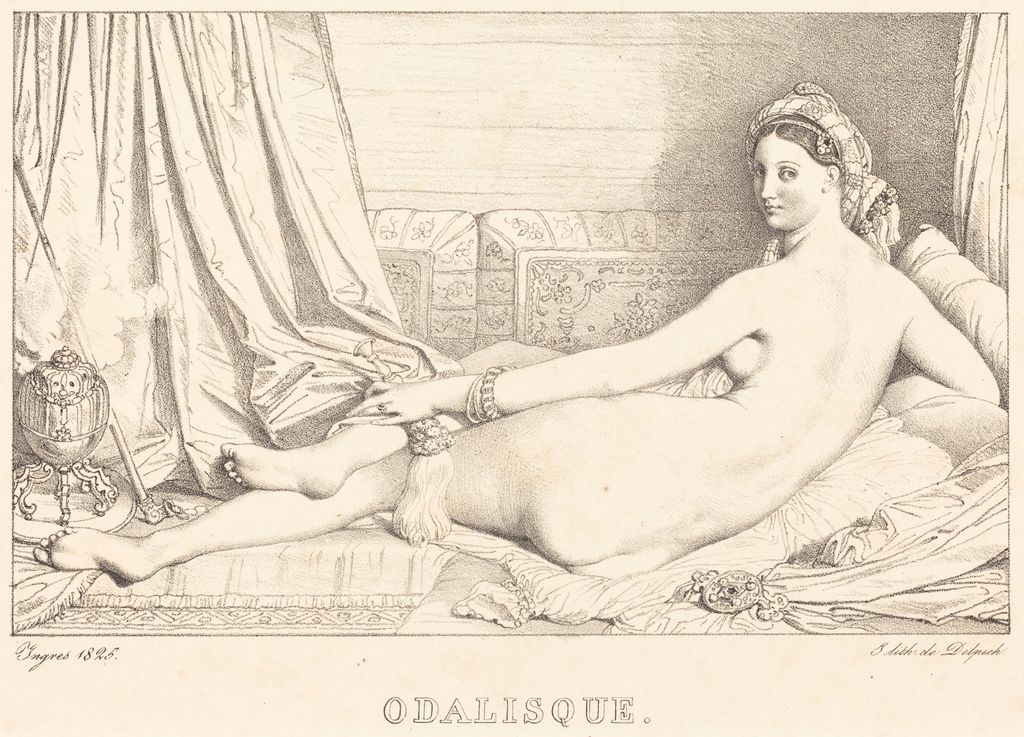
Ingres, Odalisque, made in 1825 and published in 1826. Lithograph. National Gallery of Art, Rosenwald Collection, 1946.21.117. [11]
Compare the lithograph’s small format with the broad canvas. The curves now occupy a sheet of paper, where their direction has to remain legible through printed marks. This is an original print by Ingres after his own painted composition. Sudre’s larger lithograph, discussed separately by Delaborde, is a reproductive work by another maker. [2] Keeping the distinction allows us to see two different forms of participation in the image’s circulation: the painter translating his own design and another printmaker giving it a further public life.
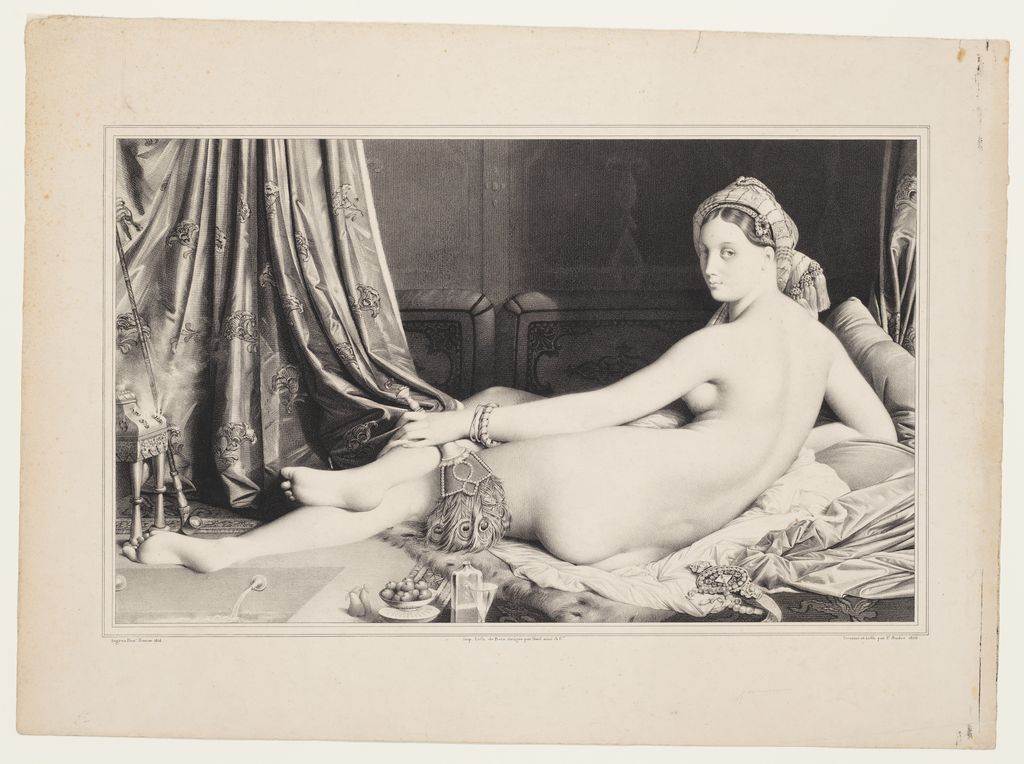
Jean-Pierre Sudré after Ingres, Odalisque Reclining, 1826. Lithograph. The Metropolitan Museum of Art, 27.43. [12]
The dates need similar care. Delaborde places Ingres’s small lithograph at the beginning of 1826, while the NGA distinguishes the 1825 date of the work from publication in 1826. [2][9] Making, inscription and publication need not collapse into one date. The print’s record is a useful reminder that the history of a reproduced image is made up of individual objects.
Other backs, other odalisques
The strongest comparisons bring out changes within Ingres’s repeated interest in the female figure. The Louvre’s 2006 exhibition essay groups the back-facing bather, reclining odalisque and endangered female figure as different prototypes developed during his Italian years. It connects the Valpinçon Bather of 1808 with later returns to the back view, and describes the odalisque’s curving organisation as an arabesque: an extended, flowing decorative movement. [13]
In the Valpinçon Bather, the seated back and wrapped head create a more upright axis. The face is turned away. In Grande Odalisque, that broad back opens into a horizontal composition, and the face returns to meet the spectator. The shared motif produces a different relation between body, space and looking.
A second comparison is Odalisque with Slave. The Walters version of 1842, with its garden prospect, follows an earlier interior version of 1839 now at Harvard. [6] Multiple figures and a wider setting make the reclining body part of an overtly organised social scene. The earlier Grande Odalisque depends much more heavily on a single figure’s encounter with the viewer.
Finally, The Turkish Bath gathers nude figures into a crowded circular field. The Louvre dates its rectangular state to 1859 and its completion as a round picture to 1862. [14] Back views, turned heads and interlocking limbs multiply, leaving far less room around each figure. What was an extended solo curve in Grande Odalisque becomes one possibility within an accumulation of bodies.
These relationships show an artist continuing to test arrangements over decades. The recurring back is a means of reorganising a picture: upright or reclining, solitary or surrounded, faced away from us or accompanied by a returned glance. Repetition gives the differences something definite to act against.

Ingres, The Valpinçon Bather, 1808. [15]
A later artist changes the image
The afterlife of the painting is especially clear in Martial Raysse’s Made in Japan – La grande odalisque of 1964, now in the Centre Pompidou. Raysse enlarged a photographed detail of Ingres’s figure, repainted it in vivid colours and added manufactured embellishments. The museum places it among his adaptations of older paintings and relates it to his questioning of stereotyped female images in advertising. [16]
The transformation narrows attention to the head. Ingres’s long, pale sweep of body gives way to an enlarged, conspicuously coloured face. A detail that had served as one concentrated point within a broad composition can sustain a new image on its own. Recognition survives the change because the turned head and elaborate wrapping are so distinctive.
Raysse also brings the history of reproduction into view. A photograph of a detail becomes material for another painting. That is a different intervention from the small lithograph made by Ingres, yet both depend on the possibility of detaching the composition from its original canvas and making it available through another object.
Returning to the Louvre painting after such an adaptation restores what its iconic status can obscure: the full width of the bed, the pressure of the curtain, the angular sheet and the long journey between head and feet. Its recognisable features are only the beginning. The most rewarding looking happens in the connections between them.
Artworks directory
Explore 150 paintings, drawings and an original lithograph. This selection includes related versions and studies; dates distinguish completed works from later revisions.
| Name | Date | Medium |
|---|---|---|
| The Apotheosis of Homer | 1827 | Painting |
| Grande Odalisque | 1814 | Painting |
| The Turkish Bath | 1859–1862 | Painting |
| Madame Moitessier Seated | 1856 | Painting |
| Portrait of Monsieur Bertin | 1832 | Painting |
| Napoleon I on His Imperial Throne | 1806 | Painting |
| Odalisque with Slave | 1839 | Painting |
| The Ambassadors of Agamemnon in the Tent of Achilles | 1801 (competition) | Painting |
| The Valpinçon Bather | 1808 | Painting |
| The Source | 1856 | Painting |
| Oedipus Explaining the Enigma of the Sphinx | 1808; revised probably before 1827 | Painting |
| The Vow of Louis XIII | 1824 | Painting |
| Antiochus and Stratonice | 1840 | Painting |
| The Comtesse d’Haussonville | 1845 | Painting |
| The Princesse de Broglie | 1851–1853 | Painting |
| Jupiter and Thetis | 1811 | Painting |
| The Dream of Ossian | 1813 | Painting |
| The Martyrdom of Saint Symphorian | 1834 | Painting |
| Venus Anadyomene | 1808–1848 | Painting |
| Portrait of Madame de Senonnes | 1814 | Painting |
| Madame Rivière | 1805 | Painting |
| Mademoiselle Caroline Rivière | 1805 | Painting |
| Portrait of Philibert Rivière | 1805 | Painting |
| Bonaparte First Consul | 1804 | Painting |
| The Death of Leonardo da Vinci | 1818 | Painting |
| Joan of Arc at the Coronation of Charles VII | 1854 | Painting |
| Madame Duvaucey | 1807 | Painting |
| La Belle Zélie | 1806 | Painting |
| Madame Panckoucke | 1811 | Painting |
| Portrait of Charles Marcotte d’Argenteuil | 1810 | Painting |
| Joseph Antoine Moltedo | c.1810 | Painting |
| Madame Leblanc | 1823 | Painting |
| Delphine Ingres-Ramel (Portrait of Madame Ingres) | 1859 | Painting |
| Portrait of Amédée de Pastoret | 1823–1826 | Painting |
| Portrait of Baronne de Rothschild | 1848 | Painting |
| Madame Marcotte de Sainte Marie | 1826 | Painting |
| Madame Gonse | 1852 | Painting |
| Aretino in the Studio of Tintoretto | 1848 | Painting |
| Don Pedro of Toledo Kissing Henry IV’s Sword | 1831/1832 | Painting |
| Raphael and La Fornarina | 1814 | Painting |
| Roger Freeing Angelica | 1819 | Painting |
| Romulus’ Victory over Acron | 1812 | Painting |
| Self-Portrait at the Age of Twenty-Four | 1804; revised 1841–1851 | Painting |
| Male Torso | c.1800 | Painting |
| Odalisque in Grisaille (Ingres and workshop) | c.1824–1834 | Painting |
| The Small Bather | 1826 | Painting |
| The Little Bather Harem Interior | 1828 | Painting |
| Jesus Among the Doctors | 1862 | Painting |
| The Virgin Adoring the Host | 1852 | Painting |
| The Virgin of the Host | 1841 | Painting |
| Virgin of the Adoption | 1858 | Painting |
| Paolo and Francesca | 1814 | Painting |
| Homer Deified (revised composition, Louvre RF5273) | 1865 | Drawing |
| Odalisque with Slave (Louvre RF4622) | 1858 | Drawing |
| Odalisque (Walters Art Museum; Ingres and Paul Flandrin) | 1842 | Painting |
| Madame Moitessier Standing (National Gallery of Art) | 1851 | Painting |
| Jacques-Louis Leblanc (The Metropolitan Museum of Art) | 1823 | Painting |
| Ferdinand-Philippe, Duke of Orléans (Louvre RF2005-13) | 1842 | Painting |
| Ferdinand-Philippe, Duke of Orléans (Versailles MV5207; Ingres and workshop) | 1843 | Painting |
| Ferdinand-Philippe, Duke of Orléans (Versailles MV5209; Ingres and workshop) | 1844 | Painting |
| Antiochus and Stratonice (Musée Fabre; Ingres and Raymond Balze) | 1866 | Painting |
| Antiochus and Stratonice (Kunstmuseum Bern, Gurlitt bequest) | Undated (early dating proposed) | Drawing |
| Composition study for Antiochus and Stratonice (MIB867.2193) | 1806 | Drawing |
| Study for the Figure of Stratonice (Met63.66) | 1834–1840 | Graphite, black chalk and charcoal |
| Nude figure study for Stratonice (Boijmans F II 36 PK) | c.1834–1840 | Drawing |
| Paolo and Francesca (The Barber Institute,54.6) | c.1814–1820 | Painting |
| Paolo and Francesca (The Hyde Collection,1971.24) | c.1855–1860 | Painting |
| Paolo and Francesca (Amsterdam Museum TA10970) | 1820 | Drawing |
| Paolo and Francesca (dedicated to Artaud de Montor) | 1816 | Drawing |
| Study for the Bust of Francesca (MIB867.1398) | 1819 | Drawing |
| Study for the Bust of Francesca (MIB867.1396) | 1819 | Drawing |
| The Archangel Raphael, first idea (MIB867.2488) | 1842 | Drawing |
| The Archangel Raphael (MIB867.2500) | 1842 | Drawing |
| The Archangel Raphael Carrying Human Prayers to God (Chantilly DE513) | 1844 | Drawing |
| Louis-Philippe as Saint Philip, stained-glass study | 1844 | Drawing |
| Marie Frédéric Eugène de Reiset (Ford Collection RBF171-2) | 1844 | Drawing |
| Virgil Reading the Aeneid (Toulouse) | Begun 1811 | Painting |
| Tu Marcellus Eris (Brussels, inv. 1836) | c.1814 (museum dating) | Painting |
| Jean-François Gilibert | 1804 | Painting |
| François-Marius Granet | 1807 (museum dating) | Painting |
| Count Nikolai Dmitrievich Guryev | 1821 | Painting |
| Caroline Murat, Queen of Naples | 1814 | Painting |
| Count Mathieu Molé | 1834 | Painting |
| Cherubini and the Muse of Lyric Poetry (Louvre) | 1842 | Painting |
| Luigi Cherubini (Cincinnati) | 1841 | Painting |
| Comtesse de Rayneval (Louvre RF4505) | 1841 | Drawing |
| Venus on Paphos (Antonie Balaÿ) | c.1852 | Painting |
| Prince Napoléon | 1855 | Painting |
| Study for The Apotheosis of Napoleon I (Petit Palais) | Late 1853 | Painting |
| The Apotheosis of Napoleon I (destroyed ceiling) | 1853 | Painting |
| The Journalist (MIB867.2733) | 1834? | Drawing |
| Henry VIII, after Holbein | c.1815–1820 (?) | Drawing |
| Madame Récamier, after David (MIB867.3637) | Undated (early Paris period) | Drawing |
| Study for Comtesse d’Haussonville (MIB867.259; background possibly by another hand) | 1842–1845 | Drawing |
| La Source (reduced version reported by Delaborde) | Date unrecorded; reported 1870 | Painting |
| Odalisque (autograph lithograph,NGA1946.21.117) | 1825; published1826 | Lithograph |
| Portrait of a Seated Lady | 1814 | Graphite |
| The Kaunitz Sisters (Leopoldine, Caroline, and Ferdinandine) | 1818 | Graphite |
| Portrait of a Man | 1814 | Graphite |
| Study for the Portrait of Louis-François Bertin (1766–1841) | n.d. | Black chalk and graphite |
| Studies for the Cadaver of Acron | ca. 1810–12 | Graphite on wove paper |
| Study for the Drapery of Molière in "The Apotheosis of Homer" | n.d. | Black chalk with stumping |
| Madame Guillaume Guillon Lethière, née Marie-Joseph-Honorée Vanzenne, and her son Lucien Lethière | 1808 | Graphite |
| Niccolò Paganini (1782–1840) | ca. 1830 | Counterproof or tracing strengthened with graphite and gouache on translucent paper |
| Lady Mary Cavendish-Bentinck (?-1843) | 1816 | Graphite |
| Madame Alexandre Lethière and Her Daughter Letizia | ca. 1815 | Graphite |
| Merry Joseph Blondel (1781–1853) | 1809 | Graphite |
| Ursin-Jules Vatinelle (1798–1881) | 1820 | Graphite |
| Bust of a Gypsy Girl (ascribed to Ingres) | 1819 | Graphite on wove paper |
| Study of a Seated Nude Male | n.d. | Graphite |
| The Archangel Raphael (Study for a stained-glass window in the chapel of Notre-Dame de la Compassion-Saint-Ferdinand, Neuilly) | ca. 1842 | Graphite |
| Lancelot-Théodore, comte Turpin de Crissé | probably 1818 | Graphite |
| Study for the Figure of the Iliad in "The Apotheosis of Homer" | ca. 1827 | Graphite and black chalk heightened with white chalk on brown paper |
| Comtesse Turpin de Crissé | probably 1818 | Graphite |
| Nude Figures for L'Âge d'Or, Château de Dampierre | n.d. | Graphite on brownish paper |
| Study of Figures (attributed to Ingres) | n.d. | Graphite |
| Study of Figures (attributed to Ingres) | n.d. | Graphite; squared in graphite |
| Admiral Sir Fleetwood Broughton Reynolds Pellew | 1817 | Graphite on wove paper |
| Madame Jean-Auguste-Dominique Ingres, née Madeleine Chapelle | 1814 | Graphite on off-white wove paper |
| Virgil Reading the Aeneid to Augustus, Livia, and Octavia | 1809/1819 (?) | Pen and black ink, graphite, brush and gray wash, white gouache heightening, Conté crayon on blue paper |
| General Louis-Étienne Dulong de Rosnay | 1818 | Graphite (hard and soft pencils) |
| Madame Alexandre Lethière, née Rosa Meli, and Her Daughter, Letizia | 1815 | Graphite |
| The Lawyer Paul Grand | 1834 | Graphite |
| Jean-Joseph Fournier | 1815 | Graphite |
| Armand Bertin | 1842 | Graphite |
| Madame Armand Bertin, née Marie-Anne-Cécile Dollfuss | 1843 | Graphite |
| The Architect Charles-Victor Famin | 1836 | Graphite |
| Henri Lehmann | 1850 | Graphite |
| Portrait of a Lady | ca. 1815–17 | Graphite |
| Edmond Cavé (1794–1852) | 1844 | Oil on canvas |
| Head of Saint John the Evangelist | probably ca. 1818–20 | Oil on canvas, laid down on wood |
| Madame Edmond Cavé (Marie-Elisabeth Blavot, ca. 1806–1883) | ca. 1831–34 | Oil on canvas |
| Madame Félix Gallois | 1852 | Graphite with touches of gold in oil to highlight jewelry, on buff wove paper. |
| Dr. François Mêlier | 1849 | Graphite with graphite framing lines, corrected with white, on buff wove paper |
| Portrait of Madame Rhode (Rhoda?) | 1810–20 | Graphite on pale buff wove paper |
| Study for "Raphael and the Fornarina"(?) | ca. 1814(?) | Graphite on white wove paper |
| Portrait of Madame Paul Meurice, née Palmyre Granger | ca. 1845–50 | Graphite on wove paper |
| Alexander the Great presenting Campaspe to Apelles | 1810 | Graphite, brush and brown wash; squared in graphite |
| Study of Hands for "Christ Among the Doctors" | 1852–62 | Graphite on tracing paper |
| Study for The Turkish Bath (RF34502) | about 1850 | Pen and brown ink with graphite, partially squared |
| Study for The Turkish Bath (RF23354) | Undated | Pen and brown ink with graphite on joined sheets |
| Study for The Turkish Bath (RF54702) | about 1859 | Pen and brown ink |
| Studies of women for The Turkish Bath (RF12292) | Undated | Black chalk |
| Achilles Receiving the Envoys of Agamemnon (Nationalmuseum sketch, NM2161) | 1801 | Oil on wood |
| Half-Length Bather (Musée Bonnat-Helleu,89) | 1807 | Oil on canvas |
| Oedipus and the Sphinx (National Gallery,NG3290) | about1826 | Oil on canvas |
| Oedipus and the Sphinx (Walters,37.9) | 1864 | Oil on canvas |
| Oedipus and the Valpinçon Bather, after David (MI.867.2035) | Undated | Graphite on tracing paper, after David |
| Study of the Virgin for The Vow of Louis XIII (Dijon,1758) | about1822 | Black chalk, stump and white chalk on brown wove paper |
| First Thought for The Vow of Louis XIII (MI.885.11.21) | 1822 | Oil on canvas |
Frequently Asked Questions
It names a type of harem figure, rather than an identified sitter. Historically, an odalisque was an enslaved female servant attached to the women of a harem. [3]
Painted in Rome in 1814; shown in Paris in 1819. [1]
Caroline Murat, Queen of Naples. Delaborde records the commission in 1813 and prints Ingres’s letter of 26 May 1814 describing the intended companion to a sleeping woman already bought by Joachim Murat. [2]
No. The intended pendant was the lost Sleeping Woman of Naples. The Valpinçon Bather is a related exploration of the female back, rather than the companion named in the commission history. [2]
The 2004 study estimated extra length in vertebral-height equivalents, rather than literal additional bones. [5]
The Met attributes its unfinished, reduced grey version to Ingres and workshop. Its precise purpose remains uncertain. [8]
In the Louvre, Paris (RF 1158). [1]
Discussion
Look again at the images and ideas explored in Grande Odalisque. These editorial prompts invite your observations.
Reader Insights
Which connection first organises the painting for you: the long back and extended arm, the blue cushion and curtain, or the headcloth and patterned fabrics? Follow one of those relationships across the picture, then see where the woman’s returning glance interrupts it.
Compare the woman’s returning gaze with the concealed face in The Valpinçon Bather. How does each pose establish a relationship with the viewer?
What do the textiles and accessories contribute to the invented setting beyond giving the painter different surfaces to describe?
Join the Conversation
Share a detail, comparison or question about Grande Odalisque below.
References
- Musée du Louvre, Une odalisque, dite La grande odalisque. RF 1158; collection record. (In French.) View source.
- Henri Delaborde, Ingres, sa vie, ses travaux, sa doctrine, d’après les notes manuscrites et les lettres du maître. Paris: Henri Plon, 1870, catalogue no. 75, pp. 235–236, including Ingres’s letter to Marcotte, 26 May 1814; p. 179, note 1, quotation of Landon’s 1819 criticism; “Du dessin”, p. 123. Posthumous compilation. English translations of the short artist quotations are ours. (In French.) View source.
- Musée du Louvre, Une beauté idéale ?, educational thematic dossier, p. 18, “La Grande Odalisque : Ingres et la sensualité des courbes féminines”. (In French.) View source.
- Robert Rosenblum, “Ingres’s Portraits and Their Muses”, in Gary Tinterow and Philip Conisbee, eds, Portraits by Ingres: Image of an Epoch. New York: Metropolitan Museum of Art, 1999, pp. 12–13, Raphael and the recurring headdress. View source.
- Jean-Yves Maigne, Gilles Chatellier and Hélène Norlöff, “Extra vertebrae in Ingres’ La Grande Odalisque”. Journal of the Royal Society of Medicine 97 (2004), 342–344. DOI: 10.1258/jrsm.97.7.342. View source.
- The Walters Art Museum, Odalisque. Collection record, 37.887, 1842; Ingres and Jean-Paul Flandrin. Attribution, comparison with the 1839 Harvard version, and interpretation of gender, race and labour. View source.
- Musée d’Orsay, Base Salons, Odalisque couchée. Transcription of the 1855 exhibition livret, catalogue no. 3350: Goupil ownership and “Peint à Rome, 1814”. (In French.) View source.
- The Metropolitan Museum of Art, Odalisque in Grisaille. Collection record, 38.65, about 1824–34; Ingres and workshop. Object details and curatorial account of its unfinished state and uncertain purpose. View source.
- National Gallery of Art, Washington, Odalisque. Collection record, 1946.21.117, Rosenwald Collection; 1825, published 1826, lithograph on wove paper, Delpech, Album Lithographique, Delteil no. 9. Object facts and inscriptions. View source.
- Supporting image. Ingres and workshop, Odalisque in Grisaille, c. 1824–1834. The Metropolitan Museum of Art; Catharine Lorillard Wolfe Collection, Wolfe Fund, 1938. Image source. CC0 / Public domain.
- Supporting image. Ingres, Odalisque, made in 1825 and published in 1826. Lithograph. National Gallery of Art, Rosenwald Collection, 1946.21.117. Image source. CC0 / Public domain.
- Supporting image. Jean-Pierre Sudré after Ingres, Odalisque Reclining, 1826. Lithograph. The Metropolitan Museum of Art, 27.43. Image source. CC0 / Public domain.
- Musée du Louvre, “‘Ingresque’ eroticism”. Ingres, 2006 exhibition website, “1806–1824: Rome and Florence”; comparative account of the bather, reclining odalisque and Angelica prototypes. View source.
- Musée du Louvre, Le bain turc. Collection record, RF 1934: rectangular painting of 1859, transformed into a tondo and completed in 1862. (In French.) View source.
- Supporting image. Ingres, The Valpinçon Bather, 1808. Image source. CC0 / Public domain.
- Centre Pompidou, Musée national d’art moderne, Martial Raysse, Made in Japan – La grande odalisque. Collection record and commentary, 1964, AM 1995-213; photographic enlargement, repainting, embellishments and advertising imagery. View source.
- Splash image. Grande Odalisque. Louvre, RF 1158. Image source. CC0 / Public domain.