by Tom Gurney
Tom Gurney BSc (Hons) is an art history expert with over 20 years experience
Published on June 19, 2020 / Updated on October 22, 2026
Email: tomgurney1@gmail.com / Phone: +44 7429 011000
The Vow of Louis XIII
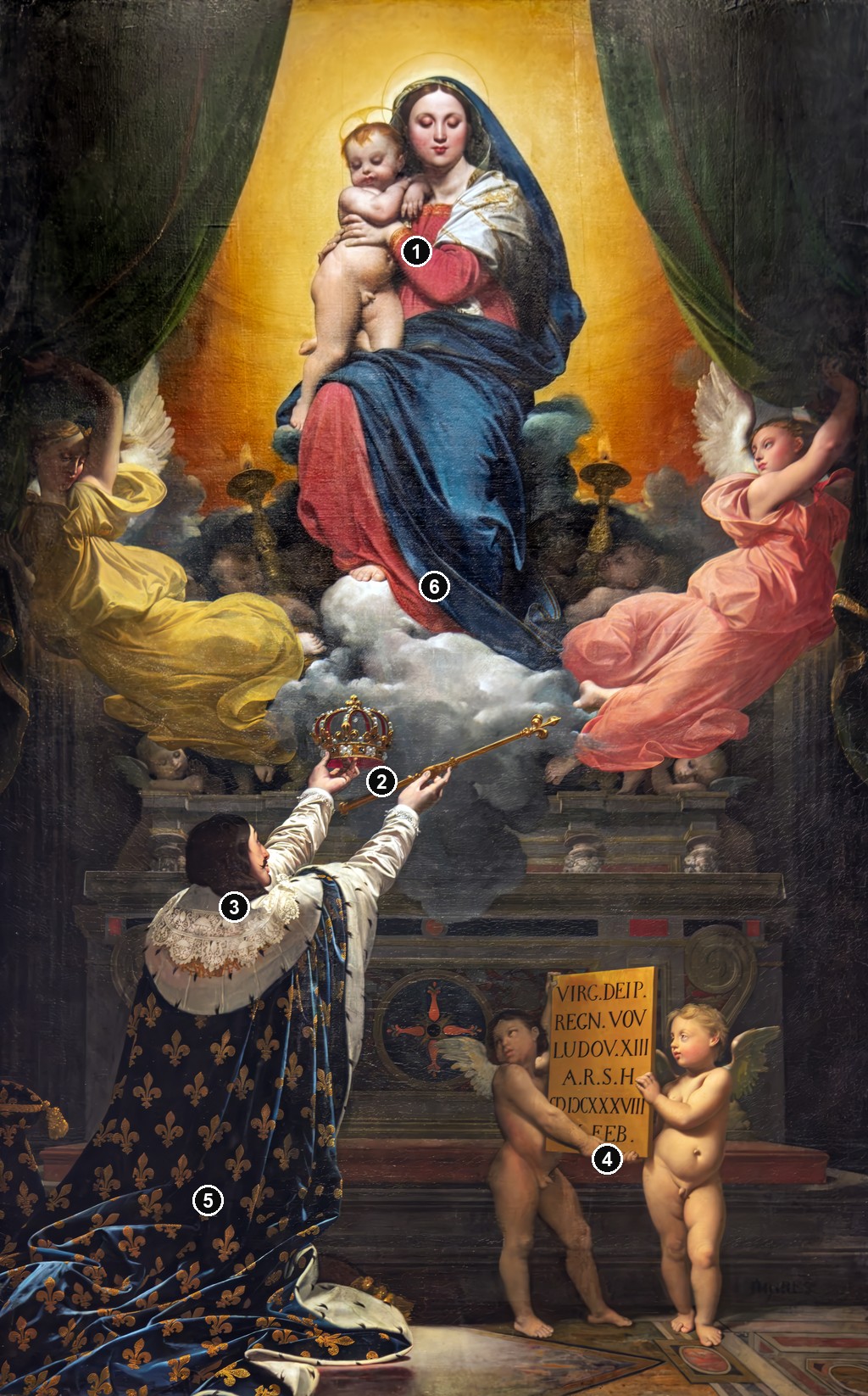
Louis XIII has taken off his crown. Kneeling before an altar, he raises it towards the Virgin and Child, together with the sceptre that ordinarily identifies his authority. His magnificent blue mantle spreads across the foreground, but his body stretches upwards in petition. Above him, Mary holds her child with a composure that steadies the entire picture. Ingres makes the king's offering visible through the relationship between these two bodies: one reaching, the other receiving.
Painted in 1824 for the cathedral of Notre-Dame-de-l'Assomption in Montauban, The Vow of Louis XIII brought a seventeenth-century act of royal devotion into the public life of nineteenth-century France. Its commission came from the Ministry of the Interior in 1820. [1] At the Paris Salon of 1824, it transformed Ingres's reputation; the religious picture intended for his birthplace also became a declaration of his place in French painting. [2]
At a Glance
- ArtistJean-Auguste-Dominique Ingres.
- Date and medium1824; oil on canvas. [1]
- SubjectLouis XIII placing France under the Virgin's protection, following his declaration of 10 February 1638. [3]
- Commission and destinationMinistry of the Interior, 1820; Montauban Cathedral. [1]
- CollectionFrench State, administered through the Centre national des arts plastiques. [4]
- Look forthe uncrowned king, the two children holding the inscription, and the contrast between his upward reach and Mary's upright stillness.
This work across Ingres’s career
Agamemnon’s Ambassadors
1801 (competition)Grande Odalisque
1814Monsieur Bertin
1832The Princesse de Broglie
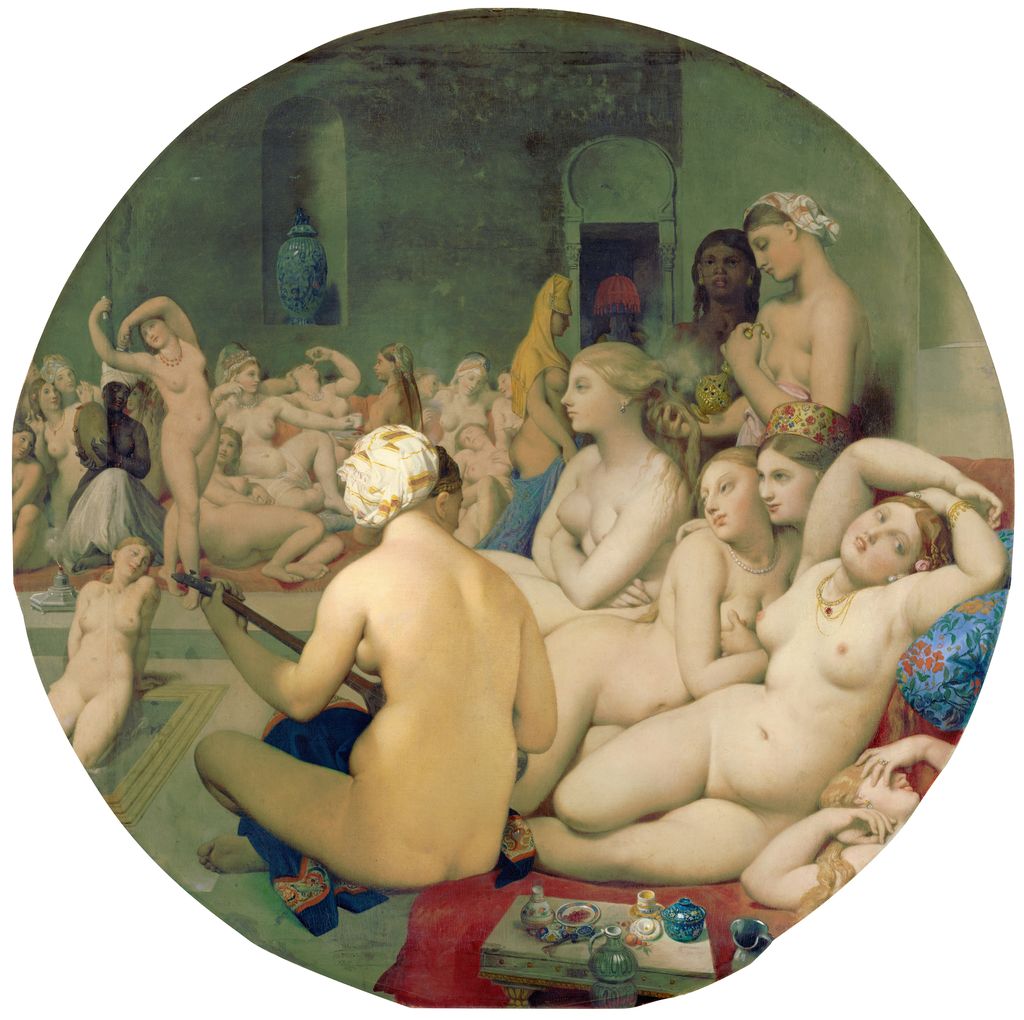
1851–1853The Turkish Bath
1859–1862Contents
- A king offering his kingdom
- Looking from the floor to the apparition
- A commission Ingres initially resisted
- Drawings, changes and the example of Raphael
- What changed at the Salon of 1824?
- A painting translated into print
- The changing life of the canvas
- Annotated details
A king offering his kingdom
The title refers to a declaration issued at Saint-Germain-en-Laye on 10 February 1638. Louis XIII placed himself and his kingdom under the protection of the Virgin Mary. [3] Annual commemoration followed on the Assumption feast, 15 August: a separate date from the declaration. [4]
The royal family's circumstances form part of this history, but the familiar account of a king simply thanking Mary for the birth of an heir reverses the sequence. Anne of Austria's pregnancy was announced in January 1638; the future Louis XIV was born on 5 September. The vow stood between the announcement and the birth. The Musée d'Archéologie nationale places it within Louis XIII's larger religious response to the difficulties of his reign, including religious conflict and threats to royal authority. [3]
Ingres does not show a ceremony unfolding among courtiers. There are no ministers, assembled nobles or human witnesses inside his image. He isolates the royal offering before a heavenly apparition. Crown and sceptre carry the political meaning of the action: the king gives up the objects through which his power is recognised. Yet he continues to wear the enormous fleur-de-lis mantle, lined with ermine. His submission remains unmistakably the submission of a monarch.
The figures occupy unequal positions. Mary occupies the upper centre, while Louis kneels to one side and reaches across the painting. He cannot meet her at his own level. His outstretched arms bring the crown and sceptre close to the clouds, creating a visual threshold between an earthly altar and a heavenly presence. The painting asks the viewer to understand royal protection as something sought from above.
Its devotional purpose is inseparable from that arrangement. An altarpiece is a painting made for an altar or its immediate setting, where it participates in religious attention as well as being looked at as art. Here the painted king offers a model of supplication to someone standing below the picture. The spectator follows his gesture upwards, while Mary's lowered gaze returns attention towards the earthly world. A public image of monarchy becomes a structure for prayer. Historian Ariane Dor relates the Restoration commission to Catholic royal authority in Montauban, where Louis XIII's failed siege of 1621 preceded victory in 1629. [4]
Looking from the floor to the apparition
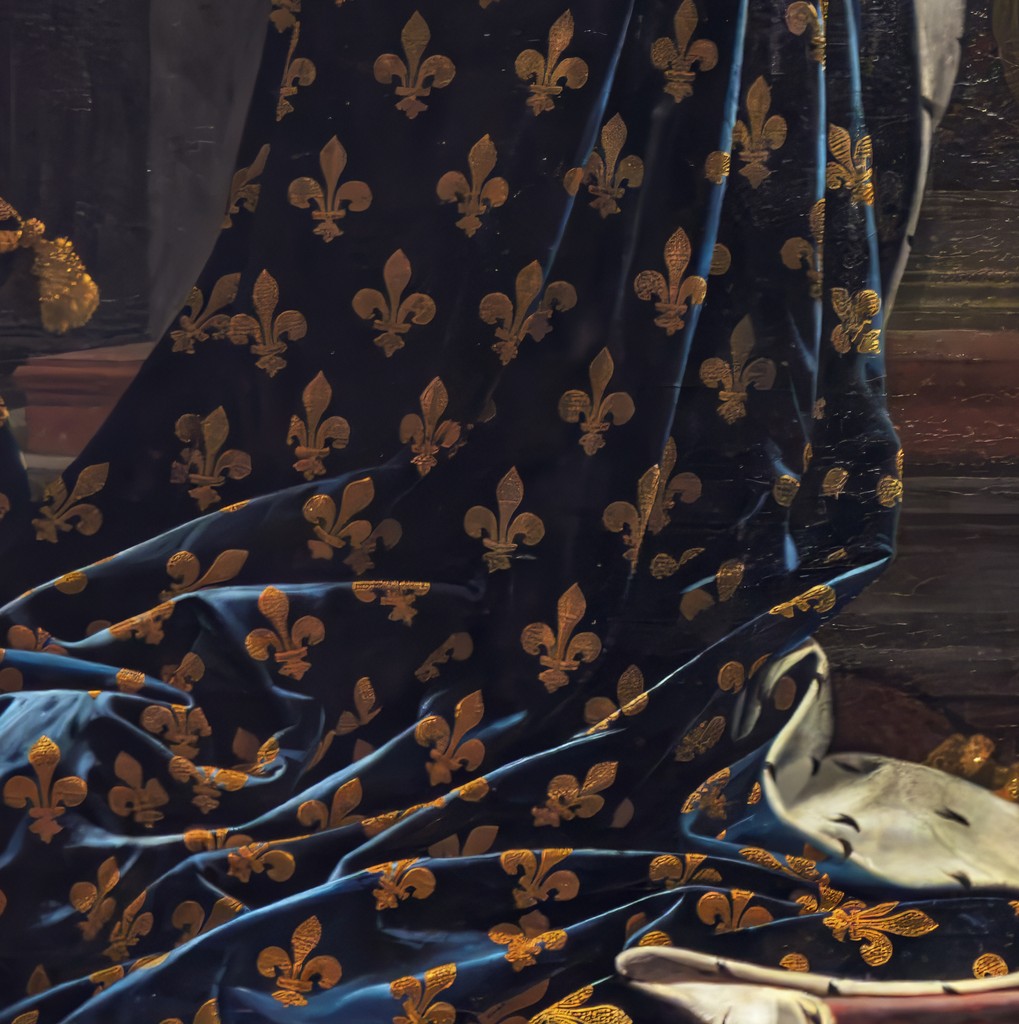
Begin at the bottom, where the king's mantle pools on the patterned floor. Its repeated gold fleurs-de-lis make the fabric readable as royal clothing even when individual folds become difficult to follow. The cloth occupies much more space than the kneeling body requires. Its weight anchors Louis to the ground, while his pale sleeves and raised hands form a much lighter path towards the centre.
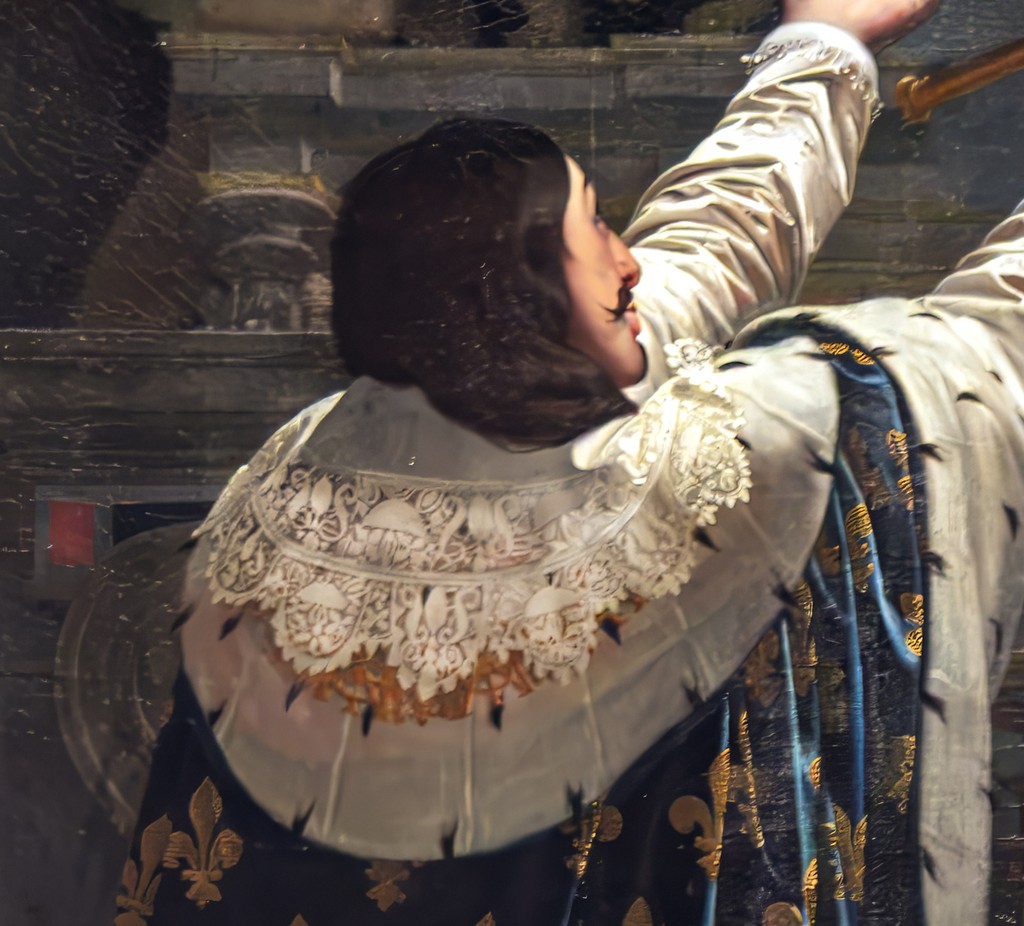
Ingres turns the king away from us. We see the back of his head, the lace across his shoulders and a narrow profile lifted towards Mary. That choice makes the gesture easier to share. The viewer stands behind or beside the royal worshipper, looking in the same direction, rather than confronting him as the subject of a state portrait. The face gives the action a destination; the arms give it force.
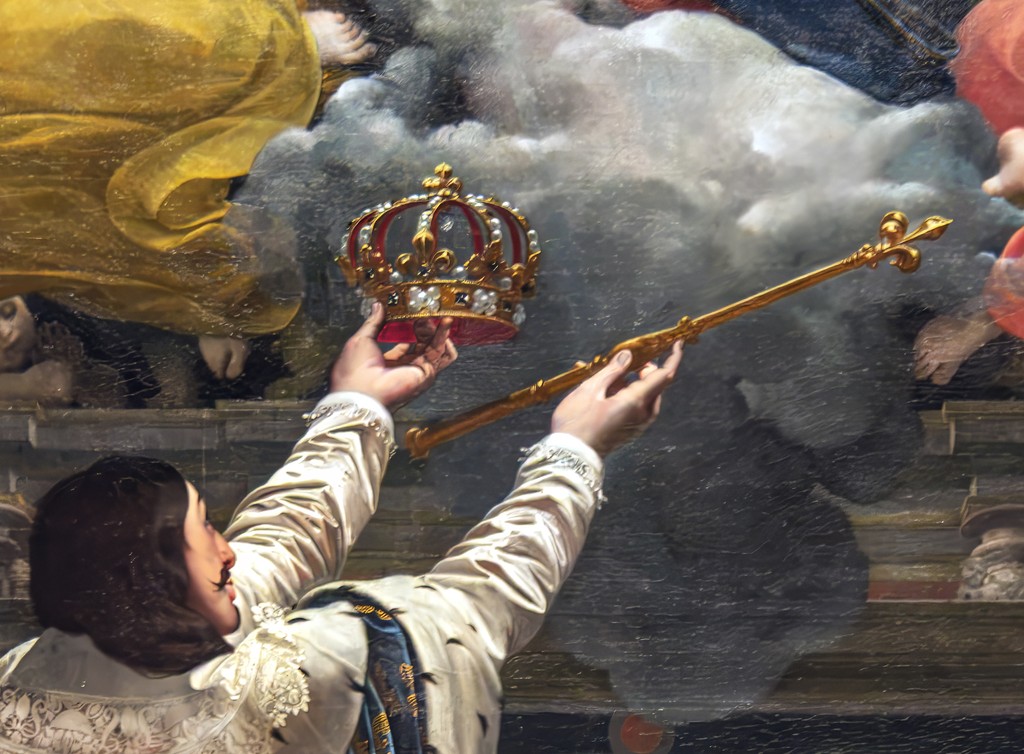
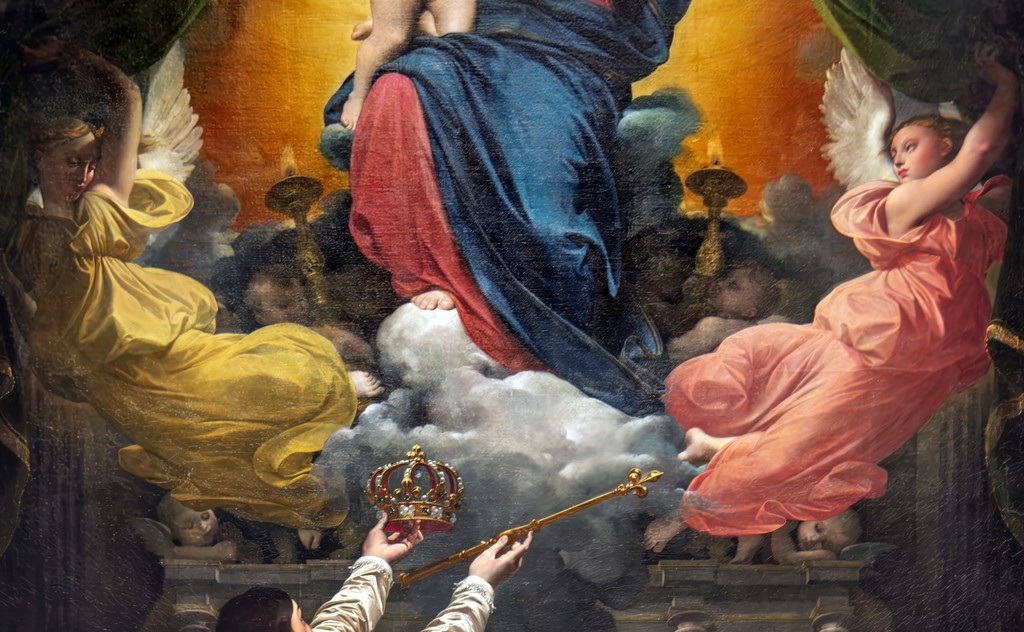
Look at the difference between the two offered objects. The crown is rounded, intricate and concentrated, poised above one hand. The sceptre forms a long diagonal across the space in front of the clouds. Together they join a point of bright detail to a line of movement. Their gold also connects the earthly regalia with the broad golden light behind Mary, although no physical exchange takes place.
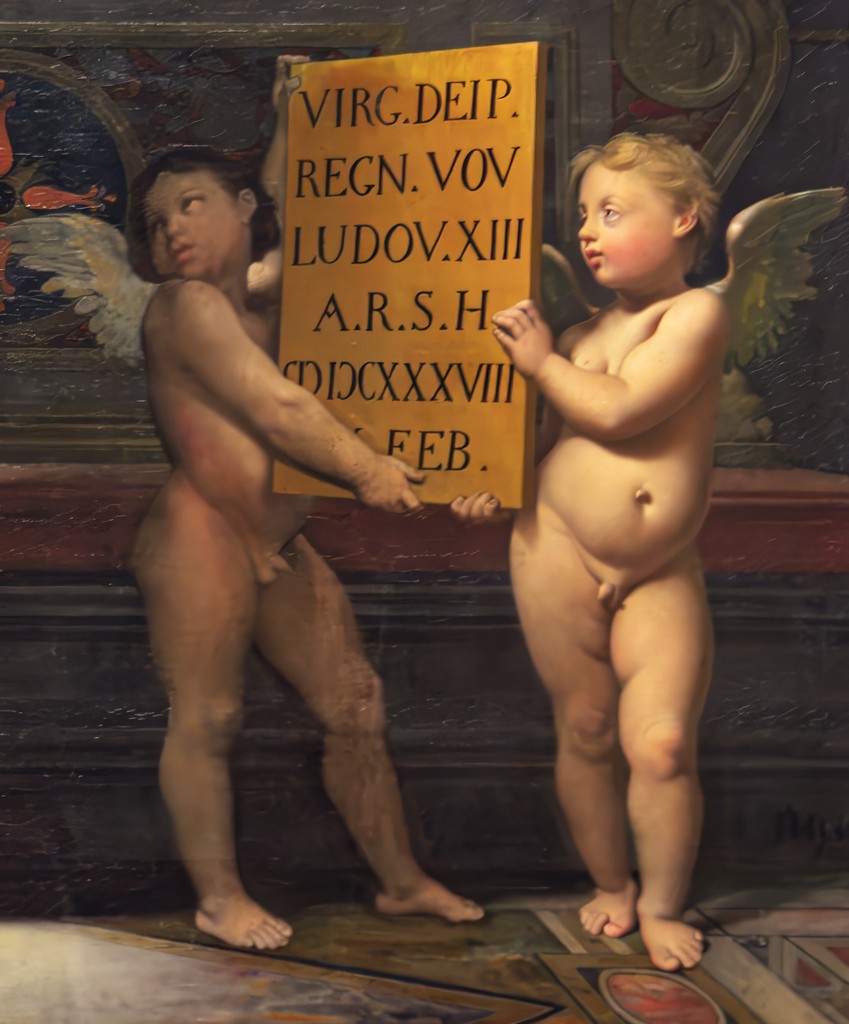
The altar supplies a contrasting geometry. Its steps and horizontal ledges extend behind the king, making his angled body more emphatic. Near the lower right, two small, unclothed children support an inscribed tablet. One turns towards the spectator. Where Louis directs attention away from us and upwards, this figure brings the scene back towards the space in front of the painting. The tablet fixes the offering in written history; the crown and sceptre enact it through gesture.
Above the altar, solid architecture gives way to cloud. Two draped angels occupy the sides of the apparition, their bodies and wing tips reaching across this boundary. Their yellow and pink garments spread outwards in great folds. They make the middle of the picture feel buoyant and mobile, even though the arrangement remains balanced around Mary.
The Virgin is seated, but her upper body establishes a firm vertical. The blue of her mantle descends across her knees in broad masses; the red of her dress supplies a warm core beneath it. A pale cloth gathers across her shoulders and around the child. Against the restless folds of the angels, these larger, slower shapes make her seem remarkably settled. She does not need to reach towards the king to command the encounter.
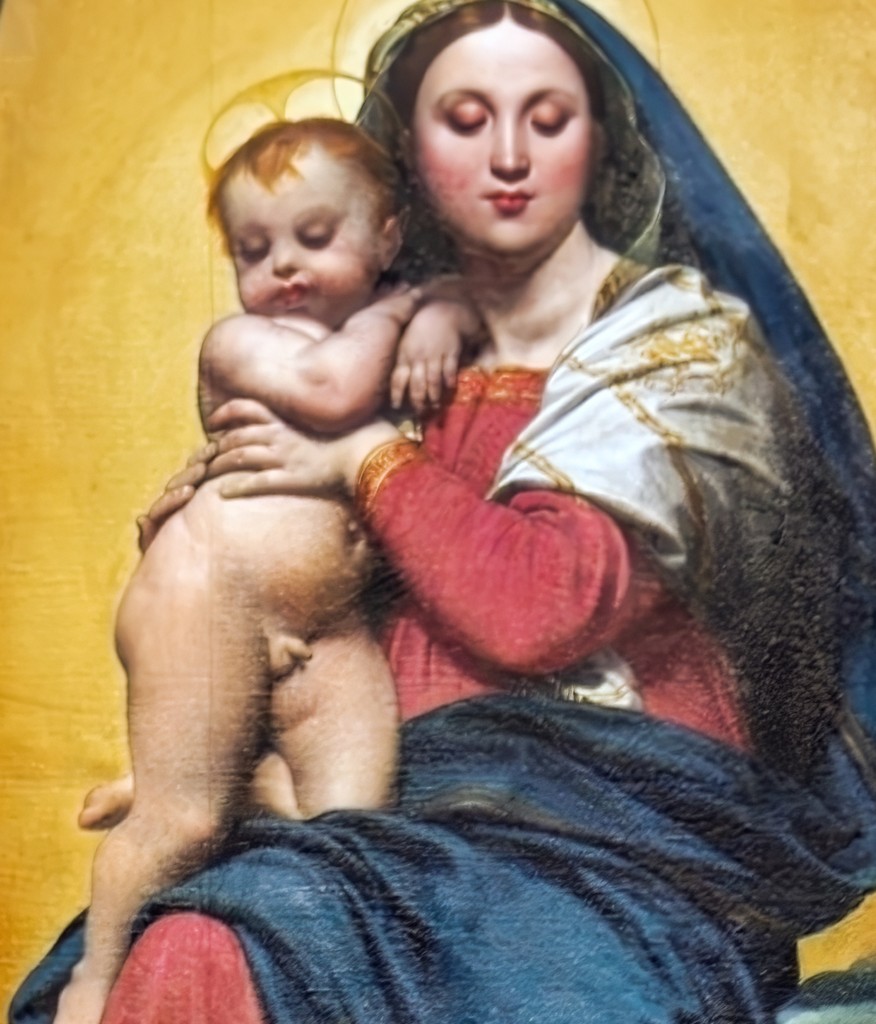
The Christ Child introduces a smaller movement within that stability. His body turns away from the upright line of his mother, and his legs hang into the space above her lap. Her arms secure him without suppressing that turn. Their group therefore contains both repose and animation. The king reaches towards a mother holding a living child, rather than towards an isolated emblem.
Dark green curtains open on either side of the upper scene. Their deep shade makes the luminous centre appear still brighter. They also give the apparition an edge: an opening has been made through which the heavenly group becomes visible. The small candles below offer another kind of illumination, contained and earthly, against the much larger field of golden light.
Colour is essential to this organisation. The dark blue royal mantle balances Mary's blue across the divide of the altar and cloud. Gold moves from the embroidered lilies and regalia into the upper radiance. Yellow and pink carry the angels out towards the sides. The picture's clarity depends on these relationships as well as on the precision of its contours. The force of its drawing works through a carefully organised field of colour.
Annotated Details from The Vow of Louis XIII
The numbered points identify visible features discussed in this article. Return from each detail to the whole composition. Ingres, The Vow of Louis XIII, 1824. Photograph taken at the Musée Ingres Bourdelle in August 2026. Photograph: Didier Descouens; Wikimedia Commons. Image source. CC BY-SA 4.0. Numbered overview: resized, with markers added. Detail images: cropped and JPEG-optimised. All these image derivatives are licensed CC BY-SA 4.0.
Details from THE VOW OF LOUIS XIII
Follow the offered objects and royal mantle towards the Virgin and Child. The photograph records the finished canvas during its temporary museum display.
The Virgin holding the Child
The Child turns within the Virgin’s supporting arms. Their overlapping hands and differently directed faces introduce small movements inside the larger central group.
The king offering crown and sceptre
The two pale hands carry objects of different shapes: a rounded crown and a long sceptre. Their diagonals continue the kneeling figure’s upward movement towards the apparition.
The lace across the king’s shoulders
A broad pale collar spreads across the king’s shoulders. Its many small points and loops contrast with the darker blue mantle below it.
The children holding the inscription
Two small figures support the inscribed tablet near the steps. One turns more directly towards the viewer while the other looks across it, giving the lower group its own exchange of directions.
Gold lilies across the blue mantle
The gold lilies repeat across large folds of blue cloth. Their changing positions make the mantle’s turns easier to follow without dissolving its broad overall shape.
The flanking angels and their clouds
The two draped angels spread out on either side of the central blue mantle. Their warm yellow and pink cloth brings colour across the boundary between cloud and the altar below.
A commission Ingres initially resisted
Ingres was living in Florence when the Ministry of the Interior commissioned the picture in August 1820. For him, the assignment offered the opportunity to make a major history painting for a French public. [2] The subject, however, presented a difficulty. The authorities wanted Louis XIII's vow in conjunction with the Virgin's Assumption: a historical king placed beside an event of sacred history. [1]
Henri Delaborde's posthumous account preserves Ingres's objection in a letter to the prefect of Tarn-et-Garonne. He considered the programme a double subject whose divided interests could damage the unity of the painting. He preferred to represent the Assumption alone. His complaint concerned the coherence of the image and the propriety of combining events separated in time inside a church. [5]
That objection is illuminating when looking at the finished work. Ingres had to establish a credible relationship between the king below and the heavenly presence above without making them participants in an ordinary shared room. The altar, cloud bank, lifted arms and descending gaze solve that problem pictorially. They divide the worlds while making the act of offering pass between them.
Delaborde also records an abandoned conception in which Louis appeared before the dead Christ supported by angels and the mourning Virgin, a form of the subject related to the Pietà. The finished painting substitutes the Virgin holding the infant Christ. [5] These alternatives would have given the king's prayer very different emotional settings. A grieving mother and a dead son would direct attention towards sacrifice and loss; the final mother and child offer a more sustained encounter between petition and protective presence.
The letters also reveal how much Ingres expected from the work. In correspondence with his friend Jean-François Gilibert in November 1821, as published by Delaborde, he described the ambition to make it Raphaelesque while retaining his own identity and drawing upon nature. Elsewhere in the same account, his hopes for the painting are entangled with anger at critics who had attacked his earlier work. [5] The serene final surface emerged from a demanding, sometimes frustrating commission.
Delaborde gives the original fee as 3,000 francs and reports that the administration doubled it after the Salon success. [5] That reward makes the public reception tangible. An undertaking that began with disagreement over the programme became a work for which the state was prepared to pay substantially more.
Drawings, changes and the example of Raphael
One surviving drawing makes the development unusually clear. The Musée des Beaux-Arts in Dijon holds an Étude de Vierge of about 1822, worked in black chalk, stump and white chalk on brown paper. It belongs to an early design in which Mary stands with her hands joined in prayer. In the completed picture she sits and holds the child. The Dijon museum notes that Ingres studied the figure nude before clothing it and that this sheet concentrates on the drapery. [6]
The difference is structural. Joined hands would close the Virgin's pose around her own prayer. Holding the child opens a relationship between two bodies at the painting's centre. It also brings the child forward against the dark blue mantle, making his small, pale figure one of the clearest forms in the upper group. A study can therefore explain the history of a decision even when it does not reproduce the pose finally painted.
The drawing belongs beside the wider practice explored in Ingres's drawings: separate investigations of figures, hands and clothing could serve a composition that appears unified when finished. Delaborde's catalogue records both an early painted sketch and studies for the angels and Christ Child. His list describes where those works were known in 1870; it is a record of preparation, not a guide to their present ownership. [5]
The king required research of another kind. The regional museum account identifies the portrait of Henri IV by Pourbus at the Uffizi as the model for the royal costume. [1] Louis XIII had died long before Ingres was born. The figure's historical appearance had to be constructed from earlier images, while the raised arms and kneeling body had to function persuasively within the new design. Dress and gesture answer different demands.
Raphael's presence is immediately apparent, but comparison is most useful when it becomes specific. The regional museum identifies Raphael's Sistine Madonna and Madonna of Foligno among the sources Ingres studied. [1] The opened curtains and flanking attendants make the first comparison especially clear; the second offers a Virgin and Child above an inscription-bearing figure. Ingres brings such elements into a composition dominated below by the king's enormous mantle and rising diagonal. The result has its own distribution of weight and direction.
This is also why his stated ambition to make the picture both Raphaelesque and his own matters. The model furnished a language of religious painting: lucid figures, a central mother and child, and the presentation of an apparition through an opening. The commission required that language to accommodate the particular offering of a French king. Influence becomes visible as a set of usable relationships rather than a single borrowed image.
What changed at the Salon of 1824?
The Vow of Louis XIII joined the Salon on 12 November 1824, well after its opening on 25 August. In January 1825 Ingres received the Legion of Honour; in June he was elected to the Académie des Beaux-Arts. The Ministry commissioned The Martyrdom of Saint Symphorian in December 1824. [2]
The change in reputation was decisive, although the reception was not unanimous. Andrew Carrington Shelton describes critics recognising Raphael where earlier reviewers had accused Ingres of awkwardness and archaism. Some now objected to excessive dependence on the Renaissance master. [7] Success changed the terms of disagreement without ending it.
The same Salon included Delacroix's Scenes from the Massacres at Chios. [8] That conjunction helps explain the later habit of opposing Ingres's classicism to Delacroix's Romanticism. The two paintings offer a useful comparison within the exhibition's wider artistic debate. A personal duel, or a uniform response from Ingres's admirers, would be a misleading way to explain that setting.
The transformation is easier to grasp through the work itself. Visitors encountered a large religious composition whose hierarchy could be understood at a glance, yet whose robes, flesh, regalia and light sustained close attention. The king's expansive gesture gives the scene emotional energy without disrupting the central stability. A painter previously treated as difficult could now be understood through the authority of a familiar master and the demands of a prestigious public commission. The broader consequences belong to Ingres's biography; here they begin with this particular meeting between picture and audience.

Ingres, The Martyrdom of Saint Symphorian, 1834. [9]
A painting translated into print
The picture acquired a second public life through Luigi Calamatta's engraving, published in 1837. Delaborde lists the engraved reproduction alongside the painting. [5] Its appearance prompted Gustave Planche's substantial review in the Revue des Deux Mondes. [10] Planche admired the work while questioning an artistic programme based too rigidly on continuing Raphael. For this particular subject, however, he thought Ingres had adapted the model: Mary required protective strength, while the king had to combine Christian humility with royal dignity. These are Planche's interpretations of the image, not recorded explanations by Ingres. [10]
His discussion of Calamatta is equally revealing. He praised the treatment of the king's hands and clothing and the organisation of tones across the whole engraving, while finding faults in two angels. For him, successful reproduction depended on the relationship of all the parts, beyond accurate outlines. [10]
An engraving introduces a different material vocabulary. A burin cuts grooves into a metal plate; printed ink carries their lines onto paper. Translating an oil painting therefore involves deciding how lines and areas of darkness can convey coloured cloth, illuminated flesh and atmospheric space. Planche's review shows that these decisions could become a serious subject of criticism in their own right. The reproductive print was one way an audience distant from Montauban could encounter and debate the composition, as explored further in Ingres's prints and reproductions.
The changing life of the canvas
The painting reached Montauban in 1826 after attempts to retain it for a Parisian church. Ingres insisted on its original destination. [1] Its association with the cathedral has nevertheless involved repeated changes of setting. It moved to the sacristy in 1847 and the north transept in 1950; Ingres requested curtains and a red backdrop to improve viewing. [4] Illumination belongs to the picture's history because its balance depends so strongly on the distinction between the dark perimeter and luminous centre. The building around it can strengthen or weaken the relationship established within the painted rectangle. Completed in late September 1824, it was lined in 1826: a second canvas supported the original. [4] The upper arch is a painted revision; the frame dates from the 1920s–early 1930s. Examination revealed red preparation, graphite, revised sceptre and candleholder, incised haloes and gilding fragments. [4] After the 2015 storm, conservators secured lifting paint, retained the lining, replaced the stretcher and thinned varnish. Some old retouching remained. The painting returned in February 2017. [4]
Restoration did not turn the painting into an untouched surface of 1824. Decisions about what to retain form part of what we see. The picture's clarity survives through the care of a physical object whose fabric, coatings and supports have aged differently.
Artworks directory
Explore 150 paintings, drawings and an original lithograph. This selection includes related versions and studies; dates distinguish completed works from later revisions.
| Name | Date | Medium |
|---|---|---|
| The Apotheosis of Homer | 1827 | Painting |
| Grande Odalisque | 1814 | Painting |
| The Turkish Bath | 1859–1862 | Painting |
| Madame Moitessier Seated | 1856 | Painting |
| Portrait of Monsieur Bertin | 1832 | Painting |
| Napoleon I on His Imperial Throne | 1806 | Painting |
| Odalisque with Slave | 1839 | Painting |
| The Ambassadors of Agamemnon in the Tent of Achilles | 1801 (competition) | Painting |
| The Valpinçon Bather | 1808 | Painting |
| The Source | 1856 | Painting |
| Oedipus Explaining the Enigma of the Sphinx | 1808; revised probably before 1827 | Painting |
| The Vow of Louis XIII | 1824 | Painting |
| Antiochus and Stratonice | 1840 | Painting |
| The Comtesse d’Haussonville | 1845 | Painting |
| The Princesse de Broglie | 1851–1853 | Painting |
| Jupiter and Thetis | 1811 | Painting |
| The Dream of Ossian | 1813 | Painting |
| The Martyrdom of Saint Symphorian | 1834 | Painting |
| Venus Anadyomene | 1808–1848 | Painting |
| Portrait of Madame de Senonnes | 1814 | Painting |
| Madame Rivière | 1805 | Painting |
| Mademoiselle Caroline Rivière | 1805 | Painting |
| Portrait of Philibert Rivière | 1805 | Painting |
| Bonaparte First Consul | 1804 | Painting |
| The Death of Leonardo da Vinci | 1818 | Painting |
| Joan of Arc at the Coronation of Charles VII | 1854 | Painting |
| Madame Duvaucey | 1807 | Painting |
| La Belle Zélie | 1806 | Painting |
| Madame Panckoucke | 1811 | Painting |
| Portrait of Charles Marcotte d’Argenteuil | 1810 | Painting |
| Joseph Antoine Moltedo | c.1810 | Painting |
| Madame Leblanc | 1823 | Painting |
| Delphine Ingres-Ramel (Portrait of Madame Ingres) | 1859 | Painting |
| Portrait of Amédée de Pastoret | 1823–1826 | Painting |
| Portrait of Baronne de Rothschild | 1848 | Painting |
| Madame Marcotte de Sainte Marie | 1826 | Painting |
| Madame Gonse | 1852 | Painting |
| Aretino in the Studio of Tintoretto | 1848 | Painting |
| Don Pedro of Toledo Kissing Henry IV’s Sword | 1831/1832 | Painting |
| Raphael and La Fornarina | 1814 | Painting |
| Roger Freeing Angelica | 1819 | Painting |
| Romulus’ Victory over Acron | 1812 | Painting |
| Self-Portrait at the Age of Twenty-Four | 1804; revised 1841–1851 | Painting |
| Male Torso | c.1800 | Painting |
| Odalisque in Grisaille (Ingres and workshop) | c.1824–1834 | Painting |
| The Small Bather | 1826 | Painting |
| The Little Bather Harem Interior | 1828 | Painting |
| Jesus Among the Doctors | 1862 | Painting |
| The Virgin Adoring the Host | 1852 | Painting |
| The Virgin of the Host | 1841 | Painting |
| Virgin of the Adoption | 1858 | Painting |
| Paolo and Francesca | 1814 | Painting |
| Homer Deified (revised composition, Louvre RF5273) | 1865 | Drawing |
| Odalisque with Slave (Louvre RF4622) | 1858 | Drawing |
| Odalisque (Walters Art Museum; Ingres and Paul Flandrin) | 1842 | Painting |
| Madame Moitessier Standing (National Gallery of Art) | 1851 | Painting |
| Jacques-Louis Leblanc (The Metropolitan Museum of Art) | 1823 | Painting |
| Ferdinand-Philippe, Duke of Orléans (Louvre RF2005-13) | 1842 | Painting |
| Ferdinand-Philippe, Duke of Orléans (Versailles MV5207; Ingres and workshop) | 1843 | Painting |
| Ferdinand-Philippe, Duke of Orléans (Versailles MV5209; Ingres and workshop) | 1844 | Painting |
| Antiochus and Stratonice (Musée Fabre; Ingres and Raymond Balze) | 1866 | Painting |
| Antiochus and Stratonice (Kunstmuseum Bern, Gurlitt bequest) | Undated (early dating proposed) | Drawing |
| Composition study for Antiochus and Stratonice (MIB867.2193) | 1806 | Drawing |
| Study for the Figure of Stratonice (Met63.66) | 1834–1840 | Graphite, black chalk and charcoal |
| Nude figure study for Stratonice (Boijmans F II 36 PK) | c.1834–1840 | Drawing |
| Paolo and Francesca (The Barber Institute,54.6) | c.1814–1820 | Painting |
| Paolo and Francesca (The Hyde Collection,1971.24) | c.1855–1860 | Painting |
| Paolo and Francesca (Amsterdam Museum TA10970) | 1820 | Drawing |
| Paolo and Francesca (dedicated to Artaud de Montor) | 1816 | Drawing |
| Study for the Bust of Francesca (MIB867.1398) | 1819 | Drawing |
| Study for the Bust of Francesca (MIB867.1396) | 1819 | Drawing |
| The Archangel Raphael, first idea (MIB867.2488) | 1842 | Drawing |
| The Archangel Raphael (MIB867.2500) | 1842 | Drawing |
| The Archangel Raphael Carrying Human Prayers to God (Chantilly DE513) | 1844 | Drawing |
| Louis-Philippe as Saint Philip, stained-glass study | 1844 | Drawing |
| Marie Frédéric Eugène de Reiset (Ford Collection RBF171-2) | 1844 | Drawing |
| Virgil Reading the Aeneid (Toulouse) | Begun 1811 | Painting |
| Tu Marcellus Eris (Brussels, inv. 1836) | c.1814 (museum dating) | Painting |
| Jean-François Gilibert | 1804 | Painting |
| François-Marius Granet | 1807 (museum dating) | Painting |
| Count Nikolai Dmitrievich Guryev | 1821 | Painting |
| Caroline Murat, Queen of Naples | 1814 | Painting |
| Count Mathieu Molé | 1834 | Painting |
| Cherubini and the Muse of Lyric Poetry (Louvre) | 1842 | Painting |
| Luigi Cherubini (Cincinnati) | 1841 | Painting |
| Comtesse de Rayneval (Louvre RF4505) | 1841 | Drawing |
| Venus on Paphos (Antonie Balaÿ) | c.1852 | Painting |
| Prince Napoléon | 1855 | Painting |
| Study for The Apotheosis of Napoleon I (Petit Palais) | Late 1853 | Painting |
| The Apotheosis of Napoleon I (destroyed ceiling) | 1853 | Painting |
| The Journalist (MIB867.2733) | 1834? | Drawing |
| Henry VIII, after Holbein | c.1815–1820 (?) | Drawing |
| Madame Récamier, after David (MIB867.3637) | Undated (early Paris period) | Drawing |
| Study for Comtesse d’Haussonville (MIB867.259; background possibly by another hand) | 1842–1845 | Drawing |
| La Source (reduced version reported by Delaborde) | Date unrecorded; reported 1870 | Painting |
| Odalisque (autograph lithograph,NGA1946.21.117) | 1825; published1826 | Lithograph |
| Portrait of a Seated Lady | 1814 | Graphite |
| The Kaunitz Sisters (Leopoldine, Caroline, and Ferdinandine) | 1818 | Graphite |
| Portrait of a Man | 1814 | Graphite |
| Study for the Portrait of Louis-François Bertin (1766–1841) | n.d. | Black chalk and graphite |
| Studies for the Cadaver of Acron | ca. 1810–12 | Graphite on wove paper |
| Study for the Drapery of Molière in "The Apotheosis of Homer" | n.d. | Black chalk with stumping |
| Madame Guillaume Guillon Lethière, née Marie-Joseph-Honorée Vanzenne, and her son Lucien Lethière | 1808 | Graphite |
| Niccolò Paganini (1782–1840) | ca. 1830 | Counterproof or tracing strengthened with graphite and gouache on translucent paper |
| Lady Mary Cavendish-Bentinck (?-1843) | 1816 | Graphite |
| Madame Alexandre Lethière and Her Daughter Letizia | ca. 1815 | Graphite |
| Merry Joseph Blondel (1781–1853) | 1809 | Graphite |
| Ursin-Jules Vatinelle (1798–1881) | 1820 | Graphite |
| Bust of a Gypsy Girl (ascribed to Ingres) | 1819 | Graphite on wove paper |
| Study of a Seated Nude Male | n.d. | Graphite |
| The Archangel Raphael (Study for a stained-glass window in the chapel of Notre-Dame de la Compassion-Saint-Ferdinand, Neuilly) | ca. 1842 | Graphite |
| Lancelot-Théodore, comte Turpin de Crissé | probably 1818 | Graphite |
| Study for the Figure of the Iliad in "The Apotheosis of Homer" | ca. 1827 | Graphite and black chalk heightened with white chalk on brown paper |
| Comtesse Turpin de Crissé | probably 1818 | Graphite |
| Nude Figures for L'Âge d'Or, Château de Dampierre | n.d. | Graphite on brownish paper |
| Study of Figures (attributed to Ingres) | n.d. | Graphite |
| Study of Figures (attributed to Ingres) | n.d. | Graphite; squared in graphite |
| Admiral Sir Fleetwood Broughton Reynolds Pellew | 1817 | Graphite on wove paper |
| Madame Jean-Auguste-Dominique Ingres, née Madeleine Chapelle | 1814 | Graphite on off-white wove paper |
| Virgil Reading the Aeneid to Augustus, Livia, and Octavia | 1809/1819 (?) | Pen and black ink, graphite, brush and gray wash, white gouache heightening, Conté crayon on blue paper |
| General Louis-Étienne Dulong de Rosnay | 1818 | Graphite (hard and soft pencils) |
| Madame Alexandre Lethière, née Rosa Meli, and Her Daughter, Letizia | 1815 | Graphite |
| The Lawyer Paul Grand | 1834 | Graphite |
| Jean-Joseph Fournier | 1815 | Graphite |
| Armand Bertin | 1842 | Graphite |
| Madame Armand Bertin, née Marie-Anne-Cécile Dollfuss | 1843 | Graphite |
| The Architect Charles-Victor Famin | 1836 | Graphite |
| Henri Lehmann | 1850 | Graphite |
| Portrait of a Lady | ca. 1815–17 | Graphite |
| Edmond Cavé (1794–1852) | 1844 | Oil on canvas |
| Head of Saint John the Evangelist | probably ca. 1818–20 | Oil on canvas, laid down on wood |
| Madame Edmond Cavé (Marie-Elisabeth Blavot, ca. 1806–1883) | ca. 1831–34 | Oil on canvas |
| Madame Félix Gallois | 1852 | Graphite with touches of gold in oil to highlight jewelry, on buff wove paper. |
| Dr. François Mêlier | 1849 | Graphite with graphite framing lines, corrected with white, on buff wove paper |
| Portrait of Madame Rhode (Rhoda?) | 1810–20 | Graphite on pale buff wove paper |
| Study for "Raphael and the Fornarina"(?) | ca. 1814(?) | Graphite on white wove paper |
| Portrait of Madame Paul Meurice, née Palmyre Granger | ca. 1845–50 | Graphite on wove paper |
| Alexander the Great presenting Campaspe to Apelles | 1810 | Graphite, brush and brown wash; squared in graphite |
| Study of Hands for "Christ Among the Doctors" | 1852–62 | Graphite on tracing paper |
| Study for The Turkish Bath (RF34502) | about 1850 | Pen and brown ink with graphite, partially squared |
| Study for The Turkish Bath (RF23354) | Undated | Pen and brown ink with graphite on joined sheets |
| Study for The Turkish Bath (RF54702) | about 1859 | Pen and brown ink |
| Studies of women for The Turkish Bath (RF12292) | Undated | Black chalk |
| Achilles Receiving the Envoys of Agamemnon (Nationalmuseum sketch, NM2161) | 1801 | Oil on wood |
| Half-Length Bather (Musée Bonnat-Helleu,89) | 1807 | Oil on canvas |
| Oedipus and the Sphinx (National Gallery,NG3290) | about1826 | Oil on canvas |
| Oedipus and the Sphinx (Walters,37.9) | 1864 | Oil on canvas |
| Oedipus and the Valpinçon Bather, after David (MI.867.2035) | Undated | Graphite on tracing paper, after David |
| Study of the Virgin for The Vow of Louis XIII (Dijon,1758) | about1822 | Black chalk, stump and white chalk on brown wove paper |
| First Thought for The Vow of Louis XIII (MI.885.11.21) | 1822 | Oil on canvas |
Frequently Asked Questions
Louis XIII is a historical figure within a religious composition. He lived almost two centuries before the painting; this could never have been a portrait made from a sitting. [3]
Ingres consciously worked with Raphael's example, adapting a Renaissance language of the Virgin and Child to the French royal subject. His letters, published after his death by Delaborde, describe the ambition to make the picture Raphaelesque while remaining his own. [5]
Discussion
Look again at the images and ideas explored in The Vow of Louis XIII. These editorial prompts invite your observations.
Reader Insights
Follow the king's hands up to Mary, then look back down through the clouds to the inscription and patterned floor. Which holds the picture together more strongly for you: the energy of the offering, the stillness of the Virgin, or the opening made by the curtains?
Compare the curtains here with the architectural frame around Homer. How does each opening establish a space of elevated authority?
Which features would remain legible from a distance in a cathedral, and which invite a much closer view?
Join the Conversation
Share a detail, comparison or question about The Vow of Louis XIII below.
References
- Musées Occitanie / Musée Ingres Bourdelle, Le Vœu de Louis XIII. Collection record D.2013.1.1; object details, commission, costume source and arrival in Montauban. (in French) View source.
- Rebecca A. Rabinow, “Chronology”, in Portraits by Ingres, 1999, pp. 548–549. View source.
- Musée d'Archéologie nationale, Louis XIII: Le vœu de Louis XIII. Declaration of 10 February 1638, annual Assumption observance and chronology of the royal pregnancy and birth. (in French) View source.
- Ariane Dor et al, Le Vœu de Louis XIII. DRAC Occitanie, 2018, pp. 7, 11, 31, 38–60. View source.
- Henri Delaborde, Ingres, sa vie, ses travaux, sa doctrine, d'après les notes manuscrites et les lettres du maître. Paris: Henri Plon, 1870, catalogue no. 3, pp. 178–180. Posthumous publication of correspondence and catalogue commentary. (in French) View source.
- Musées de Dijon, Étude de Vierge, pour le « Vœu de Louis 13 ». Inv. 1758, about 1822; materials and relationship to the standing-Virgin design. (in French) View source.
- A. C. Shelton, “Critical Reception”, in Portraits by Ingres, 1999, pp. 501–502. View source.
- Musée du Louvre, Scènes des massacres de Scio. Familles grecques attendant la mort ou l'esclavage. Eugène Delacroix, 1824, INV 3823; exhibition history, Salon of 1824. (in French) View source.
- Supporting image. Ingres, The Martyrdom of Saint Symphorian, 1834. Autun Cathedral; Wikimedia Commons. Image source. Public domain.
- Gustave Planche, “Le Vœu de Louis XIII. — MM. Ingres et Calamatta”. Revue des Deux Mondes, période initiale, tome 10, 1837, pp. 94–104; discussion of Raphael, the king and Virgin, and Calamatta's engraving. (in French) View source.
- Musées Occitanie / Musée Ingres Bourdelle, Le Vœu de Louis XIII. Exhibition announcement, 21 December 2024–21 December 2026. (in French) View source.
- Splash image. Jean-Auguste-Dominique Ingres, The Vow of Louis XIII, 1824, oil on canvas. French state collection, Centre national des arts plastiques; made for Montauban Cathedral. Wikimedia Commons. Image source. Public domain.