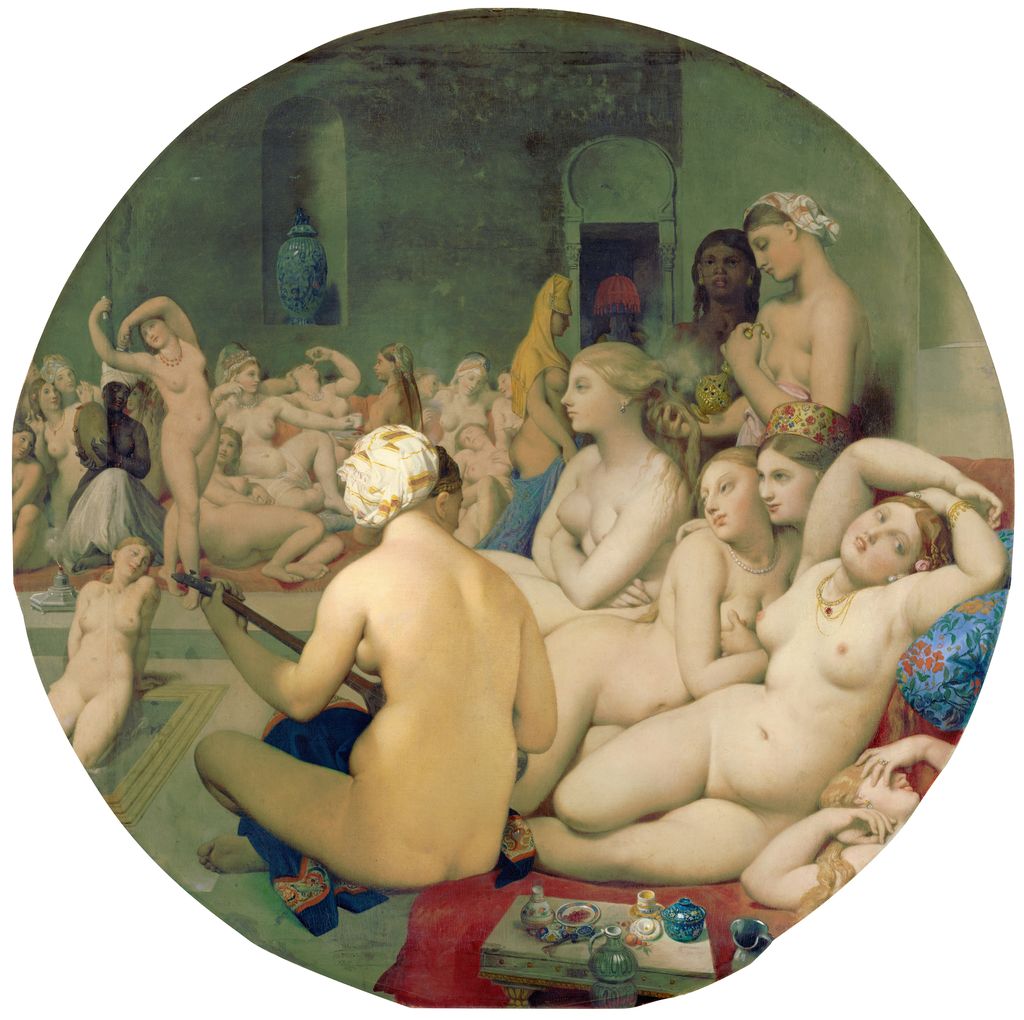
 by Tom Gurney
Tom Gurney BSc (Hons) is an art history expert with over 20 years experience
Published on June 19, 2020 / Updated on October 22, 2026
Email: tomgurney1@gmail.com / Phone: +44 7429 011000
Prints and Reproductions
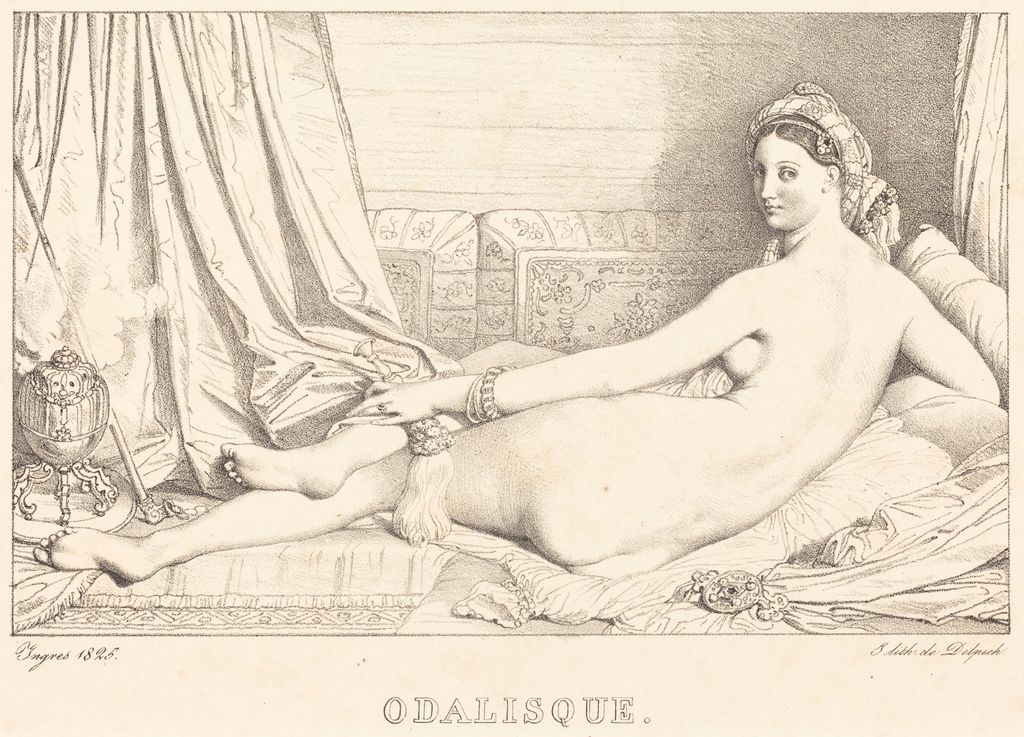
The same reclining woman can look remarkably different on two sheets of paper. In Ingres’s small Odalisque, pale, grainy shading gives the body a lightness close to a drawing. In Jean Pierre Sudré’s larger lithograph after the composition, dark curtains and carefully described fabrics make the surrounding room feel denser. Both are nineteenth-century prints; only the first is a print made by Ingres himself. [1][2]
That distinction opens a larger story. Ingres’s images travelled through lithographs, etchings, engravings and photographs, sometimes with his direct involvement. Each translation required decisions about scale, colour, outline and detail. Understanding who made a particular image helps us see those decisions, and prevents the broad phrase ‘an Ingres print’ from concealing several quite different objects.
At a Glance
- Made by IngresOdalisque is his own lithograph. [1]
- After IngresSudré translated the composition in Odalisque Reclining. [2]
- Prepared for an engravera drawing could supply a model without itself being a print. [3]
- Photographic reproductionphotographs could record works and assist further revisions during Ingres’s lifetime. [4]
- Modern art printa newly produced reproduction of an existing painting or drawing, distinct from the historical printed objects discussed here.
Contents
- What ‘by Ingres’ and ‘after Ingres’ mean
- Two odalisques, two kinds of printmaking
- An odalisque reduced to outline
- How extensive was Ingres’s own printmaking?
- Drawings made for engravers
- Photography could preserve an earlier version
- The artist’s image after his death
- Reading a label and a modern reproduction
- Annotated details
What ‘by Ingres’ and ‘after Ingres’ mean
A print begins with an image prepared on a printing surface, often called a matrix: a stone, plate or block from which ink can be transferred to paper. The resulting sheet is an impression. Several impressions can carry the same design, so an original print need not be unique. Lithography, etching and engraving produce those impressions in different ways. [5][6][7]
An original print can revisit an existing painting. Cleveland explains that Ingres used his Odalisque lithograph both to publicise the painting and to experiment with an unfamiliar medium. Originality here concerns the printable image, rather than the invention of a new subject. [8] The Met identifies Sudré as artist and Ingres as the source of the composition. [2] For the NGA’s Odalisque, Ingres is artist; François Séraphin Delpech is printer. [1]
Explore prints by and after Ingres
Two odalisques, two kinds of printmaking
Ingres’s small lithograph
The NGA dates its Odalisque to 1825, published 1826. This lithograph on wove paper has an image of 13.1 × 20.9 cm and a sheet of 29.7 × 38.3 cm. [1] Traditional lithography allows a drawing made with greasy crayon or ink on stone to be printed through the different behaviour of grease and water. The surface is treated so that ink adheres to the image while damp blank areas repel it. This permits marks that can resemble crayon or ink drawing, including delicate grain and broad shading. [5]
Look at the curtain in Ingres’s print. Dark strokes gather along the folds, while neighbouring stretches remain almost bare. The patterned cushions are described economically, with curling lines that leave much of the paper visible. Against them, the woman’s back is an expanse of light, gently turned by scattered grey marks. Her outline carries considerable weight, but the image is more than a set of contours: shaded passages establish the roundness of the hip and the hollow beneath the arm.
The figure faces in the opposite direction from the woman in the 1814 Grande Odalisque. Her head is at the right, the curtain at the left. Yet this is no mechanically identical reversal. Details have been recast, and the fan becomes a much more abbreviated shape. The small image asks us to follow a rhythm of lines across paper rather than explore every coloured surface of the canvas. [9] Henri Delaborde, writing in 1870, described Ingres’s small lithograph as having the character of a sketch. He places its publication in 1826. [9] Cleveland holds a separate impression, also catalogued as Delteil 9. [8][1]
Sudré’s larger translation
Odalisque Reclining (1826; Met 27.43) is also a lithograph. Its 30.5 × 48.8 cm image is over twice as wide as Ingres’s. [2] Both prints place the woman’s head on the right, but Sudré makes the surrounding objects much more insistent. The curtain falls in deep, dark channels; tiny patterns sit within its folds. At the bottom of the image, the vessels, fruit and textiles build a foreground full of competing textures. The fan’s feathers are individually legible, and the pale skin stands out sharply against the almost black background.
Ingres’s small print leaves the eye room to move through open, lightly worked areas. Sudré offers a slower inspection of surfaces, carrying the painting’s contrasts into a language of black ink and white paper. Enlarging one on a screen until both appear the same size can hide part of that difference: their actual dimensions shaped the encounter each sheet offered.
Delaborde attributed an important part of the painting’s eventual success to Sudré’s large lithograph, which he described as popular. This is a retrospective judgement by an early biographer, rather than a measured account of how every contemporary viewer responded. [9]
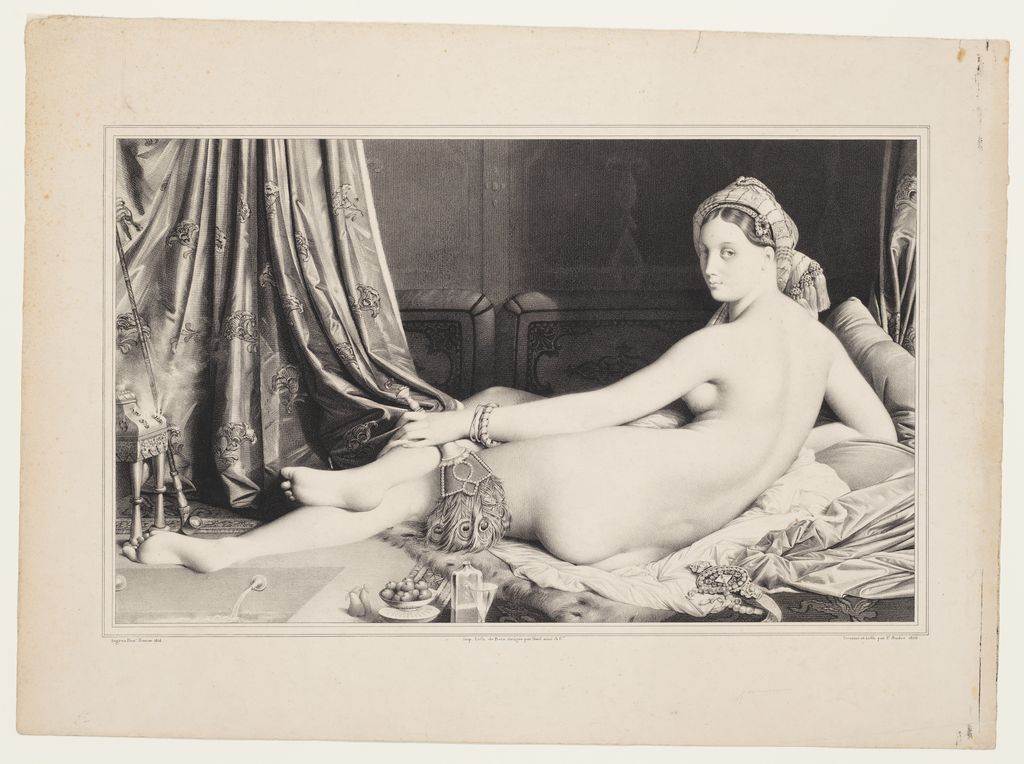
Jean-Pierre Sudré after Ingres, Odalisque Reclining, 1826. Lithograph. The Metropolitan Museum of Art, 27.43. [10]

Ingres, Grande Odalisque, 1814. [11]
Annotated Details from Two odalisque lithographs
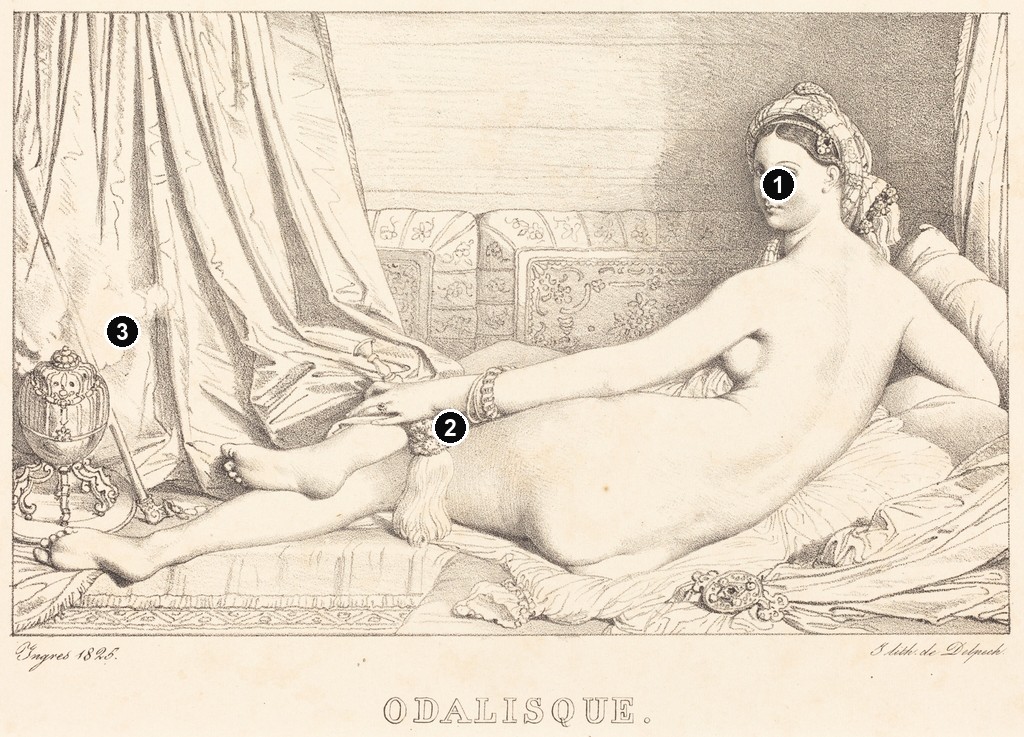
The numbered points identify visible features discussed in this article. Return from each detail to the whole composition. Each caption identifies the work shown.
Odalisque — Ingres’s Lithograph
Ingres, Odalisque (NGA 1946.21.117). Image source. CC0 / Public domain.
Odalisque Reclining — Sudré after Ingres
Sudré after Ingres, Odalisque Reclining (Met 27.43). Image source. CC0 / Public domain.
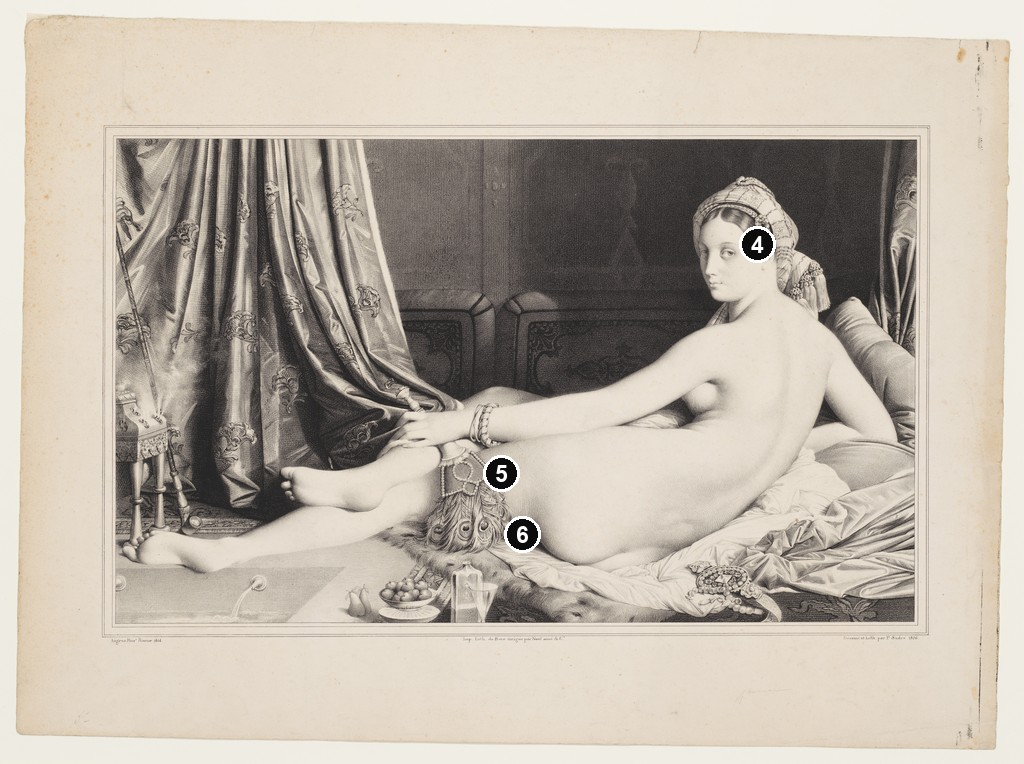
Details from TWO ODALISQUE LITHOGRAPHS
Compare Ingres’s own lithograph with Jean-Pierre Sudré’s separate lithograph after his painting. The two prints use different patterns of line and tone around a related reclining figure.
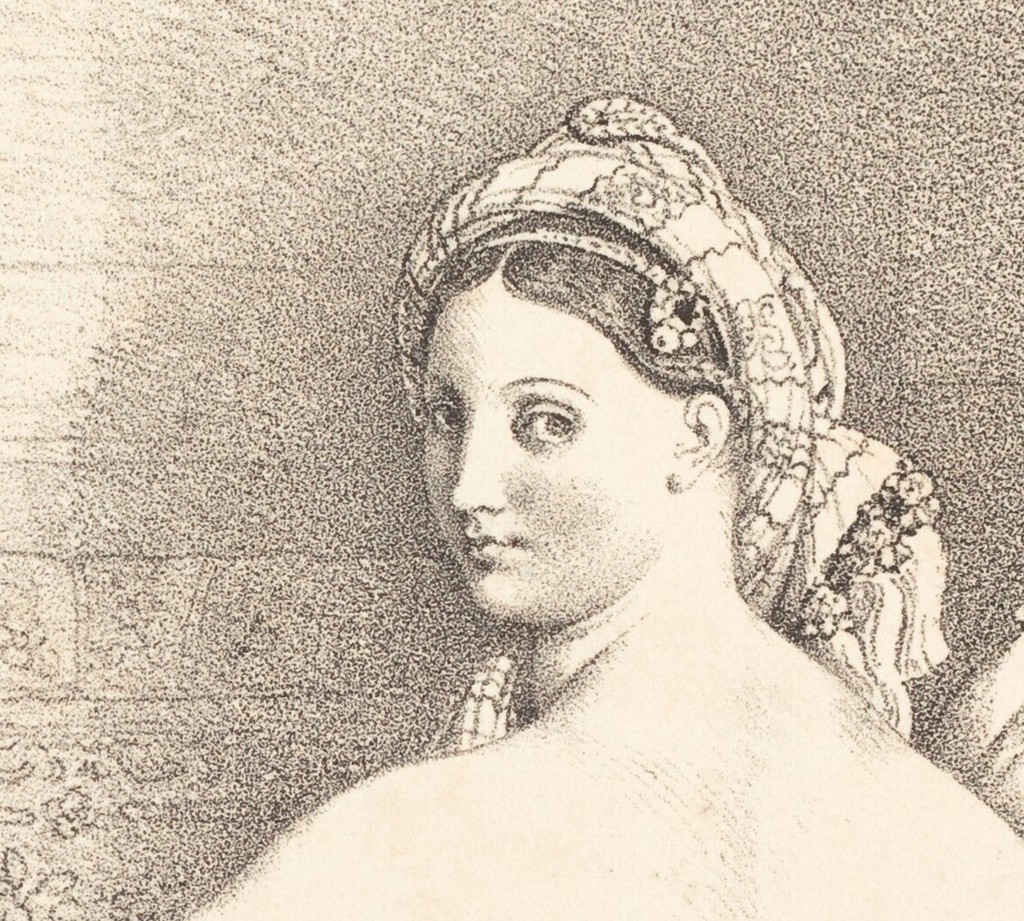
Odalisque — Ingres’s Lithograph
The face against the stippled dark field
The pale face turns towards the viewer against a field of closely placed dark marks. The headdress gathers into several patterned shapes beside it.
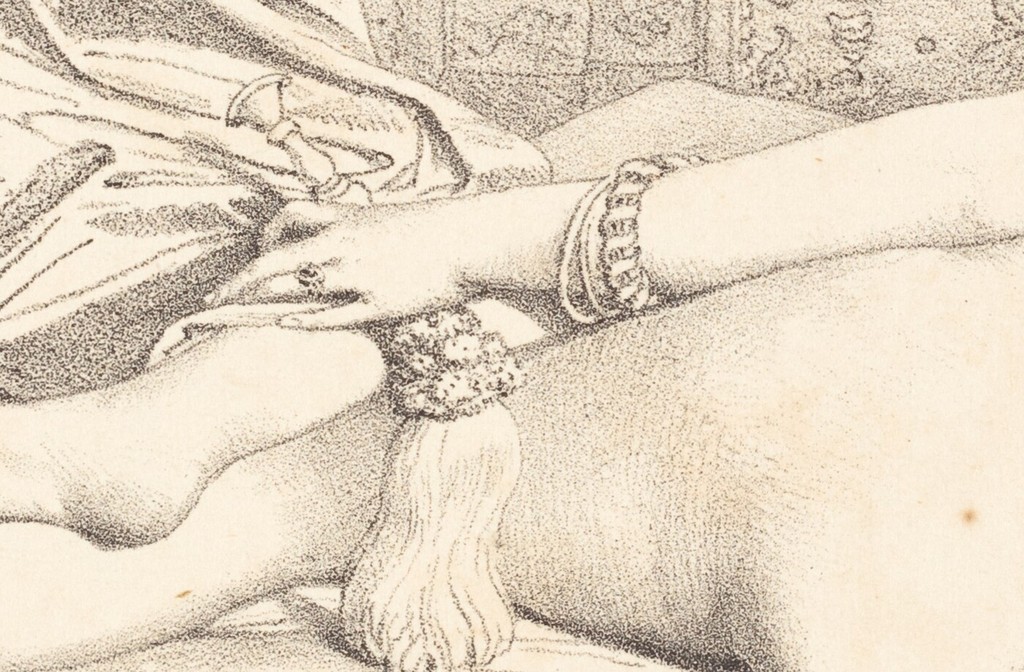
The hand beside the tassel
The extended hand meets bracelets and a large hanging tassel. Long outlines describe the fingers while denser marks gather along the nearby folds.
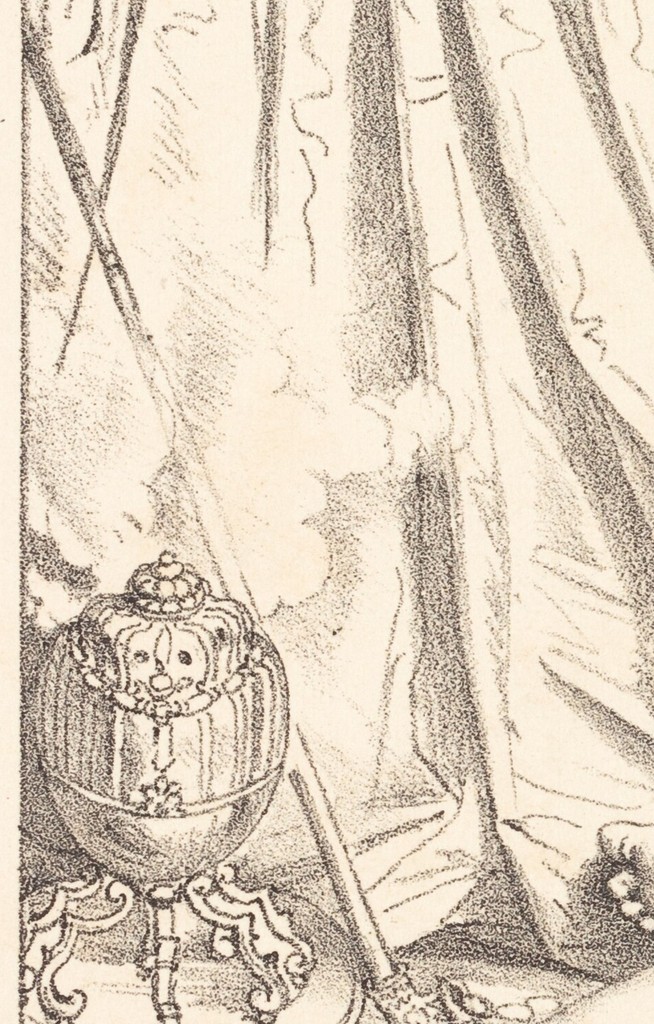
Smoke rising beside the curtain
Pale curling smoke rises from the vessel beside the curtain. Fine outlines and scattered dark marks keep the light shape visible against the surrounding fabric.
Odalisque Reclining — Sudré after Ingres
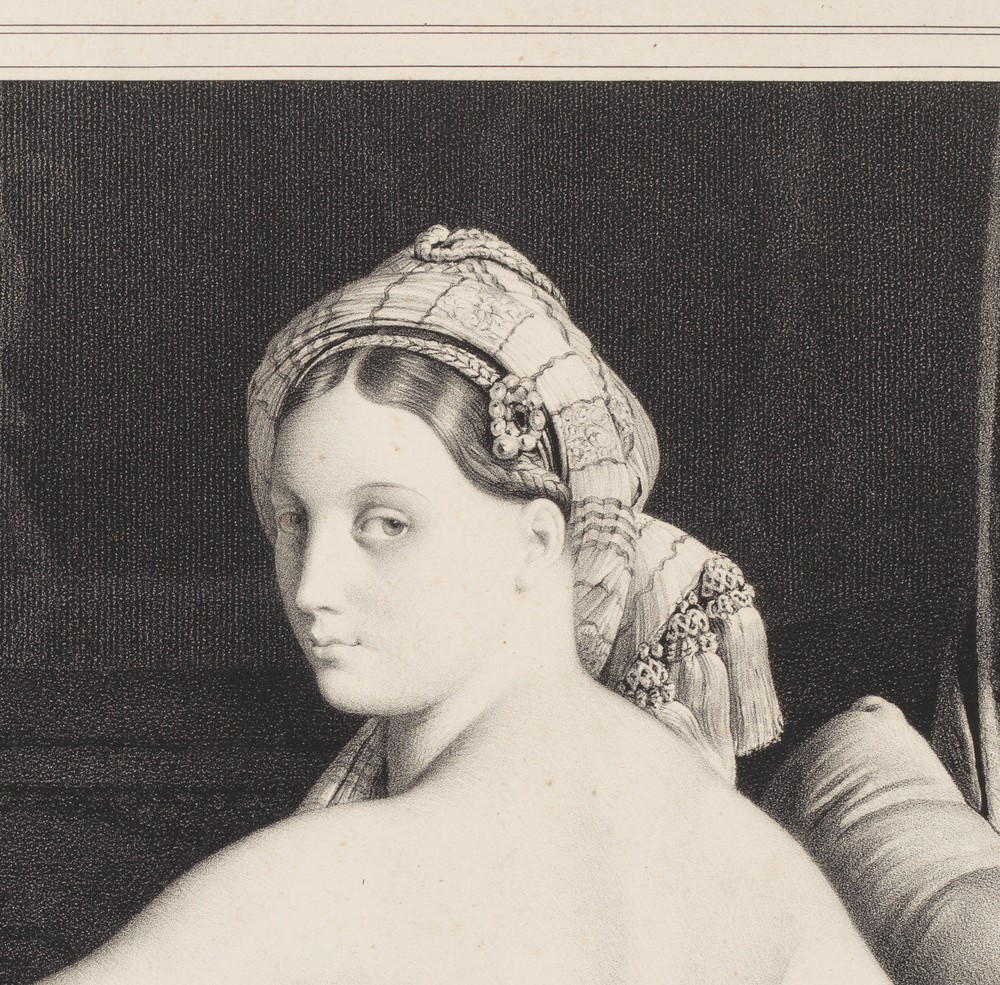
The face framed by the headdress
The face turns towards the viewer beneath the detailed headdress. Small repeated marks shade the hair and fabric beside the comparatively pale cheek.
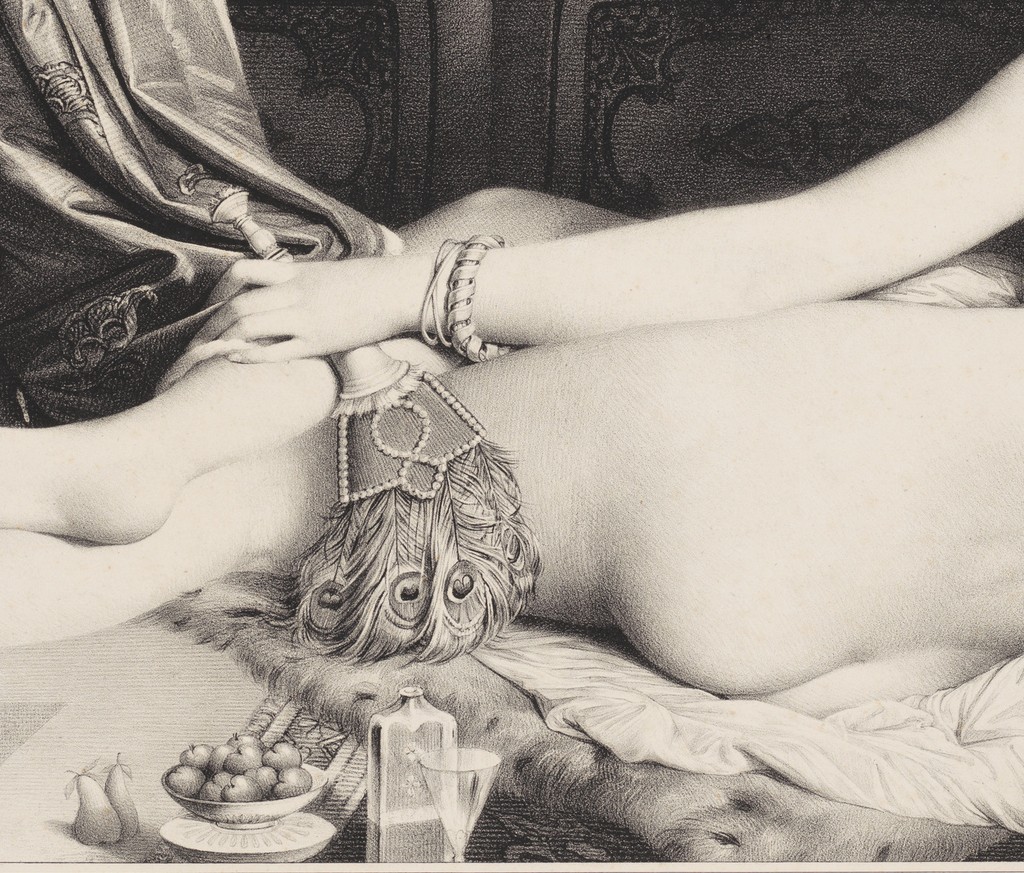
The hand, bracelets and feathered fan
The extended hand lies beside bracelets and the feathered fan. Fine dark marks describe these neighbouring forms within the larger pale body.
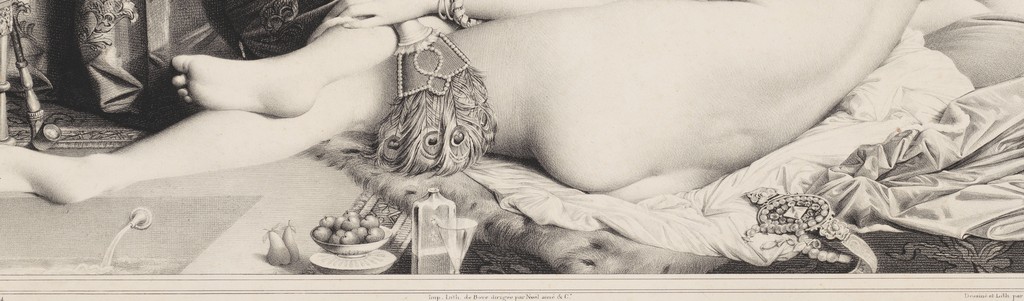
The reclining figure among patterned fabrics
The lower body stretches between the patterned hanging and gathered bedding. Compare the many small marks of the cloth with the quieter shading across the figure.
An odalisque reduced to outline
A smaller print in the British Museum presents another approach. Museum number 1876,1111.382 is an etching on chine collé, a thin paper attached to a supporting sheet, measuring 113 × 173 mm. The museum describes the woman in reverse and in outline, and identifies the impression as a proof before lettering. It dates the print broadly to about 1814–1851. [12]
Etching creates lines by exposing selected areas of a metal plate to acid. An engraver, by contrast, cuts lines directly into metal with a tool called a burin. In both processes, recessed marks retain ink for printing. A black-and-white appearance alone cannot tell us which method was used. [6][7]
The British Museum suggests that its plate may relate either to Charles Paul Landon’s publication of the Salon of 1819 or to Albert Magimel’s 1851 collection with outline plates by Achille Réveil. It does not settle that identification. ‘Before lettering’ describes the absence of the lettering that would accompany a later issue; it does not supply the missing maker or publication. [12]
An outline translation also makes a different demand on the viewer. It can preserve the relationship of the main forms while giving little account of the weight of satin, the colour of a curtain or the softness of flesh. It is useful to ask what such an image makes easy to recognise, and what must be supplied from memory or imagination.
How extensive was Ingres’s own printmaking?
Ingres’s activity as a maker of prints should be distinguished from the much wider circulation of images after his paintings and drawings. Delaborde’s 1870 catalogue has a short separate section for etchings and lithographs by the artist. It lists a portrait of Gabriel Cortois de Pressigny dated 1816, a lithographic portrait of Frederick Sylvester North Douglas dated 1815, the Odalisque, and a small decorative image of four magistrates of Besançon dated 1825 for Baron Taylor’s Voyage en Franche-Comté. These are Delaborde’s historical entries, rather than a complete modern census. [9]
His Pressigny entry explains a useful printmaking term through a physical example. He describes three states, with changes to the shading of the face and details of the cap, followed by an added verse inscription. A state records a change to the printing image. Different impressions can belong to the same state; changing a plate creates another state. Delaborde also distinguishes a lithographic copy by Ulysse Mathey from Ingres’s etching. Even within one portrait’s history, composition, maker, process and revision need separate attention. [9]
A portrait of Katherine Anne, Lady Glenbervie, brings the question of dates into sharper focus. The Fitzwilliam Museum records both an Ingres inscription dated Rome, 1815, and lettering giving the sitter’s death in 1817. That later information shows why the date attached to a design cannot automatically be taken as the date of every element printed on the sheet. The museum identifies lithography, names Charles Joseph Hullmandel as printer, and gives a broad date of about 1815–1823. [13]
Maker descriptions also vary. The Fitzwilliam calls Ingres the printmaker; Toledo’s record for the group of four associated portraits says after Ingres and names Hullmandel as printer. Those labels leave the precise division of work on the printing image unresolved. They are a reason to preserve the wording of individual records, rather than confidently count every related sheet as an additional autograph print. [13]
Drawings made for engravers
Reproduction could begin with substantial new work by the painter. In 1840 Ingres started a large drawing of The Apotheosis of Homer with an engraving by his friend Luigi Calamatta in view. The drawing, now the Louvre’s Homère déifié, RF 5273, was completed in 1865 after extensive changes. Gouache and grey wash over graphite gave it a tonal language different from the painted ceiling that had prompted it. [3]
Delaborde describes an initial intention to improve details for Calamatta’s plate. When Ingres returned to the drawing late in life, the engraving was no longer the immediate project: he enlarged the assembly of figures and revised its membership. An object begun to help translate a painting had become a further statement of the composition in its own right. [9] Calamatta’s drawing for the engraved portrait of Ferdinand Philippe, Duke of Orléans, received finishing touches from Ingres in front of the original painting, shortly after the prince’s death in July 1842. The Musée Condé identifies both makers’ contributions. [4]
Portraits could also be translated repeatedly. Eric Bertin documents engravings after Monsieur Bertin by Normand fils in 1833, Henriquel-Dupont in 1844 and Hurel in 1866, alongside the image in Magimel’s 1851 publication. One painted likeness could thus acquire several printed lives during Ingres’s lifetime. [14]
These documented relationships help explain why a monochrome painting might attract speculation about print preparation. Yet each object needs its own evidence. The Met’s Odalisque in Grisaille, attributed to Ingres and workshop and dated about 1824–1834, remains a painting in oils. The museum notes that grey paintings could guide reproductive engravers, but says this work’s intended purpose is uncertain. Its lack of colour does not prove that it was made for a particular print. [15]
Photography could preserve an earlier version
Photographs added another route by which images moved between studio, collection and public. They could also record a composition before Ingres had finished revising it. Delaborde gives a striking example in his account of Homère déifié. The drawing was photographed before Ingres added Mozart and André Chénier, with Chénier replacing Dryden. Consequently, the photographic image described by Delaborde retained a figure removed from the drawing and lacked two figures present in its final form. Apparent disagreement between a photograph and an original can therefore preserve the history of a work’s alteration. [9]
Delaborde also judged the photograph inadequate to convey the drawing’s delicate tonal effect and argued that an engraving with the burin would provide a better translation. His preference belongs to a particular historical debate about artistic interpretation and mechanical reproduction. It reminds us that photographic accuracy of outline and satisfactory representation of an artwork’s effect were not necessarily the same thing to nineteenth-century observers. [9] Chantilly records photographs used to develop the reversed Antiochus and Stratonice of 1866, made with Raymond Balze. Ingres also had the work photographed in progress. [4]
Ingres himself helped preserve this wider record. Bertin documents his gifts of fifty-six prints or photographs after his works to the Bibliothèque Impériale between 1859 and 1865. That figure describes reproductive objects donated to a collection. It is not a total of original prints made by his hand, nor does it establish fifty-six different compositions. [14]
The artist’s image after his death
The portrait of Ingres could travel through the same channels as his paintings. The Rijksmuseum holds an etching of him as a young man, made in 1869 by Léopold Flameng after Ingres’s design. The image connects it with the early self-portrait, but the sheet is Flameng’s work as a printmaker. Ingres’s presence as the person represented, and as the source of the image, does not make it an autograph etching. [16]
Such prints help explain why a search for ‘Ingres etchings’ can bring together very different things: etchings catalogued under his name, reproductive etchings after his compositions and portraits of the artist made by somebody else. The descriptive label has to do more work than the search phrase.
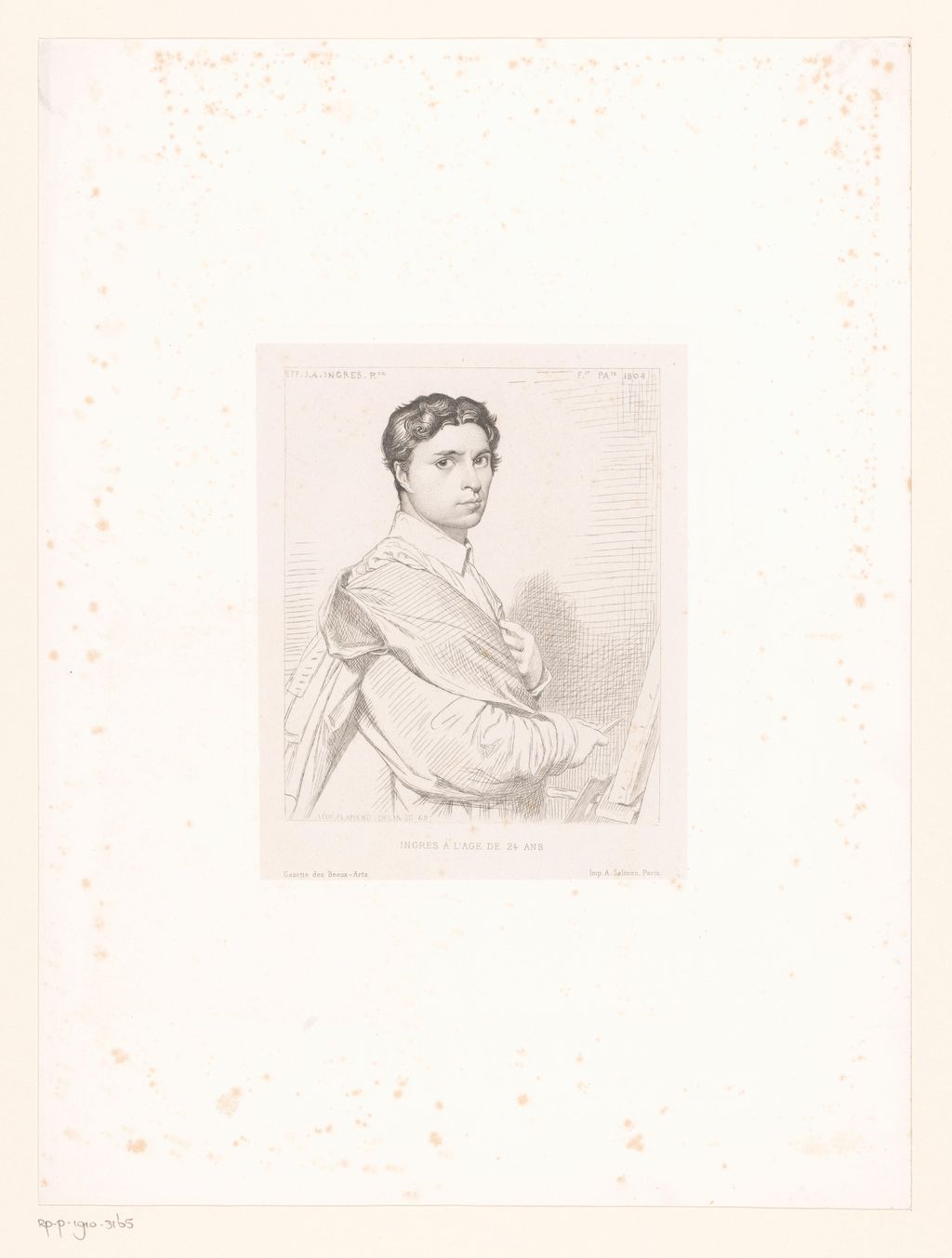
Léopold Flameng after Ingres, Portrait of Ingres Aged 24, 1869. Etching with chine collé; impression from the 1874 Album de la Gazette des Beaux-Arts. Rijksmuseum, Amsterdam, RP-P-1910-3165. [17]
Reading a label and a modern reproduction
A few details usually clarify the object in front of you:
- Names and roles: who designed the composition, made the printable image, printed it and published it?
- Medium: is it a lithograph, etching, engraving, photograph or a modern reproduction?
- Dates: does the date refer to the underlying painting, the making of the print, or its publication?
- Impression and state: does the description identify this sheet’s place in a sequence of alterations?
- Measurements: are the figures for the printed image, the plate or the entire sheet?
The odalisque examples show why the last point matters. Matching the size of two digital images can make a small album print and a large reproductive lithograph appear equivalent. Margins and lettering may disappear in a crop, taking maker credits and evidence of the sheet’s format with them.
A modern art print usually reproduces an already existing artwork from a photographic or digital image. Its immediate source might be the painting, a drawing, or even one of the historical prints discussed here. The title alone will not identify which version is being reproduced. Compare the orientation, surrounding objects and proportions with the relevant museum record.
Colour, paper tone and cropping affect that experience. A reproduction with bright white paper can make a softly toned print look harsher; a detail enlarged beyond its original scale changes the relationship between the marks and the viewer. In a reproduction of a painting, differences in the photographed colour can also change which forms seem most prominent. These are reasons to keep the identity of the reproduced object in view when exploring Ingres’s style and technique.
The status of an old artwork and the terms attached to a particular digital file should also be read separately. Museums identify which files they release openly; the National Gallery of Art, for example, provides an explicit open-access policy and marks the media for its Odalisque as public domain. An image found elsewhere needs its own accompanying information. [18][1]
Artworks directory
Explore 150 paintings, drawings and an original lithograph. This selection includes related versions and studies; dates distinguish completed works from later revisions.
| Name | Date | Medium |
|---|---|---|
| The Apotheosis of Homer | 1827 | Painting |
| Grande Odalisque | 1814 | Painting |
| The Turkish Bath | 1859–1862 | Painting |
| Madame Moitessier Seated | 1856 | Painting |
| Portrait of Monsieur Bertin | 1832 | Painting |
| Napoleon I on His Imperial Throne | 1806 | Painting |
| Odalisque with Slave | 1839 | Painting |
| The Ambassadors of Agamemnon in the Tent of Achilles | 1801 (competition) | Painting |
| The Valpinçon Bather | 1808 | Painting |
| The Source | 1856 | Painting |
| Oedipus Explaining the Enigma of the Sphinx | 1808; revised probably before 1827 | Painting |
| The Vow of Louis XIII | 1824 | Painting |
| Antiochus and Stratonice | 1840 | Painting |
| The Comtesse d’Haussonville | 1845 | Painting |
| The Princesse de Broglie | 1851–1853 | Painting |
| Jupiter and Thetis | 1811 | Painting |
| The Dream of Ossian | 1813 | Painting |
| The Martyrdom of Saint Symphorian | 1834 | Painting |
| Venus Anadyomene | 1808–1848 | Painting |
| Portrait of Madame de Senonnes | 1814 | Painting |
| Madame Rivière | 1805 | Painting |
| Mademoiselle Caroline Rivière | 1805 | Painting |
| Portrait of Philibert Rivière | 1805 | Painting |
| Bonaparte First Consul | 1804 | Painting |
| The Death of Leonardo da Vinci | 1818 | Painting |
| Joan of Arc at the Coronation of Charles VII | 1854 | Painting |
| Madame Duvaucey | 1807 | Painting |
| La Belle Zélie | 1806 | Painting |
| Madame Panckoucke | 1811 | Painting |
| Portrait of Charles Marcotte d’Argenteuil | 1810 | Painting |
| Joseph Antoine Moltedo | c.1810 | Painting |
| Madame Leblanc | 1823 | Painting |
| Delphine Ingres-Ramel (Portrait of Madame Ingres) | 1859 | Painting |
| Portrait of Amédée de Pastoret | 1823–1826 | Painting |
| Portrait of Baronne de Rothschild | 1848 | Painting |
| Madame Marcotte de Sainte Marie | 1826 | Painting |
| Madame Gonse | 1852 | Painting |
| Aretino in the Studio of Tintoretto | 1848 | Painting |
| Don Pedro of Toledo Kissing Henry IV’s Sword | 1831/1832 | Painting |
| Raphael and La Fornarina | 1814 | Painting |
| Roger Freeing Angelica | 1819 | Painting |
| Romulus’ Victory over Acron | 1812 | Painting |
| Self-Portrait at the Age of Twenty-Four | 1804; revised 1841–1851 | Painting |
| Male Torso | c.1800 | Painting |
| Odalisque in Grisaille (Ingres and workshop) | c.1824–1834 | Painting |
| The Small Bather | 1826 | Painting |
| The Little Bather Harem Interior | 1828 | Painting |
| Jesus Among the Doctors | 1862 | Painting |
| The Virgin Adoring the Host | 1852 | Painting |
| The Virgin of the Host | 1841 | Painting |
| Virgin of the Adoption | 1858 | Painting |
| Paolo and Francesca | 1814 | Painting |
| Homer Deified (revised composition, Louvre RF5273) | 1865 | Drawing |
| Odalisque with Slave (Louvre RF4622) | 1858 | Drawing |
| Odalisque (Walters Art Museum; Ingres and Paul Flandrin) | 1842 | Painting |
| Madame Moitessier Standing (National Gallery of Art) | 1851 | Painting |
| Jacques-Louis Leblanc (The Metropolitan Museum of Art) | 1823 | Painting |
| Ferdinand-Philippe, Duke of Orléans (Louvre RF2005-13) | 1842 | Painting |
| Ferdinand-Philippe, Duke of Orléans (Versailles MV5207; Ingres and workshop) | 1843 | Painting |
| Ferdinand-Philippe, Duke of Orléans (Versailles MV5209; Ingres and workshop) | 1844 | Painting |
| Antiochus and Stratonice (Musée Fabre; Ingres and Raymond Balze) | 1866 | Painting |
| Antiochus and Stratonice (Kunstmuseum Bern, Gurlitt bequest) | Undated (early dating proposed) | Drawing |
| Composition study for Antiochus and Stratonice (MIB867.2193) | 1806 | Drawing |
| Study for the Figure of Stratonice (Met63.66) | 1834–1840 | Graphite, black chalk and charcoal |
| Nude figure study for Stratonice (Boijmans F II 36 PK) | c.1834–1840 | Drawing |
| Paolo and Francesca (The Barber Institute,54.6) | c.1814–1820 | Painting |
| Paolo and Francesca (The Hyde Collection,1971.24) | c.1855–1860 | Painting |
| Paolo and Francesca (Amsterdam Museum TA10970) | 1820 | Drawing |
| Paolo and Francesca (dedicated to Artaud de Montor) | 1816 | Drawing |
| Study for the Bust of Francesca (MIB867.1398) | 1819 | Drawing |
| Study for the Bust of Francesca (MIB867.1396) | 1819 | Drawing |
| The Archangel Raphael, first idea (MIB867.2488) | 1842 | Drawing |
| The Archangel Raphael (MIB867.2500) | 1842 | Drawing |
| The Archangel Raphael Carrying Human Prayers to God (Chantilly DE513) | 1844 | Drawing |
| Louis-Philippe as Saint Philip, stained-glass study | 1844 | Drawing |
| Marie Frédéric Eugène de Reiset (Ford Collection RBF171-2) | 1844 | Drawing |
| Virgil Reading the Aeneid (Toulouse) | Begun 1811 | Painting |
| Tu Marcellus Eris (Brussels, inv. 1836) | c.1814 (museum dating) | Painting |
| Jean-François Gilibert | 1804 | Painting |
| François-Marius Granet | 1807 (museum dating) | Painting |
| Count Nikolai Dmitrievich Guryev | 1821 | Painting |
| Caroline Murat, Queen of Naples | 1814 | Painting |
| Count Mathieu Molé | 1834 | Painting |
| Cherubini and the Muse of Lyric Poetry (Louvre) | 1842 | Painting |
| Luigi Cherubini (Cincinnati) | 1841 | Painting |
| Comtesse de Rayneval (Louvre RF4505) | 1841 | Drawing |
| Venus on Paphos (Antonie Balaÿ) | c.1852 | Painting |
| Prince Napoléon | 1855 | Painting |
| Study for The Apotheosis of Napoleon I (Petit Palais) | Late 1853 | Painting |
| The Apotheosis of Napoleon I (destroyed ceiling) | 1853 | Painting |
| The Journalist (MIB867.2733) | 1834? | Drawing |
| Henry VIII, after Holbein | c.1815–1820 (?) | Drawing |
| Madame Récamier, after David (MIB867.3637) | Undated (early Paris period) | Drawing |
| Study for Comtesse d’Haussonville (MIB867.259; background possibly by another hand) | 1842–1845 | Drawing |
| La Source (reduced version reported by Delaborde) | Date unrecorded; reported 1870 | Painting |
| Odalisque (autograph lithograph,NGA1946.21.117) | 1825; published1826 | Lithograph |
| Portrait of a Seated Lady | 1814 | Graphite |
| The Kaunitz Sisters (Leopoldine, Caroline, and Ferdinandine) | 1818 | Graphite |
| Portrait of a Man | 1814 | Graphite |
| Study for the Portrait of Louis-François Bertin (1766–1841) | n.d. | Black chalk and graphite |
| Studies for the Cadaver of Acron | ca. 1810–12 | Graphite on wove paper |
| Study for the Drapery of Molière in "The Apotheosis of Homer" | n.d. | Black chalk with stumping |
| Madame Guillaume Guillon Lethière, née Marie-Joseph-Honorée Vanzenne, and her son Lucien Lethière | 1808 | Graphite |
| Niccolò Paganini (1782–1840) | ca. 1830 | Counterproof or tracing strengthened with graphite and gouache on translucent paper |
| Lady Mary Cavendish-Bentinck (?-1843) | 1816 | Graphite |
| Madame Alexandre Lethière and Her Daughter Letizia | ca. 1815 | Graphite |
| Merry Joseph Blondel (1781–1853) | 1809 | Graphite |
| Ursin-Jules Vatinelle (1798–1881) | 1820 | Graphite |
| Bust of a Gypsy Girl (ascribed to Ingres) | 1819 | Graphite on wove paper |
| Study of a Seated Nude Male | n.d. | Graphite |
| The Archangel Raphael (Study for a stained-glass window in the chapel of Notre-Dame de la Compassion-Saint-Ferdinand, Neuilly) | ca. 1842 | Graphite |
| Lancelot-Théodore, comte Turpin de Crissé | probably 1818 | Graphite |
| Study for the Figure of the Iliad in "The Apotheosis of Homer" | ca. 1827 | Graphite and black chalk heightened with white chalk on brown paper |
| Comtesse Turpin de Crissé | probably 1818 | Graphite |
| Nude Figures for L'Âge d'Or, Château de Dampierre | n.d. | Graphite on brownish paper |
| Study of Figures (attributed to Ingres) | n.d. | Graphite |
| Study of Figures (attributed to Ingres) | n.d. | Graphite; squared in graphite |
| Admiral Sir Fleetwood Broughton Reynolds Pellew | 1817 | Graphite on wove paper |
| Madame Jean-Auguste-Dominique Ingres, née Madeleine Chapelle | 1814 | Graphite on off-white wove paper |
| Virgil Reading the Aeneid to Augustus, Livia, and Octavia | 1809/1819 (?) | Pen and black ink, graphite, brush and gray wash, white gouache heightening, Conté crayon on blue paper |
| General Louis-Étienne Dulong de Rosnay | 1818 | Graphite (hard and soft pencils) |
| Madame Alexandre Lethière, née Rosa Meli, and Her Daughter, Letizia | 1815 | Graphite |
| The Lawyer Paul Grand | 1834 | Graphite |
| Jean-Joseph Fournier | 1815 | Graphite |
| Armand Bertin | 1842 | Graphite |
| Madame Armand Bertin, née Marie-Anne-Cécile Dollfuss | 1843 | Graphite |
| The Architect Charles-Victor Famin | 1836 | Graphite |
| Henri Lehmann | 1850 | Graphite |
| Portrait of a Lady | ca. 1815–17 | Graphite |
| Edmond Cavé (1794–1852) | 1844 | Oil on canvas |
| Head of Saint John the Evangelist | probably ca. 1818–20 | Oil on canvas, laid down on wood |
| Madame Edmond Cavé (Marie-Elisabeth Blavot, ca. 1806–1883) | ca. 1831–34 | Oil on canvas |
| Madame Félix Gallois | 1852 | Graphite with touches of gold in oil to highlight jewelry, on buff wove paper. |
| Dr. François Mêlier | 1849 | Graphite with graphite framing lines, corrected with white, on buff wove paper |
| Portrait of Madame Rhode (Rhoda?) | 1810–20 | Graphite on pale buff wove paper |
| Study for "Raphael and the Fornarina"(?) | ca. 1814(?) | Graphite on white wove paper |
| Portrait of Madame Paul Meurice, née Palmyre Granger | ca. 1845–50 | Graphite on wove paper |
| Alexander the Great presenting Campaspe to Apelles | 1810 | Graphite, brush and brown wash; squared in graphite |
| Study of Hands for "Christ Among the Doctors" | 1852–62 | Graphite on tracing paper |
| Study for The Turkish Bath (RF34502) | about 1850 | Pen and brown ink with graphite, partially squared |
| Study for The Turkish Bath (RF23354) | Undated | Pen and brown ink with graphite on joined sheets |
| Study for The Turkish Bath (RF54702) | about 1859 | Pen and brown ink |
| Studies of women for The Turkish Bath (RF12292) | Undated | Black chalk |
| Achilles Receiving the Envoys of Agamemnon (Nationalmuseum sketch, NM2161) | 1801 | Oil on wood |
| Half-Length Bather (Musée Bonnat-Helleu,89) | 1807 | Oil on canvas |
| Oedipus and the Sphinx (National Gallery,NG3290) | about1826 | Oil on canvas |
| Oedipus and the Sphinx (Walters,37.9) | 1864 | Oil on canvas |
| Oedipus and the Valpinçon Bather, after David (MI.867.2035) | Undated | Graphite on tracing paper, after David |
| Study of the Virgin for The Vow of Louis XIII (Dijon,1758) | about1822 | Black chalk, stump and white chalk on brown wove paper |
| First Thought for The Vow of Louis XIII (MI.885.11.21) | 1822 | Oil on canvas |
Frequently Asked Questions
An original print is an image he made for printing, even if the composition came from one of his paintings. A modern reproduction copies an existing artwork. Ingres’s Odalisque shows that an original print can itself serve a reproductive purpose. [8]
It credits Ingres’s design; Sudré made this print. [2]
It is a print made from a chemically prepared flat surface, traditionally stone. Greasy drawing materials establish the image; damp blank areas repel the printing ink. [5]
Made in 1825; published in 1826. [1]
That is a possible function for a painting in grey, but the Metropolitan Museum says the purpose of this particular work is uncertain. It remains catalogued as an oil painting by Ingres and workshop. [15]
Discussion
Look again at the images and ideas explored in Prints and Reproductions. These editorial prompts invite your observations.
Reader Insights
Compare Ingres’s small Odalisque with Sudré’s larger lithograph. Where do your eyes pause in each image? Consider how the depth of the shadows, the treatment of the textiles and the original scale change your response to the reclining figure.
Compare an outlined reproduction with the tonal odalisque lithographs. What survives the change of medium, and what gains a different emphasis?
How does your reading of an image change when the label distinguishes its designer from its engraver or lithographer?
Join the Conversation
Share a detail, comparison or question about Prints and Reproductions below.
References
- National Gallery of Art, Odalisque, 1946.21.117. View source.
- Metropolitan Museum of Art, Sudré, Odalisque Reclining, 27.43. View source.
- Musée du Louvre, Département des Arts graphiques, Homère déifié. RF 5273, 1865; technique and commentary on the drawing begun in 1840 for Calamatta. Record updated 21 February 2023. (in French) View source.
- Musée Condé, Château de Chantilly, Ingres: The Artist and His Princes. English press kit, May 2023, pp. 31 and 34: photography and Calamatta’s drawing. View source.
- Metropolitan Museum of Art, ‘Lithograph’. Materials and Techniques, 21 December 2018; preparation, inking and printing from stone. View source.
- Metropolitan Museum of Art, ‘Etching’. Materials and Techniques, 21 December 2018; acid-resistant ground, bitten lines and intaglio printing. View source.
- Metropolitan Museum of Art, ‘Engraving’. Materials and Techniques, 21 December 2018; burin, hatching and printing. View source.
- Cleveland Museum of Art, Odalisque. Collection record, 1943.177, 1825; description, dimensions and reference to Delteil, vol. III, no. 9. View source.
- Henri Delaborde, Ingres, sa vie, ses travaux, sa doctrine, d’après les notes manuscrites et les lettres du maître. Paris: Henri Plon, 1870, pp. 235–236, no. 75, on the odalisque reproductions and their reception; pp. 270–273, no. 180, on Homère déifié, revisions and photography; pp. 315–316, nos. 430–433, on etching and lithography. Posthumous compilation. (in French) View source.
- Supporting image. Sudré after Ingres, Odalisque Reclining (Met 27.43). Image source. CC0 / Public domain.
- Supporting image. Ingres, Grande Odalisque, 1814. Image source. CC0 / Public domain.
- British Museum, Print after Ingres’s Grande Odalisque. Collection record, 1876,1111.382; description, medium, dimensions, approximate date and curator’s comments on possible publication identities. View source.
- Fitzwilliam Museum, Katherine Anne (North) Lady Glenbervie, P.14248-R: maker roles, approximate dating, technique and transcribed inscriptions. Toledo Museum of Art. Portraits of Katherine Anne North Glenbervie, Sylvester Douglas, Frederick Sylvester Douglas and Frederick North, 1931.75: after Ingres, printed by C. Hullmandel, lithograph. View source 1. View source 2.
- Eric Bertin, ‘Addenda and Corrigenda to the Catalogue’, in Gary Tinterow, Charlotte Hale and Eric Bertin, ‘“Portraits by Ingres: Image of an Epoch”: Reflections, Technical Observations, Addenda, and Corrigenda’. Metropolitan Museum Journal 35 (2000), pp. 193–219; p. 213, cat. no. 99, for prints after Bertin; p. 219, ‘Gifts to Institutions’, for the fifty-six prints or photographs. View source.
- Metropolitan Museum of Art, Odalisque in Grisaille. Collection record, 38.65, about 1824–1834; current attribution to Ingres and workshop, medium and commentary on its uncertain purpose. View source.
- Rijksmuseum, Portrait of Jean-August-Dominique Ingres at the Age of Twenty-Four. Collection record, RP-P-1910-3165; Léopold Flameng, etching, 1869. (in Dutch; English structured object data also consulted). View source.
- Supporting image. Léopold Flameng after Ingres, Portrait of Ingres Aged 24, 1869. Etching with chine collé; impression from the 1874 Album de la Gazette des Beaux-Arts. Rijksmuseum, Amsterdam, RP-P-1910-3165. Image source. Public domain.
- National Gallery of Art, ‘Terms and Notices’. ‘Open Access Policy for Images of Works of Art Presumed in the Public Domain’ and ‘Policy Details’, consulted 17 October 2026. View source.
- Splash image. Ingres, Odalisque (NGA 1946.21.117). Image source. CC0 / Public domain.