by Tom Gurney
Tom Gurney BSc (Hons) is an art history expert with over 20 years experience
Published on June 19, 2020 / Updated on October 22, 2026
Email: tomgurney1@gmail.com / Phone: +44 7429 011000
Joan of Arc at the Coronation of Charles VII
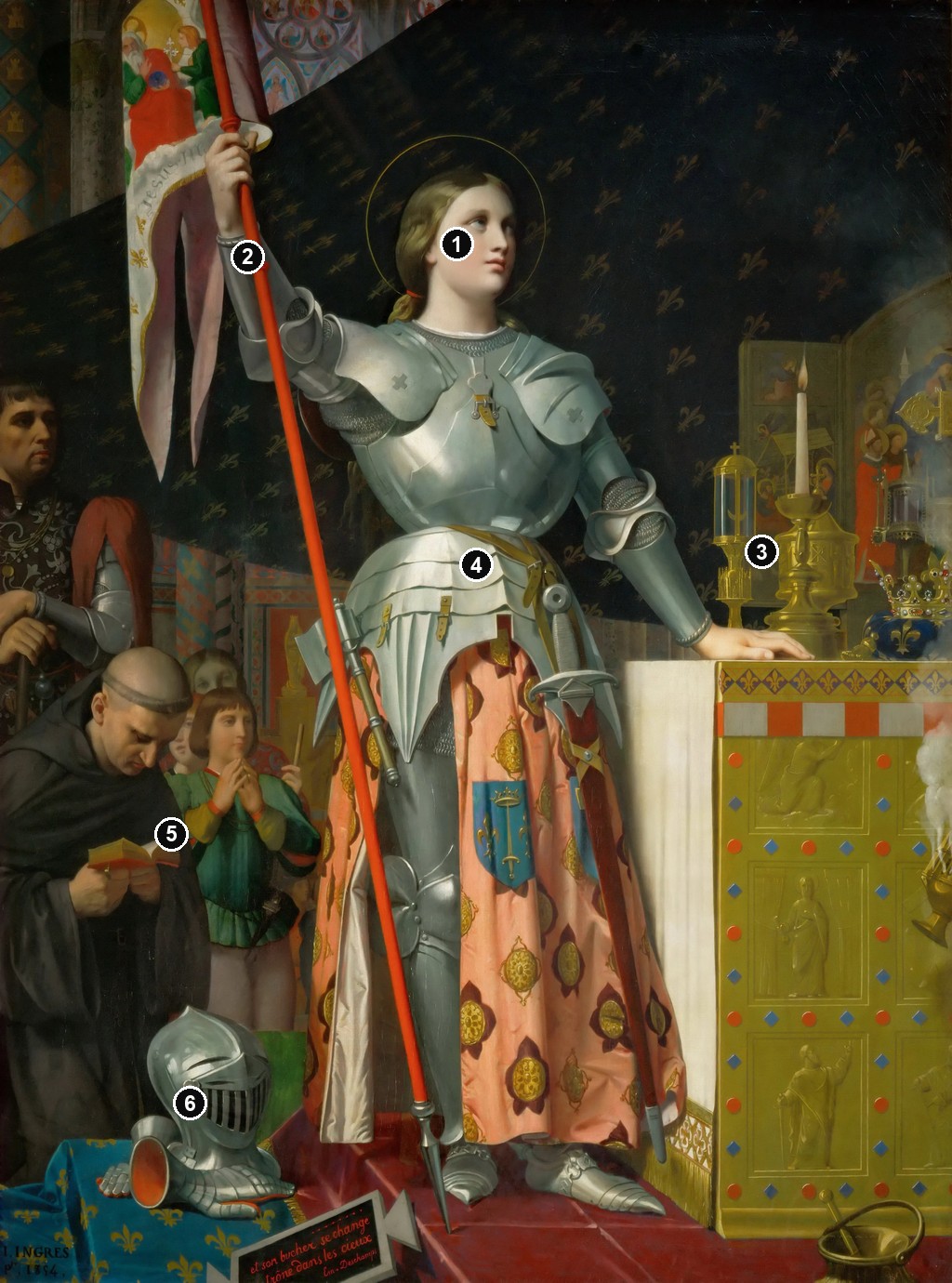
Joan stands between a banner and an altar, her armoured body facing us while her eyes turn upwards. The red staff rises almost the full height of the picture. Her other hand lies flat beside the gold objects of worship. Jean-Auguste-Dominique Ingres makes these two gestures the framework of Joan of Arc at the Coronation of Charles VII, completed in 1854: military service and religious devotion meet in a single, commanding figure. [1]
The setting is crowded with patterned cloth, polished metal and ceremonial objects, yet the pale face remains immediately legible. Around Joan, the other figures read, pray or watch. Her stillness holds this busy surface together. Although the title names a king's coronation, the painting gives its greatest space and strongest light to the woman who helped make it possible.
At a Glance
- ArtistJean-Auguste-Dominique Ingres.
- Date1854, signed and dated on the canvas.
- Medium and sizeOil on canvas, 240 × 178 cm.
- CollectionMusée du Louvre, Paris; inventory MI 667. [1]
- SubjectJoan at the coronation of Charles VII in Reims on 17 July 1429. [2]
- Look forThe upward gaze, the long red banner staff, the hand on the altar and the helmet resting below her.
This work across Ingres’s career
Agamemnon’s Ambassadors
1801 (competition)Grande Odalisque
1814Louis XIII’s Vow
1824Monsieur Bertin
1832The Princesse de Broglie
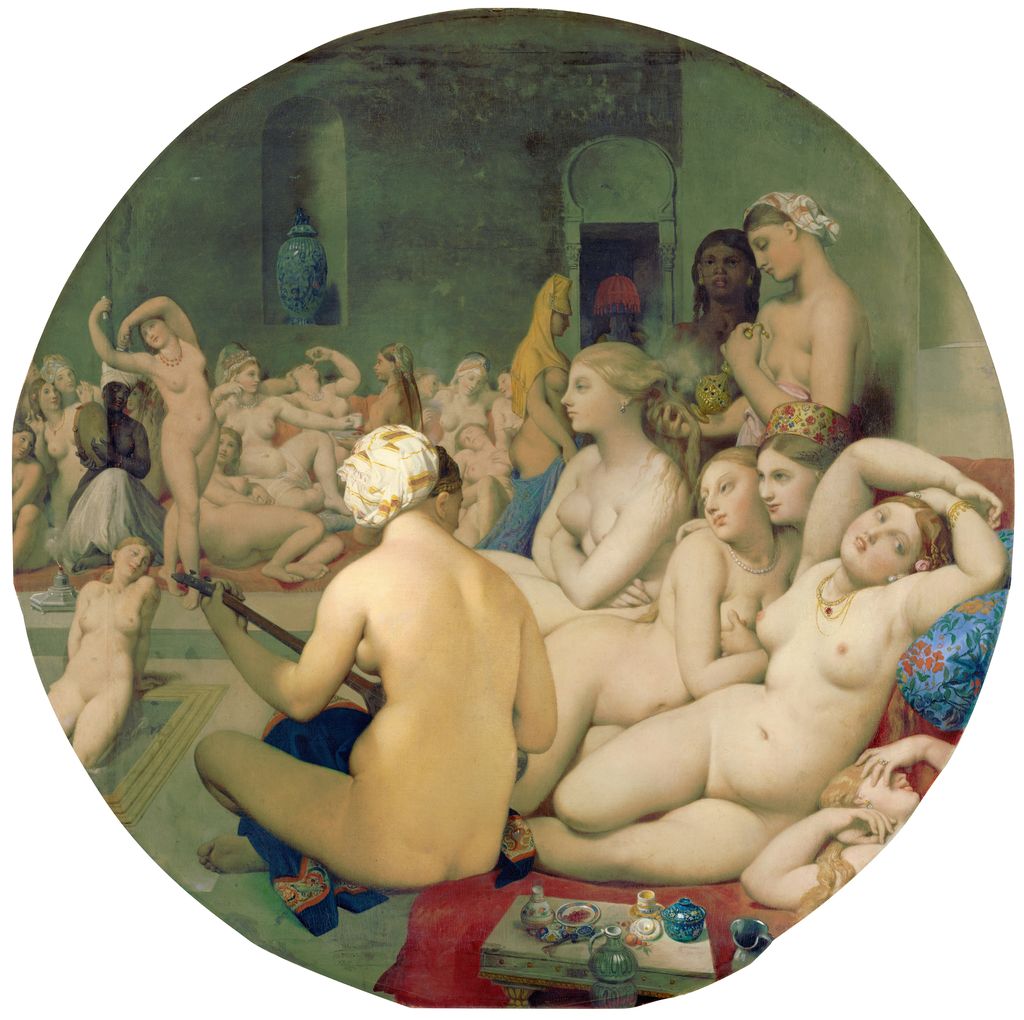
1851–1853The Turkish Bath
1859–1862Contents
- The coronation seen through Joan
- Looking carefully: steel, cloth and the movement of the eye
- From a printed illustration to a large painting
- A study that entered the museum in 2023
- The artist among the attendants
- A public image of devotion
- Annotated details
The coronation seen through Joan
The event followed the relief of Orléans on 8 May 1429. Joan subsequently urged Charles to travel to Reims for his coronation, which took place that July. Military achievement and the confirmation of royal authority were thus closely connected in the episode Ingres chose. [2]
He narrows the scene to Joan and the people beside her. We do not see Charles enthroned at the centre or a panoramic assembly of the court. Instead, the upright banner and the edge of the altar establish a small ceremonial space around her body. The painting asks us to look at someone present at the coronation rather than follow the action of crowning.
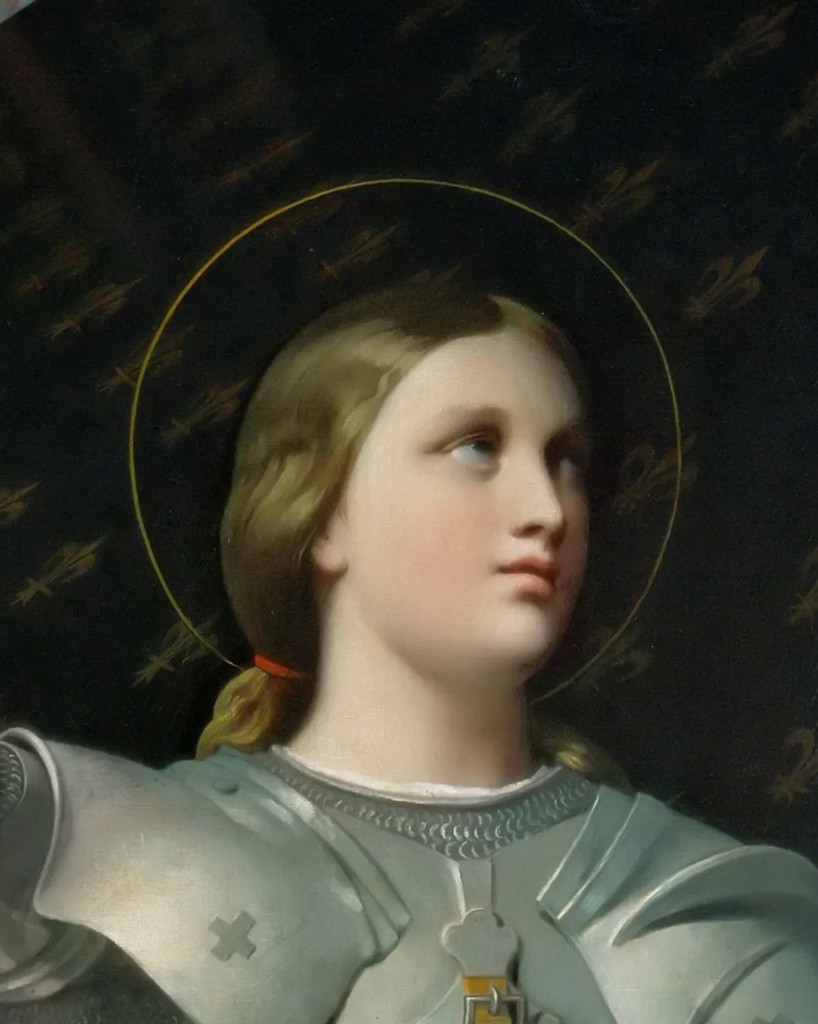
Joan's face is especially important to this shift. Its smooth, light surface stands out against the dark hanging behind her, and the thin circle of the halo keeps the head distinct from the surrounding pattern. Her gaze passes above the objects on the altar. There is no visible apparition at its destination: the upward look itself carries the sense of devotion.
The choice of episode also fixes Joan at a moment of achievement. Her execution at Rouen on 30 May 1431 lay less than two years ahead. [2] A viewer who knows that later history brings it to this scene, but Ingres supplies no execution ground or approaching captors. The armour, the banner and the unbowed stance preserve a different image of her life. The contrast between this poised presence and the violence of her subsequent fate belongs to our historical understanding of the picture.
Looking carefully: steel, cloth and the movement of the eye
A figure held between two gestures
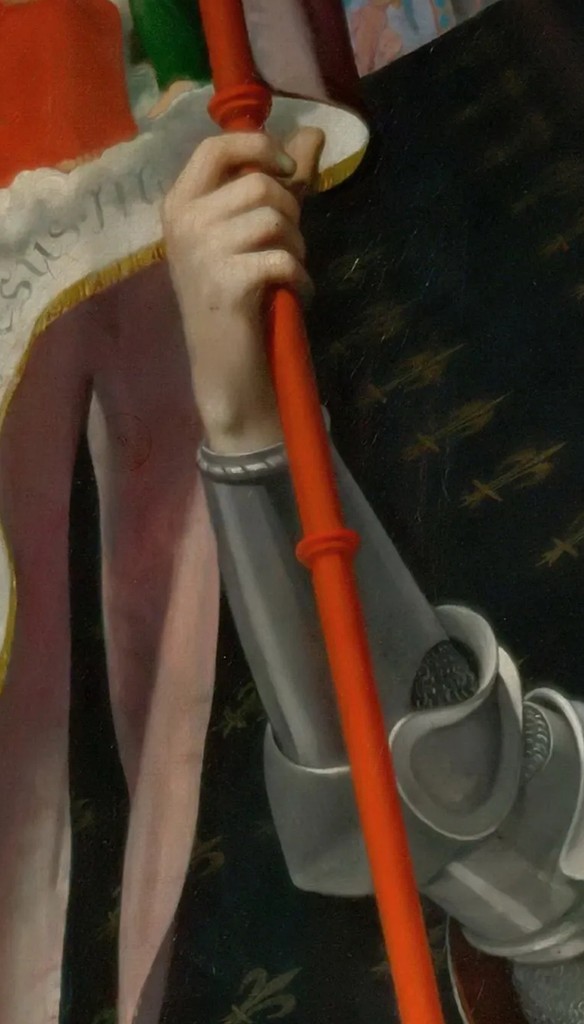
Begin with the hand gripping the red staff at the upper left. It gives the banner a firm point of attachment, while the raised arm stretches out across the darker background. Follow the metal plates towards the shoulder, then the curve of the neck into the face. The arm and the gaze both lift the composition, although they lead in different directions. One moves towards the upper left; the other turns towards the upper right.
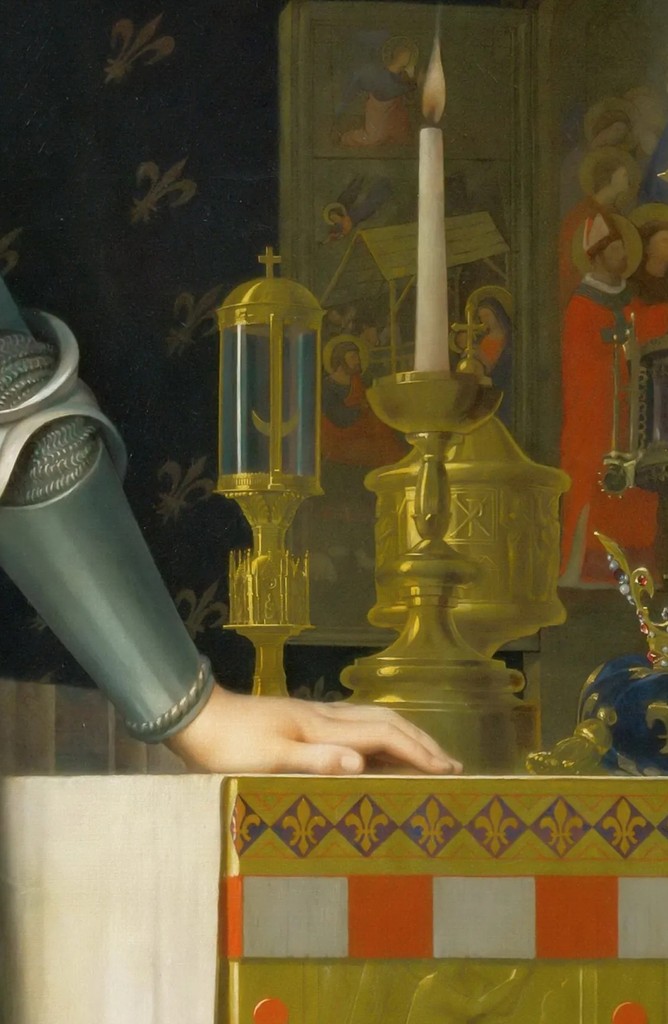
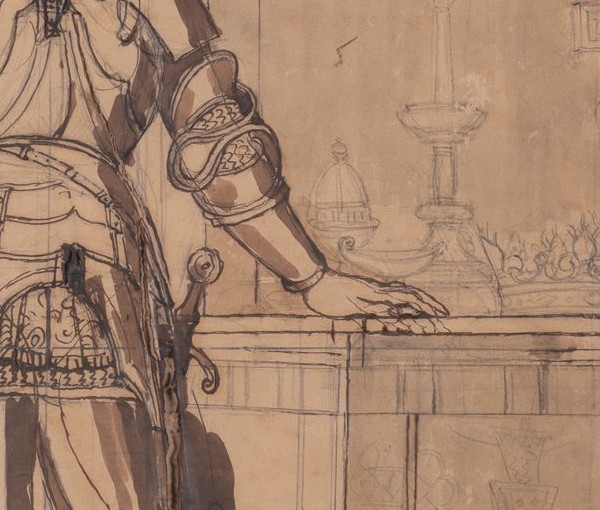
The opposite arm provides a quieter route. Its sleeve and armour descend towards the hand on the altar, where the fingers spread across a horizontal ledge. That small patch of uncovered skin is a useful pause after the bright, articulated metal. The hand appears steady and relaxed. It gives the otherwise elevated pose a physical point of contact with the room.
Together, the arms open Joan's silhouette without making it symmetrical. The staff hand is raised and closed; the altar hand is lowered and open. The difference makes the figure readable across the painting's elaborate surface. It also lets a viewer move between the banner, the face and the altar without losing Joan as the centre of attention.
Below, the long skirt falls between the armoured legs. The boots rest on separate levels of the steps, giving the body a broad base. The banner staff continues down in front, cutting across the softer folds. We can follow one uninterrupted red line from near the top of the picture to the lower foreground, even as the figure changes from smooth breastplate to patterned cloth to jointed leg armour.
The armour has more than one kind of shine
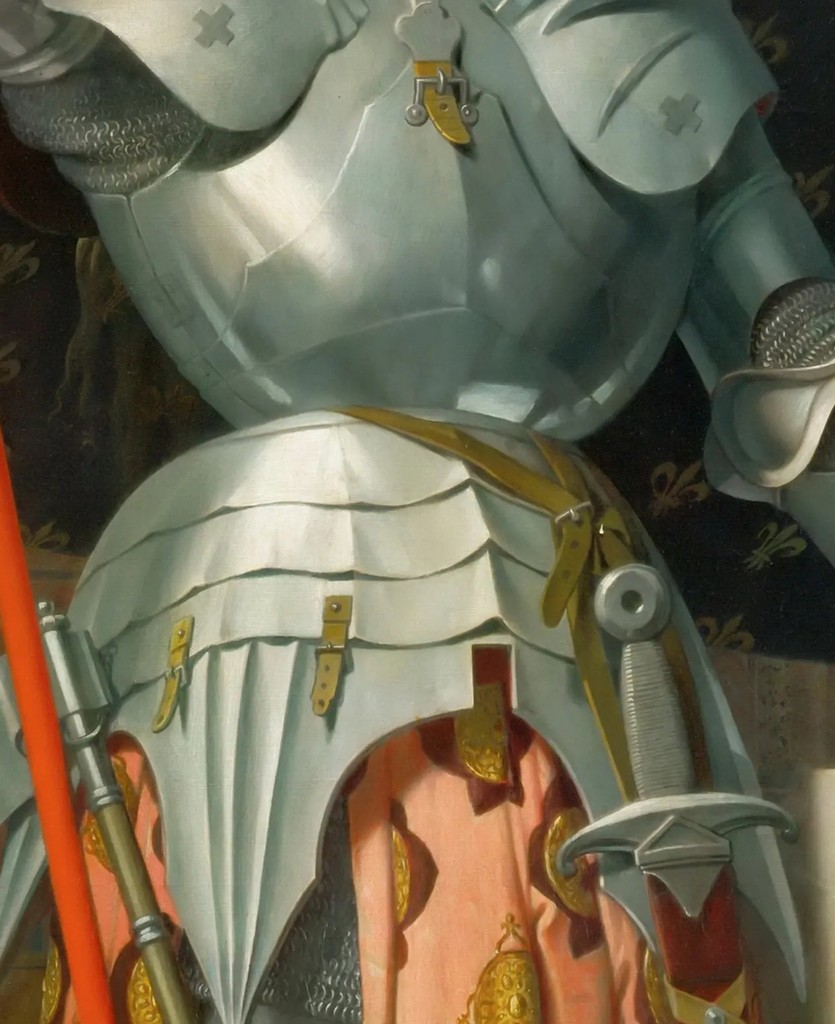
The breastplate is not a single white expanse. Broad pale reflections curve across its surface, while darker areas distinguish its rounded volume from the surrounding arms. At the waist, overlapping plates form a descending rhythm. The rounded shoulder pieces, elbow guards and knees repeat that rhythm on a smaller scale. Light moves across a body assembled from many separate surfaces.
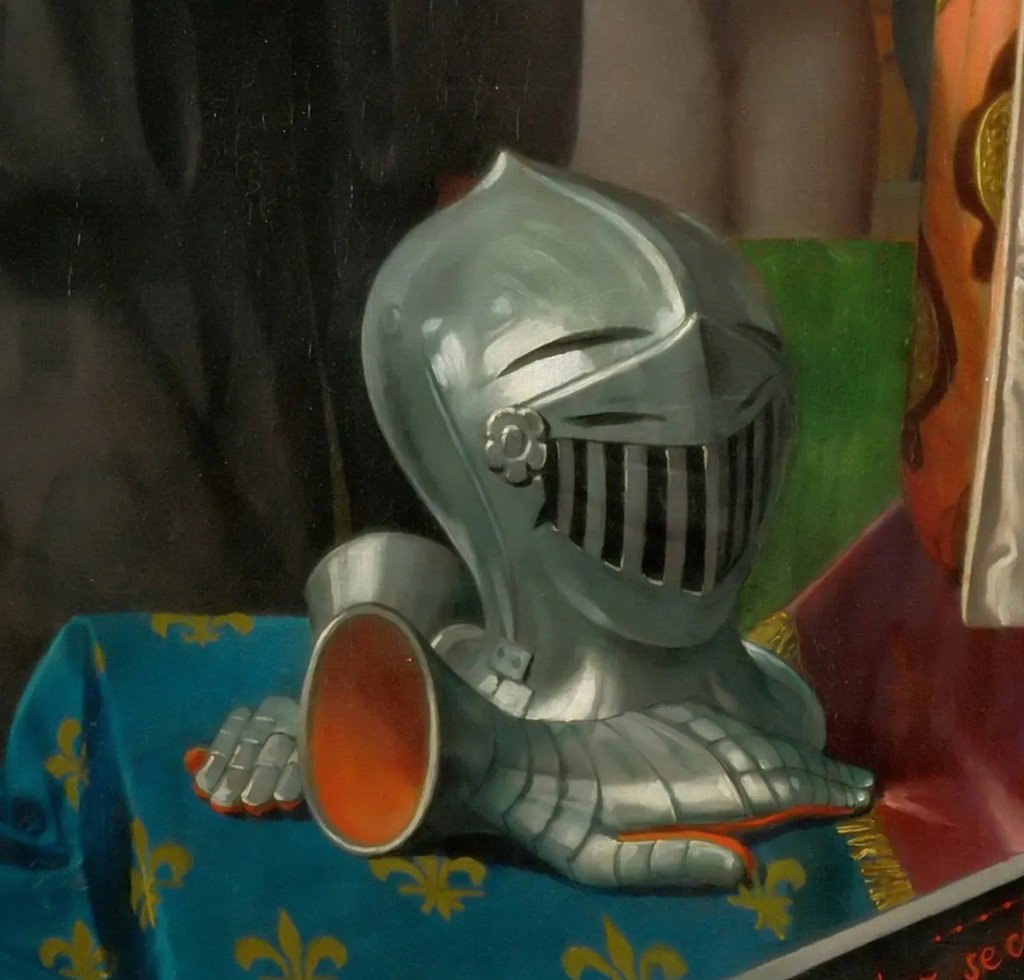
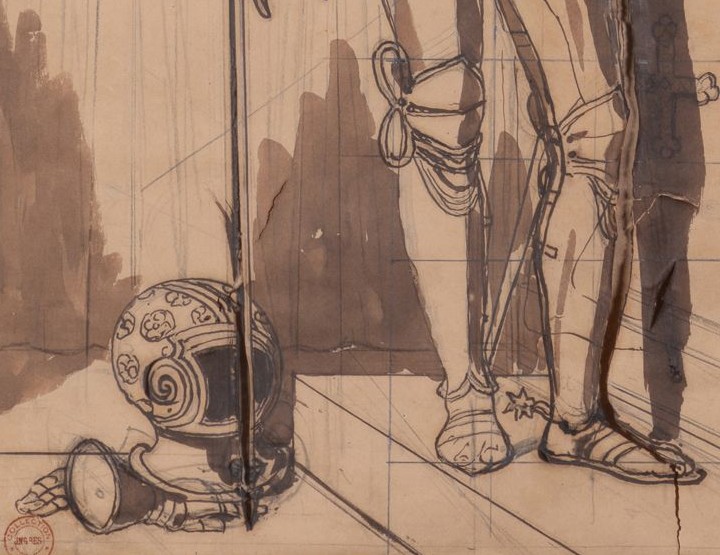
The helmet below Joan has a different task. Its dark openings and barred face contrast with the uncovered face above. Placed on the steps, it also allows us to see a piece of armour apart from the body it protects. The relationship is visual and immediate: one face is open to the light, while the other is an empty metal enclosure.
A sword hangs beside the skirt. Together with the staff and helmet, it keeps military equipment present throughout the picture, from the raised hand to the lowest steps. There is no fighting here. The equipment has entered a setting of prayer, decorated textiles and gold furnishings. Its hard outlines remain clear among these more intricate surroundings.
Polished surfaces also control attention. The broad breastplate catches the eye before its smaller joints do, and those smaller joints then encourage us to inspect the figure at closer range. Joan is legible at a distance and richly divided into details when we approach.
Pattern makes the stillness active
The pink-red skirt introduces a warmer colour beneath the steel. Its gold motifs stand out against the cloth, but the folds prevent them from becoming a flat, even decoration. Some face the light; others turn away or disappear between the armoured legs. The cloth makes the lower figure feel more complicated and less rigid than the breastplate above.
Gold appears across the picture in several forms: the skirt's ornaments, the halo, the objects on the altar and the fleur-de-lis on the blue covering below. These passages differ in scale and brightness. The narrow halo is easily overlooked; the altar's large decorative face demands attention. Repetition connects them without making each gold mark signify the same thing.
The altar is almost as insistent a shape as Joan. Its straight sides and repeated ornaments contrast with her curving armour. The line of the upper ledge passes beneath her hand, while the objects above it build a cluster of vertical accents on the right. On the left, the staff supplies a much longer vertical. Joan occupies the space between these two different arrangements of upright forms.
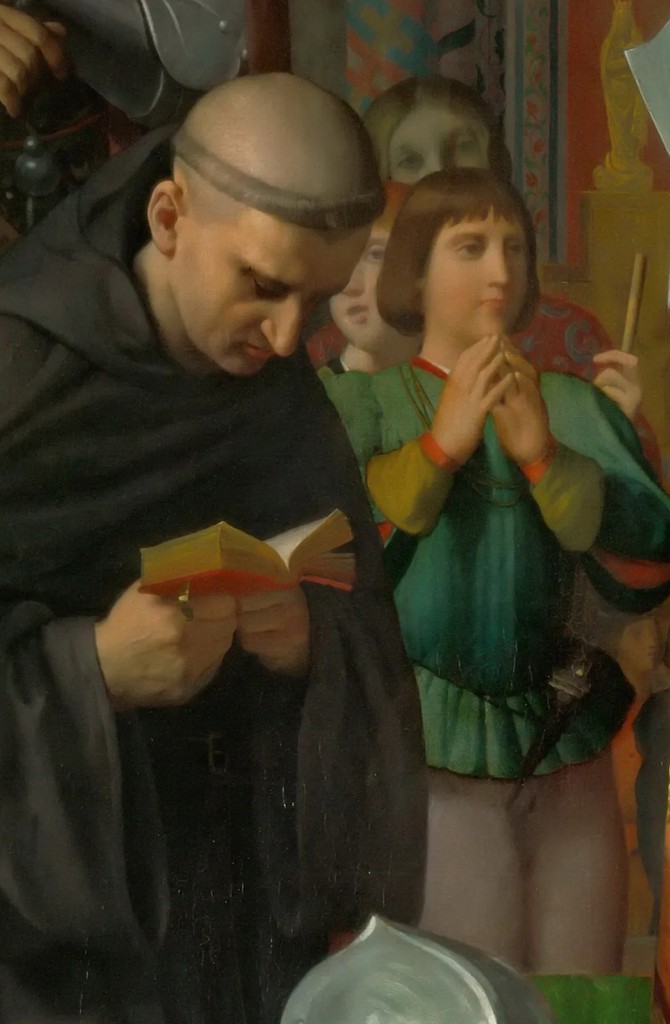
The attendants provide another contrast. The cleric bends over an open book; the younger figure holds hands together in prayer; the armoured figure at the far left stands partly obscured. Their smaller scale within the composition and their overlapping bodies make Joan's silhouette seem clearer. They also introduce several ways of attending to the same occasion. Reading, praying and watching surround the large, silent figure who looks upwards.
Annotated Details from Joan of Arc at the Coronation of Charles VII
The numbered points identify visible features discussed in this article. Return from each detail to the whole composition. Each caption identifies the work shown.
Joan of Arc at the Coronation of Charles VII
Jean-Auguste-Dominique Ingres, Joan of Arc at the Coronation of Charles VII, 1854. Oil on canvas, 240 × 178 cm. Musée du Louvre, Paris, MI 667. Wikimedia Commons. Image source. Public domain.
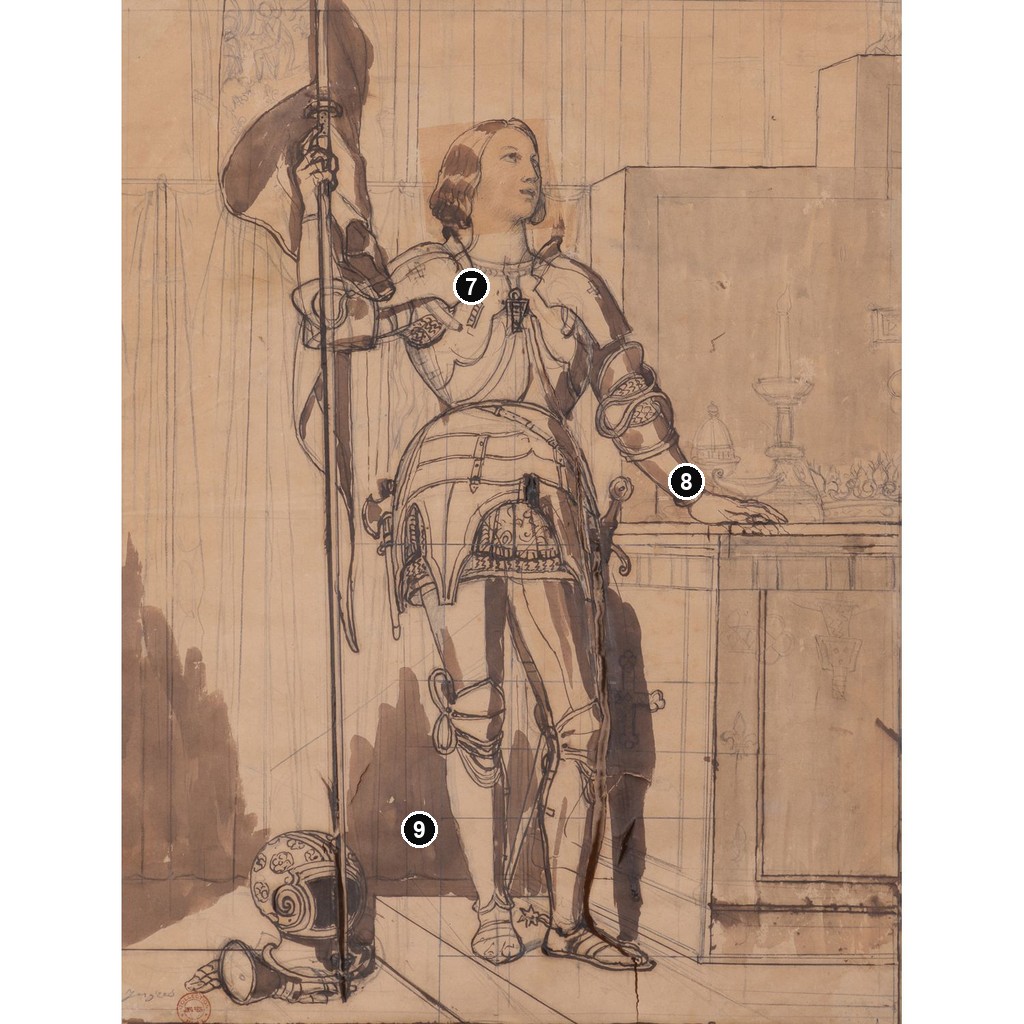
Joan of Arc — Haro Study
Joan of Arc study. MI.2023.1.1. A separate sheet from MI.867.1578. Piasa; Wikimedia Commons. Image source. Public domain.
Details from JOAN OF ARC AT THE CORONATION OF CHARLES VII
Compare the finished painting with the separate Haro study acquired by Montauban in 2023. Follow the upward face, hands, armour and floor details while keeping the two objects distinct.
Joan of Arc at the Coronation of Charles VII
The face and thin halo
The face turns upwards inside a fine circular halo. Dark patterned cloth behind the head makes its pale outline and small changes around the eyes particularly clear.
The hand around the red staff
Fingers close around the red staff beside pale hanging fabric. Follow the staff’s long direction through the picture before returning to the compact grip.
The hand resting beside the altar objects
The open hand lies flat near the edge of the altar, beside gold objects and a candle. This low, horizontal gesture balances the raised hand on the staff.
Overlapping plates across the armour
Several pale plates overlap across the waist above the patterned skirt. Their stepped lower edges and small fastenings break the torso into a sequence of differently shaped surfaces.
The reader and the praying child
A lowered head turns towards a small open book beside a child with joined hands. Their two different poses form a compact group beside the central standing figure.
The helmet and gauntlets set down below
The helmet and gloves lie on blue patterned cloth below Joan’s standing body. Their curved metal forms repeat the armour at a smaller scale near the floor.
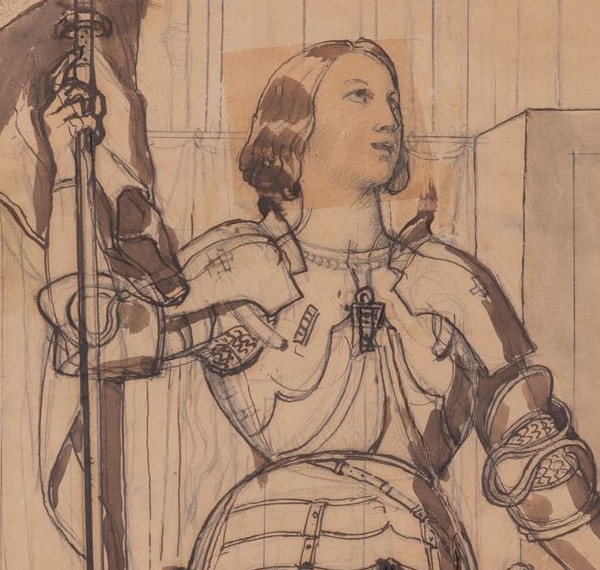
Joan of Arc — Haro Study
The lifted face and banner hand
Joan turns her face upwards while her raised hand closes around the upright banner shaft. The curved hair and articulated armour sit within long vertical construction lines.
The hand resting on the altar
The extended forearm leads to spread fingers resting along the altar edge. Dark outlines hold the hand against the straight horizontal ledge and the more lightly drawn objects behind it.
Armoured feet and the helmet
The pointed shoes stand beside the helmet on the floor. Curves within the helmet and the segmented leg armour contrast with the straight floor divisions beneath them.
From a printed illustration to a large painting
The composition had a life before the state commission. The Musée Ingres Bourdelle's records connect it with Ingres's contributions to Le Plutarque français between 1843 and 1846: full-length figures intended as frontispieces to biographies. A small armour study dated 1846, MI.867.1595, belongs to that preparation. [3]
A separate composition study in Montauban, MI.867.1578, is catalogued as 1854, in graphite and red chalk, measuring 40 × 34.5 cm. Its museum description identifies the addition of the skirt in red chalk and relates the design to the earlier illustration. It also states that the painting was already under way when the state commissioned it. [4]
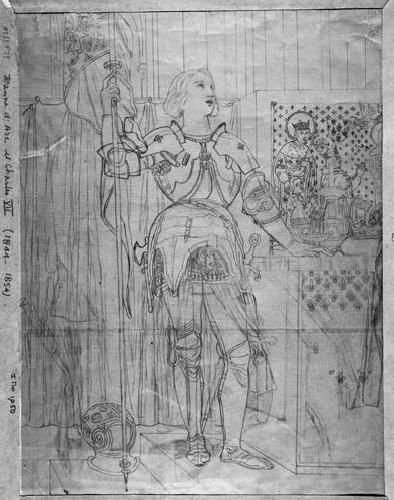
Ingres, Study for Joan of Arc at the Coronation of Charles VII, 1854. Graphite and red chalk on paper, 40 × 34.5 cm. Musée Ingres Bourdelle, MI.867.1578. Complete small grayscale reproduction. [5]
The skirt is conspicuous in the finished image, interrupting the succession of steel plates with a large area of warm, patterned colour. The documented addition helps us recognise how a decision about clothing could alter the balance of the whole figure. [4] The armour sheet and the composition study have different purposes: equipment in one, the overall arrangement in the other. They offer a specific instance of the varied preparations explored in Ingres's drawings. [3] [4]
A study that entered the museum in 2023
Another sheet joined the Musée Ingres Bourdelle in 2023. Study for Joan of Arc, MI.2023.1.1, measures 46 × 35 cm and uses graphite, black chalk and brown ink on wove paper. It bears the Haro collection stamp. This is a different object from the graphite-and-red-chalk composition study, MI.867.1578. [6]
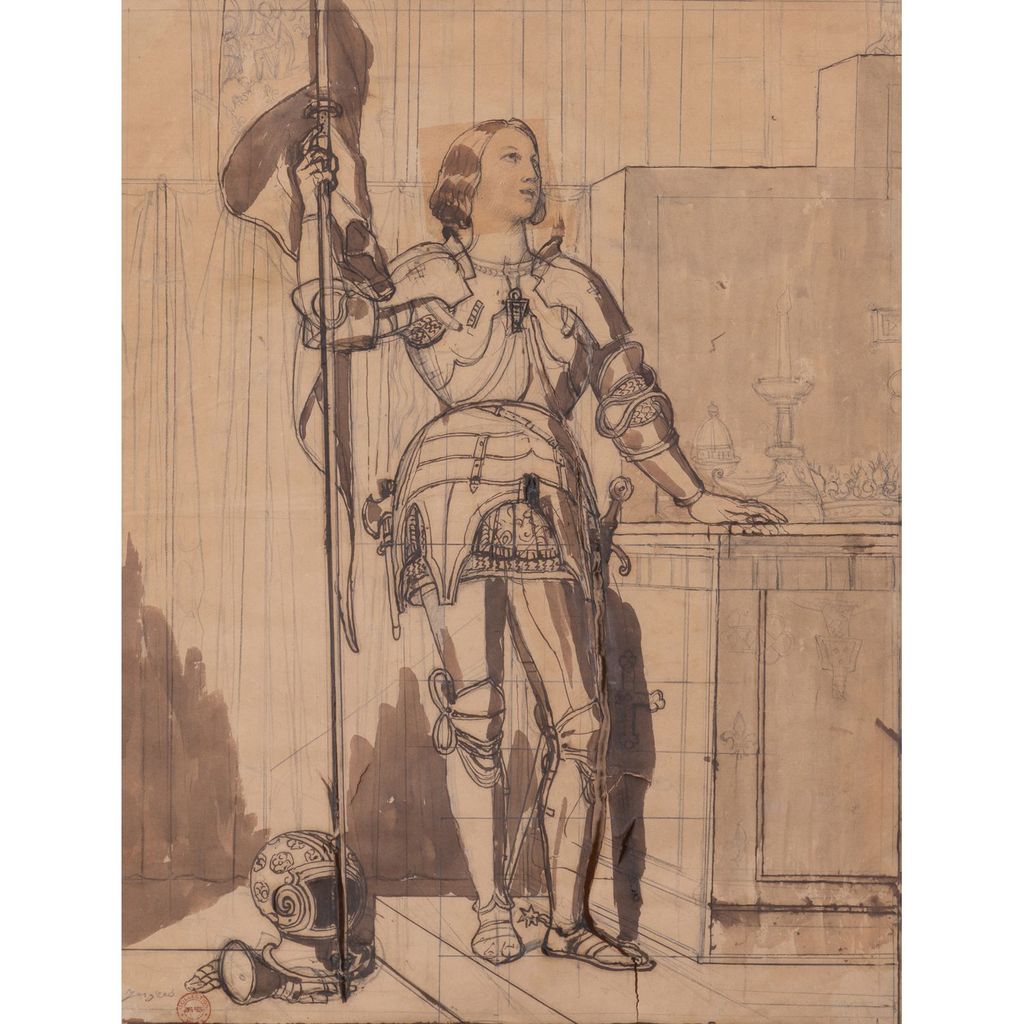
Ingres, Study for Joan of Arc. Graphite, black chalk and brown ink on wove paper, 46 × 35 cm. Former Haro collection; acquired by Musée Ingres Bourdelle in 2023, MI.2023.1.1. A separate sheet from MI.867.1578. [7]
The distinction is worth keeping because several drawings may be called a “study for Joan of Arc”. A title alone does not tell us whether we are discussing the same sheet, a detail or another stage in the composition. Here, the materials, dimensions and inventory numbers allow the two works to be identified separately.
Earlier testimony shows how widely the preparation had already dispersed. In his 1870 catalogue, Henri Delaborde recorded a first idea in pen belonging to Haro, a head study owned by Gustave Gruyer and another head owned by Albert Ramel. He said that Ingres had finished the Ramel study after completing the painting. [8] The account preserves evidence of several stages, including work continued after the canvas itself. It does not, by itself, establish that every drawing now associated with Joan can be matched to one of those nineteenth-century descriptions.
The artist among the attendants
Delaborde also supplied an unusually personal identification: he stated that Ingres represented himself as Joan's squire. [8] The armoured attendant at the far left is thus more than an anonymous supporting figure in this early account. The claim comes from a writer publishing shortly after the artist's death, and deserves to remain attached to that testimony.
Within the composition, the attendant's position is modest but purposeful. His face appears close to the left edge, below the raised hand and beyond the banner staff. He looks into the scene while Joan looks above it. Her bright armour dominates; his darker equipment merges more readily into the background. Read with Delaborde's identification, this becomes a striking placement of the painter as an attendant to the heroine he has brought before us.
The identification does not require us to invent a conversation between artist and subject or a reason for the choice of disguise. Its visual interest is sufficient. The painter's reported presence remains at the edge of a picture whose centre belongs to Joan.
The making of the canvas also involved people beyond Ingres. Georges Vigne, in his study of the workshop, identifies the participation of the Balze brothers. He also discusses a later copy for Orléans by Pichon, whose variations suggest Ingres's oversight. The extent of the collaborators' contributions to the painting remains uncertain. [9]
This evidence adds another dimension to the word “Ingres” on a museum label. It can name the artist responsible for the composition and its direction while leaving open questions about individual passages of execution. The evidence does not allow us to distribute particular pieces of armour, faces or textiles among the assistants. Looking closely can reveal the painting's varied demands without supplying an undocumented division of labour.
A public image of devotion
The Louvre records a state commission in 1851, an exhibition at Orléans during the Joan of Arc celebrations in 1854 and a subsequent appearance at the Universal Exhibition of 1855. [1] These dates distinguish the commission, the completed painting and its major Paris showing. The picture already had a public association with the city of Joan's military achievement before the 1855 exhibition.
Reproduction extended its reach. Delaborde noted an outline engraving in the publication issued by Magimel. [8] An outline reproduction removes much of what is immediately sumptuous here: the pink and blue cloth, the shaded steel, the different weights of gold. Yet it can preserve the main relationships between staff, arms, head and altar. The strong arrangement that makes the colour painting readable also permits another kind of image to carry its composition.
A useful comparison is The Vow of Louis XIII. There, the kneeling king raises his arms towards the Virgin and Child in an opening above him. In Joan of Arc, the upward turn is more contained. Joan stands close to us, and the object of her gaze remains beyond the visible scene. One painting opens a great vertical distance between worshipper and apparition; the other concentrates devotion in the relationship between a face, a raised arm and a resting hand.
Return finally to the helmet on the steps. Its presence keeps the military body in view even as Joan's uncovered head and upward eyes draw attention elsewhere. The painting's stillness depends on such relationships: a closed metal face below an open human face, a hard staff beside pliant cloth, a hand gripping above and a hand resting below. Ceremony gives these contrasting objects a shared setting, while Joan gives them a human centre.

Ingres, The Vow of Louis XIII, 1824. [10]
Artworks directory
Explore 150 paintings, drawings and an original lithograph. This selection includes related versions and studies; dates distinguish completed works from later revisions.
| Name | Date | Medium |
|---|---|---|
| The Apotheosis of Homer | 1827 | Painting |
| Grande Odalisque | 1814 | Painting |
| The Turkish Bath | 1859–1862 | Painting |
| Madame Moitessier Seated | 1856 | Painting |
| Portrait of Monsieur Bertin | 1832 | Painting |
| Napoleon I on His Imperial Throne | 1806 | Painting |
| Odalisque with Slave | 1839 | Painting |
| The Ambassadors of Agamemnon in the Tent of Achilles | 1801 (competition) | Painting |
| The Valpinçon Bather | 1808 | Painting |
| The Source | 1856 | Painting |
| Oedipus Explaining the Enigma of the Sphinx | 1808; revised probably before 1827 | Painting |
| The Vow of Louis XIII | 1824 | Painting |
| Antiochus and Stratonice | 1840 | Painting |
| The Comtesse d’Haussonville | 1845 | Painting |
| The Princesse de Broglie | 1851–1853 | Painting |
| Jupiter and Thetis | 1811 | Painting |
| The Dream of Ossian | 1813 | Painting |
| The Martyrdom of Saint Symphorian | 1834 | Painting |
| Venus Anadyomene | 1808–1848 | Painting |
| Portrait of Madame de Senonnes | 1814 | Painting |
| Madame Rivière | 1805 | Painting |
| Mademoiselle Caroline Rivière | 1805 | Painting |
| Portrait of Philibert Rivière | 1805 | Painting |
| Bonaparte First Consul | 1804 | Painting |
| The Death of Leonardo da Vinci | 1818 | Painting |
| Joan of Arc at the Coronation of Charles VII | 1854 | Painting |
| Madame Duvaucey | 1807 | Painting |
| La Belle Zélie | 1806 | Painting |
| Madame Panckoucke | 1811 | Painting |
| Portrait of Charles Marcotte d’Argenteuil | 1810 | Painting |
| Joseph Antoine Moltedo | c.1810 | Painting |
| Madame Leblanc | 1823 | Painting |
| Delphine Ingres-Ramel (Portrait of Madame Ingres) | 1859 | Painting |
| Portrait of Amédée de Pastoret | 1823–1826 | Painting |
| Portrait of Baronne de Rothschild | 1848 | Painting |
| Madame Marcotte de Sainte Marie | 1826 | Painting |
| Madame Gonse | 1852 | Painting |
| Aretino in the Studio of Tintoretto | 1848 | Painting |
| Don Pedro of Toledo Kissing Henry IV’s Sword | 1831/1832 | Painting |
| Raphael and La Fornarina | 1814 | Painting |
| Roger Freeing Angelica | 1819 | Painting |
| Romulus’ Victory over Acron | 1812 | Painting |
| Self-Portrait at the Age of Twenty-Four | 1804; revised 1841–1851 | Painting |
| Male Torso | c.1800 | Painting |
| Odalisque in Grisaille (Ingres and workshop) | c.1824–1834 | Painting |
| The Small Bather | 1826 | Painting |
| The Little Bather Harem Interior | 1828 | Painting |
| Jesus Among the Doctors | 1862 | Painting |
| The Virgin Adoring the Host | 1852 | Painting |
| The Virgin of the Host | 1841 | Painting |
| Virgin of the Adoption | 1858 | Painting |
| Paolo and Francesca | 1814 | Painting |
| Homer Deified (revised composition, Louvre RF5273) | 1865 | Drawing |
| Odalisque with Slave (Louvre RF4622) | 1858 | Drawing |
| Odalisque (Walters Art Museum; Ingres and Paul Flandrin) | 1842 | Painting |
| Madame Moitessier Standing (National Gallery of Art) | 1851 | Painting |
| Jacques-Louis Leblanc (The Metropolitan Museum of Art) | 1823 | Painting |
| Ferdinand-Philippe, Duke of Orléans (Louvre RF2005-13) | 1842 | Painting |
| Ferdinand-Philippe, Duke of Orléans (Versailles MV5207; Ingres and workshop) | 1843 | Painting |
| Ferdinand-Philippe, Duke of Orléans (Versailles MV5209; Ingres and workshop) | 1844 | Painting |
| Antiochus and Stratonice (Musée Fabre; Ingres and Raymond Balze) | 1866 | Painting |
| Antiochus and Stratonice (Kunstmuseum Bern, Gurlitt bequest) | Undated (early dating proposed) | Drawing |
| Composition study for Antiochus and Stratonice (MIB867.2193) | 1806 | Drawing |
| Study for the Figure of Stratonice (Met63.66) | 1834–1840 | Graphite, black chalk and charcoal |
| Nude figure study for Stratonice (Boijmans F II 36 PK) | c.1834–1840 | Drawing |
| Paolo and Francesca (The Barber Institute,54.6) | c.1814–1820 | Painting |
| Paolo and Francesca (The Hyde Collection,1971.24) | c.1855–1860 | Painting |
| Paolo and Francesca (Amsterdam Museum TA10970) | 1820 | Drawing |
| Paolo and Francesca (dedicated to Artaud de Montor) | 1816 | Drawing |
| Study for the Bust of Francesca (MIB867.1398) | 1819 | Drawing |
| Study for the Bust of Francesca (MIB867.1396) | 1819 | Drawing |
| The Archangel Raphael, first idea (MIB867.2488) | 1842 | Drawing |
| The Archangel Raphael (MIB867.2500) | 1842 | Drawing |
| The Archangel Raphael Carrying Human Prayers to God (Chantilly DE513) | 1844 | Drawing |
| Louis-Philippe as Saint Philip, stained-glass study | 1844 | Drawing |
| Marie Frédéric Eugène de Reiset (Ford Collection RBF171-2) | 1844 | Drawing |
| Virgil Reading the Aeneid (Toulouse) | Begun 1811 | Painting |
| Tu Marcellus Eris (Brussels, inv. 1836) | c.1814 (museum dating) | Painting |
| Jean-François Gilibert | 1804 | Painting |
| François-Marius Granet | 1807 (museum dating) | Painting |
| Count Nikolai Dmitrievich Guryev | 1821 | Painting |
| Caroline Murat, Queen of Naples | 1814 | Painting |
| Count Mathieu Molé | 1834 | Painting |
| Cherubini and the Muse of Lyric Poetry (Louvre) | 1842 | Painting |
| Luigi Cherubini (Cincinnati) | 1841 | Painting |
| Comtesse de Rayneval (Louvre RF4505) | 1841 | Drawing |
| Venus on Paphos (Antonie Balaÿ) | c.1852 | Painting |
| Prince Napoléon | 1855 | Painting |
| Study for The Apotheosis of Napoleon I (Petit Palais) | Late 1853 | Painting |
| The Apotheosis of Napoleon I (destroyed ceiling) | 1853 | Painting |
| The Journalist (MIB867.2733) | 1834? | Drawing |
| Henry VIII, after Holbein | c.1815–1820 (?) | Drawing |
| Madame Récamier, after David (MIB867.3637) | Undated (early Paris period) | Drawing |
| Study for Comtesse d’Haussonville (MIB867.259; background possibly by another hand) | 1842–1845 | Drawing |
| La Source (reduced version reported by Delaborde) | Date unrecorded; reported 1870 | Painting |
| Odalisque (autograph lithograph,NGA1946.21.117) | 1825; published1826 | Lithograph |
| Portrait of a Seated Lady | 1814 | Graphite |
| The Kaunitz Sisters (Leopoldine, Caroline, and Ferdinandine) | 1818 | Graphite |
| Portrait of a Man | 1814 | Graphite |
| Study for the Portrait of Louis-François Bertin (1766–1841) | n.d. | Black chalk and graphite |
| Studies for the Cadaver of Acron | ca. 1810–12 | Graphite on wove paper |
| Study for the Drapery of Molière in "The Apotheosis of Homer" | n.d. | Black chalk with stumping |
| Madame Guillaume Guillon Lethière, née Marie-Joseph-Honorée Vanzenne, and her son Lucien Lethière | 1808 | Graphite |
| Niccolò Paganini (1782–1840) | ca. 1830 | Counterproof or tracing strengthened with graphite and gouache on translucent paper |
| Lady Mary Cavendish-Bentinck (?-1843) | 1816 | Graphite |
| Madame Alexandre Lethière and Her Daughter Letizia | ca. 1815 | Graphite |
| Merry Joseph Blondel (1781–1853) | 1809 | Graphite |
| Ursin-Jules Vatinelle (1798–1881) | 1820 | Graphite |
| Bust of a Gypsy Girl (ascribed to Ingres) | 1819 | Graphite on wove paper |
| Study of a Seated Nude Male | n.d. | Graphite |
| The Archangel Raphael (Study for a stained-glass window in the chapel of Notre-Dame de la Compassion-Saint-Ferdinand, Neuilly) | ca. 1842 | Graphite |
| Lancelot-Théodore, comte Turpin de Crissé | probably 1818 | Graphite |
| Study for the Figure of the Iliad in "The Apotheosis of Homer" | ca. 1827 | Graphite and black chalk heightened with white chalk on brown paper |
| Comtesse Turpin de Crissé | probably 1818 | Graphite |
| Nude Figures for L'Âge d'Or, Château de Dampierre | n.d. | Graphite on brownish paper |
| Study of Figures (attributed to Ingres) | n.d. | Graphite |
| Study of Figures (attributed to Ingres) | n.d. | Graphite; squared in graphite |
| Admiral Sir Fleetwood Broughton Reynolds Pellew | 1817 | Graphite on wove paper |
| Madame Jean-Auguste-Dominique Ingres, née Madeleine Chapelle | 1814 | Graphite on off-white wove paper |
| Virgil Reading the Aeneid to Augustus, Livia, and Octavia | 1809/1819 (?) | Pen and black ink, graphite, brush and gray wash, white gouache heightening, Conté crayon on blue paper |
| General Louis-Étienne Dulong de Rosnay | 1818 | Graphite (hard and soft pencils) |
| Madame Alexandre Lethière, née Rosa Meli, and Her Daughter, Letizia | 1815 | Graphite |
| The Lawyer Paul Grand | 1834 | Graphite |
| Jean-Joseph Fournier | 1815 | Graphite |
| Armand Bertin | 1842 | Graphite |
| Madame Armand Bertin, née Marie-Anne-Cécile Dollfuss | 1843 | Graphite |
| The Architect Charles-Victor Famin | 1836 | Graphite |
| Henri Lehmann | 1850 | Graphite |
| Portrait of a Lady | ca. 1815–17 | Graphite |
| Edmond Cavé (1794–1852) | 1844 | Oil on canvas |
| Head of Saint John the Evangelist | probably ca. 1818–20 | Oil on canvas, laid down on wood |
| Madame Edmond Cavé (Marie-Elisabeth Blavot, ca. 1806–1883) | ca. 1831–34 | Oil on canvas |
| Madame Félix Gallois | 1852 | Graphite with touches of gold in oil to highlight jewelry, on buff wove paper. |
| Dr. François Mêlier | 1849 | Graphite with graphite framing lines, corrected with white, on buff wove paper |
| Portrait of Madame Rhode (Rhoda?) | 1810–20 | Graphite on pale buff wove paper |
| Study for "Raphael and the Fornarina"(?) | ca. 1814(?) | Graphite on white wove paper |
| Portrait of Madame Paul Meurice, née Palmyre Granger | ca. 1845–50 | Graphite on wove paper |
| Alexander the Great presenting Campaspe to Apelles | 1810 | Graphite, brush and brown wash; squared in graphite |
| Study of Hands for "Christ Among the Doctors" | 1852–62 | Graphite on tracing paper |
| Study for The Turkish Bath (RF34502) | about 1850 | Pen and brown ink with graphite, partially squared |
| Study for The Turkish Bath (RF23354) | Undated | Pen and brown ink with graphite on joined sheets |
| Study for The Turkish Bath (RF54702) | about 1859 | Pen and brown ink |
| Studies of women for The Turkish Bath (RF12292) | Undated | Black chalk |
| Achilles Receiving the Envoys of Agamemnon (Nationalmuseum sketch, NM2161) | 1801 | Oil on wood |
| Half-Length Bather (Musée Bonnat-Helleu,89) | 1807 | Oil on canvas |
| Oedipus and the Sphinx (National Gallery,NG3290) | about1826 | Oil on canvas |
| Oedipus and the Sphinx (Walters,37.9) | 1864 | Oil on canvas |
| Oedipus and the Valpinçon Bather, after David (MI.867.2035) | Undated | Graphite on tracing paper, after David |
| Study of the Virgin for The Vow of Louis XIII (Dijon,1758) | about1822 | Black chalk, stump and white chalk on brown wove paper |
| First Thought for The Vow of Louis XIII (MI.885.11.21) | 1822 | Oil on canvas |
Frequently Asked Questions
It is signed and dated 1854. The 1855 date refers to its appearance at the Universal Exhibition. [1]
The scene concentrates on her presence beside the altar. Her full-length figure, pale face and bright armour dominate, while the king's crowning takes place outside the view Ingres gives us.
According to Henri Delaborde's 1870 account, he represented himself as Joan's squire. That identification is historical testimony rather than a conclusion based only on resemblance. [8]
Follow the red staff to the raised hand, then move across the armour to Joan's face. Compare that upward movement with the quieter hand resting on the altar.
Discussion
Look again at the images and ideas explored in Joan of Arc at the Coronation of Charles VII. These editorial prompts invite your observations.
Reader Insights
Does Joan's raised arm and upward gaze first draw your attention away from the altar, or does her resting hand bring you back to it? Follow each route through the picture and consider how it changes the balance between military presence and prayer.
Compare the reflective armour with the large areas of cloth. How does each surface help establish Joan’s place in the scene?
Which details make her an active military presence, and which draw the picture towards prayer and commemoration?
Join the Conversation
Share a detail, comparison or question about Joan of Arc at the Coronation of Charles VII below.
References
- Musée du Louvre, Jeanne d'Arc au sacre du roi Charles VII, dans la cathédrale de Reims. Collection record MI 667, updated 9 February 2024; description, signature, material characteristics and historical information. (in French) View source.
- Cité royale de Loches, Département de Touraine, Jeanne d'Arc. Historical biography, paragraphs on Orléans, the journey to Reims and the execution at Rouen. (in French) View source.
- Rose Fernandes, Musée Ingres Bourdelle / Ministère de la Culture, Joconde, Eléments d'une armure du XVe siècle. MI.867.1595, notice 06070008077, updated 4 September 2026; creation, history, materials and dimensions. (in French) View source.
- Rose Fernandes, Musée Ingres Bourdelle / Ministère de la Culture, Joconde, Jeanne d'Arc au sacre de Charles VII (Ensemble de la composition). MI.867.1578, notice 06070004126, updated 4 September 2026; history, materials and dimensions. (in French) View source.
- Supporting image. Ingres, Study for Joan of Arc at the Coronation of Charles VII, 1854. Graphite and red chalk on paper, 40 × 34.5 cm. Musée Ingres Bourdelle, MI.867.1578. Complete small grayscale reproduction. Wikimedia Commons. Image source. Public domain.
- Musée Ingres Bourdelle, Etude dessinée pour Jeanne d'Arc. MI.2023.1.1, 2023 accession; collection record updated 6 August 2026, materials, measurements and Haro stamp. Record also reproduces the Piasa sale catalogue text of 1 March 2023. (in French) View source.
- Supporting image. Joan of Arc study. MI.2023.1.1. A separate sheet from MI.867.1578. Piasa; Wikimedia Commons. Image source. Public domain.
- Henri Delaborde, Ingres, sa vie, ses travaux, sa doctrine, d'après les notes manuscrites et les lettres du maître. Paris: Henri Plon, 1870, catalogue no. 52, p. 225; squire identification, head studies, Haro drawing and Magimel reproduction. Posthumous account. (in French) View source.
- Georges Vigne, “Ingres and Co.: A Master and His Collaborators”, in Gary Tinterow and Philip Conisbee, eds, Portraits by Ingres: Image of an Epoch. New York: The Metropolitan Museum of Art, 1999, p. 536; Balze participation and Pichon's copy. View source.
- Supporting image. Ingres, The Vow of Louis XIII, 1824. Montauban Cathedral; Wikimedia Commons. Image source. Public domain.
- Splash image. Jean-Auguste-Dominique Ingres, Joan of Arc at the Coronation of Charles VII, 1854. Oil on canvas, 240 × 178 cm. Musée du Louvre, Paris, MI 667. Wikimedia Commons. Image source. Public domain.