


 by Tom Gurney
Tom Gurney BSc (Hons) is an art history expert with over 20 years experience
Published on June 19, 2020 / Updated on October 22, 2026
Email: tomgurney1@gmail.com / Phone: +44 7429 011000
The Turkish Bath
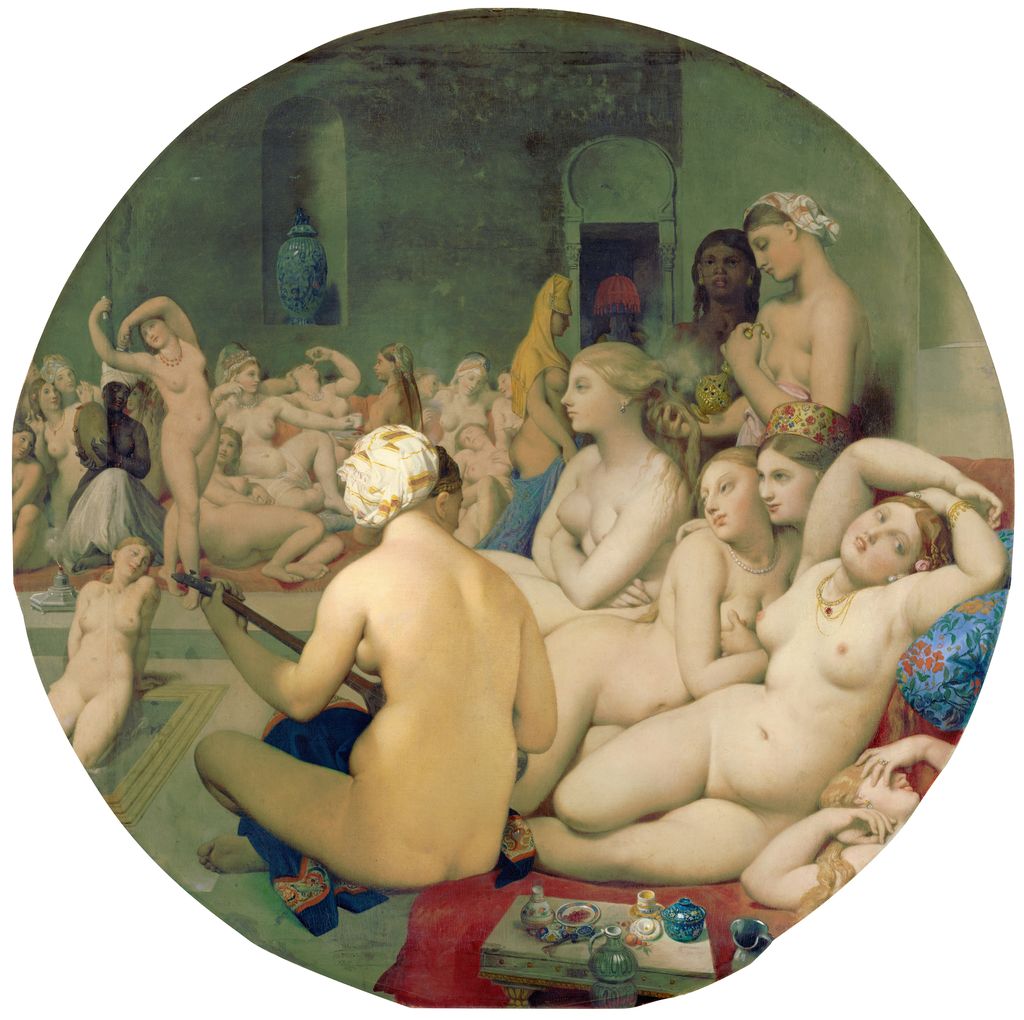
The broad back of a seated musician holds together an almost impossibly crowded room. Around her, women recline, dance, touch, turn and disappear behind one another; along the curved edge, bodies seem to continue beyond our sight. In The Turkish Bath, Ingres made a whole gathering out of the poses that had occupied him for decades. Its abundance is carefully constructed. Follow a shoulder, an elbow or a bent knee, and the apparent confusion begins to resolve into linked curves.
The painting combines a late act of revision with a much longer history of invention: an earlier rectangular composition, a familiar bather transformed into a musician, drawings assembled and reconsidered, and a traveller's account of Ottoman women read at a distance. Understanding those layers changes how we see the apparently self-contained circle. [1][2]
At a Glance
- ArtistJean-Auguste-Dominique Ingres.
- Date1862; a rectangular state was painted in 1859.
- MediumOil on canvas glued to wood.
- SizeApproximately 108 cm in diameter.
- CollectionMusée du Louvre, Paris; inventory RF 1934.
- FormatA tondo, or circular painting.
- Key connectionThe foreground musician reworks the back-facing figure familiar from The Valpinçon Bather. [1][2][3]
This work across Ingres’s career
Agamemnon’s Ambassadors
1801 (competition)Grande Odalisque
1814Louis XIII’s Vow
1824Monsieur Bertin
1832The Princesse de Broglie
1851–1853The Turkish Bath (current article)
1859–1862Contents
- Finding a way through the circle
- How a rectangular painting became a tondo
- A lifetime of bodies, rearranged
- What the drawings reveal about making a crowd
- Lady Mary Wortley Montagu's bath: an encounter transformed
- An imagined interior and an unequal view
- From a prince's collection to the Louvre
- A late work that invited further looking
- Annotated details
Finding a way through the circle
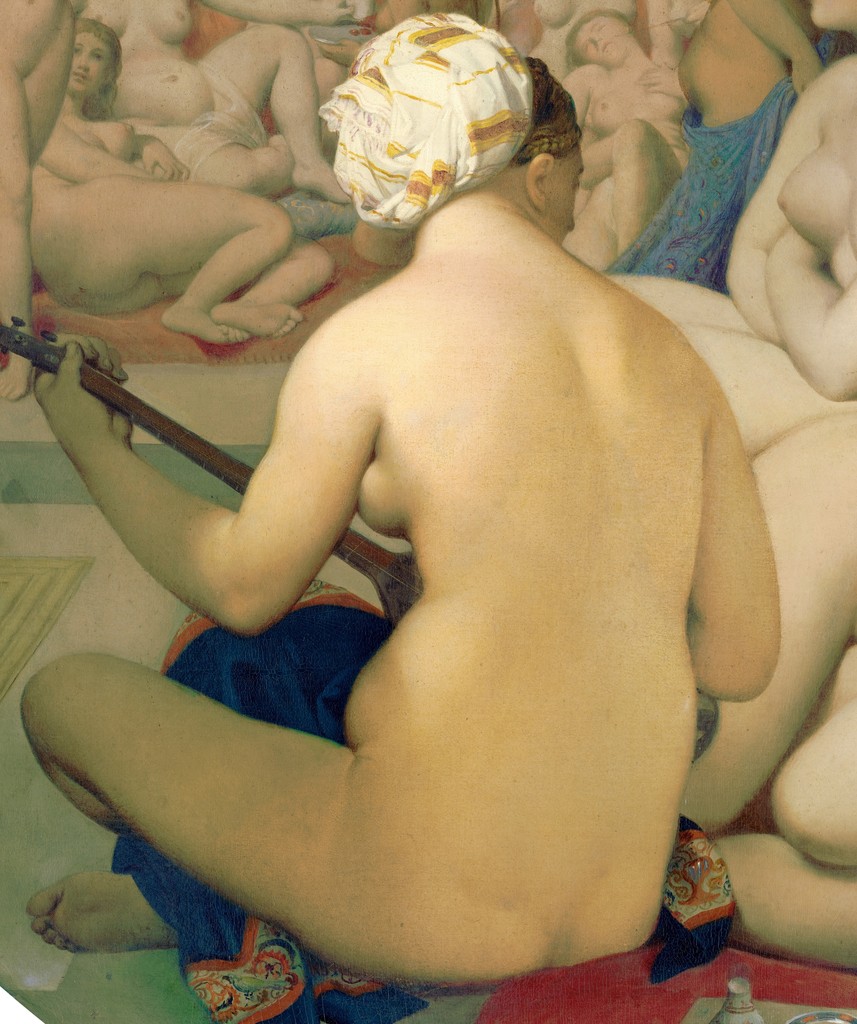
Begin with the musician, slightly left of centre. Her face is turned away, her white and gold headcloth gathered into a rounded shape above the long slope of her neck. Light spreads across her back with few abrupt interruptions. Her bent leg carries the curve towards the lower left, while the neck of her stringed instrument points sideways into the gathering. She anchors the foreground without facing us or inviting a portrait-like exchange.
That back provides a place for the eye to rest. Elsewhere, the painting offers skin in much smaller pieces: a cheek between shoulders, a forearm above a head, a breast partly hidden by another body. Against those fragments, the musician's torso is unusually continuous and legible. Her dark blue cloth sharpens the silhouette where she sits. She feels physically close, yet remains separate from us through the simple refusal of a face.
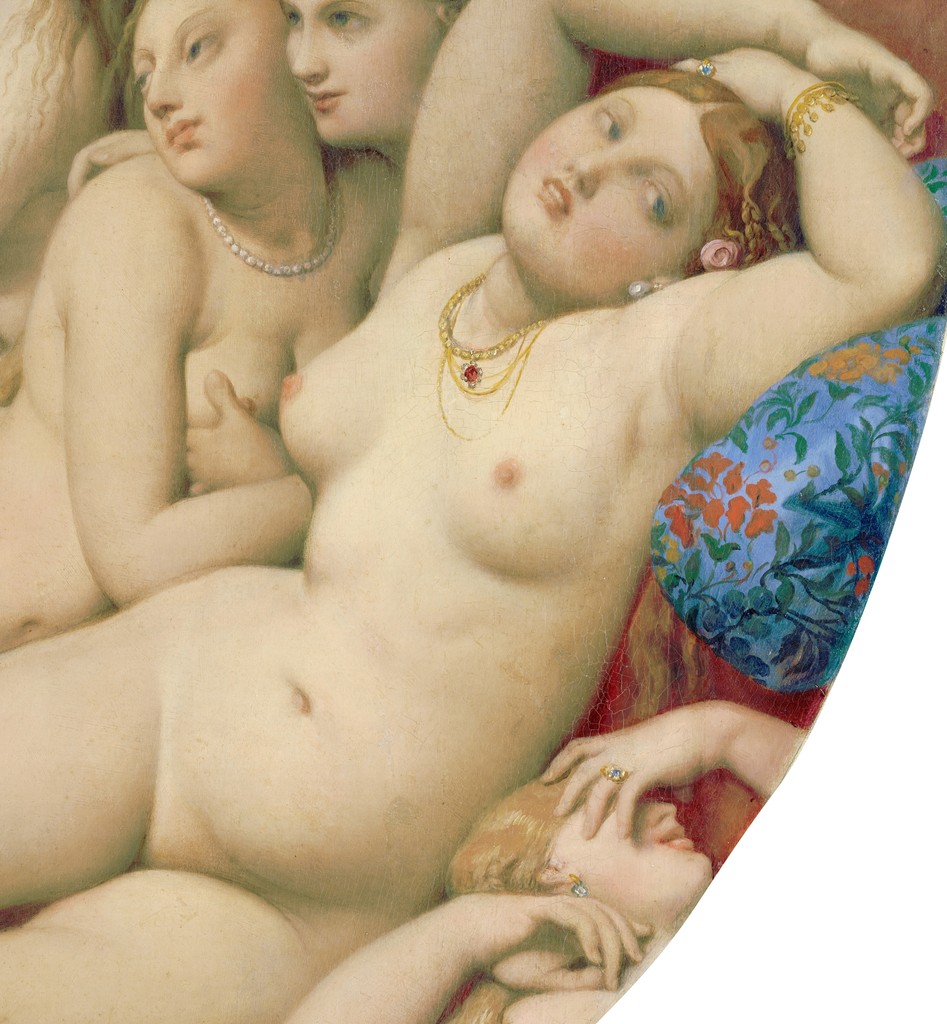
Move right from her shoulder. A fair-haired woman sits in profile, her hair falling through the fingers of a standing companion behind her. Farther right, a reclining woman raises her arms around her head. The bright blue floral cushion beneath her and the red fabric behind her make this group especially prominent. The lifted elbows form a loose enclosure around the head, answering the larger enclosure of the painting's perimeter.
The grouping is intimate, but difficult to untangle immediately. Arms cross, heads lean close and one pale body overlaps the next. Ingres gives enough contact to establish a relationship without making the whole arrangement easy to reconstruct as a set of people occupying measurable floor space. Looking becomes a repeated act of recognition: this contour belongs to a shoulder, that line turns out to be a thigh, this hand belongs to someone partly concealed.
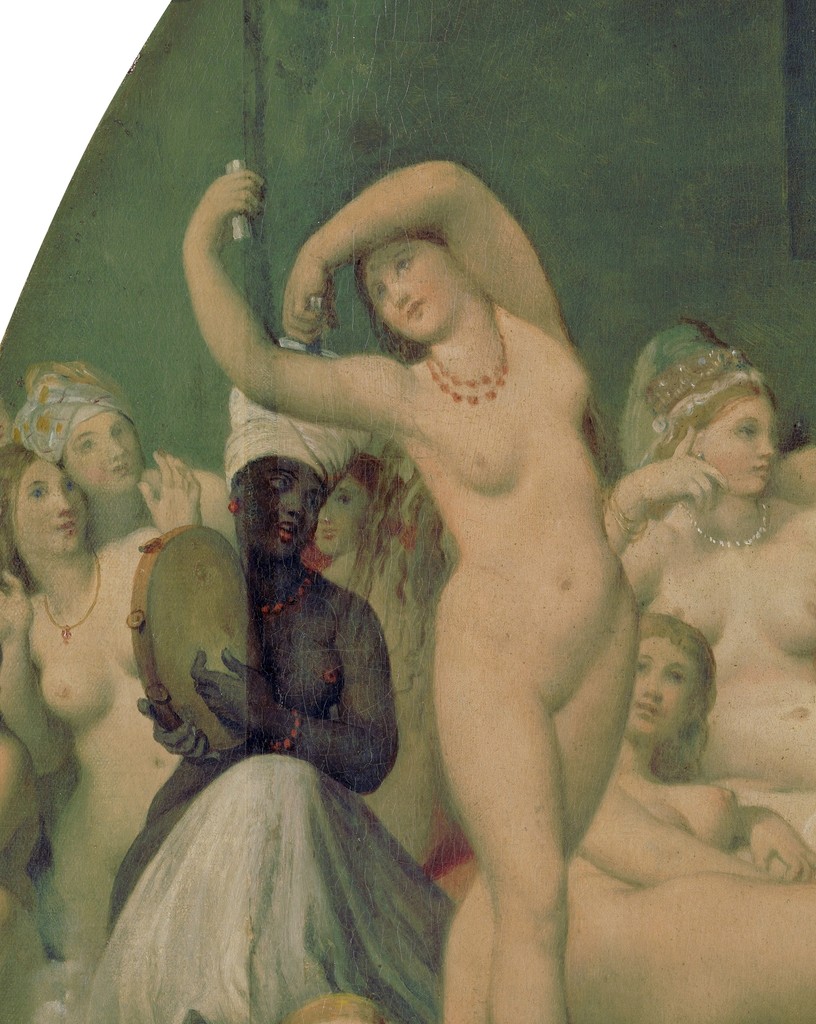
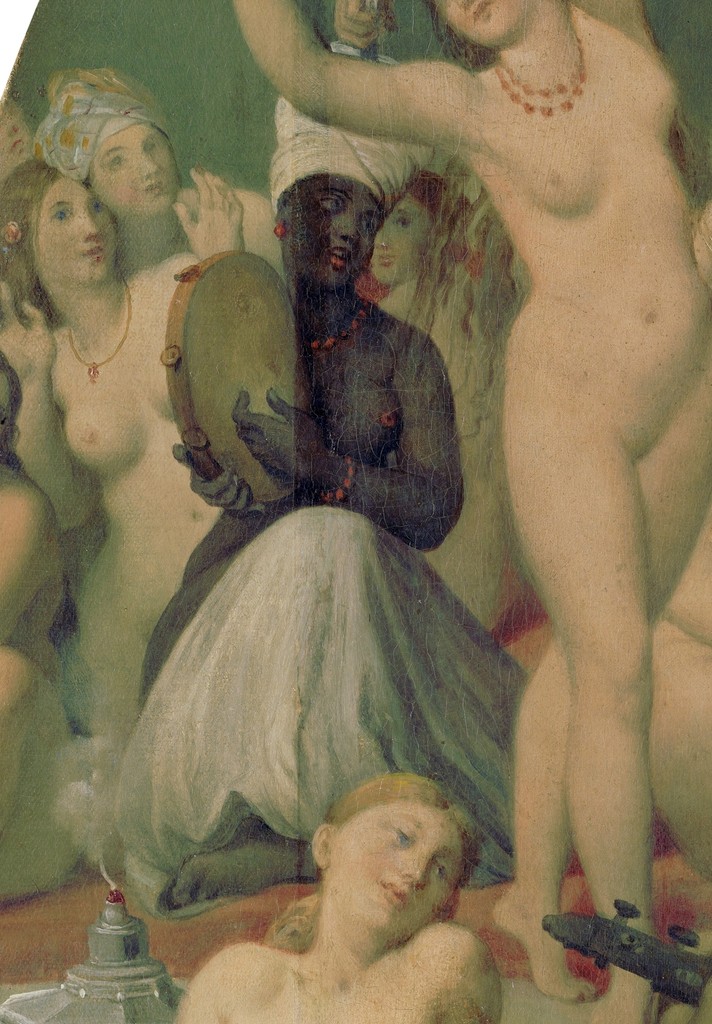
At the left, the scene opens into movement. A standing dancer lifts her arms, making a higher, more angular version of the reclining woman's pose on the opposite side. Nearby, a darker-skinned seated musician holds a percussion instrument. Small heads gather along the edge, while a reclining body stretches across the middle distance. These figures have their own activities, but they also carry the eye back towards the main seated back. The room is full of implied sound; visually, the large foreground figure remains remarkably still.
The yellow-covered head near the centre creates another pause. Its upright shape interrupts the pale horizontal and diagonal bodies around it. Higher up, the green wall, recessed niches and blue vessel offer a quieter register. They establish an interior without giving us a comprehensive plan of it. We can identify surfaces and openings, but we cannot confidently walk through the room in our imagination.
Bodies that make their own space
Overlapping is the principal way Ingres creates depth. A figure in front hides part of another behind; a row of smaller heads suggests greater distance. Yet those familiar cues are crowded together so insistently that they also flatten the gathering into a patterned surface. The foreground feels near, the distant wall feels enclosed, and the middle is packed with bodies rather than open intervals.
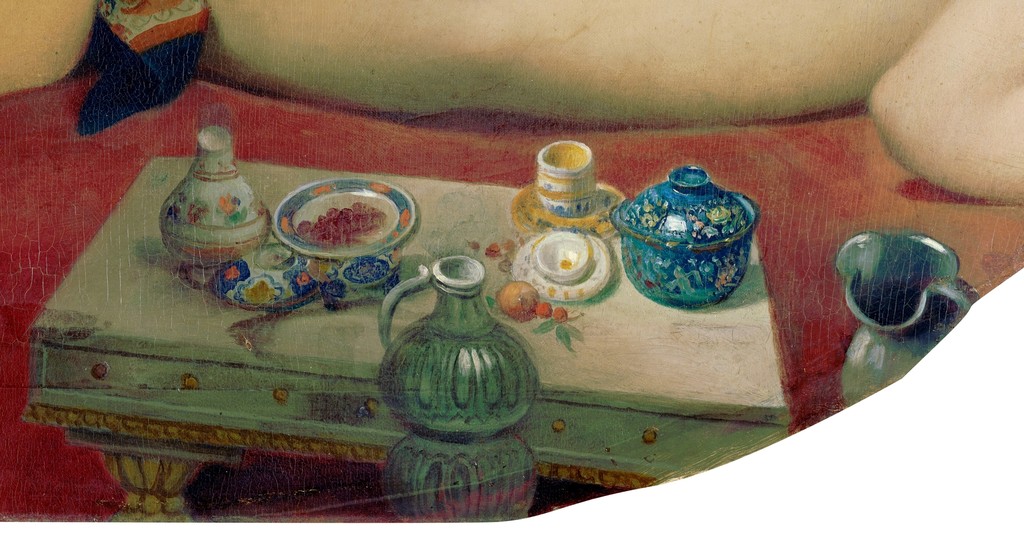
The contrast is clearest if you compare the upper and lower halves. Above, a relatively broad area of green wall rises over the crowd. Below, knees, hips, cushions, cloth and small vessels press towards the perimeter. The objects on the low stand at the bottom provide a miniature counterpart to the gathering: rounded containers, a little cup, a decorated box and a narrow-necked vessel, each given its own place within a compact arrangement. The painting repeatedly offers fullness within fullness.
Colour helps us distinguish those layers. Warm flesh advances against the cooler green interior. Blue cloth separates adjacent bodies and interrupts the spread of pale skin; red establishes passages of floor covering and upholstery; yellow draws attention to a head or a small accessory. The picture's organisation depends on these contrasts as much as on its contours. To describe Ingres here only as a master of line would leave out the means by which the bodies become visible against each other.
There is also a useful difference between recognising a body and explaining every joint. Several figures look extended, compressed or softened to fit their surroundings. A strict anatomical inventory misses the continuity that makes them persuasive as painted forms. The eye can move smoothly along an arm into an answering curve elsewhere even when the arrangement briefly resists reconstruction. The painting asks us to notice both the sensation of flesh and the design made from it.
The circle intensifies that experience. A tondo has no corners into which the composition can simply subside. Here, limbs approach the rim at changing angles, and the curved boundary cuts across figures near the sides and bottom. The gathering seems larger than the area we can see. At the same time, the frame gathers all that movement into a single bounded object, available to be taken in at once.
Annotated Details from The Turkish Bath
The numbered points identify visible features discussed in this article. Return from each detail to the whole composition. Each caption identifies the work shown.
The Turkish Bath
The Turkish Bath. RF 1934. Image source. CC0 / Public domain.
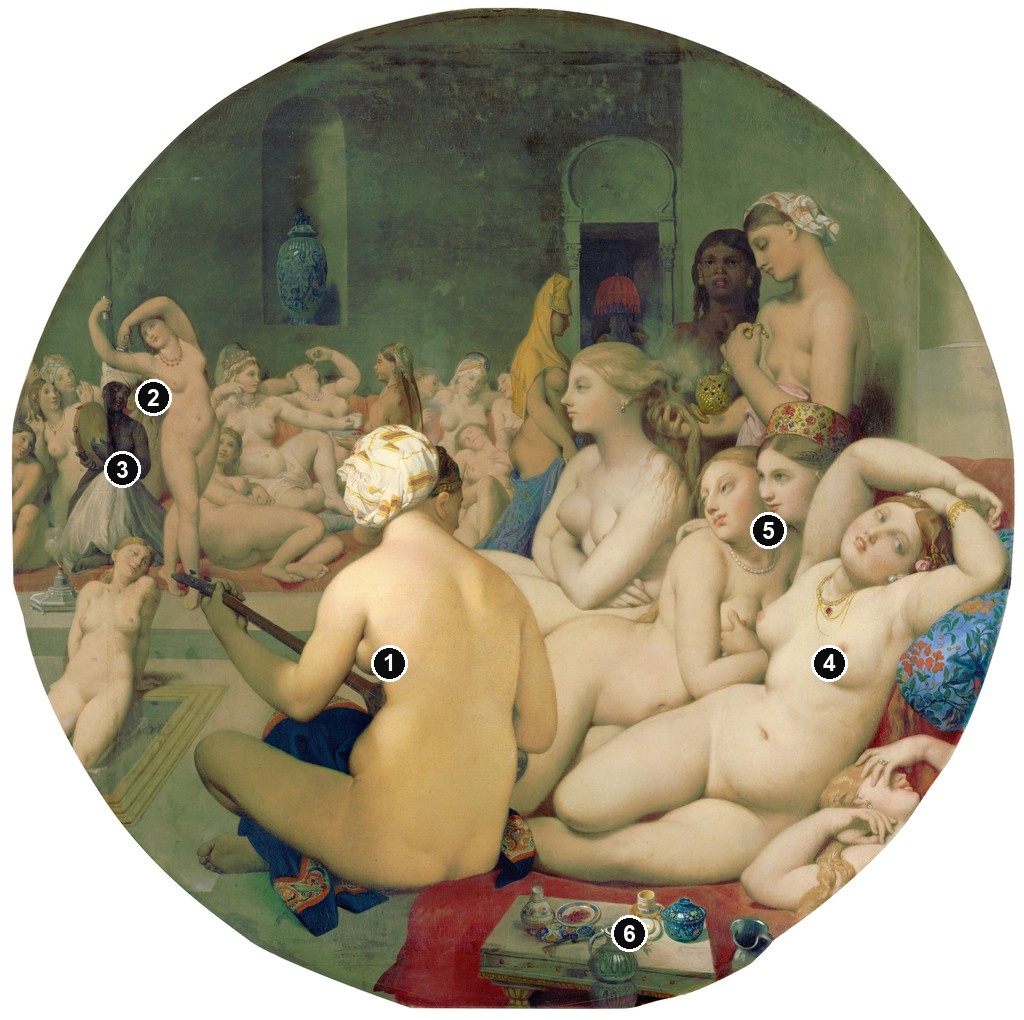
Turkish Bath — Study RF 34502
Study for The Turkish Bath. RF 34502. Wikimedia Commons. Image source. Public domain.
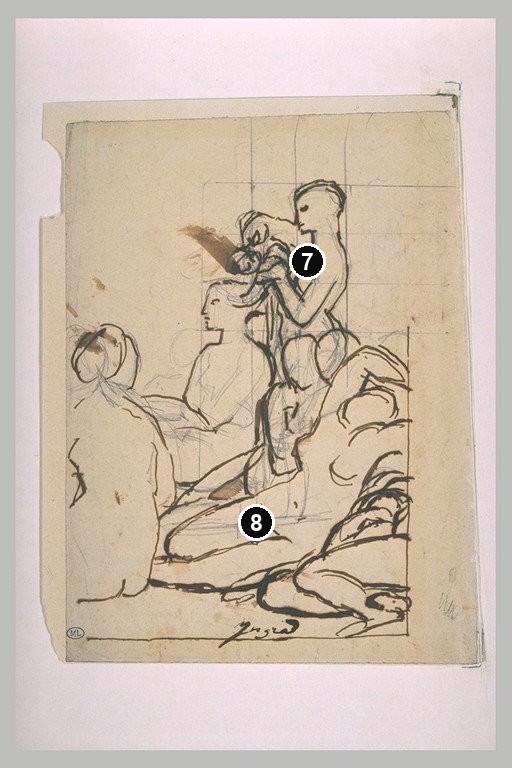
Turkish Bath — Study RF 54702
Ingres, Study for The Turkish Bath, c. 1859. Pen and brown ink. Musée du Louvre, RF 54702 recto. Photograph: Thierry Le Mage; Wikimedia Commons. Image source. Public domain.
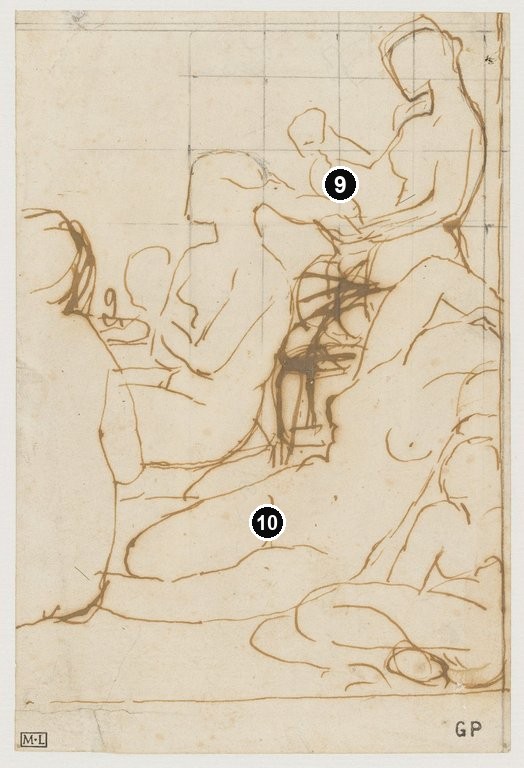
Details from THE TURKISH BATH
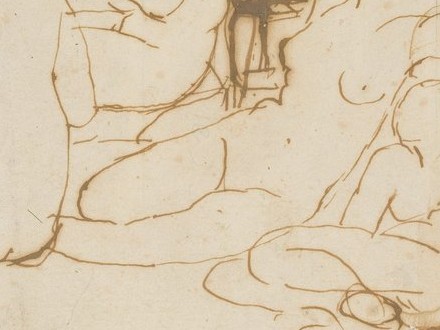
Compare the painted gathering with two separate Louvre composition studies. Their overlapping outlines and open spaces show different arrangements; the small study reproductions support broad comparisons only.
The Turkish Bath
The back of the musician
The striped head covering and broad back establish a large foreground shape. The arm reaches left towards the instrument, carrying the eye away from the central curve of the body.
Arms raised in the distance
Two lifted arms form an irregular arch over a small tilted head. The upright body cuts across a much denser group of reclining and seated figures.
A small circle within the crowd
A round instrument appears among the overlapping hands and bodies on the left. Its firm edge provides a small, clear shape within the surrounding curves.
An arm framing a reclining head
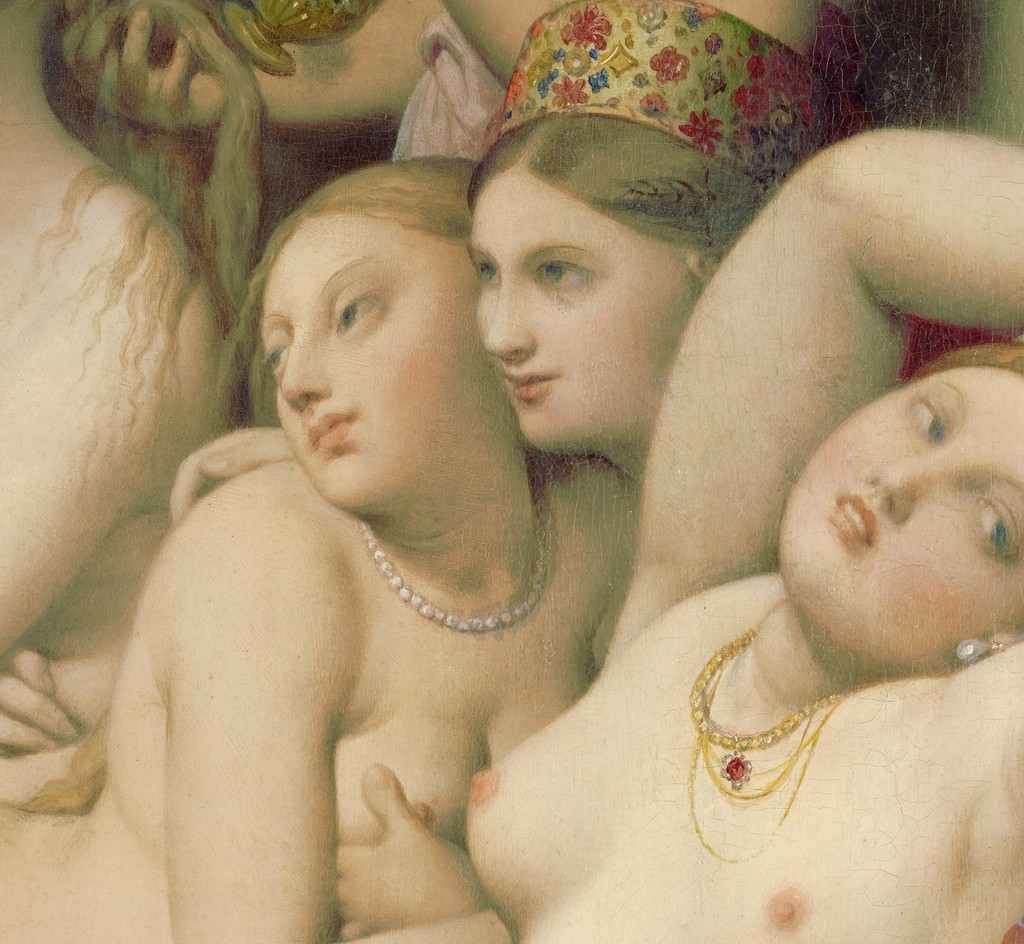
The bent arm curves around the head and echoes the rounded shoulder below. Jewellery and the patterned cushion sharpen the edges of this pale foreground figure.
Faces packed together
Heads overlap in different directions near the right foreground. Compare the profiles, tilted faces and small dark gaps that separate one figure from the next.
Vessels at the lower edge
Small vessels and dishes gather on a low table at the edge of the circle. Blue, green and gold accents compress another set of rounded forms into this narrow foreground strip.
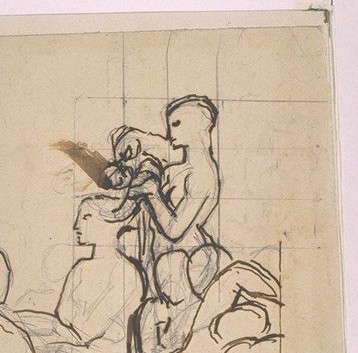
Turkish Bath — Study RF 34502
Profiles and raised arms
Dark outlines gather around the upper figures’ profiles and raised arms. Compare these compact overlapping forms with the more open paper and faint grid around them.
Reclining bodies and repeated curves
Long, loosely drawn limbs cross the lower part of the sheet. Curves of backs, knees and feet overlap rather than forming an evenly spaced row.
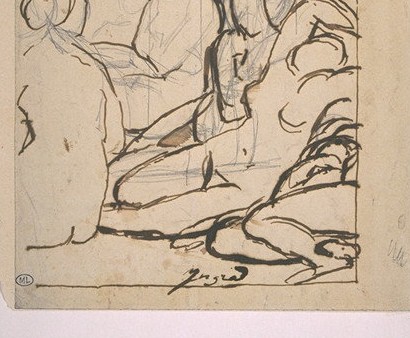
Turkish Bath — Study RF 54702
The upper figure and the crossing arms
The upper figure’s head is left largely blank inside its outline. Arms extend across the body towards the central group; the grid remains visible through the open drawing.
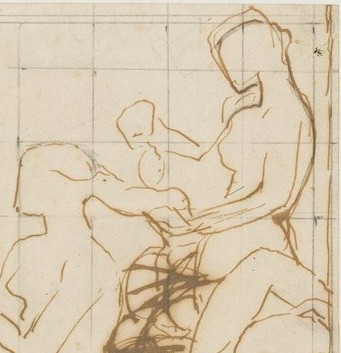
The reclining figure below the group
A long reclining form stretches beneath the seated group. Its lightly drawn outline contrasts with the darker crossing marks above it.
How a rectangular painting became a tondo
The round format was a consequential change. The Louvre dates an earlier rectangular state to 1859 and the completed tondo to 1862. The inscription includes the year in Roman numerals and the artist's age, eighty-two. The familiar circular image is therefore the result of reconsideration late in the making of the work. [1]
Henri Delaborde supplies an unusually concrete account of this transformation. Writing in 1870, after Ingres's death, he describes the earlier painting as square and says that a photograph recorded it. He reports that the change to a round format brought some figures into the border and eliminated another, formerly at the lower right. His account preserves the difference between an earlier rectilinear composition and the final circle. [2]
Cropping changes the relationship between the figures and the viewer. A body comfortably contained within a rectangle becomes a fragment encountered at the edge of an opening. The alteration also redistributes attention. The foreground musician and the reclining group dominate an area that no longer has lower corners, while figures farther back become glimpses around the central gathering. These are visible consequences of the present format; they do not require us to invent a recorded explanation from Ingres for choosing it.
Delaborde disliked some of the figures affected by the change. He considered the removed figure especially unsuccessful. That judgement belongs to him, and is useful precisely because it shows that an early commentator did not regard every part of the composition with equal admiration. His account combines information about the work's changing appearance with his own assessment of its merits. We can use the former without adopting the latter as a final verdict. [2]
The distinction also matters when discussing photography. The photograph mentioned by Delaborde preserved an appearance that the painting itself subsequently lost. It makes the earlier state part of the work's visual history, alongside drawings and the final object, although his account does not explain the artist's reason for changing the format. The broader relationship between paintings and their reproduced images is explored in Prints and Reproductions.
Older Louvre drawing commentary, quoting Louis-Antoine Prat, describes the composition as reworked in 1860 and mentions further retouches in 1863. This provides a useful distinction between the signed completion and reported subsequent adjustments. That distinction separates a signature from subsequent work. Nor should the present description of its support—canvas glued to wood—be mistaken for a complete technical history of every cutting, mounting and repainting operation. [1][4]
A changed outline can be as significant as a changed figure. Once the composition becomes round, each peripheral body acquires a new relation to the boundary. Some curves echo it, some cross it, and some are abruptly stopped by it. The painting's feeling of continuous abundance arises partly from those interruptions: we are shown enough to imagine a crowd beyond what has been retained.
A lifetime of bodies, rearranged
The musician's back is the most recognisable return. In The Valpinçon Bather, painted in 1808, a solitary woman sits with her back to us, her hair covered and a white cloth gathered around her arm. The Louvre identifies that earlier painting as an envoi, a work sent to Paris during Ingres's residence at the French Academy in Rome. More than fifty years separate its date from the final Turkish Bath. [3]
Place the two figures side by side in your mind. The rounded headcloth, turned head, descending neck and broad expanse of back make the connection immediately apparent. The later figure has acquired a different occupation and a new setting. Her arms engage with the instrument; her seated body belongs to a crowded foreground; rich cloth replaces the earlier painting's expansive white bedding. A bodily motif has travelled, while the composition around it has been remade.
The Louvre's 2006 exhibition essay treats the back-facing bather as one of the female types Ingres developed in Rome and repeatedly revisited. That curatorial perspective helps explain the later gathering: an established pose could remain productive because it could enter a different arrangement and acquire different neighbours. Repetition here is a working resource. It makes change particularly visible. [5]
Three bathers that should remain distinct
Two smaller paintings clarify how varied that return could be. The Phillips Collection's The Small Bather, dated 1826, places the back-facing figure outdoors beside a stream. The museum identifies the repeated pose and explains the substitution of a grassy bank for the earlier setting. Its object is a woodland scene, rather than the indoor bath suggested by the title of the Louvre's small version. [6]
The Louvre's La petite baigneuse. Intérieur de harem, dated 1828, is another distinct painting. Its record describes a reduced and modified repetition of the 1808 work, made for the collector L. J. A. Coutan. A woman seen from behind sits before other bathers in an enclosed interior. The relation between a large foreground back and a populated space beyond already offers a useful comparison with The Turkish Bath. [7]
These paintings show the limitations of treating titles as a simple sequence of miniature copies. The 1808 bather, the Phillips woodland picture and the Louvre harem interior each organise a different encounter with the same bodily invention. The final musician continues that process, now within a circle whose foreground is occupied by several bodies of competing prominence. The development is easier to understand as a set of recombinations than as one picture gradually filling up.
Delaborde's account adds a further distinction. He describes a small isolated painted figure, close in attitude to the earlier bather, as the long-standing starting point for the larger composition. That historical description should not turn every small picture of a back-facing woman into the same object. His narrative establishes the persistence of the idea; present collection records identify the separate surviving paintings. [2]
The comparison with Grande Odalisque makes a different point. There, a long reclining body dominates a horizontal field and a face turns towards the viewer. In The Turkish Bath, reclining forms are multiplied, and the most stable foreground figure turns her face away. The shift changes the distribution of attention: one body's long silhouette gives way to an exchange among many silhouettes. The Louvre's discussion of the early nude types provides the historical connection, while the difference can be seen directly in the paintings. [5]
Recognising those returns does not supply a list of personal identities. A familiar profile or repeated arm is evidence of a related form, not sufficient proof that a figure portrays a named wife, lover or model. The painting can accumulate the artist's earlier inventions without becoming a decipherable group portrait of the women in his life.

Ingres, The Valpinçon Bather, 1808. [8]
What the drawings reveal about making a crowd
The finished gathering required more than a stock of individual poses. Bodies had to be placed in relation to each other, enlarged or reduced, and made to occupy a common field. The surviving drawings distinguish those problems. A sheet of figure studies and a small arrangement sketch perform different jobs, even when both contribute to the same painting.
One Louvre study, RF 34502, combines pen and brown ink with graphite and a partial graphite grid. At 16.5 by 11 cm, it is a small working object. A grid divides an image into areas that can help an artist relate positions or transfer forms at another scale. Its presence records a practical concern with placement within a composition that remained open to change. The museum's discussion connects the drawing with the painting's earlier rectangular state. [4]
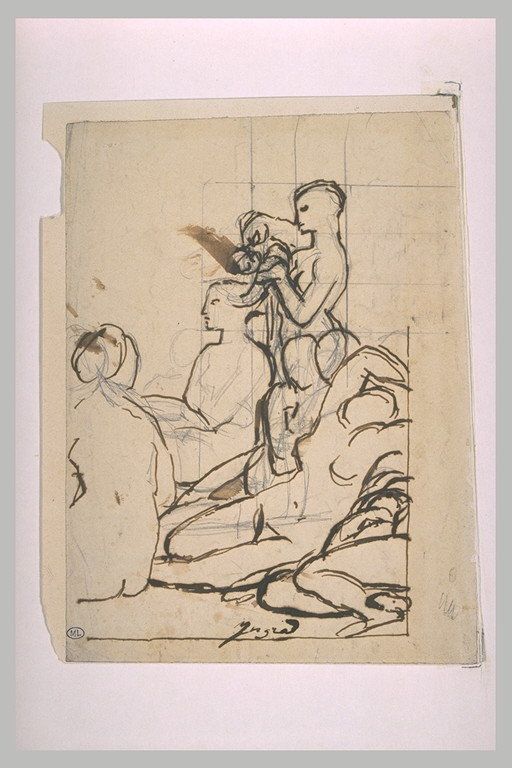
Ingres, Study for The Turkish Bath, c. 1850. Pen and brown ink with graphite and a partial graphite grid. Musée du Louvre, RF 34502 recto. [9]
A second sheet, RF 23354, is made from two joined pieces of paper and uses the same combination of brown ink and graphite. A crossed-out annotation refers to a tambourine. Such a correction gives an unusually modest glimpse of the painting as work in progress: an instrument could be considered, named and reconsidered alongside the figures. The drawing later belonged to Edgar Degas and passed through Marcel Guérin before its gift to the Louvre in 1932. That is a history of the working sheet's later appreciation, distinct from the ownership of the finished painting. [10]
Another brown-ink drawing, RF 54702, is catalogued around 1859. The Louvre describes it as one of the rare studies concerned with the broader placement of the composition, and relates the group it examines to RF 34502. It entered the museum in 2008 from the Georges Pébereau collection through a transfer in payment of inheritance tax. Its value for understanding the painting lies in that larger view: the artist had to work out relationships across a gathering, as well as perfect an isolated shoulder or arm. [11]
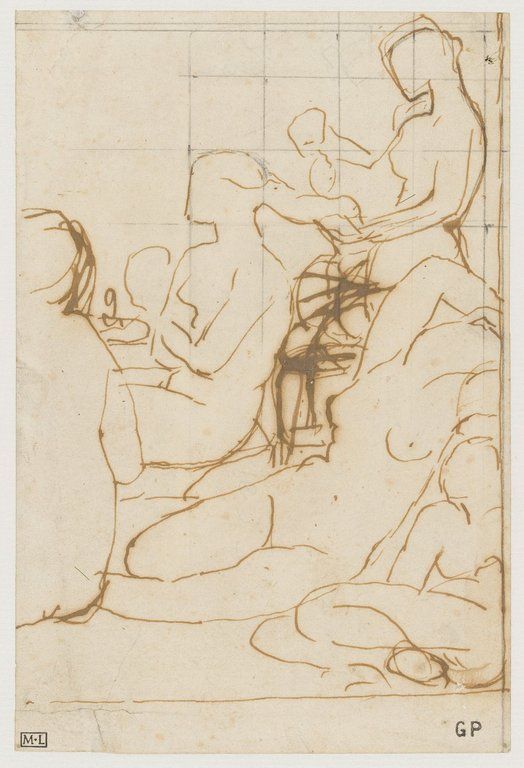
Ingres, Study for The Turkish Bath, c. 1859. Pen and brown ink. Musée du Louvre, RF 54702 recto. [12]
The Louvre also holds a black-chalk sheet of studies of women, RF 12292. It belongs to the more focused investigation of figures that accompanied the arrangement sketches. Considered together, the records show preparation operating at several levels: the individual body, the group and the space that holds the group. The gathering emerges as an arrangement developed across separate working objects. [13]
These distinctions help make sense of the painting's strange combination of clarity and congestion. A single body can have a polished, continuous contour while its position within the crowd remains difficult to reconstruct. Each has been considered locally, yet the completed composition asks it to participate in a much denser system. The friction between the two scales of invention is part of what holds our attention.
In the notes published posthumously by Delaborde, Ingres insists that “Drawing does not simply mean reproducing contours” (our translation). The surrounding passage includes expression, inner form, planes and modelling within drawing. This broader understanding suits the challenge of The Turkish Bath: the work of drawing concerns the volume and relation of bodies as well as the lines around them. The statement comes through Delaborde's editorial compilation, rather than a treatise issued by Ingres himself. [2]
For that reason, the smooth finish should not lead us to imagine an effortless execution. The surviving sheets, the recorded earlier state and the changed perimeter preserve evidence of decisions beneath the apparent ease. Drawings and Style and Technique place those practices in the wider range of Ingres's work.
Lady Mary Wortley Montagu's bath: an encounter transformed
A second kind of preparation came through reading. Delaborde reports long extracts from Lady Mary Wortley Montagu's letters in Ingres's notebooks, including her account of women at the bath. He places these extracts under the date 1819. His testimony establishes a literary connection decades before the final painting; it does not make the English text available today identical to the French translation Ingres encountered. [2]
Montagu's Letter XXVI is dated at Adrianople on 1 April, Old Style, 1717. The visit she describes took place earlier at Sophia, now Sofia. The place at the head of the letter is where she was writing, rather than the location of the bath. Her account provides a particular encounter during a journey through the Ottoman Empire, with a visitor noticing both an unfamiliar institution and the conduct of its users. [14]
Ingres never travelled to the Ottoman world he imagined in these pictures. The literary source and his accumulated images supplied a mediated encounter, separated from Montagu's visit by more than a century. This distance between the artist and the place represented is fundamental to the scene. [15]
A room for conversation and work
Montagu first describes architecture and movement through the building: roof-lit domes, marble platforms, fountains, channels and rooms of different temperatures. She explains how water could be adjusted and how the heat made clothing uncomfortable. These details give the bath a practical operation, with spaces connected by circulation and changing conditions. [14]
She then turns to the women. Some converse; some work; others drink coffee or sherbet. Enslaved attendants braid their mistresses' hair. Women rest on cushions, exchange news and spend several hours in the place. Montagu calls it “the women's coffee-house”. Her phrase makes sociability central to the scene: this is a gathering in which women do things together, including the ordinary business of talking about other people. [14]
Those activities provide points of contact with Ingres's picture. Hairdressing, music, reclining bodies and a richly furnished gathering all give the painted women occupations. Yet the correspondence is selective. His painting concentrates bodies into a much tighter visual field. Architecture recedes, and the viewer's sustained attention is directed towards skin, contact and pose. Montagu's account allows us to imagine a visit unfolding through time; the painting makes several bodily arrangements simultaneously available to a single gaze.
She is particularly struck by the women's courtesy towards her. Arriving in a travelling dress, she expects to appear conspicuous, but finds none of the hostile curiosity she associates with European assemblies. She says there was “not the least wanton smile or immodest gesture amongst them”. The observation is an explicit claim about conduct, and should matter when the letter is invoked to explain an erotic painting. Montagu did not describe the women as performing for a male spectator. [14]
At the end of the visit, their interest turns towards her clothing. Pressed to undress for the bath, she opens her shirt to reveal her stays, the stiffened undergarment shaping her torso. The women, she reports, understand it as a contrivance that has locked her up, and attribute control of it to her husband. The anecdote reverses the direction of scrutiny. The European traveller's clothed body becomes the unfamiliar object to be interpreted. [14]
That reversal is largely unavailable to us in Ingres's picture. There is no conspicuous visiting woman whose dress becomes the subject of a shared misunderstanding. We occupy a viewing position outside the gathering, able to inspect bodies whose social world remains only lightly described. Montagu narrates an exchange, including an awkwardness that belongs to her; the painting offers a much more continuous possession of the scene through looking.
Montagu's own frame of reference
Montagu's letter is nevertheless selective, socially positioned writing. She notices ladies of quality and their enslaved attendants, even while observing that nakedness removes distinctions made by dress. She records labour as part of the women's leisure. The apparent equality of undress does not eliminate the unequal relationships that organise the room. [14]
Her admiration also passes through a European artistic vocabulary. She compares the women's bearing to Milton's Eve, their proportions to goddesses painted by Guido Reni or Titian, and their hair to the Graces. She singles out the whiteness of many women's skin. These references tell us how she gives the experience shape for her correspondent. She is looking through literary, aesthetic and class expectations, even when she challenges European assumptions about Ottoman manners. [14]
One especially revealing passage imagines a painter present but invisible, improving his art by seeing the women in varied postures. The wish sits beside her insistence on their modest behaviour. It joins a social encounter to the possibility of an artist's unobserved access. Montagu's account therefore contains a tension useful for understanding Ingres: the women are people with whom she interacts, and they also become an imagined store of beautiful figures for a painter. [14]
Reading the letter closely makes the relationship between text and painting more interesting than a simple opposition between a truthful female observer and a fantasising male artist. Both select and arrange, but with different kinds of access and different purposes. Montagu's presence within the visit produces reciprocal observation, conversation and embarrassment. Ingres's accumulation of bodies concentrates the pleasures and power of viewing from outside.
The painting need not illustrate every detail of the letter to draw sustenance from it. A description of many naked women at leisure could become the starting point for something built from old studies, repeated motifs and a revised format. That transformation is central to the work's history. Treating the image as a literal view of the bath Montagu visited would erase the very acts of selection that made it possible.
An imagined interior and an unequal view
The title gives the gathering a location and a cultural identity that the room itself only partly specifies. Headcloths, jewellery, decorated vessels and textiles contribute to an imagined Ottoman setting. The walls do not identify a particular surviving building, and the figures have been arranged through the long process of reuse and revision already traced. The painting belongs to Orientalism: the European representation of an imagined East, in which selected objects, stories and bodily types could stand for a much more varied world.
The Louvre's 2006 account of Ingres's late work brings two concerns together. It describes the preparatory nudes as voyeuristic, while also emphasising his continuing exploration of variations in the body's attitudes. That pairing is productive. The formal pleasure of linked curves and the erotic pleasure of access to bodies operate together in this picture. Calling one of them the real subject would make the other harder to see. [16]
The circular edge can encourage the feeling of a privileged glimpse into an enclosed place. Yet there is no need to turn its shape into a literal keyhole or claim that we occupy a documented architectural opening. What we can observe is a fixed viewing position outside the gathering, a boundary that cuts into bodies, and a crowded interior presented with unusual visual availability. The effect can be intimate without becoming a record of actual entry.
The foreground figure offers a particularly complex kind of access. Her back is close enough to invite sustained looking, but her face remains withheld. Elsewhere, faces are more visible while bodies become partly hidden. The picture distributes intimacy in fragments. We can inspect much, though we never gain an equally complete knowledge of each person represented.
Leisure, service and the presentation of beauty
The distinction between people at leisure and people providing it deserves attention. Ingres had already made that relationship explicit in his Odalisque with Slave compositions. Harvard dates its indoor version to 1839–1840. The Walters Art Museum holds a separate version, dated 1842 and credited to Ingres and Jean-Paul Flandrin, in which the scene opens towards a garden. These are different objects, rather than alternative dates for a single painting. [17][18]
The Walters's current interpretation addresses the way its pale reclining woman is distinguished from the darker-skinned figures who entertain and guard her. The museum sees gender, racial and labour hierarchies operating together within the imagined scene. That reading supplies a useful comparison for The Turkish Bath, where leisure also includes music and hairdressing, and where the brightest, most continuous areas of skin receive considerable visual prominence. [18]
The comparison requires care. The role assigned to one person in the Walters composition does not establish the role or ethnicity of a differently placed figure in The Turkish Bath. Skin colour alone cannot supply a biography or determine whether a particular woman is enslaved. The finished bath contains visible differences of complexion and occupation; Montagu's text describes enslaved labour; the two forms of evidence should remain distinct.
What the comparison brings into focus is the organisation of attention. The musician's broad back and the pale reclining body at right command much more space than many figures behind them. Smaller heads and darker passages support an arrangement in which some bodies are presented for prolonged contemplation and others are more quickly passed over. We can notice that hierarchy of visibility without pretending to recover every person's identity.
A comparison with The Source brings out another dimension of the late work. Completed in 1856 after a project begun much earlier, it places a solitary standing nude in a tall, narrow setting. The Musée d'Orsay describes the sculptural stillness of the figure and the interaction of bodily modelling with an emphatic silhouette. [19] In The Turkish Bath, similar concerns enter a crowded system. Smooth flesh, continuous contour and restricted depth are multiplied until the figures themselves form an almost decorative field.
That transformation has consequences for the viewer. We can admire the way a shoulder is modelled, then realise how quickly we have moved from one anonymous body to another. We can follow a pattern while remaining aware that the pattern is made of people. The picture sustains both responses, and its beauty becomes more interesting when the terms of looking are kept in view.

Ingres, Odalisque with Slave, 1839. [20]

Ingres, The Source, 1856. [21]
From a prince's collection to the Louvre
The painting's history begins in private ownership. The Louvre records it in Prince Napoléon's collection from 1859 and an exchange in 1860 for Ingres's early self-portrait, now at Chantilly. Delaborde identifies the portrait as the work painted in 1804. The exchange places the bath back within the artist's history of revision before its signed circular completion. [1][2] The reason for the exchange remains less secure than the event itself. The recorded sequence lets us follow a change of ownership and a continuing revision without assigning a motive to either the prince or the painter. [2] From the artist’s studio it passed through Khalil Bey, the Say family and Prince Louis-Amédée de Broglie. The Société des Amis du Louvre gave it to the museum in 1911, with David-Weill’s participation. [1]
Delaborde's 1870 catalogue belongs within that chain. His statement that the picture had been bought by Say describes ownership at the time he was writing. It is an early witness to the work's passage into another collection, rather than a description of its present location. His account also links two parts of the story that can otherwise seem separate: changes to the picture's perimeter and movement between owners. [2]
Private collecting matters to the way the object was encountered. An imagined gathering of women became a painting that could be acquired, exchanged and displayed in a collector's interior. Its arrival in a public museum changed the circumstances of viewing again. The round field remains, but the audience looking into it has become much broader than the circle of early owners.
A late work that invited further looking
The painting can be approached through old sources, new bodily arrangements and later artists’ responses. A more specific response appears in Félix Vallotton's own The Turkish Bath, painted in 1907. The Musée Marmottan Monet's 2019 exhibition text describes it as an homage to Ingres that preserves the accumulation of bodies in a constricted space while largely dispensing with Orientalist motifs. The museum emphasises its cold blue light, odd details and mixture of classical reference and irony. [22]
That response identifies something transferable within Ingres's invention. A later artist could take up the problem of many bodies in an enclosed bath without preserving the same sensual atmosphere or cultural accessories. The relationship concerns an arrangement and an experience of looking, as well as a subject. Vallotton's difference makes the earlier picture's particular warmth and carefully distributed abundance easier to recognise.
Return now to the musician. Her pose can be recognised from an early painting, yet the present image depends on everything that has changed around it: the instrument, the bodies at her sides, the compressed distance behind her and the curve that brings the room to an end. The repeated figure is a stable point within a restless invention. Following it through the picture allows us to see an elderly painter still changing the conditions under which his earlier forms could be seen. [1][2][3]
Artworks directory
Explore 150 paintings, drawings and an original lithograph. This selection includes related versions and studies; dates distinguish completed works from later revisions.
| Name | Date | Medium |
|---|---|---|
| The Apotheosis of Homer | 1827 | Painting |
| Grande Odalisque | 1814 | Painting |
| The Turkish Bath | 1859–1862 | Painting |
| Madame Moitessier Seated | 1856 | Painting |
| Portrait of Monsieur Bertin | 1832 | Painting |
| Napoleon I on His Imperial Throne | 1806 | Painting |
| Odalisque with Slave | 1839 | Painting |
| The Ambassadors of Agamemnon in the Tent of Achilles | 1801 (competition) | Painting |
| The Valpinçon Bather | 1808 | Painting |
| The Source | 1856 | Painting |
| Oedipus Explaining the Enigma of the Sphinx | 1808; revised probably before 1827 | Painting |
| The Vow of Louis XIII | 1824 | Painting |
| Antiochus and Stratonice | 1840 | Painting |
| The Comtesse d’Haussonville | 1845 | Painting |
| The Princesse de Broglie | 1851–1853 | Painting |
| Jupiter and Thetis | 1811 | Painting |
| The Dream of Ossian | 1813 | Painting |
| The Martyrdom of Saint Symphorian | 1834 | Painting |
| Venus Anadyomene | 1808–1848 | Painting |
| Portrait of Madame de Senonnes | 1814 | Painting |
| Madame Rivière | 1805 | Painting |
| Mademoiselle Caroline Rivière | 1805 | Painting |
| Portrait of Philibert Rivière | 1805 | Painting |
| Bonaparte First Consul | 1804 | Painting |
| The Death of Leonardo da Vinci | 1818 | Painting |
| Joan of Arc at the Coronation of Charles VII | 1854 | Painting |
| Madame Duvaucey | 1807 | Painting |
| La Belle Zélie | 1806 | Painting |
| Madame Panckoucke | 1811 | Painting |
| Portrait of Charles Marcotte d’Argenteuil | 1810 | Painting |
| Joseph Antoine Moltedo | c.1810 | Painting |
| Madame Leblanc | 1823 | Painting |
| Delphine Ingres-Ramel (Portrait of Madame Ingres) | 1859 | Painting |
| Portrait of Amédée de Pastoret | 1823–1826 | Painting |
| Portrait of Baronne de Rothschild | 1848 | Painting |
| Madame Marcotte de Sainte Marie | 1826 | Painting |
| Madame Gonse | 1852 | Painting |
| Aretino in the Studio of Tintoretto | 1848 | Painting |
| Don Pedro of Toledo Kissing Henry IV’s Sword | 1831/1832 | Painting |
| Raphael and La Fornarina | 1814 | Painting |
| Roger Freeing Angelica | 1819 | Painting |
| Romulus’ Victory over Acron | 1812 | Painting |
| Self-Portrait at the Age of Twenty-Four | 1804; revised 1841–1851 | Painting |
| Male Torso | c.1800 | Painting |
| Odalisque in Grisaille (Ingres and workshop) | c.1824–1834 | Painting |
| The Small Bather | 1826 | Painting |
| The Little Bather Harem Interior | 1828 | Painting |
| Jesus Among the Doctors | 1862 | Painting |
| The Virgin Adoring the Host | 1852 | Painting |
| The Virgin of the Host | 1841 | Painting |
| Virgin of the Adoption | 1858 | Painting |
| Paolo and Francesca | 1814 | Painting |
| Homer Deified (revised composition, Louvre RF5273) | 1865 | Drawing |
| Odalisque with Slave (Louvre RF4622) | 1858 | Drawing |
| Odalisque (Walters Art Museum; Ingres and Paul Flandrin) | 1842 | Painting |
| Madame Moitessier Standing (National Gallery of Art) | 1851 | Painting |
| Jacques-Louis Leblanc (The Metropolitan Museum of Art) | 1823 | Painting |
| Ferdinand-Philippe, Duke of Orléans (Louvre RF2005-13) | 1842 | Painting |
| Ferdinand-Philippe, Duke of Orléans (Versailles MV5207; Ingres and workshop) | 1843 | Painting |
| Ferdinand-Philippe, Duke of Orléans (Versailles MV5209; Ingres and workshop) | 1844 | Painting |
| Antiochus and Stratonice (Musée Fabre; Ingres and Raymond Balze) | 1866 | Painting |
| Antiochus and Stratonice (Kunstmuseum Bern, Gurlitt bequest) | Undated (early dating proposed) | Drawing |
| Composition study for Antiochus and Stratonice (MIB867.2193) | 1806 | Drawing |
| Study for the Figure of Stratonice (Met63.66) | 1834–1840 | Graphite, black chalk and charcoal |
| Nude figure study for Stratonice (Boijmans F II 36 PK) | c.1834–1840 | Drawing |
| Paolo and Francesca (The Barber Institute,54.6) | c.1814–1820 | Painting |
| Paolo and Francesca (The Hyde Collection,1971.24) | c.1855–1860 | Painting |
| Paolo and Francesca (Amsterdam Museum TA10970) | 1820 | Drawing |
| Paolo and Francesca (dedicated to Artaud de Montor) | 1816 | Drawing |
| Study for the Bust of Francesca (MIB867.1398) | 1819 | Drawing |
| Study for the Bust of Francesca (MIB867.1396) | 1819 | Drawing |
| The Archangel Raphael, first idea (MIB867.2488) | 1842 | Drawing |
| The Archangel Raphael (MIB867.2500) | 1842 | Drawing |
| The Archangel Raphael Carrying Human Prayers to God (Chantilly DE513) | 1844 | Drawing |
| Louis-Philippe as Saint Philip, stained-glass study | 1844 | Drawing |
| Marie Frédéric Eugène de Reiset (Ford Collection RBF171-2) | 1844 | Drawing |
| Virgil Reading the Aeneid (Toulouse) | Begun 1811 | Painting |
| Tu Marcellus Eris (Brussels, inv. 1836) | c.1814 (museum dating) | Painting |
| Jean-François Gilibert | 1804 | Painting |
| François-Marius Granet | 1807 (museum dating) | Painting |
| Count Nikolai Dmitrievich Guryev | 1821 | Painting |
| Caroline Murat, Queen of Naples | 1814 | Painting |
| Count Mathieu Molé | 1834 | Painting |
| Cherubini and the Muse of Lyric Poetry (Louvre) | 1842 | Painting |
| Luigi Cherubini (Cincinnati) | 1841 | Painting |
| Comtesse de Rayneval (Louvre RF4505) | 1841 | Drawing |
| Venus on Paphos (Antonie Balaÿ) | c.1852 | Painting |
| Prince Napoléon | 1855 | Painting |
| Study for The Apotheosis of Napoleon I (Petit Palais) | Late 1853 | Painting |
| The Apotheosis of Napoleon I (destroyed ceiling) | 1853 | Painting |
| The Journalist (MIB867.2733) | 1834? | Drawing |
| Henry VIII, after Holbein | c.1815–1820 (?) | Drawing |
| Madame Récamier, after David (MIB867.3637) | Undated (early Paris period) | Drawing |
| Study for Comtesse d’Haussonville (MIB867.259; background possibly by another hand) | 1842–1845 | Drawing |
| La Source (reduced version reported by Delaborde) | Date unrecorded; reported 1870 | Painting |
| Odalisque (autograph lithograph,NGA1946.21.117) | 1825; published1826 | Lithograph |
| Portrait of a Seated Lady | 1814 | Graphite |
| The Kaunitz Sisters (Leopoldine, Caroline, and Ferdinandine) | 1818 | Graphite |
| Portrait of a Man | 1814 | Graphite |
| Study for the Portrait of Louis-François Bertin (1766–1841) | n.d. | Black chalk and graphite |
| Studies for the Cadaver of Acron | ca. 1810–12 | Graphite on wove paper |
| Study for the Drapery of Molière in "The Apotheosis of Homer" | n.d. | Black chalk with stumping |
| Madame Guillaume Guillon Lethière, née Marie-Joseph-Honorée Vanzenne, and her son Lucien Lethière | 1808 | Graphite |
| Niccolò Paganini (1782–1840) | ca. 1830 | Counterproof or tracing strengthened with graphite and gouache on translucent paper |
| Lady Mary Cavendish-Bentinck (?-1843) | 1816 | Graphite |
| Madame Alexandre Lethière and Her Daughter Letizia | ca. 1815 | Graphite |
| Merry Joseph Blondel (1781–1853) | 1809 | Graphite |
| Ursin-Jules Vatinelle (1798–1881) | 1820 | Graphite |
| Bust of a Gypsy Girl (ascribed to Ingres) | 1819 | Graphite on wove paper |
| Study of a Seated Nude Male | n.d. | Graphite |
| The Archangel Raphael (Study for a stained-glass window in the chapel of Notre-Dame de la Compassion-Saint-Ferdinand, Neuilly) | ca. 1842 | Graphite |
| Lancelot-Théodore, comte Turpin de Crissé | probably 1818 | Graphite |
| Study for the Figure of the Iliad in "The Apotheosis of Homer" | ca. 1827 | Graphite and black chalk heightened with white chalk on brown paper |
| Comtesse Turpin de Crissé | probably 1818 | Graphite |
| Nude Figures for L'Âge d'Or, Château de Dampierre | n.d. | Graphite on brownish paper |
| Study of Figures (attributed to Ingres) | n.d. | Graphite |
| Study of Figures (attributed to Ingres) | n.d. | Graphite; squared in graphite |
| Admiral Sir Fleetwood Broughton Reynolds Pellew | 1817 | Graphite on wove paper |
| Madame Jean-Auguste-Dominique Ingres, née Madeleine Chapelle | 1814 | Graphite on off-white wove paper |
| Virgil Reading the Aeneid to Augustus, Livia, and Octavia | 1809/1819 (?) | Pen and black ink, graphite, brush and gray wash, white gouache heightening, Conté crayon on blue paper |
| General Louis-Étienne Dulong de Rosnay | 1818 | Graphite (hard and soft pencils) |
| Madame Alexandre Lethière, née Rosa Meli, and Her Daughter, Letizia | 1815 | Graphite |
| The Lawyer Paul Grand | 1834 | Graphite |
| Jean-Joseph Fournier | 1815 | Graphite |
| Armand Bertin | 1842 | Graphite |
| Madame Armand Bertin, née Marie-Anne-Cécile Dollfuss | 1843 | Graphite |
| The Architect Charles-Victor Famin | 1836 | Graphite |
| Henri Lehmann | 1850 | Graphite |
| Portrait of a Lady | ca. 1815–17 | Graphite |
| Edmond Cavé (1794–1852) | 1844 | Oil on canvas |
| Head of Saint John the Evangelist | probably ca. 1818–20 | Oil on canvas, laid down on wood |
| Madame Edmond Cavé (Marie-Elisabeth Blavot, ca. 1806–1883) | ca. 1831–34 | Oil on canvas |
| Madame Félix Gallois | 1852 | Graphite with touches of gold in oil to highlight jewelry, on buff wove paper. |
| Dr. François Mêlier | 1849 | Graphite with graphite framing lines, corrected with white, on buff wove paper |
| Portrait of Madame Rhode (Rhoda?) | 1810–20 | Graphite on pale buff wove paper |
| Study for "Raphael and the Fornarina"(?) | ca. 1814(?) | Graphite on white wove paper |
| Portrait of Madame Paul Meurice, née Palmyre Granger | ca. 1845–50 | Graphite on wove paper |
| Alexander the Great presenting Campaspe to Apelles | 1810 | Graphite, brush and brown wash; squared in graphite |
| Study of Hands for "Christ Among the Doctors" | 1852–62 | Graphite on tracing paper |
| Study for The Turkish Bath (RF34502) | about 1850 | Pen and brown ink with graphite, partially squared |
| Study for The Turkish Bath (RF23354) | Undated | Pen and brown ink with graphite on joined sheets |
| Study for The Turkish Bath (RF54702) | about 1859 | Pen and brown ink |
| Studies of women for The Turkish Bath (RF12292) | Undated | Black chalk |
| Achilles Receiving the Envoys of Agamemnon (Nationalmuseum sketch, NM2161) | 1801 | Oil on wood |
| Half-Length Bather (Musée Bonnat-Helleu,89) | 1807 | Oil on canvas |
| Oedipus and the Sphinx (National Gallery,NG3290) | about1826 | Oil on canvas |
| Oedipus and the Sphinx (Walters,37.9) | 1864 | Oil on canvas |
| Oedipus and the Valpinçon Bather, after David (MI.867.2035) | Undated | Graphite on tracing paper, after David |
| Study of the Virgin for The Vow of Louis XIII (Dijon,1758) | about1822 | Black chalk, stump and white chalk on brown wove paper |
| First Thought for The Vow of Louis XIII (MI.885.11.21) | 1822 | Oil on canvas |
Frequently Asked Questions
In 1862. [1]
Eighty-two. [1]
Ingres changed an earlier rectilinear composition into a tondo, or circular picture. Delaborde reports that this brought some figures into the border and removed a figure at the lower right. The change creates a concentrated, enclosed view, but these records do not establish a single stated motive for choosing it. [1][2]
She describes a visit to Sophia, now Sofia. Her Letter XXVI was written at Adrianople on 1 April, Old Style, 1717; the place of writing and the place visited are different. [14]
Musée du Louvre, RF 1934. [1]
Discussion
Look again at the images and ideas explored in The Turkish Bath. These editorial prompts invite your observations.
Reader Insights
Start with the central musician, then follow the bodies towards the edge. Does the circle make the gathering feel more intimate, more crowded or more like a pattern? Compare her back with The Valpinçon Bather: which change in the surrounding space most alters your response to the repeated pose?
Compare the intervals around the solitary Valpinçon Bather with the overlapping bodies here. Where does repetition become a new invention?
What can this carefully arranged gathering tell us about a painted fantasy, and what could it never establish about actual bathers?
Join the Conversation
Share a detail, comparison or question about The Turkish Bath below.
References
- Musée du Louvre, Le bain turc. RF 1934. View source.
- Henri Delaborde, Ingres, sa vie, ses travaux, sa doctrine, d'après les notes manuscrites et les lettres du maître. Paris: Henri Plon, 1870. Catalogue no. 80, pp. 239–240, including p. 239, note 1; “Notes et pensées”, p. 123, for the statement about drawing. Posthumous editorial compilation. (In French; the translation quoted here is ours.) View source.
- Musée du Louvre, La baigneuse, dite Baigneuse de Valpinçon. RF 259; Description, Date and Object History. (In French.) View source.
- Musée du Louvre, Département des Arts graphiques, Étude pour le Bain Turc. RF 34502, recto; Technique and Commentary, including the passage attributed to Louis-Antoine Prat, Ingres, Paris: Musée du Louvre / 5 Continents, 2004, nos. 49–50, pp. 90–91. (In French.) View source.
- Musée du Louvre, “Rome and Florence: ‘Ingresque’ eroticism”. Ingres exhibition website, 2006, section 1806–1824. View source.
- The Phillips Collection, The Small Bather. Object 0927, 1826; collection record and commentary on the relation to the 1808 bather. View source.
- Musée du Louvre, La petite baigneuse. Intérieur de harem. RF 1728, 1828; Description and Object History. (In French.) View source.
- Supporting image. Ingres, The Valpinçon Bather, 1808. Image source. CC0 / Public domain.
- Supporting image. Study for The Turkish Bath. RF 34502. Wikimedia Commons. Image source. Public domain.
- Musée du Louvre, Département des Arts graphiques, Étude pour le Bain turc. RF 23354, recto; Technique, History and Commentary. (In French.) View source.
- Musée du Louvre, Département des Arts graphiques, Étude pour le Bain turc. RF 54702, recto, around 1859; Technique, History and Commentary, including Prat's discussion in La collection Georges Pébereau, 2009, no. 50, as quoted by the museum. (In French.) View source.
- Supporting image. Ingres, Study for The Turkish Bath, c. 1859. Pen and brown ink. Musée du Louvre, RF 54702 recto. Photograph: Thierry Le Mage; Wikimedia Commons. Image source. Public domain.
- Musée du Louvre, Département des Arts graphiques, Feuille d'études de femmes pour le Bain turc. RF 12292, recto; Technique and Commentary. (In French.) View source.
- Lady Mary Wortley Montagu, Letters of the Right Honourable Lady M—y W—y M—e. Project Gutenberg e-book 17520, Letter XXVI, to Lady ——, dated Adrianople, 1 April, Old Style, 1717. Original English letter; not the French translation read by Ingres. View source.
- Institut national de l'audiovisuel, Jean Dominique Ingres (1780–1867): Le Bain turc (1859–1863). Palettes, directed by Alain Jaubert; INA notice 77990.005, producer's synopsis; ARTE broadcast 27 June 1995, co-production La Sept Arte / Musée du Louvre. The synopsis, rather than the full film, is the source used here. (In French.) View source.
- Musée du Louvre, “A Young Man of Eighty”. Ingres exhibition website, 2006, section 1855–1867; discussion of late nude studies and variation. View source.
- Harvard Art Museums, Odalisque with a Slave. Museum collection presentation on Google Arts & Culture, 1839–1840; object details. View source.
- The Walters Art Museum, Odalisque. 37.887, 1842; current attribution to Jean-Auguste-Dominique Ingres and Jean-Paul Flandrin; collection commentary and provenance. View source.
- Musée d'Orsay, La Source. RF 219, 1856; object details and commentary on the standing figure, silhouette and sculptural presentation. View source.
- Supporting image. Ingres, Odalisque with Slave, 1839. Harvard Art Museums; Wikimedia Commons. Image source. Public domain.
- Supporting image. Ingres, The Source, 1856. Image source. CC0 / Public domain.
- Musée Marmottan Monet, L'Orient des peintres, du rêve à la lumière: dossier de presse. Exhibition curated by Emmanuelle Amiot-Saulnier, 2019. Printed p. 20, “L'Orient disparaît” and discussion of Félix Vallotton's Le Bain turc (1907). Selected passage consulted; this is the press kit, not the exhibition catalogue. (In French.) View source.
- Splash image. The Turkish Bath. RF 1934. Image source. CC0 / Public domain.


