by Tom Gurney
Tom Gurney BSc (Hons) is an art history expert with over 20 years experience
Published on June 19, 2020 / Updated on October 22, 2026
Email: tomgurney1@gmail.com / Phone: +44 7429 011000
Raphael and La Fornarina
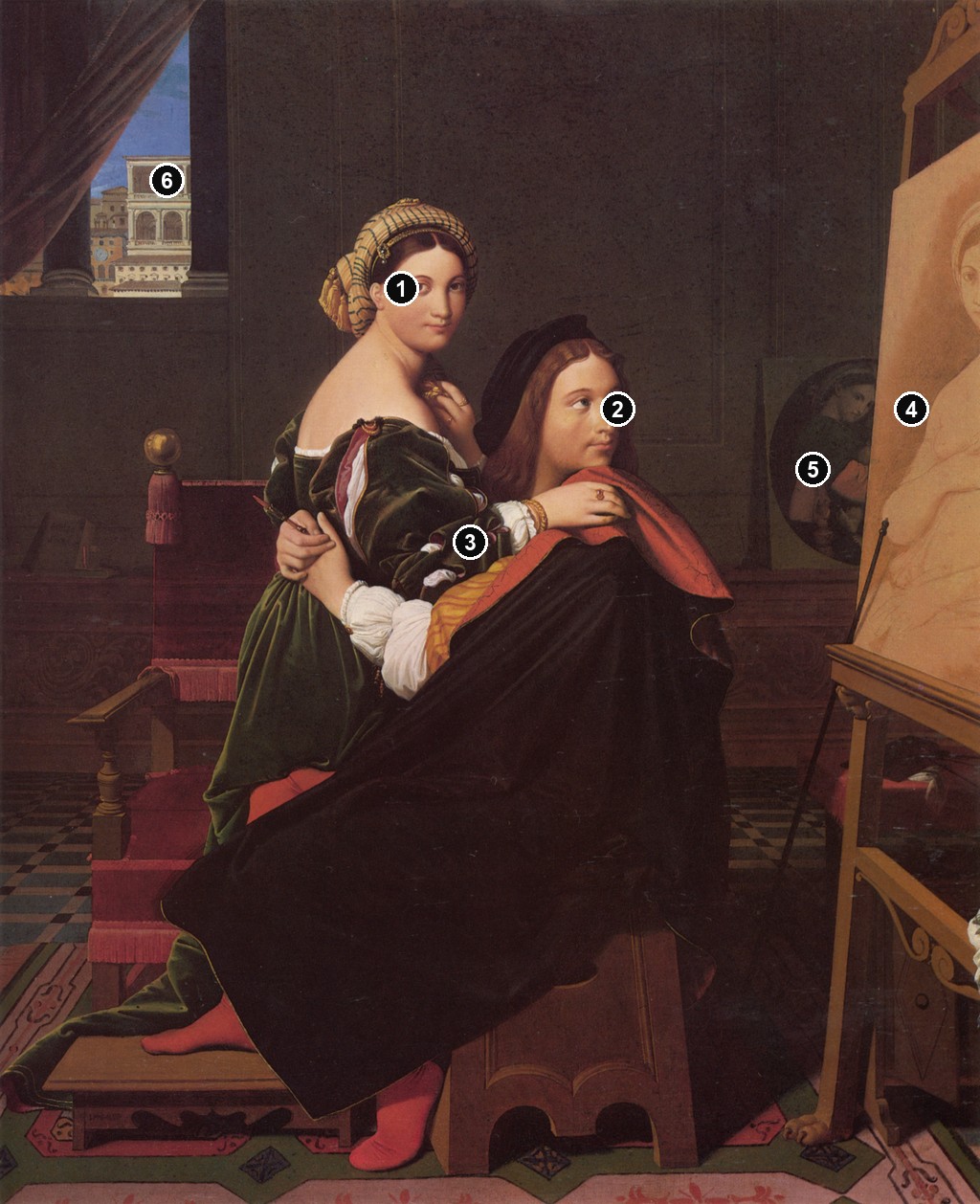
Raphael holds a woman against him, but his face turns towards her painted likeness. She rests a hand on his shoulder and looks straight out of the picture. Between the embrace and the unfinished canvas, Ingres creates a pause in which affection, looking and making seem inseparable. The woman is physically close; the image still demands the painter’s attention.
Painted in 1814, this Raphael and the Fornarina belongs to Harvard Art Museums’ Fogg Museum. It is the first of six versions identified by the museum. [1] Its subject gave Ingres something more intimate than a ceremonial tribute to a great predecessor: a way of imagining an artist at work in the company of the person he loves.
At a Glance
- ArtistJean-Auguste-Dominique Ingres.
- Date1814.
- Medium and sizeOil on canvas, 64.8 × 53.3 cm.
- CollectionHarvard Art Museums/Fogg Museum, Bequest of Grenville L. Winthrop, 1943.252. [1]
- SubjectAn imagined encounter between Raphael and the woman known as La Fornarina, with her unfinished portrait beside them.
- Look forThe separate directions of their eyes, the encircling arms and the small round Madonna behind the easel.
This work across Ingres’s career
Agamemnon’s Ambassadors
1801 (competition)Grande Odalisque
1814Louis XIII’s Vow
1824Monsieur Bertin
1832The Princesse de Broglie
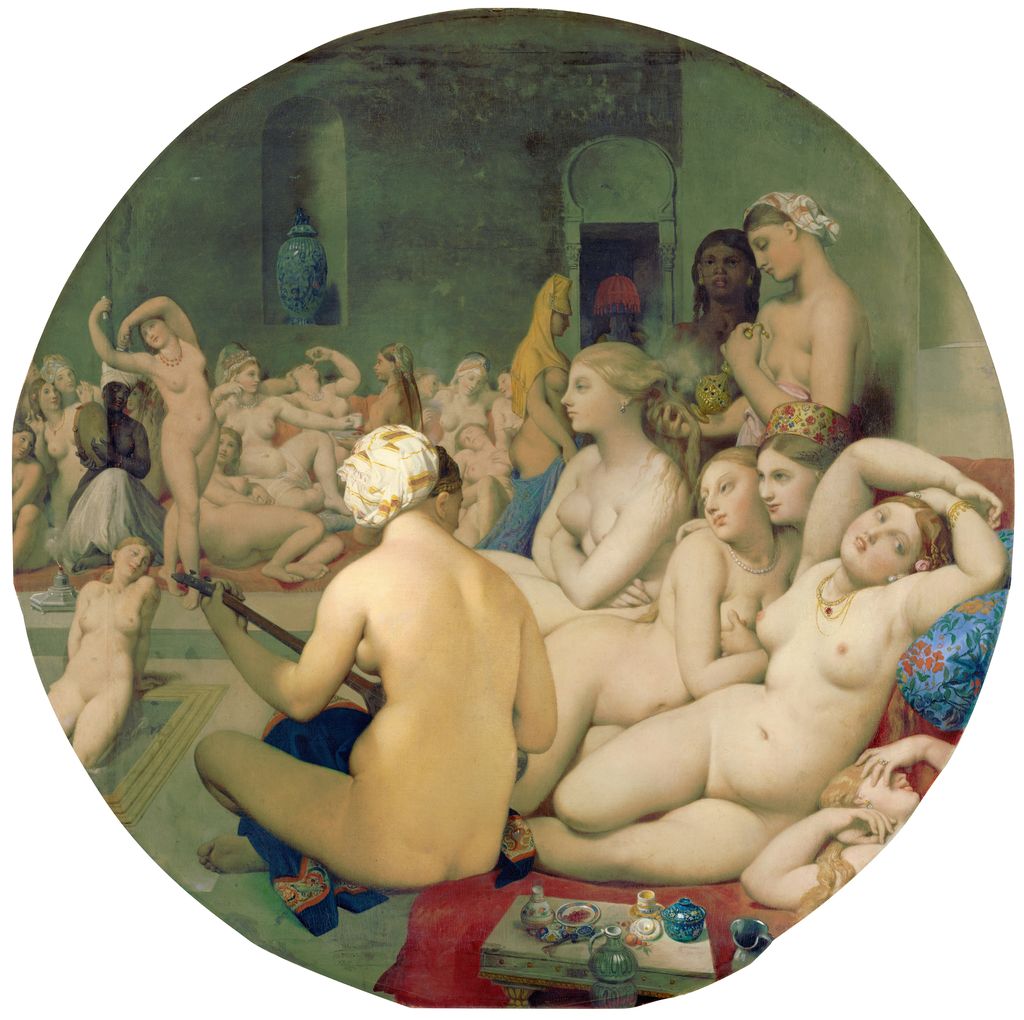
1851–1853The Turkish Bath
1859–1862Contents
- An embrace with two directions
- What comes from Vasari?
- Raphael inside Ingres’s painting
- A drawing and a possible personal connection
- A subject Ingres kept reopening
- From a private collection to a public one
- Annotated details
An embrace with two directions
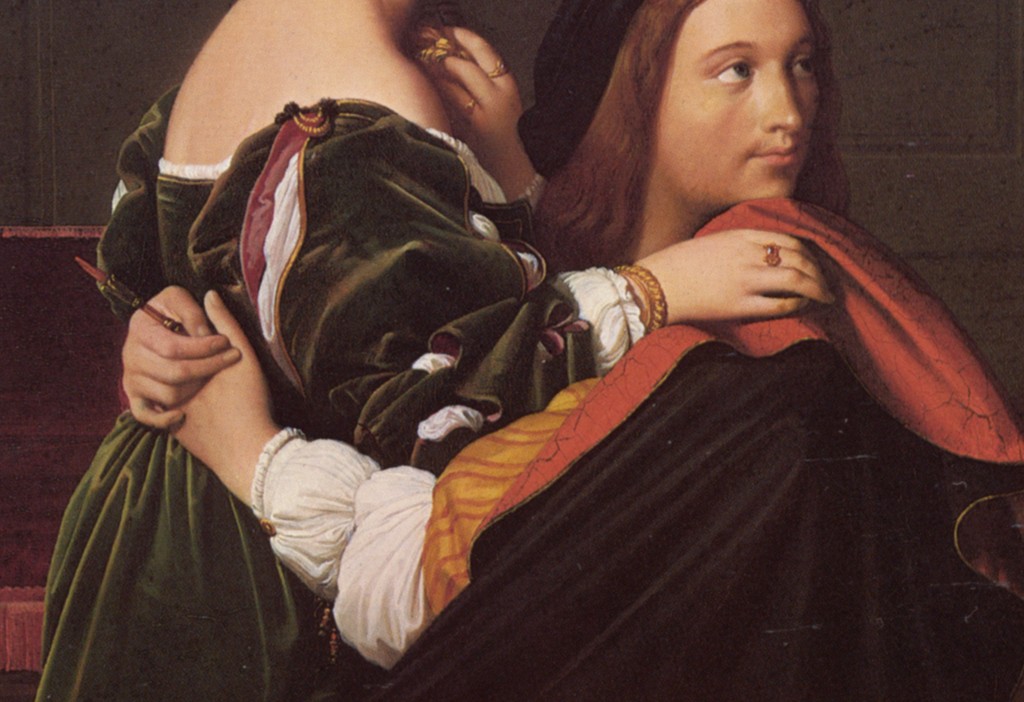
The pair occupy almost the entire foreground. Raphael’s black cloak spreads across the lower half of the canvas, its broad surface gathering the two bodies into one dark shape. Above it, the woman’s bare neck and shoulders catch the light. The red lining turned back at Raphael’s shoulder leads towards her hand, so that a strong colour accent also marks their point of contact.
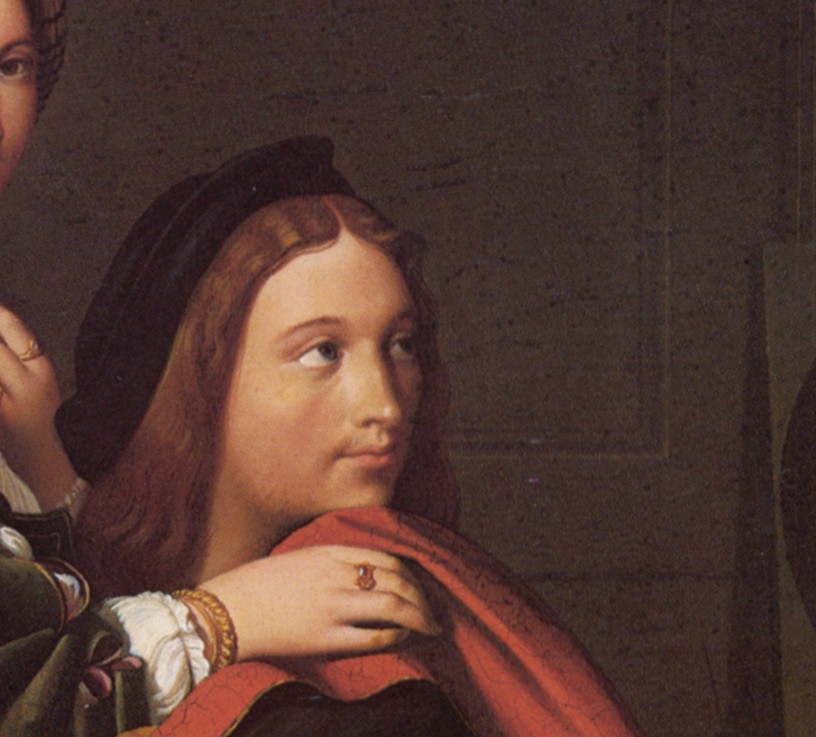
Follow the arms before looking again at the faces. Her hand lies across his shoulder; his arm circles her waist. The white folds of his sleeve brighten the middle of the embrace, between her deep green dress and his cloak. These interlocking forms make the couple look settled together. Yet his head turns away from hers, bringing a small but decisive separation into the pose.
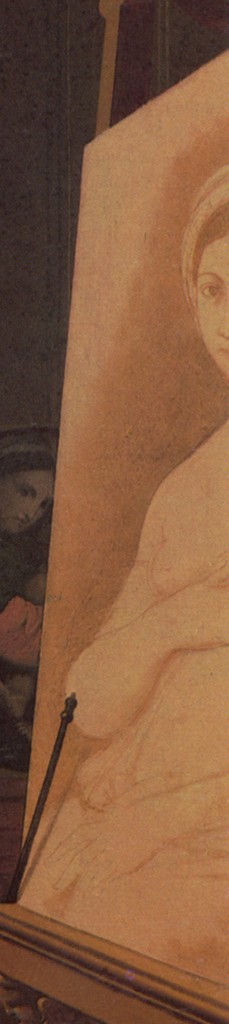
Raphael looks towards the upright canvas at the right. The drawing on it is pale and incomplete, with the woman’s face and upper body emerging against a warm ground. The difference in finish is striking. We see the clothed woman in rich colour, then her likeness as a much slighter arrangement of lines. Ingres places a developing image beside the apparently solid person from whom it is made.
This contrast lets us recognise painting as a process within a finished painting. Raphael does not need to be shown actively applying a stroke for the work to remain present. His gaze carries the action across the gap between the figures and the easel. The scene can therefore feel suspended between two activities: he is embracing someone and attending to a picture, and neither gesture has quite ended.
The woman has a different relationship with us. Her head turns sufficiently for both eyes to be visible, and her outward gaze interrupts the privacy suggested by the embrace. She cannot be reduced to an anonymous shape seen over the artist’s shoulder. We encounter her face before we examine the partial likeness at the edge. Her presence makes the painting’s question more demanding: what happens when the person being loved is also the person being represented?
The room around them
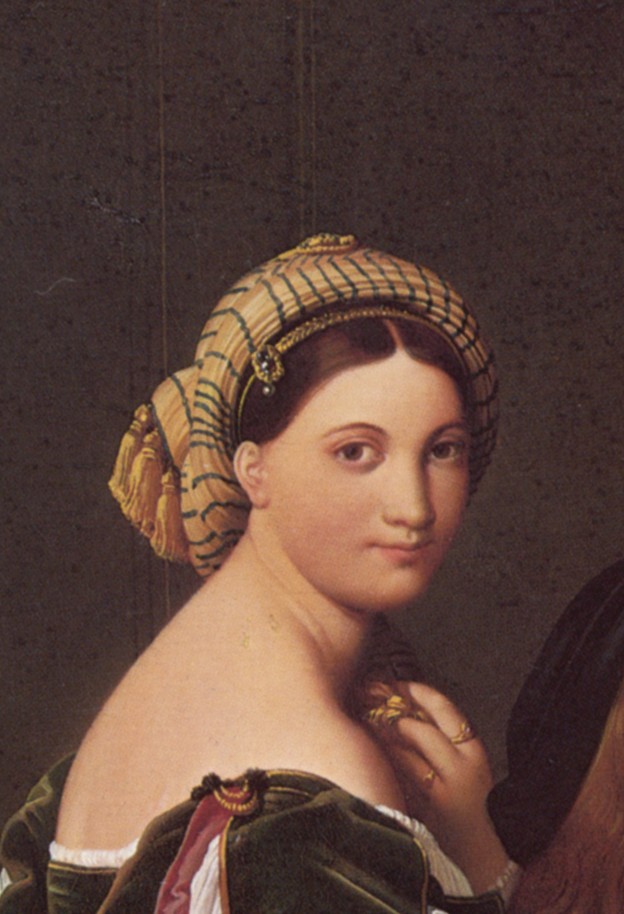
Small areas of colour keep the dark interior from closing around the figures. A yellow striped headwrap frames the woman’s brown hair. The green fabric below her shoulder catches narrow highlights along its folds. Raphael’s red stockings reappear beneath the black cloak, bringing a bright, unexpectedly domestic note to the bottom of the picture.
The furniture is equally specific. Red upholstery and fringe show behind the woman, while Raphael’s low wooden seat and the small foot platform occupy the foreground. Their different heights help explain the complicated seated pose. The tiled floor gives the room a measured recession, but the cloak interrupts most of its grid. Order belongs to the setting; the large intertwined shape of the couple dominates it.
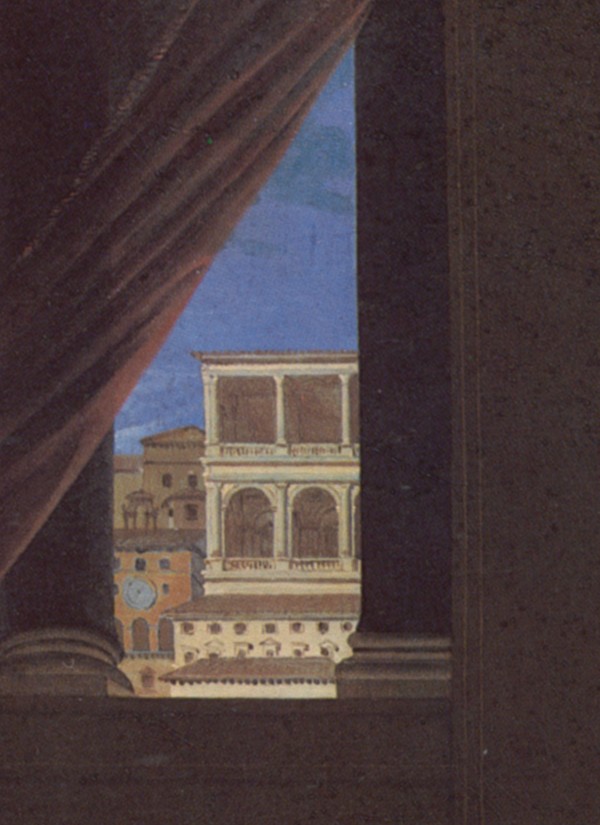
At the upper left, a curtain opens beside a window. The patch of blue sky and the brightly lit architecture outside offer a release from the interior’s muted walls. The distant buildings also make the room feel connected to a city beyond the immediate encounter. The architectural detail makes Ingres’s imagined episode feel spatially convincing.
Annotated Details from Raphael and La Fornarina
The numbered points identify visible features discussed in this article. Return from each detail to the whole composition. Each caption identifies the work shown.
Raphael and La Fornarina
Jean-Auguste-Dominique Ingres, Raphael and the Fornarina, 1814. Oil on canvas, 64.8 × 53.3 cm. Harvard Art Museums/Fogg Museum, Bequest of Grenville L. Winthrop, 1943.252. Art Renewal Center via Wikimedia Commons. Image source. Public domain.
Possible Raphael study
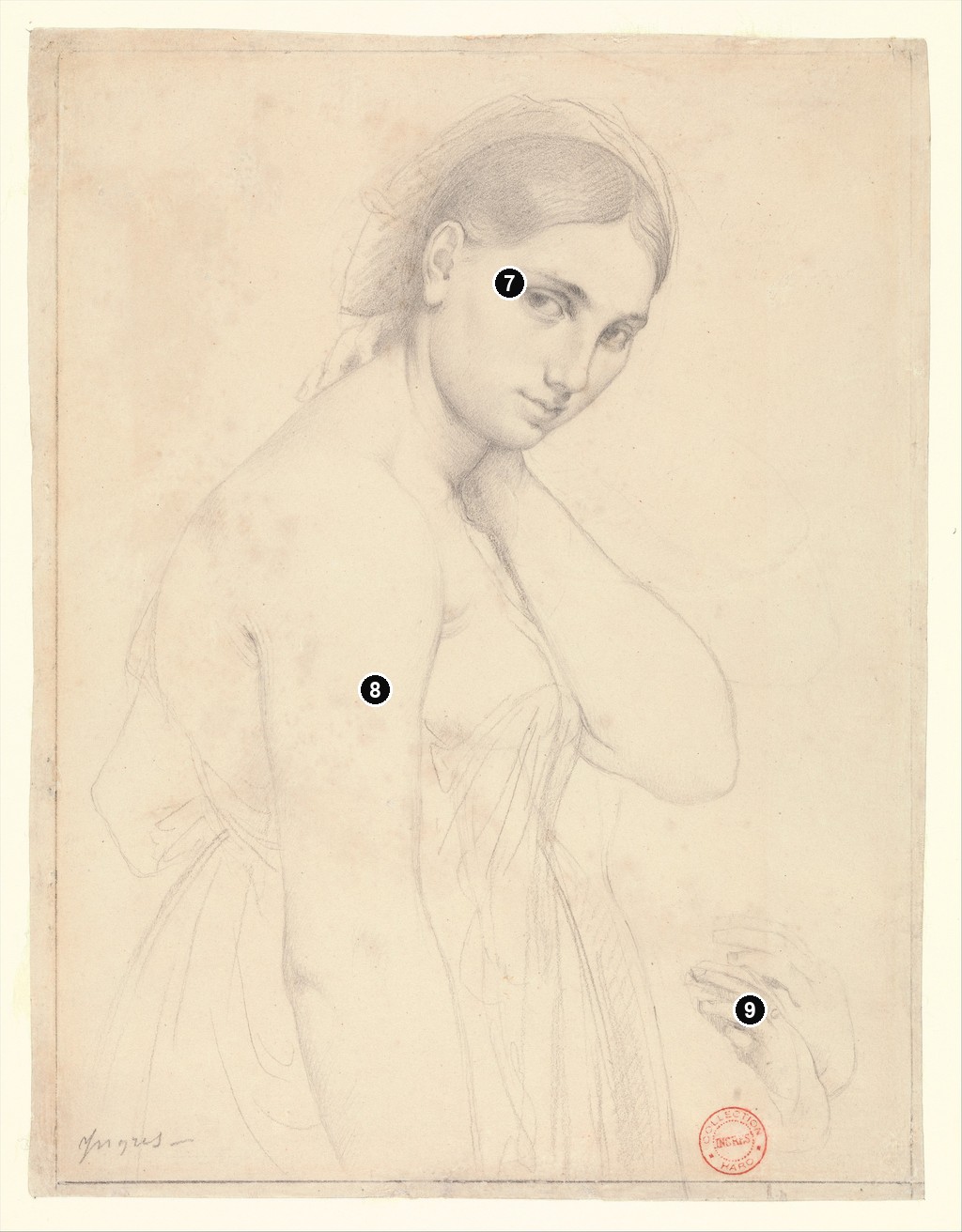
Ingres, Study for Raphael and the Fornarina(?), c. 1814(?). The Metropolitan Museum of Art, 1975.1.646. Robert Lehman Collection, 1975. Image source. CC0 / Public domain.
Details from RAPHAEL AND LA FORNARINA
Follow the hands, faces and images within the room, then compare the separate drawing whose connection with this subject remains uncertain.
Raphael and La Fornarina
The turned face beneath a striped headdress
The face turns out towards the viewer beneath the striped cloth. A few hanging strands and the small pendant at the forehead break the larger rounded shape of the head covering.
Raphael looking towards the painted likeness
Raphael turns his head towards the unfinished likeness on the easel. The direction of his eyes leads away from the woman whose body remains close to his.
An embrace made from several hands
One hand holds the upper arm while another rests across the shoulder. Pale cuffs, jewellery and dark sleeves keep the overlapping gestures distinct.
The likeness standing on the easel
The painted likeness on the easel repeats the woman’s turned head and shoulders. Its pale ground gives the partial figure a separate field within the darker room.
The small round image behind the easel
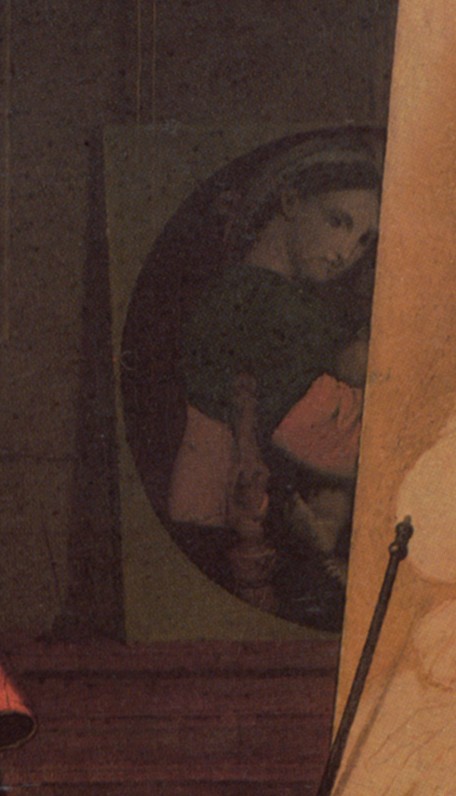
A small round image leans behind the larger canvas. Its circular boundary offers another shape within the room’s many rectangles and upright edges.
The window opening beside the curtain
A small bright view of buildings appears between the curtain and the window edge. Its distant rectangles contrast with the larger furniture and bodies in the room.
Possible Raphael study
The tilted head and gathered hair
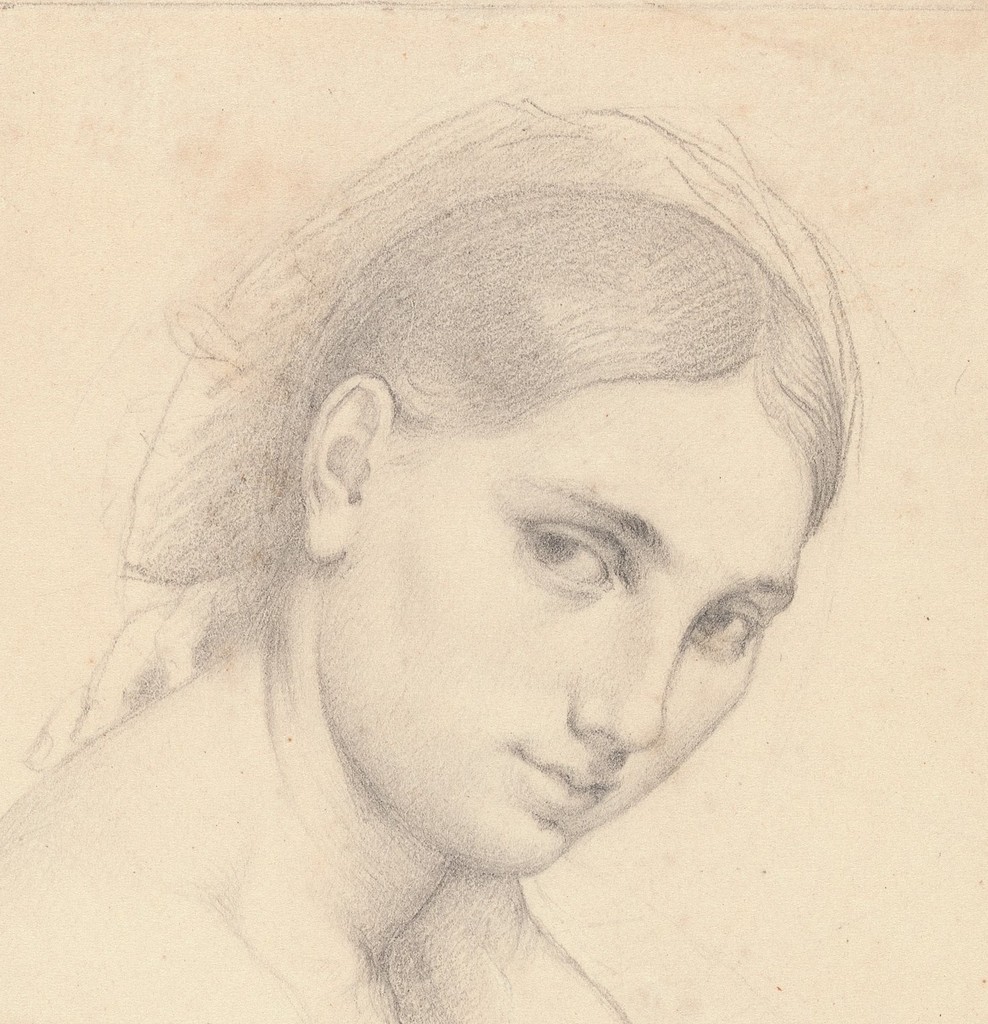
The head tilts above the shoulder, with hair gathered behind it. Closely placed lines around the eyes and mouth contrast with the lighter outlines of the clothing below.
The shoulder beside the gathered fabric
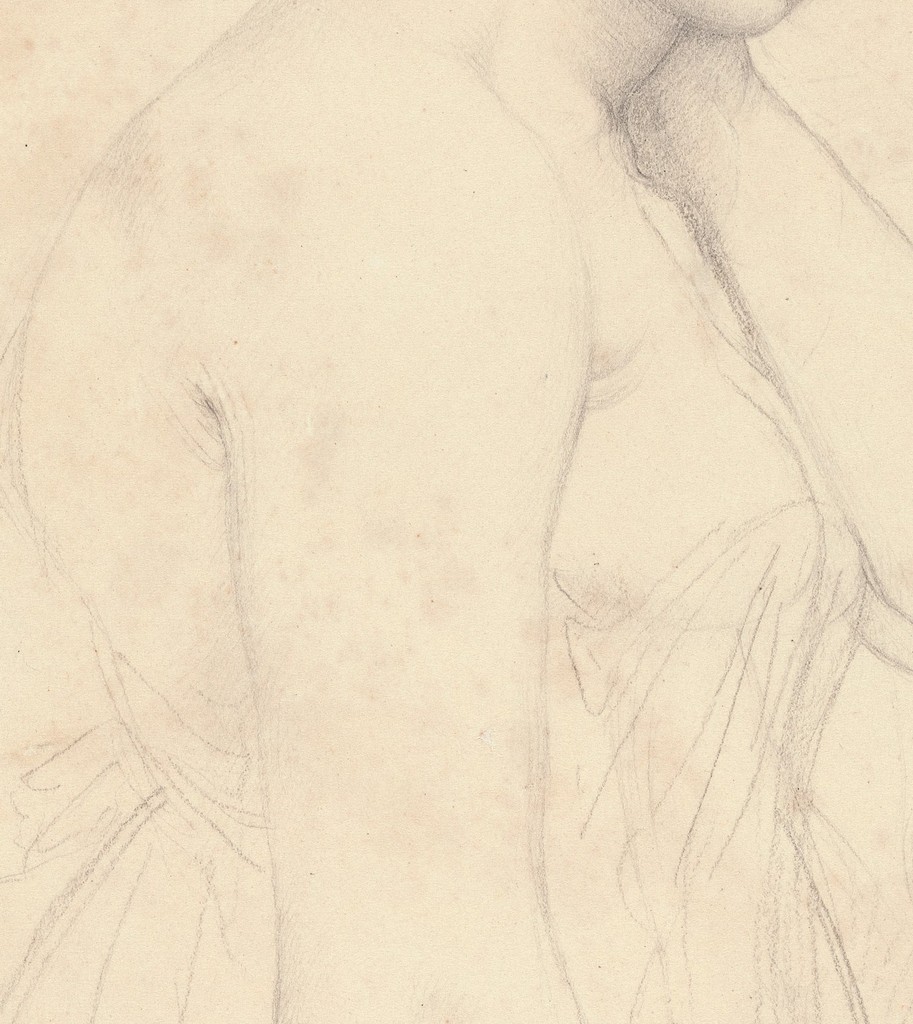
The rounded shoulder and upper arm occupy a broad pale area beside gathered cloth. Follow the curve of the arm before comparing it with the straighter folds near the chest.
A separate hand near the lower edge
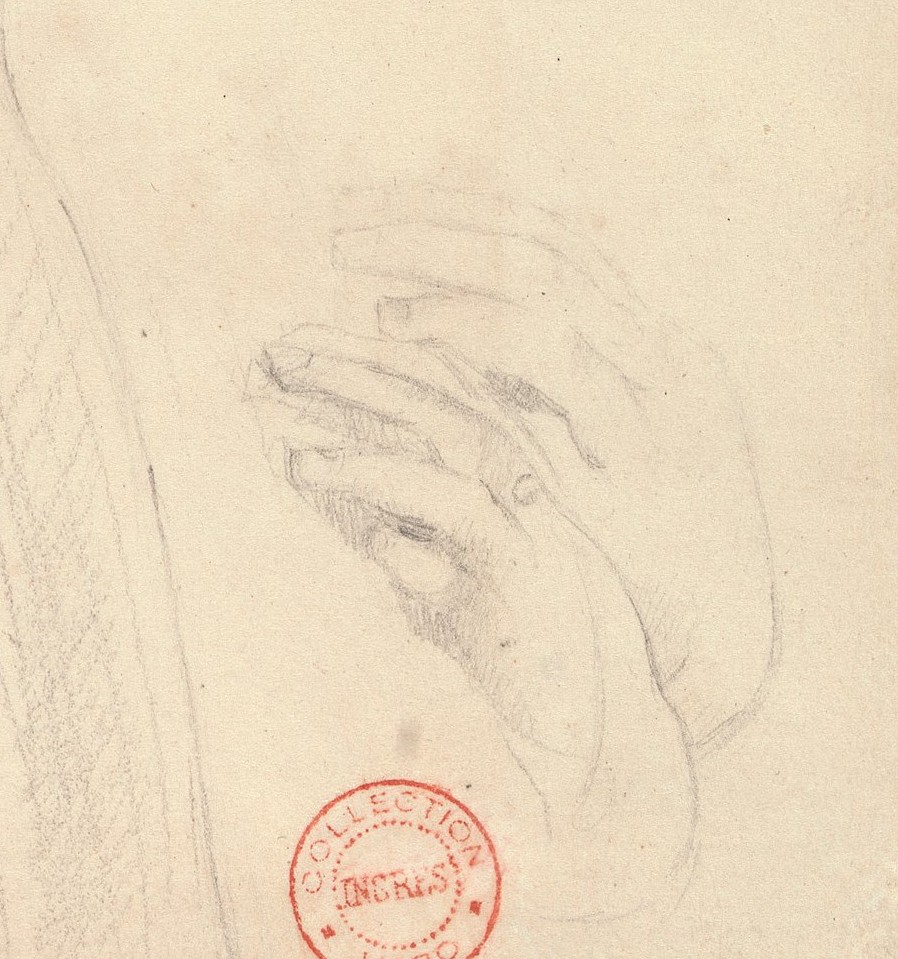
A small separate hand is drawn beside the larger figure near the lower edge. Its overlapping fingers and bent wrist form a compact study within the same sheet.
What comes from Vasari?
The literary background is important because the painting can otherwise look like an illustration of an event known to have happened. Giorgio Vasari’s Life of Raphael supplies a story about the painter’s mistress and his work for Agostino Chigi. In Vasari’s account, Raphael’s attachment to the woman distracts him from completing the decoration of Chigi’s palace. Chigi eventually arranges for her to live in the part of the house where Raphael is working, and the project is completed. [2]
The story connects artistic production to the management of desire. Separation causes difficulty; proximity makes work possible. Chigi enters the anecdote as a practical patron who solves a problem by bringing the lover into the workplace. Vasari then moves on to the decoration itself, describing the gods and the story of Psyche. The anecdote becomes a transition from the artist’s private appetites to the public achievement of his paintings. [2]
Ingres’s image invites a more sustained consideration of that relationship. There is no patron organising the room. Instead, the woman, artist and unfinished picture remain together before us. Where Vasari’s narrative resolves its interruption by announcing the work’s completion, Ingres makes the coexistence of lover and work into the subject we continue to look at.
This is a comparison between the written story and the visible painting, rather than proof that Ingres intended a single moral lesson. The embrace can suggest the enabling companionship of Vasari’s anecdote. Raphael’s turned head can also make that companionship appear unequal: she offers her presence while he studies the image. Both possibilities are supported by the arrangement. Neither requires us to decide that Ingres believed affection necessarily helped or harmed art.
Vasari’s selected passage does not name the mistress as Margherita Luti, nor does it describe this joint pose beside an easel. It is a sixteenth-century biographical story, not documentary confirmation of the scene Ingres painted centuries later. [2] The familiar title La Fornarina belongs to the image’s inherited identity; certainty about the historical woman should not be allowed to grow merely from familiarity with the name.
Raphael inside Ingres’s painting
The round picture leaning against the back wall is Raphael’s Madonna of the Chair, also called the Madonna della Sedia. The museum notes the resemblance of its Virgin to the foreground woman. [1] The circular painting is partly hidden by the larger canvas on the easel, so it can be missed when attention fixes on the embracing pair.
Its placement brings another kind of looking into the room. We see a man contemplating a portrait, a woman meeting our eyes and a devotional image behind them. The latter is neither the object towards which Raphael turns nor merely a neutral furnishing. It presents an example of his finished art within Ingres’s own reconstruction of his life.
The three appearances of a female face have different degrees of visibility. The foreground woman is fully lit and central. Her unfinished likeness is cut by the right edge of Ingres’s canvas. The Madonna is smaller, darkened and partly concealed. Our attention has to move between them. That movement makes it difficult to keep the supposedly private woman separate from the artist’s public images.
Ingres’s admiration for earlier masters also had a voice in the words preserved by Henri Delaborde after his death. In the section of notes and thoughts, Ingres urges artists to turn to the masters and speak to them because they remain alive. [3] The metaphor is useful here: Raphael is made present through an imagined scene, while one of his paintings appears within it. The work offers a conversation with a predecessor conducted through another painting.
The picture brings an artistic ideal close to the viewer through familiar experiences: holding someone, looking at a face, turning towards a task. The furniture, costumes and arrangement of gazes make that intimacy available to us in a carefully constructed setting.
A drawing and a possible personal connection
A related graphite sheet at the Metropolitan Museum of Art opens a more specific, carefully qualified connection. The museum titles it Study for “Raphael and the Fornarina”(?) and dates it about 1814(?). Its text reports that Madeleine Chapelle, Ingres’s first wife, has been identified as the model. The museum also suggests that his interest in Raphael’s love story may relate to his own courtship and marriage. These are proposed connections, not a documented explanation from Ingres. [4]
The drawing deserves attention on its own terms. The woman’s head is much more fully developed than the clothing below it. Soft shading describes the cheek, eye sockets and neck, while long, light contours establish the shoulder and upper body. Additional hand studies occupy the lower right of the sheet. These different levels of elaboration allow us to see attention being concentrated and redistributed across a single piece of paper.
The face turns towards us over the shoulder, providing a useful comparison with the painted Fornarina’s outward look. The resemblance lies in a relationship between pose and viewer, as well as in the general turn of the head. The graphite figure is not simply the finished woman with her costume removed: its lightly indicated torso and drapery retain the provisional character of a study.
Keeping the museum’s question marks makes the comparison more revealing. We can explore how a pose observed from life might serve an imagined historical scene while recognising that the precise relationship remains uncertain. The sheet does not establish that Madeleine enacted the complete embrace, or that the painting records the couple’s experience. It offers a possible bridge between observation, personal association and historical invention. Readers interested in this movement from a studied form to a finished composition can follow it further in Ingres’s drawings. Here the surviving sheet adds a human point of contact without settling the painting’s meaning into autobiography.
Costume offers another connection with Ingres’s portraiture. The 1999 Metropolitan Museum catalogue compares the red velvet dress and slashed sleeves in Madame de Senonnes with the Fornarina’s clothing as Ingres imagined it, placing both within a revival of interest in Renaissance dress. [5] In the Harvard picture, the openings in the green sleeve expose pale fabric beneath, giving the costume a layered richness. This detail helps the historical scene share the material appeal of a portrait: a story about Raphael also becomes an occasion to make a viewer linger over fabric, flesh and the hand resting against the cloak.
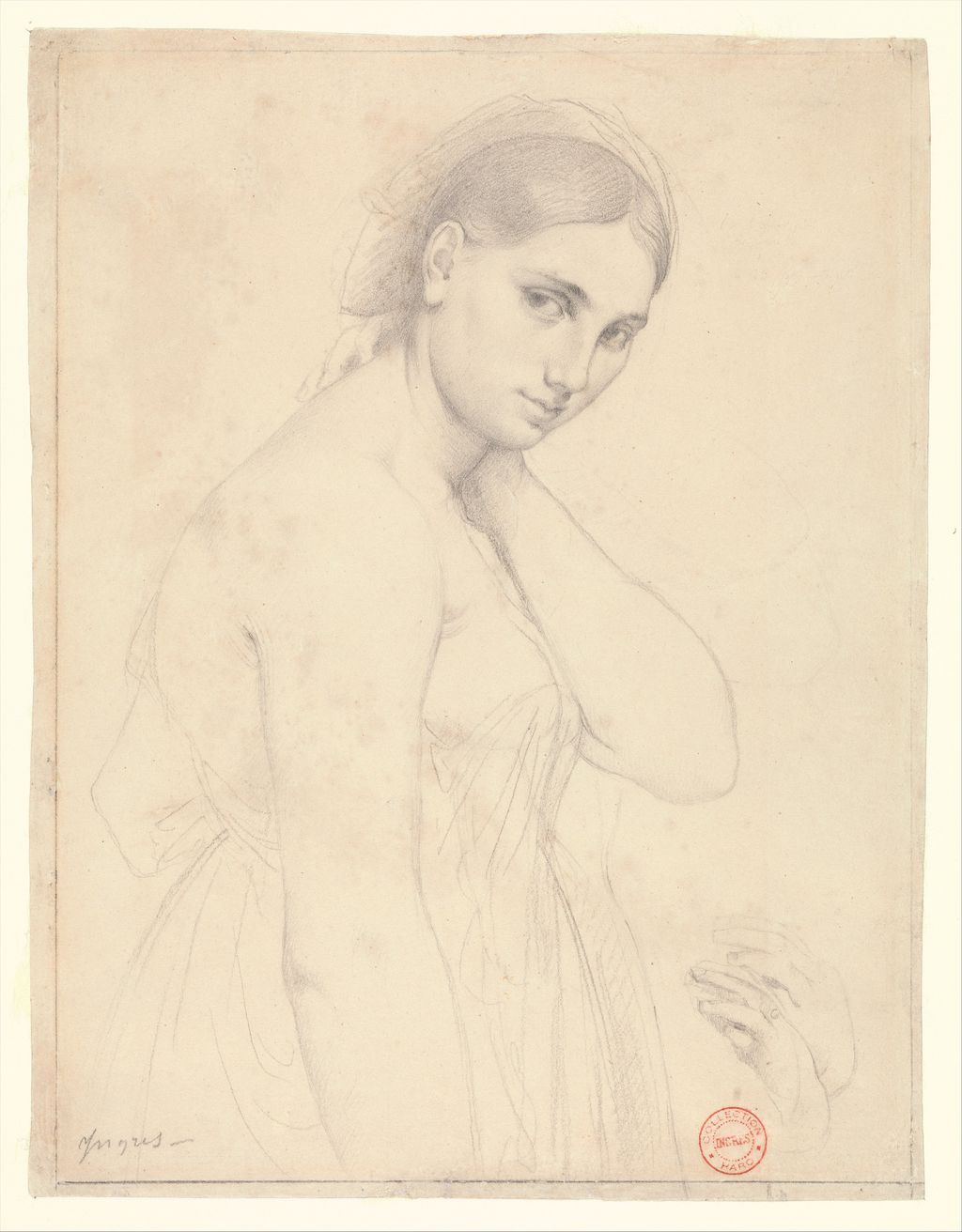
Ingres, Study for Raphael and the Fornarina(?), c. 1814(?). The Metropolitan Museum of Art, 1975.1.646. [6]
A subject Ingres kept reopening
The 1814 canvas was the beginning of a long engagement. Delaborde’s posthumous catalogue records the picture as painted in Rome and formerly in the collection of the Comte de Pourtalès. He then lists repetitions and variations, making clear that Ingres repeatedly reconsidered the subject. [3]
Two later objects help distinguish the stages. The Prado’s 2015 exhibition list identifies a graphite drawing with white highlights in the Louvre as dated 1825. It also lists an 1840 oil painting, 35 × 27 cm, belonging to Columbus Museum of Art through the Frederick W. Schumacher bequest. [7] The Louvre drawing therefore belongs to the subject’s later life; its date does not allow it to serve as preparation for the 1814 painting.
The 1840 version had a personal destination. Delaborde records a smaller repetition with variations dedicated to Ingres’s friend Duban. [3] The Art Institute of Chicago’s 1934 exhibition catalogue transcribes the dedication to Duban and the date 1840, identifying the painting then lent by Scott and Fowles in New York. [8] The dedication gives the repetition a particular social setting: Ingres returned to his admired Renaissance painter in an image intended for a friend.
These records are more useful than treating every reproduction under the same title as interchangeable. The Harvard canvas establishes the composition examined here. The smaller Columbus painting is a later version; the Louvre sheet is another object again. Differences of date, medium and destination belong to the history of the subject, even when its central embrace remains recognisable.
The unfinished last attempt
Delaborde also records a substantially altered repetition begun in 1860, with the Fornarina shown partly nude. He describes it as remaining close to the condition of a sketch. In a letter to Marcotte from Meung in September 1860, cited in the entry, Ingres called his renewed treatment the final edition of the subject and hoped it would eclipse the others. [3]
That hope matters more than a simple tally of repetitions. It shows an artist still seeking a more satisfying formulation of an established composition. His earlier solution had remained available to him for decades, yet it had not exhausted what he wanted to do with the relationship between painter and model. The planned last treatment brought a change in the woman’s degree of undress, reopening the balance between intimacy and representation.
The letter records an ambition, while Delaborde describes an unfinished object. It cannot be used to declare that Ingres completed a definitive version in 1860. Together the two pieces of evidence give a more interesting picture: a familiar subject could prompt renewed invention late in his life and still resist the closure he envisaged.
From a private collection to a public one
Delaborde records the painting’s place in the Comte de Pourtalès’s collection until 1865, and its subsequent Rothschild ownership. [3] This gives the intimate subject a long initial life in a private collection. Harvard’s exhibition history also places it in the Paris exhibition of 1814: the little studio scene had a public audience in the year of its making. [1]
It also circulated through reproductive art. Delaborde records an engraving by G. S. Pradier in 1827 and an outline reproduction in Albert Magimel’s published collection of Ingres’s works. [3] A subject centred on making a likeness could itself be encountered through further likenesses. These prints extended access to the composition beyond the people able to see the original canvas, while their different means of reproduction necessarily offered different encounters with its colour and forms.
The later ownership chain runs through Baron Nathaniel de Rothschild, his daughter-in-law Baroness James and her son Henri. Through the dealer Martin Birnbaum it reached Grenville L. Winthrop in 1931; his bequest brought it to the Fogg in 1943. [1] The painting’s present collection identity thus belongs to a history extending well beyond its earliest owner and Ingres’s lifetime.
That history also helps explain why a familiar title needs an exact object attached to it. The painting first owned by Pourtalès, a later image dedicated to Duban and an unfinished late reconsideration answer different questions. Together they reveal the persistence of the subject; individually they preserve distinct moments in his work.
Artworks directory
Explore 150 paintings, drawings and an original lithograph. This selection includes related versions and studies; dates distinguish completed works from later revisions.
| Name | Date | Medium |
|---|---|---|
| The Apotheosis of Homer | 1827 | Painting |
| Grande Odalisque | 1814 | Painting |
| The Turkish Bath | 1859–1862 | Painting |
| Madame Moitessier Seated | 1856 | Painting |
| Portrait of Monsieur Bertin | 1832 | Painting |
| Napoleon I on His Imperial Throne | 1806 | Painting |
| Odalisque with Slave | 1839 | Painting |
| The Ambassadors of Agamemnon in the Tent of Achilles | 1801 (competition) | Painting |
| The Valpinçon Bather | 1808 | Painting |
| The Source | 1856 | Painting |
| Oedipus Explaining the Enigma of the Sphinx | 1808; revised probably before 1827 | Painting |
| The Vow of Louis XIII | 1824 | Painting |
| Antiochus and Stratonice | 1840 | Painting |
| The Comtesse d’Haussonville | 1845 | Painting |
| The Princesse de Broglie | 1851–1853 | Painting |
| Jupiter and Thetis | 1811 | Painting |
| The Dream of Ossian | 1813 | Painting |
| The Martyrdom of Saint Symphorian | 1834 | Painting |
| Venus Anadyomene | 1808–1848 | Painting |
| Portrait of Madame de Senonnes | 1814 | Painting |
| Madame Rivière | 1805 | Painting |
| Mademoiselle Caroline Rivière | 1805 | Painting |
| Portrait of Philibert Rivière | 1805 | Painting |
| Bonaparte First Consul | 1804 | Painting |
| The Death of Leonardo da Vinci | 1818 | Painting |
| Joan of Arc at the Coronation of Charles VII | 1854 | Painting |
| Madame Duvaucey | 1807 | Painting |
| La Belle Zélie | 1806 | Painting |
| Madame Panckoucke | 1811 | Painting |
| Portrait of Charles Marcotte d’Argenteuil | 1810 | Painting |
| Joseph Antoine Moltedo | c.1810 | Painting |
| Madame Leblanc | 1823 | Painting |
| Delphine Ingres-Ramel (Portrait of Madame Ingres) | 1859 | Painting |
| Portrait of Amédée de Pastoret | 1823–1826 | Painting |
| Portrait of Baronne de Rothschild | 1848 | Painting |
| Madame Marcotte de Sainte Marie | 1826 | Painting |
| Madame Gonse | 1852 | Painting |
| Aretino in the Studio of Tintoretto | 1848 | Painting |
| Don Pedro of Toledo Kissing Henry IV’s Sword | 1831/1832 | Painting |
| Raphael and La Fornarina | 1814 | Painting |
| Roger Freeing Angelica | 1819 | Painting |
| Romulus’ Victory over Acron | 1812 | Painting |
| Self-Portrait at the Age of Twenty-Four | 1804; revised 1841–1851 | Painting |
| Male Torso | c.1800 | Painting |
| Odalisque in Grisaille (Ingres and workshop) | c.1824–1834 | Painting |
| The Small Bather | 1826 | Painting |
| The Little Bather Harem Interior | 1828 | Painting |
| Jesus Among the Doctors | 1862 | Painting |
| The Virgin Adoring the Host | 1852 | Painting |
| The Virgin of the Host | 1841 | Painting |
| Virgin of the Adoption | 1858 | Painting |
| Paolo and Francesca | 1814 | Painting |
| Homer Deified (revised composition, Louvre RF5273) | 1865 | Drawing |
| Odalisque with Slave (Louvre RF4622) | 1858 | Drawing |
| Odalisque (Walters Art Museum; Ingres and Paul Flandrin) | 1842 | Painting |
| Madame Moitessier Standing (National Gallery of Art) | 1851 | Painting |
| Jacques-Louis Leblanc (The Metropolitan Museum of Art) | 1823 | Painting |
| Ferdinand-Philippe, Duke of Orléans (Louvre RF2005-13) | 1842 | Painting |
| Ferdinand-Philippe, Duke of Orléans (Versailles MV5207; Ingres and workshop) | 1843 | Painting |
| Ferdinand-Philippe, Duke of Orléans (Versailles MV5209; Ingres and workshop) | 1844 | Painting |
| Antiochus and Stratonice (Musée Fabre; Ingres and Raymond Balze) | 1866 | Painting |
| Antiochus and Stratonice (Kunstmuseum Bern, Gurlitt bequest) | Undated (early dating proposed) | Drawing |
| Composition study for Antiochus and Stratonice (MIB867.2193) | 1806 | Drawing |
| Study for the Figure of Stratonice (Met63.66) | 1834–1840 | Graphite, black chalk and charcoal |
| Nude figure study for Stratonice (Boijmans F II 36 PK) | c.1834–1840 | Drawing |
| Paolo and Francesca (The Barber Institute,54.6) | c.1814–1820 | Painting |
| Paolo and Francesca (The Hyde Collection,1971.24) | c.1855–1860 | Painting |
| Paolo and Francesca (Amsterdam Museum TA10970) | 1820 | Drawing |
| Paolo and Francesca (dedicated to Artaud de Montor) | 1816 | Drawing |
| Study for the Bust of Francesca (MIB867.1398) | 1819 | Drawing |
| Study for the Bust of Francesca (MIB867.1396) | 1819 | Drawing |
| The Archangel Raphael, first idea (MIB867.2488) | 1842 | Drawing |
| The Archangel Raphael (MIB867.2500) | 1842 | Drawing |
| The Archangel Raphael Carrying Human Prayers to God (Chantilly DE513) | 1844 | Drawing |
| Louis-Philippe as Saint Philip, stained-glass study | 1844 | Drawing |
| Marie Frédéric Eugène de Reiset (Ford Collection RBF171-2) | 1844 | Drawing |
| Virgil Reading the Aeneid (Toulouse) | Begun 1811 | Painting |
| Tu Marcellus Eris (Brussels, inv. 1836) | c.1814 (museum dating) | Painting |
| Jean-François Gilibert | 1804 | Painting |
| François-Marius Granet | 1807 (museum dating) | Painting |
| Count Nikolai Dmitrievich Guryev | 1821 | Painting |
| Caroline Murat, Queen of Naples | 1814 | Painting |
| Count Mathieu Molé | 1834 | Painting |
| Cherubini and the Muse of Lyric Poetry (Louvre) | 1842 | Painting |
| Luigi Cherubini (Cincinnati) | 1841 | Painting |
| Comtesse de Rayneval (Louvre RF4505) | 1841 | Drawing |
| Venus on Paphos (Antonie Balaÿ) | c.1852 | Painting |
| Prince Napoléon | 1855 | Painting |
| Study for The Apotheosis of Napoleon I (Petit Palais) | Late 1853 | Painting |
| The Apotheosis of Napoleon I (destroyed ceiling) | 1853 | Painting |
| The Journalist (MIB867.2733) | 1834? | Drawing |
| Henry VIII, after Holbein | c.1815–1820 (?) | Drawing |
| Madame Récamier, after David (MIB867.3637) | Undated (early Paris period) | Drawing |
| Study for Comtesse d’Haussonville (MIB867.259; background possibly by another hand) | 1842–1845 | Drawing |
| La Source (reduced version reported by Delaborde) | Date unrecorded; reported 1870 | Painting |
| Odalisque (autograph lithograph,NGA1946.21.117) | 1825; published1826 | Lithograph |
| Portrait of a Seated Lady | 1814 | Graphite |
| The Kaunitz Sisters (Leopoldine, Caroline, and Ferdinandine) | 1818 | Graphite |
| Portrait of a Man | 1814 | Graphite |
| Study for the Portrait of Louis-François Bertin (1766–1841) | n.d. | Black chalk and graphite |
| Studies for the Cadaver of Acron | ca. 1810–12 | Graphite on wove paper |
| Study for the Drapery of Molière in "The Apotheosis of Homer" | n.d. | Black chalk with stumping |
| Madame Guillaume Guillon Lethière, née Marie-Joseph-Honorée Vanzenne, and her son Lucien Lethière | 1808 | Graphite |
| Niccolò Paganini (1782–1840) | ca. 1830 | Counterproof or tracing strengthened with graphite and gouache on translucent paper |
| Lady Mary Cavendish-Bentinck (?-1843) | 1816 | Graphite |
| Madame Alexandre Lethière and Her Daughter Letizia | ca. 1815 | Graphite |
| Merry Joseph Blondel (1781–1853) | 1809 | Graphite |
| Ursin-Jules Vatinelle (1798–1881) | 1820 | Graphite |
| Bust of a Gypsy Girl (ascribed to Ingres) | 1819 | Graphite on wove paper |
| Study of a Seated Nude Male | n.d. | Graphite |
| The Archangel Raphael (Study for a stained-glass window in the chapel of Notre-Dame de la Compassion-Saint-Ferdinand, Neuilly) | ca. 1842 | Graphite |
| Lancelot-Théodore, comte Turpin de Crissé | probably 1818 | Graphite |
| Study for the Figure of the Iliad in "The Apotheosis of Homer" | ca. 1827 | Graphite and black chalk heightened with white chalk on brown paper |
| Comtesse Turpin de Crissé | probably 1818 | Graphite |
| Nude Figures for L'Âge d'Or, Château de Dampierre | n.d. | Graphite on brownish paper |
| Study of Figures (attributed to Ingres) | n.d. | Graphite |
| Study of Figures (attributed to Ingres) | n.d. | Graphite; squared in graphite |
| Admiral Sir Fleetwood Broughton Reynolds Pellew | 1817 | Graphite on wove paper |
| Madame Jean-Auguste-Dominique Ingres, née Madeleine Chapelle | 1814 | Graphite on off-white wove paper |
| Virgil Reading the Aeneid to Augustus, Livia, and Octavia | 1809/1819 (?) | Pen and black ink, graphite, brush and gray wash, white gouache heightening, Conté crayon on blue paper |
| General Louis-Étienne Dulong de Rosnay | 1818 | Graphite (hard and soft pencils) |
| Madame Alexandre Lethière, née Rosa Meli, and Her Daughter, Letizia | 1815 | Graphite |
| The Lawyer Paul Grand | 1834 | Graphite |
| Jean-Joseph Fournier | 1815 | Graphite |
| Armand Bertin | 1842 | Graphite |
| Madame Armand Bertin, née Marie-Anne-Cécile Dollfuss | 1843 | Graphite |
| The Architect Charles-Victor Famin | 1836 | Graphite |
| Henri Lehmann | 1850 | Graphite |
| Portrait of a Lady | ca. 1815–17 | Graphite |
| Edmond Cavé (1794–1852) | 1844 | Oil on canvas |
| Head of Saint John the Evangelist | probably ca. 1818–20 | Oil on canvas, laid down on wood |
| Madame Edmond Cavé (Marie-Elisabeth Blavot, ca. 1806–1883) | ca. 1831–34 | Oil on canvas |
| Madame Félix Gallois | 1852 | Graphite with touches of gold in oil to highlight jewelry, on buff wove paper. |
| Dr. François Mêlier | 1849 | Graphite with graphite framing lines, corrected with white, on buff wove paper |
| Portrait of Madame Rhode (Rhoda?) | 1810–20 | Graphite on pale buff wove paper |
| Study for "Raphael and the Fornarina"(?) | ca. 1814(?) | Graphite on white wove paper |
| Portrait of Madame Paul Meurice, née Palmyre Granger | ca. 1845–50 | Graphite on wove paper |
| Alexander the Great presenting Campaspe to Apelles | 1810 | Graphite, brush and brown wash; squared in graphite |
| Study of Hands for "Christ Among the Doctors" | 1852–62 | Graphite on tracing paper |
| Study for The Turkish Bath (RF34502) | about 1850 | Pen and brown ink with graphite, partially squared |
| Study for The Turkish Bath (RF23354) | Undated | Pen and brown ink with graphite on joined sheets |
| Study for The Turkish Bath (RF54702) | about 1859 | Pen and brown ink |
| Studies of women for The Turkish Bath (RF12292) | Undated | Black chalk |
| Achilles Receiving the Envoys of Agamemnon (Nationalmuseum sketch, NM2161) | 1801 | Oil on wood |
| Half-Length Bather (Musée Bonnat-Helleu,89) | 1807 | Oil on canvas |
| Oedipus and the Sphinx (National Gallery,NG3290) | about1826 | Oil on canvas |
| Oedipus and the Sphinx (Walters,37.9) | 1864 | Oil on canvas |
| Oedipus and the Valpinçon Bather, after David (MI.867.2035) | Undated | Graphite on tracing paper, after David |
| Study of the Virgin for The Vow of Louis XIII (Dijon,1758) | about1822 | Black chalk, stump and white chalk on brown wove paper |
| First Thought for The Vow of Louis XIII (MI.885.11.21) | 1822 | Oil on canvas |
Frequently Asked Questions
No. It is Ingres’s imagined scene of Raphael with La Fornarina. Delaborde records the original as painted by Ingres in Rome in 1814. [3]
He looks towards the unfinished portrait on the easel at the right. The round Madonna behind it is a separate picture.
Vasari tells a story about Raphael’s mistress joining him where he worked for Agostino Chigi, but that account does not document the embrace and easel arrangement painted here. [2]
Discussion
Look again at the images and ideas explored in Raphael and La Fornarina. These editorial prompts invite your observations.
Reader Insights
Does Raphael’s turned head make the embrace feel interrupted, or does the woman’s presence seem part of his work? Follow their eyes and hands before deciding which detail carries the most weight.
Compare Raphael’s turned face with his partner’s gaze. Do they direct your attention into the same space or towards different concerns?
How does the presence of another picture within the room complicate the relationship between the embrace and artistic work?
Join the Conversation
Share a detail, comparison or question about Raphael and La Fornarina below.
References
- Harvard Art Museums, Raphael and the Fornarina, 1943.252. Current collection record: identification, gallery text and recorded ownership history; consulted 17 October 2026. View source.
- Giorgio Vasari, “Raffaello da Urbino”, in Lives of the Most Eminent Painters, Sculptors and Architects, vol. IV. Translated by Gaston du C. de Vere. London: Macmillan and the Medici Society, 1913, selected passage pp. 238–240, particularly the Chigi anecdote on p. 239. This later English translation is not identified as the edition Ingres used. View source.
- Henri Delaborde, Ingres, sa vie, ses travaux, sa doctrine, d’après les notes manuscrites et les lettres du maître. Paris: Henri Plon, 1870, p. 139, advice on earlier masters; p. 226, catalogue nos. 53–55, original, reproductive prints, repetitions and September 1860 letter to Marcotte. Posthumous compilation. (In French.) View source.
- Metropolitan Museum of Art, Study for “Raphael and the Fornarina”(?), ca. 1814(?), 1975.1.646. Current object record and curatorial text; consulted 17 October 2026. View source.
- Gary Tinterow and Philip Conisbee, eds. Portraits by Ingres: Image of an Epoch. New York: Metropolitan Museum of Art, 1999, p. 150, comparison of Madame de Senonnes’s costume with Ingres’s imagined Fornarina; fig. 127. View source.
- Supporting image. Ingres, Study for Raphael and the Fornarina(?), c. 1814(?). The Metropolitan Museum of Art, 1975.1.646. Robert Lehman Collection, 1975. Image source. CC0 / Public domain.
- Museo Nacional del Prado, Ingres. Exhibition, 2015–2016, selected works list, items 31–32: Columbus painting and Louvre drawing. View source.
- Art Institute of Chicago, A Century of Progress Exhibition of Paintings and Sculpture. Chicago, 1934, p. 33, no. 194, Raphael and La Fornarina: date, dedication to Duban and historical lender. View source.
- Splash image. Jean-Auguste-Dominique Ingres, Raphael and the Fornarina, 1814. Oil on canvas, 64.8 × 53.3 cm. Harvard Art Museums/Fogg Museum, Bequest of Grenville L. Winthrop, 1943.252. Art Renewal Center via Wikimedia Commons. Image source. Public domain.